
-Devotion by Makenna Landry (MN)
Key passage: “Let the rivers clap their hands; let the hills sing for joy together, before the LORD, for he comes to judge the earth. He will judge the world with righteousness, and the peoples with equity.” Psalm 98:8-9 (ESV)
Psalm 98 is a psalm of praise. It sings great thanksgiving to God recognizing God’s good works and His never ending love. It ends with the reminder that God will judge the world with righteousness and fairness.
Christians today, and across time, have been considered judgmental. Christians hold to the moral standards Scripture teaches and tries to hold others to the same moral standards. This in my own life has come across to people as overly innocent, stuffy, fake-y, and judgemental. I distinctly remember when I told a fellow classmate in my early years of elementary school that he should follow the rules because it shows respect to the adults. He did not agree with me, calling me all of the things I listed above. Needless to say, the years of elementary school he and I were never on good terms because he continued to do the wrong thing and I continued to try to correct him. He viewed me as judgmental and too proper and I was always annoyed that he refused to do the right thing.
Thank the LORD that it is not on me to judge his actions. I think that’s the sentiment behind this psalm. God is the ultimate judge and He does so with great fairness. He has set forward a path to righteousness and He draws the lines on who will receive the reward of the kingdom and who will not. If I could tell my younger self to just let it go, it would have been a much more enjoyable time in my life.
There are times that we might thank God for being the perfect judge, while other times we might question it like Job questions in Job 21.
Zophar reminds Job of the downfall of pride and reminds Job of the importance of carrying for the needy. Job’s response is one filled with questions and a complete lack of reflection on himself. He instead looks outward towards the wicked people. He wonders why they would be receiving so much and living a healthy, long, prosperous life. Zophar stated evil faced death but Job turns it around on Zophar pointing to the sinful individuals living happily around them. This brings into question God’s judgment. Is he truly a righteous and fair judge when Job, a godly man, suffered while evil men had riches?
At that moment, Job couldn’t see the full picture of God’s judgment. He saw the moment he was living in and how unfair that single moment felt.
Do you have moments like that? I know I do, as do my kids.
When I was in high school, my younger sibling was being homeschooled while I had to attend public school. At the time I would have said it felt like the boils Job experienced with how much I disliked public school. It felt unfair to have to get up at 5:30 every morning and get home at 3 just to do homework all night when my brother could sleep in and finish with school before the rest of us were home.
As an adult, I can recognize how that was better for both of us. Our learning styles and career paths were different so we needed different schooling. But in the moment, I felt like Job was pointing to other people and thinking that it wasn’t fair they had what he wanted. That phrase the grass is always greener in someone else’s yard was how I felt. Even four year olds feel this!
My four year old has started saying the phrase “that’s not fair”. It has blown me away how early children build that phrase into their vocabulary thinking they are owed some sort of evenness with their parents, siblings, and friends. Sometimes we look down on Job for having that perspective or on others when they ask why good things happen to everyone but me.
What are some times in your life that you’ve questioned the fairness of life?
In those times, we can remember that God’s fairness isn’t for this life but the life to come. His judgement is on our actions, attitudes, and beliefs during the trials of life. It’s for a glorious, perfect, eternal kingdom and not for the 80 years we are here on earth.
This brings the question, what is God looking for? How do we find ourselves in a place that we can praise God for being the perfect judge instead of viewing life as unfair?
That’s where James comes in!
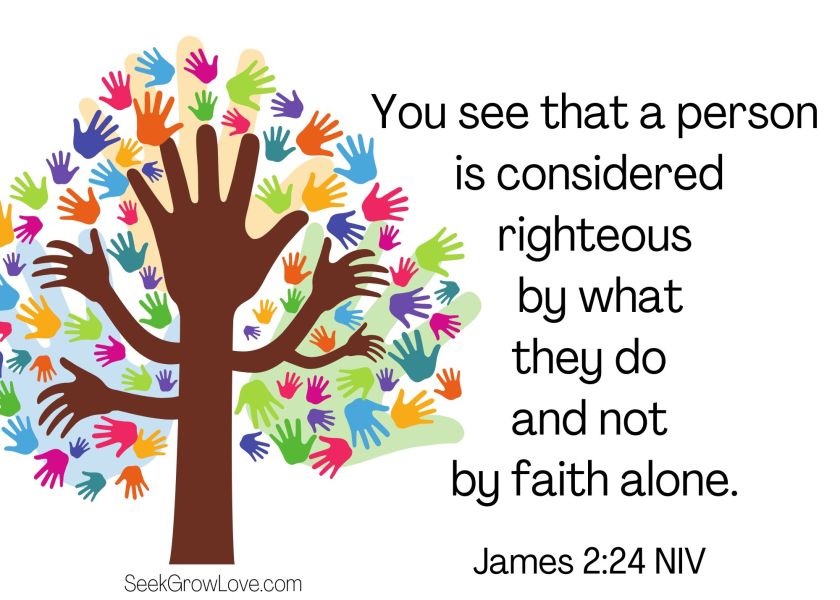
James chapter two is really what the book of James is known for. It speaks on the fact that our faith should spur on our actions in order to live a righteous life. Simple belief doesn’t make us righteous. Belief is the first step to a life committed to God. James expands on what to do once you take the step of belief.
He does this by pointing to Abraham and Rahab. For some background, Abraham is considered the founder of faith and a righteous man that we all want to strive to be like. His faith spurred him towards countless times of obedient action. The first was moving away from his home, family, and all that he knew to travel to a foreign land. During those travels he obeyed God at almost every turn. No one can claim perfect, not even Abraham, but his failures don’t define him. Instead his times of obedience do. James specifically points to Genesis 22. God commanded Abraham to sacrifice Isaac. Isaac was Abraham’s only son with his wife Sarah. Isaac was a long awaited promise who took Abraham and Sarah many years to conceive. He was God’s promises fulfilled for Abraham and the other promises God had made rested on the shoulders of Isaac. Yet, Abraham was still obedient. His actions marked his righteousness. The same goes for Rahab. She risks everything to hide the Israelite spies in Jericho.
But how do we show our faith?
Living in the United States in the 2020s doesn’t give a lot of opportunities to help hide God’s spies, discover new lands, or sacrifice everything. Some of the things Abraham did would even be extremely frowned upon in today’s society!
We can be thankful for the book of James once again. It shows that faith looks like helping others, showing fairness to everyone around us and other key ways to have our faith displayed in every aspect of our lives that we will read in the days to come.
God is our good, righteous, and fair judge. We can bring Him glory, honor, and praise through our actions towards those around us. Instead of judging others like in the story I shared from my past, we should show them love and kindness, helping when they are in need, and treating all people with respect and dignity.
QUESTIONS TO PONDER:
How can you remind yourself to trust in God’s judgment?
How can you praise God each day for what He has blessed you with even if the grass seems greener somewhere else?
What is one way you can show your faith to someone today?
PRAY:
Dear God, thank You for Your righteous judgment. Thank You for the Biblical examples You have gifted the world to show me how to be righteous. Heal my heart from judgement of those around me and replace it with a heart of love and kindness. Place in my life a way to show someone Your love today and open my eyes to the needs of those around me. Amen
Makenna Landry, née Cisler, an ABC graduate of 2021, is a licensed pastor of the Church of God General Conference working to service God by teaching His word and supporting His people through all aspects of life. She has two children, a passion for helping people, and loves Disney. She spends her time writing and enjoys playing board games with friends and family.

