
Revelation 14
-Devotion by Daniel Smead (MN)
Revelation 14 refreshes our minds about God’s greatness and victory, along with the glory of the Lamb, after what might be seen as chapter 13 emphasizing evil’s “successes.” The chapter opens with the Lamb and the 144,000 together at Mt. Zion – this is the first time the Lamb has been part of John’s vision since 6:1, and the first time the 144,000 have appeared since chapter seven. They make a fine demonstration of the principle that God has a remnant, in this case one which did not yield to the wills of the two beasts. But this is not simply a remnant, it is a first fruits (v. 4) preparing for the greater harvest.
The special status held by the 144,000 came from their being sealed with the seal of God. This sealing put the name of God, and the name of the Lamb, on each of their foreheads. Chapter seven said the group is twelve sets of 12,000 men, coming from twelve tribes of Israel, and that description gave a strong impression of symbolism rather than literal meaning. Some of the term they are described with align with Old Testament standards of purity in preparation for combat (Deuteronomy 23:9ff; 2 Samuel 11:9ff). It has been pointed out that this application of physical terms to spirituality with the 144,000 parallels the way Revelation speaks against idolatry in physical terms elsewhere in the book (for example how it links sexual immorality and idolatry at Pergamum and Thyatira in chapter 2, and with Babylon multiple times).
In 9:4 the 144,000 were referenced without being named, with the locust-like creatures with scorpion tails restricted that they could only hurt “the people who do not have the seal of God on their foreheads.” That statement seems to require that the “144,000” stands for the entirety of those who were seeking to serve God and the Lamb in that time, even if it is 170,000, for example.
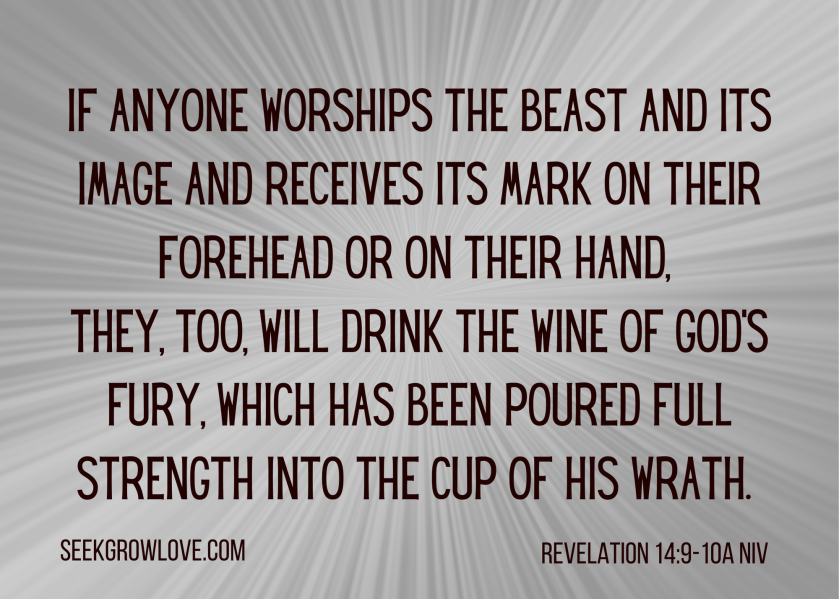
The inclusion of the sealed 144,000 in the vision here emphasizes the contrast between what God offers and what the beast(s) have been demanding and threatening. Those who accepted the beast’s mark are subject to God’s wrath, but those who accepted God’s seal are eligible for life (14:9-10; 20:4; 22:4). But the time for such decisions is basically finished. What is about to begin involves the “full strength” wrath of God (v. 10).
The situation is so dire that John is told “Blessed are the dead who die in the Lord from now on!” (v. 13). This passage doesn’t even mention the idea of remaining alive allowing a person to provide useful service; it seems like in what little remained of the age that would not be relevant.
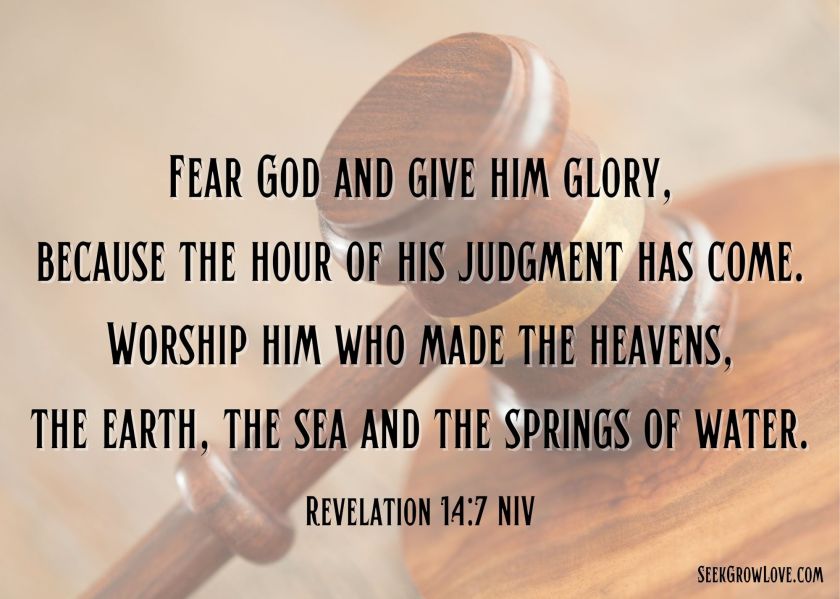
In 14:6-11 three different angels make announcements which prepare us for what is coming: fear God, for the hour of judgment is come; Babylon is fallen; the end is fast coming for the beast and those things aligned with the beast. Future chapters address all of those points.
The chapter closes with a description of harvest (14:14-20) that ties in with a somewhat vivid illustration involving a winepress for blood (perhaps tied to the idea that God is producing a cup of wrath for the nations to drink). The section seems to draw on Joel 3.
“Put in the sickle, for the harvest is ripe.
Come, tread the grapes, for the wine press is full;
The vats overflow, for their wickedness is great.”
Multitudes, multitudes in the valley of decision!
For the day of the Lord is near in the valley of decision.
The sun and moon have become dark,
And the stars have lost their brightness.
(Joel 3:13-15; NASB)
The image of the vats overflowing with grape juice / blood is described with the liquid getting up as high as a horse’s bridle (so, several feet) and spreading for a great distance – close to 200 miles – though whether that spread is to be thought of as a circle or semi-circle or along a straight path is unclear. The image seems to fascinate people, and attempts have been made to calculate how many human bodies it would take to produce that much blood. Those efforts involve assuming the blood is all human, and that the image is meant literally in the first place, neither of which can I be sure of. I will just note that some of the suggested totals are a bit absurd, amounting to more blood than exists in the world at present, so if this is a literal image its interpretation probably calls for some conservative guesses at what is meant (straight path flow, etc.).
Prayer
Lord, please bring my mind into alignment with yours and help me to trust you and your decisions. I have no real desire to experience the hour of your wrath, even at a distance, but help me to trust that you have all things under control. Some decisions are yours, alone, to make. I may not be sure which parts of the vision are concrete events, but I know that you are real and I can focus on that. You are greater than me in wisdom, love, patience, and awareness of my own heart. I wish to have your name on my forehead, to be known as yours – even to be known by my own self to be yours, with no question, no hesitation, no cloud on my mind. With you, the road will not always be easy, but you can lead me to where I need to be.
In the name of your son, who you sent for me,
Amen
Reflection Questions
- Revelation contains some of the texts that people outside the church speak about when they accuse God of being “blood-thirsty” – how do you address that charge when you hear it?
- Have you ever been so fascinated by the details of a prophetic passage that you lose track of how shocking its meaning is? Have you ever attempted to read a scripture passage as though you were not yet a believer, to think through how it might look to someone from that perspective?
- What does it mean to you that John was told those who died from then on would be blessed?

