
-Devotion by Jeremy Martin (TN)
There is a whole underlying theme of “burdens” in the first few chapters of today’s reading, and it begins by speaking of the Babylonian gods “Bel and Nebo” (also known as Marduk and Nabu, 2 Babylonian deities in a pagan pantheon), unflatteringly.
Isaiah 46:1-2 describes these ‘gods’ as “bowing down” and “stooping” because their heavy statues were being loaded onto beasts of burden during the fall of Babylon. This imagery highlights the irony that the gods themselves were powerless to save their temples, their people, or even their own images, which became a burden to the weary beasts carrying them into captivity. Not only could they not carry their people, God is highlighting the fact that they can’t even carry themselves: they’re just statues.
The next batch of scripture in v3-4 contrasts the above idols with God brilliantly, and says: “3“Hear Me, O house of Jacob, And all the remnant of the house of Israel, You who have been burdening Me from birth And have been carried from the womb; 4Even to your old age I will be the same, And even to your graying years I will bear you! I have done it, and I will carry you; And I will bear you, and I will rescue you. ” (LSB). God lets Israel know that they’re the burden, that He’s been carrying them from birth, and that like a father to his children He will continue to carry them, bear them, and rescue them.
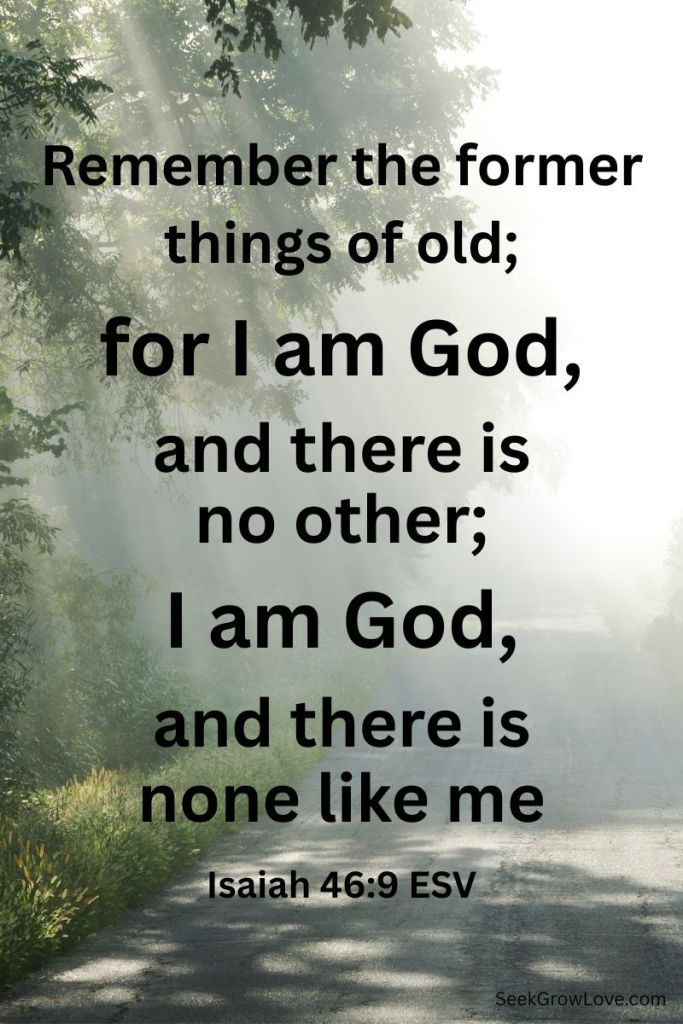
Back before the return (from the Babylonian captivity), idolatry was rampant for the ancient Israelites. Likewise, in today’s world, mankind has elevated silver, gold, and sometimes even the servants of God to equal status as the God who created everything. God explains it to us directly and bluntly: “5“To whom would you liken Me And make Me equal and compare Me, That we would be alike?” (LSB, Isaiah 46:5). Just in case there was confusion later (there is), He goes on to clarify: “9…For I am God, and there is no other; I am God, and there is no one like Me,” (LSB, Isa 46:9). What a beautiful, simple, and straightforward understanding about the nature of God, and if you notice there is a strong consistency to the message that Yahweh God is God alone (see also Deut 6:4, which Jesus the servant of God later quotes as the greatest commandment in Mark 12:29).

Moving on down to our Psalms reading today, we find ourselves beginning the longest chapter in the bible, and it’s just a really good one. We’re obviously not going to cover the entirety of Ps 119 today (it’s huge), but we’ll try to get in a good solid overview of the first 40 verses or so.
The author of this Psalm spends a lot of time focusing and reiterating on obeying God’s laws, on seeking God with all your heart, and on God revealing His will and precepts as a source of joy and life. Ps 119:1-40 all carry this theme explicitly, here are just a few excerpts from today’s scripture to reiterate this thematically (these are all from the LSB translation, Ps 119):
1 How blessed are those whose way is blameless, Who walk in the law of Yahweh. 2 How blessed are those who observe His testimonies,They seek Him with all their heart.
33 Instruct me, O Yahweh, in the way of Your statutes, That I may observe it to the end. 34 Cause me to understand, that I may observe Your law And keep it with all my heart.
You get the idea. The author here is very focused on God, and on obeying God’s precepts, and asks repeatedly for his own comprehension and God’s help and protection. This strikes me as a very healthy outlook for anyone seeking to be a servant of the living God. We search the scriptures because we believe that by them we may receive eternal life (See John 5:39), and the author of Ps 119 seems to agree with that, and also go further and asks God to change his heart (see also for reference Jer 31:33), and to grant him discernment and wisdom to understand and obey.
I did want to point out one very cool thing that’s in our Luke reading today. In Luke 1, Gabriel is a busy angel, God sends him first to Zechariah to inform him about the birth of his son (John the baptist), and then to Mary to inform her about the birth of her son (Jesus). Note that Gabriel doesn’t just show up and start saying whatever he wants: he is sent by God and delivers only the message(s) that God sent him to deliver, because he’s not God, he’s God’s servant.
This is true for any of the servants of God: even though they are not God, they are sent by God to fulfill a specific purpose on God’s behalf, and when they do so we are to accord them the same honor and authority that we ascribe to our Creator, because they are sent by God. That is actually the criteria to be a servant of God, that God sends you. This includes Jesus, the son of David, the servant of God (for reference see John 1:22,33, 3:34, 4:34, 5:23-24,30,36-38, 6:29,38-39,44,57, 7:16,28-29,33, 8:16,26,29,42, etc etc etc.-30 times in John per Jesus). Jesus really tried to make it very clear that God sent him, and that he didn’t act from his own authority but did what God told him to do, and said what God told him to say. Jesus was completely obedient to the authority of YHVH God, as not only as a servant (which he was) but as a son.
There’s something staggering that the angel (literally, “messenger”) Gabriel says when he’s delivering his messages here in Luke 1. Think about the descriptions of the throne of God (see Aug 5th devotional from earlier this year for scriptural references and descriptions about the Courts of Heaven): in every instance you see the Most High God seated on the throne, with the courts full of heavenly beings as supplicants around him, often prostrating themselves. Gabriel says this particular phrase in Luke 1:19: “…I am Gabriel, who stands before God,” Stop and think about that for a moment. That’s huge. This may be a servant of God, but he is given much power and authority if he is allowed to stand before the most high God. Now think about the Christ, our king Jesus. Not only does he stand before God, but God has invited him to sit at His right hand. The ultimate authority, just under God. It’s amazing.
REFLECTION QUESTIONS:
- We’re probably all familiar with the poem “Footsteps”. How many times in your life has God carried you? Reflect on them for a moment.
- How can you personally increase the love of God’s laws in your heart, like the author of Ps 119?
- Had you ever caught that bit about Gabriel “standing before God” before, and pondered it?
PRAYER
Father God, thank you for carrying me when I couldn’t make it on my own. Plant within my heart the fervent desire to study and obey your precepts, and to listen to the messengers You sent. Thank you for life, breath, and all things. Please carry me just a little bit further. In Jesus name, Amen.

