
-Devotion by Jeremy Martin (TN)
I suppose I should start out by saying: we’re all just humans, and that we should in love and patient understanding bear with each other, particularly those who are fellow servants of God. I should also state that it is my opinion that even with an imperfect theology or understanding of scripture, it is absolutely possible for someone to gain entry and citizenship into the Kingdom of Heaven because God sees the heart of a man, and knows all of our intents. I still think that (in addition to obedience) an accurate understanding of scripture is important since it’s God’s word that He gave us, so here are some observations about today’s readings that I offer in love.
In Luke 1 in today’s reading, Gabriel makes an appearance, first to Zechariah (John the Baptist’s father) and then to Mary (Jesus’ mom). You may recall when we were first introduced to Gabriel in scripture, back in Daniel 8:16 (and later again in Dan 9:21). Gabriel is clearly a high ranking angel, as he has authority to stand before God. He even quotes this to Zechariah after telling him of the impending (and unexpected) birth of his son, in Luke 1:19 ” 19 And the angel answered and said to him, “I am Gabriel, who stands before God …”. This makes it pretty important to listen to the particulars that he tells us because this is a heavenly being who stands in the presence of God (a tremendous honor and privilege).
Let’s examine the conversation Gabriel has with the virgin (at the time) Mary, in Luke 1:26-31 (LSB Translation): “26 Now in the sixth month the angel Gabriel was sent from God to a city in Galilee called Nazareth, 27 to a virgin betrothed to a man whose name was Joseph, of the house of David, and the virgin’s name was Mary. 28 And coming in, he said to her, “Greetings, favored one! The Lord is with you.” 29 But she was very perplexed at this statement, and was pondering what kind of greeting this was. 30 And the angel said to her, “Do not be afraid, Mary, for you have found favor with God. 31 And behold, you will conceive in your womb and bear a son, and you shall name Him Jesus.”
Note that like Jesus, like every servant of God, Gabriel was sent by God. I love that Mary is initially perplexed at the angel’s greeting, and is probably wondering why she is being favored by God. I also wonder at the translation a little: there is a reference mark in my bible under every instance above where it says “Lord” that says “Yahweh, in the OT” down below at the reference. I believe that an angel who has the authority to stand before God also has the authority to speak God’s name, and I think that’s what he did here, but that’s just speculation and the actual word used in (the Greek translation of) Luke is “kyrios”.
This could be a lifetime study on it’s own, but the divine name Yahweh (or its full form YHWH) does not appear in any extant manuscripts of the New Testament. The New Testament was written in Greek (at least the existing and accepted copies that we are aware of, though Nehemiah Gordon has some counter theories you should check out), and its authors consistently used the Greek title kyrios (“Lord”) to translate the Hebrew Tetragrammaton when quoting the Old Testament, following the tradition of the Septuagint (LXX). This became extremely confusing when translated into English because the same “kyrios” was also used to translate the word “Master”, referring to any human figure of authority.
Some scholars, such as George Howard, suggest that the original autographs of the New Testament may have contained the Tetragrammaton in Hebrew characters in Old Testament quotations, but these were replaced by kyrios by early copyists. Few, if any, surviving Greek manuscripts contain the name, but the practice initiated by the copyists to call Yahweh “THE LORD” and also Yeshua “The Lord” has led to a lot of understandable confusion among later believers who may not have understood the distinction between the two, or that there even was one.
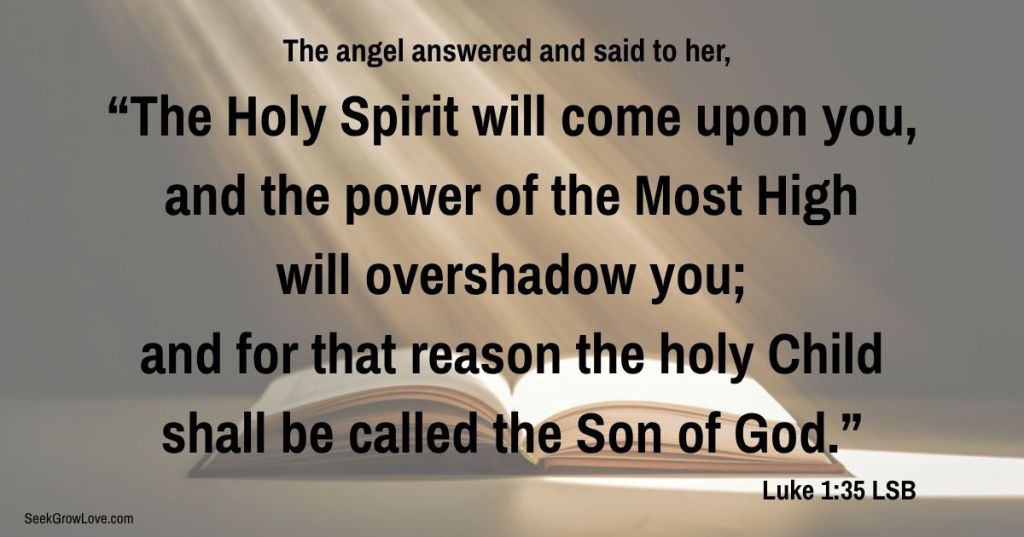
Gabriel goes on to say “32 He will be great and will be called the Son of the Most High, and the Lord God will give Him the throne of His father David, 33 and He will reign over the house of Jacob forever, and there will be no end of His kingdom.” 34 But Mary said to the angel, “How will this be, since I am a virgin?” 35 The angel answered and said to her, “The Holy Spirit will come upon you, and the power of the Most High will overshadow you; and for that reason the holy Child shall be called the Son of God.” (LSB). (FYI, every capital letter in there that isn’t the beginning of a sentence or a proper name is a translational bias in my translation. It just goes to show.)
So he will be called the son of God, and God will give him the throne of his father David. God (the ultimate authority), is going to give him (Jesus, our king) the throne of his ancestor David. In Luke 1:32, Gabriel confirms all of these prophecies are being fulfilled. 1 Cor 11:3 confirms that while the Christ (Jesus, our king) is the head of man, God is the head of the Christ. Jesus has a God (see for reference John 20:17), and it’s our God too, the same God according to what Jesus told Mary. Later on, sadly, these very clear scriptures were slowly distorted and changed.
In another prophecy, in Isa 49 God says: “6 He says, “It is too small a thing that You should be My Servant To raise up the tribes of Jacob and to cause the preserved ones of Israel to return; I will also give You as a light of the nations So that My salvation may reach to the end of the earth.”” (LSB) The servant of God, the Messiah, the Christ came not only for the tribes of Israel, but as a light to the nations. God caused it, Jesus the servant of God obediently fulfilled it, the Messiah, the anointed one, the Christ.
The very word “Christ” is greek for “The Anointed One”, which is also what “Messiah” means. To be anointed, the obvious question follows: well, who anointed him? It tells us throughout scripture: Yahweh God anoints His servants and grants them authority. To be the Messiah (or, The Christ) means that Jesus had to be a human to fulfill the mandatory requirements according to prophecy (an Israelite human descended from David, see Gen 3:15, Deut 18:18, and 2 Sam 7:12-16 among many others). Not to become a human, but to be born one.
Please don’t misunderstand me, Jesus was the very best of us. The Lamb of God is worthy, and worthy of praise, because he was obedient to God’s will and gave his own life as a ransom for many, but (according to Jesus himself) God is the one who sent him to do so. This seems to make it pretty critical to get our theology right when God tells us: “… My glory I will not give to another.” ( LSB Isa 48:11).
REFLECTION QUESTIONS
- Why do you believe what you believe, can you find or quote scriptures that support your beliefs? Why is it important?
- Have you ever, in patient love and understanding, asked someone who believes differently than you about God to share their beliefs and had a constructive and loving conversation as a result, comparing interpretations while maintaining love and respect?
- Do you think what anyone else believes is important? To what degree, to whom, and why?
- Which do you feel is more critical toward entering the Kingdom: theological accuracy, humble obedience to God, or a relationship with God? If you had to assign a percentage to each, where would they fall in your opinion?
PRAYER
Father God, we love you. Teach us and instruct us, grant us your spirit as a helper, and help us to be humbly obedient to your word. Thank you for life, breath, and all things. Please bless all those who seek your favor, and forgive us our shortcomings. In Jesus name, amen.

