
-Devotion by Jeremy Martin (TN)
Here in America where I am from, most of us have been so richly blessed and for so long that we have come to view a position of comfort as an expectation, like a child who has grown up never wanting for anything, and like that child unfortunately the mentality often becomes one of entitlement and self promotion. Additionally, most humans tend to think “regionally” (look up the theory of the Monkeysphere for an interesting theory on the limitations of human empathy). We also tend to think in terms of “us” and “them”, which is a mistake when you consider that there is only “us” (God made all mankind), and we are told to love our neighbor as ourselves.
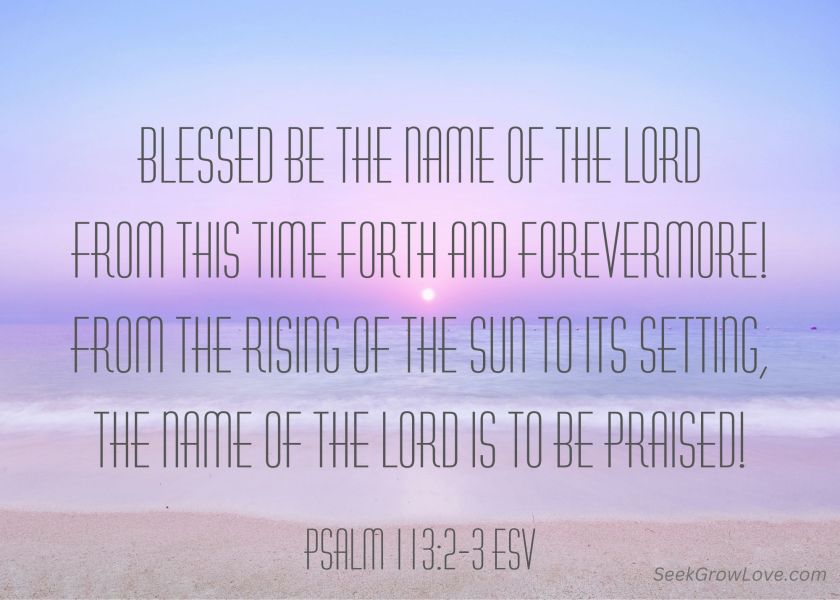
I love the reading of Psalms today, as it not only highlights a very important (and sometimes forgotten) fact about God, but also has one of my favorite songs in it (From the Rising of the Sun). The song goes like this “From the rising of the sun, to the going down of the same, the name of the Lord shall be praised” and then repeats and goes into a chorus of “So praise ye the Lord!”. Beautiful, beautiful stuff. In my LSB translation of the Bible Ps 113:1-4 reads (more accurately, but perhaps slightly more difficult to sing) : “1Praise Yah! Praise, O slaves of Yahweh,Praise the name of Yahweh. 2May the name of Yahweh be blessed From now until forever. 3From the rising of the sun to its setting The name of Yahweh is to be praised. 4Yahweh is high above all nations; His glory is above the heavens.”
All servants of the Lord, praise His name. From now until forever, from the rising of the sun, every day, the name of Yahweh is to be praised. It doesn’t matter where you’re at regionally, or what your circumstances are: because our God is high above all the nations, and bigger than any of your circumstances. Why is that important? The next few verses tell us: “5Who is like Yahweh our God, The One who sits on high, 6The One who brings Himself low to see The things in heaven and on the earth? 7Who raises the poor from the dust And lifts high the needy from the ash heap, 8To make them sit with nobles, With the nobles of His people. 9He makes the barren woman of the house sit As a glad mother of children. Praise Yah!” Ps 113: 5-9, LSB. Our God is watching what we do (see verse 6*), and He’s paying attention to His creation. He is actively helping and blessing us.
There’s a theory called “Deism” that states that while God did create the world, He is no longer involved in it, and just letting it wind down on it’s own to see what happens (this is also called the “Clockmaker Theory”). I disagree with that theory pretty strongly. Ps 113 seems to contradict that theory, because not only is God observing, but He is taking action. Additionally, we know that in the last days God will pour out His spirit upon mankind, and I believe I’ve personally experienced some of that.
While we tend to equivolate blessings with divine accolade and approval (particularly here in America where I’m writing from), it is very clear in our Isaiah reading today that there are times when we should eschew some of the finer things, and humble ourselves before our God. Isaiah 22:14-16 says: “12Therefore in that day Lord Yahweh of hosts called you to weeping, to wailing, To shaving the head, and to wearing sackcloth. 13Instead, behold, there is joy and gladness, Killing of cattle and slaughtering of sheep, Eating of meat and drinking of wine: “Let us eat and drink, for tomorrow we may die.” 14But Yahweh of hosts revealed Himself in my ears, “Surely this iniquity shall not be atoned for you Until you die,” says Lord Yahweh of hosts. “ (LSB).
Today in our Revelation reading, we see the fascinating and intriguing story of the 2 witnesses who will come, just before the last trumpet is sounded. This is right near the end of the reign of nations, just before the kingdom of God is established on the earth** (as it is written in scripture). I’ve always been fascinated by these guys. First and foremost to keep in mind, these are witnesses of God. They will come and judge the earth, speaking a witness to God’s word and having authority to inflict massive damage in various methods upon the earth for it’s transgressions. We know from previous studies that God (who is love) generally inflicts punitive action in order to change behavior (see yesterday’s devotion) for our benefit.
Most people now don’t like to be corrected though. The people of the earth are so caught up in living the good life in these final days that they see this effort from God as an intrusion more than the attempt at restoration that it is. That’s why it says (in Rev 11: 10) about the witnesses after they are killed: “10And those who dwell on the earth will rejoice over them and celebrate and send gifts to one another, because these two prophets tormented those who dwell on the earth.” LSB. This should worry us all, because it seems like these are the times that we are living in.
I remember as a very young lad, when my life had no worries in it except for if I would get to go play by the river that day, running from my father once to avoid a spanking. It did not work out well for me, and my actions increased my punishment exponentially. Had I been wiser, I would have humbled myself before my father, admitted my shortcomings, and begged for his mercy. Do you see what could be a simple correlation for the modern day believer? May I suggest that even when your life is overflowing with rich blessings and goodness; take the time occasionally to humble yourself before God, admit your shortcomings, and beg Him for mercy.
REFLECTION QUESTIONS
- Do you ever take time to fast and pray? How often?
- Do you ever pay forward the blessings that God has given you, to His glory (and not your own)?
- How else can we diminish ourselves and grow God in our life?
PRAYER
Father God, Abba, I’m sorry for my many shortcomings. Please forgive me. Correct me gently, and restore me. Help me to grant you ultimate authority over all aspects of my life, and guide me in the best way to honor and glorify You. Have mercy upon me, a sinner. In Jesus name, Amen.
* In the interests of non-biased and complete transparency, I am going to throw some of my more traditional, “orthodox” brothers who like to claim “sola scriptura” (scripture alone) as the basis for their doctrine a very small bone here. Ps 113:6 says “brings Himself low”, which is the closest thing I’ve been able to find in scriptures that could even possibly be construed as “God became a man”. It’s pretty slim, admittedly, and it’s not really enough in my opinion to base an entire Christology on, but since there is literally no scripture that says “God became a man” this is the closest you’re going to get using only the Bible as a validation for this later developed theory of the nature of the Christ. I’d still recommend reading 1-all of the prophecies regarding the requirements of the coming messiah (Gen 3:15, Deut 18:18, 2 Sam 7, Ps 89, etc, etc), 2-who the disciples thought Jesus was (Acts 2:22, Romans 5:15, and 1 Tim 2:5 etc, etc), 3-who Jesus thought he was (a “son of man” @80 times, ie a human, also see John 8:40, and John 20:17) , and finally 4-reading closely again through the stories of the birth of Jesus (in Matthew and Luke). Then compare all of that to the things that God actually does reveal about himself through scriptures and see if that matches up with what’s been taught . A much clearer scriptural understanding is that Jesus was an Israelite man born of the line of David who was empowered by the holy spirit of God to perform miracles due to his overwhelming obedience to God, but feel free to use the above as a proof text if you couldn’t find one that scripturally backed the (admittedly slim) traditional stance. You’re welcome!-J
** “Heaven” in scripture refers to the area above (outside) of the earth, wherein God and the heavenly host/heavenly court dwell currently, not a vacation residence upon demise. The “Kingdom of God” or the “Kingdom of Heaven” (as it is alternatively called) will be established here upon the earth, according to scripture, see for reference Zech 14:9, Rev 11:15, Rev 21:12, among myriad other verses). The Christian hope is that after being resurrected and judged that we may be made citizens of this Kingdom (see for reference Acts 17:31, Matt 25: 31-46). When we die we don’t “go” anywhere; we just rest in the dirt until these events occur as it is written in scripture (in direct opposition to some later teachings of the “orthodox” church in the 4th century which have become prevalent in modern day interpretations).

