
-Devotion by Jeremy Martin (TN)
If you read yesterday’s devotion, do you remember there being at least 8 devotions worth of material in Luke 8? Well, lucky day, since Luke 8 is partially in today’s reading too, one of them (the woman who touched Jesus and was healed) is going to be our primary study today.
Before we go there though, just a touch upon our Jeremiah reading today. If you read through these chapters, it really sounds like God is super-pi….well, let’s just say really angry. If you wonder why, check out the devotion from June 17th this year entitled “Tingling Ears”. Manasseh means “forgetting” or “causing to forget”, and Manasseh caused the Israelites to forget about God, while being credited in a number of scriptures as being so bad that he pretty much caused the babylonian exile (and the destruction of the temple) because of his sins. In Jeremiah 15:4 specifically it says: “And I will make them an object of horror among all the kingdoms of the earth because of Manasseh, the son of Hezekiah, the king of Judah, because of what he did in Jerusalem.”. Just another clear reminder that just because you come from good stock doesn’t mean you’re good.
Moving forward to Luke 8, let’s talk about the woman who touched Jesus, as there are a couple interesting points to make here. First let’s set the scene a little. Jesus and the twelve are travelling about, preaching and healing people, along with a group of benefactor ladies (Luke 8:1-3). Huge crowds are gathering to hear what this Jesus guy is saying, people are even being healed, so everywhere he goes there’s a crowd either curious to hear his words or maybe even to get lucky enough to be healed of an affliction. Maybe even both. Jesus got in a boat to get some peace, calmed a storm, cast out demon(s), and then returned. When he got back, the crowds were waiting on him.
So, did you ever wonder if Jesus obeyed Jewish law? He did. When the woman in the crowd touched Jesus and was healed, she touched what is commonly translated as “the hem of his robe”. What she actually touched was the fringe (or tassel) of Jesus’ garment, which was the part of the clothing known as the “tzitzit” worn by faithful Jewish men in obedience to biblical commands (found in Num 15:38 and Deut 22:12). So yes, our Messiah was a very faithful and law obeying Jewish man, just as it was prophesied throughout scripture that he would be. The seed of the woman, an Israelite man which God would raise up from among his brothers “like Moses” who would be completely obedient, a genealogical descendant of David.
When the woman touched Jesus’ tassel and was healed, he felt the power go out of him. There’s an interesting discussion here in Luke 8:45-48, in which Jesus asks who touched him. Once, while attending a “traditional, orthodox” church, a teacher speaking about this event told me (and the rest of the class) “well, he actually already knew, because God is omniscient…”. Let’s pause a moment there and consider that. While I’d agree that omniscience is probably a trait of God (Yahweh), it seems as if in addition to many of the other notable traits and characteristics that distinguish the son of God (Yeshua) from God Himself (Yahweh), Jesus did not share this trait. To imply that Jesus, our Messiah, would intentionally dissemble and mislead seems rather silly to me, and ill informed and ungracious at best. Jesus, as the man God sent, only spoke the words that God told him to speak (and that’s according to Jesus himself, see John 12:49) so I think we can safely rule that theory out completely and move on to the simpler, more honest, reading.
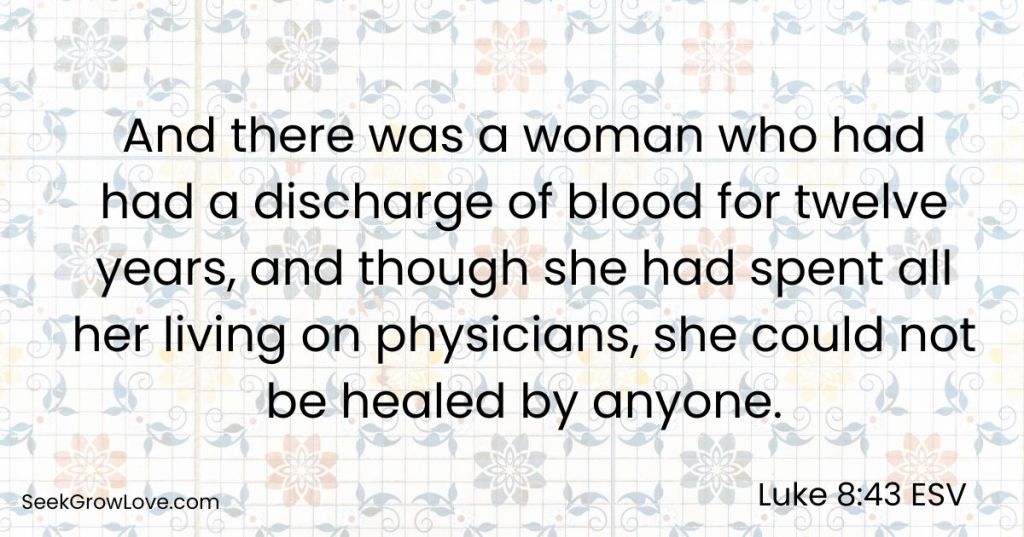
We don’t know the woman’s name* who touched Jesus in the crowd, the bible doesn’t mention it. We do know that she was suffering for 12 years from a chronic bleeding condition, “a discharge of blood” (possibly menstrual), which would render her ceremonially unclean and socially isolated under Jewish law. To even touch an unclean person under Jewish law meant that you became unclean too. What’s the big deal though?
It’s a bigger deal than you can possibly imagine. In the ancient world, the Jewish people had at the core of their social identity as a people the common belief in the one God, the God who had saved them from Egypt and claimed them as a people, and there was only one place in Israel that it was acceptable to go and worship this God, and that was at the Temple in Jerusalem. You could not enter the temple if you were unclean, not without a very specific (and time consuming) ritual cleansing. If you had a chronic bleeding condition, you could never become ritually clean, and therefore you could never enter the temple. You couldn’t make your sacrifices before God. You were cut off, not only from your people, but from your God.
Put it in your own social terms. Let’s say you live in a medium-sized town, and everybody in this town goes to one church. Now imagine that nobody will socialize with you or even approach you, and the only place that you can go to that everyone else goes to is denied to you. In addition, even though you want to serve God, the only place you’re allowed to do it is at this church, which you’re not allowed in. Feel isolated yet? It was exponentially worse for this woman, because the core of the Jewish identity centered around the temple, and the belief and worship of the one God, which could only ritually take place in the temple. This woman had no friends, and couldn’t even officially approach God, not like the rest of the Israelites could. Just imagine how that would make you feel.
When Jesus found out who had touched him, he didn’t rebuke her. He didn’t scold her as an unclean woman touching a faithful and ritually clean Jewish man. He blessed her, and told her that her faith had made her clean. From this point, all she had to do was to go and see a priest, serve out the prescribed time for purification, and then she could enter the Temple. Jesus restored her ability to have a direct relationship to God. He brought her back in to the tribe of Israel socially as well, and enabled her to be a part of the nation that was no longer isolated and excluded.
No matter who you are, no matter what tribe you are from, no matter what the color of your skin is, what language you speak, or what nation you live in: Jesus offers us this same invitation. A chance to remove our affliction, to restore us to our God, and to be a part of the kingdom. An opportunity, for those of us bold enough and willing to just reach out and try to touch him. Even if it’s just the hem of his robe. All praise to the God who sent him, our king is a restorer, a mender of the breach, a repairer of what is broken. Thank you, Jesus.
REFLECTION QUESTIONS:
- Had you ever considered the social and spiritual ramifications of having a chronic bleeding illness in the ancient Israelite world, based on Jewish law?
- Had you ever considered that our king, Jesus, was a (Jewish) law abiding man, and what the ramifications of that are to us today?
- Had you ever considered the deeper implications of why Jesus didn’t know who touched him?
Prayer
Father God, thank you for sending us your son. Please heal us. Thank you for all of the blessings that you have given us, all undeserved and unwarranted on our part. Please help me to glorify your name, to obey your laws, and to follow the teachings of the one you sent to us. In Jesus name, Amen.
* It should be noted that later “church tradition” does identify her by name with some other interesting and apocryphal trivia about her, but like any church traditions that aren’t explicitly in scripture, they should be discarded with the waste water.

