I bet we all have experience with someone who is prideful. We’ve heard stories of wildly successful people, and in their triumph, they forget the people who helped them get there.
In 2 Samuel 8, we hear about some of David’s great victories in battle- he’s at the top of his game- a picture of power and achievement.
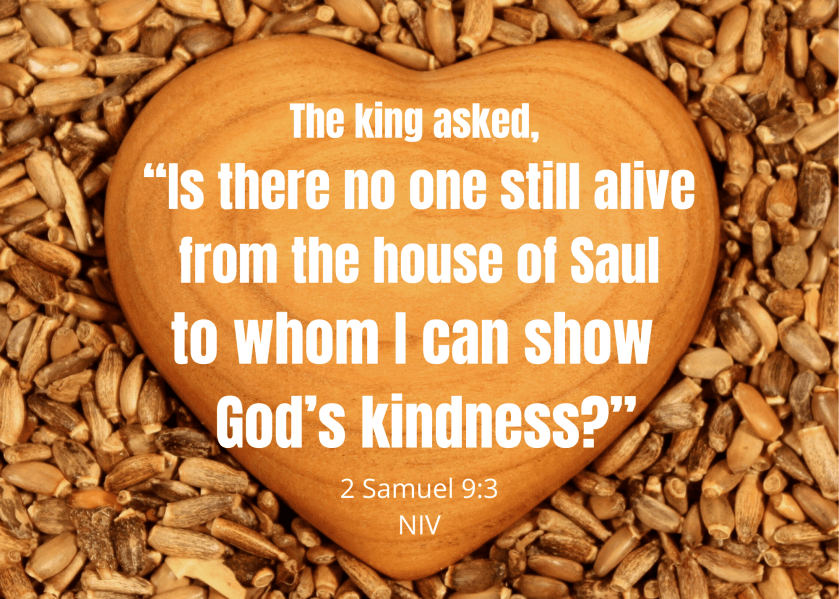
Then, in stark contrast, chapter 9 gives us a glimpse at a softer and more compassionate side of David where he actively looks for someone “from the house of Saul to whom I can show God’s kindness?” David remembers the promises that he made to Jonathan and, in his moment of power, chooses kindness over vengeance. David easily could’ve broken his promise and basked in his victories- instead, he extended grace to a man who could offer him nothing in return.
This act of unexpected mercy shines a light on David’s character, revealing a heart that prioritizes loyalty and compassion over pride and power.
-Hope Fletcher
Reflection Questions
When have you been tempted toward the power and pride side – or deep into its territory? Have you found a good way to resist pridefulness?
Who do you admire for their loyalty and compassion?
Whom can you (will you) seek out to show a bit of God’s kindness to?
When was the last time you made a truly eternal promise? If you’re married, hopefully, you’ve made an eternal promise of love and commitment. I’m sure if you have children, you’ve vowed to love and cherish them always. Even something as seemingly simple as getting a tattoo is a promise to yourself that you’ll carry that image on your body for the rest of your life.
Today’s scripture, 2 Samuel 7, reveals the profound truth of God’s eternal promises. This passage contains the Davidic Covenant, where God promises that David’s house will rule forever. We know this promise will be fully realized when Jesus returns to establish God’s Kingdom on earth. Think about it: God has been keeping this promise for over 3,000 years! Despite Israel’s occasional disappointments and frustrations, God remains steadfast.
While our most sincere promises can falter due to betrayal, anger, misunderstanding, or irreconcilable differences, a promise from God is unwavering. That’s a reason for a true celebration!
David’s response to this incredible promise is one of humility and awe: “How great you are, Sovereign Lord! There is no one like you, and there is no God but you, as we have heard with our own ears.” Today, may we find ways to celebrate God’s faithfulness that has endured all this time and will continue long past us.
-Hope Fletcher
Reflection Questions
When have you witnessed or experienced God’s enduring faithfulness?
When have you responded to God with humility and awe saying (similar): ““How great you are, Sovereign Lord! There is no one like you…”?
How are you at keeping your promises? Can your word be trusted?
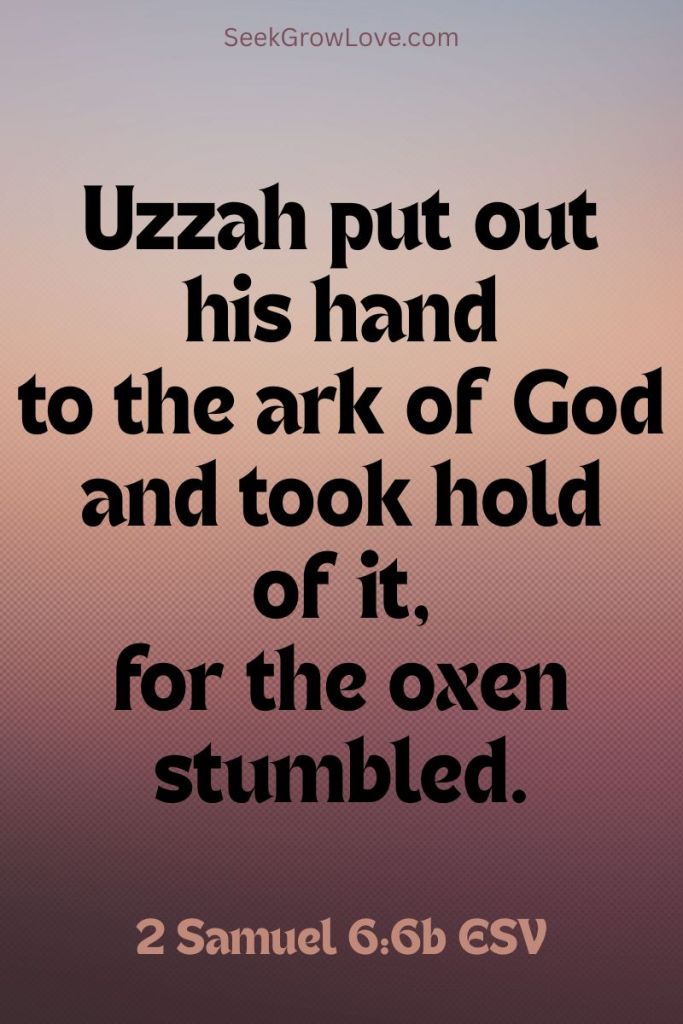
2 Samuel 6 is one of those stories in the Bible that never sat well with me in my youth. Here, we have a scene of a joyful celebration as the ark of the Lord Almighty is brought to its rightful home in Jerusalem. We’re singing, we’re dancing, we’re having a grand time. Suddenly, the oxen stumbles, and the ark begins to fall. Here, we have Uzzah, who reaches out to steady the ark to keep it from falling. See, to me, that seems like a noble thing to do. After all, we’d hate for the ark to fall to the ground, wouldn’t we? Yet, God strikes him dead for this act. Come on…the guy was just doing the best he could do! It always seemed to me that God acted unfairly to someone who seemed like they were trying to do a good thing.
You know, now that I think of it, I tend to have that same attitude toward acts of disobedience in my life. Sure, I know that sometimes I do wrong things, but if my intentions are good, isn’t it ok? I know that God doesn’t want me to lie, but if my lie has a good outcome, wouldn’t God say that’s ok? I know I’m not supposed to touch the ark, but if I keep it from falling, wouldn’t that be ok? Unfortunately, that’s not the way it works.
If you’ve been following along with the Bible readings, you’ll remember that in 1 Samuel 15, we learn that to God, “it is more important to obey than to sacrifice.” God prefers faithful adherence to His commands more than grand gestures performed according to our own understanding. I think God would rather have had Uzzah follow his commands, treating his instructions with respect and reverence than try to do what was right in his own eyes.
And another thing, the disobedience didn’t start with him reaching to steady the ark. Uzzah wasn’t even supposed to be one of the men transporting the ark as he wasn’t a Kohathite (the Levites specifically instructed by God to be in charge of this task). Not only that, but they weren’t even transporting it the right way. They made a cart for the ark, but God gave specific instructions for how to carry this thing around, and a cart was not part of the deal! Things could have been so different if only they had done things the way God said.
What we learn from Uzzah and the mistake that he made is to pursue obedience even when our own understanding leads us a different way. In this life, you will be drawn toward doing things that go against God’s teachings. Even if it doesn’t make sense, God’s way is always the best.
-Hope Fletcher
Reflection Questions
How do we avoid getting caught up in doing things our own way instead of God’s way? How do we learn what God’s way is? What are the differences between my way and God’s way?
How does Uzzah show us our need for a Savior? How important is Jesus’s death – and resurrection?
Welcome back! We are taking a brief break from our Psalms passages today 🙂
When David was anointed king over Israel, we are told that all the Israelites, all the elders, and several warriors from other areas were fully committed to the decision of making David king. That’s pretty darn impressive to get so many people on the same page about who the next leader is going to be!
But, considering the prophecy Samuel communicated to Israel earlier on, we should not be surprised this was the response to David’s reign. This wasn’t the first time David was anointed, this was simply the fulfillment of a prophecy started years earlier. And, it continued the groundwork for the Davidic covenant that connects the dots between Jesse (David’s dad), and Jesus the Messiah, which would be the fulfillment of a prophecy to come several hundred years after! It would become a pivotal point for believers, they just didn’t know it yet.
Today is Good Friday, last Sunday was Palm Sunday, and while our passages don’t reflect the story of Jesus triumphantly entering Jerusalem, they are part of the history that took place to make it possible for people to shout out “Hosanna to the Son of David!” 28 generations later. When David was anointed king over Israel, all around were filled with great joy over his rule (1 Chron. 12:40). When our King returns again to fulfill the final, greatest prophecy yet, we will experience an even greater joy than this! Praise God for all the stages of history He aligned to give us full confidence in the returning, rightful King!
Sarah Johnson
Reflection Questions
Are there moments in your life that you look back at and see how significant it was to getting you where you are today? Take a moment to reflect on those moments now and thank God for how He works in your life!
How are you preparing your heart and mind for the Easter season this year?
2 Samuel begins with Saul’s death. Chapter one tells of his death and David’s reaction. Chapter two shows David seeking God’s advice and being anointed king over Judah, the northern kingdom. Also, we see Abner anointing Ish-bosheth, Saul’s remaining son, king over Israel, the southern kingdom.
Both armies met at the pool of Gibeon. 2 Samuel 2:14 says, “And Abner said to Joab, ‘Let the young men arise and compete before us.’ And Joab said, ‘Let them arise.’” They arose, each sending 12 men to fight. They each caught their opponent by the head and thrust their sword in their opponent’s side. All 24 died. Not the brightest way to fight! A battle broke out after this and one of Joab’s brothers, Asahel, ran after Abner; Abner ends up killing him. That brings Joab and his other brother, Abishai, pursuing Abner. Joab ends up retreating, but David’s men won the battle 20 deaths to 360 deaths. Chapter three tells of Joab and Abishai getting their revenge on Abner and of Ish-bosheth’s death.
There you have the cliff notes version of the first four chapters of 2 Samuel.
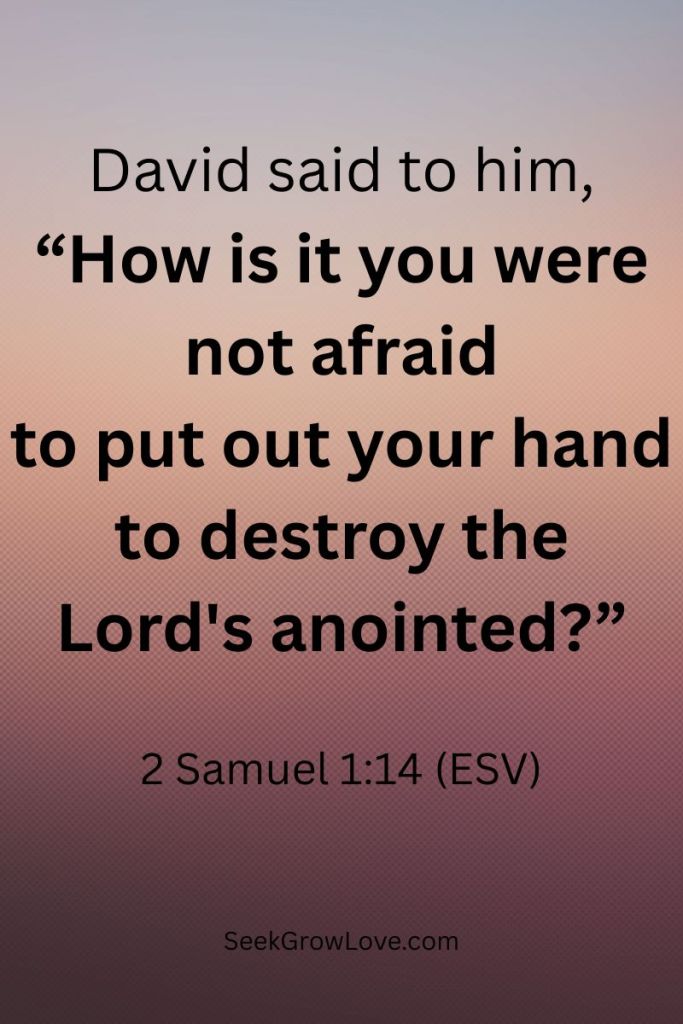
There are two stories in these chapters that show David’s moral character. If you remember, there were a couple of times when Saul was chasing David when David could have killed him and did not because Saul had been anointed by God. Even though it would have been viewed as a proper response to the situation, David didn’t do it. In 2 Samuel 1 an Amalekite man comes to David to report Saul’s death. He tells how Saul, near death already, asks to be put out of his misery and how he honors that request. David kills him. In 2 Samuel 4 we read that after Abner was killed Ish-bosheth lost his courage. Two captains of raiding bands for Ish-bosheth realized they were on the losing side and wanted to find a way to show their loyalty to David. They killed Ish-bosheth and brought his head to David. They were proud of their actions, and thought David would be as well. Just like the Amalekite man, David has them killed.
One more side note…In chapter four we are also introduced to a character who doesn’t come into play until chapter 9. Verse 4 says, “Jonathan, the son of Saul, had a son who was crippled in his feet. He was five years old when the news about Saul and Jonathan came from Jezreel, and his nurse took him up and fled, and as she fled in her haste, he fell and became lame. And his name was Mephibosheth.” Just keep that mouthful in mind (muh·fi·buh·sheth).
Amy Blanchard
Reflection Questions
When you think of your own moral character, how would you rate yourself?
When the world says something is right and good do you consider if that is how God views it? Who do you choose to follow?
Keeping in mind 2 Samuel 1:14, what are some things that David – and God – would suggest we should be afraid of?
As President of the United States, Abraham Lincoln is uniquely positioned in American history as the only leader of a broken country. No matter who he chose to serve in his cabinet, how empathetic his staff was to his role, how much they helped to shoulder the load or strengthened his areas of weakness, no one can truly understand the weight borne by the Commander-in-Chief, whose presidency was the bookends to rebellion. A great example of this can be seen in Vicksburg, a Union siege took out the Confederate stronghold on the Mississippi which was a key route for reinforcement and supplies. While this battle represented a great public triumph for Lincoln’s side, it also held personal tragedy. Lincoln received the report that his brother-in-law, a Confederate general, was killed in battle. It was stated by those surrounding him they never saw the president more moved during the war than when he received this news.
Likewise, David’s emotions in victory are complex. Tens of thousands of men look to their king to champion their victory, no doubt hearing stories of how he famously danced in the streets as the Ark made its way into the city. Instead, they see the lament of a father’s cry. Great leaders, more than anything else, are human; however, the weight of leadership will undoubtedly tip the scales in favor of fostering commitment, vision, and hope for followers, rather than abandonment trials and tragedy. Joab’s words seem insensitive, “You love those who hate you and hate those who love you. You have made it clear today that the commanders and their men mean nothing to you. I see that you would be pleased if Absalom were alive today and all of us were dead. (2 Sam 19:6) ” but they are actually encouragement to a leader who has made a personal sacrifice to acknowledge that tens of thousands of others had done the same.
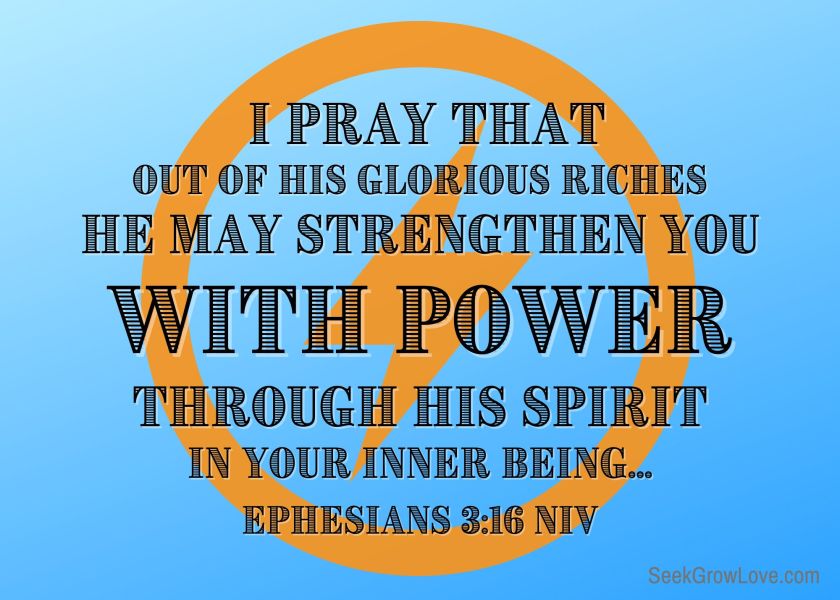
The words of Jesus could be thought equally cutting and unfeeling, “Let the dead bury their own dead, but you go and proclaim the kingdom of God. (Luke 9:60).” Our ministries do not stop because we face conflict or personal tragedy. Conversely, I would say this is when our ministry and testimony are spotlighted. By the standards of the world, this conflict provides permission to act selfishly, but when we bear our burdens with the Kingdom of God at the forefront, we lean on God and lead others to the Good News. Paul makes mention of this in Ephesians 3. He tells the church at Ephesus not to worry about his suffering, because it is for their sake and to the glory of God. The same circumstance is both a victory yet a personal hardship. Paul instead lifts those he leads in prayer, asking for the strength of the Holy Spirit to guide those for whom the letter was intended, and likewise, encourage us today. No matter what scale Paul used, no matter what was placed in the balance, the weight of the Kingdom of God far outweighed any loss. This sentiment is again echoed from his prison cell to the church at Philippi when he states:
“What is more, I consider everything a loss because of the surpassing worth of knowing Christ Jesus my Lord, for whose sake I have lost all things. I want to know Christ—yes, to know the power of his resurrection and participation in his sufferings, becoming like him in his death, and so, somehow, attaining to the resurrection from the dead.” – Phil. 3:8,10
While we may not be ready to ask for suffering like Paul, tragic circumstances are the nature of this world. It may be an unfamiliar posture, but our grief, our battle, and our dire circumstance is an opportunity to demonstrate the assurances we have, to revel in the joy and love of God. We must look for opportunities to pray for and encourage others who may be participating in the same battle, asking God to give them the strength to see the victory too. Yes, we must bear, and even welcome, hardship for the sake of the Kingdom of God because, with the help of God, we can lead within it, bringing others to the saving knowledge of Christ Jesus.
-Aaron Winner
Reflection Questions
What do you learn about leadership from David? From Paul?
What do you think of the statement: “No matter what scale Paul used, no matter what was placed in the balance, the weight of the Kingdom of God far outweighed any loss.” Do you see this in Paul’s life? Do you see this in your own life?
Who will you pray for strength to see the victory?
The second day of school has traditionally been my rule day. In the midst of hearing about respect, responsibility and best efforts, students are surprisingly invited to leave the classroom. “Did you know you don’t have to sit here and listen to me speak another word? In fact, you can leave. You can walk out right now…” Typically someone who I will get to know better as my class clown playfully walks to the door, and then I say, “but you have to deal with the consequences.” Then I lead students down the timeline of possible outcomes that lead to suspension, loss of friendships, poorer relationships at home, less opportunity in the future, and finally, on their deathbed alone, all because they chose to walk out of my class. Thankfully, no one has ever walked out.
Amnon’s actions are far more sinister than walking out on his teacher. Acting on his lust, he rapes his half-sister, both a violation and grievous sin against God’s law. This comes with its own un-hyperbolic chain of tragic ramifications. For two years, his half-brother, Absalom, becomes consumed with calculating revenge. There is discord in the family tree designed after God’s own heart. Ultimately, Amnon’s disregard for divine laws leads to an untimely death. This is the havoc that sin can wreak, even in a single choice.
It is safe to say that most of our choices fall between leaving a classroom without permission and Amnon’s sin. Likewise, the vast majority of time, the immediate consequence lies somewhere between a phone call home and death (although, quick note: all sin leads to death. Rom 3:23) So how do we stay away from the edge of the slippery slope? Proverbs 2:1-5 gives us an insight:
“My son, if you receive my words and treasure up my commandments with you, making your ear attentive to wisdom and inclining your heart to understanding; yes, if you call out for insight and raise your voice for understanding, if you seek it like silver and search for it as for hidden treasures, then you will understand the fear of the Lord and find the knowledge of God.”
The pursuit of wisdom from God is portrayed as a protective measure against the consequence of sin, serving as a shield and guide against temptation. It leads us far and away from destructive patterns or downfalls and moves us closer to our good intentions, but better yet, our good God.
Furthermore, we do not have to fight sin or seek wisdom alone. Paul beckons the family of God to be on the watch for one another. In Galatian 6 he states, “Brothers, if anyone is caught in any transgression, you who are spiritual should restore him in a spirit of gentleness. Keep watch on yourself, lest you too be tempted.” This means that offering wisdom to one another in the form of correction and accountability may halt the tragic dominos from falling or make a path forward to clean up the mess, “bearing one another’s burden.” In this way, Joab advises Absalom to deal with his own ramifications, temporarily restoring the rift in the line of David.
We must be diligent to seek God’s wisdom, especially when navigating temptation. If the chips have already fallen, let the consequence be a sobering reminder that there is opportunity for restoration in God through Jesus Christ. Though it may still hurt in the present, be reminded that the sting and tears are conditions of mortality and not life eternal. Likewise, let us pull alongside others who are battling, being gracious because of our own shortcomings, running to their defense and offering correction. In this way, we may avoid the siege that comes with a breached wall of will and choose the power of restoration through God’s wisdom and grace.
-Aaron Winner
Reflection Questions
Are you more intent upon seeking after wisdom or your own will? What can you do to pursue wisdom more?
How can you be a part of someone else’s battle against temptation and their own will? How can you help, offering restoration with God, to one who is caught in their sin? Give specifics – name who, and your actions to free them from their deadly trap.
In 2 Samuel 12 we read all about how King David is rebuked for his sinful ways and the real consequences he would suffer as a result of his sin.
9 Why have you despised the word of the Lord by doing evil in His sight? You have struck down Uriah the Hittite with the sword, have taken his wife to be your wife, and have killed him with the sword of the sons of Ammon. 10 Now therefore, the sword shall never depart from your house, because you have despised Me and have taken the wife of Uriah the Hittite to be your wife.’ 11 Thus says the Lord, ‘Behold, I will raise up evil against you from your own household; I will even take your wives before your eyes and give them to your companion, and he will lie with your wives in broad daylight.
Proverbs 1:31 from today’s reading gives us a sobering reminder of what happens when we choose to be ruled by the flesh rather than by the Spirit.
“So they shall eat of the fruit of their own way
And be satiated with their own devices. (NASB 1995)
If we want to avoid disastrous consequences brought on by sin, Galatians 5 gives us some sound advice:
24 Now those who belong to Christ Jesus have crucified the flesh with its passions and desires. 25 If we live by the Spirit, let us also walk by the Spirit.
Proverbs 1:7 further instructs us on how to live wisely:
The fear of the Lord is the beginning of knowledge;
Fools despise wisdom and instruction. (NASB 1995)
The Bible is full of examples from which we can learn. Sometimes I read the story of David and think how on earth could he do those things, but then I quickly remember that saying, “As soon as you point a finger at someone, you have four fingers pointing right back at you.” God’s word is a mirror for our hearts. If we are left to our own devices and follow the ways of our flesh, disastrous consequences inevitably ensue. We must make a conscious choice to live and walk by the Spirit. The good news is that we are not irredeemable if we have been led astray by our flesh at one point. The story wasn’t over for David and it doesn’t have to be over for us. We can make that choice to reconcile with God and we can be assured by the parables of the prodigal son and the lost sheep that He will welcome us with open arms. Your story is not over while you still have breath. If you’ve walked away from God, please know His heart yearns for you to return to Him and He will welcome you back with loving arms. The choice is up to you.
Romans 8:37 No, in all these things we are more than conquerors through him who loved us. 38 For I am convinced that neither death nor life, neither angels nor demons, neither the present nor the future, nor any powers, 39 neither height nor depth, nor anything else in all creation, will be able to separate us from the love of God that is in Christ Jesus our Lord.
Did you notice that nothing can cause God not to love us? God forgave King David and He can certainly forgive you.
-Kristy Cisneros
Reflection Questions
What consequences for sin have you experienced or are you still experiencing? What would you recommend to someone (including yourself) contemplating the sin which brought the consequences?
What role did Nathan play in 2 Samuel 12? Who sent him to David and why? As uncomfortable as it may seem, is there someone God wants to send you to?
Living by the flesh or living by the Spirit – what are the pros and cons of each? Which will win in your life?
What does reconciliation with God look like in your life? What blessings did David receive after his sin and reconciliation? What blessings have you received after sin and reconciliation? How would you describe God’s love?
In today’s passage in Galatians, 5:23, we read of the rest of the fruits of the spirit: gentleness, self-control; against such things there is no law. (NASB 1995) The spirit of self-control is a quality that would have served David well in today’s passage in 2 Samuel 11. What can we learn from the story of David? Sin can have a domino effect. One sin can easily lead to another. David’s first sin was probably just looking at Bathsheba longingly while she was bathing. Jesus tells us that for a married person to even look upon someone else with lust is equivalent to adultery. Ideally, David should have looked away immediately once he realized she was not clothed. We can probably safely assume his self-control did not kick in at that moment to prompt him to quickly avert his gaze, which then led to feelings of lust multiplying in him. Then, as the story goes on, we see David actively pursuing her, impregnating her and then frantically trying to figure out how to clean up his mess. David’s struggle with temptation is obviously not unique. We only have to look around to see we have many temptations competing for our attention. Pornography is more accessible than it has ever been and has been named as a major public health crisis due to the impact on individuals and their marriages and families.
Abiding in the living vine is our best defense against the onslaught of temptation that we face on a daily basis. Self-control is not easy to come by naturally because temptations are considered to be temptations because they are powerful and tap into our carnal desires and stimulate our senses. Whether it’s overindulging in alcohol or food, taking drugs that aren’t prescribed to us or abusing prescription drugs, sexual sin, etc., temptation comes in many forms. Thankfully we don’t have to rely on our own strength to resist them. Abiding in Christ helps us to cultivate that fruit of the spirit that includes self-control. Of course, like any plant, a vine must be tended to. We cannot ignore it and expect it to thrive. It is a choice that must be made daily, sometimes hourly, at times even minute by minute, to abide in Christ.
-Kristy Cisneros
Reflection Questions
Besides in this chapter, where else have you seen sin’s domino effect in action?
What temptation grabs your attention and pulls you away from where you should be? Where does it lead to next?
What does it look like when your temptation wins over your lack of self-control? What does it look like when your self-control wins over temptation? How do you feel in each instance? How are others affected in each case? What do you imagine God is thinking or feeling in each scenario?
What specific actions can you take this week to abide in Christ more and more? What will it cost you? What will the benefits be?
This phrase shows up twice in chapter eight of 2 Samuel. The repetition of this phrase tells me that it must be an especially important message that God wants us to hear. Reading this sentence calls to mind the passage in Deuteronomy 31:6: “Be strong and courageous. Do not be afraid or terrified because of them, for the Lord your God goes with you; he will never leave you nor forsake you.” (NIV) We know this promise was not just reserved for the Israelites because this promise is referenced again in Hebrews 13 in a message to all believers: 5 Keep your lives free from the love of money and be content with what you have, because God has said,
“Never will I leave you; never will I forsake you.”
I also want to throw in verse 6 for good measure since it really helps drive home the point.
6 So we say with confidence,
“The Lord is my helper; I will not be afraid. What can mere mortals do to me?”
I love that the passage in Psalm 71 is coupled with today’s reading. We can see that David is ever mindful of his source of help and strength and this whole passage reads like a recipe for having joy in the midst of suffering.
6
From birth I have relied on you;
you brought me forth from my mother’s womb.
I will ever praise you.
7
I have become a sign to many;
you are my strong refuge.
8
My mouth is filled with your praise,
declaring your splendor all day long. (NIV)
19
Your righteousness, God, reaches to the heavens,
you who have done great things.
Who is like you, God?
20
Though you have made me see troubles,
many and bitter,
you will restore my life again;
from the depths of the earth
you will again bring me up.
21
You will increase my honor
and comfort me once more. (NIV)
Psalm 71 reminds us that we are not promised a trouble-free life. In fact, Jesus promises us just the opposite in John 16:33: “I have told you these things, so that in me you may have peace. In this world you will have trouble. But take heart! I have overcome the world.”
Notice the promise that we can have peace in spite of suffering and trouble. Peace is even a fruit of the Spirit listed in today’s passage of Galatians 5:22:But the fruit of the Spirit is love, joy, peace, patience, kindness, goodness, faithfulness, (NASB 1995).
What is the key to having this peace? Abiding in Christ and holding fast to our hope that Jesus has overcome the world is key!
We are further reminded of this promise in today’s passage of 2 Samuel 7 that unfolds God’s covenant with David that will be fulfilled through Jesus Christ:
12 When your days are complete and you lie down with your fathers, I will raise up your descendant after you, who will come forth from you, and I will establish his kingdom. 13 He shall build a house for My name, and I will establish the throne of his kingdom forever. 14 I will be a father to him and he will be a son to Me; when he commits iniquity, I will correct him with the rod of men and the strokes of the sons of men, 15 but My lovingkindness shall not depart from him, as I took it away from Saul, whom I removed from before you. 16 Your house and your kingdom shall endure before Me forever; your throne shall be established forever.” (NASB 1995)
No matter what life throws our way, we can have peace and joy by abiding in Christ and holding fast to the hope we have in him thanks to the loving plan of our Heavenly Father. May we be especially comforted by God’s promise that He will never leave us or forsake us. We are not alone in this journey and God—the maker of the universe—cherishes us and is with us every step of the way! Wow!
Luke 12:7 Indeed, the very hairs of your head are all numbered. Do not fear; you are more valuable than many sparrows. (NASB 1995)
-Kristy Cisneros
Reflection Questions
When have you needed to hear Psalm 71? How can you relate to David and his words?
If you were to make a poster, memory card or bumper sticker of one or two verses from Psalm 71 which verses would you choose and why?
Where would you rate your peace – even in the midst of trials? Where would you rate your joy? What can you do to increase your peace and joy? How can you abide more closely to Jesus, how can you trust more fully in His Father and yours?