Ordinary People – Who Have Been with Jesus

Acts 4-6

Devotion by Rachel Cain (Ohio)

Abraham Lincoln (president), Charles Dickens (author), Steve Jobs (Apple creator), Dave Thomas (founder of Wendy’s), and Ingvar Kamprad (IKEA originator) seem like an unlikely bunch to be grouped into a similar category, but they all have this in common: each one either had little formal training or dropped out of school early, and yet became very successful. Our protagonists in Acts 4, Peter and John, also fit among this list. 

“Now when they saw the boldness of Peter and John, and perceived that they were uneducated, common men, they were astonished. And they recognized that they had been with Jesus.” (Acts 4:13, ESV) Though Peter and John lacked formal training, their time of hands-on learning with Jesus probably equated to an advanced doctorate degree! Their accusers probably recognized that they had been taught by Jesus because their teaching styles and tones so closely matched that of their Rabbi. 

We, too, are disciples! We are called to share the gospel to a hurting world, following closely to the way of our Rabbi, Jesus. So remember your mission! Here are some tips from this text to help us be more like the early church. 

Share Jesus Boldly and Without Shame

Word about Jesus’ resurrection power spread, people were healed in Jesus’ name, and the number of followers was growing exponentially. The jealous religious leaders, however, did not appreciate this threat to their authority. So the council – likely the same one that condemned Jesus to death – tried to silence the ragtag bunch and ordered them to keep quiet. The disciples’ bold response? “We can’t keep quiet about what we have seen and heard!” (Acts 4:20). Their lives had been totally changed, and they just had to spread the word! 

Humans haven’t changed much – we still can’t keep quiet about the good stuff! If you compliment a woman’s new dress, she will tell you three things about it: where she purchased it, how inexpensive it was, and that it has pockets! She is just so excited that she can’t keep it to herself! Likewise, if you visit a fantastic new restaurant and they’re offering a ton of great deals, you’ll probably tell all your friends so that they can get in on it, too. We love to spread good news to other people, so why do we shy away from sharing Jesus with the same zeal? (I’m preaching to myself here. I long to have that kind of boldness that I just can’t keep quiet about all things Jesus, don’t you?) Pray for boldness to share with others how Jesus has changed your life. 

Obey Only God 

When the religious leaders tried to shut them up again, the disciples replied, “We must obey God, not men.” (Acts 5:29) It’s always been so easy for us to slowly assimilate to the culture around us and begin to obey the gods of this world or match the expectations of the people around us. The Israelites did this chapter after chapter in the Old Testament, and we still stray today. Romans 12:2 warns us about getting too conformed with the world. Though it would eventually cost many of them their very lives, the disciples in Acts were compelled to continue sharing the hope of Jesus with everyone. Jesus had cautioned: “Do not be afraid of those who kill the body but cannot kill the soul. Rather, be afraid of the One who can destroy both soul and body in hell.” (Matthew 10:28) Pray that we – the global Church – would stay faithful until the end. 

Maybe you’re like me – never been to Bible college, don’t know an ounce of Greek or Hebrew, just living an uneventful, mundane life. God can use us still! Even without special training, we can be bold lights in a dark world. God can, and will, use you right where you are to make a difference for Him! 

Reflections: 

Your prayer prompts are within the text. Take a moment to pray over those.

  1. How do you spend time with Jesus? Can others tell that you do? What can you do to spend more quality time with Jesus?
  2. How can you lovingly, humbly, courageously show the world (including, but not limited to your family, your church, your neighbors, your “enemies”, the disadvantaged, the other side of the world, etc…) what you have seen and heard and learned from Jesus?
  3. When/how have you fallen into the trap of obeying men rather than God? What can that look like? What can you do to strengthen your resolve to Obey Only God?
  4. What courageous task will you do today to obey God?

Shifting Our Perspective

Acts 1-3

Devotion by Kaitlyn Hamilton (Michigan – and Indiana)

One of my close friends in high school, while dealing with the loss of someone she knew, asked me the question, “Is it a bad thing that I’m concerned about his soul for eternity?”  This question, this concern, about a soul’s place in eternity is something that many people often consider when faced with the loss of someone they know.  This is great and all, but there’s one big problem with this – for many people, this is the only time they seriously consider what is going to happen to people in the grand scheme of eternity.  Do you spend significant time considering the number of people around you who you know aren’t part of the church?  But, it’s not enough just to consider it; once we realize the large quantity of people that we care about who are currently on the path of destruction for eternity, we should be ready to do something about it.

In reading Acts 2, we see that Peter recognized what was at stake.  The same person, who earlier, was too afraid to be associated with Jesus for fear of his life, takes a stand before a large crowd of people, including a group who were mocking them saying, “They are full of sweet wine.” (Acts 2:13)  Peter chose to shift his perspective away from the thoughts of the world, of what this crowd could do to him if they disliked his message, of what these same people did to Jesus only 53 days earlier.  Instead, he shifted his perspective towards that of God’s will, focused on the message these people needed to hear.  In Acts 2:22-24, instead of focusing on how to keep peace with all the men who Peter knew, instead of trying to remain on agreeable terms as friends, Peter was willing to stand up for his faith, was willing to tell the Jews gathered in Jerusalem the truth of what their actions did.  The Messiah that they had been watching for all their lives and the lives of all their parents and grandparents and all their ancestors before them, they had put to death, they had crucified.  Can you imagine having the courage to stand before just one person and telling them that their actions, their sins, were the reason that an innocent man was put to death?  But, Peter didn’t just tell one person, he told a huge crowd – a crowd that should they be angry enough could easily turn into a mob and kill him.  This choice to tell everyone the truth about Jesus, the Messiah, and what they had done to him, took courage that comes only from shifting your perspective away from the worries of this world to that of the hope and peace that come from God.

What would happen if we all shifted our perspective like Peter did?  If we all chose to focus on God’s will for our life instead of the fears that try to stop us from seeking him?

What would happen if we were willing to all stand up for our faith to everyone we know?

What would happen if we let everyone know that we were Christians and weren’t willing to budge on any of our morals?

What type of revival would we see if we did all this?  

Peter saw a revival that day of 3,000 people.  Imagine just how big of a revival we would see if we all chose to stand up together and proclaim our faith.  It’s not going to be easy.  It means going against your human nature.  It’s not going to be automatic.  It won’t be a switch being flipped overnight.  But, it will change you and the world.  So, I encourage you to start shifting your perspective today, to start recognizing what is at stake, and to start standing up for your faith today!

Reflection Questions

  1. What could it look like for you to stand up for your faith today, and the rest of this week, month, year, life?
  2. What fears do you think Peter might have had to overcome that day? What fears do you currently have about boldly proclaiming your faith? How might Peter respond to you if you could discuss with him about your fears? How do you think Jesus, or Jesus’ Father, would respond if you were to tell them about these fears? Go ahead, tell them and pray about it.
  3. What “Helper” was assisting Peter? (Hint: it wasn’t wine.) What benefits does this Helper provide? Do you use the same Helper?

With all Boldness

Old Testament: Numbers 15 & 16

Poetry: Job 14

New Testament: Acts 28

At the end of the book of Acts we are following Paul in his ministry as he shares his testimony and all he is learning from God with established groups of believers as well as with those who have not yet heard the good news of Jesus Christ. He is told through a prophet that he will be bound by the Jewish leaders and sent to the Gentiles to share his story.  He is accused by the Jewish leaders in Jerusalem, then arrested and imprisoned while the Roman authorities try to figure out which side of the story to believe.  Over the course of Paul’s imprisonment he is moved to various cities and meets with several governors as well as King Agrippa.  Then finally he is sent to Rome.  During each of these transitions, Paul has an opportunity to share the story of his conversion…who he was…who he is and who he will continue to be through God’s grace.  Every time he is questioned he says something like the following phrase from Acts 23:1 “My brothers, I have fulfilled my duty to God in all good conscience to this day.” 

Paul faced so much opposition during this period of time and yet he continued to stand firm in his belief that God had a purpose for him which would be fulfilled no matter what…arrest, false accusations, storms, shipwrecks, imprisonment, isolation, death threats, nothing was going to stop God’s message from being spread.

As the book of Acts closes we are given a chance to witness Paul as he teaches a group of Jewish leaders in Rome. 

Acts 28:23-30

They arranged to meet Paul on a certain day, and came in even larger numbers
to the place where he was staying. He witnessed to them from morning till evening,
explaining about the kingdom of God, and from the Law of Moses and from the Prophets he tried to persuade them about Jesus. 24 Some were convinced by what he said, but others would not believe. 25 They disagreed among themselves and
began to leave after Paul had made this final statement: “The Holy Spirit spoke the truth to your ancestors when he said through Isaiah the prophet:

26
“‘Go to this people and say,
“You will be ever hearing but never understanding;
you will be ever seeing but never perceiving.”

27
For this people’s heart has become calloused;
they hardly hear with their ears,
and they have closed their eyes.
Otherwise they might see with their eyes,
hear with their ears,
understand with their hearts
and turn, and I would heal them.’[a]

28 “Therefore I want you to know that God’s salvation has been sent to the Gentiles,
and they will listen!” [29] [b]

30 For two whole years Paul stayed there in his own rented house and welcomed all
who came to see him. 31 He proclaimed the kingdom of God and taught about the Lord Jesus Christ—with all boldness and without hindrance!

Some of those who were listening, heard Paul’s message and their lives were changed.  Others found that they couldn’t believe what Paul was preaching and left.  They heard but didn’t understand, they saw but didn’t allow comprehension. Paul kept right on teaching, preaching and sharing his mess so that God’s message could get through.

Oh to have Paul’s boldness and eloquence!  There are many times that we are provided the opportunity to share our own stories of faith with others and we often let them pass us by.  Are we afraid?  Maybe we don’t think they would be interested, or that we’ll be bothering them if we share.  Or maybe we don’t want to offend anyone…but if we are learning from Paul’s example, we need to be sharing our stories of faith regardless of the personal costs.  God’s message will be heard, don’t you want to be a part of that exciting adventure? I promise it’ll be a good one!

-Joyanne Swanson

(Originally posted for SeekGrowLove on November 8, 2018)

Reflection Questions

  1. What do you admire most about Paul? What do you admire most about how God worked in Paul’s life?
  2. How has God worked in your life? When was the last time you told someone one of your stories of faith (it could be a conversion story, or how God provided or guided)?
  3. Does fear keep you from sharing? What is the worst that could happen if you share a story of faith? What is the worst that could happen if you don’t share? What is the best that could happen if you do share?
  4. If you would like to practice writing out a faith story, leave a comment here, we’d love to hear yours!

Citizen Rights and Privileges

Acts 25 11 NIV for SGL

Old Testament: Numbers 12

Poetry: Job 11

New Testament: Acts 25

In chapter 16, we found out that Paul was a Roman citizen. Being a citizen of this vast empire was a great privilege. There were only two ways to gain Roman citizenship; you could either purchase it (something only the rich could afford to do), or be lucky enough to inherit it from your parents when you were born. Paul was born a Roman citizen.

The reason why you would want to be a Roman citizen in the first century is that they were given rights others were not guaranteed. The rights to marry another Roman citizen, to sue and to be sued, to have a legal trial, and to not be crucified were just some of the benefits offered to those privileged enough to be Roman citizens.

As we saw in chapter 21, Paul had already used his citizenship to get out of being flogged (Romans, legally, could not be tortured or whipped). In chapter 25 Paul exercised another of his rights–the right to appeal to Caesar. Paul knew that if he was brought back to Jerusalem, the men that had pledged to kill him would probably succeed. He also knew that he had to get to Rome to testify there. Thus Paul used his privilege to get to where he needed to go, so he could do what he was required to do (though, as we shall see in the coming chapters, this journey would not be an easy one).

If you were born in the West (especially the United States), you, like Paul, are privileged. You have rights like freedom of speech, freedom of religion, and freedom of the press. But there are many parts of the world today where these rights that are taken for granted here are only the ideals of dreamers. There are Christians throughout the world who have to look over their shoulder as they travel to church (if a public place of worship is even allowed) and others who are worshiping with the knowledge that every gathering may easily be their last.

There is another privilege you share with Paul: you are a citizen of Heaven. This citizenship cannot be purchased or inherited. It is not exclusive. The Kingdom of Heaven (or, Kingdom of God) is open to anyone. The poor and the rich, the weak and the strong, the lost and the found are all welcome. The cost of this privilege was paid for by God with the blood of His Son. It is offered to any who will receive it.

Paul was first and foremost a citizen of Heaven. He lived his life devoted to advancing the Kingdom and the One who will establish it in its fullness. The rights his Roman citizenship granted him were nothing compared to those his Lord did. That being said, Paul exercised his privilege as a Roman in order to promote God’s Kingdom as a Christian. He wanted to make sure as many people as possible would become citizens of the Kingdom. You also can use your rights as a citizen of your country to further the cause of the Kingdom. Exercise your earthly privileges in a way that leads others to receive heavenly ones.

-Joel Fletcher

(originally posted March 6, 2019 for SeekGrowLove)

Reflection Questions

  1. Do you think of yourself first as a citizen of the country you were born in/live in – or a citizen of heaven (where God dwells)? What are the differences?
  2. How can you use your rights and privileges to promote God’s Kingdom?
  3. Who do you know who needs to know more about how to become a citizen of the Kingdom of God? How can you share with them?

Giving the Good Stuff

Acts 20:35 NASB

Old Testament: Numbers 5 & 6

Poetry: Job 6

New Testament: Acts 20

I would like to start off this post with a short introduction.  My name is Ruth Finnegan and I am married to Sean Finnegan and we have four sons, who range from age 11 to 1 month old.  It is my joy and pleasure to be a stay-at-home mom!  When Sean and I first got married we had a lot of discussion about “how are we going to be.” We decided to set a few tenets or standards for our life together.  These were:  seek righteousness; don’t be cheap, tip generously, only use good toilet paper, and be given to hospitality.  Recently, I went to the store to stock up on toilet paper and they were out of our usual brand.  I bought a cheap package to tide us over until I could go to the store again.  Oh man! Mistake!!  Sean started declaring, “Have we lost all of our principles?? What is this, sandpaper?! Should we stop tipping too?” I burst out laughing when he said this because I was instantly brought back to that conversation early on in our marriage.  I went out and bought good toilet paper for the house and got rid of the cheap stuff.

Sean and I have been married for almost 14 years and we have always been passionate about being given to hospitality (Romans 12:10).  Over the years, we have had many people come stay with us.  Some come for just a night and some for many months.  We feel that God has given us much and blessed us abundantly and that it is our joy to bless others with our home (and with our good toilet paper).   I have found that you discover a lot about people when they stay with you in your home.  I thought about this as I read Acts 20:17-38.

When Paul was in Ephesus, his mission was certain.  He served and lived among the people, he kept back nothing, teaching them “repentance toward God and faith toward our Lord Jesus Christ” (Acts 20:21).  Paul was a true shepherd who cared for his flock and was very clear about his purpose.  He made sure that he was not a burden.  He took care of himself and those with him and he used every opportunity to teach and shepherd the flock there.  He truly cared for people and genuinely wanted the believers to be protected from the wolves that were sure to come.  Paul knew he had to leave and wouldn’t see them again.  He implored them with these final words:

35 In everything I showed you that by working hard in this manner you must help the weak and remember the words of the Lord Jesus, that He Himself said, ‘It is more blessed to give than to receive.’”

And with that, he knelt down with them and prayed for them.  When Paul left, they did not breathe a sigh of relief because he had inconvenienced them.  No, they had deep sorrow in their heart because he had been a blessing to them.

We have had people stay with us that were all about what they needed or being served so when their time of departure came, we were thankful!   We have also had the pleasure of having guests that infused our home with light and eternal blessings!  They had eyes to see and wanted to be a blessing and help.  When we go about our lives and come into contact with others, let’s strive to be like Paul.  He was all about teaching the eternal things of life like the Kingdom of God.  He was not a burden but a blessing to the believers and sincerely cared for them.  He didn’t complain about his lot as a missionary, he was driven by the holy spirit even when it came to his own discomfort and sacrifice.  Let’s strive to encourage others and remember it is more blessed to give than to receive!

-Ruth Finnegan

(Originally posted for SeekGrowLove on June 10, 2017 – today, Ruth and Sean’s boys are much older and taller. But I bet the whole family still enjoys using, and giving, the good toilet paper.)

Reflection Questions

  1. How would you describe how Paul gave? What was he giving?
  2. When have you found it to be true that, “It is more blessed to give than to receive?” What has been your favorite thing to give?
  3. Where are you challenged to give more freely? What will you give this week? How?

Make it Spread and Grow

xr:d:DAF-jOL4x5w:6,j:901140544355471458,t:24030412

Old Testament: Numbers 3 & 4

Poetry: Job 5

New Testament: Acts 19

What stands in the way of you living completely committed to God?  Time management problems, a secret (or not-so secret) sin, a preoccupation with _______, a friend taking you in the wrong direction? Many in the early church in Acts were living out a completely committed relationship with God and His Son, Jesus. And the results are exciting to watch as we read through the book.  Their faith was living and active and daily – and tested regularly.

I wonder if today too many people who carry the label ‘Christian’ use their faith as a once-a-week booster shot, if they can make it to church that week.  But then are quite content to spend the week surrounded by (and sometimes covered in) the germs and sicknesses of worldly living and priorities.

When you read Acts 19 search for all the sold-out characteristics and examples; and while you’re at it – spot the imitations as well (those exist today, too).  I particularly like the passage in verses 18-20 where the believers were confessing their practices and bringing their (expensive) magic books to be burned.  They had heard about Jesus and they believed and they were excited and ready to change!  It’s not that they had heard about Jesus and kind of believed and were sort of interested and wanted to add in some Jesus/church/faith to their already full lives.  See the huge difference?  They were radically changing their lives because they wanted to follow Jesus well.

Do you have anything in your life to add to the bonfire?  Anything that is keeping you from being totally committed to God and His Coming Kingdom?  Anything that doesn’t mix well with Jesus’ message that you need to give up?

The believers burned 50,000 drachmas worth of obstacles to living sold-out lives (a drachma was a silver coin worth about one day’s wages) – that’s a lot of obstacles they eliminated!  The very next thing Luke wrote was: “In this way the word of the Lord spread widely and grew in power” (Acts 19:20).  Sacrifice and true change brought growth. Are you ready to grow?

-Marcia Railton

(Original devotion posted for SeekGrowLove on April 19, 2018)

Reflection Questions

  1. In your reading of Acts what do you find impressive about the early church?
  2. What in your life is keeping you from living totally committed to God and His Coming Kingdom? What do you have to confess? What do you have to add to the bonfire?
  3. What changes can you make in your life that would help the word of the Lord to spread and grow in power?
  4. What does your church already do that is similar to the actions of the early church? How can you help your church look more like the early church?

Keep on Speaking

Old Testament: Numbers 1 & 2

Poetry: Job 4

New Testament: Acts 18

Acts 18 details the cities that Paul visited on his way from Jerusalem to Greece and some of the highlights in those cities.  While in Corinth Paul again has issues with the Jewish community there and instead finds a Gentile man named Titius Justus who was a worshiper of God.  Paul also has a vision from the Lord saying,

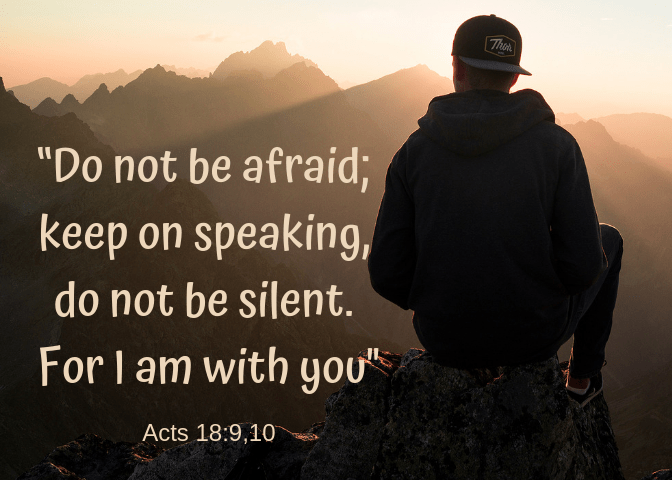
“Do not be afraid; keep on speaking, do not be silent.  For I am with you, and no one is going to attack and harm you, because I have many people in this city.” (Acts 18:9,10)

I understand why Paul would need this encouragement with the number of cities that he had been thrown out of after annoying the local Jewish population with his message.

What I find interesting is the fact that Paul is the first missionary to set foot on the continent of Europe and just recently we read about the first convert in the area, yet even in this “heathen” land filled with idols and false gods God is working in people’s lives and has people who worship him.  These people do not know the gospel and need to hear about Jesus desperately, but even without that knowledge they are seeking God and worshiping him. We see this today in many of the mission fields that we send people into. The people do not know about Christ, but it is obvious that God has been working in their community to prepare them to hear.  This is why it is so important that we get out there and evangelize. The harvest is plentiful but the workers are few.

Then while traveling in Ephesus in modern day Turkey, Paul runs into a man named Apollos who was a Jew that knew his scriptures (Old Testament) thoroughly and knew only the message of John the Baptist.  With only this information he was boldly speaking about Jesus and the fact that he was the son of God. He was off on some things, but he was on fire for God and was running with it.

These verses are encouraging because they show that you do not need to have everything figured out theologically in order to follow God.  You don’t need a master’s degree or years of training for him to be working in your life. Now I do think that seeking truth should be an important part of any believer’s life, but all that is needed to get started with God is faith in Jesus, and the Holy Spirit to work in your life.

-Chris Mattison

(Originally posted Feb 27, 2019 for SeekGrowLove)

Reflection & Application:

  1. If you heard the Lord speak to you in a vision do you think he would say, “Do not be afraid; keep on speaking, do not be silent” or “Do not be afraid; START speaking, do not be silent” or something else?
  2. Like Apollos, who didn’t first know the whole story, how has your understanding and knowledge grown? What and who has helped you in this area?
  3. How, where, when and to whom do you think God wants you to share what you know about Him, His Son and His plan of salvation?

Sharing the Message

– So it will be Received

Old Testament: Leviticus 26 & 27

Poetry: Job 3

New Testament: Acts 17

Acts 17 is very inspiring to me. Paul and his companions are traveling talking to others about God and our savior Jesus. They persuaded some Jews as well as God-fearing Greeks and prominent women. This made others jealous, causing them to make trouble for Paul and the believers. Paul did not stop talking, they went on to another city.

The people in the next city received the message with great eagerness and examined the Scriptures every day to see if what Paul said was true (vs 11). I pray that we have the the same eagerness that I imagine they had. I envision them diving into the Scripture and asking questions, strengthening their relationship with God. Can you guess what happens next? Yep, more trouble and they move on to another city.

In Athens Paul was greatly distressed to find the city filled with idols. I wonder how distressed he would be if he were to see the world as it is now. I know the Bible says there is nothing new under the sun and I don’t doubt that, but it seems that we have more to direct our attention away from God. We have more “things” to distract us from Him. I think that God had a plan with our reading today because Acts warns us about idols and so does Leviticus. Chapter 26:1 says “Do not make idols or set up an image or a sacred stone for yourselves, and do not place a carved stone in your land to bow down before it. I am the Lord your God.” We need to be very careful of what we worship and keep God at the center of it. 

Going back to Paul’s journey, he spoke about the Messiah all over the city. Some people became followers and believed. We need to continue to speak out to others about our faith. I am not saying that we need stand on the rooftops and scream at the top of our lungs, but I am saying that we need to live each day with God in our hearts. People should be able to tell that we are followers of Christ by the way we act. If someone comes to us with something, do not hide our faith but share our love of God with others so they can have a relationship with Him as well. Who knows, you may inspire them to speak out as well.

-Jeani Ransom

Reflection Questions:

Do you have eagerness to learn and study the Scriptures?

Do you have any idols in your life?

If so, how can you remove them?

How can you share your faith with others?

Closed Doors

Old Testament: Leviticus 24 & 25

Poetry: Job 2

New Testament: Acts 16

Have you ever gotten your fingers pinched, or crushed in a door? Ouch. That stings. Have you ever watched as someone walked (or ran) right into a closed door, falling backwards? I watch a lot of preschoolers – it’s a regular thing. Some handle it well, and dust themselves off as they go on, sometimes even laughing. Others need to take some time on the floor (and sometimes in my arms) to get over the shock and pain.

Have you ever been excitedly making plans of how your day, your trip or your life would go – only to find closed or closing doors. Maybe your fingers gets pinched in the process, or maybe your whole body and spirit are totally knocked out from a closing opportunity you were planning on and excitedly anticipating?

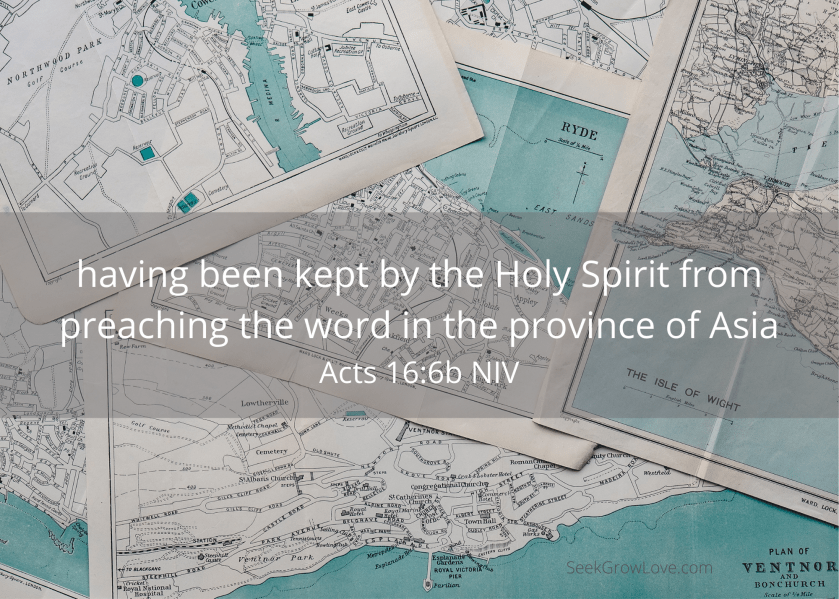
There are a lot of closed and closing doors in Acts 16. Paul and his companions (including Silas and Timothy at this point) were at the beginning of Paul’s second missionary journey. It is helpful to look at a map as you read Acts 16:6-10 to see what is really going on with Paul’s travel plans. (I also found William Schlegel’s Satellite Bible Atlas handy). Verse 6 says the Holy Spirit kept them from preaching the word in the province (not continent) of Asia. This indicates that they had wanted to, were planning on, and would have taken the gospel message to the province of Asia. That sounds like a very good thing! But, Asia became a closed door – because of the Holy Spirit. The map shows that the province of Asia would have been to their west as they were traveling. The very next verse says that at the border of Mysia (indicating that they did indeed continue traveling after their first way was blocked), “they tried to enter Bithynia, but the Spirit of Jesus would not allow them to” (Acts 16:7 NIV). Bithynia would be to their east. Closed door, again! Can’t go west, then, further down the road they can’t go east.

It would be interesting to know what these closed doors looked like. Maybe government red tape and passport issues that prevented travel to certain areas. Maybe a prophecy or just plain “bad feeling” about proceeding in the intended direction. Maybe advice from others regarding weather or disasters or unrest ahead. Maybe we will know one day what their closed doors were. Probably you can see what your closed doors are. What has kept you from the day, the trip or the life you envisioned? Maybe you have become discouraged because of all the things you were planning on doing, that aren’t working out right now as you had planned. If so, keep reading Acts.

It’s easy to ask, “What’s up, God? Don’t you want these on-fire evangelists to carry your word to the world?” How many closed doors are we supposed to come across and still keep going? It is so easy to let road blocks and closed doors defeat us, but Paul kept traveling, wherever he could. Can’t go to Asia, can’t go to Bithynia, let’s try heading to Troas. He was rewarded with a vision of a man from Macedonia calling out for help. The Bible tells us, when Paul received the vision, “We got ready at once to leave for Macedonia, concluding that God had called us to preach the gospel to them.”

So off to Macedonia they went. And what adventures – and lots of open doors – awaited them in Macedonia! There were new churches and hearts God was preparing in Philippi and Thessalonica and Berea (all cities of Macedonia). But God had planned that they would hear the message from Paul and his companions. He just needed to get Paul to them. If God had allowed Paul to enter Asia or Bithynia when they had wanted to, Lydia and the Philippian jailer and so many others would have been left waiting.

God’s plans were better than Paul’s . God’s plans are better than ours. His open doors are the best. His closed doors are closed for a reason – and that is okay – even good – even when it pinches a bit or throws us to the ground for a spell. Get up and try another door. Keep traveling and testing doors. The one He wants you to go through will indeed open. And behind THAT door are adventures and blessings that He has prepared for you – and people that He has prepared for you to carry the good news to. Don’t miss out on finding the open doors because you are sulking at the closed ones.

(Note on Holy Spirit and the Spirit of Jesus: both of these spirits were blocking Paul’s way at different times. I think it is not saying these are the same – but they did have the same purpose which was to get Paul to where God wanted him by keeping Paul from going other places, at least for now (later he would travel to Asia and work with the people who God had prepared at that time). Just as God and His Son are two side by side in heaven right now, they are active in the same spiritual battle for saving lives by sending their spirits to guide, empower, and close and open doors. It’s kind of like getting two superheroes on your side instead of just one.)

-Marcia Railton

Reflection Questions:

  1. Do you sometimes tell yourself that your plans are better than God’s? How can you trust Him more?
  2. What doors have been closed that you were anticipating traveling through? How did you handle it?
  3. What doors have been opened that you hadn’t been anticipating or planning? What blessings would you have missed out on if you had taken the closed door route instead?

Peter Saved!

Old Testament: Leviticus 16 & 17

Poetry: Psalm 39

New Testament: Acts 12

You know that feeling when things are going so well that you question if you’re dreaming? Maybe you ask someone nearby to pinch you or maybe you pinch yourself. Either way, this is the feeling I imagine Peter had the night before Herod was going to bring Peter to trial. I’d encourage you to listen to Acts 12. As you listen, visualize what this could have looked like. Go ahead and use a little bit of imagination, as we’re not given pictures to accompany the stories in the Bible. If I’m being honest, I sometimes forget that the Bible is a literary text, but this chapter allows me to pick out some details and things that make me consider the (historical) story, and smile.

I’ll mention a couple parts that I really like about this chapter, but other parts might jump out at you.

v. 7 – Peter must’ve been a heavy sleeper! First the angel appeared, with a light. That didn’t wake Peter, so the angel struck (or smote) him. A gentle, “Hey Peter, time to wake up” with a rub on the shoulder didn’t cut it…

v. 9 – Peter didn’t know what was happening. He thought it was a vision. I like how he follows the angel’s instructions though. I think this is a good example for us to follow. Even when we may be a little confused about what God wants us to do, we should still obey and follow through with whatever it is.

v. 11 – “Now I know without a doubt”. I like how confident Peter is at this point. Before he thought it could be a vision. Now he knows that this is real life, and this is all part of God’s plan.

v.14-16 – I understand Rhoda was excited, but it makes me giggle how she didn’t even open the door for Peter. She was so excited that Peter had to keep knocking! 🙂

I like this chapter a lot. I will be working at being confident while following God’s plan for me and I will work at being as excited as Rhoda about what God is doing in my (and others’) lives!

-Moriah Railton

(reposted from SeekGrowLove – May 15, 2021)

Reflection Questions

  1. What do we learn about the early church in Acts 12? In what ways would you like your church to follow the example of the early church more?
  2. What do we learn about Peter in Acts 12? How do you think he could have been sleeping (chained between two guards) on the night before he would be brought to trial before Herod who had recently had James killed.
  3. What do we learn about Herod in Acts 12? What was the reason for his death? When have you been guilty of the same attitude?
  4. What do we learn about God in Acts 12 – remembering how Peter was saved and He handled Herod…but also, remembering that James was not saved. What is your response to God when He saves and when He crushes the wicked and when He doesn’t save the righteous?