Woe to the Complacent…

Amos 6-9

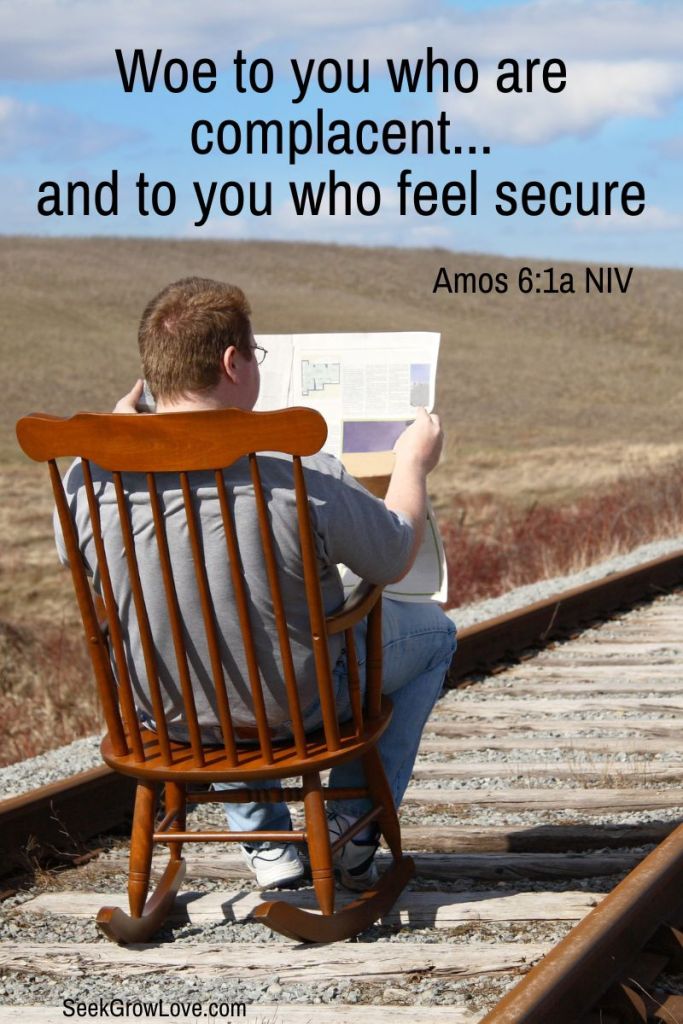
Today we are reading out of the third of the minor prophets, Amos. However, if the first three chapters make you feel a little uneasy: that’s entirely the point! Amos 6 starts with “Woe to you who are complacent in Zion,

    and to you who feel secure on Mount Samaria,

you notable men of the foremost nation,

    to whom the people of Israel come!”

Amos is speaking on behalf of God to the people of Israel in a time of prosperity. However, in a time of complacency, the people of Israel have once again allowed for themselves to become spiritually corrupt. They “lie on beds adorned with ivory,” and “lounge on (your) couches,” but they “will be among the first to go into exile.” (Amos 6:4-7). This is because they “do not grieve over the ruin of Joseph.” Because the people of Israel have become so complacent and uncaring of those in need lest it take away from their pleasure, God seeks to divide and destroy the nation as it currently stands. 

Amos 7-8 essentially goes into vivid imagery of how Israel’s destruction will be met. First, the locusts. However, Amos convinces God to relent to an impending famine. Then, the fire. However, yet again Amos convinces God not to destroy the land. Then, God showed Amos a vision of him holding a plumb line, which is a device used to measure the straightness of a vertical drop. However, when God was “setting a plumb line among my people Israel,” he was measuring their righteousness to his standard. And for this, he must judge them and divide them. 

Surely this should serve as a MASSIVE wakeup call for Israel. Unfortunately, the priest of Bethel (Amaziah) was not wanting Amos to prophesy against Israel in the city of the king. That didn’t end too well for him. Read Amos 7:17 for more on that. Ouch.

We must use this time when Israel was judged as a reflection on our own lives. What does it mean to be complacent? Does God despise complacency? Is it not okay to be comfortable? Although it almost certainly looks to be that way, I would argue that the grave mistake that Israel was making was their complete ignorance of righteousness and their spiritual lives. Are we more concerned with our personal comfort than with the brokenness around us? Do we avoid lamenting over sin and injustice because it disrupts our peace? Although we must always strive for times of peace, we must be aware of our own sin and also make active attempts to comfort those around us who are not at peace. 

Furthermore, God says that a famine will fall upon Israel after all. However, it’s a little different than the usual famine. It’s “Not a famine of bread… but of hearing the words of the LORD” (Amos 8:11). Are we listening for God’s voice or have we tuned Him out in our own prosperity and ignorance? The greatest famine we could ever face is not material, but spiritual when we no longer hunger for God’s Word or even notice when it’s absent. With that said, we must heed the words of Amos and continue to hunger and thirst for the righteousness that God offers us through his words. 

Although most of this sounds like a dire warning and a time for lamenting to come, we actually don’t get to end off our devotion with a bad note! As God promises in Amos 9 that there will be a restoration. “The days are coming… when the reaper will be overtaken by the plowman and the planter by the one treading grapes. New wine will drip from the mountains and flow from all the hills, and I will bring my people Israel back from exile” (Amos 9:13-14). Therefore, if we apply this message to our own spiritual journey, we can know that even if we are burdened by the weight of our own complacency and sin, that it is not too late to act. There is hope for our own restoration, just as God promised that there will be a restoration for the people of Israel. 

-Colby Leggitt

Discussion Questions: 

  1. Where in my life have I grown complacent or overly comfortable?
  2. What injustices am I ignoring or avoiding?
  3. Am I listening for God’s Word daily or has it become background noise?
  4. How can I live today with urgency for hope in restoration through repentance?

Not-So-Famous Amos

Amos 1-5

I love a good chocolate chip cookie! I can’t say that vending machine cookies are my favorite thing, but if I need a sugar fix, a bag of Famous Amos cookies can do the trick. However, today’s devotion and scripture contain no chocolate chip cookies (unless you would like to eat one while you’re reading).

I can’t think of any songs or poems proclaiming Amos’ greatness. He wasn’t a king, a priest, or in any elevated position. Amos 1:1 says that this not-so-famous Amos was “Among the sheepherders from Tekoa.” Even the place he was from isn’t famous to our modern-day ears. (I had to cheat a little bit to find out more about Amos by going to chapter 7). In Amos 7:14, he says, “I am not a prophet, nor am I the son of a prophet; for I am a herdsman and a grower of sycamore figs.” He didn’t speak out so he would gain fame. He spoke out because God called him to.

Once again, God shows us that he can use anyone from any background as a vessel for His word. Amos had powerful things to say, and He was willing to be God’s vessel. Some of his writings might be a little bit difficult to read and understand without knowing about the events of his day so if you need a Cliff Notes version to help you gain clarity, I recommend this video from The Bible Project.

Remember, it doesn’t matter what your age, gender, race, or education is. It doesn’t matter if you’ve been raised in the church or are just starting on your Christian journey. God can use you to further His Kingdom and share his love!

-Lacey Dunn

Reflection:

• What gifts or talents has God given you that you can use for furthering His Kingdom?

• What is one way that someone else has shared God’s word with you? What made it effective, and how can you effectively share God’s word with someone else?

Posts and Planes

Old Testament: Amos 7-9

Poetry: Psalm 74

New Testament: Luke 14:1-14

“This is what he showed me: The Lord was standing by a wall that had been built true to plumb, with a plumb line in his hand. And the LORD asked me, “What do you see, Amos?” “A plumb line,” I replied. Then the Lord said, “Look, I am setting a plumb line among my people Israel; I will spare them no longer.” Amos 7:7-8

 Three summers ago, I took on the task of building 300 or so feet of fence in my backyard to enclose the wandering space of two quickening toddlers.  I am far from a carpenter by trade, so in every way, it took me significantly more time to get the job done; however, I was committed to doing it right, building something that had some staying value. It was my Great Wall.  After doing some YouTube research, I knew even the smallest deviation, a single degree to the left or right on a plane, could have pretty severe consequences.   If you can’t imagine the measurements of fence posts, an example more relevant might be one drawn from James Clear in Atomic Habits.  He asks his reader to imagine an airplane taking off from California destined for New York. Just after takeoff, the heading is adjusted by the smallest degree shift.  This unnoticeable change, if never corrected, will have you arriving in Florida, not New York, roughly 1000 miles away from your destination.

Whether it is posts or planes, we can see that God is using a measure for Israel and us, that is making sure that we are vertically aligned with Him.  Amos alludes to the scattering of Israel and a final judgment at the return of Jesus. Unchecked cultural allowances passed from generation to generation compound their effect and become paradigm shifts.  While Israel was at the height of its economic and political power, seemingly built on a great foundation of previous generations, small allowances and leanings away from God, moves Israel away from God’s chosen, eventually leading to their conquered and scattered status in the 1st century.

Additionally, at the beginning of Luke 14, Jesus reminds us of the measure we should use. The Pharisees took great pride in regularly measuring themselves to a standard.  Unfortunately, the rules they followed were often legalistic, self-imposed, and focused solely on their status with one another. Taking seats of honor, refusing to help on the Sabbath, and blessing only those who can repay you are incorrect measures that can skew the outcome of your vertical alignment more quickly than one or two poles being out of line.  Jesus gave them the measure, “but when you give a banquet, invite the poor, the crippled, the lame, the blind.” Alignment with God means blessing those who cannot return the favor.  Simply put, this is the Father’s love shown through Jesus Christ paying a debt we could never repay.


So how do we combat these leanings that will make our defenses weak? First, we are encouraged to regularly check our progress or face being cut out of the plan of God.  Here’s a quick check-in: the average American takes in 100,000 words a day through conversation and content. Reading a Bible study like this is 2,000 of those, solely if you stick to the plan and stay away from devotional.  Over the course of a year, not reading a daily Bible plan misaligns you by 800,000 words, roughly 8 full days within a year without God’s presence.  This is only a single, simple action, which does meet the requirements of the plumb line alone in isolation. Giving up a hundred words here and there may seem harmless, but they add up, and could place us far from our destination in a matter of months. 

Start today with something small to plumb. Pray for patience over your first cup of coffee.  Offer a line or two of a worship chorus when you hear the rain. Thank God aloud whenever you arrive home safely. If we check in with this single task daily, how much more aligned would our life be to Christ’s in a few months?  We cannot spare any more time without God’s presence beckoning the standard in Christ and shoring up our shortcomings. Daily measure against God’s standard and build your life with eternal value.

Reflection Questions

  1. What steps do you want to take to be well aligned with God? What practices and habits do you need to remove and replace because they are pulling you away from proper alignment?
  2. How does being just a few degrees off over time take you where you do not want to go?
  3. What does God’s standard look like? How can we follow it more closely?

A God of Justice

Old Testament: Amos 5 & 6

Poetry: Psalm 73

New Testament: Luke 13:10-35

Justice is a solid theme throughout the book of Amos. Through the prophet Amos, God is pronouncing judgement upon Israel and neighboring nations. He first announces why said nation is being punished, and then warns of the coming consequences. It stood out to me how God cast judgment upon the same nations he would also be defending. For example, in Amos 1:12, the people of Edom are to be punished for crimes committed against Israelites. In 2:1, Moabites are punished for having desecrated the bones of Edom’s king. In later chapters, Israel is being punished for idolatry. God’s justice reigns. 

Whether a group was victimized or guilty, God did not let wrongs go unnoticed. 

God is a God of compassion and mercy, but he is also just. It can be difficult for us to fully comprehend how these attributes coexist, but that is because we are understanding these concepts in mere human terms. To simply put, God has a God brain, and we, with our human brain, will never be able to fully understand how God works through both grace and justice. Fortunately, we don’t need to know the how in order to believe He does. 

Everyone experiences injustice in their lives. Whether large scale injustice like racism or sexism, to smaller personal injustices within relationships and friend groups. No matter the severity, God is aware of them all. It is the smaller injustices I want to address, today. 

When our feelings are hurt, when lies or gossip has been spread about us, when we are betrayed by people we trust, we feel robbed and empty. We want someone to hear our side of the story. If we’re honest with ourselves, we really aren’t looking for God to rain down fire upon the guilty individual(s). Usually, all we really want is an apology. But there are some situations in which we will never get this. This can hurt, so deeply. I know. I’m in a situation like that now. 

If you’re like me, dealing with a relational injustice, you probably aren’t wishing terrible horrible judgment upon said person. You are probably just wanting closure or a chance to be heard. Take comfort in today’s reading. God is a God of justice, one who rights wrongs. While I may never get the respect I deserve, or the chance to rewrite the narrative believed about me, God knows, and God sees. In these cases, punishment need not necessarily occur in order for us to feel justified. The fact the LORD knows and sees can be justice enough.

~ Emilee Ross

(originally posted July 10, 2020 for SeekGrowLove)

Reflection Questions

  1. Amos 6:12 says: “But you have turned justice into poison and the fruit of righteousness into bitterness”. What might this look like?
  2. Justice is important to God. How does He show justice?
  3. How can you work to establish justice?

Come Back

Amos 5

Sunday, November 6, 2022

For the last three years I have been in the retail industry. Working with the public, you are exposed to a wide variety of people. Ever heard of people watching? That’s when you literally just observe people for fun, whether at a shop or restaurant, because the state of our society can be so entertaining. However, it can be disheartening to a Christian. The way people talk and conduct themselves, and especially the way people treat each other, is really hard to watch. Let’s look at today’s scripture.

In Amos 5 we are greeted by a funeral song. Now, music has always been a huge part of my life. From Frank Sinatra to Dr. Dre, my appreciation of music is quite eclectic. Imagine my joy when I hear the chapter I get to write about is Amos 5! It reads, “ ‘The virgin Israel has fallen, never to rise again! She lies abandoned on the ground, with no one to help her up.’ The Sovereign Lord says: ‘When a city sends a thousand men to battle, only a hundred will return. When a town sends a hundred, only ten will come back alive.’ ” This is a warning from the prophet Amos to the people of Israel to provide another chance before facing the judgment of God. The sin they needed to repent from in this case was idolatry, and the imagery of the men dying in battle was to foreshadow the eventual tool God had planned to use to remove this sin, an invasion at the hands of the Babylonian empire. 

In verse 4 it reads, “Now this is what the Lord says to the family of Israel: ‘Come back to me and live!’ ” And that’s the amazing thing about the grace of God, is that’s all it takes. If the Israelites had simply put their false gods aside, they would have not (eventually) been punished.

Let’s pull it all together. You hear all the time from people that modern times are “so awful” and “that nothing like this has ever happened”. But that is plainly false! The sins of man have always been abhorrent, but “God is not a man, that He should lie, Nor a son of man, that He should repent…” (Numbers 23:19, NASB 1995), that means that when God said “Come to me and live” he MEANT that and will ALWAYS mean that.

-John Evans

Reflection Questions

  1. Read Amos 5 and list all the things God saw the Israelites doing that He was warning them against continuing. Also list what God wanted them to do instead. Which of these actions and attitudes do you see today in society? In God’s church? In yourself?
  2. What warning do we need today?
  3. What does it look like to Come Back to God? How will you Come Back to Him? How will you help another to Come Back to Him?

Mercy

Amos 7-9

When you think of judgment, what comes to mind? Maybe you think of a judge, sentencing a convict. Maybe you think of punishment. The minor prophets have a lot to say about “judgment” against Israel. First, we need to understand why God has so much to say to Israel before we can understand God’s judgments against Israel.

In Deuteronomy 30, God is covenanting with the people of Israel. A covenant is not like today’s modern-day transactional relationships, like an employee and client relationship. Rather, a covenant is a binding union between two parties. It can have conditions or strings attached, but the point is that a covenant is not fickle or nonchalant. It’s intimate and binding. Marriage is a form of a covenant: there are expectations (or vows) between the two parties, and it is an irrevocable binding of two parties. In Deuteronomy 30:15-16, Moses says “See, I set before you today life and prosperity, death and destruction. For I command you today to love the LORD your God, to walk in obedience to him, and to keep his commands, decrees, and laws; then you will live and increase, and the LORD your God will bless you in the land you are entering to possess.”   

This is a covenant. You may remember yesterday, in Amos 5, God said “Seek the LORD that you may live.” In other words, life is ONLY found in devotion to God. So what happens when God’s covenant partner utterly forsakes the agreement? We find our answer in Amos 7-9.

This passage can be hard to understand. It’s rife with visions. In chapter 7, God shows a series of images depicting total destruction–this is what Israel deserves– but He promises mercy instead (see 7:3,6). Chapter 8 describes horrific famines that affect even the strongest men and women in the land. But in chapter 9:11-15, after these fearsome images of judgment and punishment, God says something the reader might not expect. God says that He’s going to restore Israel, build it up, and make them prosper. He’s going to pick them back up, dust them off, and help them to be the nation He designed them to be. In other words, God is keeping His end of the covenant, no matter what.

Amos shows us an image of judgment (in fact, most of the minor prophets do). However, even moreso, Amos shows us that God is loyal in spite of our sin, merciful in the face of our sin, and blesses us when we don’t deserve it. He is so good! Praise God! 

-Levi Salyers

Read or listen to today’s Bible reading passages at BibleGateway.com here – Amos 7-9 and Revelation 4

Seek the LORD and Live

Amos 5-6

Amos. A prophet to Israel in a difficult time. Amos introduces himself as a mere shepherd rather than as a prophet–and God still used him to deliver a mighty message to His people. His words still ring loud for us today:

Seek me and live. (Amos 5:4b)

Every culture, every civilization, and every era of history has given false promises about where to find life to the full.

Seek the LORD and live (Amos 5:6).

God uses Amos to tell His people over and over again: life is only found in Him.

The God who made the stars, brings each passing day and night, and moves each and every tide of the ocean waves– the LORD is his name! (Amos 5:8).

We have a great God, who is glorious and mighty beyond comparison. He is a beacon of goodness, and if we seek him, we can pass that onto others. A major theme of Amos is a call to pursue justice and righteousness.  Verse 14 says “seek good, not evil, that you may live.”

What does the LORD require of us? Church traditions?  Heartless obedience? Quite the opposite. God tells us in verses 22-23 that the sacrifices, songs, and festivals mean nothing without– you guessed it– justice and righteousness. Treat your neighbors justly, and live rightly.

How do we know what justice and righteousness even look like? Where do we go? 

Seek the LORD, that we may live!

-Levi Salyers

Read or listen to today’s Bible reading plan passages at BibleGateway.com here – Amos 5-6 and Revelation 3

Feeling Unqualified?

Amos 7-9

amos 7.png

Saturday, April 15

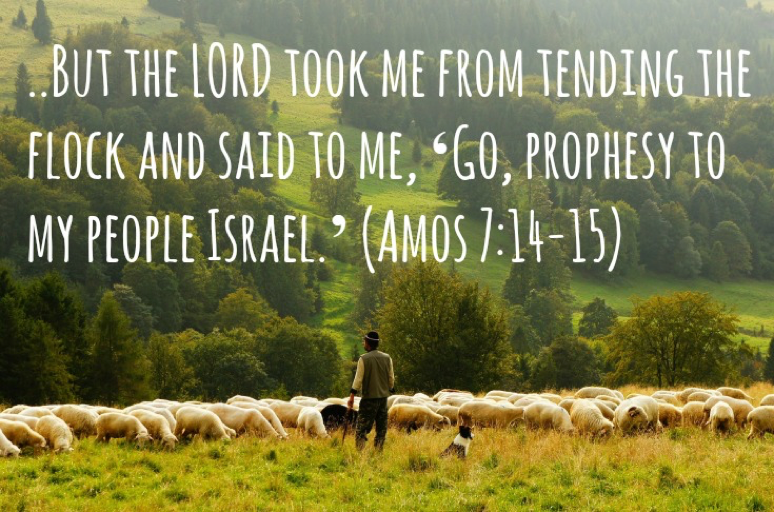
“I was neither a prophet nor the son of a prophet, but I was a shepherd, and I also took care of sycamore-fig trees.  But the Lord took me from tending the flock and said to me, ‘Go, prophesy to my people Israel.’ (Amos 7:14-15)


God specializes in using ordinary people. Amos was the first prophet after the kingdom of Israel was divided by Jeroboam, preceding even Isaiah and Hosea.

Amos was just a shepherd (and a tree-tender).  He was hardly qualified to speak on behalf of the God of the universe.  But God had a job for him.  I think sometimes God calls those who seem ‘unqualified’ to do the most amazing work for him for three reasons.

  • They will give all the credit to Him.
  • They won’t question Him, assuming they know a better way.
  • They speak the language of the people and won’t talk over their heads.

Amaziah was the priest who should have been speaking God’s words.  He was the one “qualified” to be God’s prophet.  But when Amos goes to him, here’s what happens:

Amaziah says,

  ‘Do not prophesy against Israel,
    and stop preaching against the descendants of Isaac.’

Amos replies,

This is what the Lord says:

“Your wife will become a prostitute in the city,
    and your sons and daughters will fall by the sword.
Your land will be measured and divided up,
    and you yourself will die in a pagan country.
And Israel will surely go into exile,
    away from their native land.”


Did you get that?  The priest-boss says “Hey, knock it off. Quit saying bad stuff is going to happen” (Isn’t that a pretty common thing in the prophets?  People telling them to stop saying bad stuff was going to happen).  And Amos is like, “God says you’re all gonna die.  Mic drop.”


(Don’t think I don’t know that I’m too old and un-cool to use that phrase. But it fit, right?)


So whether you think you are qualified or not, keep your ears open for God’s call and your eyes open for His opportunity to speak truth and serve.


He’s got something for you!


-Susan Landry


Because He Loves

Amos 4-6

amos 4

Friday, April 14

Words I hope I never hear from God:   “…yet you have not returned to me.”

“I gave you empty stomachs in every city
    and lack of bread in every town,
    yet you have not returned to me,”
declares the Lord.

“I also withheld rain from you
    when the harvest was still three months away.
I sent rain on one town,
    but withheld it from another.
One field had rain;
    another had none and dried up.

People staggered from town to town for water
    but did not get enough to drink,
    yet you have not returned to me,”
declares the Lord.

“Many times I struck your gardens and vineyards,
    destroying them with blight and mildew.
Locusts devoured your fig and olive trees,
    yet you have not returned to me,”
declares the Lord.

“I sent plagues among you
    as I did to Egypt.
I killed your young men with the sword,
    along with your captured horses.
I filled your nostrils with the stench of your camps,
    yet you have not returned to me,”
declares the Lord.

“I overthrew some of you
    as I overthrew Sodom and Gomorrah.
You were like a burning stick snatched from the fire,
    yet you have not returned to me,”  (Amos 4:6-11)


All children are different, you know.  Some are brought to repentance with simply a stern look.  Others, you could beat them with a stick (not that you would, of course) and they would still dig their heels in.


I remember a mother in my Women’s Bible Study years ago pray every single week for wisdom for herself and her husband to be able to mold their daughter’s strong spirit into a passion for God instead of a selfish passion.  She prayed for this child to grow to be a force to be reckoned with on behalf of God’s Kingdom.  And you know what, that is exactly what happened.


I feel like that’s what we’re seeing in this passage.  Each stanza is a punishment.

I gave you empty stomachs … stern look

I withheld rain … time out

I sent plagues … swat

…you get the picture.


Yet time and again, they stubbornly ignore and refuse to return to God and obey.


As we learned yesterday, God disciplines us because he loves us.  Keep your eyes open today for God’s discipline in your life.  What is He doing to get our attention and call you back to Him?  Pray that when you see His discipline, that you have the courage to act on it.  And you will become a force to be reckoned with for His Kingdom.

-Susan Landry


Goody-Two-Shoes Gets It, Too

Amos 1-3

susan amos.png

Thursday, April 13

In a couple of days, we’ll dig in to just who Amos was and why he was writing.  But as we start reading his book, I’m wondering if the same thing that stood out to me also stands out to you.

The book begins with God giving Amos a list of places He’s about to bring judgement on.  My Bible labels this section “Judgement on Israel’s Neighbors”.  He goes through Damascus, Gaza, Tyre, Edom, Ammon, Moab..and so on.

This scene reminds me of being in a class where the teacher is scolding some students for misbehavior.  The goody-two-shoes in the class is sitting there watching it unfold with a smug look on her face, watching her classmates get taken down a notch.  That’s Israel.

But then the teacher turns and points at her.  Miss Perfect herself.

Midway through chapter 2 we see God turn to Israel.  And through the end of chapter 3 He is telling her what for.

Interestingly, He says this:

“You only have I chosen
    of all the families of the earth;
therefore I will punish you
    for all your sins.”

That sounds contradictory, doesn’t it?  I’ve chosen you therefore I will punish you?

It reminds me of Hebrews 12 where we’re told that God disciplines those He loves.  Proverbs 3:12 speaks the same wisdom.

Come back tomorrow to see what else God has to say as he disciplines His chosen Israel.

-Susan Landry