Producing Endurance

Old Testament: Jeremiah Intro – found below

Poetry: Proverbs 3

New Testament: James 1

(James is the only book we are reading twice, back-to-back. What can you find in a second reading of this short but wise letter?)

“Count it all joy, my brethren, when you meet various trials, knowing that the testing of your faith produces endurance.” — James 1:2–3

The testing of your faith through trials produces endurance. What is the opposite of endurance? Well, I suppose the opposite of “endurance” is “giving up”. When faith doesn’t endure it peters out. So if you don’t want your faith to peter out then you need some trials. Because James says it is trials that “produce endurance.”

Few experiences expose who we are like the experience of suffering. When trials come, we almost cannot help but hold out our heart for all to see.

Some sufferers bow their heads and give glory to God, while others curse him. Some say, through tears, “I trust you,” while others refuse to pray. Some collapse into God’s presence, and learn to love him with a broken heart, while others turn their backs and walk away.

What makes the difference between these sufferers? Dozens of factors, of course. But one of the most significant is what we know about suffering. The apostle James, writing to Christians beaten up by trials, calls them to suffer faithfully because of what they know: “Consider it all joy, my brothers, when you meet trials of various kinds, for you know . . .” (James 1:2–3).

Rejoice, James says, because you know something about suffering. And what did they know? They did not know many of the specific good God was working in their trials. They did not know why these trials should be happening now. Nor did they know how long their trials would last. But they did know a simple promise, filled with power: “. . . for you know that the testing of your faith produces steadfastness” (James 1:3).

Testing produces steadfastness. If these three words can sink their roots down into our souls, then we might meet our trials with the most radical response of all: joy.

If we know the promise that testing produces steadfastness, we may gain strength not only to endure our suffering, but to trace a line from our present pain to our future perseverance — and, wonder of wonders, to find ourselves counting even trials as joy (James 1:2).

Such joy will not be a simple joy. It will not be a fake smile or the motivation of a great speaker. It will instead be a complex joy, a joy mingled with tears and mixed with sorrow, all the way to the bottom (2 Corinthians 6:10). In other words, it will be an otherworldly joy, the kind that can only come from the man of sorrows himself. And being from him, it will one day return to him on the other side of our trials, “perfect and complete, lacking in nothing” (James 1:4).

In order to get there, we need to recognize our suffering for what it is: not ultimately a thief who steals our best years, nor a murderer who kills our greatest dreams, or a madman who wields his weapons at random. Our suffering is, rather, a servant from God, sent to make us strong and to use our word again. Steadfast.

-Andy Cisneros

Jeremiah Introduction

The book of Jeremiah was likely written by Baruch, Jeremiah’s scribe, as Jeremiah dictated it.  He prophesied against the people of Judah because of their wickedness – but nobody listened to his message.  Jeremiah prophesied during the rise of the Babylonian empire and the subsequent destruction of Jerusalem.  God commanded him to never marry and have children because God was going to send deadly diseases, sword, and famine.  Jeremiah ultimately was carried off to Egypt by fleeing Israelites, and likely died in Egypt.

Jeremiah didn’t have much choice in his profession, as we see in 1:4-5, “The word of the Lord came to me saying, Before I formed you in the womb, I knew you, before you were born I set you apart; I appointed you as a prophet to the nations.”

Jeremiah is called the “weeping prophet” because we see so much about his personal life and his sorrow.  4:19 is one of many examples, “Oh, my anguish, my anguish!  I writhe in pain.  Oh, the agony of my heart!  My heart pounds within me, I cannot keep silent.  For I have heard the sound of the trumpet; I have heard the battle cry.”

Jeremiah was very straightforward, whether talking with the rebellious people of Judah, as we see in 44:23, “Because you have burned incense and have sinned against the LORD and have not obeyed him or followed his law or his decrees or his stipulations, this disaster has come upon you, as you now see.”; or when talking with God, as we see in 12:1, “You are always righteous, LORD, when I bring a case before you.  Yet I would speak with you about your justice:  Why does the way of the wicked prosper?  Why do all the faithless live at ease?”

While most of the book of Jeremiah prophesied judgment, there are still many places (like Chapter 31) where God promised that He will make a new covenant with Israel.  31:34 says, “No longer will they teach their neighbor, or say to one another, “Know the Lord”, because they will all know me, from the least of them to the greatest declares the Lord.  For I will forgive their wickedness and will remember their sins no more.”

As you read Jeremiah, consider the sins of Judah and the judgment God poured out on them because of their sins.  And then consider the sins of our own society…  

-Steve Mattison
Part 2

Old Testament: Isaiah 65 & 66

Poetry: Proverbs 1 & 2

(Sorry, yesterday I missed that the month Of October we will be re-reading the book of Proverbs with one chapter every day- the 1st chapter on the 1st of Oct, the 2nd chapter on the 2nd, and so on…we will return to Psalms on Nov. 1)

New Testament: James 5

Today, we will continue with the devotion Andy started on James 4. Yesterday he wrote about considering the proper view of life. Here is today’s …

The right view of God. What is the right view of God that he teaches us to have in verse 15 of James 4? He tells us two very important things about God. One is contained in the words: “If the Lord wills, we will live.” And the other is contained in the words, “If the Lord wills, we will . . . do this or that.” How would you state the truth about God contained in each of those two sentences?

First, when he says, “If the Lord wills, we will live,” he teaches us that the duration of our lives is in the hands of God. Or: God governs how long we will live. Or: God is ultimately in control of life and death. We may not know how long our vapor-like life will linger in the air, but God knows because God decides how long we will live: “If the Lord wills we will live.” And James is saying: If this is a true view of life and God, then it should shape our mindset and shape our way of talking.

In Acts 18:21, Paul left Ephesus and said, “I will return to you again if God wills.” In 1 Corinthians 4:19 he writes, “I will come to you soon if the Lord wills.” For most of his life, he did not know if the next town might be his burial place. That was in the hands of God. And so are our lives. God will decide how long we live and when we die. James’ point is: that God means for that truth – that reality – to shape our mindset and our attitude and our words. He means for that truth to be known and spoken about. He means for it to be a part of the substance of our conversation. God means for a true view of himself to be known and believed and embraced and cherished and kept in mind and spoken of. “Instead you ought to say . . .”

Now, there is another truth about God in verse 15: When he says, “If God wills we will . . . do this or that,” he teaches us that the activities and accomplishments of our lives are in God’s hands. God governs what we accomplish. Not only are our lives in his hands, our success is in his hands. “Instead, you ought to say, ‘If the Lord wills, we will live and also do this or that.” “If the Lord wills . . . we will do this or that.” And if the Lord does not will, we will not do this or that. Whether we do this or that in all of our business is in the hands of God.

So what was wrong with what these people said in verse 13: “Come now, you who say, ‘Today or tomorrow we will go to such and such a city, and spend a year there and engage in business and make a profit'”? What’s wrong with that? What’s wrong is that it does not give expression to a true view of life or God. Specifically, it does not give expression to the truth that life is a vapor, and it does not give expression to the truth that God governs the length of our lives and the achievements of our lives.

Is there a deeper problem here than just the absence of true words and the presence of bad theology? Yes, there is, and James describes it in verse 16: “But as it is, you boast in your arrogance; all such boasting is evil.” The root problem is arrogance or pride, and the expression of that arrogance, he says, is “boasting.” And all they said was, “Today or tomorrow we will go to such and such a city, and spend a year there and engage in business and make a profit.” That’s all they said. And James calls it boasting and says it’s rooted in arrogance. I look very carefully to the bible as well as to my own life to see what real arrogance is. It is arrogant not to believe in the heart and confess with the lips that how long you live and what you accomplish are ultimately in the hands of God. How are you planning? With God on your mind or in your own thoughts and strength? My prayer for you is that you take a look at the plans you are making and consider God in all of them.

-Andy Cisneros

Reflection Questions

  1. Is it important to you to do your planning (and speaking of them) as James, and God, teach here in James 4? If so, how can you work at keeping God foremost in all of your planning? How can you share that with others when you speak of your plans?
  2. How often do you remember that your life is a vapor and your life and death and activities are in God’s hands? How does keeping that in mind affect your thoughts, words and plans?
  3. How are you sometimes guilty of pride and arrogant boasting? What is the remedy?

If the Lord Wills

OLD TESTAMENT READING: ISAIAH 63 & 64

POETRY READING: PSALM 90

NEW TESTAMENT READING: James 4

As we focus on James 4. We are going to look particularly at 4:13-16. Let’s walk through this text together, see the picture of God that is here, and how James says it should affect us. Who Is James addressing?

James 4:13, “Come now, you who say, ‘Today or tomorrow we will go to such and such a city, and spend a year there and engage in business and make a profit.'”

James is reprimanding some folks here – perhaps businessmen or merchants – but it is stated very broadly to include virtually anyone. Anyone who does what? Five things:

1.      They plan to set out on a trip today or tomorrow: “Today or tomorrow we will go . . .”

2.      They plan to arrive at a destination: “Today or tomorrow we will go to such and such a city.”

3.      They plan to spend a certain amount of time there: “Today or tomorrow we will go to such and such a city and spend a year there.”

4.      They plan to engage in business and carry through a plan of action while they are in that city: “Today or tomorrow we will go to such and such a city, spend a year there, and engage in business.”

5.      They plan for the business to have certain results: “Today or tomorrow we will go to such and such a city, spend a year there, and engage in business, and make a profit.”

What’s the problem here? Is this wrong? To plan and intend to go places and do things? No, not really. In verse 15 he is going to say it is legitimate to plan to do this or that. What’s wrong then if it’s not planning?

What’s wrong is that the plan that is made in verse 13 is made in the mind and spoken with the mouth (“Come now you who say . . .”) without taking a true view of life and God into account. Verse 14 talks about the true view of life that is not being considered, and verse 15 talks about the true view of God that is not being considered when they plan their business venture.

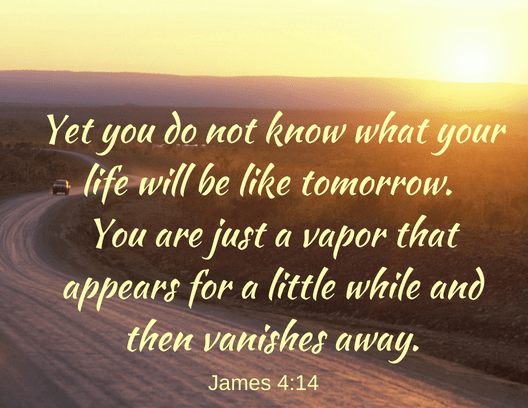
In verse 14, James says to those who are planning this business venture: “Yet you do not know what your life will be like tomorrow. You are just a vapor that appears for a little while and then vanishes away.” In other words, in all your planning and in all your talk about your planning (“Come now you who say . . .” verse 13) you are not taking this view of life into account.

My Life Is a Vapor. So What? So what is the point? The point is that for James, and for God, it matters whether a true view of life informs and shapes the way you think and how you speak about your plans. Your mindset matters. How you talk about your plans matters. Think about this. Believing that your life is a vapor may make no practical, bottom-line difference in whether you plan to do business in a place for one month or one year, or ten years. But, in James’ mind – and he speaks for God – it makes a difference how you think about it and talk about it. “Come now you who say . . .”

Why? Why does that matter? Because God created us not just to do things and go places with our bodies, but to have certain attitudes, convictions, and verbal descriptions that reflect the truth – a true view of life and God. God means for the truth about himself and about life to be known and felt and spoken as part of our reason for being. In other words, it not only matters that you have a right view of life when you make your plans – you are like a vapor – but it also matters that you have a right view of God as you make your plans. And that you give an expression of this true view of God: “You ought to say, ‘If the Lord wills, we will live and also do this or that.'” Look at some of the plans you have made and ask yourself today “Have I considered God”? We will finish James 4 tomorrow and answer the question “What is the right view of God?

-Andy Cisneros

Reflection Questions

  1. As Andy suggests, look at some of the plans you have made and ask yourself today “Have I considered God”?
  2. How does remembering that your life is a vapor affect your planning and how you speak about your planning?
  3. What does the phrase, “If the Lord wills” mean to you? Do you use the phrase? Do you have that mindset? How would it affect your hearers if you were to use it?

Formula

James 5

Wednesday, October 6, 2022

The last section of James 5 contains some wisdom about prayer and healing. Like most everything else we’ve encountered in James, it is simple, but not easy.

“Are any among you sick? They should call for the elders of the church and have them pray over them, anointing them with oil in the name of the Lord. The prayer of faith will save the sick, and the Lord will raise them up; and anyone who has committed sins will be forgiven. Therefore confess your sins to one another, and pray for one another, so that you may be healed. The prayer of the righteous is powerful and effective.” (James 5:14-16 NRSV)

God does heal, and when he does, we rejoice. We proclaim the wonders of how our good and faithful God answers prayer. But what about when the healing doesn’t come? In those times, there doesn’t seem to be much to rejoice about, and it isn’t as easy to truly believe that God is good or that he answers prayer.

When there is no healing, we want to know why. Did we mess something up? Did we not pray hard enough or with enough faith? Should we have gotten the elders to pray and anoint us with oil? Have our unconfessed sins gotten in the way? Were we not righteous enough for our prayers to be effective? Did we do everything right, but forces of evil sabotaged our prayers? Was it just not God’s will to heal? Is it not God’s timing to heal now?

There is no end to the questions we could ask about this, and to make things worse, there is a severe shortage of good answers. But, like in the book of Job, you can find lots of bad answers from people who mean well. I would just add to the bad but well-meaning category if I were to offer my own explanations.

Let’s get out of that rabbit hole for now and try to grasp James’ practical advice. We could zoom out and summarize it in two main pieces: Do your part, and ask God to do his. 

Doing your part might actually mean seeking out the elders to pray over you and anoint you with oil. It could mean confessing your sins and asking for forgiveness. It could mean going to see a doctor and following their advice. Your formula may not look exactly like James’, but the important part may be that you do something, or whatever it is that you are able to.

While we are doing our part, it is important that we ask God to do his part also (remember the importance of asking from James 4?). We’re not going to be able to do everything ourselves, so asking God initiates our cooperation with him. By asking, we’re acknowledging that God has real power in our lives and that we’re receptive to it. It’s not a we-do-everything or a God-does-everything scenario. It’s a cooperation that requires both sides. It is a James kind of faith that is coupled with action.

After doing your part and asking God for his, the way forward may be to wait, or to keep doing and asking, all while hoping for the best.

-Jay Laurent

Questions

1. What does your “formula” for healing look like? Is it anything like James’ formula?

2. How can you do your part for your own healing or for the healing of others?

The Right Friendship

James 4

Wednesday, October 5, 2022

Conflicts and violence are problems we humans have always dealt with. If only there were some insights in the book of James to help us understand why, and how we might be able to help the situation.

“Those conflicts and disputes among you, where do they come from? Do they not come from your cravings that are at war within you? You want something and do not have it; so you commit murder. And you covet something and cannot obtain it; so you engage in disputes and conflicts. You do not have, because you do not ask. You ask and do not receive, because you ask wrongly, in order to spend what you get on your pleasures.” (James 4:1-3 NRSV)

James says the source of conflict is the cravings at war within us. We covet things that we don’t have, and perceive that there isn’t enough to go around, leading us to take what we want by force, many times at the expense of others. We’re wired so deeply for survival that the fear of scarcity often drives us to get what we need in whatever way we can. It’s both a blessing and a curse. 

The passage goes a level deeper into the investigation and explores why we don’t have what we need: It’s because we don’t ask. That’s something I’m not good at. I often feel uncomfortable asking someone else for something, because I think it’s my own responsibility to take care of it. By not asking, I’m underutilizing one of the biggest strengths of being part of family and community. There is more than enough to go around if asking and sharing happen freely.

There’s another layer to this. Sometimes when we ask, we don’t receive because we ask with wrong or selfish motives. By chasing after the wrong things, we are fueling the fire of conflict. James is prompting us to take inventory of our desires and motives. It’s not wrong to need or want things, but the challenge is to seek the right things with a pure heart.

James continues his train of thought by contrasting “friendship with the world” and friendship with God. When we seek things with the wrong motives, we make ourselves friends of the world, and therefore enemies of God. Instead, make yourself a friend of God by humbling yourself and submitting to the leading of his spirit that lives within us. Set aside your selfish desires, as painful as that may be, and ask for truly good things.

James is offering us an antidote to conflicts and violence, advocating for a more peaceful way—partner with God (“draw near” to him) by properly aligning your desires. Seek after and ask for the right things, and have enough as you share in God’s abundance and grace.

-Jay Laurent

Questions to consider:

1. What are some things you need or want, but don’t have?

2. Do you think these needs/wants are because of selfish desires, or are they good things to seek after?

Wildfire

James 3

Tuesday, October 4, 2022

It can be a challenge to control what we say. James describes the tongue like a poisonous and evil beast we can’t tame. He says that it’s a fire that sets the whole cycle of nature ablaze. That’s a lot of power to ascribe to one small part of the body. How can it be so powerful?

James gives us two potent analogies for how this works. You can put a small bit in a horse’s mouth and be able to steer them wherever you want, and you can steer a large ship with a small rudder. It’s the same with the tongue. It’s a small part of the body, but it has great “steering power.”

Have you ever met someone who is just always a positive thinker? It’s equal parts encouraging and annoying how they can always manage to put a positive spin on things. On one side, it seems like they’re not acknowledging the reality of the situation, but on the other, they might have a deeper handle on reality. There is something I can learn from this kind of person. Thinking and saying positive things is like a small investment in those truths. It signals that we are aligned with them and committed to them, and when that is the case, we’ve paved the road for positive actions.

The same could be true for negative thoughts, words, and actions. If you’re putting your chips down on your dismal predictions, you want to be right. Sometimes we want to be right more than we want things to be right, so we can say, “See, I told you so.”

The influence of your tongue goes far beyond just yourself. Imagine you are having a conversation with someone you care about. Somewhere along the line, you start interpreting each other incorrectly (which happens all the time), and one or both of you gets triggered by what the other says. In such a moment, especially when you are angry, it is like all control of the tongue goes out the window. You are suddenly saying hurtful things that you are wishing you didn’t say—even before you finish saying them. The tongue takes over and starts steering the conversation into a fiery disagreement. This is real. You know it’s real because you’ve experienced it. This is the wildfire James is talking about.

For moments like those, it is appropriate to remember to be quick to listen, slow to speak, and slow to get angry (James 1:19). When my pastor, Michael Hoffman, talks about this verse, he says that is why God gave us two ears and only one mouth. If only this was something I could remember more in the moments that count. When you really put effort into hearing people, you take some of the destructive ammunition away from the tongue.

These days, we have quicker and easier ways to cause wildfire than James could ever imagine. I’m pointing at social media. The internet is an amazing innovation and it’s hard to imagine my life without it, but we were clearly not ready for it as a species. Now we are dealing with a beast more ferocious than just the tongue. Now anger, polarization, fear, disillusionment, disinformation, and pure stupidity can be spread across the world in just a short moment with a comment, tweet, post, video, or what-have-you. Those who see or hear it will likely not react or filter themselves as if they are interacting with a real human, and their response will reflect that. It’s a terrible feedback loop. To make it worse, there are algorithms lurking in the background making sure you see the things that are most likely to trigger you. If the tongue is a wildfire, social media is uncontrolled nuclear fission.

Somewhere around 10 years ago now, I realized that social media was not a healthy thing for me, for various reasons. I imagined what would happen if I just quit using it. So one day I quit, and I’ve never missed it. I’m not saying you should do the same, but if you ever find yourself burdened or distracted by it more than you know is healthy, consider it.

The things we say really do affect us. They ripple out and affect our families and friends. They touch our communities and influence our world in ways we don’t even comprehend. This is the reality that James recognizes and wants to warn us about. And given how fast and wide technology allows our communication to spread, that means we have an even higher level of responsibility for what we say.

-Jay Laurent

Questions:

1. When was the last time you started a wildfire with your words?

2. Are there any strategies you could use to help tame the beast that is your tongue?

The Faith/Works Dilemma

James 2

Monday, October 3, 2022

In the second chapter of his letter, James continues with his onslaught of practical but difficult advice.

“What good is it, my brothers and sisters, if you say you have faith but do not have works? Can faith save you? If a brother or sister is naked and lacks daily food, and one of you says to them, ‘Go in peace; keep warm and eat your fill,’ and yet you do not supply their bodily needs, what is the good of that? So faith by itself, if it has no works, is dead. But someone will say, ‘You have faith and I have works.’ Show me your faith apart from your works, and I by my works will show you my faith. You believe that God is one; you do well. Even the demons believe—and shudder.” (James 2:14-19 NRSV)

It would seem from this section that just believing things is no good. If my interpretation of James is correct, that means it’s not enough to go around quoting John 3:16 and telling people they only need to believe in Jesus and they will be saved. There is no checklist of beliefs where you can just tick all the boxes and receive salvation. No single belief will save you, and neither will any magical combination of beliefs.

James is asserting that action must accompany faith in order for it to be the real thing. Doing good works is the evidence of your faith. Faith and good works don’t live isolated lives, but are coupled together. To decouple faith and works is to reveal an inconsistency.

Imagine that someone claims to believe in the value of human life as the image of God, yet they go around hurting or killing people. Or maybe they just neglect to help someone else they know is in need. You would notice the inconsistency in that. They must not truly believe in the value of human life since their actions show they don’t value it. James is telling us that actions are louder than words. He cuts right through the nonsense and says, “Hey, don’t just tell me what you believe. Show me.”

When we talk about this passage, it’s likely that we’ll also think of a passage from Ephesians that seems to be in tension with it.

“For by grace you have been saved through faith, and this is not your own doing; it is the gift of God—not the result of works, so that no one may boast. For we are what he has made us, created in Christ Jesus for good works, which God prepared beforehand to be our way of life.” (Ephesians 2:8-10 NRSV)

Paul here is saying that works can’t save you; it’s a gift you accept through faith. James is saying faith alone doesn’t save or justify you; you need works too. Is there a conflict between what James and Paul are saying?

Part of the beauty of this collection of writings we call the Bible is that different authors often have different perspectives on things. We have four different gospel accounts, each with their own angle and emphasis. The general story and message are the same, but some of the finer details differ. This is exactly what you would expect if you asked four different people to describe something they witnessed years ago. This is not a problem at all for the gospels, and in actuality, bolsters the case for their authenticity. It shows that four people didn’t get together in a room for a weekend and collude to produce the exact same fairy tale. Four real people wanted to pass on what they witnessed, and they did so under the inspiration of God.

We see the world with two eyes, each from a slightly different angle. This allows us to perceive depth, in other words, to see things in 3-D. Your brain does some kind of trigonometry with the signals from your eyes to give you an idea of how far away something is. If you had only one eye, it would be much harder to judge depth.

We can regard James and Paul as two eyes looking at the topic of salvation from two different angles, and the result is seeing it in 3-D. It’s the same core truth with different emphases. James sees something Paul doesn’t see, and Paul sees something James doesn’t see. At great risk of oversimplification, I’ll try to bring their viewpoints together. They would agree that faith and works go hand-in-hand. James is saying faith alone is not enough, and Paul is saying works alone are not enough. Neither would say that you can earn salvation by works, but would agree that the works are evidence of a saving faith. Well, I took a stab at it. My only hope is that they can get together sometime to discuss this topic and release it as a long-form podcast.

-Jay Laurent

Question Time

1. Why do you think it is so hard to really live out what you believe?

2. What small steps could you take this week to put your faith in action?

The Long Game

James 1

Sunday, October 2, 2022

The letter of James has some of the most immediately practical wisdom you can find in the Bible. Some have called it the “Proverbs of the New Testament.” If you are looking for guidelines about how a Christian should live, James is a great place to start.

The only problem is that some of James’ advice is hard to take: 

“My brothers and sisters, whenever you face trials of any kind, consider it nothing but joy, because you know that the testing of your faith produces endurance; and let endurance have its full effect, so that you may be mature and complete, lacking in nothing.” (James 1:2-4 NRSV)

I don’t know about you, but when I’m going through difficult things in life, I’m not feeling joy. Isn’t joy supposed to be reserved for things that are… joyful? Isn’t joy for when people get married, or when babies are born, or when a new season of your favorite show is available to stream, or when you are going to have tacos? Yes, joy is for the good things in life.

So why does it sound like James is telling us to enjoy suffering? Is he insane?

Well, no. In order to understand what he is saying, we have to think of the long game. We’re not to be joyful because of the difficult times we are facing, but because of the growth potential they provide for us. Going through things teaches us to endure, and being able to endure makes us more mature and complete. Pressures shape us into stronger people. Recall that if you subject carbon to intense heat and pressure, you get diamonds!

Consider any elite athlete. They didn’t get where they are by accident, but through years of difficult and intense training. Do you think they truly enjoyed all of that training? Of course not, but I bet they did enjoy knowing that through their training, they were going to be the GOAT at their sport.

If you want your muscles to become stronger, you have to progressively challenge them. Likewise, when our faith is challenged, it also becomes stronger. James is asking us to take on the right attitude of joy during our times of discomfort, because we know that through those challenges, we are deepening and growing our faith.

In thinking about all these things, I’m reminded of the time Jesus was in the garden of Gethsemane, under unimaginable distress because he knew he would soon lose his life. Imminent death is the kind of thing that would test anyone’s faith, even Jesus. He didn’t want to go through with it any more than you’d want to drive a stake into your own eye socket. In his situation, I would have been tempted to just run away and wash my hands of the whole thing. I’d say to myself, “This whole messiah business has taken quite a turn and I just want a quiet life somewhere.” I can imagine he had that same temptation. Surely he didn’t enjoy being betrayed, put on trial, scourged, and nailed to a piece of wood to die in total humiliation.

Jesus didn’t have to do what he did, but he was thinking of the long game. Yes, he knew he would face a horrible death, but deep in his heart he had something resembling joy. Not joy because of the circumstances he was enduring, but because of what was just over the horizon. It was this joy and hope that allowed him to muster the strength to say with his dying breath, “It is finished.” He knew that his dying would mean, paradoxically, conquering over the powers of sin and death, and leading us on a mass exodus out of their clutches. He knew that his resurrection would unleash a new reign of God on the earth and again put us at one with God.

Jesus did what he did because he was thinking of us.

-Jay Laurent

A couple questions to reflect on:

1. What are some trials or difficult times that you have had to endure?

2. Can you think of any ways you grew as a result of these times?

Not Forsaken

Jeremiah 51 & 52

As a junior high teacher, there have been a couple of times when a student’s behavior warranted their removal from the classroom, even after multiple redirections and warnings. The school administrator would assign a consequence, such as on-campus suspension for one to three days, and then the student would return to reintegrate back into our class community.

While this scenario isn’t a perfect analogy to what we read in Jeremiah chapters 51 and 52, it has a few similarities.

Throughout generations, Israel had been warned over and over about what would be the consequences if they failed to be obedient to God’s decrees. And yet the kings over God’s people and the people themselves rebelled, they did evil in the eyes of the LORD. And God cannot tolerate sin. There had to be consequences. 

So God allowed Babylon to capture Israel. God allowed for His dwelling place, the temple built by Solomon, to be ransacked and destroyed. This was the consequence of decades of disobedience. 

But throughout this time, God never stopped loving His people. He longed to see them be restored. And so He made a way. The very kingdom that had caused destruction to Israel, would eventually face its own consequences and be brought down by its enemies. God’s people would be released from captivity. 

What we read in Jeremiah 51 and 52, describes what no doubt was a rough patch for Israel, to put it mildly. And it even foretells what it might be like during the time leading up to Christ’s second coming.

But we can also read it through the lens of how God must deal with us as individuals. Because He is the Holy One of Israel, there must be consequences to our sin. We are destined to be separated, exiled, from Him because our sin and His holiness cannot coexist. But God longs to be in a relationship with us. And so God provides for a way, through Jesus’ crucifixion and resurrection, for this relationship to be restored. So even though our lives are “full of guilt before the Holy One of Israel”, we will not be “forsaken by our God, the LORD Almighty”.

-Bethany Ligon

Today’s Bible reading passages can be read or listened to at BibleGateway.com here – Jeremiah 51-52 and James 4

Words, Works & Wisdom

James 3

The two prominent subjects in James 3 are the tongue and wisdom.  Though the tongue is a body part and wisdom is intangible Godly knowledge, James manages to successfully contrast their attributes for the reader.  And as we have seen in the previous chapters, he does not “sugar-coat” his words! 

James again uses word pictures to introduce us to this most necessary part of our body, “the tongue.”

“Now if we put the bits into the horses’ mouths so that they will obey us, we direct their whole body as well.” (verse 3)

The bit is an important part of a horse’s tack and controls the horse’s mouth.  The bit, bridle and reins work together to control the horse’s head for its rider.  The average bit size is 5 to 6 inches, quite small compared to a horse’s size. 

James continues with another word picture to “set the stage” for his coming discourse on the tongue. 

“Look at the ships too: though they are so large and are driven by strong winds, they are nevertheless directed by a very small rudder wherever the inclination of the pilot determines.”  (verse 4)

A rudder is a flat piece hinged vertically near the stern or rear of a boat and is used in the steering process.  But as James points out, compared to the large ship it directs, its size is incredibly small. 

  • Small bits control/direct—large horses
  • Small rudders control/direct—large ships
  • Small TONGUES control/direct large bodies—US!

“So also the tongue is a small part of the body, and yet it boasts of great things.  See how great a forest is set aflame by such a small fire! And the tongue is a fire, the very world of unrighteousness; the tongue is set among our body’s parts as that which defiles the whole body and sets on fire the course of our life, and is set on fire by hell. For every species of beasts and birds, of reptiles and creatures of the sea, is tamed and has been tamed by the human race. But no one among mankind can tame the tongue; it is a restless evil, full of deadly poison.” (verses 5-8)

Tell us how you really feel, James!  Oh, he did!

Our tongues can get us into so much trouble!  Remember, James told us in 1:19, let everyone be, “quick to hear, slow to speak.” Once we share that small bit of gossip, respond with rudeness, call out a mean-spirited comment, or answer in anger, the “fire” has started.  It quickly gains ground and can no longer be easily extinguished. 

Proverbs 12:27 says, “A worthless man digs up evil,
While his words are like scorching fire.” 

Think of the massive forest fires that have destroyed thousands of acres in the USA and Canada this past summer.  Think of the devastation of homes and property and the loss of human and animal life.  NOW, think of the lives wounded, ravaged, and ruined because of thoughtless words from tongues. 

 “With it we bless our Lord and Father, and with it we curse people, who have been made in the likeness of God; from the same mouth come both blessing and cursing. My brothers and sisters, these things should not be this way.” (verses 9-10)

What a humbling reprimand!

James finishes this serious warning with another word picture.  “Does a spring send out from the same opening both fresh and bitter water? Can a fig tree, my brothers andsisters, bear olives, or a vine bear figs? Nor can salt water produce fresh.”  (verses 11-12) James wants his readers to “see” the disparity of an uncontrolled tongue.

James’ discourse on the tongue, (“a world of unrighteousness”), contrasts with the wonderful wisdom from above, wisdom from our heavenly Father.   Worldly versus Heavenly.

“Who among you is wise and understanding? Let him show by his good behavior his deeds in the gentleness of wisdom” (verse 13)

Notice that if we have Godly wisdom, it will be evidenced in our daily lives—what we do, who we help, how we serve.  Don’t you love that James says our deeds should be done “in the GENTLENESS of wisdom?”  Softly, thoughtfully, kindly.

These WORKS contrast greatly from the “LIP service faith” of the tongue.  As James said in 2:17, “Even so faith, if it has no works, is dead, being by itself.”

Verses 14-16 tell us jealousy and selfish ambition have no place in our “works.”  If they live in our hearts, we don’t have true wisdom, but instead, “disorder and every evil thing.” 

What constitutes the wisdom from above?  “But the wisdom from above is first pure, then peace-loving, gentle, reasonable, full of mercy and good fruits, impartial and sincere.”  (verse 17)

When we have this wisdom described in detail by its eight desirable characteristics, the end result is peace—peace within ourselves, peace in our relationship with others. 

“Peacemakers who sow in peace reap a harvest of righteousness.” (verse 18)

Be wise and grow a Godly garden of goodness, living out your FAITH through your peaceful words and WORKS.   

-Paula Kirkpatrick

Today’s Bible reading passages can be read or listened to at BibleGateway.com here – Jeremiah 49-50 and James 3