I was blessed to bring you this part of Revelation because this chapter means so much to me.
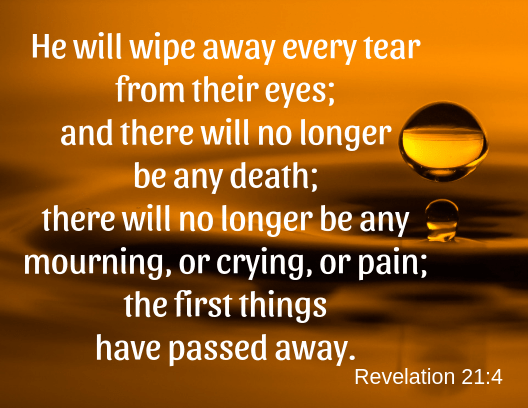
Go back to Revelation 21:3-4 and read it again. And again. And again.
I don’t want you to read another sentence of this devotion until you dwell on the glorious truth of Revelation 21:3-4.
God will be with us.
That’s the goal. I don’t mean the goal of Revelation. The goal of EVERYTHING, everything collectively and every thing individually, is to be connected to the God who created it, who sustains it, who loves it. Everything God did was so that he could be among those who accepted him, so he could be their God. He would have every right to sit in the middle of the city, demanding we come and bow to him and confess our sins and honor and adore him without his speaking to us.
But the old order of things has passed. He comes to us. Instead of an unreachable, untouchable King far away and distant, He walks up to us.
He walks up to you
He walks up to me
and He wipes away our tears.
Think of all the tears you’ve cried. I’ve cried so many. Relationships I’ve hurt. Trust I’ve broken. Loved ones who have been lost. Pain seen in the eyes of my wife and daughter.
God will not remain distant. He will walk up to me, and he will say “My Son, the old things are gone, the new have come. Cry no more.” God Himself, the creator of all things, will wipe away my tears.
God Himself will wipe away your tears.
God will be among us and be our God.
Everything else, the grand city, the streets of gold and the walls of precious stones, all these images of the glorified future, everything is icing on the cake. Without God it wouldn’t mean anything. Because God is there among us, it means everything.
My brothers and sisters, I can’t wait until your tears are wiped away. I can’t wait until the old is gone and the new has come.
May the Lord Jesus come quickly, prepare the way for his Father, and may God come and be our God.
Jake Ballard
(originally posted November 23, 2019 for SeekGrowLove)
Reflection Questions
What are your favorite verse(s) in Revelation 21? Why?
What OLD things are you looking forward to being gone? What NEW things are you looking forward to coming?
Because of this passage – what ought you to do today? Do you agree about the Goal of EVERYTHING? How often do you forget this goal? How can we do a better job of remembering it and living by it?
The title of this post is unassuming. Two words: a noun, the subject, and a verb in the future tense.
I am in the business of speaking, teaching, training, sermonizing. And sometimes (less often than I’d like to admit) I may have a sermon that God uses in spite of all my failures and faults. But if I were to have all the power of the greatest speakers, the powerful conviction of Billy Graham, the clarity and precision of Andy Stanley, the dedication of pastors from Martin Luther to Martin Luther King Jr. and beyond, more than a thousand eloquent sermons could not compare to the truth of the future of the world summed up in these two words.
God wins.
I don’t want to take away from that truth, but I do want to flesh it out a bit.
In the earlier parts of Revelation, the beheaded souls have been calling out from beyond the grave to the God who will give them justice (Rev. 6:9-11). God promised the victors that they would have reward upon reward (Rev. 2:7, 11, 17, 26-28; 3:5, 12, 21). When God wins, those who placed faith in God above even their own lives have the incredible promises. For time out of mind (1000 years) they will reign with Christ, they will not be hurt by the second death. While the language of two resurrections is not common in the rest of the NT*, the truth is that they are SO ASSURED of their salvation its as if they cannot possibly be brought to judgment. The joy of this resurrection is that we who are powerless, weak, poor, and oppressed will one day win, be victorious and live forever with God and his Christ, because God wins.
And Satan can’t win. The dragon’s wings are clipped, and the serpentine body is prepared for the flames. In this world, God has power to throw the serpent of old, the devil and Satan, and bind him for 1000 years. During that time, his temptation and power are cast down. In the end, the devil who deceived the world was thrown into the lake of fire and brimstone. This is a threat and a promise. Moreover, Satan KNOWS this is his end. The battle between God and Satan is not a cinematic, climactic masterpiece. There is no worry about who will win. Satan is not trying to win, because he can’t. He IS trying to make YOU LOSE, because that is a possibility. But God will help you overcome sin, fight temptation, and come through faithful. God can protect you from the defanged, declawed, clipped-wing dragon, because God wins.
In some sense, part of the glory of God, part of his winning, is allowing humans to choose their outcomes. God allows people to determine their final state. While we are only and forever able to be saved by the glory and grace of God, God both does not force his salvific will upon us and does not preclude us from choosing him. God gives people what they desire. The books are opened; the dead are judged. Christ is our hope (Col. 1:27), our peace (Eph. 2:14), our resurrection and life (John 11:25). If any person has rejected Christ, what have they done but rejected peace with God and people? Rejected hope of eternal life? Rejected the resurrection and the life? God gives them exactly what they demanded. God doesn’t put up with those who were rebellious against him in this life. Because…
God wins.
No ifs, ands, buts.
No amount of persuasive words will make it less true.
No force of hell can stop Him, not a dragon or an atheist.
The promise is true:
God wins.
– Jake Ballard.
* There are hints of two resurrections in the rest of the NT, but nowhere is it explicitly stated like here in the apocalyptic work of Revelation.
(originally posted Dec 5, 2022 for SeekGrowLove)
Reflection Questions
How significant is the phrase “God wins” to you? To elaborate, in what areas of your life are you losing? Temptation and sin? Suffering and pain? Anxiety, depression, stress? What would it mean for you to stop trying to fix it all yourself, and let God win, allowing him to be victorious where you haven’t been yourself?
In the ultimate sense, Satan is powerless. While we might be attacked, tormented, and tempted by evil today, that is not the way the world will be forever. How does it make you feel to know that all evil and wickedness are going to be overcome by the power of God? Will you allow God to protect you, so the battle is one-sided in your favor today?
There is no peace, hope, resurrection or life without Christ. Have you given him control of your life, allowing him to be your savior and lord?
At the start of Revelation 19 heaven rejoices over God’s actions regarding Babylon the great. Soon we hear about the coming of the marriage supper of the lamb, and John is informed that the bride is clothed in fine linen which “is the righteous acts of the saints” (v. 8). He is also told to write that those who are invited to the wedding supper are blessed. This feels a bit like when Jesus commented in 16:15 “I am coming like a thief,” drawing our attention forward to coming attractions rather than remaining in sequence with events.
The voice which spoke about the marriage supper came from God’s throne, and hearing it speak caused John to fall and want to offer worship. John is corrected for this and told that only God is to be worshipped (v. 10). But it seems like in this case he made an understandable error. Throughout Revelation voices come from a variety of exalted sources, among them angels, strong angels, mighty angels, an angel standing in the sun, the Temple, the altar, and the horns of the altar. For John it may have been like experiencing holy surround sound, never knowing where the next proclamation would emerge from. Maybe degrees of grandeur are indicated by who spoke from where, giving different impacts to their statements. It wasn’t always clear to John what the intention was.
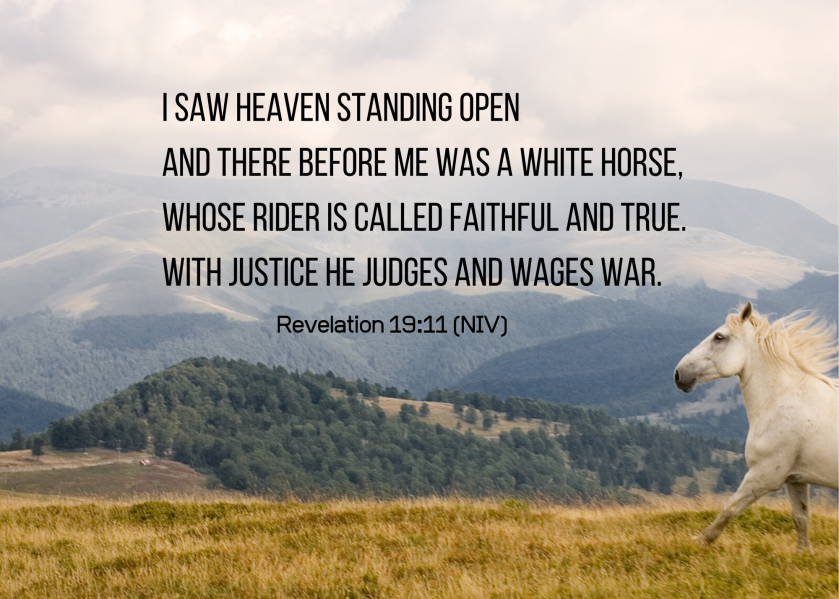
The message of the chapter proceeds, announcing the arrival of Christ, and of the armies of the world gathered for Armageddon. In fact, the word “Armageddon” is only named back in 16:16 where its origin is explained. Here the battle is previewed as “the great supper of God” – a supper for the birds, to eat the carrion it will provide, in contrast to the wedding supper of the lamb (v. 17‑18). With Jesus on the move there is no contest (2 Thessalonians 2:8). Jesus seems to be given credit for the entire victory: the gathered forces “were killed with the sword which came from the mouth of Him who sat on the horse.” That is, except for the beast and the false prophet. Those two are removed from the scene and dropped into the lake of fire, receiving their punishment for serving the dragon and for deceiving the nations.
The description of Christ includes having “a name written on Him which no one knows except Himself” (v. 12). Note that this mirrors part of Christ’s letter to the third church, Pergamum. There Christ said he would give overcomers a white stone with a new name written on it, which only the recipient would know (2:17). (That same letter identifies Christ with the sharp two-edged sword, shown in John’s opening vision sticking from Christ’s mouth, much as in chapter 19; 1:16; 2:12.) I like the idea of these names which are known only to oneself. I wonder if I am being fanciful in thinking this new name involves having a sense of your own identity. You won’t need to share that with anyone else. There will be no need to. There will no longer be self-doubt, rivalry, jealousy, any of the potential bitterness that plagues our current lives. It will be a wonderful time. I hope to see you then.
Lord, I look forward to the day when your kingdom has come on earth as you now reign in heaven. You have been waiting for a long time, allowing more people to be saved through the grace of your son. May your glory and your majesty be shown in my life while I wait for that day. Let me be empowered and enthused to perform righteous actions that will please you. Let me set my mind on the things of the Spirit, live as your humble servant, and exalt you. Let my light so shine before men that they will glorify you. Let me present my body as a living and holy sacrifice, acceptable to you. Renew my mind, so I may prove what your will is. Thank you, my God. In Jesus’ name I pray these things, Amen.
-Daniel Smead
(Originally posted November 15, 2023 for SeekGrowLove)
Reflection Questions
Do you ever think about the fact that it is our opportunity, and honor, to clothe the bride of Christ in righteous acts?
Who are some of the people you want to sit with at the wedding supper of the lamb? What do you think you will talk about there?
Chapter 7 is one of the passages in Revelation which can seem like it reverses or unworks what God had done before. God had called out a people for His own, setting Israel apart. Then God sent Jesus and brought up an upheaval in the relationship of God and humanity. The events of Pentecost launched the church, and while it took some time for Jews and Gentiles to be combined in one organization it can be a surprise for people to find Israel identified here again, and not just as a nation but with 12 tribes. But even in this context the tribes are set together with the peoples of the world, based on their common acceptance of God and the Lamb.
At the start of the chapter a period of calm is established. Perhaps this does not follow chronologically from the events that were described just before, we may be stepping away from that part of the vision to get another angle on things. We are told about four angels who have been authorized to bring destruction with the four winds of the world – from the four main directions – but for now the angels are keeping the winds still at the instruction of another angel holding the seal of God. In this time of calm that angel seals 144,000 people, 12,000 each from 12 tribes of Israel. This is a vision so perhaps the sealing process passed quickly, as can happen in a dream.
The identities of the tribes who were sealed create a small puzzle. We are used to reading of Joseph’s blessing being passed to his sons Manasseh and Ephraim (for the ‘half-tribes’), forming a set of 12 tribes only when Levi is excluded from the normal count. Levi gets excluded because Levi’s descendants gained a special role with God in the time of Moses and that was treated as their inheritance instead of land. But here Ephraim is excluded, and we have the “Tribe of Joseph” and the Tribe of Manasseh joining the Tribe of Levi. We lose Dan, the northernmost tribe, instead. Why? It might be because Ephraim’s name is so associated with the line of kings who brought idolatry to Israel, and that Dan was the tribe first associated with idolatry in the time of the judges (Judges 18:30-31). But we also have in Ezekiel 48:2 the prophecy that Dan will be in the kingdom and receive land, so there is something symbolic happening here rather than something permanent.
The larger point is that God continues to have a portion of people who are sealed for Him – God never gave up on Israel, never gave up the promises made to Abraham, Isaac, Jacob, David, etc. The results may not look like what people were expecting at different points along the way, but God does not forget to give gifts (just as God does not forget to give punishments, which the previous chapter was establishing). The significance of the seal itself in the Revelation vision doesn’t come up until chapter 9, but in marking those who are with God it provides protection (at least). I see this as being rather like the Passover in Egypt, but rather than being told to remain safe within certain buildings marked with blood the people themselves were marked for God and therefore able to travel with protection. And unlike those earlier Hebrew people they were not being told to separate themselves from everyone else, the context pairs them with a crowd “beyond count” from every nation and people.
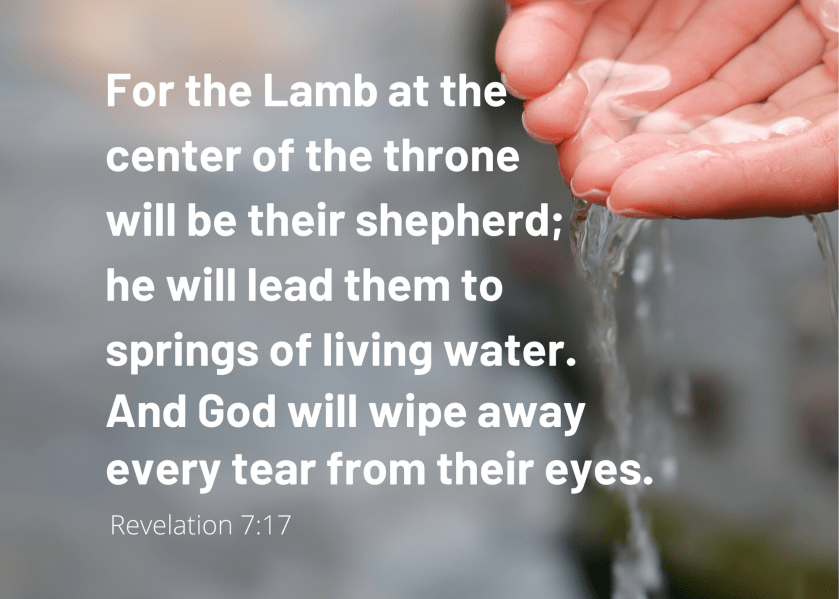
The crowd in white robes sounds much like those who had been slain (6:11) who were “waiting” for their fellow servants who were to die. We are told that these many “came out of great tribulation” (7:14) but are not told how many (if any) survived it. This may be another reference to the souls from under the altar. Or others may have been added to the number. What is clear is that God rewards His servants. It says they shall hunger no more, thirst no more, and no longer will the sun beat down on them. It sounds like we are being told that the curse on the soil doesn’t apply to them anymore; they no longer must be concerned about working by the sweat of their brow to eat. Springs of living water are being offered, and God Himself will wipe the tears from their eyes. Pain and struggle is being reversed – permanently. You can see why I think this chapter may step out of the chronology of the vision to give an overview of promises that are being offered, refreshing our memory of joy.
Lord, you keep your promises, even the ones I don’t fully understand. Please help me to take seriously what you have said to me, and what I say to you. Thank you that you love so much better than I do. Let me be committed to learning from you, not simply facts or ideas, but growing as a person and growing in my relationships with others and with you. Help me to remember that you never want anything bad for me. Help me trust you to show me right paths. Thank you, Amen.
-Daniel Smead
(originally posted for SeekGrowLove on Nov 22, 2022)
Application & Reflection Questions
Who will receive the punishments of Revelation 6? Who will receive the rewards of Revelation 7?
What do we learn from Revelation 7 about worship, commitment and faithfulness?
What are some gifts and rewards God has already given to you? What gifts and rewards are you still looking forward to? Give thanks to God for what He has done, is doing, and will do!
You’ve made it to the last letter! Thank you, as always, for joining me as we grow in our faith walk. It is always a pleasure and a growth experience for me as well!
Laodicea is one church briefly mentioned outside of these Revelation verses. While writing to the Colossians, Paul also mentions the church in Laodicea, encouraging them throughout his letter there, and reminding the Colossians that this letter was meant for the Laodiceans as well (Colossians 4:16). By some verses, it seems that Paul himself did not travel there, but did have fellow believers he was connected with that traveled there on his behalf and supported the ministry. There is some scholarly debate as to if Paul ever wrote Laodicea a letter directly that may be hidden in one of the other New Testament books, or lost, or simply is a misunderstanding of translation. A mystery you could choose to explore yourself… but not our main point for today.
Laodicea was a very wealthy, abundant city. When destroyed by an earthquake, they refused to take Roman funds but instead paid themselves to rebuild it back to its prosperous state. It was full of strong, independent, rich people. And yet, it is listed as a church with no positive attributes and only rebuke from Jesus. In fact, Jesus writes of his desire to spit or vomit them out (v.16). Ouch.
So, what’s so bad about being lukewarm? At least they weren’t called spiritually dead like in Sardis, right?? Well, Sardis was at least doing something, and there were a few members still actively living out the truths of Jesus’ ministry. It seems that Laodicea was truly doing nothing… they weren’t being useful in any capacity, and were so inflated with their own sense of self that they didn’t even notice they were really poor, blind, and naked (v.17)! They had turned their hearts so far towards their own wealth and recognition, that they truly just abandoned their faith. Maybe they still met at church for a social gathering, but there was no discussion, no action, no edification, no growth. They weren’t doing one thing wrong, they were doing absolutely nothing.
To correct this, Jesus gives them advice to buy gold from him that has been refined by fire, clothes to cover their nakedness, and salve to heal their blindness (v.18). In the context of this particular church and city, this probably felt a bit like a slap in the face. They had their own gold, they made their own beautiful linens, and they even were known for their medicinal salve! Why would anyone tell them they needed to go anywhere else to get those things? Well, Jesus was trying to point out the fact that what he was “selling” was nothing they could find in their own material possessions. He was intending to knock them down a few notches and realize what they needed was God’s grace, and that wasn’t something they could just buy at one of their various stores around town!
In verse 19, Jesus reminds this church that he rebukes and corrects the people he loves. One thing this church has going for them, that really every single person has, is that Jesus loves them enough to call them out! In this letter he reminds them that he is present, he is knocking at their door, calling for them, with an invitation to spend time with him (v.20). Jesus is actively pursuing this group of people with a desire to include them, to lift them up to a place of majesty (v.21). He deeply wants them to be part of the Kingdom, but they needed to first recognize how much they needed him to get there. There is a destruction coming that they aren’t going to be able to pay for themselves… and Jesus wants them to be on the side of redemption instead.
When we experience worldly wealth and success, we run the risk of becoming lukewarm in our faith, because we lose the recognition of our true need for God. We must have a level of humility and respect (or fear!) for the Creator of all things in order to really put our faith in action daily! We are dependent on God for so much more than we may consciously think throughout our days, but when we ignore how we desperately need His Grace, His Son, and His plan for salvation, we miss out on the opportunity to be in His Kingdom. Not to mention so many other blessings we could experience in this current life!
My prayer for anyone reading these devotions this week is that you were able to find something that spoke to you. Whether it was conviction, encouragement, or an idea for how to apply it in your home and church, I hope you found something in it for you. I pray it was a blessing and that you continue to dive deeper in Scripture to continue strengthening your faith!
Reflection Questions:
Have there been seasons in your life where you “forgot” to rely on God? Have there been seasons where you were reminded of just how much you needed Him? What were the biggest differences in your life at those times?
What barriers do you see in your life that prevent you from relying on God, and may get in the way of you focusing too much on your sense of self?
If you’re anything like me, you probably saw a bit of yourself in each letter. When reflecting on each letter, which do you resonate with the most? Re-read Jesus’ correction for the church you feel most like, and see how you can apply that rebuke to your life this week.
In today’s passage, we read about the church in Philadelphia, the church that (most people agree) had ZERO correction from Jesus. What an honor they had earned!!
Jesus comes in with powerful encouragement for this church in “Little Athens”, where it was surrounded by temples to other gods. This church was the youngest in comparison to the rest of the churches listed here, and experienced many physical challenges, specifically earthquakes, throughout its entire existence. The city itself was smaller and less populated, but was strategically built as a gateway city for the larger areas around them. This unique geographical location placed the church in a vital position for supporting the growth of Christianity. They truly had an open door if you will…
Most scholars believe that this open door to evangelism is what Jesus is referencing in verse 8 – reminding this church of their opportunity to spread the Gospel to a whole new group of people, that could continue growing and spreading in new cities. And of course, right before this in verse 7 he introduces himself as one who holds the keys to open what no one else can, and to shut what no one else can. Some people debate if this was a way that Jesus was correcting this church, by putting them in their place to remember who really was the one to give them such a successful ministry.
This church received praise for holding fast to Jesus Christ, his teachings and his name. Jesus acknowledges that he has seen their works, knows they don’t have much strength, and yet they have persevered (v.8). His encouragement to them was focused on condemnation for their enemies, and validating his love for them to those who may have been persecuting them (v.9). He also describes how their patient faithfulness will save them from later suffering when the world is experiencing testing and trials (v.10). Not only would this serve as encouragement for those believers, but it would have also served as a strong reminder of what they needed to continue doing in order to experience those promises!
So, what is this young, tiny, faithful, and weak church to do with the abundant opportunity they have received? They are to hold on to what they have, knowing that Christ is coming again (v. 11).
Living in today’s day and age, we all have abundant opportunities to share the Gospel of Jesus Christ. Whether it’s in-person, virtually, maybe even through online devotionals… (I’m sure Marcia would love a few more writers next year – or even next week has a few holes 🙂) we all have ample chances to tell people about the Kingdom, and to know and uphold the Word. We are probably just as weak and tiny as the church in Philadelphia felt, and maybe as young! Yet we have the same chance to claim this same victorious message when we hold firmly to Jesus’ teachings and his name.
Here’s the thing: we already know how the story ends. We know who the winner is of this constant war and messed up world. And, we know HE IS COMING SOON! That message should excite us, energize us, and encourage us daily! It can be so challenging when we are bogged down by the many woes of this life. We live in an incredibly imperfect world, full of yucky people, horrific disasters, and overall just depressing moments. I’m sure the Philadelphians were probably sick of seeing all these pagan gods, constantly rebuilding their homes from earthquakes, and being picked on by everyone around them. If they can withstand life’s challenges so well that Jesus is shouting their praises, maybe we can too.
Reflection Questions:
How would you feel to receive a letter like this from Jesus? What things in your life right now do you think Jesus would be praising? What would he be correcting?
In Psalm 119:71, David writes about how his afflictions helped him learn God’s decrees. In Jeremiah 40, we read about Jeremiah finally getting some freedom back after being confined and imprisoned, and continuing to spread God’s messages. What challenges have you experienced in your life that you have come to see as a blessing or an opportunity to grow in your faith?
What is one way you can seize an opportunity to share Christ in your world today? What doors do you see that Christ has opened in your life?
We’ve made it to the fifth letter in our series! Thanks for joining again!
Sardis is another church not mentioned elsewhere in the Bible with limited information. Historically, we are told Sardis was once a wealthy city citizens thought was well-defended because of their geographical location up above most other cities. Because of this, Sardis experienced multiple significant attacks they were ill-prepared for, and as a result, the city had deteriorated significantly from what it once was or what it could have been. Keep this in mind as we take a look at the letter itself today.
Jesus does not take much time before diving right into some pretty critical correction for this church. He immediately jumps to calling out their fake reputation – calling them dead instead of alive as it may seem (v.1). This would have been a pretty close comparison to how their city also had the appearance of being well-off, when in reality, they could not withstand the attacks of those around them! So what are they to do? WAKE UP. Jesus tells Sardis to take action in strengthening what little remains (possibly referencing the few in the church that have remained worthy (v.4)), because he still sees a chance for them to finish or perfect their deeds or purpose (v.2). Some Bible translations use the language, “…I find your actions do not meet the requirements of my God.” This means there are some actions happening, but they are unfinished and not up to standard.
Sardis was a church full of barely believers who were just scratching the surface of what it means to be a Christian. Full of people coming together and going through the motions, maintaining the look of a “good” church, and yet missing out on true spirituality and fellowship with Christ. People who weren’t motivated by their love of Christ, or love of others, but rather by their desire to be viewed with the “Christian” label. That is why Jesus calls this church to remember what they learned at first, Biblical truths of who he is and what the Kingdom will be, hold it fast, clinging to these truths with passion and deep love, and repent, because where they are is dangerous for their salvation (v.3). Jesus uses the analogy of a thief coming at an unknown time because he knows this would be an image that resonates with this group of people, and he desperately wants to convey the urgency behind his words.
It is incredibly simple to slip in a pattern of apathetic worship and works. All it takes is falling out of good spiritual habits like daily fellowship with God through prayer, reading our Bible, and genuine worship to fall into a rut of maintaining a reputation. I personally feel this is one of the biggest ways Satan draws Christians away from Christ in the United States today. BUT, when we listen and act on what Jesus tells the church in Sardis (remember, hold fast, and repent), we have the best chance of our name being written in the Book of LIfe, acknowledged by Jesus to his Father, and angels (v.5).
It is overwhelming to feel like or recognize that you or your church may be spiritually dead. But be encouraged that we worship a God who raises the dead. His Kingdom is coming, and you have a chance to be part of it. Praise God!
Reflection Questions:
What is one thing you have done recently (or can do), to re-energize your love of Christ? How can this help you avoid a pattern of apathy?
What are the things you learned at first that God may be calling you to remember? What does it look like for you to hold fast to these things in your daily life?
Our other passages today offer multiple examples of people who held on to God’s words regardless of their reputations. In Psalm 119:58 David writes how he has sought the Lord’s face with his whole heart. Despite his own shortcomings, David clearly had a deep relationship with God and was blessed because of his dedication. Living in a post-Jesus world with access to Old Testament scriptures, we are at even more of an advantage to developing a relationship with God. How are you utilizing the time you live in now to further your relationship with God and His Son?
While we don’t hear much about Thyatira outside of these passages, we do get a little sneak peak at it in Acts during one of Paul’s trips where he meets Lydia, and she and her whole family are baptized in the truth of Jesus Christ. From there, we are told Lydia offered a place for Paul to stay (Acts 16:13-15). While we don’t know the number of days Paul stayed with Lydia, it is likely that the believers reached during this time were the ones to eventually establish the church in Thyatira. While this isn’t incredibly relevant to our main point, I do think it’s pretty amazing that just one family made such an impact in their community!
Now getting into the praise Thyatira received: The church here was doing good work, and it seems that they were improving in this throughout their existence too! They are commended for their love, faith, service, and perseverance (v.19). This was a group of active Christians who clearly cared deeply for their community. They had a big focus on outreach and growth. Both great things to aspire for!
Now comes to their correction… Thyatira had allowed a false prophet, a “Jezebel” (think the Biblical “Karen”… not really their name, but the stereotype that goes with it), into their church and followed her teachings, even into sinful acts such as sexual immorality and eating food sacrificed to idols (v.20). It is possible that this church was so focused on the external look of creating a community where no one was pushed away, that they instead let in someone(s) that became like a cancerous growth in their congregation. Rather than confronting someone with wrong teaching, the church allowed false prophets a space to teach that incorrect doctrine, ultimately dragging down the church as a whole.
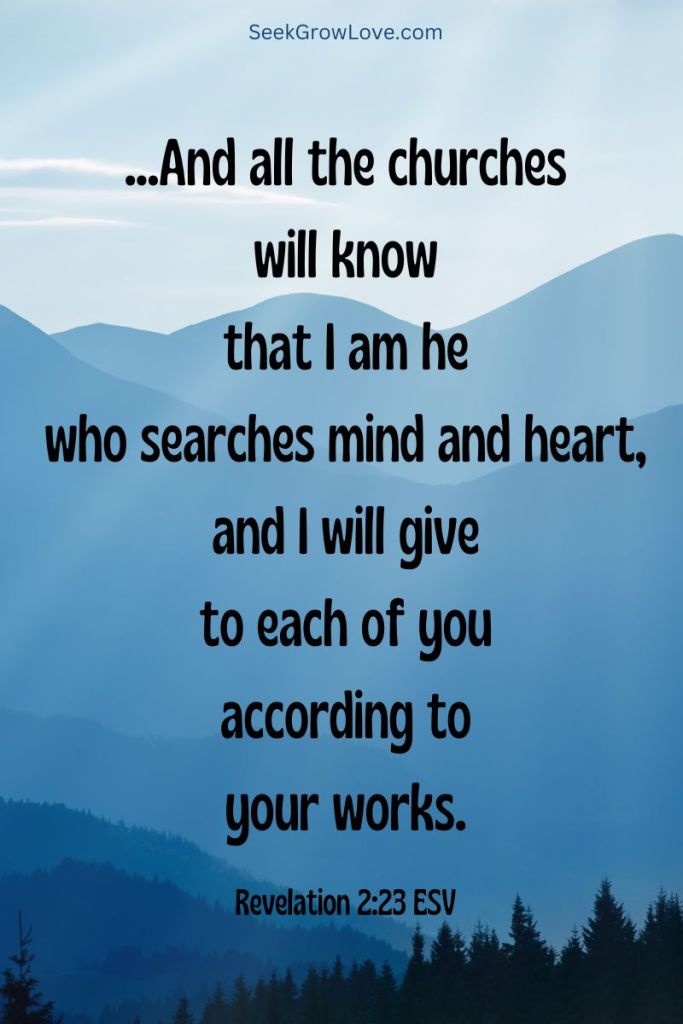
In this letter, Christ reminds the church, and the false prophets, that those who go off the path of Christ’s teaching will perish, but there is still an opportunity for repentance (v.21-22). In verse 23, it’s written that Jesus will repay each one in the church according to their deeds. Now, for a church that was commended for their deeds, this may not seem too concerning. However, within the context of the same verse, it appears this is more of a warning for these Christians. Even in their good deeds, if they have been actively following a false prophet and engaging in actions they know to be sinful according to Scripture and Christ’s teachings, those deeds will also be repaid. I think this is Jesus taking a moment to remind Christians that without obedience to God’s expectations Jesus taught, the result will still be death, no matter how good their deeds were. Interestingly, there seems to be a group within the church here that has been defying the false teachings, and Jesus urges them to continue to hold on until he returns (v.24-25). Just a little light within that grim reminder!
That harsh correction also comes with a very exciting promise for everyone just a few verses later. Jesus reminds these believers that those who do his will to the end will be given authority over nations and a morning star (v.28). These promises are hopeful, exciting, and rewarding!
In our modern day, it can be just as easy to allow false teachings to slip into our churches and our lifestyles as in the time of Thyatira. This makes it that much more imperative for each individual believer to have a strong foundation of Biblical knowledge to test teachings with! Church leaders also have an important task of addressing false teachings inside the church appropriately and timely. We all must use discernment to evaluate the messages we hear inside (and outside) our churches to ensure they truly align with the teachings of Jesus. And if or when they don’t, we must have the courage to call it out! Always remembering that everyone is created by God, and given the same chance for repentance as you and I. It’s no easy task, but the reward makes it all worth it.
Reflection Questions:
Have you experienced a time where you had to use discernment in confronting sin in your life, or in the life of another believer? What went well in that situation, and what could have improved?
In our Psalms passage today, we read that David finds comfort during suffering because God’s promise preserves his life, and he finds comforts in God’s laws. When you consider the laws and Jesus’ teachings, do you find comfort in obeying them? Are there any that are challenging for you?
In our Jeremiah verses for today, we see an example of God’s response to disobedience to His laws for the sake of “freedom” from them. How has this concept remained the same throughout history? How has this concept changed since Jesus?
While Pergamum (or Pergamos) is not mentioned directly in other places of Scripture, it is located in the region Mysia, which Paul traveled through on his way to Troas (Acts 16:7-8). Some scholars believe this is when the church would have “picked up” the Christian beliefs and began around this time, and may have been strengthened by Paul’s later travels to Ephesus. Pergamum was a very lofty, worldly place that served as a temple for many pagan gods, including the temple for Zeus (AKA “Satan’s throne”). It was a challenging place to have belief in the One True God, and His son, Jesus Christ.
For this reason, Jesus commending the church for remaining true to his name is all the more powerful. This is a group of people who day in and out were faced with false gods and pressured to worship them. Even through martyrdom experiences, they held fast to the name of Jesus (v.13). What a compliment and praise to receive from the Savior!
BUT, unfortunately, the praise Jesus gives quickly turns to correction. Despite continuing to believe in Jesus, many believers did not hold fast to the doctrine Jesus taught, and tolerated the ungodly practices in their church. They did not maintain the command to worship no other god, except God himself. Instead, they permissed to teachings of Balaam and the Nicolaitans (v.14). Really, what this means is this church had compromised the teachings of Jesus for what the world around them was teaching. They accepted the teachings of false gods and allowed them in their lives. And Jesus calls them out! He tells them to repent, or else face the sword of his mouth (v.16), which we know is the Truth of who he is and his Father!
In comparison with the church in Ephesus, Pergamum seems to be on the opposite end of the spectrum. Ephesus struggled being too far away from their community to speak the truth in love, whereas Pergamum struggled to be set apart from the world and speak the truth at all.
Again, Jesus reminds this church that this message is for anywho who has ears. He writes to them about the promise of hidden manna (being filled with Jesus, the bread of life), a white stone (a clean slate free of judgment), and a new name (an identity in Christ). Those who not only remained faithful, but also remained set apart for Christ, were given a satisfying, safe, community to be part of.
In today’s modern day, it can be far too easy for believers to compromise the biblical truths they know for what the world has to offer, for the sake of wanting to belong or be comfortable, or just not ruffle any feathers. Yet, we are called to more, with a reward that is so much more than anything anyone in this world could even come close to comparing to. Our society yearns to be satisfied, safe, and accepted. But the only way to truly experience those things is when we cling tightly to Jesus Christ and his teachings, and fully put on our new identity in him. When we withhold the truth from anyone, we are not truly loving them the way Christ loves his church. Jesus loved the church in Pergamum enough to call them to repentance. Do you have the same love for those around you?
Reflection Questions:
We know that the world markets false satisfaction, safety, and acceptance today. How can you ensure you are equally marketing the truth about Jesus in a loving way?
One of the best ways to proclaim the truth of Jesus to nonbelievers is through our actions. Are you acting set apart, and loving, the way Jesus calls us to? What can you do today to live out the truth you know, and show the world around you?
Our reading in Psalms today talks about delighting in God’s commands, something Pergamum struggled with acting out. Is this something you find yourself naturally doing? How can you work to love the commands God gives us?
Looking at some historical context of Smyrna is a bit harder than other churches, because it is only mentioned here in these verses. However, we do know that the church of Smyrna is the only church still thriving in the modern day. Reportedly, more Christians have lived in this area than any other Turkish city in the world. This is quite impressive, considering this region has experienced repeated wars, massacres, earthquakes, and plague since they first received this letter.
Smyrna was a very rich area, populated by Roman and Jewish-born people. Unfortunately, Christians were viewed as “cult followers” and often banned from being able to work, purchase needed items, and often faced social or physical persecution. This really highlights what Jesus was speaking of in verse 9 when he described their poverty and afflictions. So how could they possibly be rich? Well, because just like all of us who are baptized, they had the promise of life, and avoiding hurt in the second death (v. 10-11).
From historical records, it has been concluded that a pastor at the church in Smyrna by the name of Polycarp, refused to worship Caesar and renounce the name of Christ. Because of his choice, he was burned at the stake. From these records, it is reported that when commanded to reject Christ, he stated “Eighty-six years have I served Him, and in nothing hath He wronged me; and how, then, can I blaspheme my King, who saved me?”. From there, records indicate he was heard singing praises to the Son of God while being burned alive. It seems Polycarp truly took the words of Jesus to heart, not fearing what he was suffering, and being faithful to the point of death.
It’s hard to imagine even a fraction of the persecution that was experienced in Biblical times, living in modern day America. Even harder, we know that both social and physical persecution still exists around the world today. In a recent report from Open Doors (link below), it is estimated that 1 in 7, or 365 million, Christians worldwide faced persecution in 2023. Of those numbers, roughly 5,000 murders are recorded to be directly related to a person’s faith. Nearly 15,000 churches or Christian properties were attacked. From these reports, it has been determined that North Korea is the most dangerous place in the world to be a Christian. Despite this, Christianity continues to be the highest category across the global population, AND is projected to continue to grow even higher based on current trends. Even with the affliction and suffering, Jesus continues to touch the lives of billions around the world.
Smyrna was one of many churches to experience persecution, but because of their faith, they are considered rich and worthy of the victor’s crown. This message of reward was not meant just for them, but is for everyone who has ears to hear what the Spirit says (v.11). You will face trials in this life as a Christian, whether or not they may be as severe as others around the world. Will you remain faithful?
Reflection Questions:
Have you ever imagined yourself in the place of a Christian around the world? Contemplate how you would respond when faced with persecution. Pray today for those that experience this on a daily basis. For more information, check out the “World Watch List” found here: https://www.opendoors.org/en-US/persecution/countries/
In the passages in Jeremiah today, we see an example of God describing His restoration on earth, sharing the same promise that we also cling to in times of trials. Reading those chapters, what verse sticks out to you as most encouraging when you consider the perfect restoration we will get to experience?
What ways can you hold fast to your faith when you experience suffering in this life? What has worked for you in the past? How can you encourage and support a fellow believer who may be struggling right now?







 Seek Grow Love