Unexpected Callings – Amos 6-9

God Calls Us to the

Today’s reading contained similar prophecy to what we have seen over the last few days with a couple short narratives thrown in the mix. One was Amos 7:10-17, when Amos meets with Amaziah, the high priest at Bethel. In this story, we get a little bit of Amos’ background. Threatened by the prophecies of destruction, Amaziah demands Amos leave Israel. Amos responds, “I’m not a professional prophet, and I was never trained to be one. I’m just a shepherd, and I take care of sycamore-fig trees. But the LORD called me away from my flock and told me, ‘Go and prophecy in Israel.’” (14-15 NLT) 

Sometimes, like Amos, God calls us to do the unexpected. He calls us to do tasks for which we were never trained or prepared. Time and time again, all throughout the Bible, there are stories like this. David was a shepherd but called to be King. Peter, James, and John were fishermen, but called to be disciples of Jesus and leaders of the early church. Esther was a mere girl but called to rescue the Jewish people. All these individuals relied on God to sustain and strengthen them. They were not expecting to become heroes and martyrs. It was not in their plans, but it was in Gods’. That is the key for today. Keep an open mind. 

What is God possibly calling you to do? The summer season is a season of transition. Even if you are no longer in school, much of our society is built around the school calendar. Summer is the space in between the last school year and the next. Let this be a time of reflection as you prepare for whatever is next. Ask God to guide you and be willing, like Amos, to do something different. Even the unexpected. 

~ Emilee Ross


Today’s Bible passage can be read or listened to on Bible Gateway.

Tomorrow, we move on with the history of Israel, reading 2 Chron. 27 and Isaiah 9-12 – as we continue the 2020 Chronological Bible Reading Plan

Amos 1-5 – A Just God

7_10 Blog

Justice is a solid theme throughout the book of Amos, especially in today’s reading. Through the prophet Amos, God is pronouncing judgement upon Israel and neighboring nations. He first announces why said nation is being punished, and then warns of the coming consequences. It stood out to me how God cast judgment upon the same nations he would also be defending. For example, in Amos 1:12, the people of Edom are to be punished for crimes committed against Israelites. In 2:1, Moabites are punished for having desecrated the bones of Edom’s King. In later chapters, Israel is being punished for idolatry. God’s justice reigns. 

Whether a group was victimized or guilty, God did not let wrongs go unnoticed. 

God is a God of compassion and mercy, but he is also just. It can be difficult for us to fully comprehend how these attributes coexist, but that is because we are understanding these concepts in mere human terms. To simply put, God has a God brain, and we, with our human brain, will never be able to fully understand how God works through both grace and justice. Fortunately, we don’t need to know the how in order to believe He does. 

Everyone experiences injustice in their lives. Whether large scale injustice like racism or sexism, to smaller personal injustices within relationships and friend groups. No matter the severity, God is aware of them all. It is the smaller injustices I want to address, today. 

When our feelings are hurt, when lies or gossip as been spread about us, when we are betrayed by people we trust, we feel robbed and empty. We want someone to hear our side of the story. If we’re honest with ourselves, we really aren’t looking for God to rain down fire upon the guilty individual(s). Usually, all we really want is an apology. But there are some situations in which we will never get this. This can hurt, so deeply. I know. I’m in a situation like that now. 

If you’re like me, dealing with a relational injustice, you probably aren’t wishing terrible horrible judgment upon said person. You are probably just wanting closure or a chance to be heard. Take comfort in today’s reading. God is a God of justice, one who rights wrongs. While I may never get the respect I deserve, or the chance to rewrite the narrative believed about me, God knows, and God sees. In these cases, punishment need not necessarily occur in order for us to feel justified. The fact the LORD knows and sees can be justice enough.

~ Emilee Ross


Today’s Bible passage can be read or listened to on Bible Gateway.

Tomorrow, we continue reading the writings of Amos – Amos, chapters 6-9 – as we continue the 2020 Chronological Bible Reading Plan

God Has Answers

Isaiah 5-8

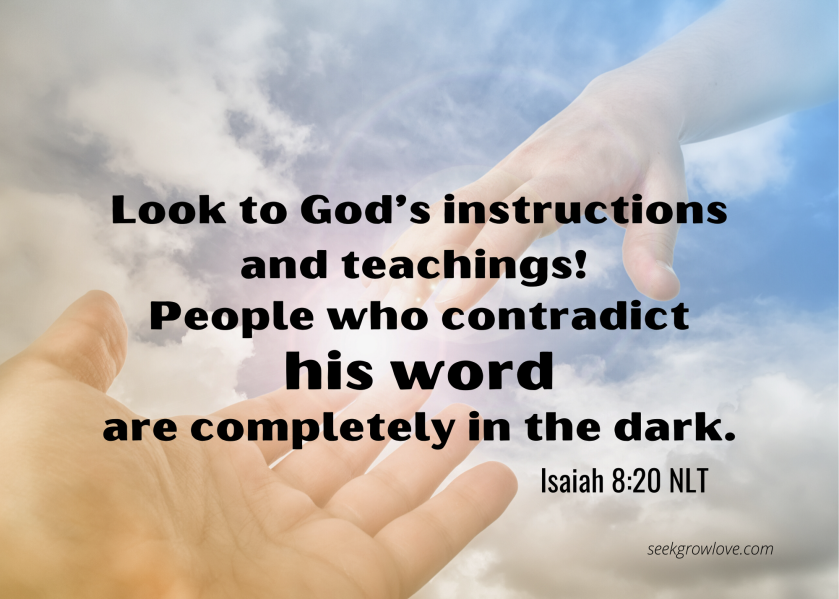
Isaiah 8 20 NLT sgl

Today’s reading contained some pretty grim and possibly confusing stuff. In some sections it seems the people of Judah are completely doomed for destruction, while other parts tell of a coming protection. If you have come here today looking for an explanation and clarification on all that took place in these chapters – I’m sorry to say, I haven’t got one. Mainly because one perfect answer doesn’t exist. Scholars, theologians, historians, have all made attempts at understanding biblical prophecy. There has yet to be one universal agreed upon interpretation. The language barrier is one reason, as is the lack of context and historical gaps. If you want to know more about today’s reading and other prophecy, I encourage you to do two things. One, reach out to your local pastor with your specific questions. He or she would love to help you digest the Old Testament. Many have a wealth of biblical knowledge and bookcases stocked with resources. Plus, during this Covid time, many pastors are feeling a disconnect with their congregation, unable to meet under normal circumstances. They would welcome your questions and this opportunity to serve.

My second bit of advice is to follow that in Isaiah 8:20, “Look to God’s instruction and teachings! People who contradict his word are completely in the dark.” (NLT) Isaiah goes on to describe the type of darkness these people experience as a sort of wandering aimless search for answers. He paints a picture of people looking at the sky and shaking their fists at God. These people sought psychics and other mediums for answers, instead of seeking the LORD’s instruction. Whenever you are reading scripture and stumble upon a passage that confuses you, look to what you know to be true about God. Some of these Old Testament passages can be tricky and may produce the picture of God as being only angry and vengeful. Be sure to look to ALL of God’s instructions and teachings. Personally, when reading doom and gloom in the Old Testament, I try to keep in mind what God says about Himself as being “the LORD, the compassionate and gracious God, slow to anger, abounding in love and faithfulness, maintaining love to thousands, and forgiving wickedness, rebellion and sin. Yet he does not leave the guilty unpunished;” (Exodus 34:6-7 NIV). I love this verse in Isaiah, because right in the midst of confusing prophecy, he gives us an answer, encouraging us to seek “God’s instructions” known to us through scripture.

This advice from Isaiah can also be applied to other aspects of our lives when searching for answers. I would say all aspects, except I’ve not yet found the part in scripture that explains calculus. Math aside, when we face difficult or confusing challenges, wandering in unknown darkness, we as believers are encouraged to seek God for the answers. We can approach God through our wonderful redeemer, Jesus Christ. Whether these answers are revealed to us by understanding scripture, receiving peace, or prayer, answers exist. I am experiencing some personal challenges in my life right now. A couple weeks ago, one of my best friends sent me a text reminding me to seek answers from God during this trial. Her encouragement applies also to you, and whatever your current struggles may be. The last part of Isaiah 8 reminded me of her words. I want to share some of them with you as a closing thought.

“It may seem like the pain, loss, confusion, and hole in your heart, are the only things you will ever know, but please remember, the Lord has a plan for you and He is there to listen to you, He is there to listen to your cries of anguish and despair. And He will console you, but you have to ask Him for His help. Please don’t shut yourself out of His sweet  and divine presence, my dear friend. Ask Him to give you guidance for what you should do next. How you should proceed with your life. Ask Him for His wisdom so that you can understand what lesson He wants to teach you, how He is trying to mold your character. And also maybe think of what He wants you to ask Him. What is HIS will?”

Emilee Ross


Today’s Bible passage can be read or listened to at https://www.biblegateway.com/passage/?search=Isaiah+5-8&version=NIV

Tomorrow we begin another prophet writing at a similar time – Amos, chapters 1-5 – as we continue the 2020 Chronological Bible Reading Plan


One Hand Washes the Other

2 Kings 5-8

2 Kings 5 16 NIV sgl

Over the course of the past few months, it would not be presumptuous to say that many of us have amended our handwashing technique; however, we have most likely been using one hand to wash the other for quite some time (hopefully with warm water and soap, too).  It is a mutually beneficial relationship, which makes both hands equally clean, each part repaying the debt to the other. This has become a beautiful analogy for many who do favors in expectation of a return. No matter how you say it, “one hand washes the other” or “you scratch my back, I’ll scratch yours” (which you will definitely need to wash your hands if you scratch someone’s back), going out of our way and doing the right thing can be advantageous to a relationship, a caching of IOUs, or marking our debt paid. Handwashing itself is definitely a biblical, Levitical principle, but is this tit-for-tat the way God works?  Should we expect a return when we have lived out the moral will of God? Should we be cleanly rewarded because we have taken a risk on someone else’s mess?


Today’s reading challenges us to think differently about the expectations of doing a good deed.  Naaman is healed of leprosy by the instructions ordained through Elisha.  Naaman was indeed searching for a cure, but as the many who came up to Jesus looking for healing, he had a curiosity about the God of Israel.  Overwhelmed by the healing, he asked Elisha if there is anything He can do in return? For a moment, think of your hospital bill if you were healed of a flesh-eating disease that could ultimately take your life, much less the deep appreciation you might have for your new quality of life.  Both would be truly astronomical.  Elisha could have asked for enormous amounts of wealth, power or favor in Syria, or even asked for a vow of protection from an enemy captain.  He wanted part of no such thing.  His whole purpose in helping is so that men, specifically Naaman, would know and confess “…Now I know that there is no God in all the world except in Israel…” – 2 King 5:15.  If we needed any further confirmation of this truth, Elisha’s servant is struck with leprosy after turning back to essentially say Elisha had changed his mind and would be happy to take a few things in return (2 Kings 5:26,27).


The Gospel of Jesus Christ is not a message of hand washing hand.  It is a message of hands washing feet. We are to be servants of God, and in turn, servants of those He loves, people.  We do not do these things because we can earn our spot in the Kingdom of God, or buy our way into his favor (Rom 6:23).  Our debt is so enormous, we could never repay it.  We become the beneficiaries of this gift when we humbly accept the healing instructions God offers us; that we would be made clean by the waters of baptism and know and live that there is no other god in our life, except the living, one true God of Israel.  When we act as God, meaning, when we act as an agent of His attributes (love, kindness, patience, truth, faithfulness, forgiveness, grace) we are not offering something that is from us.  We are offering God.  God’s terms have already been agreed upon; we do not have any additional conditions to bring to the table.  We are not owed, nor should we expect a return on such an investment we make with our life or provisions. God is the rewarder. Every good and perfect thing flows down from the Father (James 1:17).  Ultimately, we should not ever extend our hands out to expect a reward from God or anyone else. As we serve the Lord in whatever capacity he has called us to, we should extend our hands upward to give Him the praise because He is rewarding us in a literally astronomical way that will reshape the structures of heaven and earth.  We may lose all we have or be thought of as fools as we try to serve like Jesus, but we can truly never settle the score, or wash the hand of God, and that is an awesome, powerful, wonderful thing.

Aaron Winner

Today’s Bible passage can be read or listened to at https://www.biblegateway.com/passage/?search=2+Kings+5-8&version=NIV

Tomorrow’s reading will be 2 Kings 9-11 as we continue the 2020 Chronological Bible Reading Plan

Portion Sizes

2 Kings 1-4

Let me inherit a double portion of your spirit

On our occasional visits to Disney World, I often think about the cruel irony of Walt never laying eyes on his biggest dream.  He died just five years before the Magic Kingdom opened, just as they were breaking ground. While Disney was charismatic, passionate, creative, and a visionary, he surrounded himself with an entourage of like-minded people, so consequently, his dream did not die with him. By mentoring and empowering those who worked for him, he allowed their passion, creativity, and vision to fuse with his own, to accomplish even greater things than even he could imagine.  In some manner of speaking, each one of the people around him each received the spirit of Disney, yet retained their own spirit, allowing them to benefit from both. This legacy has been passed down over and over again, and Disney has become one of the most innovative companies in film, television, and travel.  Using a conversion that translates 1966 dollars to 2020, The Walt Disney Company is worth a hundredfold more today than it was 54 years ago, maybe even more than Walt, the greatest of the imagineers, could have ever dreamed.


While the opening today sounds like one of the final chapters of a leadership book, it is akin, albeit less significantly and definitely imperfectly, to the promises of Elijah and Jesus.  Both not only spent a great deal of their time speaking with God, prophesying, and doing miracles, but both these men made specific investments in the people around them for God’s message to increase.  Jesus surrounded himself with the disciples, and Elijah’s legacy is specific to Elisha.  There is no doubt that these men’s examples made a profound impact on those who spent the most time with them (and yes, the example of Jesus is reverberating, impacting us today, but that’s the direction we’re heading).  The momentum of Elijah or Jesus did not stop when they were taken to heaven.  In fact, Elisha, and Peter, often thought of as the disciple Jesus was closest to, were recipients of faith-induced natural phenomena (2 Kings 3:17 ; Acts16:26).  Additionally, both Peter and Elisha raised people from the dead (2 Kings 4:32-35; Acts 9::32-43). Years of watching, listening, and serving led to specific callings for each of these men to do bigger, bolder things than demonstrated by their predecessors (with exception to the propitiation of Christ).  In fact, both Elijah and Jesus prophesied this to be so (2 Kings 2:10; John 14:12-14)


This begs the question: who are we bringing along on our faith journey?  If we are effectively sharing the Gospel message, is there not someone who is receiving an exponential portion of whatever our faith has to offer?  How can we extend our finite time on earth to impact the infinite time we will inherit in the kingdom of God? It may be as simple as sharing our faith with our family.  As my children grow, I am alarmingly realizing the majority of their modeling and information is from my wife and me.  Our ultimate goal is that their faith far exceeds our own, yet if we do not show the devotion, love, and belief we have, they will never receive even a single portion of it, much less build upon the faith we have.  It could be we have served in ministry or occupation where we are now becoming the experienced one (this is also known as “old”).  It is time to take someone under our wing, share our testimony and calling.  By allowing someone to watch, listen, and serve, they can learn from our successes and failures without having to bear the consequences or responsibilities, ultimately placing them in a more successful position when they are on their own, long after our influence has left for one reason or another. Their trajectory is steeper, and at some point will outpace us.


Ultimately, we should be intentional about sharing our faith, vision (God-given), and resources (also, God-given) with our families or small circle of influence. Our greatest calling may be to prepare the way (Eli, Mordecai, and John the Baptist) for someone who will do more than we could possibly imagine because God will use them to exponentially grow his kingdom.  Let’s make some significant investments. Let’s sow and tend the seeds. Let’s watch as God makes the return thirty, sixty, or even a hundredfold because the world is starving for His message. Let us pray and work to serve up bigger portions than ever.

Aaron Winner

Today’s Bible passage can be read or listened to at https://www.biblegateway.com/passage/?search=2+Kings+1-4&version=NIV

Tomorrow’s reading will be 2 Kings 5-8 as we continue on the 2020 Chronological Bible Reading Plan

The Opposite of God

Obadiah and Psalm 82 & 83

Obadiah 15 NIV sgl

In yesterday’s devotion, one of four bullet points focused on making God the judge. In today’s reading, there are calls from Obadiah and the Psalmist(s) for justice to come from on high.  To be clear, we are not appointing God to a position He doesn’t already command, and we aren’t necessarily persuading Him to intervene.  When we implore God to judge, we are inviting Him to rule in our favor by having a life-contrast or dichotomy that would allow Him to easily see we are for Him.  We are the wheat. We are the sheep. Whether he intervenes today or not, ultimately, “Come” will be the words of invitation we will hear from our King inviting us to dwell with God in love and in eternity.  Conversely, we are all declared guilty for the first death, but we can be condemned to a second and permanent death if we are not found covered by the innocent blood of Jesus Christ.  Those who remain are against Him. The chaff. The goats. “Depart” will be the words of condemnation to those who made themselves a stranger.  There is no invitation.  There is no love.  There is no eternity. God’s ruling is truly sovereign. There is no room for shades of gray.


Although the following isn’t a joy-filling thought to charge the beginning of your day, we need to be reminded there is a place opposite of God.  Sometimes those who dwell there actively and openly oppose Him (Obadiah 1:3). In fact, there are people in this world who would love nothing more than to imprison Christians, outlaw prayer, burn down churches, and try to expunge the name of Jesus Christ from existence.  Sadly, this happens quite a bit across the world today, and I dare say, at an ever-increasing pace in the United States. However, we must also remember, open defiance and apathetic faith are equally punishable in the eyes of God: women and men who prioritize their lives by accumulating wealth, try to make a name for themselves, acquire dizzying intellects, repeatedly give into vices, forget to take care of those who are hungry, thirsty, or imprisoned, or many other acts not listed here that do not center solely around God (Psalm 82:3,34, Matt 25:44,45). Apathy, complaisance, half-heartedness, and postponement can place us in imminent condemnation of God as plainly as open defiance.


To not share the name of Jesus Christ is to annul his message. To not lift up the church is to tear it down.  To not empower the weak is to place them in the hands of those who would do them harm.  Where is the contrast in your life?  Are you living for the finite or existing for the eternal? Are you with Him or against Him?  Yes, there is a place opposite of God, but let us pray that God uses these words we read today to convict us, bringing us closer to His calling as good and faithful servants.

Aaron Winner

Today’s Bible passage can be read or listened to at https://www.biblegateway.com/passage/?search=Obadiah+1%2C+Psalm+82%2C83&version=NIV

Tomorrow’s reading will be 2 Kings 1-4 as we continue our journey through the 2020 Chronological Bible Reading Plan

Keep Your Eye on the Ball

2 Chronicles 19-23

2 Chronicles 20 1 NIV sgl

If you have been to any youth ballfield, the mantra of even the most uninformed coach or parent to his/her child in most all situations is “keep your eye on the ball.”  Whether it is baseball, soccer, football, tennis, or basketball, knowing where the ball is at any given point in a game is the greatest predictor of success and will result in the highest probability of a favorable outcome.  In order to strike, kick, tackle, return, or rebound, you have to know where the ball is.  It seems simple enough; yet, anyone who plays any number of the ball-including sports at any level suffers from the occasional mishap that begins with losing sight of the most important object to the game.  Why?  We get scared.  We’re thinking about our next move.  We get caught up in the emotion.  Or it might simply get lost in the lights.


“If calamity comes upon us, whether the sword of judgment, or plague or famine, we will stand in your presence before this temple that bears your Name and will cry out to you in our distress, and you will hear us and save us…We do not know what to do, but our eyes are on you.” –   1 Chronicles 20:9,11b


In today’s reading, Jehoshaphat gives us an example of what it looks like to keep our eyes in the most important place.  Not all of us play sports, and if we do, we most certainly may not play them well (present company included), but we all have a part to play in the will of God.  Without your eyes on the Father, you might still have a bit of fun, but there is no purpose in the participation of it all.  You are simply existing, a benchwarmer staring off into the distance, oblivious to the wonderful plan that God has for your life.  Yet, keeping our gaze affixed to Him isn’t exactly as easy as it sounds.  Even the most professional ballplayers have blunders. Here are a few reminders of how to readjust our focus, to make sure it is in the right place, no matter what “level” we are playing at:


To keep your eyes on God, let Him take away the worry.


There is a ton of uncertainty in the air right now.  Disease, political unrest, economies, natural disaster, not to mention all of the “typical” fears we have about things like acceptance and loss.  Jehoshaphat had a vast army approaching, yet he remembered that God had promised Israel and Judah the land they possessed. Remind yourself of the simple yet immense promises of God – He will never leave you, nor forsake you (Hebrews 13:5), We know all things work together for those who love the Lord (Romans 8:28), Do not fear, for I am with you always (Isaiah 40:1; Matt 28:20). The promises purge us of the pressure to take the entire crushing yoke upon ourselves and hand it over to God.  In exchange He will give us peace in the restless situations (John 14:27).


To keep your eyes on God, remember He has planned the present.


One of the greatest defensive failings in baseball is thinking about throwing the ball before you have ever fielded it.  Time and time again, the baseball zips “through the wickets” or is fumbled as it is being removed from the glove and falls flatly to the ground.  Jehoshaphat could have spent his time sending messengers to form alliances.  He could have armed the remaining men, women, and children to increase the size of his army. He could have sent out terms of surrender to try to salvage the lives of his people.  He didn’t do any of this.  He kept the most important thing as the most important thing; his gaze never faltered. He didn’t “throw the ball” before He fielded God’s response (as we saw yesterday).  Don’t forget to serve God now because there is a bigger, better plan you have made to serve Him down the road.  He is the God of tomorrow, but before then, the God of today.  Seek first the Kingdom of God. Don’t worry about tomorrow, for it will take care of itself (Matthew 6:33,34). He may call us to things that inconvenience, disrupt, or even abort the plans we have made down the road, but when those days come, or if they don’t, He has planned those days too.


To keep your eyes on God, make him the judge.


One of the most frustrating things is a competitor who doesn’t play fairly or feeling we are the victim of unjust treatment.  What’s even more frustrating is an umpire or referee who fails to see it or worse, lets it persist.  Our God doesn’t turn a blind eye to us; He sees the struggle.  He isn’t deaf; He hears the petition.  When we want to take matters into our own hands, be reminded that you too are a trespasser but also an unfair recipient of favored treatment. This more than anything, should make us compassionate and ready to forgive others.  We will be called to be God’s facilitator of forgiveness many times more than we will be judicator of justice.  Jehoshaphat made the appeal, but was also seemingly ready for whatever answer came his way. We must trust God, let Him be the judge, and maybe the hardest thing, be ready, like Jesus, to be dealt injustice, yet still forgive for the sake of the Gospel and our message.


To keep your eyes on God, eliminate the distractions.


The lights can be blinding.  The hecklers can be loud.  The teams’ morale can be affecting you. Even seemingly good things like family and church can provide an incorrect context of focus if not filtered through the lens of their role in God.  When we work, provide, heal, love, carry on, feed, protest, or serve, constantly remind yourself you are doing it all for the Lord.  Take a lesson from Jehoshaphat’s army; worship God while you are in the battle (1 Chronicles 20:22).  It would be challenging to give into your pride when you sing “Oh Spirit come make us humble…” It would be tough to look at inappropriate material when you sing “We turn our eyes from evil things…” It would be difficult to spend Sunday morning after Sunday morning with your family at the ballfield while singing “Oh Lord, we cast down our idols.” Filling our mouth with praise, worship, and prayer prevents anything else from slipping out.  The same could be said of our eyes, ears, hands, and most importantly, minds.  Engage God with everything you have, and you will be ready and attuned to His movement no matter where on the field He takes you.


“You will not have to fight this battle. Take up your positions; stand firm and see the deliverance the Lord will give you, Judah and Jerusalem. Do not be afraid; do not be discouraged. Go out to face them tomorrow, and the Lord will be with you.” – 2 Chronicles 20:17

Aaron Winner

Today’s Bible passage can be read or listened to at https://www.biblegateway.com/passage/?search=2+Chronicles+19-23&version=NIV

Tomorrow’s reading will be the short book of the “minor” prophet Obadiah and Psalm 82-83 as we continue keeping our eye on the Father through our 2020 Chronological Bible Reading Plan


Beware of the Buttkissers

1 Kings 22 & 2 Chronicles 18

1 Kings 22 5 NIV sgl

Yes, I know, a bit of a sensational title. In fact, I can hear my mom reaching for the Irish Spring to place in my mouth because “butt” is not a church word. Please give me grace just a few sentences longer as I am someone who spends a great deal of time at school with 11 and 12-year olds. I often use a bit of high-brow potty humor for the connection and to make sure that I have your attention.  From here on out, I promise <crossing heart> I will use yes-men, suck-ups, sycophants, or something similar, but we’ll both know that I truly mean <in a whisper> “the ones who kiss b-u-t-t.”

Scattered throughout the last couple of weeks, we have read about the life of King Ahab. Today we will finish off Ahab [spoilers ahead] in more ways than one.  Ahab has grown unhappy that a previously Israeli owned-city, Ramoth Gilead, is now occupied by the Syrian (Aram) people, the very nation that was given over to him by God (1 Kings 20).  No doubt that Ahab’s misintentioned mercy to the Syrian nation (Again 1 Kings 20) has become less than advantageous, contemptuous, or is now, simply biting him in the…rear.  Ahab forms an alliance with Judah’s king, Jehoshaphat, who says he will fight with Ahab to take back Ramoth Gilead if he consults the LORD first.  Ahab thinks, “No problem; I have plenty of prophets.”. Enter the yes-men.

‘So the king of Israel brought together the prophets—about four hundred men—and asked them, “Shall I go to war against Ramoth Gilead, or shall I refrain?”  “Go,” they answered, “for the Lord will give it into the king’s hand.” – 1 Kings 22:6

Jehoshaphat isn’t convinced by the mass of soothsaying suck-ups for a simple reason: they do not mention God, YHWH, which prompts his head-scratching statement “Is there no longer a prophet of the LORD here whom we can inquire of?” “But didn’t the prophets say ‘the Lord will give <Ramoth Gilead> into the king’s hand?’” You may have heard it before, but it is worth reminding, that not all “lords” are equal in most English translations of the Old Testament.  L-o-r-d means master, which is often used for God, but L-O-R-D is the indisputable proper name of God, the Father, YHWH.  The sycophantic seers have not consulted with the Almighty, but have most likely consulted one another, telling the king whatever they think he wanted to hear.    Ahab confesses there is still ONE prophet of the LORD, Micaiah, but he doesn’t like to use him because he doesn’t like to kiss-up like the others. In fact, Ahab’s reluctance shows that he most likely already knew the truth. Micaiah lives up to his reputation, delivering a Word from the LORD that was unfavorable to what Ahab had already set upon his heart to do.

Is Ahab’s folly not our own? As I read about his fatal flaw, I can feel my own groan, lurch, and tumult described by Paul in Romans 7:15-20, between what I have intentioned in my heart and what the LORD wants of me.  What makes it worse is the body of booty smoochers ready to tell me that fulfilling my desires are what will ultimately make me happy.  In 2020, it doesn’t take much searching to find 400 people that agree with you.  Just because a crowd has formed in agreement with you, it doesn’t mean they (or you) know what’s best.  There are well-established organizations, conferences, websites, movements, forums, etc. that have opposing views to God’s desire for your life.  No matter how convincing the mob, there is only one way to get the truth: The Word of the LORD.  Yet the fact of the matter is as I wrestle with my desire, my pride, and my sin, I’d rather hear comforting, confirming, justifying lies from hundreds than hear a truth from a single person that would convict me and cause me to change. This would mean that the problem doesn’t externally exist in the world I live in, but within me, which is the hardest thing to hear (and the reason why we don’t invite challenging scriptures or a truth-telling Christian friend to the party, i.e. Micaiah)

“The word of God is quick, and powerful, and sharper than any two edged sword, piercing even to the dividing asunder of soul and spirit, and of the joints and marrow, and is a discerner of the thoughts and intents of the heart.” – Hebrew 4:12

There is great advice in the word of Jehoshaphat, “First seek the counsel of the LORD.”  Before taking any course of action, no matter how great or small, let me stop consulting my social circle of “yes people” and search the Word of the LORD for discernment.  Almost always, our only reluctance is because we already know the answer that is buried not-so-deep within our heart. Let’s pray that God will bring his convicting truth to our aspirations and challenge us to listen to His voice only as He guides us to His way.


Aaron Winner


Today’s Bible passage can be read or listened to at https://www.biblegateway.com/passage/?search=1+Kings+22%2C+2+Chronicles+18&version=NIV

Tomorrow’s reading will be 2 Chronicles 19-23 as we continue the 2020 Chronological Bible Reading Plan

Still Not Alone

1 Kings 20-21

1 Kings 20 13 NIV sgl

I neglected to mention at the end of yesterday’s “You are Not Alone” devotion that one excellent way to battle the weary, lonely depression that sometimes falls upon those who speak for God is to find a partner in ministry – work together with one you can mentor.  At the end of chapter 19 Elijah found Elisha.  Some Bible scholars suggest they worked together about 6 years, but I found another that thought it could have been closer to 23 years.  Regardless of the length of time, I believe it is safe to say the apprenticeship was a mutual blessing to both Elijah and Elisha – and likely multiplied the work that either one could have done on their own.  Elisha will have a very long and powerful ministry for the LORD, but what would it have looked like if he had not had the opportunity to serve under Elijah?  Who are you serving under?  Who are you mentoring?

It is interesting that in the next chapter neither Elijah nor Elisha are mentioned, but at least twice a prophet or son of a prophet speaks to evil King Ahab – once to tell him how to be victorious over the attacking Ben-Hadad of Aram, and once to reprimand him for being too leniant on Ben-Hadad when God delivered him into Ahab’s hand.  This is further proof that Elijah was indeed not the only one left to stand for and speak for God.  And proof, that while Elijah had very faithfully performed many deeds and sermons for God – God did not need Elijah.  The Almighty can call any man or woman – or rock – to work for Him.  I do believe when the city walls fall down on 27,000 fleeing enemy soldiers God’s rocks were at work – perhaps others would have merely called it a coincidence or an earthquake (1 Kings 20:30).

It can truly be amazing who and what God uses – even the evilest king who had ever lived.  Sure, enough, when God wanted to show HIS strength against the advancing foreign army – He tells Ahab the winning battle plans through a prophet and Ahab somewhat surprisingly listens and follows along – to a point.  And, in the last chapter of today’s reading we will even see Ahab repentant – for a time.  There is no heart God can’t soften and change or use for His glory.

But, you are just asking for trouble if you choose to hang out with the bad girls (or in Ahab’s case, his wicked wife).   They have done a lot of evil things but how many commandments do they manage to break when Ahab decides he would love to have a vegetable garden for his second palace?  Once, again, sin snowballs.  One leads to another and it grows larger and larger. With serious consequences.

Following the violent murder of innocent Naboth and the stealing of his property, Elijah is sent to condemn Ahab and Jezebel and foretell their own violent deaths – only partially put on hold by Ahab’s repentant spirit.  Isn’t it good to know that God still sees the  cruelty and injustice of the world today and His timeline is put in place to make all things right.  There will be a time when all humanity meets their judge and will be held accountable for all their deeds and the condition of their hearts.  Until that day may we faithfully carry His word – knowing that we are not alone!

Marcia Railton


Today’s Bible reading can be read or listened to at https://www.biblegateway.com/passage/?search=1+Kings+20-21&version=NIV

Tomorrow’s Bible reading will be 1 Kings 22 & 2 Chronicles 18 as we continue the seekgrowlove.com 2020 Chronological Bible Reading Plan
You are Not Alone

1 Kings 17-19

1 Kings 19 14 NIV sgl

Don’t you love Elijah!  The showdown at Mount Carmel is one of my all-time favorite Old Testament stories!  Elijah makes a bold, strong, fast, quick-witted hero for the LORD.  We love to see how he repeatedly stands firmly for God and how God takes care of him, over and over again.  Even though his king (Ahab), his queen (Jezebel) and his nation (Israel) are making some really bad decisions following a man-made god (Baal), Elijah doesn’t back down and his deep faith in God allows him to display God’s power in amazing and miraculous ways.  He prays and God holds back the rain for 3 and a half years. During the drought he is fed by ravens.  (Don’t worry, there are no sanitation problems when God provides the birds to bring you your daily breakfast and supper). He is the first person recorded in Scripture through which God raises the dead!  Never-before seen miracles – at the hand of Elijah!  He prays and God sends fire from heaven to burn up the absolutely drenched sacrifice, wood, stones and soil.  With God’s power he outruns Ahab’s chariot – I bet that was fun to do.  Can you imagine the face and heart of Ahab who had just been bested on Mount Carmel by his enemy Elijah, and then here comes Elijah running past his royal chariot that is trying to outrun the storm clouds that Elijah predicted?  Triple whammy!  It is like Elijah is untouchable!   A super-human spokesman and miracle maker for God.

But no, he was not super-human.  In case anyone was wondering, James sets the record straight many years later in the New Testament that, “Elijah was a man just like us.  He prayed earnestly…”  (James 5:17).  He was a regular man like us.  But he sure knew how to pray!

But being a regular man like us, he grew tired, too.  And fearful sometimes as well.  Ministry can be exciting and exhilarating.  And, tiring and scary.  Sometimes the results aren’t quite what you were hoping for.  Instead of a dramatic conversion – now the ones you were trying to convince of God’s majesty are trying to hunt you down to destroy you!

When Elijah hears that Jezebel has vowed to take his life he is so ready to give up.  Maybe you have been there too, sitting under a broom tree telling God you are done.  But God provides for him again and sustains his long journey (40 days) to a safer (and holy) spot and then reveals himself in a gentle whisper.  Elijah knows he has had a special, one-of-a kind moment with God.  God asks, “What are you doing here, Elijah” (1 Kings 19:13).  Elijah answers, saying he has done so much for God, but the people still won’t listen, and now he is the only one left who speaks for God and they are trying to kill him, too.  It is a little bit of a pity party perhaps – that’s where we go when we are tired and worn out and fearful for the future.

God could be angry.  After all that God has done for Elijah, how dare he mope?  But God doesn’t respond with anger and condemnation; instead, the loving, compassionate, faithful God gives Elijah specific action steps as well as correction.   He says – “Go Back”.  You have had your 40 day sabbatical – you have encountered me in a gentle whisper – I have provided for you – now return, your work isn’t done.

God knows the world is broken and rough and a difficult place to speak for God.  But He says don’t give up.  Keep at it.  He still has more people for you to influence – more people for you to anoint with God’s words and purpose.  The evil king (Satan) may not be brought down in your lifetime.  That’s okay, God will still take care of him, God’s rule will prevail, and He is lining up the people (including His Son the Messiah) and the events to bring it to be.  In the meantime, it is still your job to pass along the good news and the words and power of the Almighty.  And in this way the faithful chain continues through the generations – each one doing their part to proclaim the greatness of our Heavenly Father and prepare the way for His ultimate Kingdom rule.

And, no, Elijah – you are not alone.  Yes, you felt alone.  But you were never alone.  We know that Obadiah (a God-believer in charge of Ahab’s palace) had risked his life by saving the lives of 100 prophets of God in caves (1 Kings 18:2-4).  And God himself corrects Elijah by telling him He had personally reserved 7,000 in Israel who had not worshipped Baal.  It was far from a majority – you don’t need to be a majority to continue speaking God’s word.  But know that you are not a lonely army of one.  God sees you – and He sees all those He has given the most important task of speaking for Him.  Don’t bend your knee to evil.  Don’t give up.  God sees and provides.  Keep speaking for Him.

Marcia Railton


Today’s Bible passage can be read or listened to at https://www.biblegateway.com/passage/?search=1+Kings+17-19&version=NIV

Tomorrow’s reading will be 1 Kings 20-21 as we continue the 2020 Chronological Bible Reading Plan