
Paul is Proof

Free Theme Days – Evidence for the Risen Jesus

Acts 9

Acts 9 5 (2)

Much of what we believe in the Christian faith is taken, understandably, on faith. However, if I had to give one story that almost shuts down the need for faith and instead have PROOF about  Jesus and the Resurrection, it would be the story of Saul/Paul and his conversion in Acts 9.

Up until the point in Acts 9, Saul has been persecuting the Christian faith. They were most likely being stoned or thrown in prison for trumped up charges. Stephen was accused of blasphemy and he was stoned to death. We all know he spoke no words of blasphemy, because the truth is not blasphemous, but that is where the Jewish leaders were.

But in Acts 9, something amazing happens, Saul gets knocked off a horse, goes down, hears the voice of a man who claimed to be Jesus, goes blind, and wanders into Damascus blind and healed by a Christian, one of the very people who he had just been persecuting.

Why does this count as proof for me?

1. Because it’s clear that Paul is not crazy. In a day and age where scholars doubt everything from the historical Moses to the historical Jesus, one would assume that when they agree on a traditional understanding, that counts for something. No scholar doubts that Paul wrote Romans. Ask for yourself, is Romans the work of a man out of his mind with guilt, that turned to follow Christ because he was driven to the small band he once hated out of a plagued conscience? There are parts of certain letters where we see Paul’s expressed sorrow (1 Corinthians 15:9, for example), and one could point to that as a case. But Romans! It’s a theological magnum opus! He is a man still gifted with all his intellect and faculties.

2. Could Paul be lying, hoping to gain wealth or fame off this new movement? We will go into this kind of theory even more in depth tomorrow, but Paul lost everything by getting on board this Jesus movement. He was persecuted, beaten, battered, and abused (2 Corinthians 11), and this after he had everything he ever wanted. He was the top dog of Judaism (Philippians 3) but he turned away from all those things so that he may follow Christ.

I encourage you to consider the persecutor-turned-evangelist Paul. What could cause a man rabidly dedicated to defending the faith of his ancestor and the honor of his God to so drastically change his tune and agree with those whom he persecuted?

For my part, it convinces me there is something going on with this Jesus movement, particularly that the leader must still be alive.


So, do you believe Jesus is alive?


-Jake Ballard
Do You Believe Jesus is Alive?

FREE THEME DAYS: Evidence for the Risen Jesus

Acts 1

Acts 1 3

Over the next few days, I have been given free reign to focus on any portion of scripture. However, I am going to hop around a bit, focusing on a theme: evidence for the risen Jesus.   (And on Sunday our devotions will continue our chapter-by-chapter walk through the New Testament with the book of 1st Corinthians.)
We just celebrated Easter/Resurrection Sunday. This is the most important, most key and most crucial story to what it means to be a believer in Jesus. If Jesus is not raised from the dead: Christmas is little more than a nice story, his teachings are little more than nice words, and his death is little more than a sad story of injustice. BUT, if Jesus was raised to life, never more to die, it means that God put his seal of approval on Christ. Christmas becomes the birth of the Savior, his teachings are divinely given mandates from the best of all possible prophets, and his death is a sacrifice for sin and a ransom from evil/Evil.
Many people in our world today doubt all sorts of miracles. They question the Exodus story due to the “outlandish” claims about the Nile turning to blood or the parting of the sea. They question the stories of creation: was the Earth created in six literal 24 hour days six thousand years ago or through a gradual process involving billions of years? Did Jesus REALLY feed 5,000 people with some fish and some bread, or did they share with one another and no one was left hungry? All of these are interesting questions, and different theological beliefs and convictions lead to various answers.* However, as noted above, CHRIST’S RESURRECTION  is not incidental to the story of the Bible; the Bible IS THE STORY OF THE LIFE, DEATH AND NEW LIFE OF CHRIST. That is God’s Central theme in the pages of Scripture. It gets us to Jesus or points back to him. Jesus, then, connects us to God. Therefore, whatever we believe about other miracles, the resurrection of Jesus from the dead is essential.
Which is why Acts 1 was included in Scripture.
READ ACTS 1!
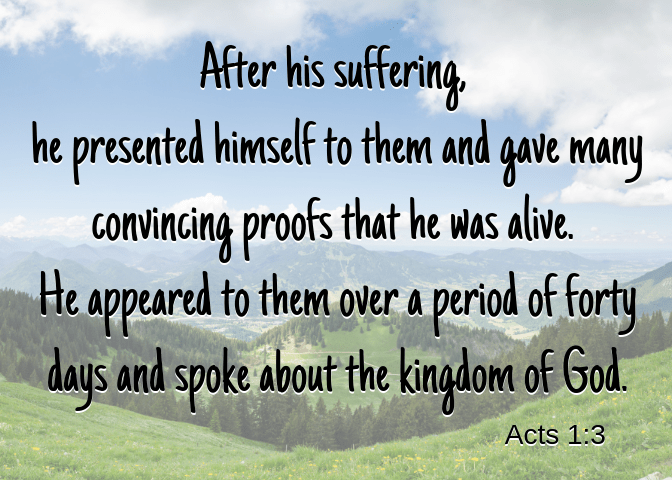
What is so interesting about it is that Christ doesn’t appear to one guy in a room with the door closed (we could chalk that up to lying or insanity). He doesn’t even appear to just the twelve. There are anywhere from 120 (Acts 1:15) to 500 (1 Cor. 15:6) witnesses who saw Jesus resurrected, walking around preaching and teaching and convincing them that He was real and not a figment of their imagination.
Were the disciples crazy? Scripture shows their flaws but none of them would have been delusional.
Were the disciples lying? That could have been refuted easily and wouldn’t they have quickly given up the story and admitted the lie. (We are getting ahead of ourselves, stay tuned.)
The important point to make is pretty clear. Jesus began a movement. The movement didn’t end with his death, but continued on far afterwards, presumably with him coming back to life. Over and over, this has been confirmed in the pages of Scripture and in the lives of believers. When I ask, “Do you believe Jesus is alive?” I am really asking three question.
Is scripture trustworthy about its claims? If yes, then we must believe Jesus is alive.
Are believers trustworthy about their claims? If yes, then we should trust scripture, and should believe that Jesus is alive.
Have you experienced Jesus? If yes, then tell others that Jesus is alive.
So, do you believe Jesus is alive?
-Jake Ballard
_____________________________________________________________________________
*For my part, I think when the Bible tells a narrative, we should trust the narrative to be historically accurate, and when it tells poetry and myths, we don’t hold poetry and myths to that same standard. That discussion takes a lot to unpack… if you are intrigued, be on the lookout for a Young Adult Class coming to FUEL this Summer!

He is RISEN! He is RISEN INDEED!

John 20

John 20 8

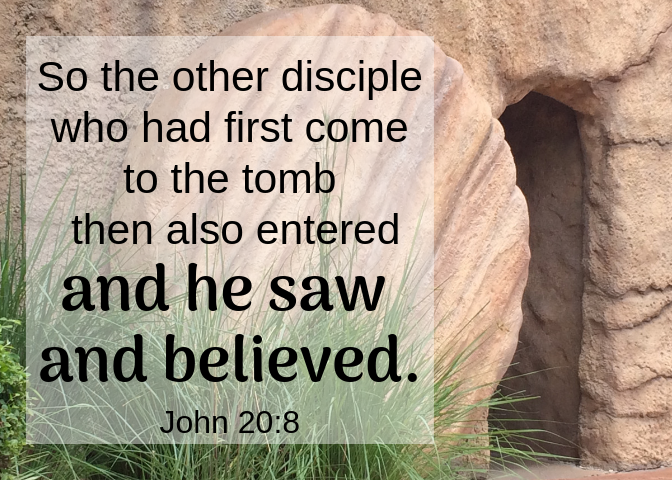
In John 20, we see Christ has been raised. He is no longer in the tomb. The stone was rolled away and he lives.
The Darkness is over!
The LIGHT HAS DAWNED!
The Light who gives light to every person is ALIVE.
Praise the God who gives life to the Light who shines forth in the Darkness. The Darkness COULD NOT overcome the Light.
However, in this metaphorical language, taken straight from the mouth of John, I don’t want to lose sight of the amazing couple of statements made at the end of the chapter.
John specifically says exactly why he wrote the book.
“These [things] have been written so that you may believe that Jesus is the Christ, the Son of God; and that believing you may have life in His name.”
You have read through the entire book of John. You have read the prologue of chapter one. You have read the “book of signs”, from chapter 2 to 12, and the seven signs Christ performed. You have read the “book of teachings”, from chapter 13 to 17 and all the things that Christ tells us there. Finally, you have read the “book of glory”, from chapter 18 to 20, all about how he receives his exaltation in the crucifixion and the greatest exaltation of the resurrection.
The reason for each “book”, for every chapter, for every phrase, for indeed EVERY WORD, all of it was for you to at the end say “I believe that Jesus is the Son of God.”
Do you believe? Do you believe that Jesus, the one performing miracles, the one speaking truth, the one who died, is the Son of God? Do you have life in his name?
If you don’t, don’t wait. On this day, as we celebrate Christ raised to life, I want to celebrate that YOU have been raised to life. Talk to your mom or dad, grandma or grandpa, legal guardian, your pastor or youth worker, your best bud who believes… talk to ANYONE about giving your life to Jesus, about getting baptized, about believing in the name of Jesus and experiencing life and life abundantly.
If you believe, remember, that today we speak of Jesus and we say
“He is Risen indeed.”
In the future, Christ will say of you, believer,
“My Brother, my sister, the children of my Father, they are all risen. They are RISEN INDEED!”
Amen,
Come Lord Jesus.
-Jake Ballard

The Spirit of God

JOHN 14

John 14 16

Today, we will continue what we started yesterday, what scholars call “The Upper Room Discourse.” Many people believe that the teaching of Jesus from John 13-17 were all taught to the disciples the night before he died. (They were in the upper room of a house, hence the name.) When Jesus speaks, he encourages the disciples to not be troubled. Though he will not be with them in person, he promises something else. What does he promise?
A counselor. (v16) The Spirit of Truth. (v. 17)
Jesus says that the Spirit will come, who will counsel the disciples and guide them into all truth.
What is the Holy Spirit?
This is a question that has perplexed theologians in Churches around the world for quite some time. Jesus says here that he will send the Spirit, and that he will come to be with his disciples. Is he the Spirit? No, because it’s clear in John that there is a difference between Jesus and the Spirit. And that same difference is found in verse 26 in regards to the Spirit and the Father. So the Spirit is something other than the Father and the Son. This have led some to conclude that the Spirit is a distinct person, being, or entity, but this is problematic, because in many ways the Spirit is described in non-personal terms. (Spirit comes from the Greek word πνευμα, meaning wind, breath or spirit.) It is poured out, given, and we are baptized into it. However, at the same time, the Book of Acts, and here in John, Jesus and his early followers listen to the Spirit deciding things and guiding and teaching.
So what is the Spirit? Another name for God or Jesus, or the power of God in action, or even a Person?
I don’t know.
For a long time, the words “I don’t know” made me terribly uncomfortable. They made me feel weak, like I wasn’t living up to my potential. (In truth, being a nerd AND a member of the CoG, I was getting social AND theological pressure to know everything.) However, I’ve come to know that I CAN’T know completely; the language about the Spirit is not about knowing and controlling but about submitting, relating and embracing. When the Spirit guides the disciples in the book of Acts, they submit, not ask what is guiding them. When Paul is encouraging his brothers and sisters to love in Corinth he writes “The grace of the Lord Jesus Christ, and the love of God, and the fellowship of the Holy Spirit be with all of you.” When the Spirit comes, the Spirit is coming from God and in the name of Jesus. Do I trust Jesus enough to allow whatever the Spirit is to effect me in such a way that the Spirit changes me?
As you read this language in John about Spirit and what the Spirit will do, don’t get lost in the weeds asking questions about what the Spirit is. At some point, there can be a time and place for that discussion. But today, right here and now, ask God to send that Spirit in the name of Christ into your life. When Jesus breathed on his disciples (John 20:22) and gave them his Spirit, when fire fell in Acts 2 and they were refilled in Acts 4, those disciples were more concerned about how God was going to help them live tomorrow. If you need the power of God on a Monday morning (or evening or night) what you need is to say with me…
“Lord I don’t know everything, but I know that I need your Spirit.”
And that is a prayer God will answer in the name of Jesus.
-Jake Ballard

Opposite Reactions – Opposite End Results

John 12

John 12 46

John 12 opens with Jesus attending a dinner held in Jesus’ honor.  Lazarus, whom Jesus had raised from the dead was among those eating at the table.

While he was there, a large crowd came, not only to see Jesus, but also to see Lazarus, whom Jesus had raised from the dead.  Then we read… 10 So the chief priests made plans to kill Lazarus as well, 11 for on account of him many of the Jews were going over to Jesus and believing in him.

I am astounded at the lengths to which the religious leaders of Jesus’ day would go to deny Jesus.  They saw all the miracles, but rejected Jesus anyway.  Even after Jesus raised Lazarus from the dead, they still wouldn’t believe.  And because so many others believed, the religious leaders wanted to kill Lazarus again, to stop people from following Jesus.  Wow.

At this same meal, we see someone with an opposite reaction.  While Jesus was reclining at the table, Mary, Lazarus’ sister, poured expensive perfume on Jesus’ feet, and wiped his feet with her hair.  We’re told the perfume was worth a year’s wages.  We’re told in Matthew 26:13, where we also find this story, Jesus said,” 13 Truly I tell you, wherever this gospel is preached throughout the world, what she has done will also be told, in memory of her.”   And indeed, we’re still talking about this today.

Much later in John 12, we find this in verses 44-46:  44 Then Jesus cried out, “Whoever believes in me does not believe in me only, but in the one who sent me. 45 The one who looks at me is seeing the one who sent me. 46 I have come into the world as a light, so that no one who believes in me should stay in darkness.

The chapter closes like this… “the very words I have spoken will condemn them at the last day. 49 For I did not speak on my own, but the Father who sent me commanded me to say all that I have spoken. 50 I know that his command leads to eternal life. So whatever I say is just what the Father has told me to say.”

So again, we have a decision to make.  Will we believe in Jesus, honor him like Mary did with our actions and our wealth, and live in his light?  This leads to eternal life.

Or will we reject him, like the religious leaders of his day, and stay in darkness (and be condemned at the last day)?

I choose life.  What about you?

-Steve Mattison


Stake Your Life on This

John 11

John 11 25

In John 11, Jesus received word that his dear friend was very sick, and yet Jesus stayed where he was for two more days before heading to Bethany, where Lazarus was.  When he finally got there, Lazarus had been dead for four days.

Martha, Lazarus’ sister came out to meet with Jesus, and we have a record of their incredible conversation.

21 “Lord,” Martha said to Jesus, “if you had been here, my brother would not have died. 22 But I know that even now God will give you whatever you ask.”

23 Jesus said to her, “Your brother will rise again.”

24 Martha answered, “I know he will rise again in the resurrection at the last day.”

25 Jesus said to her, “I am the resurrection and the life. The one who believes in me will live, even though they die; 26 and whoever lives by believing in me will never die. Do you believe this?”

27 “Yes, Lord,” she replied, “I believe that you are the Messiah, the Son of God, who is to come into the world.”

I love these incredible statements of faith:  If Jesus had only been there, he could have healed Lazarus.  Even now, God would give Jesus anything Jesus asked.  “I know he will rise again in the resurrection at the last day.”  “I believe you are the Messiah, the Son of God.”

No wonder Jesus loved this family.  They were devout followers of Christ with amazing faith.

You know the rest of the story.  Jesus told them to roll away the stone.  Martha said basically, “he’s going to stink, he’s been dead four days.”

40 Then Jesus said, “Did I not tell you that if you believe, you will see the glory of God?”

Then Jesus called in a loud voice, “Lazarus, come out.”  And the dead man came out!

Many people believed in Jesus because of this miracle.  But not everyone believed. The Pharisees’ response was, “If we let him go on like this, everyone will believe in him…” and they plotted to kill him.

How is it possible to have such diametrically opposed reactions?  Unfortunately, we see a similar range of reactions to Jesus today, from faithful devotion to hostility.

I don’t know about you, but I want to have the same reaction Martha demonstrated.  And I’m staking my life on verses 25 and 26.  I want to encourage you – do the same.  And I’ll look forward to seeing you at the last day.

-Steve Mattison


Don’t be Mutton

John 10

John 10 14

In John chapter 10, we find Jesus telling a story about shepherds and sheep.  A person who is hired to protect the sheep will run away when his own life is in danger (like when a wolf comes), and abandons the sheep.  The true shepherd will put his life in harm’s way to defend his sheep.  Then we find this gem in verses 14 through 18:

14 “I am the good shepherd; I know my sheep and my sheep know me—15 just as the Father knows me and I know the Father—and I lay down my life for the sheep. 16 I have other sheep that are not of this sheep pen. I must bring them also. They too will listen to my voice, and there shall be one flock and one shepherd. 17 The reason my Father loves me is that I lay down my life—only to take it up again. 18 No one takes it from me, but I lay it down of my own accord. I have authority to lay it down and authority to take it up again. This command I received from my Father.”

I see a couple of things in these verses that I’d like to comment on.

We all know that we are his sheep, and that Jesus laid down his life for his sheep.  We may be less focused on Jesus’ comment that he has other sheep not of this sheep pen that will listen to his voice and be part of the same flock.  In Jesus’ day, he was talking with the Jews, who thought they were the exclusive people who could have a relationship with God.  Jesus was pointing out that non-Jews would also come to God through Jesus.

Then we see this phrase in verse 17 that says God loves Jesus because Jesus is going to lay down his life.  I believe Jesus was saying that it was his decision whether or not to completely obey God.  He had the authority to obey, and lose his life.  He also had the authority to disobey, and retain his life.  My interpretation for all of this is:  Jesus had complete free will to do whatever he chose to do, just like we have free will.  It’s just that Jesus always chose to do God’s will.  This is exemplified in Jesus’ willingness to follow God’s will, no matter what, even to the point of suffering and dying.  And God loves that fact about Jesus.  (As an aside, this attribute of Jesus is undoubtedly why God said, “This is my son in whom I am well pleased, listen to him.”)

You might be thinking, “This is a nice story, but how does it apply to me?”

I’m glad you asked.

First, I want God to be pleased with me.  And I project from this story that if I am obedient to God like Jesus was obedient to God, I will please God.  So, I’d like to challenge you to be completely obedient to God as well.

Second, I might tend to think, like the Jews, that I, or my church, or my denomination have an exclusive relationship with God.  I need to remember that Jesus is the Good Shepherd, not me, and he (not me) gets to decide who are and who are not his sheep.

Finally, we see from this passage that Jesus knows his sheep, and his sheep know him.  Wolves are prowling around outside the sheep pen.  If you’re not in the protection of the pen, being protected by the Shepherd, you’re going to be mutton.  So if you don’t know Jesus, there’s no time like today.

-Steve Mattison

In the Pool of Siloam

John 9

John 9 35 36.png

In John 9, we see the story of Jesus healing the man born blind.  You know the story… Jesus spat on the ground, made some mud, put the mud on the man’s eyes, and had him go wash in the Pool of Siloam.  After the man washed, he could see.

We’re told the story again as he told his neighbors the story.  Then, we’re told again as he told the Pharisees the story.

The Pharisees are so hung up on the fact that Jesus did this on the Sabbath (and therefore broke the law, so therefore he must be a sinner), that they totally miss the magnitude of the miracle.  They were saying Jesus was a sinner, others were saying, “How can a sinner do such miraculous signs?”  So they were divided.

The Pharisees didn’t even believe the man had been blind, so they called his parents to testify that he was their son, and he was born blind.  The Pharisees asked him again how he came to see, since Jesus was clearly a sinner, in their mind.  The man had a great response:  25 He replied, “Whether he is a sinner or not, I don’t know. One thing I do know. I was blind but now I see!”

The man then scolded the Pharisees for not knowing who Jesus was, since no one had ever opened the eyes of a man born blind.  Clearly Jesus couldn’t do this if he was not from God.  And if they were really God’s representatives, they should know Jesus.

At this, the Pharisees heaped insults on him, and threw him out of the church.

Jesus found the man, and asked him if he believed in the Son of Man?  (This was a favorite title Jesus used of himself.)  I love the exchange that followed:  36 “Who is he, sir?” the man asked. “Tell me so that I may believe in him.”

37 Jesus said, “You have now seen him; in fact, he is the one speaking with you.”

38 Then the man said, “Lord, I believe,” and he worshiped him.

This man recognized the amazing transformation Jesus made on his life, he believed, and worshiped Jesus.

For those of us who were born and raised in the church, it’s sometimes hard to recognize the amazing transformation Jesus has made (or should have made) in our lives.  We don’t necessarily acknowledge that “I once was blind, but now I see.”  And how often are we overwhelmed and say, “Lord, I believe” and worship him?

The Pharisees, even though they knew what to look for in a Messiah, were blind to who Jesus was, despite amazing miracles.

So who are you most like in this story?  The man born blind, or the Pharisees?

If you haven’t yet received Jesus as your Lord and Savior, ask him today, “tell me so that I may believe.”  And for the rest of us, today is a good day to focus on Jesus, say, “Lord, I believe”, and worship him.

–Steve Mattison


IF you Believe, THEN…

John 8

John 8 31 32

As we have read repeatedly in the last two chapters, we see again in John 8:30, 30 Even as he spoke, many believed in him.

Then Jesus shared this powerful truth:

31 To the Jews who had believed him, Jesus said, “If you hold to my teaching, you are really my disciples. 32 Then you will know the truth, and the truth will set you free.”

This passage points out that while belief is important, belief alone is insufficient.  If I’m completely honest, I don’t like the implications of this passage.  I want to just believe and know I’m ok.  Unfortunately, I see a similar warning in James 2:19, where we’re told, “Even the demons believe – and shudder.”

Now Jesus has my attention.  If belief alone isn’t enough, what does He expect? I interpret these two verses as Jesus giving his followers a series of If .. Then conditions:

  1. If you hold to my teaching (which I interpret as meaning: you need to live your life like Jesus told you and demonstrated to you).
  2. Then you are really my disciples (meaning, you’re not really His follower unless you do what He told you to do.)
  3. If you are really my disciples, then you will know the truth. (This suggests to me that people can’t even understand the truth unless they are really Jesus’ disciples.)
  4. Finally, when one knows the truth, the truth will set them free.


The believers Jesus was talking to had the same reaction I tend to have.  Wait a minute, set me free?  I’m not a slave.


Jesus went on to say that anyone who sins is a slave to sin, and Jesus came to set people free from sin.


This is really interesting to me.  As members of a denomination that claims to have the faith of Abraham, we may tend to think we have a corner on the market for faith and truth.  But how focused are we on the holiness message Jesus is sharing in this passage?  This should challenge us.

Verses 35 and 36 go on to say, 35 Now a slave has no permanent place in the family, but a son belongs to it forever. 36 So if the Son sets you free, you will be free indeed.

I don’t know about you, but I want a permanent place in God’s family.  But to have that place, I need to be set free – first, from sin, and ultimately from death.


This requires adding to belief:

  1. Following Jesus’ teaching
  2. Becoming his disciple
  3. Knowing the truth
  4. Having Him set me free.

Sign me up!  How about you?

-Steve Mattison

Judging Jesus

John 7

John 7 24

In John 7, we see multiple examples of people struggling to believe in Jesus because he didn’t fit their expectations of the Messiah.

In verse 27, the people were saying, 27 But we know where this man is from; when the Messiah comes, no one will know where he is from.” I don’t know what scripture or teaching they were relying on, but they were confused, and it prevented their believing.

Despite his not meeting their expectations, verse 31 tells us, 31 Still, many in the crowd believed in him.  They said, “When the Messiah comes, will he perform more signs than this man?”

The religious leaders heard the crowd whispering about him, and sent temple guards to arrest Jesus.

40 On hearing his words, some of the people said, “Surely this man is the Prophet.”

41 Others said, “He is the Messiah.”

Still others asked, “How can the Messiah come from Galilee? 42 Does not Scripture say that the Messiah will come from David’s descendants and from Bethlehem, the town where David lived?” 43 Thus the people were divided because of Jesus. 44 Some wanted to seize him, but no one laid a hand on him.

45 Finally the temple guards went back to the chief priests and the Pharisees, who asked them, “Why didn’t you bring him in?”

46 “No one ever spoke the way this man does,” the guards replied.

47 “You mean he has deceived you also?” the Pharisees retorted. 48 “Have any of the rulers or of the Pharisees believed in him? 49 No! But this mob that knows nothing of the law—there is a curse on them.”


We see three general categories of people in John 7.

First, some people just believed in Jesus because of the miracles he did and because of his teaching.

Second, some wanted to believe, but they knew some scripture (like the Messiah was to come from Bethlehem), and they thought they knew some facts (like Jesus came from Galilee, and not from Bethlehem), and they couldn’t reconcile the two – so they struggled to believe.

Third, we see the religious leaders, who knew the scriptures far better than the common people, but flatly rejected Jesus — partially because he broke the letter of the law by healing people on the Sabbath, and partially because he was disrupting their hold on the religious establishment of their day.

It’s easy to look back at those people and think, “They were so stupid.  Why didn’t they just believe?”  What about us?  Are we any better?  Do we have pre-conceived expectations of God, or Jesus, or Christianity that just don’t seem to fit our knowledge or experiences, so we’re struggling?  Have we studied the Bible so much that we already “know it all” (like the Pharisees), and are relying more on our knowledge of scripture than relying on our relationship with God and His son?  Or will we take Jesus at his word, as recorded in John 7: 24… 24 Stop judging by mere appearances, but instead judge correctly.”

The good news is, regardless of whatever you decided before, you get to make your choice again today.  Choose wisely.


–Steve Mattison