Financial Peace

When you hear the term financial peace, you may think of Dave Ramsey and his teachings about finances.  He has a lot of good advice and I recommend you read his books to discover great ways to be good stewards of your money.  He will show you how to overcome your financial difficulties and will help you put your mind at ease.  However, true financial peace isn’t about having enough money; it is the realization that money is not very important and God will take care of your needs.  Of course, this guarantee only applies to those who trust in God and seek His kingdom first.

This is the last devotion of the week and I would like to list the reasons why people experience financial trouble and solutions to those issues.  Much of this is just common sense, but I think it is important for people to realize that there may be consequences for our actions, but there is a way out of the struggle.

I believe the number one reason people stress over their finances is because they have purchased things that they could not pay for by using credit cards and taking out loans.  I can relate to this one.  Obviously, the first step to a solution or a way to avoid this altogether is to not use credit cards or take out loans.  If you don’t have the cash to buy something, don’t buy it.  This might be very difficult to do, but Hebrews 13:5 is a good verse to remember.  “Keep your lives free from the love of money and be content with what you have…”  If you are content with what you have, you will not be so anxious to buy something you can’t afford.

An obvious reason you may be experiencing trouble with finances is that you don’t work.  We talked about the need to work earlier this week.  Proverbs 10:4 says, “Lazy hands make for poverty, but diligent hands bring wealth.”  Enough said.

Another reason you “think” you are having financial difficulty is that you “think” you don’t have enough money.  Recall that we learned that more than a third of the world’s population lives on less than $2 per day.  If you live in the United States, you are probably better off than you think, even if you are not keeping up with those around you.  If you don’t worry about where your next meal is coming from and you have a place to sleep, you may just need a different perspective about your situation.

Proverbs 21:17 warns us that whoever loves pleasure will become poor.  The simple solution to that is to not love pleasure, but let’s dig a little deeper.  Why would someone love pleasure?  People who love pleasure are living for themselves.  If you live for God and not for yourself, you will not have trouble with this one.

I think the most difficult situation to deal with is a tragedy.  There are many different tragedies that can wreak havoc on a person’s life.  Accidents, illnesses, fires, hurricanes, crime, etc. are many times out of our control and cannot be avoided.  We can take steps to avoid some tragedies or at least lessen their chances, but being a Christian does not mean you won’t experience a tragedy.  There may be consequences to a tragedy that you did not deserve, but I can tell you that if you put your trust in God, He will make sure your needs are met.  One way He helps people get through these tough times is to engage others to help you.  I would encourage you to keep your eyes open for people that need help and to be that help that they need.

Lastly, Luke 12:29-31 says, “And do not set your heart on what you will eat or drink; do not worry about it.  For the pagan world runs after all such things, and your Father know that you need them.  But seek His kingdom, and these things will be given to you as well.”  This is actually a pretty key concept about financial peace.  If you seek His kingdom, God will take care of your needs.  However, if you are not seeking His kingdom, I can understand why you are worrying about your finances.  You should be worried.

I hope these devotions this week have given you some clarity about money.  I was confused about money before I searched the scriptures for some answers.  I now have a much better understanding of the role money should or should not play in my life.  The Bible is pretty big, but I love that there is so much to learn if you take the time to search it out.  Thank you, God, for sending us your words of wisdom.

-Rick McClain

Today’s Bible reading plan passages can be read or listened to at Biblegateway.com here. Isaiah 59-60 and Titus 1

Got Money?

We’ve talked about giving money to the church, but is there anything else we should be doing with our money?  I found several ways in the Bible that we should be using our money.

The first way is not necessarily the most important thing I learned during my study of money in the Bible, but it is the most surprising thing I found.  Jesus told us to use worldly wealth to gain friends for yourselves.  Yup, we are encouraged to buy our friends.  People have a hard time believing Jesus said that, but look at it for yourself in Luke 16:9.  I think he is trying to tell us that relationships are important, and buying someone a lunch may be the start of a friendship that could have eternal consequences in a good way.

It is not surprising to hear that we should provide for our relatives, especially our own household in 1 Timothy 5:8.  However, it is bit shocking that the verse tells us that we have denied the faith and are worse than a non-believer if we don’t.  Worse than a non-believer!  Don’t ignore the financial needs of your relatives.

1 John 3:16-18 questions if the love of God can be in someone who has material possessions and sees a brother or sister in need but has no pity on them.  The verse in Timothy was talking about our relatives, but notice that these verses are referring to our brothers and sisters in Christ, our church family.

Deuteronomy 15:7-11 goes a step further by telling the Israelites that they should give generously to fellow Israelites who are poor.  This opened the giving beyond the church family to any poor people in their community.  In verse 9 it warns them that if they show ill will toward the needy and give them nothing, they will be found guilty of sin.  It’s not just a good thing to give to the poor, it is a sin if you don’t.

Along those same lines, Proverbs 21:13 states that whoever shuts their ears to the cry of the poor will also cry out and not be answered.  Ouch.

Acts 4:32-35 is not a commandment for us to follow, but it is an interesting way that believers took care of each other.  No one claimed that any of their possessions were their own and they shared everything they had so there were no needy people among them.  They went so far as to sell their land or houses and give the money from the sales to the apostles so they could distribute it to anyone in need.  It mentioned that God’s grace was powerfully at work in them all.  Would you be willing to sell your house for a brother or sister in need?

I hope the verses we covered today were enlightening or a good reminder if you had heard them before.  I think Proverbs 3:9-10 sums up pretty well what we should be doing with our money.  It says to honor the Lord with your wealth.  I would feel pretty good about honoring the Lord, but wait, there’s more.  It says your barns will be filled to overflowing and your vats will brim over with new wine if you honor God with your wealth.  And I think it is safe to say that some really nice blessings would be headed your way even if you don’t have a barn or a vat.

Got money?  Honor the Lord with it.

-Rick McClain

Today’s Bible reading plan passages can be read or listened to at BibleGateway.com here – Isaiah 57-58 and 2 Timothy 4

Is it OK to be Rich?

More than a third of the world’s population lives on less than two dollars a day according to research done by the United Nations.  You might not consider yourself rich if you compare yourself to others in the United States (and many other countries), but most or all of you are probably quite rich when looking at the whole world.  Is it ok to be rich?

Let’s first consider Solomon, the richest king that ever was.  God gave him wealth, possessions, and honor such as no king before or after him (2 Chronicles 1:12).  God made Solomon rich, so the good news is that we have an example of someone who was very rich and it was ok in God’s eyes.

Being rich may be ok, but the rich young man in Matthew 19:16-24 received advice from Jesus that made him sad.  Jesus told him if he wanted to be perfect, he should sell his possessions and give to the poor.  He then told his disciples that it is hard for someone who is rich to enter the kingdom.  Jesus had more to say about the matter in Luke 6:20-26.  He said, “Blessed are you who are poor, for yours is the kingdom of God.”  He went on to say, “But woe to you who are rich, for you have already received your comfort.”  Jesus was warning us that being rich could interfere with your salvation.

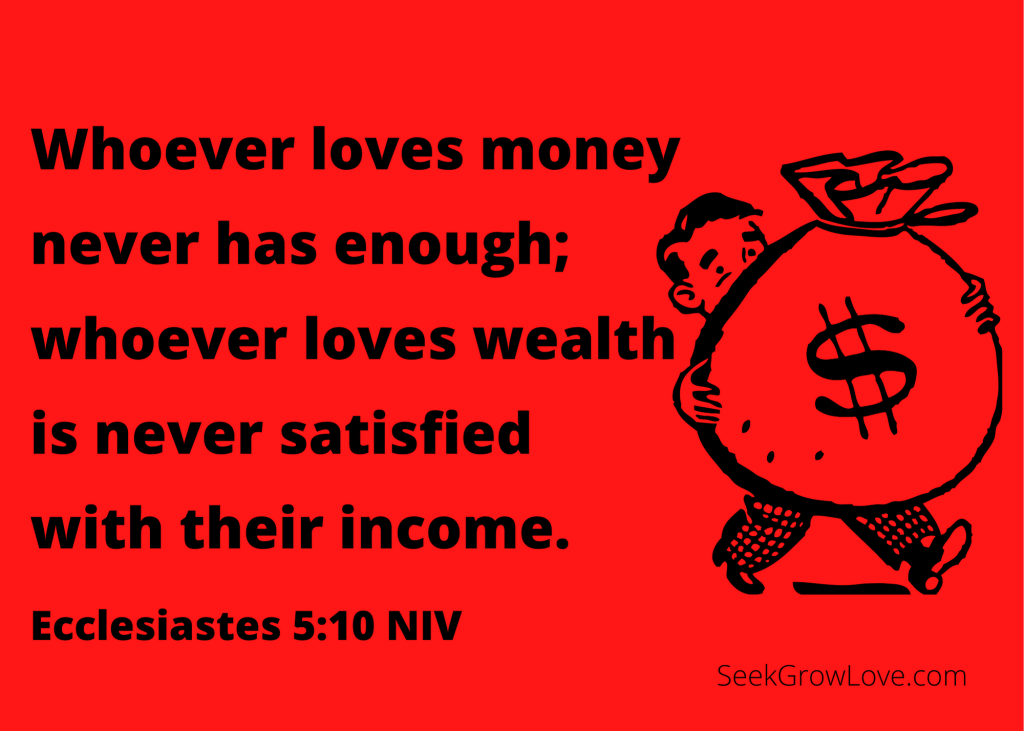
Ecclesiastes 5:8-20 says that whoever loves money never has enough, and whoever loves wealth is never satisfied with their income, and this is meaningless.  It also says that the abundance of the rich permits them no sleep.  However, it also says that it is appropriate for a person to eat, drink, and find satisfaction in their labor during the few days God has given them.  It explains that it is a gift from God when He gives someone wealth, possessions, and the ability to enjoy them.

This may be a bit confusing to hear that wealth can be good or bad.  I think it all boils down to your attitude and how you spend your money.  If money is your master, you are always wanting and trying to get more, and you spend it all on yourself; that is bad.  If you realize that your money comes from God, is actually owned by God, and is not the focus of your life, it is fine to enjoy that gift from God from time to time.

I now want to change gears a bit here and talk about yesterday’s devotion on tithing a bit more.  I said it was not mentioned in the New Testament that we should tithe.  However, there are two verses in the New Testament (Matthew 23:23 and Luke 11:42) that talk about the Pharisees giving a tenth of their spices and Jesus scolding them for neglecting justice, mercy, faithfulness, and the love of God, and saying they should have practiced the latter without neglecting the former.  I do not consider these two verses a mandate for us today to tithe ten percent of our earnings, although I can see how it can be interpreted that way.  These individuals were giving a tenth of their spices and Jesus said they should continue to do that.  If they had said they were fasting, I think Jesus might have told them to continue to do that, but I don’t think that necessarily means we all must fast today.

I could be wrong about this, but I don’t think the ten percent tithe is a specific rule we must follow today like the many rules they were required to follow in the Old Testament.  However, I definitely believe we should be giving money to the church, and I think it would be fine to look at what they were instructed to do and model that by giving ten percent of your earnings to the church.  I also believe it is possible that God wants some people to give more than ten percent.

Paul never discussed tithing ten percent, but he did talk about giving.  In 2 Corinthians 8:3, he said the Macedonians gave as much as they were able, and even beyond their ability.  In 2 Corinthians 9:6-7 he says, “Remember this:  Whoever sows sparingly will also reap sparingly, and whoever sows generously will also reap generously.  Each of you should give what you have decided in your heart to give, not reluctantly or under compulsion, for God loves a cheerful giver.”  In Paul’s first letter to the church in Corinth, he told them that they should set aside a sum of money in keeping with their income on the first day of every week (1 Corinthians 16:2).  I think if it was still a rule to tithe ten percent, Paul would have mentioned it, but instead he talked about giving with the proper attitude and according to your income.

-Rick McClain

Today’s 2021 Bible reading plan passages can be read or listened to at BibleGateway.com here – Isaiah 55-56 and 2 Timothy 3

To Tithe or Not to Tithe

Our discussion this week about money would not be complete without talking about tithing.  Many believe that we should be giving ten percent of our earnings to the church, which is called tithing.  I must admit that I was very surprised when I researched the topic of money to find that it was not mentioned in the New Testament that we should tithe.  Does that mean we are not required to tithe anymore?

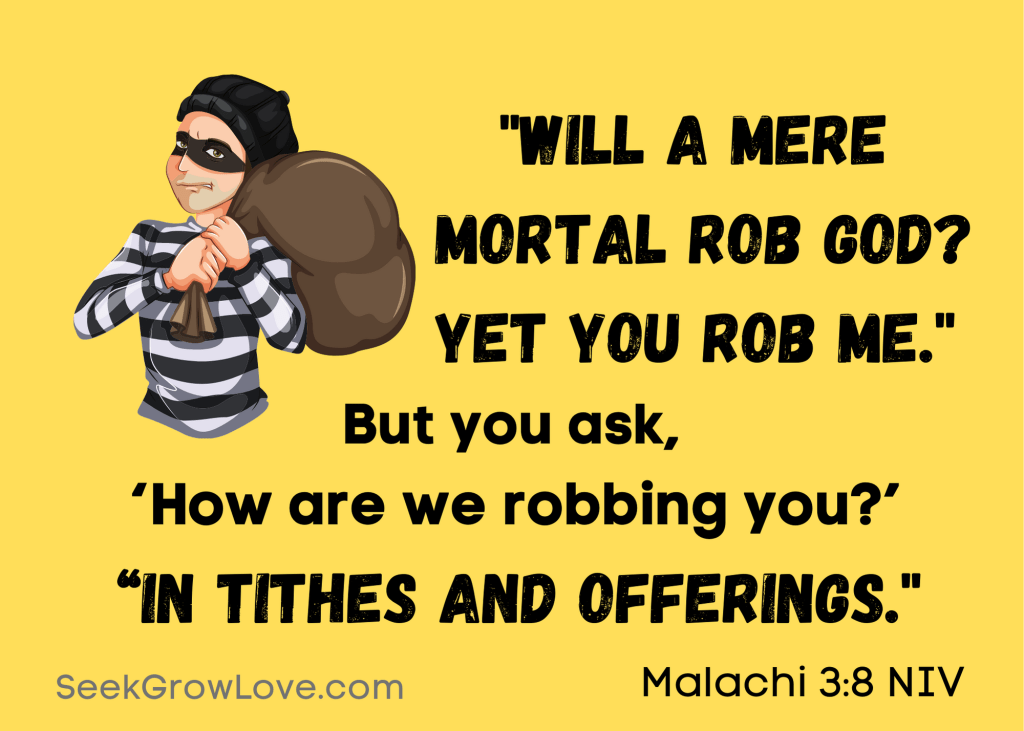
Let’s start with some Old Testament history.  Tithing was a practice back then (Malachi 3:8-12), but if you think you should be following the guidance from the Old Testament, you need to read about all the ways to give money to the church.  I won’t go into great detail, but there were some pretty elaborate rules about giving.  Check out Deuteronomy 14:22-29, Numbers 18:21-32, Numbers 18:8-11, and especially Leviticus 27:1-21.  For example, in Leviticus, if anyone dedicates their house to the Lord, a priest will judge its quality and set a value on it.  If the homeowner wants the house back, they can redeem it by adding a fifth to its value.  You could also dedicate people to the Lord by giving an equivalent value.  A male between the ages of twenty and sixty was valued at fifty shekels of silver, while a female between one month and five years was valued at three shekels of silver.  Of course, we are not under the Old Testament law anymore, so these rules are not in place anymore, including tithing.

Again, the talk of tithing is absent in the New Testament so what should we do about giving money to the church?  I don’t believe there is an exact calculation to follow so I am going to give you my opinion about what should happen.  First, we do not need to follow Old Testament rules anymore, but I think we can learn about God and how he operates by looking at the rules in the Old Testament.  Giving ten percent was a popular theme in the Old Testament.  I think that is probably a good starting point for our giving today.  If God liked using that percentage back then, I think it is likely He still thinks that is a good percentage today.  However, don’t forget that there were other rules for giving that didn’t simply follow the ten percent rule, so it is probably a bit naïve to think that is exactly what we need to do today.

Yesterday we learned that all our money is God’s money, not our own.  I think we need to consider that when deciding on how much to give to the church.  Furthermore, some of God’s money should probably be given to areas outside of the church.  For instance, your neighbor’s house burns down.  God may let you know that it is a great idea to send some money their way to help them get back on their feet.  Should that come out of the ten percent?  That is a trick question.  We should not be concerned about a particular percentage when 100% of the money we have is God’s.  We need to figure out the best way to use that money by listening to God and trying to understand His desires for that money.  I think He may want some to give twenty percent, fifty percent, or maybe even more to the church.  Perhaps, someone is in a tough situation right now and five percent is the right amount.

I do think church is important, and I do think it is important to give money to the church to further God’s work.  I would not want to be selfish in that regard and spend too much on myself and neglect the church.  If you want to know what is important to yourself in life, just look at what you spend your money on and what you do with your time.  If you don’t spend very much money and time on church, then church is not important to you.  If church is important to you, you do not have to tithe to it, but I encourage you to make God’s day by giving an appropriate amount to His work.

-Rick McClain

While this week we are discussing a Christian perspective on money…you can still keep up with your Bible reading plan. Today’s Bible reading passages can be read or listened to at BibleGateway.com here – Isaiah 53-54 and 2 Timothy 2

My Money

Many people work hard for their money, some have inherited their money, and others make money in many ways.  Most of us feel good about the money we have, even if it isn’t that much, but is the money really ours?  Today we are going to talk about the heart of the matter when it comes to a Christian perspective about money.  The most important thing you need to understand about your money is that it is NOT your money.

Psalms 24:1 states that the earth and everything in it is the Lord’s.  God says that the silver and gold are His in Haggai 2:8.  1 Corinthians 6:19-20 tells us that we don’t even own our own bodies; they were bought at a price.  God owns everything, including your money.  That makes you the manager.  He is the owner, and you are the manager that works for Him.

If this is a new idea to you, it can be a game-changer.  Have you ever been upset when your car broke down and you wondered how you were going to pay for the repairs?  Let me explain this situation with our new lens.  Let’s pretend you work for UPS (unless you actually do work for UPS; then you don’t need to pretend).  Let’s pretend that the UPS truck you drive breaks down and needs major repairs that will cost a lot of money.  Are you going to be upset about that, or are you just going to let someone know that your truck broke down and ask for a different one to drive?  You aren’t going to be too upset because you don’t own the truck, UPS does.  You know they have plenty of money to fix it and you won’t lose any sleep worrying about the cost of the repair.  When your car, I mean God’s car, breaks down, you shouldn’t be worried about the cost of the repair.  I’d be quite sure God is not up in heaven wondering how He is going to get through this problem.

Let’s try another one.  Someone steals $100 out of your wallet.  That tends to make us upset.  Let’s pretend this time that we work for Wal Mart as a cashier and someone steals $100 out of your cash register at gunpoint.  Granted, being held up at gunpoint would be very stressful, but how concerned would you be that Wal Mart just lost $100?  You wouldn’t be concerned at all.  And God is not concerned about how He is going to help you get by with $100 less in your wallet.  He is pretty capable of finding solutions to help you get by so you should not be concerned when someone steals money from your wallet.

Having said that, it does not give us a license to be reckless with our money.  We are the manager of the money and we still need to act responsibly.  We shouldn’t be driving crazy and we shouldn’t leave our wallets sitting on our front porch.  But if bad things happen when you are acting responsibly, don’t sweat it; God is going to take care of you.

We have one last myth to bust with this new mindset.  Some Christians believe that if they give 10% of their money to God, the rest is theirs to do with it whatever they want.  Again, we don’t own 90% because God owns 100% of our money.  That doesn’t mean you can’t spend any money on yourself.  You are the manager, and you need to decide what an appropriate amount of spending on food, housing, clothes, vacations, etc. would be.

If you are a good manager, Luke 16:10-12 explains that someone who can be trusted with little can also be trusted with much.  It is likely that if you make good decisions with the money you are managing, God will trust you with more.

If you find yourself stressing out about finances, think about who really owns the money.  That should put your mind at ease because we both know that God is not stressing about your finances.

-Rick McClain


Today’s Bible reading plan passages can be read or listened to at BibleGateway.com here – Isaiah 51-52 and 2 Timothy 1

Work

Yesterday I tried to convince you that money is not that important.  So…you may be thinking, great, I don’t need to work that much.  Not so fast.  The Bible is pretty clear about the need to work.

Proverbs 10:4 says that laziness makes you poor and Proverbs 6:9-11 states that sleep brings on poverty.  Moreover, 1 Thessalonians 4:11-12 says that we should work and not depend on anybody.  Paul even gave the Thessalonians a rule concerning work.  He said, “The one who is unwilling to work shall not eat.”  He then told them that if someone refuses to work, they should not associate with that person in order that they may feel ashamed.  He said they should not regard them as an enemy, but they should warn them as a fellow believer.  Clearly, we need to work.

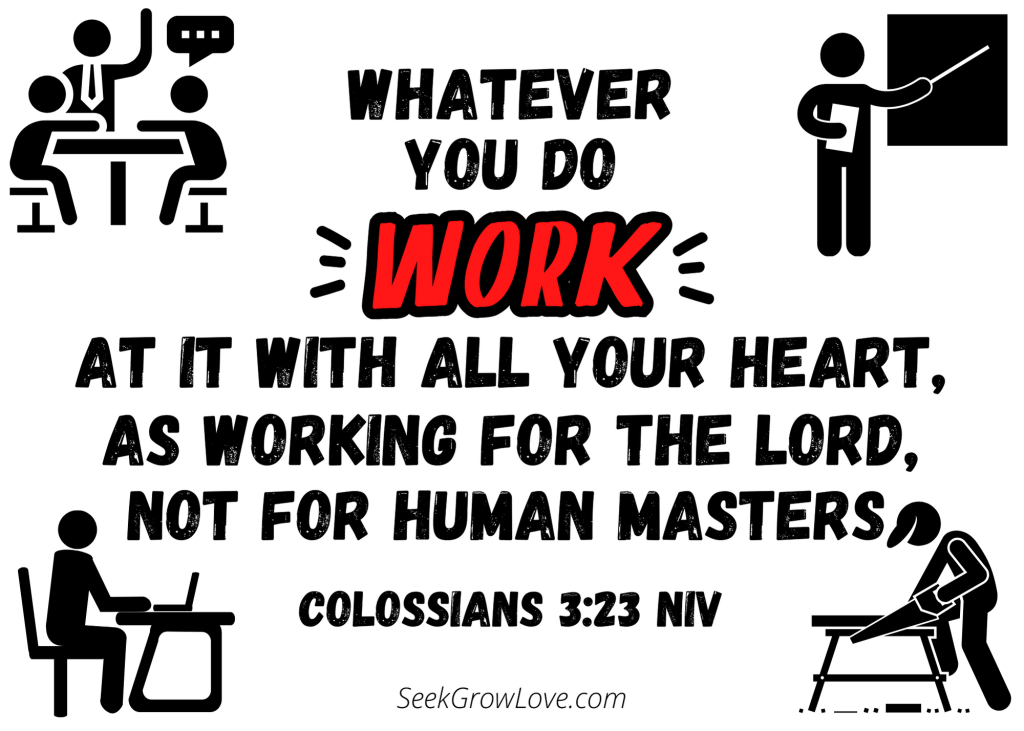
Work can bring us down sometimes.  If you are working in a job that you love, you are fortunate; good for you.  However, I think there are many who don’t love their job and are just doing it to get by.  I don’t think you have to love your job, but Colossians 3:22-24 tells us that whatever we do, we need to work at it with all our heart, as if we are working for the Lord, not for human masters.  We need to put forth our best effort at our jobs every day.  If something is worth doing, it should be done well.

Okay, we need to work, but how much should we work?  First, Proverbs 23:4-5 warns us not to wear ourselves out to get rich.  Again, don’t let money be your master.  Second, if you have made a decision to live your life for God, all of your time is God’s time, and He also has some work for you to do.  Ephesians 2:10 says that we are created to do good works, which God has prepared in advance for us to do.  If you are a Christian, you have some “God work” to get done.  Although, you shouldn’t try to think of ways that you can do work for God.  It said that God has already planned out your work for you in advance.  You just need to figure out what that work is.  If you are having trouble knowing what you should do for God, pray, listen to others, and be aware of what needs are around you.  God has given you a purpose in life and it is your job to fulfill that purpose.

We have a lot of work to do, but there is also good news for those that work.  Ecclesiastes 5:18-20 lets us know that it is appropriate for a person to eat, drink, and find satisfaction in their toilsome labor during the few days God has given them.  It goes on to say that when God gives someone wealth and possessions, and the ability to enjoy them, they should accept their lot and be happy in their toil because this is a gift from God.

Think about your own situation.  First, are you working or are you depending on others to meet your daily needs?  Second, are you working with all your heart or do you put forth less effort when nobody is looking?  Third, are you doing the work that God has prepared for you to do or do you use most of your time on yourself?  Fourth, do you work too much due to your drive to make more money?  Last, do you ever slow down enough to enjoy some of the gifts in this world that God has given you to enjoy?  If you struggle with any of these areas, work at it.  😊

-Rick McClain

Today’s 2021 Bible reading plan passages can be read or listened to at BibleGateway.com here – Isaiah 49-50 and 1 Timothy 6

How Important Is Money?

As a Christian, what am I supposed to think about money?  Do I need to give all my money away to the poor?  Can I take a vacation?  How much should I give to the church?  I know money can buy a lot of useful things, such as food, shelter, Bibles, church buildings, etc., but how hard should I work to earn money?  How much money do I need?  Can I put a steak on the grill when I know there are so many people starving?  These questions were gnawing at me because I wanted to do the right thing, but I wasn’t sure what the proper Christian perspective regarding money was.  Therefore, several years ago I set out to find as many answers as I could in the Bible.  I thought of every money term I could think of and looked up every verse I could find with those words.  I found a lot of answers that I would like to share with you this week.

I think many Christians are ultra-concerned about money.  They want to be good stewards with what God has given them.  They know they can do a lot of good with their money, so it becomes very important to them.  I used to think the same way, but my mindset shifted after I completed my study, and I no longer think money is that important.  Don’t get me wrong, we need money to survive, and we can do God’s work with the money we have, but our focus just shouldn’t be on money.  I find it weird to talk a whole week about something I don’t think is very important, but I think it is very important to get our thoughts about money right.

Money is a salvation issue.  Luke 16:13-15 says we can’t serve both God and money.  You must choose one or the other.  1 Timothy 6:6-10 warns that money is the root of all kinds of evil.  I think we have all seen and probably experienced how money can lead to sin.  Have you ever stolen something?  Have you ever cheated on your taxes by increasing a charitable deduction or not even paying taxes on money you have earned?  Have you ever spent your money foolishly on worldly things?  Are you so driven to make money because there is so much pleasure to buy in this world?  These verses tell us that our salvation is lost if money becomes too important to us.

Proverbs 23:1-8 was very confusing to me at first, but once my eyes were opened, it really helped me form my view about money.  The story is about dining with a ruler who provides all sorts of great food and dining with a stingy man who cuts corners with the meal to save money.  The verses say that both situations should be avoided.  It was easy to understand why eating with the rich man and giving in to gluttony was wrong, but why would it be so wrong to try to be prudent with your money and not overspend on a meal for your guests?  I had to read this several times before it hit me that the problem with the begrudging host was that he thought money was too important, even though he may not have had much of it.  Today we call this person “cheap”.  It might seem like you are being a good steward with your money by buying cheaper things, looking for all the deals, cutting coupons, etc., but it may also be a sign that money is too important to you.  I’m not saying you should never use a coupon or look for a great deal, but the point is that you want to be sure that money is not your master.

Psalm 49:5-20 points out the obvious, you can’t take it with you when you die.  Money is quite meaningless when you consider the big picture, living in a Kingdom for eternity.  You can work hard to make a lot of money and buy a lot of stuff, but it is all quite useless to you when you die.  Jesus was asked in Matthew 22:17-22 about paying taxes to Caesar.  He pointed out that it was Caesar’s image on the coin and told them to give back to Caesar what is his and give to God what is his.  It doesn’t sound like Jesus thought money was very important.

Hopefully you are realizing that money is not important, but you still might be thinking, “Hey, everyone needs some money to live in this world.”  That is true, and I think Proverbs 30:7-9 sums it up very well where our mindset should be.  Agur, son of Jakeh, asked the Lord to neither make him rich or poor, but just to give him his daily bread.  He didn’t want to make so much that he would disown God, and he didn’t want to be too poor and steal.  That seems like a pretty good place to be; you have what you need to live comfortably so your focus is not on money.

-Rick McClain

While our devotions this week will be following the important topic of not focusing on money – and having a proper attitude toward and use of our finances, if you’ve been using the Bible reading plan, keep it up! What important lessons are you finding? Today’s Bible reading plan passages can be read or listened to at BibleGateway.com here – Isaiah 47-48 and 1 Timothy 5

Let the World See

1 Timothy 1

Welcome!

Today’s passages seem to have some different main themes, so while all of these are valuable, we will be focusing mainly on 1 Timothy 1 for the purpose of keeping this devotional to a reasonable length 😊

1 Timothy 1 is written by a very dedicated and enthusiastic believer, Paul.  Paul is a very impressive man with an incredible testimony (that we get to see a little bit here) and clearly has a passion for the Kingdom.  This is why I sometimes have to re-read his messages to better comprehend just how deeply he cares for people and soak up all the energy for spreading the gospel he has!  Paul tells Timothy that God’s plan operates by faith (v. 4) and that our role as believers is to have love that comes from a pure heart, a good conscience, and a sincere faith (v. 5).  I LOVE that description of who Christians should be in the world!  Loving, Good, and Sincere.  Do you think the world today has that view of Christians? Or do you think that unfortunately, the world has the view of Christians who turn to fruitless discussions regarding the law (v.6-7)? 

It can be hard to swallow verses like 1 Timothy 1:9 where it says “the law is not for the righteous, but for the sinful”, if you are a sinner and know a Christian who has fruitless discussions about the law.  However, if more Christians today took their righteousness and expressed the “glorious gospel” that has been entrusted to them (v. 11), I have a feeling that it would be much easier to reach those who do not know the law!  The implied context in this passage is not expressing the idea that once you are a believer you don’t have to follow the law, but rather that once you are a believer your focus should shift off yourself and your “good works”, and move towards reaching others who need to know the law.  Paul models a great example of how to approach others about Jesus, by telling them that Christ came to save ALL sinners, including the worst of them all, which was himself! (v.15) When we openly share the impact Christ has in our lives and humbly recognize that we are all sinners, it becomes much easier to reach those who need salvation just as much as we do.

This is not to say that discussions of the law should not happen amongst believers!  Paul tells Timothy to strongly engage in battle to avoid having a shipwrecked faith (v. 18 -19).  To be prepared for battle, it’s important to know what you are up against and how to combat it!  What is key here is that our battle is not one meant to destroy arguments or put down people by boasting of our own righteousness, but rather our battle is against the evil one who is dedicated to keeping people out of the Kingdom.  Our battle is fighting for the citizenship of an eternal Kingdom, for ourselves and for everyone we meet.  The law is one tool we use to win that battle!  Another tool is our own testimony, another is the story and purpose of Jesus’ life, death, and resurrection, and yet another is simply sharing how amazing our God truly is.

Isaiah 40:28-31 provides a great passage to reach others with; I encourage you to memorize it for the sake of winning the battle!

“Do you not know?  Have you not heard?  Yahweh is the everlasting God, the Creator of the whole earth.  He never grows faint or weary; there is no limit to His understanding.  He gives strength to the weary and strengthens the powerless.  Youths may faint and grow weary, young men stumble and fall, but those who trust in the LORD will renew their strength; they will soar on wings like eagles; they will run and not grow weary; they will walk and not faint.”

-Sarah (Blanchard) Johnson

Today’s Bible reading plan passages can be read or listened to at BibleGateway.com here – Isaiah 39-40 and 1 Timothy 1

The Apostle Paul Refused to Mask Up!


1 Thessalonians 2

If you’ve not read Marcia’s devotion for yesterday, it would be good to give it a quick scan now.  She sets us up well for I & II Thessalonians.  By the way, thank you Marcia, for all the work you do with SeekGrowLove!  These readings and devotions are a great ministry!  It is amazing how often the Old and New Testament readings complement each other.  Isaiah did speak a great deal of judgment, but as always, God never wasted an opportunity to lay out hope for his people.  Isaiah also had much to say about the coming Messiah.  I appreciated Marcia’s suggestion that we note what Paul alludes to at the end of every chapter in I Thessalonians.  If I had known that before, I had forgotten.  


At any rate, let me note just a few highlights in I Thessalonians 2 . . .


Paul was literally driven to preach the gospel, the good news of the Kingdom of God and the Name of Jesus the Christ.  Neither opposition, nor disagreement, nor persecution could dissuade him.  He was a straight shooter, told it like it was.  He would have nothing to do with masking, hiding anything, or any impure motives (See V. 5).  He provided for his own needs, toiling at his own profession, rather than to be a burden in any way upon the church.  Actually, on another occasion he apologized for that very practice, realizing the church needed to understand and meet their responsibility to care for those who provided for their spiritual needs.  The context of the situation would evidently dictate what is right.  


Notice the tenderness of Paul’s love and concern for the brethren.  He was gentle with them, like a mother caring for her little children (V. 7).  Then in Vs. 11,12, he dealt with them as a father deals with his own children – encouraging, comforting, and urging them to live lives worthy of God who calls us into his kingdom and glory.  He was thankful for them, and proud of them as they served and obeyed.  Who are your spiritual mentors, men and women who have taught you, encouraged you, comforted you, and challenged you spiritually?  May we make them proud.  May we walk in their footsteps.  May we build on the foundation others have laid before us!  May we minister to others!  May we be true as we wait and watch for the coming of Jesus!    

-John Railton

Read or listen to today’s Bible reading plan passages at BibleGateway.com here – Isaiah 25-26 and 1 Thessalonians 2

Rescue from the Coming Wrath

Isaiah 23-24 and 1 Thessalonians 1

As editor of SeekGrowLove, last December I created the Bible reading plan we are using this year. Each day we are generally reading two Old Testament chapters and one New Testament chapter. But, to fit it all into 365 days we’ve included Psalms and Proverbs in chunks throughout the year, taking the place of the New Testament reading. I didn’t pay much attention to what Old Testament and New Testament chapters were lining up together for each day. But, I have been amazed throughout the year at how often the two readings have complimented each other. It just goes to show how God’s scriptures are all connected, forever pointing us to the One Almighty God, His Son Jesus, and His plan of salvation and hope for the future. And, it’s been that way for all the generations who went before us, even for those who were reading His words as they were originally written by their writers.

Isaiah had been writing and preaching to the Jews around 740 BC. He was sharing many prophecies he’d received from God of what destruction was to come if the Jewish people and their neighbors did not repent and turn to God. Many of the things Isaiah wrote about did indeed come true within the next few generations. Some of the prophecies Isaiah wrote about (such as we find in Isaiah 24) were telling of a coming judgment further down the timeline – a time still in our future as well. We have not seen it all take place yet, but we can be sure that God’s words are true and just and will happen as He told Isaiah they would – perhaps in our generation or the next few.

In Isaiah 24 we read that God’s judgments will reach across the earth and affect everyone: priest and people, master and servant, borrower and lender, rich and poor. There are none who will be able to escape it because of their wealth or power or position. “The exalted of the earth languish. The earth is defiled by its people; they have disobeyed the laws, violated the statutes and broken the everlasting covenant. Therefore a curse consumes the earth; its people must bear their guilt.” (Isaiah 24:4b-6a NIV). This will be the fate of the majority, those stuck in their sins without a Savior.

Isaiah also gives hope. To the Jews of his time he spoke of a remnant who would survive the destruction from the conquering armies and return to Jerusalem. This too, has already happened. And, regarding the judgment that is yet to come, Isaiah also has a word of hope and restoration for those who do trust in God in a world that doesn’t – the “very few” that are left after the harvest has taken place. (verse 6 and 13). We have not seen it take place yet, but we can be sure God’s words are true and just and will happen as He told Isaiah they would – perhaps in our generation or the next few.

Those who are left are shouting for joy, giving God praise and singing, “Glory to the Righteous One” (vs. 14-16). Isaiah warns it won’t be easy. This group will be targeted by the evil who tries to trap them. But, God is coming with power and justice. “In that day, the LORD will punish the powers in the heavens above and the kings on the earth below. They will be herded together like prisoners bound in a dungeon…for the LORD Almighty will reign on Mount Zion and in Jerusalem, and before its elders, gloriously.” Satan, his demons, and all sin and evil and those who have turned their backs on God will face God’s judgment. And God will reign.

Truly, there are so many passages that line up so well with Isaiah 24 (Matthew 24, Mark 13, Luke 21, Daniel 12, and Revelation just to name a few). For this is indeed a huge part of God’s story for the ages. It is what God wanted Isaiah to tell the nations nearly 3,000 years ago. And, it is what God wanted Paul to remind the church in Thessalonica less than 2,000 years ago. 1st & 2nd Thessalonians are often called the eschatological letters of Paul because of the many references to the end times (or, the end of this age and the beginning of the next). It was not enough for Paul to tell them how they ought to love and serve at the present, without preparing them for what was to come in the future, even if it wasn’t during their lifetime.

As we read 1st and 2nd Thessalonians this week and next, look for how many times Paul teaches, reminds, warns, and encourages the church with God’s perfect plans for our future. How does each chapter in 1st Thessalonians end? For a clue, let’s look at the end of chapter 1? “They tell how you turned to God from idols to serve the living and true God, and to wait for his Son from heaven, whom he raised from the dead – Jesus, who rescues us from the coming wrath.” (1 Thessalonians 1:9b-10 NIV). It is especially exciting reading of a part of the future that Isaiah was only able to allude to – the second coming of Christ Jesus, since Jesus had not come for the first time at the time of Isaiah’s writing.

May we read and heed the warnings of Isaiah and Paul as sent by God. May we be encouraged by God’s plan for the ages as displayed throughout His scriptures. And may we too turn, “to God from idols to serve the living and true God, and to wait for his Son from heaven, whom he raised from the dead – Jesus, who rescues us from the coming wrath.” (1 Thessalonians 1:9b-10 NIV).

-Marcia Railton

Today’s Bible reading plan passages can be read or listened to at BibleGateway.com here Isaiah 23-24 and 1 Thessalonians 1