With all Boldness

Old Testament: Numbers 15 & 16

Poetry: Job 14

New Testament: Acts 28

At the end of the book of Acts we are following Paul in his ministry as he shares his testimony and all he is learning from God with established groups of believers as well as with those who have not yet heard the good news of Jesus Christ. He is told through a prophet that he will be bound by the Jewish leaders and sent to the Gentiles to share his story.  He is accused by the Jewish leaders in Jerusalem, then arrested and imprisoned while the Roman authorities try to figure out which side of the story to believe.  Over the course of Paul’s imprisonment he is moved to various cities and meets with several governors as well as King Agrippa.  Then finally he is sent to Rome.  During each of these transitions, Paul has an opportunity to share the story of his conversion…who he was…who he is and who he will continue to be through God’s grace.  Every time he is questioned he says something like the following phrase from Acts 23:1 “My brothers, I have fulfilled my duty to God in all good conscience to this day.” 

Paul faced so much opposition during this period of time and yet he continued to stand firm in his belief that God had a purpose for him which would be fulfilled no matter what…arrest, false accusations, storms, shipwrecks, imprisonment, isolation, death threats, nothing was going to stop God’s message from being spread.

As the book of Acts closes we are given a chance to witness Paul as he teaches a group of Jewish leaders in Rome. 

Acts 28:23-30

They arranged to meet Paul on a certain day, and came in even larger numbers
to the place where he was staying. He witnessed to them from morning till evening,
explaining about the kingdom of God, and from the Law of Moses and from the Prophets he tried to persuade them about Jesus. 24 Some were convinced by what he said, but others would not believe. 25 They disagreed among themselves and
began to leave after Paul had made this final statement: “The Holy Spirit spoke the truth to your ancestors when he said through Isaiah the prophet:

26
“‘Go to this people and say,
“You will be ever hearing but never understanding;
you will be ever seeing but never perceiving.”

27
For this people’s heart has become calloused;
they hardly hear with their ears,
and they have closed their eyes.
Otherwise they might see with their eyes,
hear with their ears,
understand with their hearts
and turn, and I would heal them.’[a]

28 “Therefore I want you to know that God’s salvation has been sent to the Gentiles,
and they will listen!” [29] [b]

30 For two whole years Paul stayed there in his own rented house and welcomed all
who came to see him. 31 He proclaimed the kingdom of God and taught about the Lord Jesus Christ—with all boldness and without hindrance!

Some of those who were listening, heard Paul’s message and their lives were changed.  Others found that they couldn’t believe what Paul was preaching and left.  They heard but didn’t understand, they saw but didn’t allow comprehension. Paul kept right on teaching, preaching and sharing his mess so that God’s message could get through.

Oh to have Paul’s boldness and eloquence!  There are many times that we are provided the opportunity to share our own stories of faith with others and we often let them pass us by.  Are we afraid?  Maybe we don’t think they would be interested, or that we’ll be bothering them if we share.  Or maybe we don’t want to offend anyone…but if we are learning from Paul’s example, we need to be sharing our stories of faith regardless of the personal costs.  God’s message will be heard, don’t you want to be a part of that exciting adventure? I promise it’ll be a good one!

-Joyanne Swanson

(Originally posted for SeekGrowLove on November 8, 2018)

Reflection Questions

  1. What do you admire most about Paul? What do you admire most about how God worked in Paul’s life?
  2. How has God worked in your life? When was the last time you told someone one of your stories of faith (it could be a conversion story, or how God provided or guided)?
  3. Does fear keep you from sharing? What is the worst that could happen if you share a story of faith? What is the worst that could happen if you don’t share? What is the best that could happen if you do share?
  4. If you would like to practice writing out a faith story, leave a comment here, we’d love to hear yours!

How will your story end?

Old Testament: Numbers 14

Poetry: Job 13

New Testament: Acts 27

One of our readings today has a very good ending. One of our readings today has a very bad ending. The story with the very good ending could have ended very differently and many lives could have been lost at sea, including Paul’s. The story with the very bad ending could have ended very differently and many lives could have been saved including the ten spies who died in a plague and all those over twenty years of age who died in the wilderness.

I won’t retell the stories here. Make sure you read the account of the grumbling Israelites who listened to the ten scared spies instead of the two faithful ones in Numbers 14, and see what the consequences were for their actions and especially their attitudes. It is a powerful chapter that would have a huge devastating effect on the lives of every single Israelite young and old.

And also read the detailed account of Paul’s voyages towards Rome which included hurricane strength storms that went on for days with no sun or stars. Read of God’s promise to Paul in the midst of the storm.

God could have saved all onboard Paul’s ship by simply stopping the storm. But He didn’t. He let them endure the storm that raged for days. Maybe He was building character and perseverance and teaching the other 275 onboard to listen to Paul and Paul’s faithful God. Perhaps He was preparing the Malta islanders to receive all the castaways who would miraculously survive as well as receiving the good news of the God that saves. Maybe he was giving Paul one more great adventure and answer to prayer before arriving in Rome.

God could have sent earthquakes, fire or plagues to instantaneously wipe out the Amalekites and Canaanites so the Israelites wouldn’t need to face opposition and could just march in and take the land God promised to them. But He didn’t. We don’t always get to hear the mind of God and reasons He has for doing it His way, but in this case we do get one interesting reason I wouldn’t have thought of in Deuteronomy 7:21-24.

Do you believe the promises of God? Do you trust Him enough to not grumble against Him when there are obstacles in the way? Do you believe that safety and rest are on the other side of those storm clouds? When you face storms, trials and opposition it is not because God doesn’t care or He is not powerful or smart enough to have avoided the speed bump. Can we trust God knows more than we do and the troubles we face are not too big for Him? We tend to get into pretty big trouble when we decide we know more than God and we want to do it our way instead or we are too scared to go where He guides. Will we listen to the Joshuas, Calebs and Pauls who remind us of God’s promises and His power to provide, when we obey? Or will we grumble against our God in fear of what is in front of us?

How will your story end?

It depends on your view of God and what you do in the storms. Will you believe Him? When the easy way is enticing, when the opposition is scary, when the storm is big, will you remain faithful to God remembering the promises He has given? Will you remember how big and great your God is?

-Marcia Railton

Reflection Questions:

  1. What promises has God given to you? How do they help you when you are scared or unsure of the future?
  2. What obstacles have you encountered on the way? How have you grumbled against the Lord which leads to rebellion?
  3. How can you build your trust in Him so you aren’t tempted to join the masses when they grumble and rebel and try to jump ship but you stand strong with the Joshuas and Calebs and Pauls.
  4. How do you see your story ending?

What Can Your God Do?

Job 12:13 for SGL

Old Testament: Numbers 13

Poetry: Job 12

New Testament: Acts 26

What can your God do? Is there anything He can not do? In our Bible readings today we get a glimpse into how a few different people might have answered those questions.

Let’s look at Job 12 first. Job is replying to his friend Zophar who just suggested that since God is great and right and true and since Job is suffering, that must mean that Job is deceitful, evil, or witless (or all three) and is being punished. Job is ready with a quick reply. Do his friends think “wisdom will die with you?” (vs. 1). He certainly still has some spirit left in him.

Most of this chapter Job is giving credit to God for what God can and has and will do:

– giving life and breath to every creature and all mankind (vs 10)

– owning wisdom and power, counsel and understanding (vs 12)

– controlling the waters with drought or flood (vs 15)

– holding strength and victory (vs 16)

– overthrowing men long established – even judges, kings and priests (vs 17-19)

– reveals the deep things of darkness (vs 22)

– makes nations great, and destroys them (vs 23)

– deprives the leaders of the earth of their reason (vs 24) – hmm – interesting

Job is agreeing with his friends on the greatness of God! No one can come anywhere close to comparing to what God is and what He can do. No human wisdom, strength, plans, or power can successfully stand against Him. When God wants to bring them down, He can and He has and He will! He can make them rise. He can make them fall.

Oh, if only the 10 scared spies knew that lesson from Job! How might their lives – and the lives of ALL of the Israelites who listened to them – have been different. In Numbers 13 we see Moses following God’s direction to send out 12 men (one from each tribe) to look over Canaan land which God had promised long ago to Abraham’s descendants. The twelve found the land just as wonderful as God had promised – flowing with milk and honey, huge clusters of grapes, bountiful harvests. It must have looked pretty amazing as they had just spent a couple years in the wilderness mostly surviving on God’s manna and quail – which were also true signs of God’s miraculous provision – but ones they had become accustomed to and now took for granted.

But rather than believing God for the promise and remembering how He had bested the powerful Egyptians, they shrunk back in fear. They knew on their own they were no match for the strength and size of all the people who already lived in the land. But they forgot what God could do. They forgot how God had already gotten them this far. They forgot what was most important to remember! They forgot what their God can do!

-Marcia Railton

Reflection Question

  1. What have you seen God do for others? What have you seen God do for you? What promises do you believe God will indeed accomplish?
  2. When you feel like a grasshopper up against a giant, what can you remember about your God? What can He do?
  3. How does your view of what He can do change what you do?
  4. Who have you told what God can and has and will do? Who else can you tell?

Peter Saved!

Old Testament: Leviticus 16 & 17

Poetry: Psalm 39

New Testament: Acts 12

You know that feeling when things are going so well that you question if you’re dreaming? Maybe you ask someone nearby to pinch you or maybe you pinch yourself. Either way, this is the feeling I imagine Peter had the night before Herod was going to bring Peter to trial. I’d encourage you to listen to Acts 12. As you listen, visualize what this could have looked like. Go ahead and use a little bit of imagination, as we’re not given pictures to accompany the stories in the Bible. If I’m being honest, I sometimes forget that the Bible is a literary text, but this chapter allows me to pick out some details and things that make me consider the (historical) story, and smile.

I’ll mention a couple parts that I really like about this chapter, but other parts might jump out at you.

v. 7 – Peter must’ve been a heavy sleeper! First the angel appeared, with a light. That didn’t wake Peter, so the angel struck (or smote) him. A gentle, “Hey Peter, time to wake up” with a rub on the shoulder didn’t cut it…

v. 9 – Peter didn’t know what was happening. He thought it was a vision. I like how he follows the angel’s instructions though. I think this is a good example for us to follow. Even when we may be a little confused about what God wants us to do, we should still obey and follow through with whatever it is.

v. 11 – “Now I know without a doubt”. I like how confident Peter is at this point. Before he thought it could be a vision. Now he knows that this is real life, and this is all part of God’s plan.

v.14-16 – I understand Rhoda was excited, but it makes me giggle how she didn’t even open the door for Peter. She was so excited that Peter had to keep knocking! 🙂

I like this chapter a lot. I will be working at being confident while following God’s plan for me and I will work at being as excited as Rhoda about what God is doing in my (and others’) lives!

-Moriah Railton

(reposted from SeekGrowLove – May 15, 2021)

Reflection Questions

  1. What do we learn about the early church in Acts 12? In what ways would you like your church to follow the example of the early church more?
  2. What do we learn about Peter in Acts 12? How do you think he could have been sleeping (chained between two guards) on the night before he would be brought to trial before Herod who had recently had James killed.
  3. What do we learn about Herod in Acts 12? What was the reason for his death? When have you been guilty of the same attitude?
  4. What do we learn about God in Acts 12 – remembering how Peter was saved and He handled Herod…but also, remembering that James was not saved. What is your response to God when He saves and when He crushes the wicked and when He doesn’t save the righteous?

The Workers are Fewer

Old Testament: Genesis 7-8

Poetry: Psalm 1

New Testament: Matthew 5:13-16

According to a study by the NORC at the University of Chicago, the last three decades have seen a rapid decline in those who confidently believe there is a God. In 1993, two-thirds of respondents answered “yes” to the claim they “know God exists and have no doubts.” In the most recent survey taken last year, this number has been reduced to 50%. That means in roughly a generation, 50 million Americans have reduced, abandoned, or failed to pass on their faith. No doubt, we are seeing the symptoms of this in our culture, where the most influential theology being preached is that each man or woman is their own idol and that their identity, narrative, or definitions supersede any relationships, including God.

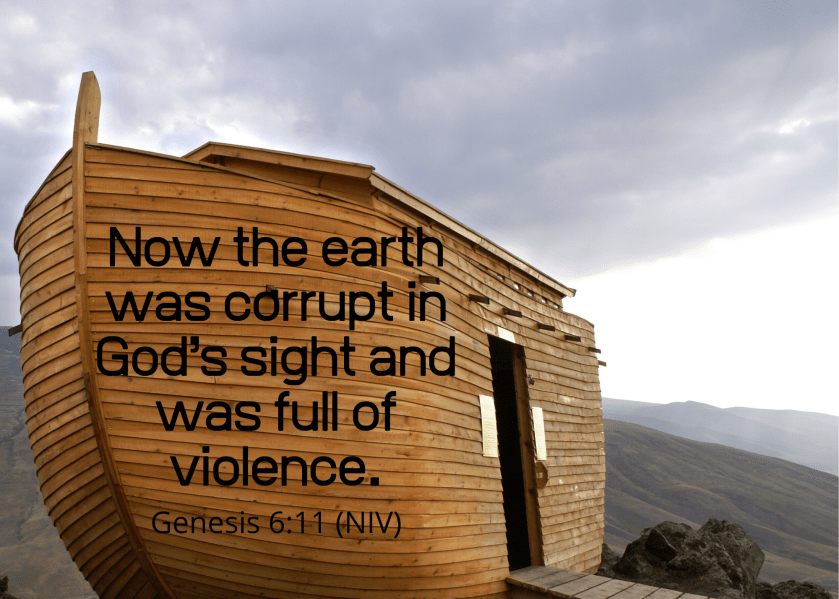
“The Lord saw how great the wickedness of the human race had become on the earth, and that every inclination of the thoughts of the human heart was only evil all the time.” – Genesis 6:5

“Remember this! In the last days there will be many troubles because people will love themselves, love money, brag, and be proud. They will say evil things against others and will not obey their parents or be thankful or be the kind of people God wants. They will not love others, will refuse to forgive, will gossip, and will not control themselves. They will be cruel, will hate what is good, will turn against their friends, and will do foolish things without thinking. They will be conceited, will love pleasure instead of God, and will act as if they serve God but will not have his power. Stay away from those people.” – 2 Timothy 3:1-5

I would love to end this first week of 2024 on a more positive note, but here we are at the ministry of Noah, and I can’t help but see the correlations. I consider myself a church half-full, not half-empty type of person, so please understand I am not hanging an albatross around the neck of the place I call home. Recently, we have seen and could see more revival as people realize there is no salvation in pursuing self. Nevertheless, as it stands today, it seems like the wind is blowing hard in a different direction, and I can’t help but look at the forecast and know that the rain is coming. It may not be here or now, but it is. It is so disheartening to see people jump off the boat, abandon their God, so they can instead find their own way swimming to survive. I want none of us to be the next person overboard, so let us be ready to answer the challenges of the storm that very well may lie ahead, and be defiantly obedient as the prescriptions of Jesus in Matthew 6

Leave your righteousness at the door – Jesus says that if actions are done for the sake of being seen by others or if we are religiously pious thinking that we are worth saving and others are not, that we have already received our reward in full. Noah was the only righteous man left, but while building the boat, he did not tout his own righteousness. He preached to bring salvation to others, even if it fell upon deaf ears. We do not decide who is and isn’t worthy (see: Jonah). Our own righteousness is as filthy rags and none of us can be restored without the atonement of Jesus.

Extend the grace of forgiveness of God – If for no other reason, we should forgive because it is the measure for which we are forgiven; however, we forgive because we have the love of Christ that shows us mercy every time that we fall short. By simply listening and looking for those who thirst, we become more like Christ. A quote that has stuck with me by psychologist Russell Barkley, “The children who need love the most will always ask for it in the most unloving ways.” Do not let rhetoric or trespasses keep you from loving those who need Living Water. You can be the bearer of grace and forgiveness they are most desperately looking for if you cut through the crap and see the child of God.

Endure any suffering with joy – Those of us in the United States have enjoyed a pretty good run of Christian values as the dominant culture. While this run has been far from perfect, it has been easy to avoid persecution. It is very likely that my children will not live in this world. God, I pray that they will be able to declare you in a world that will try to snuff them out. For us all, may we endure the coming trials with joy. When we are persecuted because of the Gospel, we suffer alongside Him. What greater joy could there be than to live out the fullness of Christ?

Don’t worry about not going with the flow – God has promised to take care of our needs if we trust in Him and share His words. We may be unflatteringly categorized, lose our social standing, our job, live threatened, or the reality of violence. If God takes care of the flowers and the sparrows, He will take care of you in every single instance. Even though the traffic may be moving against you, be singularly focused on the Gospel of the Coming Kingdom, and everything else will be added unto you. Ask for your daily bread and then get to work for His Glory because the harvest is becoming more plentiful, but the workers are fewer.

-Aaron Winner

  1. Describe the world you live in today. What similarities do you see to the time of Noah?
  2. What do you admire most about Noah? What can you learn from him? What do you learn about God in Genesis 7 & 8?
  3. What is the problem of going with the flow? How can you help yourself, your family, your church stay in the boat?

Death and Life

*Theme week – Celebrating Jesus: John 20

Old Testament: Zechariah 13 & 14

Poetry: Psalm 148       

            It feels funny to be talking about Jesus’ death and resurrection during Christmas week.  Sunday we were expecting a baby to be born, Monday the angels were singing to the shepherds announcing his birth.  Here it is Friday and he has already been crucified and his cold, dead body lies in a tomb.  It is kind of jarring to go from celebrating a baby born to be king to suddenly mourning his death. 

            Life is often experienced as a kind of emotional roller coaster.  Something great happens, and you are laughing and joyful.  Then, suddenly you are hit with bad news and the laughter turns to tears.  The events we have been reading about took place over 30+ years from the time Gabriel first appeared to Mary with the announcement that she had been chosen by God to bear his son, the Messiah until she stood at the foot of his cross and watched him die.  As you may recall, there was death surrounding Jesus right from the beginning, as King Herod was trying to kill him when he was a baby, when the little innocent baby boys of Bethlehem were slaughtered.    Jesus warned in John 10:10 that “the thief comes to kill, steal and destroy”.  Right from the beginning evil was out to destroy Jesus.  It took 30 years, but finally Jesus was dead.  The rejoicing has turned to weeping.

            The good news of the Gospels is that death doesn’t have the final word.  Evil doesn’t win.  God wins!  At the Last Supper just before Jesus was arrested he laid out for his disciples what was about to happen:

16 Jesus went on to say, “In a little while you will see me no more, and then after a little while you will see me.”

At this, some of his disciples said to one another, “What does he mean by saying, ‘In a little while you will see me no more, and then after a little while you will see me,’ and ‘Because I am going to the Father’?” They kept asking, “What does he mean by ‘a little while’? We don’t understand what he is saying.” 

Jesus saw that they wanted to ask him about this, so he said to them, “Are you asking one another what I meant when I said, ‘In a little while you will see me no more, and then after a little while you will see me’? Very truly I tell you, you will weep and mourn while the world rejoices. You will grieve, but your grief will turn to joy. A woman giving birth to a child has pain because her time has come; but when her baby is born she forgets the anguish because of her joy that a child is born into the world. 22 So with you: Now is your time of grief, but I will see you again and you will rejoice, and no one will take away your joy. (John 16:16-20).

            This brings us to today’s reading in John 20.  As we saw yesterday, Jesus was unjustly killed for political reasons.  The principalities and powers tried to buttress their own power and control and they saw Jesus as a threat, so they had him unjustly killed.  However, it takes more than the death of his son to thwart God’s plan.  As it turned out, the powers who orchestrated Jesus’ death played right into God’s plan that goes back to the very beginning.  That’s right, since the time of Adam and Eve and the Fall, God’s plan to defeat evil included the sacrificial death of the one who would be the son of God and Messianic King.  Revelation 13:8 speaks of the “lamb that was slain from the foundation of the world.”  Before Jesus ruled as King, he first had to die as sacrifice, as savior, as redeemer.  He died to bear our sins as Isaiah 53 prophesied would one day happen.

            God raised Jesus from the dead.  Death did not have the final word, God has the final word and it is life.  Along with life, Jesus offers the gift of forgiveness.  When you believe that Jesus died and was raised to life and give your loyalty to him as your king, you will share in that blessing Jesus promised. Your sins will be forgiven and you will have your fellowship with God restored. The result of this restored fellowship is peace, the peace that only Jesus can give.

            Jesus points out to the disciples that they came to believe in him by seeing him in person after the resurrection.  Thomas even had the benefit of physically touching Jesus’ scars to help him accept the truth of the resurrection.  Jesus points to those who will believe in him without the benefit of having seen him after his resurrection. Those who have faith in the message of the gospel passed down for 2000 years in the Bible from the first eyewitnesses to the risen Jesus. The good news is, that is you, if you believe that God raised Jesus from death to life, you receive the blessing Jesus promised.  I hope you believe, I know I do.

-Jeff Fletcher

Reflection Questions

  1. What do you love about God and His plan as revealed in John 20? What questions do you have about God and His plan and Jesus’ part in that plan?
  2. What has Jesus offered to you? Have you accepted these gifts? Why or why not?
  3. What is the next step in God’s plan and what is your role in it?

The Day We Have All Been Waiting For

Old Testament: Zechariah 5 & 6

Poetry: Psalm 144

New Testament: Luke 2

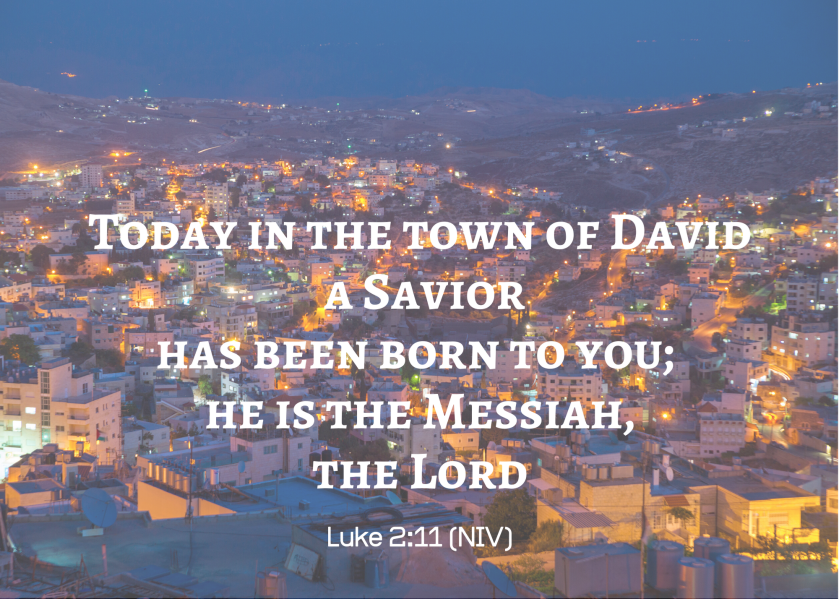
“For unto you is born this day in the city of David a Savior, who is Christ the Lord.”

            It’s Christmas Day!  The day we have all been waiting for.  Unless you’re really, really good, you likely will have already gotten up, peeked in your stocking and maybe opened gifts with your family.  You may have even eaten a large meal.  Maybe now you’re taking a few minutes to check your email and give some attention to your devotions for the day.  Whether you’re reading this at 8 a.m. or 8 p.m., it’s still Christmas Day.  A day you’ve been waiting for.  Christmas comes every year so at most, you’ve had to wait 364 days for Christmas. 

            The people of Israel had to wait hundreds of years for the first Christmas.  From the time King David was first promised that his son would be the Messiah and would reign forever, it had been many generations.  Now that day had finally come.  Normally, when a royal birth happens, especially a future King, it’s a pretty big deal.  There are grand proclamations that come from out of important palaces in important cities.  The whole community might stand outside the walls of the royal palace to hear the great news officially announced.  But this first Christmas announcement was quite different.  It wasn’t in the city of Jerusalem outside the palace walls, it was in the fields of rural Bethlehem.  The audience wasn’t the whole city gathered, it was a few sleepy shepherds in the middle of the night making sure their sheep were safe from predators.  The one making the announcement wasn’t the royal page or member of the court of Jerusalem, it was an angelic messenger of God.

            News of the Messiah’s birth went largely unnoticed for many years.  It would take several announcements from God “a voice from heaven saying, this is my beloved son, with whom I am well pleased.”  Eventually, his few disciples understood that he was the Messiah.  What finally sold many people was his death and resurrection.  The Bible says that one day “every knee shall bow and every tongue confess that Jesus is Lord” (Messiah/king).  On this Christmas Day, let us be sure that we not only hear and believe the Good News that at long last the promised Messiah was born in a manger in Bethlehem over 2000 years ago, but that he died for our sins and God raised him up from death and clothed him in immortality, he has ascended to the side of God and will come again to reign over all.  One day every knee will bow, but for today, be sure that you are bowing and giving your allegiance to King Jesus, and be sure to share this news with everyone you know. 

Merry Christmas!

-Jeff Fletcher

Reflection Questions

  1. How was God’s plan for a Messiah different from what many people expected? What do you love about how God brought about His plan for a Messiah? What does His plan reveal about Him? 
  2. Does your holiday festivities show that you are celebrating that Jesus is Lord? How are you bowing before him and confessing that he is Lord – yesterday, today and tomorrow?
  3. How can you share the good news of great joy? Who needs to hear it?

Ask the Hard Questions

Old Testament: Job 3 & 4

Poetry: Psalm 32

New Testament: John 12

The phrase ‘the patience of Job’ is really not accurate. Job persevered for sure, but not patiently. He suffered, but not silently. The book of Job is the story of a rebel.

After his suffering begins, his saintly friends take turns explaining his problems to him with good, logical, theological phrasing. I would call their monologues churchy. Job, on the other hand, goes to God with his irreverent appeal for an explanation. And that’s the real difference between Job and his friends… Job spoke to God about his suffering while his friends spoke about God to Job.

Chapter 3 begins with Job opening his mouth and cursing the day of his birth, saying, “Let the day perish on which I was born.” He goes on at length and in great detail describing that notion.

But this isn’t a typical poor me kind of complaint. His personal lament turns to a lament for all of those who suffer through life. The poorest of the poor, those who grow up with no advantages, despised, rejected, people who are just surviving.

Why is light given to him who is in misery,
    and life to the bitter in soul,
 who long for death, but it comes not,
    and dig for it more than for hidden treasures,
 who rejoice exceedingly
    and are glad when they find the grave?

Job invites us to ask the hard questions rather than to slip into the platitudes that can come too easily. Questions about the meaning of life and about God himself. And he models to us the way to find peace in our questioning…not by talking about God, but by talking to him.

Uncomfortable? Yup. Worth it? I think Job would say so.

-Susan Landry

Reflection Questions

  1. Do you spend more time talking to God or talking about God? Which comes easier to you?
  2. Do you have a little list of hard questions you have been avoiding asking God? Talk to Him about them – and see how He answers.

Making Splashes

Old Testament: Nehemiah 7 & 8

Poetry: Psalm 22

*New Testament: John 2

First impressions are important. What someone thinks of you or what you think of them the first time you meet can set a trajectory for the future of the relationship. After watching the pilot episode of a show, you should come away with some kind of clue as to what direction it will take. Are you going to continue watching the show, or have they not gripped your attention enough?

In John 2, we are given the first impressions or the pilot episode of Jesus’ public ministry, at least according to John’s gospel. Jesus breaks out onto the public scene with the wedding at Cana miracle and the temple cleansing showdown. What is the significance of these events, and how do they foreshadow or help establish a rhythm for the rest of Jesus’ ministry?

The wedding at Cana is only mentioned in John’s gospel. That is not to say that the author made it up. The other gospel writers may not have heard the story or for whatever reason didn’t include it. On the surface, it does seem odd that the first of Jesus’ miracles appears to do nothing more than enable some celebratory characters to get even more drunk than they were before. I’ve never been quite sure how to make sense of that (but hey, welcome to the bible). 

What is being accomplished or communicated with this event? For one, Jesus is providing a clear sign for his disciples that he is the real deal. After seeing the miracle, the disciples have no doubt that Jesus is who he says he is, and that he has the authority from God he claims to have. Another thing being shown is that God is a God of abundance, generosity, and quality. Jesus not only provided very good wine for the party, but provided way more than was needed. Also, by not letting the celebration stop short, Jesus affirms that the good things in life are worth celebrating. That is not a green light on abuse of alcohol, though. Celebration can happen without the aid of recreational substances.

Perhaps most significantly, Jesus is using this miracle to symbolize and foreshadow the transformative work that is about to happen through his ministry, death, and resurrection. Those giant old jars that were used to hold water for purification rites were now going to hold the good stuff. Something was happening that was going to blow the doors off their old, dusty religion. There was a new order, a new reign of God rising up among them. God was really up to something! For some, it was just an epic party (if they even remembered), but for others, it was the night they realized that Jesus was going to change the course of history.

The next event we hear about is the cleansing of the temple. The observant may note that this event happens later in other gospels, much closer to his crucifixion. There are a couple of ways to deal with this. One opinion is that there were two temple cleansing events. John happened to tell us about the earlier one and not the later one, while the other gospel writers told us about the later one and not the earlier one. Another way to deal with it is to say there was really just one event, but John decided to chronologically place it near the beginning of Jesus’ ministry and the other gospel writers placed it near the end. Don’t lose any sleep over it. Whether it was one or two events, there is significance in John’s choice to share an early account of the temple cleansing.

To understand the context, we should try to make sense of why Jesus was so upset about the money changers. It appears they were providing a legitimate and needed service for those visiting the temple. What could be the harm in that? There is a strong possibility that their businesses had started to exploit people. When you have a corner on the market, what’s to stop you from jacking up prices or treating your customers unfairly? The customers have nowhere else to go. Another reason Jesus may have been upset is that the temple is supposed to be a sacred place. When you turn a sacred place into a marketplace, you are distorting its purpose. It appears that Jesus was taking a stand for the purity and integrity of the temple and worship practices.

This event helps set the stage for the tension Jesus will have with the religious leaders throughout his ministry. This tension will spawn many conflicts that will eventually cost Jesus his life. Late spoiler alert. Another thing being communicated is that Jesus is asserting his authority as the true temple. He says in verse 19, “Destroy this temple, and in three days I will raise it up.” He said this in reference to his own death and resurrection, but like so many other times in John’s gospel, his words were misunderstood.

Jesus made his first public impressions by powerfully establishing his identity, authority, and mission, and by giving everyone a taste of the transformation that was about to take place. There is something captivating about the character of Jesus. I’m biased when saying that, but I like to think if I had known nothing about Jesus and only read this chapter of John, I would be wanting to see what he did next and where this whole thing was going. In other words, I would totally binge this show.

-Jay Laurent

Reflection Questions:

1. What kinds of transformative work has Jesus done in your life?

2. Jesus caused a scene in the temple over concerns about the integrity of worship practices. What should worship look like?

3. In verse 4, it appears that Jesus is a little reluctant to begin his ministry. Why might that be? Is there something you feel called to do, but don’t feel quite ready for?

Peter and Cornelius

THEME WEEK- Peter: Acts 10

Old Testament: Nehemiah Intro – found below

Poetry: Psalm 18

This devotion comes from Acts chapter ten. The Centurion of what was known as the Italian Cohort was a devout Christian man named Cornelius. Being known for the faith of all his house and his charitable actions toward the Jews, Cornelius is definitely the kind of guy you want around when change needs to be made. Now Cornelius has a vision, and in this vision he is instructed to seek out Simon Peter, afterwards he listens whole heartedly and dispatches a group to go find Peter and bring him to meet Cornelius. While the group is going to find Peter, Peter goes to a housetop to pray. On the housetop he becomes hungry and he is shown a vision. In this vision, a large sheet descends from the sky and in it are a multitude of unclean animals; birds, reptiles and all kinds of four footed animals. A voice instructs Peter to get up, kill and eat. But Peter is hesitant. He doesn’t want to, for he follows the tradition of the time and won’t eat anything considered unclean by tradition. The voice tells Peter “What GOD cleansed, no longer consider unholy” three times and the sheet is taken back up into the sky.

 At this time, while Peter is thinking over what he witnessed, the men sent by Cornelius arrive at the house of Peter. The Spirit tells Peter to receive the men without misgivings and after they greet one another Peter invites them in to stay.

So finally the stage is set. These men have come to take Peter to meet a Gentile, as Peter is starting to rethink what GOD considers holy and unholy. Breaking down traditions.

The group takes Peter and some others from Joppa to Caesarea to meet Cornelius and as he enters the house Cornelius bows to worship Peter. “Stand up” Peter says “for I too am just a man.” There with Cornelius were multiple other gentiles. Peter says “You yourselves know how unlawful it is for a man who is a Jew to associate with a foreigner or to visit him; and yet God has shown me that I should not call any man unholy or unclean. That is why I came without even raising any objection when I was sent for. So I ask for what reason you have sent for me.”

Cornelius gives the account of the vision he received and how he was instructed to reach out to Peter, and to hear the preaching of Peter. 

So Peter begins to preach. Starting with the beginning of Jesus’ ministry and his anointing. Then to the death and resurrection of Jesus, ending with the fact that Jesus appeared to those who ate and drank with him before his crucifixion. And while Peter was still preaching to those gathered the Holy Spirit descended upon all those that were in the room, Jew and Gentile alike. 

The believers that came with Peter were amazed that the gentiles also could understand the speaking of tongues. 

Acts 10:47-48 reads “Surely no one can refuse the water for these to be baptized who have received the Holy Spirit just as we did, can he?” And he ordered them to be baptized in the name of Jesus Christ. Then they asked him to stay on for a few days.”

So that’s the story of Acts chapter ten, but what do we learn? Our preconceived notions of what “GOD wants” may not always be true, just because our traditions teach us something doesn’t mean it’s right. Even though everyone is doing something doesn’t make it right.

But this passage is beautiful in its own way. Just because we may not belong to the house of Israel, doesn’t mean GOD’s love isn’t for us. While it seems like a surface level idea, this passage plainly shows our adoption into the family of GOD.

-John Evans

Reflection Questions

  1. Peter described to Cornelius who Jesus was. How would you describe Jesus?
  2. Are there any areas in which perhaps your ideas of what “God wants” is actually different than what God truly wants? Explain.
  3. What does it mean to you to be a part of the family of God?

Nehemiah Introduction

The book of Nehemiah was written by Nehemiah, the cupbearer to King Artaxerxes.  This is the exciting sequel to the book of Ezra.  Ezra oversaw the rebuilding of the temple.  Nehemiah oversaw the rebuilding of the wall of Jerusalem in an amazing 52 days.

The two important themes of the book are:
1. The amazing way God protected and provided as the returned exiles rebuild the wall around Jerusalem with amazing speed
2. The importance of being loyal to God.

I particularly appreciate chapters 8 and 9 where Ezra read the law of Moses to all the people; the people listened attentively and worshiped God.

May we be able to say, like Nehemiah in 13:31, “… Remember me with favor, O my God.”

-Steve Mattison