We spent yesterday with Haggai urging the Israelites to obey God with a pure heart and focus on His coming Kingdom. Zechariah, another minor prophet, does something similar, encouraging the Israelites to rebuild the temple.
Here again, the Israelites are discouraged. Zechariah challenges them to not be like their ancestors, rebellious and disobedient. He reminds them that if they turn back to God, He will be with them. “Return to me,’ declares the Lord Almighty, ‘and I will return to you,’ says the Lord Almighty.” (Zech. 1:3)
Zechariah has a series of God-brought nighttime visions, solidifying His promises to restore and protect His people and the city of Jerusalem, and to bring the promise of the Messiah to fruition.
Today, visions and dreams from God are far less common, or even do not occur at all, depending on one’s interpretation of the Word. We can’t expect God to give us clear visions while we sleep, but what we can do is remember that He left us his Word, which is 66 books of His goodness, His plans and His promises. Within these pages you’ll find the assurance that God is with us, that He promises to never leave us. He urges us to return to Him, and there we will find Him. Just like Zechariah encouraged the Israelites, so God encourages us.
Reflection Questions:
Have you ever experienced a vision? Or, recall a time when Scripture spoke to you so strongly that it was as a vision.
Has there been a time in your life where you rebelled or were disobedient? What happened when you returned back to God?
What is your favorite promise from God? Reflect on that today.
Isaiah 14:24 says: The Lord Almighty has sworn, “Surely, as I have planned, so it will be, and as I have purposed, so it will happen.”
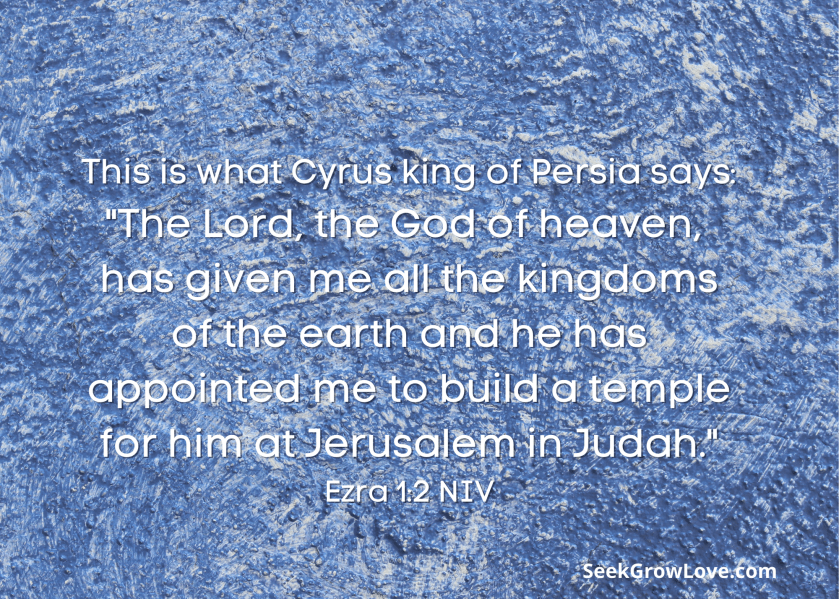
In the first chapter of Ezra it says that God stirred the heart of King Cyrus to fulfill a prophecy of Jeremiah that they would be exiled for seventy years and after this time they would be allowed to return to Jerusalem. See Jeremiah 25:11-12, 29:10.
In Isaiah 44-45, it names King Cyrus over a century before he was born. It is amazing to see how God chooses to work, here he is using a pagan king to fulfill his prophesies. King Cyrus sent out a proclamation that “the Lord, the God of heaven” had appointed him to rebuild His house in Jerusalem. Ezra Chapter 1 v.3 says “Whoever there is among you of all His people, may his God be with him! Go up to Jerusalem which is in Judah and rebuild the house of the Lord, the God of Israel; He is the God who is in Jerusalem.”
Then, he told all the survivors to support them with silver, gold, or other valuables. Everyone had a part in the rebuilding of the temple even if they were not actually doing the building. We all have a part in ministry, it may be supporting those that are doing the work, but that is an important and much needed part of any ministry. King Cyrus also brought back the vessels from the first temple that Nebuchadnezzar had taken and restored them to their rightful place.
These people had been taken into captivity when Babylon had taken over, now they are given a chance to return and chapter 2 lists the people and the families that they represent who came back. In 2:68-69a “Some of the heads of fathers’ households, when they arrived at the house of the Lord which is in Jerusalem, offered willingly for the house of God to erect it on its site. According to their ability they gave to the treasury…” The identity of the Jewish people as the people of God was tied up in the temple, where the presence of the Lord dwelt. The Jewish people were devastated by the destruction of the first temple in 586 BC. They were filled with despair and a loss of hope. With the chance to rebuild the temple, the people gained some of their hope back. Their national pride began to come back. In the seventh month after the return, the Levites built an altar to God so that they could offer burnt offerings on it. This was important to them to show obedience to the Law of Moses. It was also an important act of worship to God. They were terrified of the people around them, and they wanted the protection of God to surround them. They reinstated the offerings and the festivals even before the foundation for the temple had been laid, because they wanted to restore their worship to God. The people were excited to build the temple again, to have a place where God would dwell, and where they could go to worship Him.
When the foundation was laid, it says in chap 3 v. 10b-11a “they praised the Lord according to the directions of King David of Israel.” “And they sang, praising and giving thanks to the Lord, saying, ’God He is good, for His lovingkindness is upon Israel forever.” They shouted and wept in celebration and it says it was heard far away.
Just as God used people in the Old and New Testament to carry out his purposes, he also uses us for His purpose. Ephesians 2:10 “For we are His workmanship, created in Christ Jesus for good works, which God prepared beforehand so that we would walk in them.” Also, Philippians 2:13 “For it is God who is at work in you, both to desire and to work for His good pleasure.” God is working with us and using us to bring about his promises. We can rest in the knowledge that whatever He has planned for us to do, he will give us the means to fulfill it.
Questions for Reflection:
Describe the thoughts and feelings the Jews may have felt as they heard King Cyrus’ proclamation of Ezra 1:2-4. And, also, as they entered Jerusalem?
In what ways have you been a part of a ministry planned by God and much larger than yourself?
“We can rest in the knowledge that whatever He has planned for us to do, he will give us the means to fulfill it.” – How have you already seen this to be true in your own life? What might God have prepared for you to do next? How has He already prepared you for it? What means are being put in place?
One of the most important Christian disciplines is learning how to pray and to keep praying. For some of us, we learned to pray almost before we learned to walk! For others, we learned about the discipline of prayer later in life after we decided to follow Jesus. Prayer is an incredibly important part of our Christian lives. To pray, or “entreat or implore” (fancy words for asking for something or giving God thanks) is necessary for any Christian. God wants to enjoy a special relationship with you. Praying allows you to express your desires, your faith, your devotion, and love to God. Jesus even took time to teach his disciples how to pray (Matthew 6:5-15).
Daniel understood the importance of prayer. Time and again God had strongly supported Daniel during his captivity in Babylon under several kings. Through it all, God had given Daniel special insight in which to interpret dreams and speak truth to powerful people. In Daniel chapter 9, we see Daniel praying for the people of Judah and for answers about his dreams – which were a series of confusing dreams full of monsters and beasts!
Daniel is also praying for Judah, his homeland with Jerusalem as its capital. For many years, Judah was held in captivity by the Babylonians, Medo-Persians, and Chaldeans. All this time, God faithfully protected Daniel and blessed him. Now, after many years of captivity, Daniel understood that the time was approaching when God would restore the people of Judah to their homeland. Daniel intercedes for his people by praying to God. In his prayer he confesses the sin of Judah to God, declares that only God is righteous, and agrees that they deserve the punishment put upon the nation. But Daniel also thanks God for being a God of mercy. Daniel understood that the punishments of God only come after we reject His mercy. Daniel believed in God’s word and looked forward to the day when God would rescue His people.
However, as he is praying, he is surprised when the angel Gabriel arrives bringing a special message from God (Daniel 9:20-23). The angel declares to Daniel that from the moment he began to pray, the word went forth from God to deliver a special message. The special word from God to Daniel? You are greatly loved (Dan. 9:23). God would declare the interpretation of the dreams, but before anything else, God desired to express His love.
When we pray to God, we often ask God to help us with something, to bless someone else, to bring deliverance or to confess our sins. Whatever the reasons for you to pray to God, the most important thing to realize, whatever the answer to prayer might be, is that God loves you. He loves you because of who you are and for your faithfulness to Him. The message throughout the entire Old Testament can be shortened down to this: God wants you to love him and obey him. We might not get a special visitation by Gabriel, be we can be assured that God hears our prayers, acknowledges our prayers, and lovingly acts upon them.
Questions for Discussion:
Why was Daniel praying to God? What was he looking forward to?
What types of things do you believe occur in the “spiritual realms” when you pray to God?
Why is it important for God to express His love for Daniel before getting into the interpretation of his dreams?
Have you ever heard someone say “I see the writing on the wall…”?
Sometimes the truth of a situation can be so obvious and plain that we can do nothing but accept it as reality. After the reign of the Babylonian king Nebuchadnezzar, his son Belshazzar took the Babylonian throne (Daniel 5:1-2). As a son, he no doubt saw the amazing transformation of his father from a king who worshipped gods of gold and silver to a devoted worshipper of the one True Living God (Daniel 4). But he failed to acknowledge God as the source of his wealth and power. Instead, Belshazzar gave praise and thanksgiving to the old gods of his father Nebuchadnezzar (Daniel 5:4). As a consequence, The One True Living God (our God Yahweh) decided to destroy the Babylonian empire because of the sinfulness of its leader, King Belshazzar.
What Belshazzar needed to read was “the writing on the wall”. Daniel tells us that the “fingers of a human hand appeared and wrote on the plaster of the wall of the king’s palace” (Daniel 5:5). The king was terrified and pleaded for someone to help him understand the writing that had appeared on the wall. Once again, Daniel was brought before the king to interpret the strange message – Mene, Mene, Tekel, Peres.
As we have seen, Daniel was a devoted follower of the One True Living God. All the days of his captivity in Babylon, Daniel had been richly blessed by God. Daniel was able to read the writing on the wall. He delivered the terrible message that Belshazzar would be brought to an end, that he had been found guilty of sin, and that his kingdom would fall to his enemies. Stunned by the message, Belshazzar rewarded Daniel for his honesty and skill in deciphering the message. That very night, the king would be killed by the enemies of Babylon, the Medes and Persians.
It is difficult to face the truth of sin in our lives. Each of us, like Belshazzar, has been “weighed in the balances and found wanting” (Daniel 5:27). Each of us has been found guilty by God because of the sin that is in each of us. His word says that each of us has sinned and fallen far short of God’s glorious, holy standards (Romans 3:23). Like Belshazzar, we deserve to suffer the consequence of that sin (Romans 6:23). But God desires to offer His grace to each of us. He wants to forgive us of our sin and restore us to a right relationship. He gave us this chance by delivering up His only Son to be the “atoning sacrifice” to take away our sin (Romans 3:25). Though we deserve spiritual and eternal separation from God, He graciously offers to us a path of salvation. Some believe that Nebuchadnezzar may have submitted himself to the one True God. This new faith in God could have resulted in his redemption. God himself refers to Nebuchadnezzar three times as his “servant” (Jeremiah 25:9, 27:6, and 43:10). Perhaps, just maybe he was a recipient of God’s amazing grace.
The message is so clear and is freely given to each of us. It is as if He wrote the message clearly upon the walls of our hearts and minds (Ezekiel 36:27-28). The message of grace, freely given by God, to offer us salvation and adoption into His family – through faith (Ephesians 2:8). This very moment, will you read the “writing on the wall” and place your faith in the Son of God, for the forgiveness of sin?
Questions for Discussion:
Why did God continue to bless Daniel during the reign of three different kings?
Why do you suppose Belshazzar fully accepted Daniel’s interpretation of the writing on the wall?
Daniel consistently stood for God despite dangerous opposition. How can you faithfully submit to God in your situations?
Why do bad people seem to succeed in this life? Why do the righteous suffer while the wicked seem to get away with everything? And if God sees it, why doesn’t He step in right away?
That’s exactly where the book of Habakkuk begins. The prophet cries out to the LORD, confused and hurting, asking why injustice is allowed to go on. It’s a reminder that God isn’t afraid of our concerns. He wants us to bring our pain, our doubts, and even our “why” straight to Him.
God answers Habakkuk in a way he doesn’t expect. He says He will use the Chaldeans (a powerful and wicked people) to bring judgment on Judah (a less powerful and less wicked people). But He also makes it clear that their strength is nothing compared to His, and their own judgment is coming.
Habakkuk learns that affliction is part of living in a broken world. God’s justice is not absent just because it isn’t immediate. His plans are bigger than what we can see, and even while Habakkuk was praying, God’s answers and plans were already in motion, just not in a way he could yet understand.
In the middle of this, God gives Habakkuk a promise. “The righteous shall live by his faith” (Habakkuk 2:4). Paul quotes this later in Romans 1:17, reminding believers that faith is the foundation of a right relationship with God.
By the end of the book, Habakkuk’s tone shifts. His questions turn into worship. Chapter 3, written as a song, closes with
“Yet I will rejoice in the LORD; I will take joy in the God of my salvation.” (Habakkuk 3:18)
That’s the kind of faith we’re called to, not just praising God for what He’s done, but trusting in Him even when the outcome is still unseen.
Reflection Questions:
What does Habakkuk’s honesty in prayer teach you about how to approach God in hard times?
How does “the righteous shall live by his faith” (Habakkuk 2:4) challenge your response to unanswered prayers?
What would it look like for you to rejoice in the LORD this week, even in uncertainty?
I was especially struck by several verses in today’s reading. In chapter 31 verse 18 we read,
“I have surely heard Ephraim’s moaning:
‘You disciplined me like an unruly calf,
and I have been disciplined.
Restore me, and I will return,
because you are the Lord my God.
God heard their moaning. I find great comfort in that the creator of the universe cares enough about us to hear our moaning. He also cares enough about us to discipline us for our own good. Hebrews 12:7-11,
7 It is for discipline that you have to endure. iGod is treating you as sons. For what son is there whom his father does not discipline? 8 If you are left without discipline, jin which all have participated, then you are illegitimate children and not sons. 9 Besides this, we have had earthly fathers who disciplined us and we respected them. Shall we not much more be subject to kthe Father of spirits land live? 10 For they disciplined us for a short time as it seemed best to them, but he disciplines us for our good, mthat we may share his holiness. 11 nFor the moment all discipline seems painful rather than pleasant, but later it yields othe peaceful fruit of righteousness to those who have been trained by it.
We all fall short of the glory of God and we will struggle many times to do what is right. When we recognize that we have strayed, we must repent and turn away from that sin. Jeremiah 31:19 gives a great example of what repentance looks like in action:
19
After I strayed,
I repented;
after I came to understand,
I beat my breast.
I was ashamed and humiliated
because I bore the disgrace of my youth.’
Verse 20 is perhaps the most poignant of all:
20
Is not Ephraim my dear son,
the child in whom I delight?
Though I often speak against him,
I still remember him.
Therefore my heart yearns for him;
I have great compassion for him,”
declares the Lord.
I don’t know about you, but my eyes fill with tears and I get goosebumps on my arms at the thought of God’s heart yearning for His people and Him having great compassion for us. Though he must discipline us at times, He does so out of His great love for us!
-Kristy Cisneros
Reflection Questions
How do you view God’s discipline? Is there a time(s) you feel God disciplined you? Why do you think He disciplines – in that case, and in general? Or – asked a different way – Does a Good God discipline? Explain.
What role does repentance play? What feelings come with repentance in Jeremiah 31:19?
What do you love about God’s love? How would you try to explain it to somehow completely new to the concept of a loving God (who disciplines)?
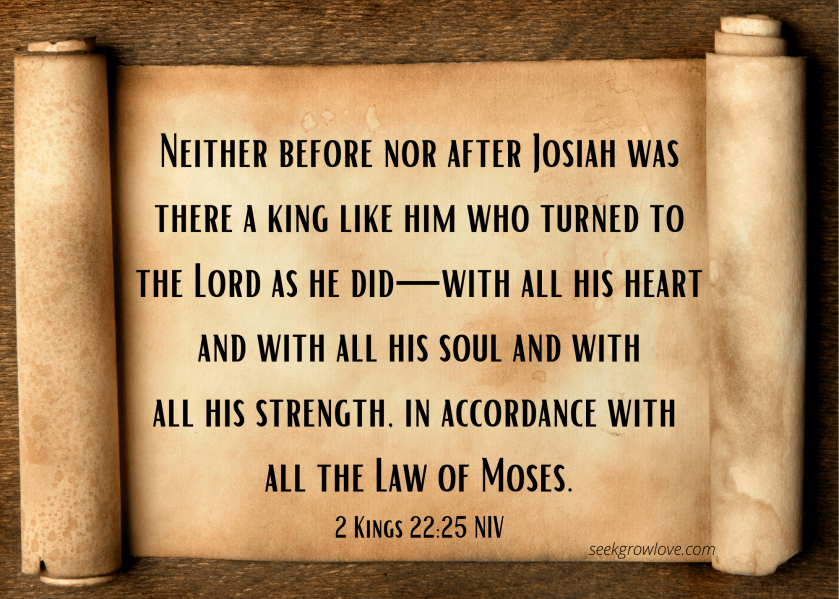
Ah, finally we get to a humble, obedient, and faithful king! King Josiah was only eight years old when he became king & perhaps his childlike faith, characterized by an unwavering trust in God, was partially responsible for his complete devotion to the One True God. According to 2 Kings 22:2, “He did right in the sight of the Lord and walked in all the way of his father David, nor did he turn aside to the right or to the left.”
King Josiah stands out as one of the most faithful and courageous leaders in all of Israel’s history. From a young age, he set his heart on God, and as he matured, his devotion bore fruit through sweeping reforms and bold obedience. When the long-lost Book of the Law, the Torah, was discovered during temple repairs, Josiah didn’t dismiss its warnings or delay its commands. Instead, he tore his clothes in humility and led the nation of Judah in heartfelt repentance.
Josiah’s leadership was marked by deep reverence for God’s Word, active obedience, and massive reform. He didn’t just believe privately, he acted publicly. He removed idols, tore down altars to false gods, and restored worship as God intended. Josiah renewed the covenant between God and his people, and led a national Passover celebration unlike any since the time of Samuel.
Despite the sins of previous generations, Josiah believed it wasn’t too late to return to God. His story reminds us that genuine faith leads to repentance and action. His life models how one heart, fully surrendered to God, can impact others – even an entire nation!
Even though Josiah didn’t live to see all of the long-term fruit of his efforts, God honored his humility and faithfulness. His legacy encourages us to lead with courage and humility, obey with conviction, and seek the Lord with passionate, undivided hearts.
Prayer:
Father God, we thank You for children of faith who grow up to be men and women of faith! May our hearts be renewed as we study Your Word and learn to have unwavering faith and obedience, like that of King Josiah. Thank You for giving us Your Word and examples of the righteous who have come before us. We humbly ask that you fill us with your power to lead this generation and the next back to you!
Reflection Questions:
1. What can Josiah’s immediate response to God’s Word teach us about how we respond to truth and correction?
2. In what areas of your life might God be calling you to remove “idols” or restore rightful worship?
3. How can you use your influence, big or small, to lead others in faithful obedience to God?
These chapters are a crescendo of God’s redemptive plan. From the confession of sin in Isaiah 59 to the celebration of salvation in Isaiah 63, we see a God who refuses to leave His people in darkness. Though judgment is real and sin has separated people from Him, God promises to act, not because His people are worthy, but because He is faithful.
Isaiah 59 opens with a hard truth: the problem is not that God is distant, but that sin separates us from Him. Yet God does not abandon His people. In verses 15–20, He looks and sees there is no one to intercede, so He promises to send a savior who will put on righteousness like armor and salvation like a helmet. This is a clear prophetic picture of Jesus, the Redeemer, who comes to Zion and turns hearts from transgression.
Isaiah 60:1 is stated as an enthusiastic command: “Arise, shine, for your light has come!”
God promises a day when His glory will shine on His people, even though darkness covers the earth. This is not merely for dramatic effect, it is the fulfillment of God’s plan to make His people a light to the nations. In Christ, this light has come, and now we are called to shine with His glory!
Isaiah 61 contains one of the most beautiful promises in all of Scripture, the mission of the coming Messiah:
“The Spirit of the Sovereign Lord is on me, because the Lord has anointed me to proclaim good news to the poor…” (Isaiah 61:1)
Jesus quoted this very passage in Luke 4 and said, “Today this Scripture is fulfilled in your hearing.” God promises comfort, freedom, healing, and restoration. He trades ashes for beauty, mourning for joy, and despair for praise.
God is not content to redeem, He delights to rejoice over His people. In Isaiah 62:4 He says, “You will be called Hephzibah (My delight is in her), and your land Beulah (married).” No longer forsaken, no longer desolate, God’s people will be treasured, honored, and watched over like a crown in His hand.
God shows up as a mighty warrior, executing justice and salvation in Isaiah 63. He judges evil but also remembers mercy. In verses 7-9, the prophet recalls God’s faithful love and how He personally rescued and carried His people, to magnify His name in the world. His promises are not cold declarations, they are acts of compassion, flowing from His heart.
God’s promises are not vague hopes, they are guaranteed realities. When sin separates, He comes to redeem. When darkness falls, His glory rises. When the broken cry out, He binds their wounds. And when His people forget, He remembers. He is the God who keeps His covenants forever.
Prayer:
Lord, thank You that You are the God who keeps Your promises. When I am weak, You fight for me. When I am broken, You heal. When I am in darkness, You shine. Help me trust Your Word, live in Your truth, and walk in the light of Your glory. In your son Jesus’ name, Amen.
Reflection Questions:
• Where do you struggle to put your trust in God?
• How have you grieved God’s Holy Spirit & have you repented, turned from sin, and gratefully accepted restoration?
• How has God’s light shone through you, in the midst of darkness?
• Are you walking in the identity and mission God has given you?
Isaiah 54-58 paints a beautiful picture of God’s mercy, restoration, and covenant faithfulness. While written in the context of Israel’s exile and return, these words convey God’s love and faithfulness for all generations and people. They offer hope of the New Covenant, which is fulfilled in Christ and graciously extended to all who call upon His name.
In Isaiah 54, God speaks to a people who feel forgotten and barren. They have lost trust in God, and betrayed him numerous times. Yet, He invites them to sing with joy and promises to enlarge their tents! Why? Because He is about to fulfill His promise of restoration. Though they had strayed, His covenant of peace stands firm:
“With everlasting kindness I will have mercy on you,” says the Lord. (Isaiah 54:8)
“My unfailing love for you will not be shaken.” (Isaiah 54:10)
God knows exactly what He intends his people to become. He knows exactly what circumstances, both good and bad, are necessary to produce that result in our life. Will we trust him through it all, with greater faith and obedience than the Israelites?
God himself grants an invitation to the weary and empty in Isaiah 55.
“Come, all you who are thirsty, come to the waters.” (Isaiah 55:1)
It’s important to note, that this is not a transaction but a gift. The gift of life, of forgiveness, and of purpose. Isaiah points us to a “Davidic covenant” made new: an everlasting covenant for all who will listen and obey God’s Word. His promises are not vague hopes, rather they are declarations backed by His unchanging character.
In the New Covenant, Jesus is the Living Water and the Bread of Life. The “free” offer in Isaiah 55 becomes the gospel invitation: “Come to Me, all who are weary and burdened, and I will give you rest.” (Matthew 11:28)
Isaiah 55:8-9 reminds us that God’s thoughts and ways are far above our own. This doesn’t mean He is indifferent to our suffering, rather that His plan is bigger than what we can see or understand. In our limited perspective, we often can’t fully understand what God is doing. But Isaiah assures us that God is always at work, even when we can’t fathom his ways.
In Isaiah 56, God declares that the foreigner and the eunuch (those who were once excluded), now have a place in His house. The New Covenant throws the doors wide open! No one is too far gone, too broken, or too different. In Christ, all are welcomed and made new. That is excellent news for us, as Gentiles!
Isaiah 57 declares that God dwells in two places: the high and holy place, and with the contrite and lowly in spirit. That’s the mystery of grace. He’s not looking for spiritual perfection, but for hearts that are humble and honest. The New Covenant brings God near, not because we’ve earned it, but because Christ has made the way.
The New Covenant doesn’t reward the proud or the religious elite. It finds its home in the hearts of those who know their need and bow before God in humility, repentance, and dependence.
Religion says, “I messed up, my Dad is going to kill me!”, whereas Sonship says, “I messed up, I need my Dad’s help!”
Isaiah 58 makes it clear that God isn’t impressed with hypocritical, half-hearted religion. He desires hearts that reflect His justice and compassion. Fasting, prayer, and worship are empty if they’re disconnected from love for the Father and love for others. Proper fasting humbles us, blesses others, and honors God. This echoes the heart of Jesus’ ministry. The New Covenant reshapes our worship, not just as acts of ritual and obedience, but as a life poured out for others, empowered by the Spirit of God, and rewarded with blessings of salvation and the Messiah’s kingdom!
Let us live as grateful recipients of the New Covenant. Set apart and motivated not by religious performance, but by a relationship with our loving Creator. May we display trust, obedience, and confident hope in the one true God, our loving and merciful Father, who always keeps His promises.
Prayer:
Father in heaven, let me receive Your grace freely and trust that Your Word will bear fruit in my life. Come and dwell in me, not because I am worthy, but because You are full of mercy. Father, teach me to worship You in truth, not just with words, but with action. May my life reflect the love, kindness, and action that You desire. In your son, Jesus’ precious name, Amen.
Reflection Questions:
• Where in your life have you doubted God’s faithfulness?
• Is your faith more about ritual (religion) or relationship (sonship) ?
• Do you believe that God’s ways are better than yours, even when life hurts?
• What areas of life do you need to surrender to God, allowing Him to turn your brokenness into beauty, for his glory?
The first year that I attended National Berean Youth Camp (aka RYOT, aka FUEL) way back in the late 1980’s, I was overwhelmed by the number of familial relations. Everyone seemed to be related to everyone else! I was the odd man out because I didn’t have twenty cousins also in attendance at camp. As I have grown up and continued to be involved with the Church of God General Conference, I am still discovering others’ family connections. But I am excited that my family of origin now has a third generation participating in COG events!
The rich history of the Church of God is like a beautiful family tree that has incredibly deep roots that go back for more than a century! As a Conference we are dedicated to nurturing the next generation, helping the young ones to know where they come from and what earlier generations have done on their behalf. At the same time, we continue to graft new fellow believers into this family tree giving them a secure foundation on which to build their faith and grow their own family branches.
In today’s Scripture reading, God, through the prophet Isaiah, is reminding the people of Israel, that they have a rich heritage that extends back to Abraham and Sarah. From one couple, an entire nation was born! And what’s exciting is that you and I get to be part of that heritage as well!
Isaiah 51:1b-2a remind me of what the apostle Paul wrote in 2 Timothy 3:14-15: “But as for you, continue in what you have learned and have become convinced of, because you know those from whom you learned it, and how from infancy you have known the holy Scriptures, which are able to make you wise for salvation through faith in Christ Jesus.”
We can be sure in what we believe because we have had trustworthy teachers, preachers, mentors, and leaders that have remained by our side as we grow deeper in our understanding of the Word of God about who God is, what has been accomplished on our behalf, and the abundant life that we are invited to participate in. My personal experience of those within the General Conference who have invested in my life are too many to count. I am so blessed and thankful, for it is their involvement in my life that has shaped who I am today. You and I have a similar opportunity to pay it forward with the same love and generosity by investing in others.
If you are reading this on the publish date, July 19, 2025, we have over two hundred FUEL participants (students and staff) that have just returned from FUEL, a week-long event designed to bring high school and college aged students closer to God, his Son, Jesus, and each other. If you know anyone who attended, be sure to reach out to them and ask them about their experience. Nurture the relationships that make the General Conference so incredible and encourage the next generation in their faith so that we can continue to grow the Family of God family tree.
Reflection Questions
Who are the “Abrahams and Sarahs” in your life – people whose example reminds you of God’s faithfulness?
How does remembering your spiritual roots or faith heritage strengthen your trust in God today?






 Seek Grow Love