All Things New!

Isaiah 64-66


The final chapters of Isaiah turn from sin and exile to a glorious, eternal promise: God will make all things new! These chapters are echoed through the New Testament and Revelation, pointing to the coming Kingdom of God!

Isaiah 64:1 begins with the longing: “Oh, that You would rend the heavens and come down!” It’s the heart-cry of a people who’ve seen the brokenness of the world and long for God’s presence to change everything. Isaiah confesses sin, but he also appeals to God’s nature as Father and Redeemer. The coming Kingdom won’t just be a fix for the troubles of this world, but it will be a family reunion, where God will triumphantly restore His children!

In Isaiah 65, God answers the cry of his people with staggering promises. He speaks of new heavens and a new earth, a place of peace, joy, and justice. No more weeping. Long lives. Fruitful labor. Harmony between creation and Creator. This is not merely symbolic, it’s a literal vision of what God is preparing for those who love Him! Revelation 21 goes into further detail of the hope we have in the promise of His coming Kingdom.

Isaiah 66 is both sobering and glorious. God will come in fire and judgment against all pride, hypocrisy, and idolatry. He will also gather nations, comfort His people like a mother comforts her child, and establish global worship that never ends. All flesh will bow before Him, and His Kingdom will endure forever.

Isaiah 64-66 reminds us that this world is not the end of the story. The brokenness we see now will be consumed by the glory to come. God’s future Kingdom is not just about future perfection – it’s a living hope that shapes how we live today. Every word and act of faith and love is a preview of the Kingdom that will be revealed. Like Isaiah, we cry out for God to “rend the heavens”- establishing his eternal Kingdom on earth.

Prayer:

Father, thank You for the promise of a new heaven and a new earth! Thank You that Your Kingdom will come and Your will be done – perfectly, eternally, and joyfully. Help me to live today with eternity in view, to be faithful, and to carry Your light as I wait for Your glory to be revealed. Come quickly, Lord Jesus – Amen.

Reflection Questions:

• Do you recognize God as the potter, and yourself as the clay? How do you demonstrate this and acknowledge your dependence on Him?

• What part of God’s future Kingdom gives you the most hope right now?

• How does knowing the end of the story change how you face today’s challenges?

-Beth Osborn

Just and Tender Father

Isaiah 40-43

Many, many years ago, as a novice classroom junior high teacher, I was learning what it meant to “be firm, be fair, be consistent”; which now as a veteran educator is my favorite word of advice to pass along to the next generation of teachers. 

One of my nicest, most reliable, hard-working students entered the classroom tardy one day. Any other week of the school year, I would have not given it a second thought and have her sit down and get to work – something she would have done naturally. However, the previous day, I had just had a stern conversation with the class about the importance of showing up on time and the consequences if anyone chose to be late to my class in the future. I had already taken attendance and wondered out loud if anyone knew where this particular student was. No one knew. A few minutes later, she walks in – without a pass. She paused as she entered the room. The rest of the class looked at her and then looked at me – was I really going to hold this ‘good kid’ accountable for what I just had said the day before? As much as I hated to do it, I reminded her that she would be eating lunch with me that day and the rest of the class knew if I meant business with this kid, I was absolutely serious about my message for the rest of them. 

Later on as I was holding this student during lunch, we talked about where she had been, why she didn’t have a pass, and how the entire incident was so out-of-character for her. Her explanations made sense and she understood why I had to do what I did. She was never late again.

In leadership, this style of management is often referred to as a “velvet hammer”. In other words, “be firm, be fair, and be consistent” with everyone, every time. 

As I read the opening verse of Isaiah 40 and the next couple of chapters of today’s Bible reading, I am reminded of the velvet hammer and my educator mantra. 

Through the prophet Isaiah, God had just completed pronouncing judgement on the Israelistes in the previous chapters, aka the “hammer”. Now, in what is sometimes referred to as the “Second Isaiah”, God is now offering comfort and encouragement to His people, aka “the velvet”. 

“Comfort, comfort”. With the repetition, you can almost hear the tenderness of a parent reassuring a child, “There, there, now. It’ll all be alright.” Discipline is never pleasant when the relationship is loving. The authority figure in the relationship knows that the pain and discomfort associated with accountability is necessary in order to provide guidance and direction for the child, follower, or subordinate. For the child, it’s a difficult reminder of the offense and the actions required to make things right again. However, with the reassurance that things can indeed be made right, the discipline is easier to accept. 

“My people”. Even though the Israelites have continued to make disappointing choices, God still claims them as His. Any other sovereign probably would have given up on such an obstinate group, but not the Almighty. His covenant with the Israelites is reaffirmed with these two words. God is not going anywhere, He is not giving up. 

“Says Your God”. And just as resolute as God is in holding up His side of the covenant relationship, He wants to remind the people that He longs for them to do the same. He still desires to be known as the God of Israel. There is nothing that can be said or done to make Him want anything less. Additionally, God is reminding them that amid all the other false idol gods that have been manufactured, He alone is their God. He is the one who is worthy of all glory, honor and praise. He alone is “the LORD, the everlasting God, the Creator of the ends of the earth” (v.40:28).

My hope and prayer for you reading this today is that if you’ve ever experienced God’s discipline, you’ve also experienced His tenderness and mercy. God loves you more than you can possibly imagine and His discipline is evidence of this love. Cling tightly to our Father because He is always faithful, always present, always full of grace and mercy, always all-powerful, always right there where we need Him to be. May you be comforted by this covenant of love today. 

Reflection Questions

  1. When have you experienced God’s ‘velvet hammer’ – a moment of discipline wrapped in love and mercy?
  1. How does God calling the Israelites “my people” after their failures, influence your own identity and relationship with God, especially after you have missed the mark?
  1. How does knowing that God is both just and tender shape your trust in Him?

-Bethany Ligon

Desert Seasons

Isaiah 35-36

Isaiah 35:1 – “The desert and the parched land will be glad; the wilderness will rejoice and blossom…”

There is often a misconception about what defines a desert. The temperature is not what makes a desert ecosystem; it’s the amount of precipitation, or should I say the lack thereof. It’s not uncommon to go 100 days without any significant rainfall. And by significant, I’m talking about 0.01 inches. The second longest rainless streak the Phoenix area had was just this past winter. January 29, 2025 ended 159 days without rain. Another fun fact is that this past June 1, it rained for the first time on that date in 114 years. It was so wonderful that my family decided to eat lunch on the patio of Culver’s after church. The breeze and the coolness of the air was just too good to hide inside. 

So when I read the words from Isaiah 35 about the “desert and parched land will be glad”, it’s certainly relatable. 

However, a lack of rainfall isn’t what the prophet Isaiah was talking about. The Assyrian army was knocking on Judah’s door and it was going to get bad for God’s people. Judgment was coming. Those who survived the enemy’s attack would feel like they had been stranded in the desert, with no provisions, no shelter, no rain. And they would often wonder, “Will it ever get better? Will relief ever come? Where is God in all of this?”

This chapter was written as a message of hope. God will rescue. God will redeem. God will restore. And not only will God show up, He will provide a highway for those who stand blameless. This Way of Holiness will be reserved for all who stood firm in their faith even when circumstances were the most difficult. This path will be protected against any threat and will lead directly to a place of plenty, of refreshing, of beauty and splendor. Gladness and rejoicing will be the response of those who enter Zion. 

This chapter of hope was not only written for the people of the day, but for us in modern times as well. If you are experiencing a season of stressful relationships, or of financial instability, or of illness, or of grief for a loved one, or of doubt and uncertainty of faith, let Isaiah’s words encourage you. This is not all that there is. It will get better; relief is on its way; God sees you and will rescue, redeem, and restore you. 

So take heart my friend. “Gladness and joy will overtake you, and sorrow and sighing will flee away” (Is 35:10).

Reflection Questions

Are you currently going through a “desert” season? In what areas of your life do you feel dry, weary, or without hope?

How have you experienced God’s rescue or refreshment in the past?

What might it look like for you to “walk in the Way of Holiness” in your present circumstances?

What gives you hope for today?

-Bethany Ligon

The Problem – and The Solution

Isaiah 23-27

Isaiah 23-27 tells of God’s judgement upon the earth, the peace that comes from God, and the redemption that we find in Him. Though these may seem in opposition to each other, each of these elements is a key facet to the overall theme of these chapters. In chapters 23 and 24, we read about the suffering, desolation, and punishment which is a result of the people’s wickedness. Isaiah 24:5 says that:

              [5] The earth lies defiled under its inhabitants; for they have transgressed the laws, violated the statutes, broken the everlasting covenant. (ESV)

My mind immediately recalls Romans 3:23 which says, “for all have sinned and fallen short of the glory of God”. All of mankind have done things that are displeasing to God and are deserving of the punishment which is talked about in Isaiah 23/24. Often when we sin, there is a conscious knowledge that what we are doing is wrong, yet we continue anyways. Our sin pushes us away from God’s presence and leads us down into some very dark places where we try to cover up or escape the last bad thing we did. This cycle of sin continues, and we draw further away from God and for our unrighteousness, God will punish us. However, there is hope that for those who trust in God and repent from sin, he will save us and deliver us from destruction.

              [8] He will swallow up death forever; and the Lord GOD will wipe away tears from all faces, and the reproach of his people he will take away from all the earth, for the LORD has spoken. (ESV) – Isaiah 25:8

This passage gives me so much hope and encouragement for what is to come when there is no more pain, suffering, and death. Everyone at some point in their lives will experience hardship. Maybe that is the loss of a loved one, battling addiction, becoming seriously ill without any warning, or maybe going through a breakup. Maybe you’re in that time of life right now or maybe it is around the corner. Whatever it is, there is hope that someday, God will restore this earth to its rightful state, but in the meantime, we can set our eyes to the one who has the power to save and deliver.

Isaiah 26:3–5 says:

[3] You keep him in perfect peace whose mind is stayed on you, because he trusts in you. [4] Trust in the LORD forever, for the LORD GOD is an everlasting rock.

I’d like to end with this portion from our text as a final reminder to set your mind on God. This can be very difficult amidst the infinite distractions in our world, but when you set aside these distractions, you can see clearly through that business or pain and find everlasting peace.

Here are some application questions to ask yourself:

Are you building your life upon the God?

When was the last time you asked God to be your rock or firm foundation?

How can you encourage someone in your life and lead them to the hope of deliverance?

-Jeremiah Grable

What is Required?

Micah 4-7

After the heavy words of judgment in chapters 1–3, Micah shifts his tone in chapter 4. We are given a beautiful glimpse into a future when there is a godly rule from Zion, and nations will come to learn His ways (Micah 4:1–4). Peace replaces war. Oppression is overturned. God gathers the lame and makes them into a strong nation (4:6–7).

Micah chapter 5 reveals God’s answer to a broken world: a king born in Bethlehem (Micah 5:2). This prophecy clearly points to Jesus, the ruler who will bring security and peace to all of the Earth. Though God is serious about his judgement, He is also a gracious and merciful God who has offered redemption for us. 

Micah chapter 6 is home to my personal favorite verse. For some reason, Micah 6:8 constantly comes up in any messages I do. I believe it’s because it so broadly applies to many message themes and is an answer to the idea of sacrifice. First, Micah exaggerates the idea of a sacrifice that would be worthy to be in the presence before God in Micah 6:7:

“Will the Lord be pleased with thousands of rams, with ten thousand rivers of olive oil? Shall I offer my firstborn for my transgression, the fruit of my body for the sin of my soul?” (‭‭Micah‬ ‭6‬:‭7‬)

Afterwards, he amends by stating my favorite verse:

“He has shown you, O mortal, what is good. And what does the Lord require of you? To act justly and to love mercy and to walk humbly with your God.” (‭‭Micah‬ ‭6‬:‭8‬)

Sometimes, it may feel like a lot to read through the Bible, meditate on His words, and realize that there is a lot that we are called to do. However, we come almost full circle here with this idea of walking humbly with God. If we do this, and we put our faith in him and act justly, we are more worthy of our calling in his presence than any sacrifice ever could make us. 

Then, at the finale of this book, Micah laments. He laments the corruption and distrust in Israel, and he laments the misery in the nation. However, he does not end the book on a sour note. Instead, Micah presents words that should echo for us in times of darkness.

“But as for me, I watch in hope for the Lord, I wait for God my Savior; my God will hear me.” (‭‭Micah‬ ‭7‬:‭7‬)

Micah ends on a message of clear hope. Hope in God being with him. Hope in God redeeming the nation of Israel with the remnant of Jacob. Hope in God delivering on his promises. 

-Colby Leggitt

Discussion Questions:

  1. Why do you think the people offered sacrifices instead of obedience?
  2. What does it practically look like to “act justly, love mercy, and walk humbly with God” in your life or community?
  3. Micah 7:7 says, “My God will hear me.” Do you live with that same confidence? Why or why not?

Woe to the Complacent…

Amos 6-9

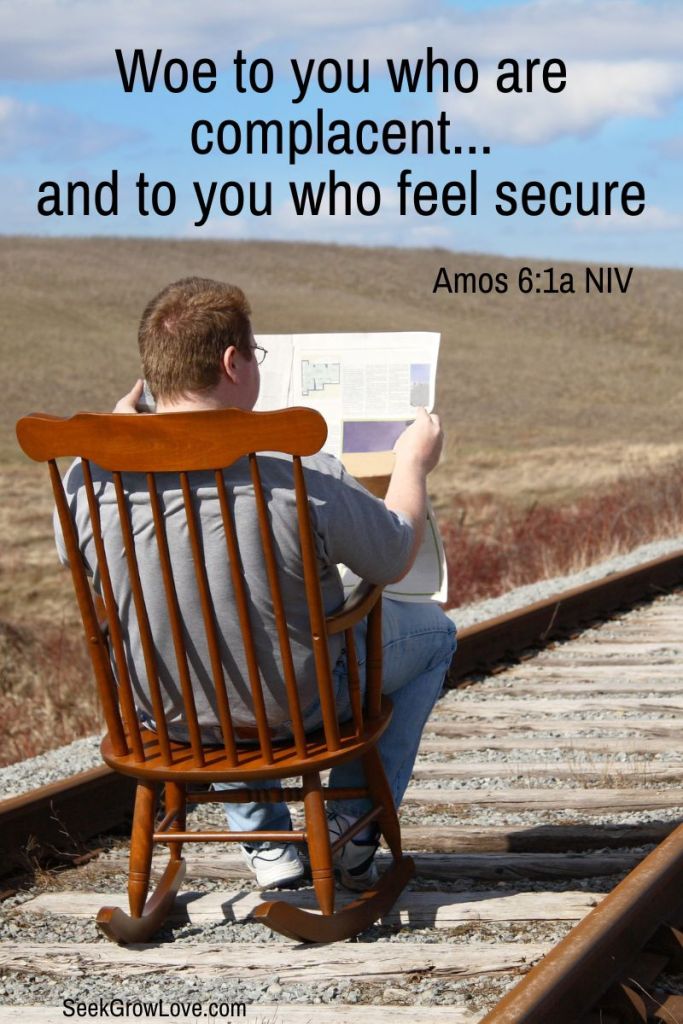
Today we are reading out of the third of the minor prophets, Amos. However, if the first three chapters make you feel a little uneasy: that’s entirely the point! Amos 6 starts with “Woe to you who are complacent in Zion,

    and to you who feel secure on Mount Samaria,

you notable men of the foremost nation,

    to whom the people of Israel come!”

Amos is speaking on behalf of God to the people of Israel in a time of prosperity. However, in a time of complacency, the people of Israel have once again allowed for themselves to become spiritually corrupt. They “lie on beds adorned with ivory,” and “lounge on (your) couches,” but they “will be among the first to go into exile.” (Amos 6:4-7). This is because they “do not grieve over the ruin of Joseph.” Because the people of Israel have become so complacent and uncaring of those in need lest it take away from their pleasure, God seeks to divide and destroy the nation as it currently stands. 

Amos 7-8 essentially goes into vivid imagery of how Israel’s destruction will be met. First, the locusts. However, Amos convinces God to relent to an impending famine. Then, the fire. However, yet again Amos convinces God not to destroy the land. Then, God showed Amos a vision of him holding a plumb line, which is a device used to measure the straightness of a vertical drop. However, when God was “setting a plumb line among my people Israel,” he was measuring their righteousness to his standard. And for this, he must judge them and divide them. 

Surely this should serve as a MASSIVE wakeup call for Israel. Unfortunately, the priest of Bethel (Amaziah) was not wanting Amos to prophesy against Israel in the city of the king. That didn’t end too well for him. Read Amos 7:17 for more on that. Ouch.

We must use this time when Israel was judged as a reflection on our own lives. What does it mean to be complacent? Does God despise complacency? Is it not okay to be comfortable? Although it almost certainly looks to be that way, I would argue that the grave mistake that Israel was making was their complete ignorance of righteousness and their spiritual lives. Are we more concerned with our personal comfort than with the brokenness around us? Do we avoid lamenting over sin and injustice because it disrupts our peace? Although we must always strive for times of peace, we must be aware of our own sin and also make active attempts to comfort those around us who are not at peace. 

Furthermore, God says that a famine will fall upon Israel after all. However, it’s a little different than the usual famine. It’s “Not a famine of bread… but of hearing the words of the LORD” (Amos 8:11). Are we listening for God’s voice or have we tuned Him out in our own prosperity and ignorance? The greatest famine we could ever face is not material, but spiritual when we no longer hunger for God’s Word or even notice when it’s absent. With that said, we must heed the words of Amos and continue to hunger and thirst for the righteousness that God offers us through his words. 

Although most of this sounds like a dire warning and a time for lamenting to come, we actually don’t get to end off our devotion with a bad note! As God promises in Amos 9 that there will be a restoration. “The days are coming… when the reaper will be overtaken by the plowman and the planter by the one treading grapes. New wine will drip from the mountains and flow from all the hills, and I will bring my people Israel back from exile” (Amos 9:13-14). Therefore, if we apply this message to our own spiritual journey, we can know that even if we are burdened by the weight of our own complacency and sin, that it is not too late to act. There is hope for our own restoration, just as God promised that there will be a restoration for the people of Israel. 

-Colby Leggitt

Discussion Questions: 

  1. Where in my life have I grown complacent or overly comfortable?
  2. What injustices am I ignoring or avoiding?
  3. Am I listening for God’s Word daily or has it become background noise?
  4. How can I live today with urgency for hope in restoration through repentance?

Hope

Isaiah 1-4

Regardless of your political ideas and loyalties, I believe we can all agree that the world is a mess right now. War and the threat of new wars are a daily reality. Mud-slinging goes back and forth between our politicians while important issues that they should be finding solutions to go unresolved and forgotten until the next election cycle. The soaring cost of buying a home or even purchasing groceries shows no sign of significant improvement. Anxiety and stress levels are high, causing many both inside and outside of the church to feel hopeless.

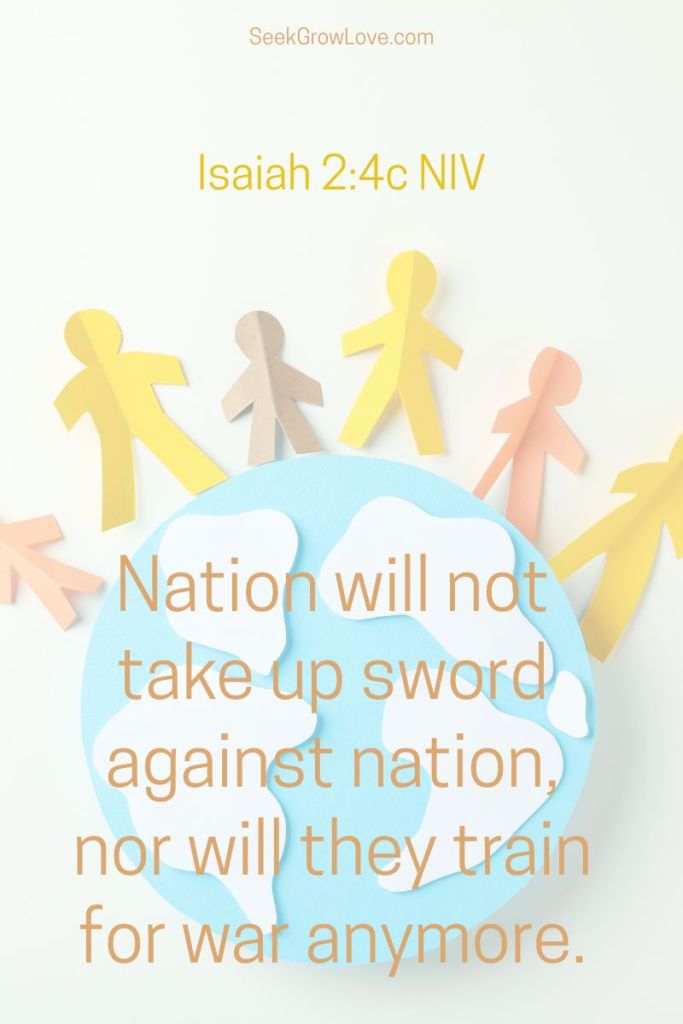
And yet, we have hope! Although there is quite a bit of reading material from the Bible today, I’m going to focus on just one verse that can bring all of us hope. In the NASB 1995, Isaiah 2:4 says:

“And He will judge between the nations, And will render decisions for many peoples; And they will hammer their swords into plowshares and their spears into pruning hooks. Nation will not lift up sword against nations, And never again will they learn war.”

Imagine living in a time and place where God is our judge. Of course, he is already in our hearts, but the nations of our world don’t worship and obey him. Even the USA, with “In God We Trust” printed on our money, documents, and buildings, does not truly and wholly worship God.

Imagine no more need to create bigger and faster weapons. In verse four, by turning weapons into plowshares and pruning hooks, they are creating tools used for growth instead of destruction. Without war or the threat of war, more creativity and time could be devoted to feeding the hungry and easing each other’s burdens. No one would fear their loved ones becoming a casualty of war or going off to fight only to return as a different person because of their experiences.

I encourage you today, as we await God’s Kingdom, to seek out ways to bring good to the damaged world we live in. Regardless of the hate and dismay, help to cultivate life and renewal for your family, church, and community. Seek peace whenever possible and spread hope far and wide.

-Lacey Dunn

Reflection:

• What are ways that you can spread the hope of God’s peace to others in your family, church, school, work, community, etc…

• Take time to imagine what life will be like in God’s Kingdom. What does it look like, smell like, and feel like?

• Are you feeling hopeless? Who is someone you can talk to who can help restore your hope? 

Remember His Faithfulness

Deuteronomy 14-16

Celebrate the Festival of Tabernacles for seven days after you have gathered the produce of your threshing floor and your winepress. Be joyful at your festival—you, your sons and daughters, your male and female servants, and the Levites, the foreigners, the fatherless and the widows who live in your towns.” – Deuteronomy 16:13-14

Today we read God’s commands to begin observing three major feasts: Passover, the Feast of Weeks, and the Feast of Tabernacles. Each of these festivals was meant to be an intentional time set aside for remembrance (a recurring theme in Deuteronomy). The Israelites had witnessed God’s power and provision in so many ways… like so many. They were delivered from Egypt, provided for in the wilderness, and were finally being brought into the Promised Land—all of which included various miracles and supernatural occurrences. These celebrations were more than legalistic rituals—they were acts of worship and gratitude intended to continually remind God’s children of His unending goodness.

While most Christians today don’t keep these feasts in their traditional form, their purpose no doubt remains deeply relevant. We are still called to remember God’s goodness, rejoice in His provision, and keep His Kingdom promise forefront in our minds. Jesus, our Passover Lamb, has secured our ultimate deliverance, and we live in the hope of the final harvest when God will gather His people into His eternal presence. Not only must we live in hope, but in daily remembrance. Our hope is not a baseless one. We have a book full of stories and people and places that display our Father’s faithfulness. We live in a world uniquely and precisely designed for human life in ways that defy mere chance. We see glimpses of the Kingdom in small moments every day. These are the things that we must recognize and reflect upon on a daily basis. 

Whether through communion, worship, prayer, or perhaps even partaking in some feasts or holidays, we are called to consistantly honor the God who has redeemed us, sustains us, and promises us a future. I pray today that we cultivate hearts of gratitude and remembrance, celebrating our Father’s steadfast love and infinite goodness in every season of our lives. 

-Isabella Osborn

Reflection Questions:

  1. God established specific times for Israel to remember His faithfulness. How can setting aside time for remembrance strengthen our faith? How might neglecting remembrance weaken faith?
  2. How can you intentionally set aside time to remember and celebrate God’s goodness?
  3. What are some specific ways God has delivered you in your life? Have you taken time to truly reflect on and thank Him for those moments?

Light Dawns on the Dark Night of the Soul

Exodus 10-12

As we go through life, there are times when it seems like God is very active and involved in our day to day lives and we sense God’s love, nearness and active interest in our lives.  However, if we are honest, there are other times when life seems to just move along and God doesn’t seem to be saying much or doing much on our behalf.  The technical term for this awareness of God’s absence is called “the dark night of the soul.”  Many growing Christians have and do experience times of God’s apparent absence in our lives.

As we read through the Bible it becomes apparent that there are times when God gets actively involved with His people.  God was there in creation, making the earth, making the plants and trees, making the animals, making Adam from dirt and Eve from Adam’s rib.  God was there in Eden talking openly and directly with Adam and Eve.  God was there asking Cain about his brother Abel.  But then we don’t hear much from God.  We know that people like Enoch “walked with God”, but we’re told very little about what God is up to for hundreds of years, as the population of earth increases and also the sin of humanity increases.  There is a long period of God’s apparent absence from history until the days of Noah when God appears to Noah and tells him to build the Ark because a flood is coming.

After the flood there appears to be more years of silence, until the Tower of Babel gets built and God comes down and confuses people’s language.  Then there is more silence from God until he calls Abraham.  And so on and so on…There are intermittent times where God is active and involved and times when God seems silent throughout the book of Genesis.

At the end of Genesis God saves Abraham’s family from famine by bringing them down to Egypt.  At first, all is well as Joseph, Abraham’s great grandson is the second most powerful man in all of Egypt.  But Joseph eventually dies, and he is no longer able to protect his family from the powerful Pharaoh, and eventually the descendants of Abraham are enslaved by the Egyptians.  This lasts for a period of roughly 400 years.  During that 400 years it seems that God is once again silent.

During that time Israel is growing from a few hundred people, to millions of people.  Millions of men, woman and children living in bondage in a foreign land.  Perhaps stories about God and their ancestors Abraham, Isaac and Jacob were passed along by word of mouth, but we might imagine that so many years of silence may have left the nation of Israel in a permanent Dark Night of the Soul.  But then… out of the darkness and silence, Moses is born and becomes a member of the Egyptian royal family.  God is at work, but he’s not quite ready to make himself fully known to Israel.  Moses kills an Egyptian and flees to the wilderness and it seems that the darkness continues and the voice of God remains silent…until God appears to Moses in the burning bush and tells him to go back to Egypt.

In Exodus 10-12 the time has come for God to make himself known to His people… and to Egypt. Exodus 10:1-2 – “Then the Lord said to Moses, “Go to Pharaoh, for I have hardened his heart and the hearts of his officials so that I may perform these signs of mine among them that you may tell your children and grandchildren how I dealt harshly with the Egyptians and how I performed my signs among them, and that you may know that I am the Lord.”

Here, God tells Moses that He’s about to make his presence known in a powerful way.  God’s about to show up, the darkness is ending, the silence is over.  And show up He does!  God shows up in a profound and powerful display of his power and might.  Bear in mind, Egypt was, at the time, the most powerful empire in the whole world.  Pharaoh was the most powerful person in the whole world.  Pharaoh had been exerting his power in a ruthless way over God’s chosen people for hundreds of years.  Lord Acton once said “Absolute power corrupts absolutely.”  In the United States we live under a Constitutional system that intentionally balances power among three different branches of government- Executive, Legislative and Judicial.  This is to prevent any one person from having too much or absolute power.  These lessons were learned after observing thousands of years of kingdoms.  Pharaohs and other absolute monarchs have historically used their power in destructive and unjust ways.  And with such unmatched power comes hubris.

The Poet Percy Bysshe Shelly captures the hubris in his powerful poem Ozymandias:

I met a traveller from an antique land,

Who said—“Two vast and trunkless legs of stone

Stand in the desert. . . . Near them, on the sand,

Half sunk a shattered visage lies, whose frown,

And wrinkled lip, and sneer of cold command,

Tell that its sculptor well those passions read

Which yet survive, stamped on these lifeless things,

The hand that mocked them, and the heart that fed;

And on the pedestal, these words appear:

My name is Ozymandias, King of Kings;

Look on my Works, ye Mighty, and despair!

Nothing beside remains. Round the decay

Of that colossal Wreck, boundless and bare

The lone and level sands stretch far away.”

Pharaoh, like Ozymandias in the poem, was filled with hubris over his unmatched power.  He believed himself to be king of kings.  He needed to be taught a lesson in humility by the true King of Kings.  God showed up.  Ten plagues later and all of Egypt was brought to their knees.  Meanwhile, the people of God began to see first hand just how great and powerful their King, the true God, YHWH really was.  That story has been told for thousands of years, and today, the people of Israel continue to sit down and eat bread without yeast and drink wine and remember the Passover and how powerful their God really is.

Sometimes, God seems to be silent, but make no mistake, God is still there and God is still powerful and in the end, God will show himself to be greater than all human opposition.  May you know the true God.

Jeff Fletcher

(originally posted for SeekGrowLove on February 2, 2020 – Thank you, Jeff!)

Reflection Questions

  1. Have you ever felt like you were in a dark night of the soul? How would you describe this time? How might God describe this time? Is there anything you found helpful during this time?
  2. How do you think the Israelites were feeling as they: made bricks without straw, encountered the first 9 plagues, asked their Egyptian neighbors for jewelry – and received, selected a lamb, killed it, put the lamb’s blood on their doorframe, experienced the distinction God made between Israel and Egypt?
  3. What lesson was Pharaoh learning in Exodus 10-12? What were the Israelites learning? What are you learning about man and about God?

Blessings

Genesis 48-50

At the end of their lives the patriarchs bless their children.  The ancients believed words matter.  If you asked them, “What’s wrong with the world?”  or “Why is the world broken?” they would answer, “The curse.”  What’s wrong with the world is that God cursed it–using words.  So, how should we expect the world to find healing and redemption?  How does God plan to undo the consequences of our first parent’s rebellion?  He blesses.  First he calls Abraham and blesses him.  Abraham calls Isaac and blesses him.  Isaac calls Esau, but Jacob impersonates him to receive the blessing.  Even so, now Jacob has come to die and he wants to pass on the  blessing to his twelve sons who will become the twelve tribes of Israel.  Somehow or other, God is going to use this dysfunctional Abrahamic family to initiate his master plan of redemption that will one day culminate with making everything wrong with the world right.  Jacob is here playing his part in God’s agenda.

What’s interesting about how he blesses his children is that for several of them, the blessing sounds more like a curse.  For example, to Levi and Simeon he says, “Cursed be their anger…I will divide them in Jacob and scatter them in Israel.”  Through Jacob’s words, God is prophesying about the future.  Indeed Levi was scattered throughout the tribes and Simeon was absorbed into Judah.  What’s so fascinating about the blessing is that Israel passes over his first born, Reuben, as well as his second and third born, Simeon and Levi, and he jumps to boy number four–Judah.  He compares Judah to a lion and then says, “The scepter shall not depart from Judah, nor the ruler’s staff from between his feet” (Genesis 49.10).  This prophesy is rather staggering as we look forward to the rest of the bible.  The great king David and his successors were from Judah.  Ultimately, Jesus, himself, descended from Judah.  So, how did Jacob know which of his children would hold the scepter?  The odds of guessing it right are only one in twelve–about 8%.  God was working with this man of faith to know what to say and whom to say it to.  Jacob might be old, but he is still walking with God, right up until his last breath.

After Jacob dies, we learn about how Joseph forgives his brothers rather than taking vengeance into his own hands.  Ultimately, Joseph himself arrives at death’s door.  We read in the New Testament hall of faith the following about Joseph:

Hebrews 11.22
By faith Joseph, at the end of his life, made mention of the exodus of the Israelites and gave directions concerning his bones.

Out of everything that Joseph went through, his heroic perseverance and faith in God, this is what he is remembered for.  When he came near to death, that same Abrahamic promise that had burned in Israel’s heart, blazed in Joseph’s as well, even while he came to the end of his life.  He expressed his faith by this last request:

Genesis 50.24-25
24 And Joseph said to his brothers, “I am about to die, but God will visit you and bring you up out of this land to the land that he swore to Abraham, to Isaac, and to Jacob.”  25 Then Joseph made the sons of Israel swear, saying, “God will surely visit you, and you shall carry up my bones from here.”

Look at the faith of this man!  He’s suffered so much in the course of his life and yet he never gave up on God.  He had been elevated to the highest office in the land, next to Pharaoh, and he still retained his faith.  In the end, God’s promises to Abraham, Isaac, and Jacob would not die.  One day he would return to the land of his childhood.  It would be centuries, but eventually, when the Israelites came out of Egypt, they carried Joseph’s sarcophagus with them through the desert and laid him to rest in the promised land.  Whether you experience hardship or prosperity, be like Jacob and Joseph and keep faith your in God’s promises to bring the kingdom.

-Sean Finnegan

(originally posted for SeekGrowLove – back when it was Grow16BibleReading – on August 8, 2016 – our first full month of daily devotions!)

Reflection Questions

  1. What can we learn from Jacob and his blessings for his offspring? What part of Jacob would you like to display in your life?
  2. What can we learn from Joseph and his relationship with his family, with Egypt and with God? What was important to him? What part of Joseph would you like to display in your life?
  3. Why is “the land” important? What have we seen happen throughout the book of Genesis in regards to the land?
  4. What have you learned from the book of Genesis about God and how He works? What characteristics does He have? What is important to Him? What is God’s agenda? How has He interacted with His people? What has been a genesis/beginning in your relationship with God? What blessings are awaiting God’s children?