2020 has been quite a year – of Bible devotions! Thank you to all our writers this past year! You have helped us see into God’s word. Let’s press on into 2021 to see what God wants to teach us in the New Year He has given. Our new Bible reading plan
will include some Old Testament and either New Testament or Psalms/Proverbs every day. Daily SeekGrowLove.com devotions will either be based upon one of the readings for the day – OR – the writer may choose a Biblical topic to discuss for the week. Become a follower at SeekGrowLove.com to receive daily email devotions all year, with a new writer every week. Make this year THE year to get closer to your Creator and His Son than you have ever been before! Dig into His Word!
More than any year in recent history, people are looking forward to the closing of 2020. There is no magical spell that will make our worries disappear as the zero turns to a one, yet for many there will be a great sigh; a new year brings a new promise. There are some prognosticators who say the worst is yet to come, yet for some reason, I have a renewed sense of hope. I have longed for an eventual reprieve, rest, and relief from restrictions. The whole world is longing to move forward, and see 2020 left on the side of the road in the rearview mirror, “Good riddance. Goodbye.” as we blow it a sardonic kiss. Mwwahh.
As we have seen in our time with Revelation this week, any break we have is temporary because the worst is yet to come <balloon pops>. The pandemic we have seen up to this point will pale in comparison to the plagues preceding the Kingdom of God. Although there has been some pretty intense weather and natural disasters this year, this isn’t even close to what is being forecasted for future calamities. While many wars have waned in the wake of coronavirus, war will be truly inescapable, pressing in on all sides before the coming of Christ. It is so true that grief, sorrow, exhaustion, frustration, and anxiety have been intensely felt in 2020, and I would never make light of that, but when compared to the longing of the earth that is to come, it will easily eclipse all we have felt this year. The people, and the earth itself, will be longing more than ever for refreshing.
Then I heard what sounded like a great multitude, like the roar of rushing waters and like loud peals of thunder, shouting: Hallelujah! For our Lord God Almighty reigns! Let us rejoice and be glad and give him glory! For the wedding of the Lamb has come, and his bride has made herself ready. – Revelation 19:6,7
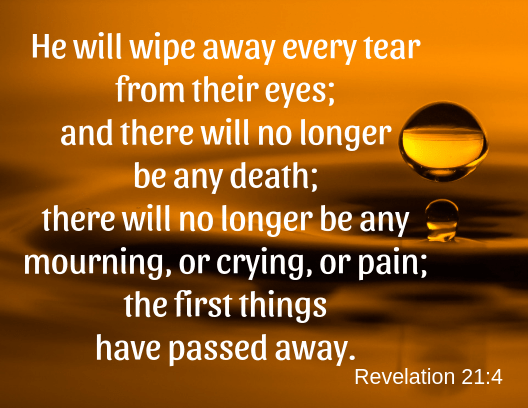
And I heard a loud voice from the throne saying, “Look! God’s dwelling place is now among the people, and he will dwell with them. They will be his people, and God himself will be with them and be their God. ‘He will wipe every tear from their eyes. There will be no more death’ or mourning or crying or pain, for the old order of things has passed away.” Revelation 21:3,4
The best news of the gospel of Jesus Christ is this ultimate reprieve will come alongside our Lord and Savior. This will be the greatest of all welcomes and simultaneously, the best of all riddances. While we can retain some small hope that our life will return to the way it was a year ago, was it not still filled with tears, death, mourning, crying, pain, the entirety of the whole old order? To long for a return to 2019, or even a better version of the past, is similar to the cry of the children of Israel in the desert to return to Egypt because at least their bellies were full there (Ex 16:2,3). Life as we know it (or even knew it) is marginally mediocre when we compare it to what is in store for us. If we are to cry out, to groan, to bemoan, let us do so as people who are ready to be rid of our sin and the captivity it has placed upon us and the earth once and for all (Ex 2:23). Our present suffering, no matter how great, is nothing compared to the glory that awaits.
“I consider that our present sufferings are not worth comparing with the glory that will be revealed in us. For the creation waits in eager expectation for the children of God to be revealed. For the creation was subjected to frustration, not by its own choice, but by the will of the one who subjected it, in hope that the creation itself will be liberated from its bondage to decay and brought into the freedom and glory of the children of God. We know that the whole creation has been groaning as in the pains of childbirth right up to the present time.” Rom 8:18-22
-Aaron Winner
If you have been reading along all year, congratulations! Today we read the final chapters of God’s Inspired Word – Revelation 19-22.
Tomorrow we begin a New Year and a New 2021 Bible reading plan! Every day we will read 2 passages – an Old Testament passage (usually just 2 chapters) and a New Testament or Psalms/Proverbs passage (often just one chapter or a few short Psalms). Our writers may write about one of the day’s passages, or some will choose to write all week on a chosen theme, giving us the opportunity to dive a little deeper into some relevant subject matter and what Scripture teaches on that topic.
Print your copy of our Bible reading plan below – and let’s see what God has to tell us in 2021! Seek Him! Grow Your Faith! Love!
Dodge City, Kansas made the perfect background for many of the early westerns that hit the silver screen. Any title character was the game-changing lawman who took on the town that was historically and notoriously known for its gunslingers, reckless living, violence, and pretty much the hub for all things unabiding and uncouth. Dodge became the epitome of frontier lawlessness, and those who resided there were in a collective agreement: every man or woman for himself. What initially seemed like a good time, a get rich quick plan, or a temporary set of circumstances became a way of life for most those who stayed, and ironically for many, that is exactly what it cost them to stay in Dodge: their life. Those few that escaped the cruel fates of this city, these ethical outsiders who found themselves living inside its “walls”, could see the turn of the tide, and knew it was time to get the heck out of Dodge.
Dodge City is not alone for its notoriety as an evil city. Abraham’s nephew, Lot and his family hailed from Sodom and Gommah, cities God destroyed with sulfur and fire because of their wickedness. God also gave instructions to Joshua to destroy the seven nations that were descended from Canaan (who did equally despicable things including child sacrifice). Additionally, a once-blessed Babylon is handed over to Darius which would lead to an idiom in its own right, because God spoke through the “handwriting on the wall.” In each of these instances, God provides opportunities for the inhabitants of the places to get the heck out. (Angel’s warning and Lot’s escape (Genesis 19); Jericho’s march and Rahab’s salvation (Joshua 6); Jeremiah; Israelites spared (Daniel 5)
As we see in the prophecy delivered in Revelation, there is a new nation that is forming/formed that is not the Babylon of old, but a new one represented by an adulterous woman (Rev 12) There are definite similarities in the wickedness that is taking place in the future and that of Babylon’s past. This new Babylon is a place of great excess which results in every opportunity to do evil (including the destruction of God’s prophets), and possibly a physical location to the events that are taking place near New Jerusalem (although some think it may be a western civilization like the United States) soon to be established by Jesus. So what is the word given for those who reside in this place? That same warning delivered by Jeremiah 600 years prior: Flee from Babylon! Run for your lives! (Jeremiah 51:6)
.
We do not need to be able to pinpoint on a map where this new Babylon is in order to make plans to run in the direction of God. He will deliver those who follow his perfect and pleasing will, making a way for those who choose Him. While the United States or the Western World may or may not be the Babylon spoken of here in this text, with some quick conjecture, there are striking similarities in the way our culture is rapidly shifting in the last half-century or so. The quest to be the source of knowledge is valued more than faith in God Almighty. Our wealth and standard of living continue to increase, but so do our distractions and devices. Lawful and unlawful wickedness occurs even to the point that lives of children are being destroyed. So, does this mean that we should flee to a new country? Probably not. And it isn’t our physical location that is the primary issue. It is the heart. We need to make distinctions about our citizenship – it is kingdom bound first. We are simply in this world, not living for it.
So where have you made your encampment? Just outside of Sodom? It won’t be long before you are inside the city walls (Genesis 13:12). Is your indulgence a constant? Then it is not a vacation home — it’s where you live. Run away from Sodom! Flee from Babylon! Get the heck out of Dodge! This is a cry to myself and to you. Keep yourself from getting tangled in the web of fulfilling your every whim, pursuing knowledge that gives you some sort of power or position, and desiring things that have nothing to do with God’s kingdom. Your diplomas, your clothing, your dwelling, and your status are the commodities of moths. Bridle your body so your hands and feet are available to do the work of God or physically move if you must (FLEE! 2 Timothy 2:22) Only then can we be saved from the fate of Babylon and live in the fullness of the new city worth taking up residence.
-Aaron Winner
Today’s Bible passage can be read or listened to at BibleGateway here – Revelation 14-18
Tomorrow we finish the book and the year with Revelation 19-22.
Stay tuned for the big unveil – SeekGrowLove’s Bible Reading Plan for 2021!
The Hebrews watched as the plagues of Israel consumed the whole of Egypt. They watch God lead them in a cloud by day and a fire by night. They watched the Red Sea part and swallow the advancing armies hoping to kill or reenslave them. Yet, fresh off the heels of all of these things, they lost their nerve when Moses, their leader and messenger from God, had been gone for a few moments longer than expected. In the place of God Almighty, they erected a golden calf to worship saying these were the true gods that brought them out of Egypt. An enraged Moses came down from the mountain to see utter chaos. Aaron fumbles through his excuses and the people of Israel are punished. Moses declares that each person must pick a side – You are either for the Lord or against him. (Ex 32:26)
So much destruction occurs in these few chapters of our reading today as angel ominous trumpeting announces another terrifying event on earth. Cities are destroyed from earthquakes, fire, sulphur, and smoke destroy a large percentage of the population, and a plague occurs that tortures to the point of death, but never comes. It isn’t a pretty site – unleashed by ultimate permission giver. It will be an understatement that many will have their faith tested during these times, and begin seeking any answer to the misery they see unfolding before them. When there is no great parting of the Red Sea proclaiming the Lord is in this moment, so many will begin to look to new creatures, whether literal, people, or nations, to follow for immediate comfort or distraction. In fact, war will be raged against anyone who tries to serve the Lord during this time or who shares the testimony of Jesus (Rev 12:17). The only way to survive it seems, is to worship a beast and take its mark so you may buy or sell.
“The rest of mankind who were not killed by these plagues still did not repent of the work of their hands; they did not stop worshiping demons, and idols of gold, silver, bronze, stone and wood—idols that cannot see or hear or walk.” – Revelation 9:20
“The second beast was given power to give breath to the image of the first beast, so that the image could speak and cause all who refused to worship the image to be killed. It also forced all people, great and small, rich and poor, free and slave, to receive a mark on their right hands or on their foreheads, so that they could not buy or sell unless they had the mark, which is the name of the beast or the number of its name. This calls for wisdom.” – Revelation 13:15-18a
There is much to study in these scriptures about what the unfolding of these events may look like in our coming world, but the implications of these passages are as simple as the charge from Moses. When I struggle, whose side am I on? If there isn’t immediate relief from the pain, whose side am I on? If it keeps me from my dreams, whose side am I on? When it costs me my reputation or position, whose side am I on? If it costs me my friends, my family, my children, or my life, whose side am I on? Even if you don’t live long enough to set your eyes on the terrifyingly terrific events laid out by the trumpets, you must make a decision before you cross the path of the lesser trials in your own life. A claim must be laid for the Lord in your heart, and you must begin setting yourself apart. Otherwise, your faith will be crushed at the first crosswind of complication. Indecision will place you in the queue of those ready to receive their mark on the path of least resistance. You may receive a momentary benefit from your idol, but it ultimately places you opposite of God. Much like the fate of the Israelites who stood against Moses, destruction comes for those who stand against the Lord Almighty. Draw a line. Pick a side. Ready yourself for the fight of your life.
“If your right eye causes you to stumble, gouge it out and throw it away. It is better for you to lose one part of your body than for your whole body to be thrown into hell. 30 And if your right hand causes you to stumble, cut it off and throw it away. It is better for you to lose one part of your body than for your whole body to go into hell.” – Matt 5:29,30
-Aaron Winner
Today’s Bible passage can be read or listened to at BibleGateway here – Revelation 9-13.
There is much to take in with today’s reading as John describes the throne room of heaven and the events that unfold, marking the Kingdom of God being set into motion. There are angels, horsemen, and elders, each executing and exacting the will of God. If you are a bit overwhelmed by today’s reading, you are not alone. John, who spent more time with Jesus than most, is still awestruck by the worship of God happening before him, and he is doing his best to describe heavenly things for which there is no earthly vocabulary (something important to keep in mind as we examine the remainder of this book and prophecy). With a resounding question, John’s attention is drawn to the hand of God:
“And I saw a mighty angel proclaiming in a loud voice, “Who is worthy to break the seals and open the scroll?” But no one in heaven or on earth or under the earth could open the scroll or even look inside it. I wept and wept because no one was found who was worthy to open the scroll or look inside.” Rev 5:2-4
John weeps, for the content of the scroll could very well never be known. Salvation’s plan locked inside this scroll with no one on heaven or earth who is worthy of removing the seven seals that keep it shut. This is seemingly the end of the road. Without a Savior, life on earth has no redemption. This is most definitely worth a weep, knowing that for some, their story stops here. They have put everything in what they alone can achieve, yet they are like every other creature in heaven and on earth. Without the hope delivered in the next verses, all that would remain is remorse and regret (Luke 13:27,28).
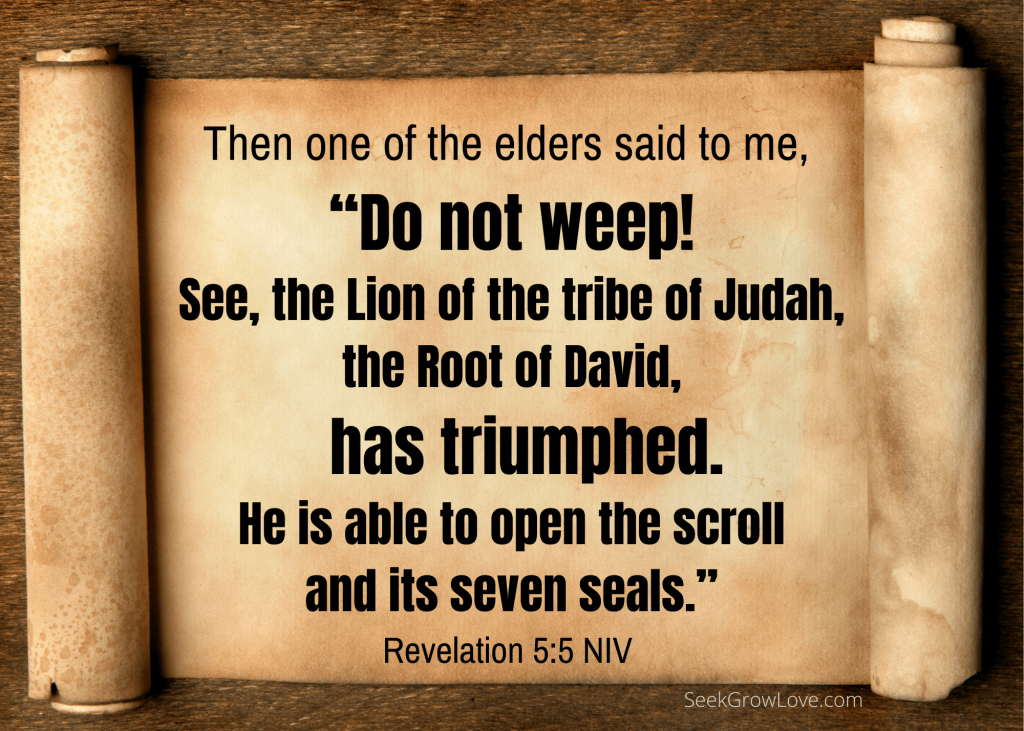
Then one of the elders said to me, “Do not weep! See, the Lion of the tribe of Judah, the Root of David, has triumphed. He is able to open the scroll and its seven seals.” Rev 5:5
Salvation is a gift of God, paid for by the blood of Jesus Christ (Eph 2:8,9). In the moments when we are overcome with great grief, sense the defeating drift of sin, are lost or lonely, feel pressed or persecuted, let Jesus Christ step forward. Do not reach deeper into empty stores, pour out of a broken vessel, or pick up the shattered pieces; let him do what we cannot. We need only lift our heads – to pray, to seek, to take heart – as we listen to the words of the elder that Jesus Christ, the Lamb of God, has triumphed. He will step forward and unfurl a new banner, renewing and restoring the purpose of our life. He alone is worthy to open the scroll, yet we are indeed the beneficiaries of the prize of his propitiation.
And they sang a new song, saying: “You are worthy to take the scroll and to open its seals,because you were slain, and with your blood you purchased for God persons from every tribe and language and people and nation.” Rev 5:9
-Aaron Winner
Today’s Bible passage can be read or listened to at BibleGateway here – Revelation 4-8.
It is very likely that at the time of the Revelation of Jesus Christ to John, he was the last living apostle of Christ. In his final days, he was banished to the Greek island of Patmos for his preaching and prophesying, both viewed as ways of stirring up unwanted rebellion in the Roman Empire. It is here that he is delivered a vision of final days before the return of Christ. Of the men that followed Jesus, John may have had the least cruel fate. According to scripture or historical accounts, all had been killed – stoned, clubbed, crucified, beheaded, and speared – preaching the Good News of the Kingdom of God, doing everything in their power to fulfill their commission (Acts 1:4-8) and reach the ends of the earth before the return of their friend and Savior. The disciples preached the Kingdom of God as something that would be seen by the generation they spoke to or the coming one. There was an extraordinary emergency to their message. And yet, 2000 years or so later, here we are.
I am reminded of my internal adolescent rebuttal when hearing Christ was coming soon — “If Jesus Christ has not come in the last 100 generations, why should I think that he will come in mine?” Through our reading this week, we will unpack the message of John and, like many before us, apply his words to the time and place that we live in. We live in interesting times, but so have many generations before us. They each had their own political unrest, plagues, and natural phenomenon. With all the challenges of this year included, to live in the United States as a Christian is still pretty easy by comparison to many places in the world today, and most definitely effortless compared to the challenges faced by apostles of Christ. For many of us, our ease of living has led us to share (or not) a complacent gospel. This was already happening in the days of John; a symptom shared by many of the churches in Revelation 2 & 3. As you read this week, consider the following to renew your sense of urgency to the Gospel message and reinstate Christ’s Kingdom as the centerpiece of your daily purpose:
1. You are always a single breath away from the Kingdom of God. No person knows the day or hour of his/her death. We must live our life to be found in Christ, not wait for signs of his return and scramble our way to grace. The thing is, if you’re waiting for signs before you live out the Gospel, you will be distracted, diverted, or disconnected (Matt 25:1-13, Parable of the Ten Virgins). “Now listen, you who say, ‘Today or tomorrow we will go to this or that city, spend a year there, carry on business and make money.’ Why, you do not even know what will happen tomorrow. What is your life? You are a mist that appears for a little while and then vanishes.” – James 4:13,14
2. No one, except the Father, knows the day or the hour Christ returns. The days before Christ arrival will be as in the days of Noah (Matt 24:38) – people will be married, there will be parties, children will be born, parents will send their teens to college, couples will be building their dream homes, and many will be working hard to retire early (v.40-42). Despite the best efforts of John to deliver his prophecy, many will be caught unaware of the harbingers of Christ’s return. Because of this, it is imperative we deliver the Gospel message wherever our feet are on the daily. “But about that day or hour no one knows, not even the angels in heaven, nor the Son, but only the Father. As it was in the days of Noah, so it will be at the coming of the Son of Man.” – Matthew 24:36,37
3. Many of the dramatic events that unfold in Revelation will happen within a single generation. God has been working on His salvation plan since the foundations of the world (Col 1:16) with the culmination being (spoilers ahead) the establishment of the Kingdom of God on Earth. According to the words of Jesus and the vision of John there are compounding and intensifying events as seals are opened and the wrath of God being poured out. Natural wonders, dramatic plagues, famines, wars, and a global political climate will feed off one another and spur along the intervention and return of Christ. If this year has taught us one thing, it is how fast the world can change with some of these elements aligned; however, the ignition point for the return of Christ is already set. There will be a fire that follows and it will consume quickly; the temperature need only rise a bit more. “Truly, I say to you, this generation will not pass away until all these things <Matt 24:14-33> take place.” – Matthew 24:34
“Blessed is the one who reads aloud the words of this prophecy, and blessed are those who hear it and take to heart what is written in it, because the time is near.” Revelation 1:3
-Aaron Winner
Today’s Bible passage can be read or listened to at BibleGateway here – Revelation 1-3
Tomorrow we continue Revelation with chapters 4-8.
Today, you are racing through two books at a blazing speed. Some of the shortest books in the Bible by word count, verse count, chapter count. However, a sad reality happens with Biblical books. The smaller they are, the less they are read. Out of the top 10 least read books on BibleGateway, you have read three this week. Jude is number 8 on the list of least read books. Though Obadiah takes home the #1 spot, 2 John and 3 John take spots 3 and 4, respectively. It’s sad, because what we get in 2 John and 3 John is the same God-inspired message, just in much smaller, some would say, bite-sized portions.
Let’s talk about the letter’s collectively. Both are written to smaller groups than 1 John. 1 John was to a general audience; 3 John is to one man, and 2 John is to one woman, or one church. Either way, 2 John’s statements make sense. John says that he is joyous that some “children” are walking in truth. In 3 John 4, we see that this is his greatest joy. Walking in truth means believing in Jesus and following his way of living. Those young people he loves, who he has “raised in the faith”, his “children”, he loves to know they have remained faithful to Jesus.
We have already talked about this remaining faithful. You must follow the commands of Jesus. It is not a new commandment but an old way. LOVE our brothers and sisters, one another in the body! If you don’t understand loving a brother and sister, you don’t understand the gospel. John is clear. This is THE commandment of Jesus. 3 John gives us an example of this. John is commending Gaius for supporting the work of brothers and sisters who were passing through preaching the gospel. He welcomed them in, allowed them to teach, gave them money and sent them on their way. This was the right thing to do. And a man named Diotrephes DIDN’T do the right thing, but in jealousy and out of a lack of love, did not support them and kicked out those who helped them.
But Diotrephes isn’t alone in harming the message of Jesus. Diotrephes wanted to be the top dog, and his ego was hurt that respected teachers were coming into town. He wanted to be the greatest in the eyes of the church. His arrogance earned him disapproval from John. Moreover, John’s CONDEMNATION is poured out onto those who are deceivers, false teachers. People come along who are denying that Jesus came in the flesh, that he was born in the Little Town of Bethlehem on a Silent, Holy Night. John roundly condemns this attitude, this belief.
We don’t have people claiming that to us, but we can learn from this. John encourages “the woman” to compare the claims of these “teachers” with the claims of the apostles. If they didn’t match up, follow the trusted source. For you, test the claims that you hear about God, Jesus, the world, the afterlife, against the claims of those who have known and followed God, in scripture and the church. Trust those who have known and experienced God over those who want to be “first among everyone”. Don’t let false teachers and “Big-Headed-Egoists” harm THE faith or harm YOUR faith.
My brothers and sisters, I am glad to have been reading along with you this week, this week when we remember the birth of Christ. Whether we celebrate together or separately, we are bound together in love, affirming together the truths of Jesus and his message of eternal life.
May you love your brothers and sisters in faith.
May the church you call home be a beacon of love in a hurting world.
May you never be divided by the arrogant or the false teachers, but if they try, may you stay true to the faith of scripture.
My brothers and sisters, may you forever live in the words of 3 John 2 – Beloved, I pray that in all respects you may prosper and be in good health, just as your soul prospers.
On Christmas, it’s appropriate that we read 1 John. It may seem better that we read Matthew or Luke, but 1 John distills the life and teaching of Jesus from the perspective of an old man. If we want to hear an old, inspired teacher dispensing his wisdom, John (and the books attributed to that name) are books to which to turn.
John is old and he is concerned with the most important things in life. He testifies about Jesus, the light who comes into the world, to fulfill the joy of himself and his readers. Joy is a chief concern of the old man. Jesus doesn’t turn us into a curmudgeon. That’s because Jesus brings us to a God who is greater. A God who is light. A God who is love. That’s a God of Joy.
If we want to be in Christ, to have this God who fulfills joy, to be counted among the children of light and love, we must keep the commands of Christ. We must walk as Jesus walked. But what is the command. When John says the old command they have heard from the beginning, he is not referring to the law. He is referring to the command from the beginning of the teaching of Jesus. The message which we have heard from the beginning, that we should love one another.(3:11) Just as Christ laid down his life for us, we should be willing to lay down our life for our brothers and sisters in love (3:16). We believe in the name of Jesus and love one another, just as Christ commanded us (3:23). More verses that tell us to love one another because of the love of God : 4:7-8, 4:10-12, 4:19-21.
The command is to love our brothers and sisters.
But we are also commanded to NOT love the world. Of course, this doesn’t mean to not love people. The “world” according to John, are all the things that are not of God: sin, power, money, control, hate. We so easily love sin, which gives us momentary pleasure, usually at another’s pain. We love power and money and control, so that we can continue to sin without consequence in this world. And hate allows us to have superiority to others even as we hurt them, because we think we are better.
AVOID THAT. Avoid those idols!
Know that if you keep the command to love, if you believe in the name of Jesus, and allow him to guide you in light and love, the God of joy is going to give you a joy that lasts forever. We are promised eternal life.
May you, my brothers and sisters, experience the JOY that God gives.
May you LOVE one another, as is the command of Christ.
May you avoid sin and the love of the world, and have PEACE in yourself.
May you experience eternal life, both now and forevermore, and have HOPE.
And with that HOPE, PEACE, JOY, and LOVE, may you have a very, very…
Merry Christmas!
-Jake Ballard
Today’s Bible passage can be read or listened to at BibleGateway here – 1 John.
Today, I would encourage you to read the material (Jude, 2 Peter) BEFORE the devotion, if you don’t already do that. Go do that. This can wait. You may be saying to yourself, did I just read the same thing twice? They are very similar.*
I’ve written this before, but in scripture, when something is repeated, IT IS IMPORTANT. In Ancient Cultures, reading wasn’t the norm. The people in the time of Jesus and before were oral cultures, and repeating oneself in written form was a way to emphasize important points. What’s happening in Jude and 2 Peter is God “repeating himself” for our benefit.
Jude and 2 Peter are both focused on false teachers bringing in destructive teachings among the people of God. Jude tells us that these people “creep” in “secretly”. They are teaching two general ideas : they are denying Jesus as Messiah and Master and they are turning grace into immorality and sensuality. These are twin ideas. These people were declaring that Jesus was not the only one who could save us from our sins (Messiah) and had no place in telling us what was right and wrong (Master). The false teachers seemed to have held the view that sin was not “real”; there was not one thing that was right and another that was wrong, but all were saved by the grace of God, and all would be permitted to spend eternity with him. All action was permitted.
We are still talking about the ancient world, though I know how similar it sounds to our own. Jude and Peter are warning us to not be seduced by these ideas. Instead, FIGHT for the faith. Don’t let those who would water down the gospel win. In love, speak truth, the whole truth and nothing but the truth. You contend because those who are teaching these false things are bound for destruction. THEY should have known better, but YOU DO know better. Don’t let others go down this same path, but watch out for yourself. Peter says to live with all godliness and righteousness. Jude says to build yourself up in faith and keep yourselves in the love of God.
My brothers and sisters, may you see in Jude and 2 Peter faithful authors speaking to the same truth : there will always be someone trying to convince you that Jesus is not the Messiah, and their way to live is the best (either by adding commandments or removing standards). May you turn away from these false teachers. May you see two testimonies about the dangers of these heresies and sins, and may you make sure to be doubly cautious before following an unknown teacher.
-Jake Ballard —————————————————————————————————*If you would like to see a pretty decent analysis of why they are similar, you can read this article here : http://exegeticaltools.com/2020/05/15/the-literary-relationship-between-2-peter-and-jude/ The author of this devotion does not necessarily endorse everything said on the site (of course) or even the implicit conclusion of the article. (I think Jude wrote first, and Peter copied and riffed on his writing.) ** To the Tune of Last Christmas by WHAM! (Merry Christmas Eve)
Today’s Bible passages can be read on BibleGateway here – 2 Peter & Jude
I wish I could tell you that after you are faithful, after you have lived a life dedicated to loving God and loving people, that everything is smooth sailing. I wish I could make and keep a promise that you will never get sick, never be poor, never be mocked, never be persecuted, for the faith that you have. But, the truth is that we live in a world full of sinful people, a world full of broken people. We may even be the cause of some of our pain. When the world gets tough, when life is hard, what are we supposed to do?
Paul addresses these questions in his second letter to Timothy that we have in scripture. We need to recognize that, when Paul is writing this letter, he is currently under arrest for his faith. He had spoken the name of Jesus and the Jews arrested him. Because he was a Roman citizen, he appealed to Caesar for his trial. Instead of walking free, he was bound, shipped around the Mediterranean, shipwrecked, and transported to Rome, where he was kept under house arrest. (Before, I thought house arrest didn’t sound bad, but 2020 lockdowns have drastically changed my mind.) In the midst of all this, everything that Paul is going through, his message to Timothy, a young pastor, is “Keep being faithful to the Gospel message.” Even though that message is the very thing that has Paul in chains, as he follows God’s will to be in Rome, Paul knows that the Gospel is the only source of life. The Gospel message of Jesus tells us about God’s Kingdom, both later over the whole world and in our hearts now, how to live as a citizen of that kingdom today, and how to be given eternal life in the future. No amount of suffering now can compare to the hope, peace, love and joy that come through the Kingdom Message.
Paul notes to Timothy that this doesn’t make life easier. In 2 Timothy, we can almost hear the sadness in Paul’s words as he notes that his friends have left him. He’s not angrily ranting, but sadly noting that his entourage has turned into only the smallest, die-hard band. Moreover, Paul seems to know that his death is near (4:6-8). He is getting his affairs in order, even in case he dies before Timothy’s coming (4:9-15). He knows things are at the end. This is his farewell note before going to sleep.
So what does he say?
Teach others, Timothy! (2:2, 4:1-2) Paul wants the things that Timothy heard to be passed on to others, who will know the faith so well that they can pass it on to others. For the pastors reading this, this is CLEARLY meant for you (and me). If we are not teaching in order to create teachers, we are not doing the job he has called us to do. if you are not a pastor, there is still a calling for you in this. For our more mature readers, this is calling you to share your faith with others in such a way that it sinks down deep and molds people so that they will share their faith. And for those who are new to the faith, share your faith, but also seek out mature and faithful believers to see what they have to teach and offer you. Paul spoke to Timothy, AND TIMOTHY LISTENED TO, TRUSTED AND OBEYED PAUL.
This is not giving everyone you meet a complex theological treatise. There is nothing wrong with complex theology; I’m a big fan myself. But Paul tells Timothy to keep the message simple to not wrangle over words or about things that don’t matter. (2:14, 16) Be FOCUSED on the things that matter because the days will get worse. You, Timothy, and you, reader, must be strong, because all those who desire to live holy lives, the best lives we can live, will be persecuted by those who don’t want to live that way. (3:12)
Finally, Paul lets Timothy know that there should not be despair at his “departure” (death). Paul knows who he is … and more importantly whose he is. Paul knows what awaits him at the coming of Christ. A Kingdom
A Heavenly Kingdom
A Kingdom that will come down from God on high and will last forever.
Paul’s farewell letter is an ode to this Kingdom. He wants his Son in the Faith Timothy there. He wants those who have not yet heard the message there. His singular focus is glory to God through Jesus Christ.
May you my brothers and sisters, be strong in the midst of difficult times.
May you proclaim the faith boldly.
May you trust God, obey him, and serve him in his kingdom, now and forevermore.
-Jake Ballard
Today’s Bible passage can be read or listened to at BibleGateway here – 2 Timothy 1-4.





 Seek Grow Love