It always amazes me that the Israelites respond this way after seeing the great works and power of God:
10 As Pharaoh approached, the Israelites looked up, and there were the Egyptians, marching after them. They were terrified and cried out to the Lord. 11 They said to Moses, “Was it because there were no graves in Egypt that you brought us to the desert to die? What have you done to us by bringing us out of Egypt? 12 Didn’t we say to you in Egypt, ‘Leave us alone; let us serve the Egyptians’? It would have been better for us to serve the Egyptians than to die in the desert!”
If we aren’t careful though, I think we all can easily lose the awe and reverence for God that He so richly deserves. We all have been witness to the great and mighty things God has done, but we can quickly forget all of it if we don’t take the proper precautions. The Bible is an amazing tool to continually remind us of just how worthy God is of our praise, reverence and adoration and just how fallible our hearts are. As noted in, Hebrews 4:12:
12 For the word of God is alive and active. Sharper than any double-edged sword, it penetrates even to dividing soul and spirit, joints and marrow; it judges the thoughts and attitudes of the heart.
His word keeps our hearts in check. If we are missing that frequent interaction with it, our hearts can wander astray. We read in Matthew 13:15: “For this people’s heart has grown callous; they hardly hear with their ears, and they have closed their eyes. Otherwise they might see with their eyes, hear with their ears, understand with their hearts, and turn, and I would heal them.”
Romans 1:21 also speaks to the dark turn that our hearts can take, “For although they knew God, they neither glorified Him as God nor gave thanks to Him, but they became futile in their thinking and darkened in their foolish hearts.”
A number of years ago, I was introduced to an acronym that helps us with prioritizing our prayer and approaching God in a manner that is worthy of Him: A.C.T.S. I don’t quite remember the source of this acronym, but it has always stuck with me. The “A” is for adoration and reminds us first and foremost to adore God. “C” is for confession and reminds us to confess our sins before God and repent. “T” is for Thanksgiving and reminds us to give thanks to God. The “S” is for Supplication and reminds us to ask God about whatever is on our hearts (praying for a need for others or ourselves). Oftentimes our prayers can get very out of balance and are simply reduced to an act of supplication. The God of the universe deserves so much more from us. We are reminded from this week’s readings that God hears our cries and cares about us; however, that should not be the sole focus of our prayers.
-Kristy Cisneros
Questions for Reflection and Discussion
Do you consistently give God the praise, glory, adoration and thanksgiving that He so richly deserves? If not, what are some steps you could take today to change that?
How is your prayer life? Do you find that you sometimes bypass the important part of prayer where you get a chance to adore God and just go straight to the asking? Why not create a challenge for a week to see if you can start out each day with a praise to God when you wake up?
What do you do when tragedy strikes? How do you respond when it looks like evil has triumphed? How do you handle great loss?
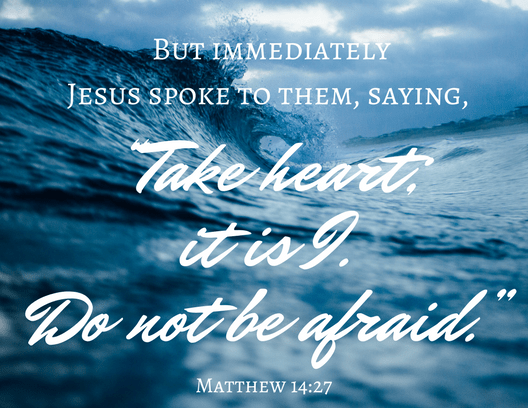
In Matthew 14 we get to see how Jesus reacted. He had just heard about the fate of his relative and fellow worker, the man who had prepared the crowd for his own arrival – John the Baptist. John must have been such a blessing to Jesus. John was the one who knew and believed and spoke for Jesus first. He had performed the baptism in which the dove and the voice of God announced that Jesus was the loved son of God. I am sure that had been an incredible bonding moment for both of them. And now John was dead. Too young to die, he was just a few months older than Jesus. He still had more work to do. He had been so faithful.
To compound emotions, John’s death had been a violent, vengeful, plotted beheading at the hands of Herod the tetrarch (which means he was a ruler of one quarter of the region formerly ruled by his father Herod the Great). Herod the Great had been the one who had ordered the death of all baby boys 2 years old and younger in the vicinity of Bethlehem, trying to assassinate young Jesus because the Magi had told him the star they were following signaled the birth of a new King of the Jews. Jesus had escaped the grasp of Herod the Great. But, now Herod’s son, with assistance from his twisted family tree, had murdered Jesus’ kin, John, who had boldly told Herod he had sinned by marrying his living brother’s wife. Evil had triumphed in this round. The righteous man John was dead while Herod, Herodias and her daughter lived and celebrated the death.
Jesus’ first reaction is to get away – alone. “When Jesus heard what had happened, he withdrew by boat privately to a solitary place.” (Matthew 14:13). There may have been some tears. There may have even been some angry outbursts, perhaps. Or maybe not. We don’t know exactly. But he was wise in seeking a moment of stillness and quiet – just him and God. It doesn’t say he prayed – but we know Jesus. For example, see what he does next time he is able to be alone (Matthew 14:23).
The crowds aren’t sensitive to Jesus’ needs, but they know they need Jesus so they seek him out and disrupt his quiet time. Rather than rebuking them or running away, Jesus compassionately makes time for them and meets their needs. In fact, the next 24 hours are going to see some of the most amazing ministry and miracles Jesus has with the crowd and with his disciples. Many more sick are healed, thousands are fed with one small lunch, and Jesus and Peter walk on the water! And, between it all, Jesus gets in some more quiet time with his Father.
When faced with tragedy, loss, heartache and evil it is easy to be tempted to give up or give in. Jesus shows us how to give it to God (again and again) and continue the fight. Jesus knew the war was not over. This round went to Herod, but there was more to prepare for. There would be more battles. There would be more sick, hurting, hungry, and scared to care for. The victor has not yet been crowned. We look forward to that day! Until then, give it to God and continue the fight.
-Marcia Railton
Questions for Reflection and Discussion
What loss have you faced? During your lifetime when has it looked like evil has won a round? What was your first response? Were you able to get back in the game? Do you benefit from quiet alone time with God? If so, how? If not, what’s missing?
Jesus invited Peter to get out of the safe boat and come join Jesus ON the water in the middle of the lake in the middle of the night. And Peter got out of the boat! What would you have done? What would Peter have missed if he had stayed in the boat? Can you think of a time you courageously tried something new for Jesus? What could you do with Jesus if you were willing to step out of the boat?
Peter was walking on the water with Jesus!! He began to sink when he saw the wind and was afraid. What fears are you sinking in? What could you do with Jesus if fears didn’t hold you down? How can you keep your eyes on Jesus instead of on your fears?
Jesus rescued Peter and said, “You of little faith, why did you doubt?” What tone of voice do you think Jesus used? How do your own doubts affect your relationship with Jesus? Did John the Baptist ever doubt? What did he do? What evidence can you find to counter your doubts?
Finances, relationships, life decisions like which college or what job will fit you best, what people think of you or your family, pandemics, what your test result will be (covid test, spelling test, pregnancy test, SAT test, etc…), who will play with you at recess, the health of your parent, your child, your grandparent, your pet or yourself, how you will pay your bills, if your clothes are fashionable, global warming, flights and travel plans (or the lack thereof), government instability, natural disasters, and the list goes on. And on. And on.
There is a lot we can worry about. And the last two years hasn’t helped our worry levels. Anxiety is on the rise across all ages, but hitting young people especially hard. How can we help protect ourselves and our kids from the damage done by worry?
Worry does not change what will happen or what has already happened. (Though so often we waste much time worrying about what never happens at all.)
Worry does not change how well or how poorly we will respond to what does happen.
Worry does steal our thankfulness.
Worry does make us feel bad – and has a proven strong link to depression.
Worry does strip our focus off of God and His goodness and love and righteousness.
Can we agree that worry isn’t helpful? That we will be better off spending as little time as possible stuck in a worry cycle? So what do we do when we catch ourselves (or one dear to us) catching a ride on the worry train?
Yesterday I read a suggestion to limit yourself to a specific 5-15 minutes a day to worry. If you catch yourself worrying any other time of the day tell yourself it is not the time to worry now, but you will do that at the prescribed worry time (say, 6:10-6:20 pm). Interesting idea I have not tried yet.
But, I can tell you what HAS worked for me, and my family and friends, over and over again. Three times in the last three days I have heard and experienced the overwhelming power of turning to God in His Scriptures to combat our worry and anxiety.
A dear friend was worried about a new job possibility that appeared to be a closing door. She wisely decided to put a hold on her worried thoughts and instead took the time to write out her Bible passage for the day which happened to be about new beginnings. And when she was done – the phone rang with some positive information about the job.
My husband was stuck in a hotel overseas concerned about not receiving a negative covid test result so he could begin work he had been sent to do. It appeared there was nothing to do but wait and worry. Until, he decided to use the time instead to do the last 2 days of Bible reading and devotions. When he was done – the email came with the negative results and he got to work.
I was struggling with a decision that was weighing heavily on me for the past two months. But Monday was my deadline. I needed to contact my boss to let them know if I was going to pursue a job opportunity with them or not. I was worried about making the best decision and what it would mean for me and my family and those I would (or wouldn’t) encounter at work. I was struggling to know what I wanted..and what God wanted. Early Monday morning I was preparing the devotion on John the Baptist from Matthew 3 but wanted to check on some background information so turned to Luke 1. And, there was my answer as clear as could be, repeated twice in Luke 1:41-44. The letter has been written and peace has been growing while the worry has been wiped away. God sent the answer to my worry when I was in His Word. I know I didn’t give a lot of details, but ask me later and I can fill in the rest of the story but the important part is that in God’s Word the worry disappeared.
It sounds almost like magic. But, it’s not. It’s God at work. And God at work beats me at worry any day! And it happens again and again. My son has a great story about finding peace in his college decision when he was faithful in his Bible reading. Two generations earlier my mom has a similar story of the same peace discovered in scripture regarding a previously worrisome huge move and new job for her young family.
Often the answer and peace doesn’t come the same day. When our youngest was in elementary school she struggled with worry – especially at night. She would lie in bed long past bedtime thinking of what might go wrong the next day or the next year. Together we created some posters of Philippians 4:4-9 and stuck them to the wall by her bed. Here’s verses 4-7, but you might want to look up 8-9 as well and you can make a beautiful poster for your bedside, too.
“4 Rejoice in the Lord always. I will say it again: Rejoice! 5 Let your gentleness be evident to all. The Lord is near. 6 Do not be anxious about anything, but in every situation, by prayer and petition, with thanksgiving, present your requests to God. 7 And the peace of God, which transcends all understanding, will guard your hearts and your minds in Christ Jesus.”
It didn’t happen overnight, but she read and re-read those words every night. She put those Scriptures deep into her memory and into her heart. She turned to God in prayer and petition with thanksgiving. Under those circumstances worry had no chance to thrive. Over time her worry shrank and her peace grew and she slept soundly. She still does.
There is a lot we CAN worry about. And the worry can mess with our mind, diminish our health, steal our sleep, damage our relationships and take us deeper into depression and further away from God’s will for us. Or, we can SEEK HIM. Open the Bible He’s given to you where He reveals Himself and His answers for life and peace. Seek Him in prayer, just as Jesus taught. We can rest in peace knowing God is at work. He is feeding the birds. He is growing the lilies of the field. He is supplying answers. He is giving peace. That doesn’t mean that every day will be easy and no troubles will come. It just means that God is still there in those trials. He still has a plan. He still loves. He still guides. He still provides. He is still right. He still has a Kingdom like no other coming around the bend. Seek Him, His Kingdom, His righteousness. Rest easy knowing it’s gonna be alright. God is at work so I don’t have to worry.
-Marcia Railton
Reflection and Discussion Questions
What did you used to worry about that you don’t worry about any more? What changed? Are you worried about something now? Do you think you will also be worried about it next year? 10 years from now? In the Kingdom? How could seeking God’s kingdom help take care of a worry problem?
Describe an environment in which worry grows. Describe an environment in which worry can not thrive. Which environment do you want to live in? What steps can you include today to start changing your daily schedule and environment to reduce worry?
Philippians 4:4-9 says prayer helps replace anxiety. In Matthew 6 the Lord’s Prayer, fasting, and teaching on our treasures all accompany Jesus’ teaching on worry. What can we learn about prayer from these passages? What pieces do you see in the Lord’s Prayer? Any aspects of Jesus’ prayer that you feel your prayer life could use more of? If so, practice adding those into your prayers today.
How can you use the lessons of prayer and not worrying to help someone else today? Who?
As we close our week of devotions together, it’s fitting to end with the words of David himself. Known for his incredible Psalms (though he surprisingly didn’t write them all), David is a perfect example of what it means to be a worshipper of God.
In the first verses of Psalm 138, we see David connect to Psalm 136. “Give thanks to your name for your steadfast love and your faithfulness”. David follows the pattern of thanking God for who he is before thanking God for what he had done in his life.
This is key. God didn’t have to do anything for you for him to be worthy of praise. He gave you life and breath. He gave his Son. He gave you the hope of eternal life. Our creator did it all. Regardless of the blessings he has brought to you in your life (which are awesome, please don’t misunderstand me), God has earned gratitude and praise from you. He deserves it. Don’t forget to show gratitude and recognize that he is God when you come before him in prayer.
David follows in verse three showing how God answered prayer in his life. This wasn’t the first, nor the last time David called and God answered, but I love how simple this prayer is.
“On the day I called, you answered me, you increased my strength of soul.” (v 4 Ps. 138)
How beautiful is that? I called and you answered. That is such a rich picture. David is wanting everyone to understand the power of prayer. More importantly, he wants God to know that David heard God answer his call. God wants to know when we recognize how he works and moves in our life. It brings him joy when we get it. It’s like a father seeing his kids opening up a gift he gave them. Our father loves it when we love the gifts he brings us.
Reading down, David proclaims that all of the kings that have heard God’s word shall praise you. I believe this is a calling to us as well All of us that have tasted and seen the works of God are called to sing his ways–because his glory is great.
But for us, we know more of the story than David did. Which gives us an even greater calling. We have the Son of Man who died on a cross, was raised from the dead, and sits at the right hand of God. Jesus gives us access to the throne room. He is our victor. Our forerunner. Our king.
Though David never met Jesus, he still understands the power that the anointed one holds…
Though I walk in the midst of trouble,
you preserve me against the wrath of my enemies;
you stretch out your hand,
and your right hand delivers me.
The Lord will fulfill his purpose for me;
your steadfast love, O Lord, endures forever.
Do not forsake the work of your hands. -Psalm 138:7-8
I can’t help but think that David is seeing a picture of the Christ at the right hand of God in this. As Jesus is a descendant of David, it is incredible to see the connection between these two men.
The right hand of God delivers us as well. How gracious and miraculous is that?
I have loved going through these scriptures with you this week. I hope your devotions continue to draw you closer to the LORD and his Son. I hope you feel inspired to praise and sing to our God. He hears each moment. And, he will answer your call.
Our final song is: See a Victory by Elevation Worship. Because, I think David would bring his drum and sing this one with us.
-Leslie Jones
Read or listen to today’s Bible reading plan passages at BibleGateway.com here – Psalm 137-138 and Daniel 1-2
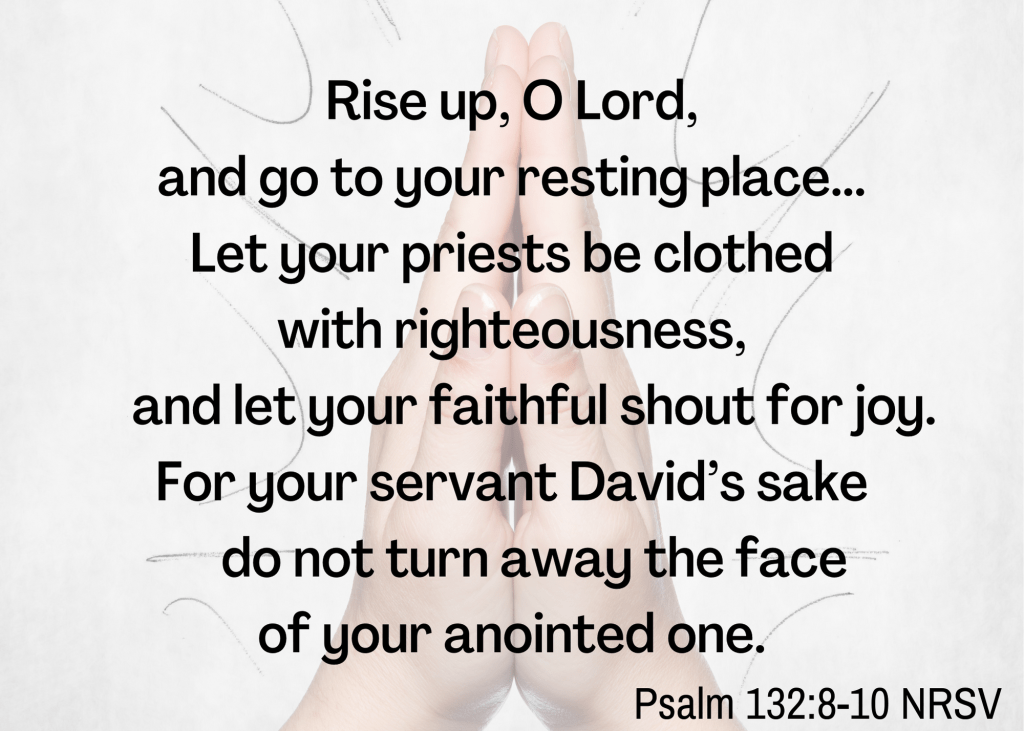
This morning, we are reading Psalm 132-133. The author of these Psalms calls upon God to remember David, his afficitions, his praise, and the promises that God gave him. We get a taste of David’s endurance and God’s faithfulness to him and the people of Israel.
I read these scriptures as a prayer. This author is intimate and transparent. They desire for God to rise up for them. And he is specific about it. He asks God to remember the promise he gave to David and to keep going. Wow. I admire the spiritual confidence of this author.
The idea of calling upon God in this way is tricky. We should never go to God with demands and tell him what to do for us. “Okay, God. You WILL do this.” Nah… I don’t think that will get us anywhere. We can never forget the privilege it is to be able to sit at our Father’s feet and pray to him. We can thank the Messiah for that–along with so much more.
However, I think this Psalmist is doing something right. He is praying in a way that we likely don’t do enough. We praise God for what he did, what he’s doing, and what he WILL do.
The LORD wants us to remember. Hebrews 1 is another amazing biblical example of this idea. The author of Hebrews exclaims the faithfulness of so many of those that came before him–all to the glory of God.
By the author asking God to remember David, the author is expressing to God that he believes, relies, and wholeheartedly trusts in him to work and move. The author is expressing that he is right where David was–open and available to God.
I want to pray like this. I want God to know that I am excited for him to fulfill the promises he made to the men and women who walked with his Son, our Lord Jesus first. I want him to know that I am making him my resting place as they did. I will always remember.
Our God never fails. He is faithful. He is true. And he always will be.
Today’s song is Faithful Now by Vertical Worship.
-Leslie Jones
Read or listen to today’s Bible reading plan passages at BibleGateway.com here – Psalm 132-133 and Ezekiel 43-44
Today, we will be reading from Psalm 126, 127, and 128. Wow, what an incredibly rich set of scriptures. As a worship leader at my local church in Nashville, I am always convicted to meet God in a deeper place when I read Psalms. These authors understood the honor and glory that worship brings to the LORD.
I am in awe of the authenticity and vulnerability of these authors. I have always wanted to be able to worship like David — I hope to worship with him in the Kingdom.
These specific Psalms are short in nature but packed for exaltation and prayer to God. I was specifically drawn to Psalm 126.
“When the Lord restored the fortunes of Zion,
we were like those who dream.
Then our mouth was filled with laughter,
and our tongue with shouts of joy;” -Psalm 126: 1-2
Have you ever been filled with so much joy that you can’t help but laugh? It’s the feeling where in that moment nothing else matters. All of the anxieties, worries, and struggles vanish in that brief time. I would like to think of this as a taste of the kingdom– where joy will be at home every morning.
Today, my message is simple and short. Be a dreamer in God. Pray that he draws you closer to him. Pray for his plans for you to be made evident! And when he shows up (He is never late afterall), remember to give him the glory he is owed.
Our God is a doer of great things. He has done so much for you. From raising his Son from the dead to bringing breath into your lungs, God has worked in your life. And he doesn’t plan on stopping anytime soon.
Today’s song is “Great Things” by Phil Whikham. Is it theologically perfect? No. However, I believe it expresses the heart and mind of the author of Psalms who was brought to laughter from God’s providence. Yes and amen.
-Leslie Jones
Read or listen to today’s Bible reading plan passages at BibleGateway.com here – Ezekiel 39-40 and Psalm 126-128
Before you click away, don’t be scared, turned off, or apprehensive of the words “spiritual discipline”! It’s a shorthand term for something like “the practices and habits that, when performed in love for God, move our hearts and minds to such a place that God can change us.” You can see why “spiritual disciplines” is easier. Psalm 119 has, implicitly and explicitly, four of these practices running through the text. If continually done, these practices and habits can put us in a place to live the best kind of life, the kind of life God wants us to live.
Prayer
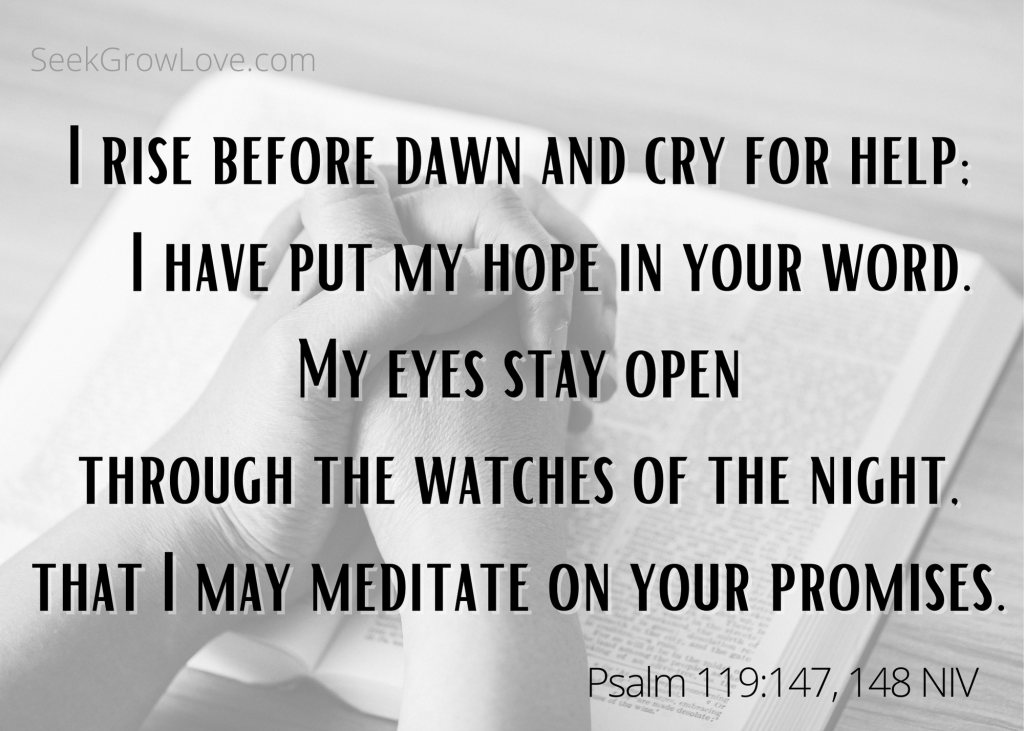
First, the psalm itself is a prayer. The psalmist is constantly calling on God. God is the “you” in the psalm. “You have ordained your precepts” and “By keeping it according to your word” are both ascribing worth and prestige to God. He is the God who gives precepts. He is the God who gives his word. The ground of every discipline is prayer, speaking to God and allowing space for him to speak back. In verse 147 this is the most clearly said. “I rise before dawn and cry for help; I wait for Your words.” The psalmist speaks and is ready to listen. The psalmist has cultivated a prayer life in God as he opens the pages of the Torah and begins to read.
Bible Reading
Second, an extremely important spiritual discipline is Bible reading. While we should be open to hearing God’s voice in a miraculous vision from heaven, in speaking in tongues, and in prophecy (all which may have a place in the Christian life), the most common and most sure way to hear the words of God is to open a Bible and start reading. What an amazing gift it is that we can do this on computers, tablets, and in our homes. The psalmist would have to wait to go find a scroll in the temple to be able to read or hear the words of the Lord. The psalmist delights in the commandments of God. (See verse 47) Twice in two verses (47-48) he says that he LOVES the commandments of God. How can we love a book we never read? The psalmist knew that the only way to ground his life in truth was in God’s words. “Your Law is truth.”(142) He also knows that it’s not just a truth “out there” that we assent to and merely know, but truth that we can live by. “Your word is a lamp to my feet and a light to my path.”(105) Do you read the word of God to know truth and to know how to live truly?
The third and fourth discipline is also founded on this one. Simply reading God’s word is necessary to be able to spend more time with it.
Biblical Meditation
And spending time with God’s word is the way to define “Biblical meditation.” Meditation has grown in popularity in the west in the past few years. In Hinduism, Buddhism, and Yoga, meditation is quieting the inner voice so that enlightenment and oneness may connect you to everything else. (At least, that is the claim of these philosophies and beliefs.) In these practices, one wants to detach and empty oneself from the world. In modern, western meditation, self-emptying is a part, but so that one can fill up with visions of the future they would like to make manifest, or they speak words of affirmation over themselves. You focus, but the focus is on you.
In Biblical meditation, you engage your mental faculties on God. You pour over his words. You take words into your mind, but so that they can travel the 18 inches from you brain to your heart. “I will delight in Your commandments, which I love. And I shall lift up my hands to Your commandments, which I love; and I will meditate on Your statutes.” (47-48) The psalmist loves God’s word, so he wants to allow them to rumble and roll around in his head and heart. Meditation is allowing the words to tumble in your mind. To read with love is different than to read to understand. When I read a love letter from my wife, I don’t parse every word to make sure I have the proper tense of the verb. But I do mull over the words in different ways. Each turn of phrase leaves a sweet taste in my mouth as I sound them out. When we were apart before we got married, every “I miss you” text felt like a dagger. And the same is true for the words of the Torah. We mull them over and feel the pain when we are no longer with the Father who loves us and the God who made us. The psalmist in his delight of God meditates. “I will meditate on Your precepts and regard Your ways. I shall delight in Your statutes; I will not forget Your word.” (15-16) It seems the psalmist reads early in the day so that the words can be there all day long. “How I love Your Law! It is my meditation all the day.” (97) And meditating on God’s word, focusing on his words to the exclusion of everything else, is both facilitated by and facilitates the final discipline.
Bible Memorization
How many verses of scripture do you know?
Did you know that by 10-13, most Jewish boys were expected to memorize the Torah?
Someone said recently “Well, they memorized their whole Bible!” And I said “Yes, but it was shorter!”
But, I don’t have the Bible memorized, not even an entire book. I do have sections down, many verses memorized. But I could always learn more.
Meditation helps memorization and vice versa. When we read a verse in the morning and spend time thinking about it, and allow it to be the focus of our thoughts through the day, then we will have an easier time memorizing. If we memorize verses, then we will be able to have then stick in our heads.
The psalmist clearly did this. “I have treasured Your word in my heart, so that I may not sin against You.”(11) The psalmist treasured up the words of God in his heart, meaning they were not just known but acted out. BUT, to be acted out, they must be known, memorized. In the midst of temptation the psalmist wasn’t fumbling around for a Bible, or a scroll. “The snares of the wicked have surrounded me, but I have not forgotten Your Law.” (61) The way of life was know to them. He understood that it was vital to memorize God’s law. It was life or death! “My life is continually in my hand, yet I do not forget Your Law.” (109) He knew that following the words of God was because God was the one who gave him life through his birth (73) and the one who gave him new life every day. (93)
Brothers and sisters,
May you connect with God through prayer in a new and powerful way today,
May you hear his voice as you read his words, in this and every book of the Bible,
May you hold his words in your mind,
And as you have them memorized, may they transform your heart.
When I think about responding to God’s direction to “go and make disciples of all nations”, the last place I want to go is into a hostile community.
And yet this is exactly what God commands Ezekiel to do.
Israel is described as being rebellious. They know what God requires of them, but they flat out refuse. Instead, they partake in all sorts of immoral acts that God detests.
But God sees Ezekiel as one whom he can trust to deliver a message. And God tells Ezekiel to not be afraid; that whether or not Israel listens, Ezekiel needs to be bold and speak.
Have you ever had to deliver a difficult message to an individual or a group? You know what you have to say won’t be received well, but you still have to say something? Maybe it’s to a friend at school or work. Maybe you’re a supervisor and you have to correct your employee. Maybe it’s a family member who isn’t doing what they should be doing.
Holding others accountable for their actions can be very challenging, especially, when the others haven’t asked for you to do so. It’s even more stressful if you’re seen as the enemy.
So how do we go about entering a hostile environment to deliver a difficult message?
The first thing you can do is to pray. Confirm that it is indeed a message that God wants you to give. Pray that you’re given the words that God needs you to say. Pray that the recipient of the message will be soft-hearted.
Second, remember to be compassionate. This isn’t the same as “giving in”, but you do want to remind the recipient that you are there to help and support them.
Third, keep the message brief, to the point and honest.
The recipient will most likely not react well, so you will also want to acknowledge their frustrations, while helping them see a way forward.
Finally, remind the individual of God’s love for them. They can have forgiveness if they are willing to repent. If they are open to it, offer to pray with them.
There will undoubtedly be times when God asks us to have difficult conversations with others. Do not be afraid to speak the truth in love.
-Bethany Ligon
Today’s Bible reading passages can be read or listened to at BibleGateway.com here – Ezekiel 1-2 and 1 Peter 2
Today in Isaiah 37 we see a glimpse of Hezekiah’s prayer life and the boldness he has when asking God for deliverance. This boldness is not in an outward appearance…when Hezekiah hears the King of Assyria’s threats he rips his clothes and wears sackcloth, both common practices for those who are mourning or in a vulnerable state. While he seems unsure, Hezekiah is still willing to ask God for deliverance from this threat, even though we do not hear much regarding his faithfulness or attitude towards God until this time. In my opinion, this makes his request even more bold because he seems to lack relationship with God! And yet, we see a prayer for his city to be saved for the purpose that they know God is LORD (v.20), and God delivers! God sends an angel to strike down the Assyrians and scares away the king (v. 36). While the appearance of Hezekiah almost seems cowardly to human eyes, God saw Hezekiah’s humility and his acknowledgement of the one true God and rewards him for that!
In chapter 38 we see Hezekiah again boldly ask for healing from God. This bold request for healing shows Hezekiah has confidence in God’s power and knows God can do amazing things. It’s easy to think, “If I had experienced an answered prayer like Hezekiah I would always pray boldly!”, however, we experience answered prayers daily, but I know I am constantly reminding myself to pray boldly with the concerns I have! Maybe it’s just me, but when I get caught up in the brokenness of the world it doesn’t always come as my first instinct to offer up a prayer. Sometimes I may first try to find a solution on my own, other times I may just ignore the problem, or maybe I just sit in the problem! Although it may seem unlikely, Hezekiah can be a great example of how to pray boldly and have complete trust in God’s power to answer those bold requests.
When we look at our passage in 2 Thessalonians, we see Paul’s encouragement to bold and consistent prayer. In this chapter, Paul is specifically requesting prayer from the church to guard against the evil one and for the gospel to be spread and honored (v. 1 – 3). Paul also asks and reminds the church to pray for them to have strength to carry on in good things such as spreading the gospel and working hard to provide for immediate needs. These requests may not seem as bold as asking God to destroy an army, but I do find them much more relevant to our lives today, and still just as difficult to remember to pray for! Spreading the gospel is an easy thing to say, but doing so truly does require great effort, dedication, and strength. Asking for help in this is certainly a bold task, mainly because if you ask God to help you spread the gospel, He is going to put you in places to practice that! Paul writes “Do not grow weary in doing good” (v. 13), which tells me to expect that doing good will be wearisome. In this letter we can see the benefit in not only praying bold requests for ourselves, but also praying boldly to encourage our brothers and sisters.
You may not know, but the Church of God has over 600 fellowships of believers outside of the United States. We have a LOT of brothers and sisters in Christ that can constantly use our prayers for strength, encouragement, and deliverance. If you are interested in knowing more about our fellow believers, I encourage you to go to https://lhicog.com/ to learn more about what bold prayers you can bring to God on their behalf!
One thought I had (and maybe you did too) during today’s reading was ‘What about when prayers aren’t answered?’ I prayed about this thought, and here is what I felt based on our reading for today: We must faithfully know that God’s purpose is greater than our own. I do not believe there are UNanswered prayers, but rather prayers that have an answer yet to come or an answer we do not want to hear. There are other stories in the Bible where bold prayers are not answered the way that people want or when they want… I think of David and Bathsheba’s son dying after David prayed and fasted, Hannah diligently praying for her future son to be born, or Jesus himself who prayed to not have to go through the horrible crucifixion process! We may not be able to comprehend the purpose God has, but we are always invited to pray with boldness and faith. We are also invited to pray for “peace in every way” (v. 16) for ourselves and our fellow believers when the prayers don’t result in what we want or when we want them. I look forward to a day when we will never have to bring another bold request to God because we will be living in a perfect Kingdom where all believers can constantly rejoice in God’s holy presence and perfection! Until that day, let’s continue to boldly pray and praise our amazing YHWH.
-Sarah (Blanchard) Johnson
Today’s Bible reading plan passages can be read or listened to at BibleGateway.com here – Isaiah 37-38 and 2 Thessalonians 3
Today we are going to look at two different groups of God’s people: those in Jerusalem at the time of Isaiah’s writing and those in Colosse at the time of Paul’s writing. Which will you be?
In many of the previous chapters of the book of Isaiah we read about God’s coming judgments on Israel and Judah’s neighbors and sometimes her enemies. It’s not all bad reading what disasters are coming to your wicked neighbors. Yay, God! Go get em! Show em who’s boss! But, it gets downright personal in chapter 22 as the prophecies of judgment and doom now center on Jerusalem, God’s Holy City. What did they do to deserve this? Well, much. Other scriptures tell of Jerusalem’s idol worship and shedding of innocent blood and even sacrificing their own children. But specifically in Isaiah 22 we are told of their pride and arrogance, their celebrations and their disregard for God. When they saw danger on the horizon they did everything in their own power to protect themselves, including tearing down houses to strengthen the wall and building reservoirs. “But, you did not look to the One who made it, or have regard for the One who planned it long ago” (Isaiah 22:11 NIV). What would have changed if they had only called out to God for help?
God was waiting for His people to seek Him, to turn to Him, to cry out to Him, to confess and mourn and repent. But, instead, they were too busy. Busy with their preparations to save themselves. Busy with their sins. Busy with their celebrations and feasting and misplaced joy. Busy in their “town full of commotion…city of tumult and revelry.” (Isaiah 22:2 NIV).
They had abandoned God first. He was still calling out to them on that day (Isaiah 22:12). But, they were busy. They drowned out the sound of God’s voice with their sinful busy-ness and celebrations. So, His holy and righteous judgement was coming.
Contrast this tragic picture with what we read in Colossians 4 as Paul is closing out his letter to the church in Colosse with his final instructions and greetings. He urges the church, “Devote yourselves to prayer, being watchful and thankful” (Colossians 4:2 NIV). And, while he’s got the people praying – he says pray for me, too. Paul requests prayers for open doors (not to physically get out of house arrests, but open doors to reach more people), for opportunities to proclaim Christ and for clear communication in his ministry. And further on, I love his description of Epaphras, “a servant of Jesus Christ…He is always wrestling in prayer for you, that you may stand firm in all the will of God, mature and and fully assured” (Colossians 4:12 NIV). These people are busy, too – in prayer – in seeking God and in ministry . They are praying for their spiritual leaders and churches and those who will hear God’s message, and asking for prayer. Rather than ignoring God and drowning out His voice, they are seeking God regularly and whole-heartedly, coming to Him in prayer, always desiring to do more for Him and His Son.
Which group are you more like today?
Do you have see any similarities between yourself and God’s people in Jerusalem? Are you surrounded with so much commotion that you miss God’s voice calling out to you? Is he asking you to mourn when you are busy celebrating and feasting? Are you so caught up in your self-preservation preparations that you have neglected to call out to God? Do you rely on yourself instead of on God? When you see trouble coming do you invest time in creating a longer to-do list, throw a party, or fall to your knees before God? What would be different in your life and in your community if you called on Him in prayer instead of trying to do it your own way?
Do you see any similarities between yourself and God’s people in Colosse? Are you devoted to prayer, being watchful and thankful? Are you praying for open doors – not to get ahead or out of a jam – but to advance God’s gospel message? Are you busy praying for your Christian brothers and sisters and leaders and missionaries? Are you asking others to pray for your ministry? What would it look like if you spent time today wrestling in prayer?
Praying for you today – to Stand Firm in God’s Will, mature and fully assured
-Marcia Railton
Read or listen to today’s Bible reading plan passages at BibleGateway here – Isaiah 21-22 and Colossians 4








 Seek Grow Love