Imposters

Isaiah 44-48

Each morning as I open and check my email inbox, I am compelled to clean out and delete all of the spam messages that are delivered as well. Every time, I “block sender” and yet those pesky messages still show up! Have you ever noticed how similar some of the spam messages are to a legitimate vendor or service? Most are easily identified as junk, but every once in a while, I need to look a bit more closely to see if it’s the real deal or not. According to a CBS report in April 2025 over $16.6 BILLION was lost due to fraudulent emails, text messages, and phone calls in the previous year. Imposters are very persistent and clever in disguising themselves as valid and trustworthy sources.

In Isaiah chapters 44-48, God emphasises that He alone is God, there is no other and none are like Him. In fact, there are nine times within this section that a variation of this phrase is stated. 

  • Isaiah 44:6
  • Isaiah 45:5, 6, 14, 18, 21, 22
  • Isaiah 46:9
  • Isaiah 48:12 (variation) 

As God’s people had been captured by Babylon, they were surrounded by false, fake gods. Through the prophet Isaiah, God makes it crystal clear who the REAL God is. 

The false, fake gods are man made. The one, true God made man and the entire universe.

The false, fake gods are unable to speak and fulfill promises. The one, true God not only claims things to come, but works to see those claims come to fruition.

The false, fake gods have no power, authority, or sovereignty. The one, true God orchestrates unlikely foreign leaders to rescue His people.

The false, fake gods cannot provide salvation. The one, true God is salvation for His people.

As a reader of this passage of Scripture, it’s tempting to think, “How could someone be duped by a false, fake god?”. But when you never seek and study the one, true God, it becomes a challenge to distinguish between the imposter and the authentic. When you are familiar with the characteristics, the qualities, the patterns, the motivations, and the promises of the one, true God, it becomes easier to discriminate against the attempts of the false, fake gods. 

So spend a little extra time today in the presence of the one, true God so your heart and mind can confidently claim, “There is no other; there is none like You”. 

Reflection Questions

  1. What are some “false, fake gods” or imposters in your life that compete for your attention, trust, or hope?
  1. How can you become more familiar with God so you’re not fooled by spiritual imposters?
  1. Finish this prayer: “God, there is no other; there is none like You because…”

-Bethany Ligon

Warning, Mourning and a Whisper of Grace

Micah 1-3

Like many times in history, Israel had to be confronted by a prophet who had a message from God that wasn’t savory. That is, in times of comfort, complacency, and wickedness they would find that they were not walking with the Lord. In Micah 1-3, Micah speaks for the Lord and completely rebukes the state of Israel and the leaders that allow for it to be in the state it is. Their morals have been corrupted, their path is unjust, and they have implemented idols again into their nation. 

The themes from previous days’ devotions persist here. Violent imagery and a great lament is detailed in Micah 1-3 as he warns and mourns the judgement that is to come. The imagery from Micah 3:1-4 is especially fiery and vivid to the imagination as Micah rebukes the leaders of Israel. To pile onto the agony being described, Micah also details that God will be separated from those in religious authority in Israel in Micah 3:7:

“The seers will be ashamed

    and the diviners disgraced.

They will all cover their faces

    because there is no answer from God.”

With this, we must reflect on our own lives. In a position of leadership, we must set an example. James 3 echoes this idea of the judgement that will be faced by those who teach and lead those astray. If we are to act as examples for others, we must also walk in the ways of the Lord. Micah is clear with this striking message: where in our lives have we settled for religiosity without righteousness? Comfort without compassion?

God’s heart breaks over injustice. He doesn’t just call it out. He promises to act. That’s a sobering reminder: God cares too much to remain silent in the face of oppression. However, tucked inside Micah’s warnings is a whisper of grace: “I will surely gather the remnant…” (Micah 2:12). God’s judgment is never the end of the story. Even as He tears down, He is preparing to build again. On that foundation, with that remnant, he will build on principles of humility, justice, and faith.

-Colby Leggitt

Discussion Questions

1. Where in your life or community do you see injustice that needs to be addressed?

2.Are there areas where you’ve grown comfortable with compromise or overlooked truth?

3. How can you walk more humbly and live more justly today?

Hearing What We Don’t Want to Hear

1 Kings 22, 2 Chronicles 18

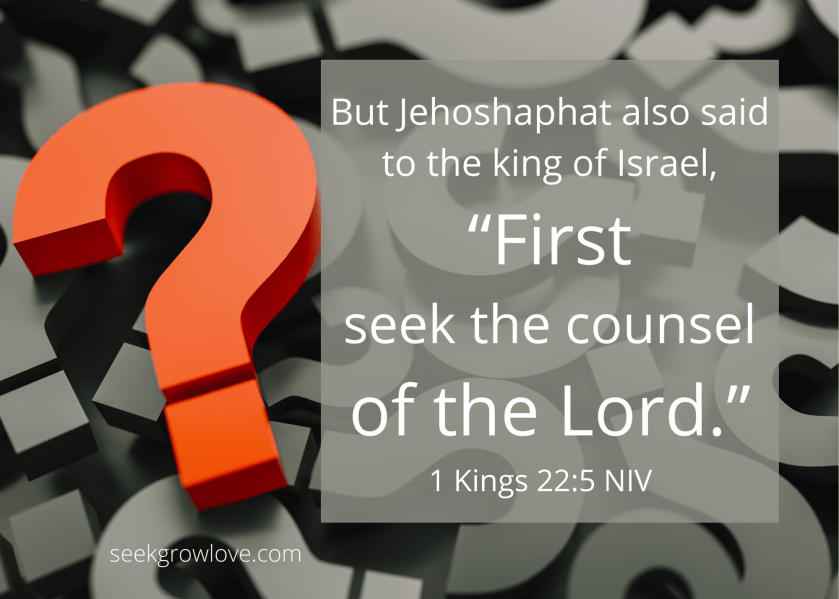
In First Kings 22 and in Second Chronicles 18 we find the same account of evil King Ahab considering going to war against Ramoth Gilead.  He asked about 400 prophets what he should do and they all said to go victoriously to war.  When encouraged by King Jehoshaphat of Judah to ask a prophet closer to the matter about this, King Ahab’s response is found in First Kings 22:8.  He says, “There is still one man through whom we can inquire of the LORD, but I hate him because he never prophesies anything good about me, but always bad.  He is Micaiah son of Imlah.”  Now remember, it is said of evil King Ahab from First Kings 21:25-26, “There was never a man like Ahab, who sold himself to do evil in the eyes of the LORD, urged on by Jezebel his wife.  He behaved in the vilest manner by going after idols, like the Amorites the LORD drove out before Israel.”  It is no wonder the true prophet of God never had anything good to prophesy, but always bad!

It is noteworthy that King Ahab avoided the truth because he deemed it as bad.  Instead, he listened to the 400 voices that told him what he wanted to hear.  King Rehoboam did the same thing in First Kings chapter 12.  Instead of listening to the advice of the elders, who gave advice he did not want to hear, he followed the advice of his peers.  He followed what he wanted rather than what was best for him.

It would be easy to look at these kings and heap ridicule upon them in judgment.  However, it might be beneficial to consider our own ways.  How often do we gravitate toward people who affirm our immorality, rather than seeking the truth of God?  How often do we lean into confirmation bias, rather than seeking godly ways of thinking about a matter?  The book of Proverbs consistently supports the idea of seeking wise counsel.  Consider Proverbs 1:5, “let the wise listen and add to their learning, and let the discerning get guidance”.  Also, Proverbs 19:20 says, “Listen to advice and accept instruction, and in the end you will be wise.”  Clearly, God desires that we would listen to the voices that speak His wisdom into our lives, even if we don’t want to hear it.

One more thing to consider today.  Sometimes we are the ones who need to hear something from God, even when we don’t want to hear it.  However, sometimes we are the Micaiah’s who have something to say that someone else may not want to hear.  Progress in these situations slowly, discerning God’s wisdom to speak in love.  Ephesians 4:15 says, “Instead, speaking the truth in love, we will in all things grow up into him who is the Head, that is, Christ.”  The words we speak must be spoken in love.  Our goal of speaking should be for us to grow into Christ together.  

Listen to God’s Word, especially if you don’t want to hear it.  Speak to others in love, especially when they might not want to hear God’s Word.

-Michael Cisler

Reflection Questions

How can you actively seek godly voices in your life?

What does it mean to speak the truth in love?  What does each element (truth and love) entail?

When is the right time to speak and when is the right time to be quiet?

Too Much Experience

1 Kings 15:1-24
2 Chronicles 13-16

I will be celebrating my 40th birthday in just a few short weeks. To be candid, I’m not exactly thrilled about this milestone—but one thing I am looking forward to is being able to say, “That was half a lifetime ago.” There’s something satisfying in acknowledging that with age has come experience.

One of the longest experiences I’ve had is playing guitar. For the last 1,352 weeks, I have averaged a few hours of play and have become masterful at my style. That’s not a gloat or a flex—just an illustration that I’m familiar with my craft. Much of what I do now is second nature, developed through repetition and refined over time. The same could be said of anyone who’s practiced a craft or trade for a significant portion of their life.

But experience is a double-edged sword. It gives us the ability to say things like, “I’ve seen this before,” or “We’ve already tried that,” or “We’ve made it through worse.” That can build confidence as we develop our approach. But when we rely solely on experience or live under the illusion there is nothing to learn, we may fail to consult the Word of the Lord. We make ourselves the master of our own fate, and in time, we are doomed to fail.

King Asa was a dependable leader. After the division of the kingdom, his reign represented a season of peace and prosperity.  These blessings came upon the whole of Judah because he “did what was good and right in the eyes of the Lord.” Asa tore down idols, repaired the temple, and called the people to return to God. He didn’t trust in his half-million soldiers alone.  He petitioned the Lord for help:

“Lord, there is no one like you to help the powerless against the mighty. Help us, Lord our God, for we rely on you, and in your name we have come against this vast army. Lord, you are our God; do not let mere mortals prevail against you.” – 2 Chronicles 14:11

As a result God delivered Asa and the people of Judah.  In gratitude and commitment, Asa responded in worship.  His people offered a tremendous sacrifice as a wholehearted oath to their Deliverer. Again, the Lord gave them a season of rest.

But in Asa’s 36th year—after decades of faithfulness—something changed. Faced with conflict, he no longer sought the Lord. Instead, he relied on his own strategy, forming a treaty with a foreign power. The prophet Hanani rebuked him:

“Were not the Cushites and Libyans a mighty army with great numbers of chariots and horsemen? Yet when you relied on the Lord, he delivered them into your hand. For the eyes of the Lord range throughout the earth to strengthen those whose hearts are fully committed to him. You have done a foolish thing, and from now on you will be at war.” – 2 Chronicles 16:8–9

The temptation to take matters into our own hands often comes not in times of scarcity, but in times of prosperity.  Our experience, knowledge, notoriety, or wealth can make us feel capable, but no matter our breadth or depth, we each have  blind spots and limitations that fall far short of the omniscience of our Heavenly Father.  This is the great irony: the more experienced we become in serving the Lord, the more we should rely on His voice. If anything, maturity should deepen our dependence, not diminish it.

God is ready to win battles for those who are whole-hearted committed to Him. May we be found among them—not only in our youth or our desperation, but even more in our decades of experience. Let us not confuse our  familiarity with faithfulness. And when we hear His voice—whether in instruction, correction, or comfort—may we respond with the same dependence that brought us to Him in the first place.

-Aaron Winner

Reflection Questions

  1. What did Asa do right? What did Asa do wrong? What might his thought process or motives been when he was doing right? And when he did wrong?
  2. Consider your own life – when did you seek the Lord and He blessed you for it? When did you NOT seek the Lord, but relied on your own strength, decision making skills, and human knowledge? What was the outcome?
  3. What does it look like to seek the Lord and rely on Him?
  4. In what areas are you currently relying on the Lord? Where are you in danger of falling into the “too experienced”, can-do-this-on-my-own trap?

The Final Conclusion

Ecclesiastes 7-12

Yesterday we searched Ecclesiastes for the wisdom that Solomon put there for us to find.  Today we continue our search for the eternal truth that God has set for us to find.  Remember that the human mind wants to have the certainty of knowledge and wisdom, but that the only true wisdom is from God and not human thought. 

Ecclesiastes 7:8-13(NLT) Finishing is better than starting.
Patience is better than pride.
9 Control your temper,
for anger labels you a fool.
10 Don’t long for “the good old days.”
This is not wise.
11 Wisdom is even better when you have money.
Both are a benefit as you go through life.
12 Wisdom and money can get you almost anything,
but only wisdom can save your life.  Accept the way God does things,
for who can straighten what he has made crooked?

It is interesting that wisdom and money can go hand in hand.  When we are part of God’s family we have the resources of the head of our Household to help us. 

Does God give us the financial resources that we have for us alone?  Or are the resources for the work of His church and kingdom?

Ecclesiastes 7:29(NLT) But I did find this: God created people to be virtuous, but they have each turned to follow their own downward path.”

Ecclesiastes 8:16-17 In my search for wisdom and in my observation of people’s burdens here on earth, I discovered that there is ceaseless activity, day and night. 17 I realized that no one can discover everything God is doing under the sun. Not even the wisest people discover everything, no matter what they claim.

Maybe Artificial Intelligence will be able to find all knowledge? 

Will it find that God’s Word is ultimate truth or will it decide that the Word is not correct? 

Is there ultimate true wisdom in any human endeavor?

I think these verses give us the truth that God alone has ultimate wisdom and we will find it when we search for Him, and not for the knowledge that comes from the world.  All else is “vanity” trying to breath into a bottle.

Ecclesiastes 12:11-14(NLT) The words of the wise are like cattle prods—painful but helpful. Their collected sayings are like a nail-studded stick with which a shepherd drives the sheep.
12 But, my child, let me give you some further advice: Be careful, for writing books is endless, and much study wears you out.
13 That’s the whole story. Here now is my final conclusion: Fear God and obey his commands, for this is everyone’s duty. 14 God will judge us for everything we do, including every secret thing, whether good or bad.

How does the conclusion of Ecclesiastes compare with the proverb that Jesus gives us in Matthew?

Matthew 10:16(NKJV) Behold, I send you out as sheep in the midst of wolves. Therefore be wise as serpents and harmless as doves

May you have a great day being shrewd in the world’s ways, but with God’s love and truth as the foundation of the way to live.

-Tom Siderius

See Reflection Questions above in bold

A Majestic God

1 Chronicles 1

Psalm 6, 8-10, 14

“O Lord, our Lord, how majestic is your name in all the earth!  You have set your glory above the heavens.”  Psalm 8:1a 

Majestic…Grand…Magnificent…Imposing…Grandiose…Awe-Inspiring…Dignified…Impressive…Distinguished

There really isn’t a good enough word to describe how majestic God is, not even a list of words can do Him justice!  The rest of verse one says, “You have set your glory above the heavens.”  David points out in this Psalm that we can see God’s majesty in the work of His fingers (His creation)– specifically mentioned is the moon and the stars.

After looking to the vastness of God’s creation, David asks in 8:4, “what is man that you are mindful of him, and the son of man that you care for him?”  David goes on to say that God crowned us with glory and honor.  We are such a small piece in God’s creation that it is hard to imagine that God cares so much for us.   And even more than that, He gave us dominion (rule or control) over the rest of His creation.  

Wow!  So often I read a Psalm like this and don’t really take in its powerful message.  God made the whole world and everything in it.  That includes people.  That includes you and me.  Do you feel crowned with glory and honor?  Do you feel watched over and cared for? 

As the world turns further and further away from God’s path it is easy to become discouraged.  To wonder, “How bad was it in Noah’s day that God ended most of mankind?”.  Psalm 14:1a says, “The fool says in his heart, “There is no God.”  There seem to be fools aplenty – all you have to do is turn on the news, log on to Facebook, listen to the conversations around you in a restaurant or grocery store.  Fools are everywhere.  All of the Psalms from today’s reading offer great encouragement for those who follow God.

Amy Blanchard

Reflection Questions

  1. What in God’s creation speaks of God’s majesty to you?  Mountains, oceans, colors, wildlife, sunrises/sunsets, music, a newborn, etc.?
  2.  As you consider that God made – and makes – all people, consider that this statement includes you.  Also consider, this includes your bossy sister, your nosy neighbor, your know-it-all relative, etc.  Who might you need to start seeing through God’s eyes?

A Just Cause

Psalm 17, 35, 54, 63

We all think that what we want, the way we think something should be, is a just cause.  But is it, really?  Lots of things can sound like noble causes, but would they be in God’s eyes?  I have been known to think I’m right about something when I’m actually wrong.  For example, because texts & emails don’t allow for any verbal cues or body language to help with interpreting the message, they are often misunderstood.  I have made the mistake of assuming someone’s intent based on a few words I read on my phone.  I have made the mistake of responding unbecomingly – by responding directly to the person with a bad attitude, or worse yet, talking to others about what they sent to me, pleading my “just cause”.  I have found myself in the position of having to humble myself and apologize.  Maybe you’ve been there, too. 

David considered his cause to be just and he wanted God to be the one to vindicate him. 

In Psalm 17, David calls on God

  • To hear him – verse 6b:  incline your ear to me; hear my words.”
  • To show him His love – verse 7a: “Wondrously show your steadfast love,”
  • To protect him – verse 8: “Keep me as the apple of your eye; hide me in the shadow of your wings,”

David also takes a look at himself

  • Verse 3b:  I have purposed that my mouth will not transgress.” 
  • Verse 4b: “I have avoided the ways of the violent.”
  • Verse 5:  My steps have held fast to your paths; my feet have not slipped.”

David tells God what his enemies are doing

  • Verse 9a: “the wicked who do me violence”
  • Verse 10: “they close their hearts to pity; with their mouths they speak arrogantly.”
  • Verse 12: “…like a lion eager to tear”

David asks God to stop the wicked

  • Verses 13: “Arise, O Lord!  Confront him, subdue him!  Deliver my soul from the wicked by your sword,”

David raises his just cause before God.  He fully trusts God will see the good and right as well as the ugly and evil.  He believes God will respond justly, because that is His character.

Amy Blanchard

Reflection Questions

  1. Taking time to do a self-evaluation can help us see our “causes” (desires) in a more accurate light.  When faced with a negative situation, before responding or reacting ask yourself some important questions:
    • Are my priorities what I want them to be?
    • Am I being self-centered?
    • Do I need to right a wrong?
  2. Are you confident in your choices to welcome God’s testing of your heart?  If not, what can you do to move in that direction?

More Sin and Straying

Judges 20-21

Judges 20-21 picks up where Judges 17-19 left off (and not in a good way). The Israelites assembled to discuss what had happened to the dismembered woman, and the Levite tells them his “truth.” He leaves out a few vital parts that may have drastically shifted how the Israelites handled the situation. He states that the men of Gibeah wanted to kill him and leaves out the part that his concubine was given to them (even though we see with hindsight the truth recorded earlier in 19:22-25). This false witness leads the Israelites down a dark path with lots of stumbling (as sin does to those who commit it and those around them). 

Instead of verifying the account of the Levite with even one or two more witnesses, they decide to confront and accuse the Benjamites. Unfortunately, the responses from the Israelites and the Benjamites reflected just how far they had strayed from God and the truth. The Israelites went to God, but not with a question about whether or not they should fight the Benjamites (or believe the Levite’s story), but with a question about who they should send first (20:18). The Benjamites, instead of searching for a way to settle things peacefully and purge the sin from among them, decide to go to battle as well (v.14). This doesn’t end well for the Benjamites. The Israelites (though experiencing their fair share of casualties) wiped out over twenty-five thousand Benjamites (v.35) and burned up their towns (v.48). However, it also doesn’t go well for the Israelites either. 

After realizing that they may have been a little harsh (or extremely harsh), they decide to find a way to help restore the tribe of Benjamin. Sadly, this only resulted in more death and suffering. People of Jabesh Gilead were killed (21:12), the Israelites grieved with and for the Benjamites (v.15), and the young women of Shiloh were caught in the crossfire (v.23). Israel had no king, no ruler, and they did as they saw fit. God was certainly in the picture for the Israelites but He wasn’t in the foreground (or close to their hearts and minds).

The consequences for sin aren’t anything to scoff at. In James 1:15 we read, “Then desire when it has conceived gives birth to sin, and sin when it is fully grown brings forth death.” Desire is where sin and death start, but it’s also where a Godly and Christ-centered life can begin. As a child, whenever I went to a Zoo or an Aquarium, I desired to be close enough to reach out and touch the animals God had created. However, as an adult, I understand why they took many precautions (such as very thick glass or bars) and certain animals were/are exempt from the petting zoo. Though I long for the day when “The infant will play near the cobra’s den, and the young child will put its hand into the viper’s nest,” (Isaiah 11:8 ESV) I’d like to keep my head, shoulders, knees, and toes intact in between now and then. God has given us desires, which, when handled appropriately, result in life to the fullest (both in this one and the next). However, when we place ourselves as a god, king, or ruler in our hearts and minds, we begin to live like the Israelites and lose God-given opportunities to live the way God intended for us.

-Jeffrey Seiders

REFLECTION Q’s

  1. The Levite told the Israelites his version of the truth and many people suffered. When you tell your version of the truth, is it aligned with God and His truth, purpose, and plan? If not, who can hold you accountable and help realign your truth with God’s?
  2. The Israelites eventually realized they had “gone too far” with the Benjamites. In what ways have you “gone too far” and realized you needed to do something about it? What did you do and could you have done more to prevent further pain and heartache?
  3. In James 1:15, we read about desire giving birth to sin, and sin bringing death. What desires do you have that have led you down a dangerous path? How can those desires, with God and His son in mind, be handled healthily for God’s truth, purpose, and plan in your life?

**Optional question: Some people look forward to seeing certain kinds of animals in God’s kingdom. What are you most looking forward to in God’s kingdom? Why?**

God’s Truth and Way – Not Ours

Deuteronomy 11-13

Chapter 12 is the beginning of a new set of comprehensive laws that take up the bulk of the book of Deuteronomy.  Today we read about the specific ways in which God desired His people to worship. He called them to worship in His good and perfect way, not in the ways of the surrounding nations. The Israelites were instructed to destroy any false altars and worship only where God had chosen. This was about doing what was right in God’s eyes, rather than every man acting on his own whims or false morals.

You shall not worship the Lord your God in that way. But you shall seek the place that the Lord your God will choose out of all your tribes to put his name and make his habitation there. There you shall go. – Deut 12:4-5

You shall not do according to all that we are doing here today, everyone doing whatever is right in his own eyes, for you have not as yet come to the rest and to the inheritance that the Lord your God is giving you. – Deut 12:8

Chapter 13 issues a strong warning against abandoning their commitment to the one true God for a false god. It is warned that there will be false prophets and dreamers who can perform signs or wonders, but that they must not fall for such tricks and deception. It is even warned that if your family member whispers to you suggesting that you serve other gods, you must not listen to them. In fact they were instructed to kill them. Fortunately for us, such violence is no longer expected in these cases, however, discernment and steadfast loyalty to our Creator are expected of us. In today’s age, we are instructed to be aware of false prophets, and even false messiahs, as Jesus warns in Matthew,

Then if anyone says to you, “Look, here is the Christ!” or “There he is!” do not believe it. For false christs and false prophets will arise and perform great signs and wonders, so as to lead astray, if possible, even the elect. – Matt 24:24

Today, we may not have physical altars to tear down or false priests to execute, but our hearts can easily become divided. We are tempted to blend worldly influences with our worship, allowing distractions, personal desires, or cultural norms to shape our devotion rather than the truth of God’s word. In a world full of voices claiming to speak truth, it is imperative that we remain anchored in scripture. Even generally positive things, such as success, relationships, or even religious experiences, can become idols if they pull our hearts away from God. True devotion means prioritizing Him above all else, not in the ways we see fit, but in the ways He has commanded us.

-Isabella Osborn

Reflection Questions:

  1. Are there any influences in your life—cultural, personal, or societal—that may be shaping your faith or outlook in ways that are not aligned with God’s Word?
  2. How can you actively practice discernment in recognizing false teachings or influences that lead you away from total devotion to God?
  3. In what ways can you ensure that your worship and daily life reflect God’s truth, rather than personal preferences or societal norms?

The LORD God: Past, Present & Future

Numbers 23-25 

Today’s chapters 23-25 (and 22) are like an action movie with a lot of suspense! Balak, King of Moab, looked out at the numerous Israelites camped nearby and was greatly afraid. He called upon a sorcerer to come and curse them, which God didn’t allow him to curse but blessed them! 

Interestingly, Balaam (sorcerer) was confronted three times to go, three times his donkey refused to proceed and was hit, and three times he built seven altars and sacrificed a bull and ram on each (21x). Not sure of the significance of the tresome repeats but does show the intensity of the situation!

The Spirit of God came upon Balaam and he blessed Israel three times. In the three different oracles a meaningful phrase struck me with each one.

  1. How can I curse whom God has not cursed? How can I denounce whom the LORD has not denounced?” (23:8)
  2. God is not man, that he should lie, or a son of man, that he should change his mind.”  (23:19)
  3. A star shall come out of Jacob, and a scepter shall rise out of Israel.” (24:17)

These biblical accounts are written in past, present, and future. God has not cursed or denounced the Israalites. God is not a man, nor past nor will be! Lastly, God will have a future dynasty in Israel.

This is not what Balak wanted to hear, but Balaam obeyed God’s command to only say what he was told to say. Unfortunately, he advised Balak further on how he could bring harm to Israel, and his advice unfortunately worked. The Israelite men were seduced by the foreign women to worship their gods, which brought great anger to the God of Israel. Sadly, more than 20,000 were killed in the plague as a result.

Do you have God’s number on speed dial? It’s easy to remember …Jeremiah 33:3

Call to me and I will answer you, and will tell you great and hidden things that you have not known.For thus says the LORD, the God of Israel.” 

He’s ALWAYS available, never sleeping anytime of the day.

-Stephanie Schlegel

REFLECTION QUESTIONS

1. Who do you call upon for help? Depends what kind of help we need, right?

2. What’s God’s “phone number?”  Do we go to the throne or phone when we need help?

3. Is there something today that you’re afraid of? What care needs to be cast upon Him today because He cares for you?