What is your favorite book? Who is your favorite speaker? Do you have a favorite preacher? What kind of prophet would you really like to listen to?
The verse in Micah 2 that really caught my attention this time around was verse 11 – “Suppose a prophet full of lies would say to you, ‘I’ll preach to you the joys of wine and alcohol!’ That’s just the kind of prophet you would like!” (Micah 2:11 NLT). It got me to thinking – maybe I should be spending a little more time listening to the preachers and prophets that I DON’T really like listening to.
Poor Micah might not have been a very popular guy in his day and age. Most of the people of Israel and Judah would rather not hear what he had to say. His social media accounts might not have had a lot of friends and followers and his devotions might not have gotten a lot of likes. Sometimes when we speak the truth it’s not real popular, and neither are we. But being popular and comfortable isn’t nearly as important as speaking and hearing and doing what God desires. I think Micah recognized this when he said, “If you would do what is right, you would find my words comforting.” (Micah 2:7b NLT).
How do we recognize a prophet that is full of lies? There are so many lies being circulated today. Whether they come from the Dove chocolate candy wrapper, social media or the preacher/prophet at the local church – everything we hear needs to be checked. Not just to see if it’s popular (do a lot of people believe it). Not just to see if it is comforting (do I like to listen because it makes me feel good). But of life and death consequence – does it line up with what God says is right and true and beneficial – even when it is unpopular and uncomfortable. And if it doesn’t line up with God’s standards, disregard it! And seek truth elsewhere! How do we know if it lines up with what God says is right and true and beneficial – even when it is unpopular and uncomfortable? Take a look (a lot of them, actually) in His Book! Like everyday – every book of the Bible (not just our favorites) – all year long.
-Marcia Railton
Reflection Questions
What prophets of lies have you heard? How did you distinguish it as untruth?
Micah’s example of the prophet of lies spoke of the joys of wine and alcohol – a popular belief indeed that brings a lot of ‘comfort’ to many. What do you think Micah’s thoughts on wine and alcohol were? Do you think he was preaching God’s truth here? Do you see dangers in wine and alcohol? What problems could develop by listening to and following the prophet speaking of the joys of these beverages?
Who do you listen to/read/watch? Why does what you listen to/read/watch matter?
What other Bible passages can you find to support what Micah is saying?
Heads up! This devotion is going to take you in a mini dive into the history of the buckle of all things! But first…
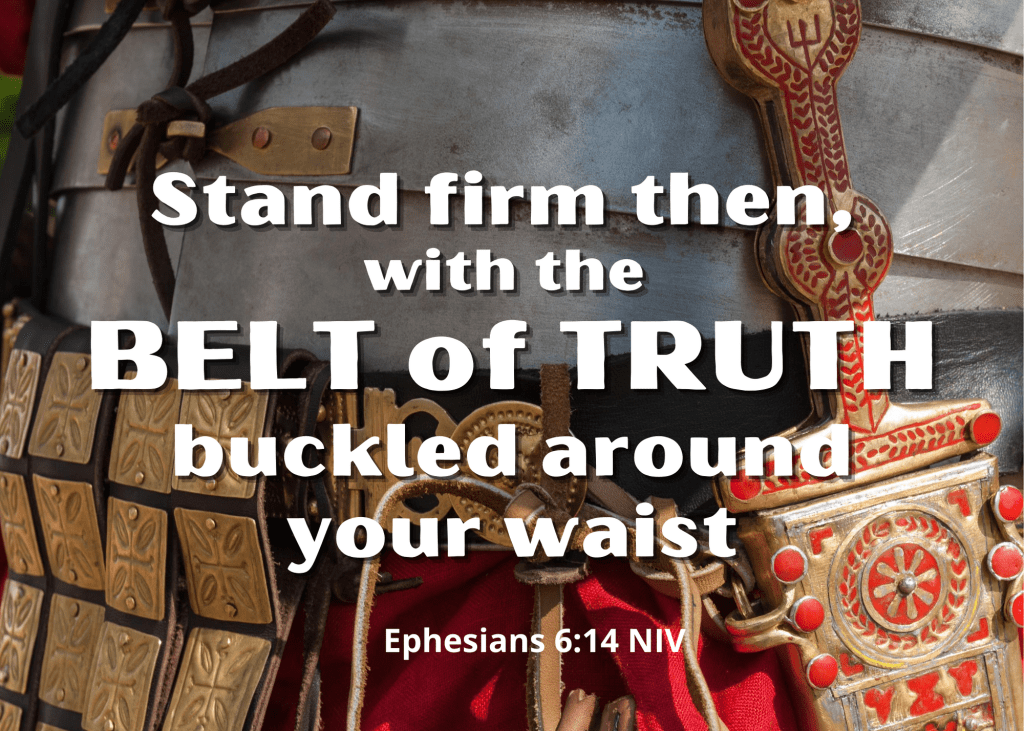
Many of us have read our key verse more than a handful of times in our lives. And we’ve even been taught about the belt of truth in our Sunday School lessons. It’s been explained that in ancient times, before a foot race or prior to battle, runners and warriors would tuck their long garments into their cloth belt, in order to provide free movement for the legs.
As I considered this first half of this verse, the word buckle stuck out to me. My thoughts went a little something like this:
“Wait a minute…a buckle in ancient Roman times? This doesn’t make sense. The earliest I’ve ever seen buckles in history books is on the Pilgrims. Did Roman soldiers wear buckles?”
A few clicks in my web browser confirms that indeed, buckles were part of the Roman body armor. Depending on the type of armor, there could be one main buckle, or in segmented forms of armor, many mini buckles to hold all the pieces together. What’s more, the more elite soldiers had super fancy buckles, whereas those that served in the infantry had simpler and more practical buckles.
Who knew???
With this new knowledge, our key verse today starts to take on an expanded meaning. Without the buckled belt of truth, the breastplate won’t stay in place and the protective plates on the shoulders wouldn’t be able to stay attached. Also, the tunic part of the armor which protected the groin wouldn’t have anything to attach to if it weren’t for the buckle.
It all starts with the buckle on the belt. Just like it all starts with Truth.
John 14:6 – “I am the way, the truth, and the life.”
John 8:32 – “Then you will know the truth, and the truth will set you free.”
2 Timothy – “Do your best to present yourself to God as one approved, a worker who does not need to be ashamed and who correctly handles the word of truth.”
Psalm 25:5 – “Guide me in your truth and teach me, for you are God my Savior, and my hope is in you all day long.”
Ephesians 1:13 – “And you also were included in Christ when you heard the word of truth, the gospel of your salvation…”
The start of our key verse in Ephesians chapter 6 begins with “Stand firm then…”. If we are ignorant of the Truth, there is no way that we can stand firm. We must know the Truth of YAHWEH, and His Son, Jesus. We must know the Truth of salvation and the coming Kingdom. If we fail to know these truths, then our efforts to stand firm against the attacks of our opposition will be for nothing.
So buckle up and stand firm in Truth.
-Bethany Ligon
Reflection Questions
What would happen if you went into battle but couldn’t keep your pants up, or were restricted by your long garments? How important is truth? How do the other components of the armor rely on truth? What happens if we try to stand firm without truth?
What truths do you believe about YAHWEH, His Son, Jesus, salvation and the coming Kingdom? Are there any that you are unsure about and need to study more? How do these specific truths affect other pieces of your armor: salvation, righteousness, faith, and gospel of peace?
What can you do today to be better buckled into the truth?
One major theme in Psalms 62 is slander. According to Merriam-Webster slander is “the utterance of false charges or misrepresentations which defame and damage another’s reputation.” In this Psalm, David is being slandered by his enemies. He shares in Psalms 62:3-4 about the way he is being slandered:
“How long will you assault me?
Would all of you throw me down—
this leaning wall, this tottering fence?
Surely they intend to topple me
from my lofty place;
they take delight in lies.
With their mouths they bless,
but in their hearts they curse.”
Have you ever been the victim of slander, or even slandered someone else? Slander is a form of gossip. In my personal opinion, slander is one of the biggest issues we have in the church today. Slander is gossip personified—it’s deliberately telling information with the intent of harming someone else. Slander is not only an Old Testament issue, it’s talked about throughout the Bible. In Romans 1:28-32, Paul lists the traits of someone who is not close to God and slander is included within the list.
“They have become filled with every kind of wickedness, evil, greed and depravity. They are full of envy, murder, strife, deceit, and malice. They are gossips, slanderers, God-haters, insolent, arrogant and boastful; they invent ways of doing evil; they disobey their parents;” (Romans 1:29-30)
We need to find ways to move away from these things. Colossians 3:7-8 states:
“You used to walk in these ways, in the life you once lived.But now you must also rid yourselves of all such things as these: anger, rage, malice, slander, and filthy language from your lips.”
The only way we can move away from slander is with a new heart. Psalms 62 is a poem of instruction on trust. We need to trust that God will deal with our enemies, so we don’t need to take revenge. The Psalm tells us that we should trust in God, but if we trust in men or our negative emotions, we are depending on that which is lighter than breath. We must remember what is said in Psalms 62:12:
“You reward everyone according to what they have done.”
If we are slandering, God will not reward us but judge us.
-Brooke Cisneros
Reflection Questions
How much do you value and appreciate the truth from others? Do you hold yourself to the same standard when it comes to gossip, lies and slander?
How does trusting in God relate to your feelings and expectations, words and actions toward anyone you might consider your enemy?
Usually, when we watch a movie we are introduced to a hero or heroic group to root for. We want the “good guy” to win and the “bad guy” to lose. We need to see Batman defeat the Joker or 007 to defeat the agents of SPECTRE.
Occasionally, though, the filmmaker sneaks one by us and we find ourselves rooting for the anti-hero. The show Breaking Bad did an outstanding job of getting us to root for Walter White who morphed from being an ordinary hard-working science teacher husband and dad to Heisenberg, the drug kingpin of the southwest who poisoned people with his methamphetamine creation.
I recently saw someone post on Reddit that he realized later in life that the movie Top Gun had us rooting for Maverick instead of Ice Man when clearly Ice Man was the far better pilot and person. “Iceman was the only pilot that: actually obeyed the rules, was a skilled flier, never killed anybody in the entire movie and correctly identified all of Maverick’s faults.” Yet we were all rooting for Maverick.
To that, I will simply add that I can’t imagine why anyone would ever root for the evil New York Yankees, Dallas Cowboys, or Alabama Crimson Tide. (I’ll stop before I make some more lifelong enemies).
The spirit of this age is constantly working to pull people away from finding joy in truth. The Bible contains an epic story about our hero, a loving God who creates a place where everything is good and populates it with people in his divine image to care for the earth, who are opposed by those he created. But God loves this creation so much that he will stop at nothing to find ways to rescue and restore that which is lost and broken and corrupt.
We are currently living amidst the ongoing battle against that which is true and right. People are daily undermining what is good and just and loving and claiming that that which is evil and corrupt is good, and that which is good and holy is evil.
For Paul, true love does not root for the villain or the anti-hero. True love does not rejoice that evil is victorious. True love finds its joy in the truth that is consistent with God and God’s love.
Jesus predicted that before the end of this age, there would be a decrease in love. In Matthew 24:12 Jesus says: “And because lawlessness will be increased, the love of many will grow cold.” When people reject what is true and right, when people reject the ways that God lays before us to keep a rightly ordered society, it will result in a loss of love. Lovelessness is the natural outgrowth of lawlessness.
Jesus said “I am the way, the truth and the life.” (John 14:6). If you want to have true life, you have to follow the path of Jesus, the path of truth. Paul says essentially, you can’t find love if you reject God’s truth. You can’t truly love God and love people if you don’t love God’s truth.
Today, ask yourself, “Are there things in my life that I know are the opposite of God’s truth?” If you answer “yes”, you must be willing to reorient your life to pursue God’s truth and rejoice in God’s truth to practice true love.
Pastor Jeff Fletcher
Reflection Questions
Why do you think increased lawlessness results in failure to love the truth?
Why is society becoming more enamored with anti-heroes who are opposed to truth?
To wash or not to wash – that was the question the Pharisees and teachers of the law asked Jesus: Why don’t your disciples wash their hands before they eat? Good question, most of us would agree it’s a good thing to wash your hands before you eat, and when you return from the marketplace, and several other times of the day. This Jewish delegation (comparable to today’s church leaders) were very curious about Jesus and his followers. They had traveled all the way from Jerusalem to Galilee (approximately 70 miles over rough terrain, most likely walking for 2 or more days) to check out this Jesus. They had heard about his many miracles and teachings, and had probably been around long enough to witness some as well. They were watching him closely to decide what they were going to do with this man. And then they saw a problem they could attack: Jesus’ disciples didn’t wash before they ate. It is interesting that Matthew says “your disciples”, Mark says, “some of your disciples”, but it does not say that Jesus didn’t wash – so it doesn’t appear the Pharisees could personally attack Jesus for his own uncleanliness – but what of his disciples? They asked Jesus, “Why do your disciples break the tradition of the elders? They don’t wash their hands before they eat!” (Matthew 15:2 – even with exclamation!)
Jesus quickly flipped the question around – “And why do you break the command of God for the sake of your tradition? (Matthew 15:3). And then he gave an example of how they enticed people to break God’s law which said to honor their parents. It appears they were encouraging people to give large showy gifts to God even when it meant they no longer had the means to provide for their aging parents. Jesus shows how the Pharisees had majored in the most minor issues (like pointing out someone’s dirty hands) and left the most important things neglected.
I think of my daycare children and all the potty-training and hand-washing I have taught over the years. I can certainly attest that hand-washing is very important. However, supremely more important is that child’s love for God and others. Imagine a child who is a beast all day long. Fighting with the other children, biting, ripping toys out of their playmates’ hands, yelling at authority, and screaming during lunch time prayer. But, they washed their hands very well before coming to the table. When I give a report to the parents at the end of the day how foolish it would be for me to congratulate them on a child who follows well the rules of man and has clean hands to eat.
Likewise, at the end of the day, we will stand before Judge Jesus. Some will expect to be commended. They did a really great job of following the laws of the land or the traditions of the church, they loved their family, excelled in their business and other man-made expectations. They always washed their hands before they ate. They were good people.
But, that is not what will matter. Jesus will be rewarding those who truly love God and love people – not just in their words but in their actions and sacrifices and daily priorities. Did they keep God’s law first, even when society said they should follow man’s law instead? Did they accept God’s son as the only way to salvation, even when the world said there are many different roads to salvation? Did they carry their cross, even when the world mocked and pointed fingers and threw accusations?
Beware of following the wisdom of this world and the traditions of men. It won’t get you where you want to be in the end. Instead, consider carefully God’s way, every time, and walk in it. In what areas of your life would God have you turn your back on the traditions of men and human rules and expectations to instead dive deeper and deeper into His way – love God, love others, accept Jesus, prepare for the Kingdom.
-Marcia Railton
(Originally posted Oct 18, 2020 for SGL)
Reflection Questions
Where have you seen Christians stressing and honoring the traditions of man instead of the commands of God?
Is there anywhere you can see it in yourself?
In what areas of your life would God have you turn your back on the traditions of men and human rules and expectations to instead dive deeper and deeper into His way – love God, love others, accept Jesus, prepare for the Kingdom.
A teacher poses a challenging question in his class. Most students begin to ponder, some begin to turn and whisper, some cross their fingers and hope they are not asked to contribute. Not a single hand goes in the air. The teacher repeats the question; this time, he says it in a different way. It doesn’t help. Thoughts become more frantic. Anxiety increases. Some students begin to avoid eye contact. At the moment that it seems that the teacher will start combing the class for a response, a lone hand ascends into the air. It is that kid who knows everything. Thank you, that kid who knows everything! The teacher calls on her, and you are saved from having to answer the question. All’s right with the world; you now can rest easy.
I have seen this scenario played out many times as both a student and a teacher. No matter how difficult the question, it seems there is always one person in our lives who is prepared to answer it. Whether it is at school, in your family, your circles of friends, or your work, there is always that one person (who very well may be you) that you turn to that has the experience, knowledge, or wisdom it takes to figure out life’s most difficult questions.
A passage in today’s text is like “that kid who knows everything.” It is the all-encompassing answer that holds God’s key and fundamental truth in which we can fix our hope. It stops us from over-thinking, stifles our anxiety, and helps us to take on, not avoid challenging situations, like:
When you are having trouble making sense of the world around you
When you feel like your prayers are not being answered
When you seek “the reason” THIS is happening to YOU
When you lose someone or something you dearly love
When justice cannot be found
When we lose our health or happiness
When we face many other examples from Job 19:7-20
This is Job’s answer and ours:
Job 19:25-27 – “I know that my redeemer lives, and that in the end he will stand on the earth. And after my skin has been destroyed, yet in my flesh I will see God; I myself will see him with my own eyes—I, and not another. How my heart yearns within me!”
It is not resignation. It is not a cop-out. It does not mean you stop seeking, studying, or pursuing. It is the assurance and peace which you can rest in and be guided in while you are waiting.
-Aaron Winner
(Originally posted December 18, 2016)
Reflection Questions
What are some of the hard questions Job was wrestling with? What hard questions do you have?
What was Job’s “that kid who knows everything” answer in Job 19? What is the definition of redeemer? Do you have one – who lives? How do you know?
What is your hope for the future? How does this give you peace today?
I don’t know about you, but I find reading the book of Job to be a bit (or downright) exhausting. I’m not saying I don’t like the book, but it takes some work. This year might be the first year I have tried reading just one chapter of Job a day. Perhaps it is not as tiring when taken in small chunks. Though I also am considering finding a chunk of time (estimates say about 3 hours) to read the book as a whole to more clearly see the big picture, including the progression of thought and the conversational back and forth between Job and his friends which takes up so much of the book.
I think I have decided what makes the book of Job more exhausting for me than any of the other 65 books of Scripture. Partly, sorrow is hard, whether it is your own or someone else’s. And Job has a lot of good reasons to be sorrowful. In the first two chapters Job was struck with monstrous trials: the loss of his material goods and livelihood, the death of all of his 10 children at once, a painful disease that affects his entire body with sores from his head to his toes, and a wife who tells him to curse God and die. We know that these ordeals were not a result of God’s judgment on Job for some large, grievous, hidden sin because in Job 1:8 we heard God’s own description of Job – “he Is blameless and upright, a man who fears God and shuns evil.”
I admire his friends, Eliphaz, Bildad and Zophar, for coming alongside their suffering friend. Job 2:11-13 says when they heard of Job’s distress they made a plan to meet together to visit Job to sympathize and comfort. When they saw him they wept – and then they sat with him in silence for seven days and seven nights. To think, how often do I have trouble making the time to just send a card to a hurting friend? And here they are starting out with spending 7 days hurting with their grieving friend. These friends had the best intentions and were certainly giving of themselves in a time of crisis. But, good intentions are not always enough. We will hear many conversations between Job and his friends who came to console him, but then turned to some questionable counseling instead.
Along with their good intentions, they also were armed with some very true and accurate knowledge of God. Throughout the passages of Job there will be many times when Job’s friends – and Job himself – will share solid truths about God, His majesty, sovereignty, power, love, justice and faithfulness. In today’s chapter 9 Job is speaking (wisely and correctly) of the truth of God’s majesty and power. Some of my favorites from this chapter are:
vs 4 – “His wisdom is profound, his power is vast.”
vs. 8-10 – “He alone stretches out the heavens and treads on the waves of the sea. 9 He is the Maker of the Bear and Orion, the Pleiades and the constellations of the south. 10 He performs wonders that cannot be fathomed, miracles that cannot be counted.”
I can learn a lot from Job and his friends as they relay to one another the awesome qualities of God that we sometimes casually dismiss or even forget. He is the Maker of Heaven and Earth! Nothing compares to His wisdom and power! He is in control of nature, and wonders and miracles. We can not understand all He is and all He can do. Our God is greater than anything. He is the Greatest!
But sometimes, even starting with good intentions and a knowledge of the truth (or some truth), is not enough. Sometimes we can start with a true view of God and still come up with false conclusions. And I think that is the biggest reason the book of Job is mentally exhausting for me. It’s a little bit like playing a game of two truths and a lie – always questioning where the lie might slip in. As I read beautiful descriptions of God’s power and love I nod, smile and agree. I have the same big God. But then, sometimes in the very next verse or stanza the same speaker continues saying, “He would crush me with a storm and multiply my wounds for no reason” (9:17). Wait. No. I do not agree. I shake my head as my brows furrow. YES, God is powerful, that is true. But NO, God does not use His power to crush and wound for no reason.
As we read through Job let’s look for instances where his friends (and Job) begin with their good intentions and a truth about God and mankind – but come up with false conclusions. One example repeated many times over will be – God is just – so if you are suffering you must have done a terrible sin for which He is paying you back with trouble.
Also, while we search for those truths that were then twisted in the ancient book of Job, let us also search our society, our community, our church, ourselves. Where do we find true descriptions of God (such as, God is love) leading to false, twisted conclusions (so His love for sinners means He won’t punish sin)? What songs do we sing, books do we read, people we listen to, that we agree with the first verse/page/post/thought, but then find untruth in the next? It can be exhausting keeping our guard up. The lies can be hard to discern when they are buried amongst truth. Stay on your guard. Don’t buy the lies and untrue conclusions the world has accepted about God. Keep seeking Him and the truth of who He is and what He does.
-Marcia Railton
(parts of today’s devotion were originally posted on January 5, 2020 for SeekGrowLove)
Reflection Questions
Sometimes people start with complete untruths about God (He doesn’t exist, He exists but has no power, etc…). Those can be easier to spot as false. Where have you seen a true description of God but then a false conclusion?
One thing that bothers me about the book of Job is the large part Satan plays in chapters 1 & 2, but Job and his friends seem completely unaware of Satan’s presence and power and responsibility. Are we as clueless, too? What role do you think Satan plays today?
Don’t miss out on the wonderful foreshadowing found in Job 9:32 & 33. Who is able to “lay his hand upon us both” (vs 33 original NIV)? What difference could that have made for Job? What difference can it, or has it, made for you?
If you were asked what the gospel is, what would you say?
Most Christians today would tell us that the gospel is primarily about Jesus dying for our sins and rising from the dead. While that is certainly good news, and necessary for our salvation (see 1 Corinthians 15:3-4), is that the entire story? Our passage today tells us something different, in a verse that is usually “skipped over”: it is Matthew 16:21, which states that “from that time Jesus began to show his disciples that he must go to Jerusalem, and suffer many things from the elders and chief priests and scribes, and be killed, and be raised up on the third day.” If Jesus only started talking about his death and resurrection in chapter 16, what has he been talking about the previous 15? We are already halfway through Matthew: are we missing something important that Jesus meant to share with us?
If we return to the beginning of Jesus’ ministry in Matthew, we read that after his baptism and temptations in the wilderness, Jesus began preaching about the kingdom of God/heaven: “From that time Jesus began to preach and say, ‘Repent, for the kingdom of heaven is at hand.’” If you look back throughout Matthew, almost everything that Jesus talked about revolved around the kingdom of God. In another book, the Gospel of Luke, Jesus clearly tells us that his primary purpose in ministry was to teach about the kingdom of God: “I must preach the kingdom of God to the other cities also, for I was sent for this purpose.” (Luke 4:43)
It is an unfortunate reality that many Christians today are completely unaware of what Jesus taught concerning the kingdom of God: they have only been introduced to his death and resurrection. A friend of mine was at a pastor’s conference and asked a group of pastors what the gospel was. Of course, they answered as most people would, that the gospel is about Jesus dying and rising for our sins. Then my friend directed them to Luke 4:43 that we just read, and they were stumped. Remember, these were PASTORS, and they had no clue about Jesus’ kingdom message…
Brothers and sisters, Jesus’ death and resurrection are crucial parts of our salvation: we have no hope of being saved without it. However, we shouldn’t neglect the largest message of Jesus’ entire ministry: the kingdom of God. I want to encourage you today to skim through Matthew and find out what Jesus says about the kingdom of heaven/God. You may be surprised at how often it shows up and how important this kingdom is.
So I’ll ask you again, what is the gospel? May you find the truth that Jesus revealed to us today.
Talon Paul
REflection Questions
What do you find Jesus teaching about throughout Matthew?
What is the danger in missing what Jesus taught?
If you were asked what the gospel is, what would you say?
Jesus is on a bit of a tirade at the start of this chapter. He has got to be pretty sick of the Pharisees! But when he quotes from Isaiah to them in verses 8 and 9, I wonder if we fall into this trap too, and how frustrated he might feel with us at times.
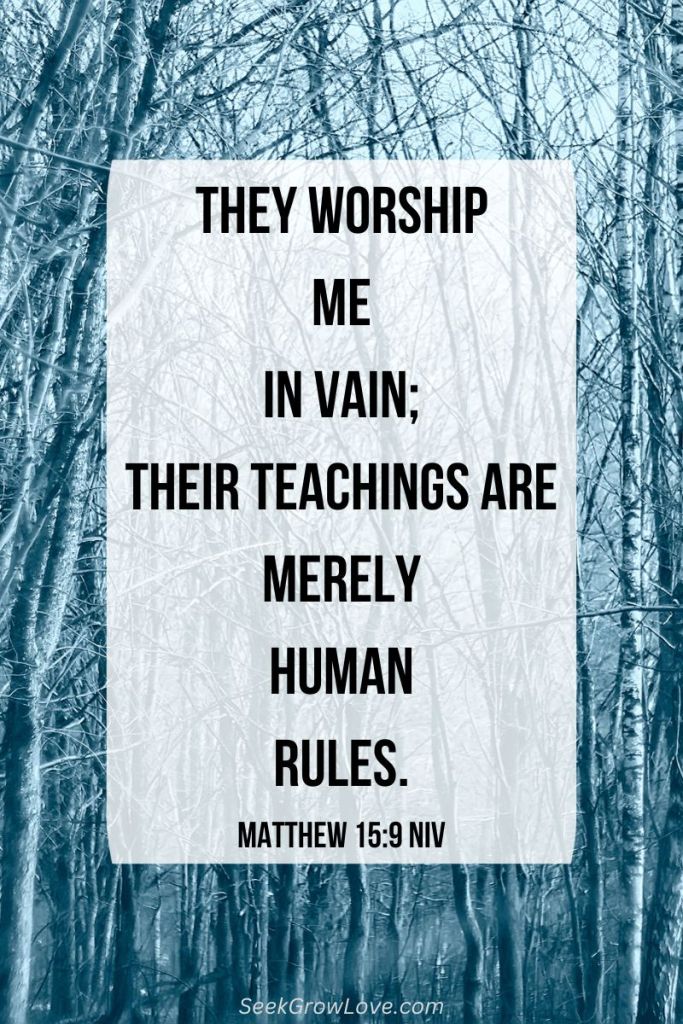
8 “‘These people honor me with their lips, but their hearts are far from me. 9 They worship me in vain; their teachings are merely human rules.’”
I have been doing some reading on church history earlier this year, and it seems this was some of the problem that started the reformation back in the 1500s. Some brave individuals stood up to the churches that led culture at the time and said that people were no longer following the word of God, but rather they were just following the church’s rules which were made by people, often for political reasons.
Are we still doing this? Teaching things that are merely human rules rather than focusing on God?
While we are to follow the laws of the land that were created by people (as long as they don’t contradict God’s laws), we should not be so focused in our churches on following a set of rules of how a worship service should be set up, or the exact number of times per year you should have communion that we miss out on looking at the heart. There is a difference between Jesus’ teachings and a tradition set up in a church.
Traditions can be good, but when we focus so much on them that we don’t pay attention to the results of what is being done or said, they have no purpose. If someone new comes in from another church and they ask “why are you doing things this way?” people tend to get defensive even when the question is asked with a genuine desire to understand rather than to criticize. The truth is, we should be able to answer that question, or if we can’t, consider the practice to determine if what we are doing does still make sense, or if it has become an outdated tradition that could be changed to better serve people.
After Jesus speaks, the disciples come out like “hey, did you know what you said upset the Pharisees?” Jesus doesn’t care if they were offended by what he said. He spoke the truth and wants people to realize the meaning and intent of things. Yes, washing your hands before you eat is a good practice. You are less likely to consume bacteria that way. But not doing that doesn’t defile you spiritually. The things that come out of your mouth (which come from your heart) do – evil thoughts, murder, adultery, sexual immorality, theft, false testimony, slander.
~Stephanie Fletcher
Reflection Questions
What is something in your life that needs to be examined to ensure your heart is in the right place?
What instances can you think of in which the church is following mere human rules and not the word of God and teachings of Jesus?
One of my favorite Christian songs of all time is “Voice of Truth” by Casting Crowns. In this song, the band talks about choosing to listen to the voice of Jesus out of all the different voices calling out to them. Although those voices keep laughing at us, reminding us of all the times we’ve failed before, and saying that we will never be enough, Jesus says something different. Jesus tells us that we are strong with his God, that we are forgiven, and that we don’t need to be afraid. Everything that happens to us is only for his glory and the glory of his God, and we just need to listen to what he says.
Psalm 12 talks about two different voices that are shouting at King David: the wicked who flatter themselves and destroy God’s people, and the pure voice of the one true God that is like silver. King David stands in the middle and must make a choice: will he listen to voices of wicked, powerful forces that tear him down, or the voice of God that promises to preserve and keep him forever (verse 7)? King David makes the right call and follows after God’s voice, resulting in him being saved from those forces surrounding him (verse 5).
We also have a choice to make: what voice is shouting loudest at you? There are many voices around you that will claim that you are not good enough, are a failure, are ugly, or worthless. Every single person has these voices surrounding them, sometimes coming from mean people or from ourselves. However, our God through Jesus tells us that we are precious, worthy, and loved. There is nothing that will be able to separate us from God’s love in Jesus Christ (Romans 8:38-39), if we will just listen and trust in that great voice over the others. We can have rest, assurance, peace, and joy if we listen to the voice saying, “You’re my son/daughter: I love YOU”.
Brothers and sisters, you are more loved than you can imagine. Although you have people saying horrible things about you, and may be saying horrible things to yourself, you are a child of the one true God: you have value, purpose, and a family. Please find hope and encouragement today in knowing that this Voice is greater than all the rest and speaks the truth.
-Talon Paul
Reflection Questions
What lies about yourself have you heard, and sometimes believed, from others or from yourself? Why are they wrong? Why are they harmful?
What does God say about you and His love? What is Jesus’ role in sharing God’s love and truth?
How can you listen LESS to the lies and MORE to the truth?
How can you help carry God’s words of truth and worth to those who are listening to lies?




 (Originally posted December 18, 2016)