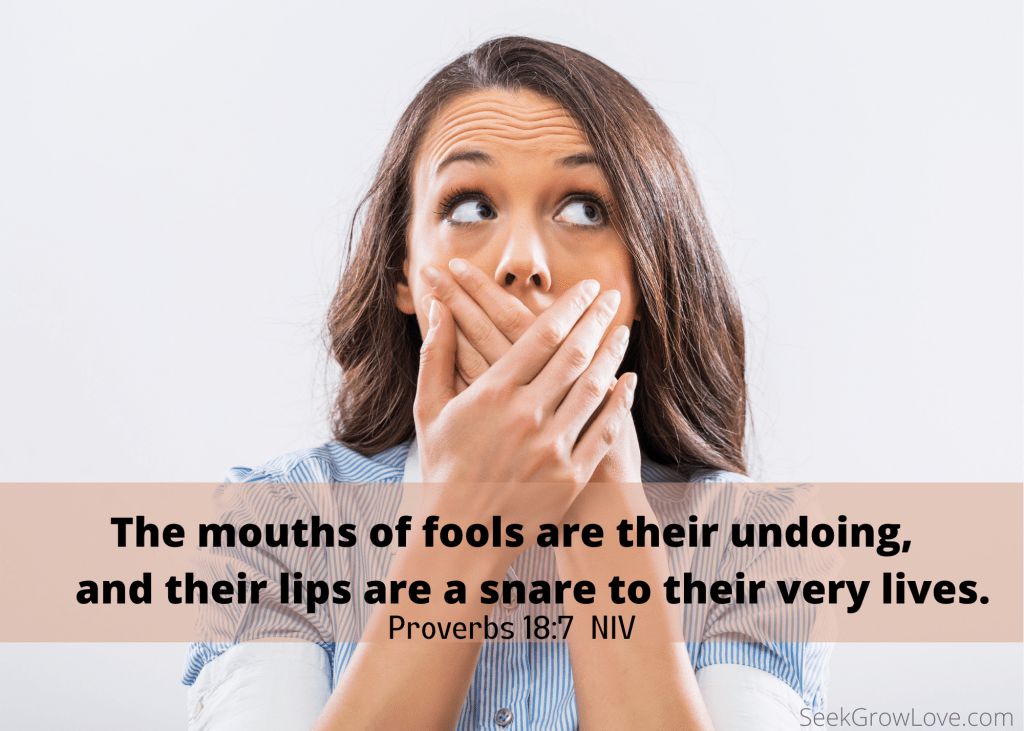
The mouth speaks out of that which fills the heart

Proverbs 17-18

The book of wisdom says, “Death and life are in the power of the tongue, and those who love it will eat its fruit.” (Proverbs 18:21). I understand this scripture to mean that we have the power to speak words to others unto life or words unto death, so we should choose our words carefully. If we love to talk, we better make sure our speech represents who we are because we become what we speak (eat your words). Our words are death and life to our own bodies.

I keep coming back to the issue of the heart. I know we need to have a heart for God if we desire to be with him and his son in the Kingdom of God. But how do we really know if we have a heart for God? The heart can be seen in the things we do that correspond with Jesus’ commandments (love) that we must do to enter in. Works are fruit but works can be deceiving if the heart behind the works is not motivated by love. Mathew 7:15 – 23 says:

15 “Beware of the false prophets, who come to you in sheep’s clothing, but inwardly are ravenous wolves. 16 You will know them by their fruits. Grapes are not gathered from thorn bushes nor figs from thistles, are they? 17 So every good tree bears good fruit, but the bad tree bears bad fruit. 18 A good tree cannot produce bad fruit, nor can a bad tree produce good fruit. 19 Every tree that does not bear good fruit is cut down and thrown into the fire. 20 So then, you will know them by their fruits.

21 “Not everyone who says to Me, ‘Lord, Lord,’ will enter the kingdom of heaven, but he who does the will of My Father who is in heaven will enter22 Many will say to Me on that day, ‘Lord, Lord, did we not prophesy in Your name, and in Your name cast out demons, and in Your name perform many miracles?’ 23 And then I will declare to them, ‘I never knew you; depart from Me, you who practice lawlessness.’

The people speaking to Jesus in this passage are shocked that Jesus doesn’t know them. The works mentioned in this passage do outwardly appear to be good fruit. Fruit can look good on the outside but can be rotten on the inside.

It can be difficult to identify bad fruit sometimes. If you really want to know if you’re producing good fruit or not, there is one particular fruit that’s pretty transparent, at least to the people we’re around the most. Our words are a good indication of what’s in our hearts.

Here’s a similar passage from Luke’s perspective in Luke 6:43-47:

43 For there is no good tree which produces bad fruit, nor, on the other hand, a bad tree which produces good fruit. 44 For each tree is known by its own fruit. For men do not gather figs from thorns, nor do they pick grapes from a briar bush. 45 The good man out of the good treasure of his heart brings forth what is good; and the evil man out of the evil treasure brings forth what is evil; for his mouth speaks from that which fills his heart.

46 “Why do you call Me, ‘Lord, Lord,’ and do not do what I say? 47 Everyone who comes to Me and hears My words and acts on them, I will show you whom he is like: 

Jesus has a little more to say about the mouth in Mathew 12:30-37:

  30“He who is not with Me is against Me; and he who does not gather with Me scatters.

      31“Therefore I say to you, any sin and blasphemy shall be forgiven people, but blasphemy against the Spirit shall not be forgiven. 32“Whoever speaks a word against the Son of Man, it shall be forgiven him; but whoever speaks against the Holy Spirit, it shall not be forgiven him, either in this age or in the age to come.

      33“Either make the tree good and its fruit good, or make the tree bad and its fruit bad; for the tree is known by its fruit. 34“You brood of vipers, how can you, being evil, speak what is good? For the mouth speaks out of that which fills the heart35“The good man brings out of his good treasure what is good; and the evil man brings out of his evil treasure what is evil. 36“But I tell you that every careless word that people speak, they shall give an accounting for it in the day of judgment. 37For by your words you will be justified, and by your words you will be condemned.”

James gives us even more clarity about the power of our speech in chapter 3:5-12:

So also the tongue is a small part of the body, and yet it boasts of great things. See how great a forest is set aflame by such a small fire! And the tongue is a fire, the very world of unrighteousness; the tongue is set among our body’s parts as that which defiles the whole body and sets on fire the course of our life, and is set on fire by hell. For every species of beasts and birds, of reptiles and creatures of the sea, is tamed and has been tamed by the human race. But no one among mankind can tame the tongue; it is a restless evil, full of deadly poison. With it we bless our Lord and Father, and with it we curse people, who have been made in the likeness of God; 10 from the same mouth come both blessing and cursing. My brothers and sisters, these things should not be this way. 11 Does a spring send out from the same opening both fresh and bitter water12 Can a fig tree, my brothers and sisters, bear olives, or a vine bear figs? Nor can salt water produce fresh.

Are you noticing as I am that some of the scariest, most convicting verses in the bible for a supposed Christian regard our speech? We must tame our tongue. To tame the tongue we must change our hearts.

By examining our own words, we can tell if we have a heart for God or not. I think it’s a really good indication about our destiny too. If you really want to know if you are producing good fruity speech, ask those who are closest to you how they perceive your speech towards them. If they aren’t on the receiving end of your good fruity speech, that’s not good. Be prepared with your response. If you don’t like what you hear, how will you respond? Choose your words wisely.

If you know you will have trouble responding with good fruit, prune your speech! You might find it helpful to practice not saying anything at all. Proverbs is chock-full of verses that tell us that there is wisdom in keeping our mouths closed. Even a silent fool is considered wise if he keeps his mouth shut. We can use that silent time to pray for wisdom and words of life and in the meantime, practice our sacrifice of praise to God, which is the fruit of our lips that give thanks to his name.

-Juliet Taylor

Today’s Bible reading passages can be read or listened to at BibleGateway here – 1 Chronicles 3-4 and Proverbs 18

Lead

The Right Way

2 Kings 15-16


As a child, I was always told to be a leader, not a follower. The importance of leading with wisdom and godliness was engrained in my mind; it was repeatedly being taught by parents, teachers, mentors, and of course, leaders. I’m sure most of us grew up with similar advise. We all know the impact a good leader can have, as well as the impact a bad leader can have. That’s why
if we know what it means to be a good leader, we must take it upon ourselves to be one.


The thing is, most of us do know what it means to be a good leader. We all have it within us to lead as God instructs us to lead, because He gave us this whole enormous book full of leaders to read about and learn from. Jesus Christ was obviously the top dog when it comes to leaders…and everything else, but there are so many others we can look at too, including the not so great leaders.


Throughout the Old Testament, the importance of a strong leader is stressed over and over again. We see these amazing, capable, resilient, faithful leaders bringing God’s people into the light, guiding them in the direction God laid out for them, like Jesus someday would. But we also see weak leaders, lacking in faith and abounding in pride. When leaders like that are in charge, they
normally can be observed dragging their followers down with them. The readings of the past week have been absolutely full of leaders who could not leave behind the sins of their predecessors, which “made Israel to sin.” When you have been blessed with the knowledge of the truth, and you know the commands God has given us, it is your duty to be a leader. It is your duty to point others to God in everything you do, not to continually lead others in sin.

When Israel had weak kings who did evil in the eyes of the LORD, the whole nation was brought down as a result. On the other hand, when Israel had strong kings who did what was right in the eyes of the LORD, the entire nation would be lifted up. You can see when God favored Israel and its king, because He would lead them to victory in battle, and bless them with prosperity. When the king and Israel failed, however, they would often be delivered into the hands of their enemies.


It is clear how much of an impact a leader can have in the Bible, and that hasn’t changed at all today. We are so blessed to have the knowledge of the truth, and to know that we are loved by the Almighty. To have this knowledge, and to have a real relationship with God, we also have to accept our responsibility on this earth to be leaders. Not the kind that will lead others into sin, but the kind of leader God can count on to be a light, just as His son was. The kind of leader that has unwavering faith, because they know who holds the future. The kind of leader that obeys the words of the LORD in every circumstance. The kind of leader that shows the unconditional love of God to each and every one of His children, everyday.


Let it be our prayer that we become the leaders God made us to be, to be a bright light that guides others to Him even in this dark world.

-Isabella Osborn

Today’s Bible reading passages can be read or listened to at BibleGateway here – 2 Kings 15-16 and Proverbs 12

Watch Your Step

Proverbs 4

Have you ever seen the videos of people walking down a street when suddenly they fall in a construction hole? They were too busy watching their phone screen that they did not look where they were going. Because they were not watching, they stumbled and fell into something that was well marked as being dangerous. Maybe you have experienced something like this yourself.

Sometimes in life we can be like this. In our walk of faith, we don’t pay attention like we should. Something other than the path draws our attention and we stumble. In those videos, the person usually walks right into a construction zone that is marked with bright orange cones and construction tape. It is not a secret that what they are walking into is dangerous. However, they refuse to look at their path and keep walking regardless.

Proverbs 4:25-27 tells us to look ahead and to keep our eyes fixed on the path ahead. When we allow our eyes and our thoughts to be distracted by other things, we are more likely to fall into the pit. We need to instead put our eyes away from such distraction and turn to the LORD. We need to keep our eyes on Him and His Word so that when temptation comes our way, we can see it and turn from it. Just as Proverbs reiterates, we need to listen to instruction. Instead of ignoring the warning signs, we need to avert our path away from them. We need to follow the directions that guide us away from the hole. We need to keep our eyes on the path.

-Hannah Deane

Today’s Bible reading passages can be read or listened to at BibleGateway here – 1 Kings 21-22 and Proverbs 4

The Instruction Booklet

Proverbs 1

Have you ever tried to help a child put together a toy train track? There are so many pieces and in the end they are supposed to make a complete track. Some of the pieces make sense and, well, others are like that onion ring you find in an order of fries. No instruction booklet is included, so you are on your own. You attempt to put the train track together yourself based off of what you think it looks right. If you are like me, the end result is a train track with very strange turns and a dead end. It is not the complete figure eight as pictured on the box. If only the factory had sent some sort of instructions, then perhaps you wouldn’t be in this fix.

In Proverbs 1, we learn from that, “the beginning of knowledge is the fear of the LORD”. It tells us that only fools despise the wisdom and instruction that they receive. The Bible offers us so much instruction on how to live our lives. Proverbs tells us to walk in the way of wisdom and here we are told that to be knowledgeable we must look to God. He is the foundation of knowledge and only through Him and the heeding of His word can we hope to access true wisdom.

It is encouraging to know that, unlike the factory and the toy train, God gave us an instruction booklet. He didn’t expect us to just figure it out, but God gave us His word so that we may have wisdom and know Him. Sometimes, though, when we are going through hard times, it can be difficult to remember to go to Him and His word for guidance. Like with the train, the instruction booklet may not have been included, but I could have Googled it. Sometimes we get so caught up in the moment that we forget to look for wisdom and instruction.

-Hannah Deane

Today’s Bible reading passages can be read or listened to at BibleGateway here – 1 Kings 15-16 and Proverbs 1

Positive Reactions to Negative Events

1 Samuel 29-31

Today’s Old Testament passage continues the story of David and his men while they were living with the Philistines away from Saul. In 1 Samuel 29, David is about to go fight with the Philistines, but several of the Philistine leaders are worried that David is still loyal to Saul and will turn against the Philistines in battle. So David and his men are sent back to their home, Ziklag. Unfortunately, “When David and his men reached Ziklag, they found it destroyed by fire and their wives and sons and daughters taken captive” (NIV, 1 Samuel 30:3). This event alone would be quite devastating to David, but in addition, some of David’s men were then considering turning on him and stoning him based upon the recent misfortune. 

This rough series of events would be hard to get through alone, but verse six states that “David found strength in the LORD his God” (1 Samuel 30:6). His positive reaction to these negative events can be used as an example. Instead of immediately taking revenge on the Amalekites for destroying his home and taking his family and friends, he decides to ask God first. David’s initial response can be used in many situations to choose the wisest action instead of simply reacting in the first imaginable way that is likely unwise. 

After God responds, David and some of his men successfully chase down the Amalekites and get everything back that was stolen. Although they retrieved all their possessions again, some of the men weren’t willing to give back part of the goods to those that didn’t participate in the raid. However, David’s response to this situation is again a positive example that can be applied to many other situations, even today. David disagreed with those men and instead insisted that even those that didn’t participate should receive part of the plunder. He argued that what they had received had actually come from the LORD, not from those that had actually participated in the fight. Further, David didn’t just divide up the plunder between him and his men, he also then gave gifts to others that had been kind to them in the past. As one people united with a common goal to serve and follow God, it is important to remember to share the possessions that have graciously been given by God.

-1st time Devotion Writer who Preferred being Anonymous

Today’s Bible reading passage can be read or listened to at BibleGateway here – 1st Samuel 29-31 and Acts 9

See What You Can Do

1 Samuel 25-26 and Acts 7

In 1 Samuel 25 we are introduced to Abigail. If you haven’t yet – go read her story now. Abigail – intelligent and beautiful, a safe place for the servant to come speak truth, she “lost no time”/”quickly” – woman of decisive action, generous gift-giver, humble and contrite, willing to accept blame (even when it more rightly belonged to her husband instead), thinking ahead to future ramifications, eloquent, known and praised for good judgment, discerning and a peacemaker. Not promoting peace by just keeping her mouth closed or looking the other way, but from speaking up and standing up for what is right and just.

I can learn a lot from Abigail, as well as from her servant. The servant who warned Abigail of her husband’s foolish treatment of David confided in her and said, “Now think it over and see what you can do, because disaster is hanging over our master and his household” (1 Samuel 25:17). Think it over – and see what you can do. Wise words of advice from the servant. I too often overthink myself into non-action. I get stuck in the ‘think it over’ stage. I might feel I have discerned a situation well and see the foolishness, wickedness or injustice but become paralyzed by what to do about it by overanalyzing or fear of getting personally involved. Or, just as unhelpful – I can come up with lots of solutions of what other people could or should do to fix the problem. But not Abigail. She thought it over and saw what she could do and “lost no time” in getting it done. Twice it says she “quickly” mounted or dismounted her donkey. She is wasting no time hem hawing around. There is action to be taken – and she will do it.

However, even though Abigail acts decisively and quickly – she also avoids erring on the side of rash, reckless behavior she might regret later. When she returns home to a drunk husband she doesn’t engage him then but waits til morning to tell him of all that had transpired. She still takes the time to wisely interpret a situation and choose the best time, not necessarily the first chance, to intervene and speak.

And, God takes care of the rest. I imagine it was scary for Abigail to approach David and then confront her husband – not knowing how either of them would react or what it would mean for her future. When we are called to act we usually don’t know what the results will be – either short or long-term. But we can know that God is faithful in providing for His children who have stepped out in faith to right wrong and peacefully pursue justice.

But wait – how did God provide for faithful Stephen in Acts? Like Abigail, Stephen was also a courageous, eloquent person of action and wisdom who boldly served his master and spoke for his king, Jesus, in the face of wicked opposition. He saw that disaster was hanging over all those who had rejected Jesus and he had considered what he could do – speak in Jesus’ name. And he did it faithfully, regardless of the outcome. A life cut short and the agony of being stoned to death doesn’t seem like much of a reward for bravely doing the right thing. But, when you read the description of Stephen there is an amazing amount of peace. He is not in fear or second-guessing his words or actions. He is full of the Holy Spirit and he is allowed a glimpse into heaven and sees, “the glory of God, and Jesus standing at the right hand of God.” (Acts 7:55). Even at his last moment before “falling asleep”, he is at peace with his Lord Jesus and even with his adversaries.

We don’t need to know the immediate outcome before courageously taking action and speaking up for what is right. Disaster is indeed hanging over so much of the world today. It is time for God’s children to think it over and consider what each one can do. And then take action, quickly mount your donkey, open your mouth, speak His words. You can be confident – you might not know the outcome, but God’s got His children.

-Marcia Railton

Today’s Bible reading passages can be read or listened to at BibleGateway here – 1 Samuel 25-26 and Acts 7

David and Stephen

1 Samuel 23-24 and Acts 6

Today’s Old Testament reading includes strong, powerful David sparing King Saul’s life in a cave when he could have easily taken revenge and killed the king, clearing the way for his own rule and prosperity. Strong, bold, but full of mercy and God-fearing appreciation for those God had placed in power.

Today’s New Testament reading tells of Stephen, “a man full of God’s grace and power, did great wonders and miraculous signs among the people” (Acts 6:8). But, not everyone was a fan. Just as David and Jesus had run into opposition, now it was Stephen’s turn. Jealousy, arguing, false witnesses ensued. Stephen remained steadfast. I love the descriptions of this man. Those who argued against Stephen, “could not stand up against his wisdom or the Spirit by whom he spoke.” (Acts 6:10) and even the Sanhedrin saw that, “his face was like the face of an angel” (Acts 6:15). We will read more of Stephen’s story tomorrow.

Motherhood is on my mind today. The characteristics displayed in today’s reading of both David and Stephen are characteristics I want to help develop in my children. Strong, bold, full of grace and wisdom and the Spirit of God, also able to face opposition and remain steadfast and godly.

We do not hear anything about Stephan’s family or mother. We know very little of David’s mother – though in yesterday’s reading we learned that he cared for and provided for the safety of his mother and father when Saul was seeking to kill David (1 Samuel 22:3). Just like the Disney princesses (and princes), they seem to have grown and developed with no maternal influence mentioned. But, we know, for better or worse every child ever born has had a mother. It is perhaps a good reminder to me that God doesn’t NEED me to grow my children into the Davids or Stephens or Hannahs or Marys he wants them to be. But, what a privilege to get that opportunity to do my best in His Spirit to develop those characteristics in my children. And, I am so thankful for the mother who did that for me.

-Marcia Railton

Today’s Bible reading passages can be read or listened to at BibleGateway here – 1 Samuel 23-24 and Acts 6

Jesus’s Mic Drop

Luke 20

Remember the king that was greeted with palm leaves and shouts of hosanna yesterday? Today, we see him bombarded with questions meant to entangle him. The religious elite were threatened by Jesus—by his growing popularity, his radical views of religion, and his claim to be the Messiah. The teachers of the law and Pharisees tried to make Jesus stumble.

Keeping a close watch on him, they (the teachers of the law and chief priests) sent spies, who pretended to be sincere. They hoped to catch Jesus in something he said, so that they might hand him over to the power and authority of the governor (Luke 20:20). 

The religious elite were trying to make Jesus stumble through an intense line of questioning, just like the lawyers do to criminals on TV. Of all the questions thrown in Jesus’ direction, I find this question most interesting: 

Is it right for us to pay taxes to Caesar or not? (Luke 20:22)

It’s a lose-lose question. If he sided with Caesar, he would be in trouble with the Jews; if he sided against Caesar, he would be in trouble with the Romans. Instead of pleading the fifth or requesting to see his lawyer, he answered with the perfect solution. Since it’s Caesar’s image on the denarius, that is to be given back to Caesar. However, whatever is God’s should be given back to God. 

His answer is so profound yet simple that it literally silences the crowd—better than any answer given by a fancy attorney on TV. Jesus spent the first thirty years of his life preparing for interactions like this one. He was so in tune with God’s spirit that the perfect words just seemed to flow out of his mouth effortlessly. In the same way, we should prepare ourselves to answer tough questions and defend our faith—this includes praying for wisdom and understanding, studying truth, and committing scripture to memory. As a reminder of just that, I painted the following verse on the cover of my Bible: 

Always be prepared to give an answer to everyone who asks you to give the reason for the hope that you have (1 Peter 3:15). 

Paul likens scripture to a sword, but we must wield it well in order to enact its power. Every time I open my Bible, I want to grow more confident in my faith so that I can rise to the defense of it and share it with others. 

How will you build up your defense? 

-Mackenzie McClain

Today’s Bible reading passages can be read or listened to at BibleGateway here – Deuteronomy 23-24 and Luke 20

The Third Option

Mark 11

            Have you ever been in a situation when you didn’t know what to do? Maybe you felt like you only had one or two options and you didn’t like either of them? We will all run into obstacles in our lives that we don’t know how to handle. With almost certainty, this will happen with your faith. You will probably at one time or another be questioned about your faith or pushed on what you believe. Jesus himself experienced multiple situations like this in his ministry. We read about one of those situations in Mark 11:27-33. In this passage, Jesus is confronted by the religious leaders in the temple. They asked him by what authority is he doing and saying these things. If Jesus said that he was doing these thing by the authority of being the Messiah, the son of God, he probably would have been attacked. If he said that that we was doing it by his own authority, he might have lost credibility. Either way, answering this question, at this particular time, would have disrupted the plans God had made for Jesus. This isn’t the only time Jesus was seemingly trapped with a difficult question.

            In John 8:1-11, the Pharisees brought a women, caught in the act of adultery, to Jesus. They asked him if they should stone her according to the Law of Moses or let her go? This lands Jesus in another difficult to answer situation. If he says to stone her, then he is condemning this women. If he let her go, then the Pharisees’ trap would have worked and they could have accused Jesus of denying the authority of the Law. In both passages, what we read in Mark 11 and John 8, Jesus is in a tricky spot and seemingly only has a couple of options. However, Jesus, in the wisdom given to him by the Spirit, comes up with the third option. In Mark 11, he asks the religious leaders a question they can’t answer, effectively ending the conversation. In John 8, Jesus defuses the situation by saying, “He who is without sin among you, let him be the first to throw a stone at her” (John 8:7). After that, everyone leaves. The point is, God provides us with other options.

-Josiah Cain

Links to today’s Bible Reading – Exodus 27 & 28 and Mark 11

Listening to Jesus

Today’s Bible Reading – Matthew 25 and Genesis 49 & 50

                I Love stories, don’t you?

Here’s a story by CS Lewis found in the book: The Voyage of the Dawn Treader as retold by Jennifer Neyhart:

               “Eustace is a character you kind of just want to punch in the face until his transformation experience with Aslan. He was arrogant, self-centered, and all around annoying to Edmund and Lucy.

On one of the islands the crew lands on, Eustace finds a dragon’s lair and is very greedy for the treasure. He puts on a gold bracelet and falls asleep, and when he wakes up, he has been turned into a dragon. Lewis writes, “Sleeping on a dragon’s hoard with greedy, dragonish thoughts in his heart, he had become a dragon himself.” Eustace had fleeting thoughts of relief at being the biggest thing around, but he quickly realizes he is cut off from his friends, and all of humanity, and he feels a weight of loneliness and desperately wants to change.

That night, Aslan comes to Eustace and leads him to a large well “like a very big round bath with marble steps going down into it.” Eustace describes the scene to Edmund after the fact. He says the water was so clear and he thought if he could get in there and bathe it would ease the pain in his leg (from the gold bracelet he had put on when he was human). But Aslan told him he had to undress first. And doesn’t God ask this of us? As Lewis wrote in Letters to Malcolm: “We must lay before him [God] what is in us; not what ought to be in us.”

Eustace found that no matter how many layers of dragon skins he managed to peel off of himself, he was still a dragon.

“Then the lion said – but I don’t know if it spoke – ‘You will have to let me undress you.’ I was afraid of his claws, I can tell you, but I was pretty nearly desperate now. So I just lay flat down on my back to let him do it.

“The very first tear he made was so deep that I thought it had gone right into my heart. And when he began pulling the skin off, it hurt worse than anything I’ve ever felt. The only thing that made me able to bear it was just the pleasure of feeling the stuff peel off. You know – if you’ve ever picked the scab off a sore place. It hurts like billy-oh but it is such fun to see it coming away.”

“Well, he peeled the beastly stuff right off … And there was I as smooth and soft as a peeled switch and smaller than I had been. Then he caught hold of me – I didn’t like that much for I was very tender underneath now that I’d no skin on – and threw me into the water. It smarted like anything but only for a moment. After that it became perfectly delicious and as soon as I started swimming and splashing I found that all the pain had gone from my arm. And then I saw why. I’d turned into a boy again…” – C. S. Lewis, The Voyage of the Dawn Treader

 This scene always grabs my heart. It reminds me that I cannot fix myself. It paints a beautiful picture of baptism and transformation to new life. It humbles me as I put myself in Eustace’s place. And even long after our initial baptism we have the ongoing challenge of surrendering to God’s work in our lives which can be painful at times, even when it’s a good pain.

And I like Lewis’s note of narration at the end of this scene as well:

“It would be nice, and fairly nearly true, to say that “from that time forth Eustace was a different boy.” To be strictly accurate, he began to be a different boy. He had relapses. There were still many days when he could be very tiresome. But most of those I shall not notice. The cure had begun.”        

https://www.jenniferneyhart.com/2014/10/c-s-lewis-undragoning-of-eustace.html

End of Story.

Jeff’s comments:

                Stories have a way of capturing our attention and keeping our interest.  In a really good story like the undragoning of Eustace we might discover after reading it that it stays with us, that it somehow changes the way we see the world or the way that we are in the world.

                Jesus was a master storyteller.  Throughout the Gospels we hear him telling stories, and amazing stories they were as they somehow manage to transcend time and place and language and cultural barriers.

                In Matthew 25 Jesus tells three stories.  One story is about bridesmaids and oil, one is about masters and servants and bags of gold, and one is about sheep and goats.  Jesus told these stories just a few days before he was to be arrested, tried, condemned and nailed to a Roman cross and publicly executed. 

If you’ve ever been around someone who knew that they were going to die soon, you know that near the end of life people usually want to focus on those things which are most important.  They want to say “ I love you” to people they care about.  They want to say “ I’m sorry” to the people they have hurt or they want to say “I forgive you” to the people who have hurt them.  Since Jesus is running out of time and opportunities to preach and teach before his arrest you can imagine that what he has to say is very important to him. This is Jesus saying “I love you” to people he cared deeply about.

I encourage you to read and reflect on those stories in Matthew 25. 

Why is he talking about weddings and bridesmaids and having enough oil and the danger of missing out on the wedding banquet?  What does he want us to do or not do?

Why is he talking about a rich landowner going away on a long trip and leaving behind something valuable and asking his trusted workers to manage his valuable gold well?  What does he want us to do or not do?

Why is he talking about sheep and goats and why is he praising and rewarding some for the good things they do to help others (and him) and condemning  and punishing others for the good things that they fail to do to help others (and him)?  What does he want us to do or not do?

Spend some time thinking about each story.  Imagine yourself there in the story.  What’s it like to be a bridesmaid who wasn’t ready and missed out on your friend’s wedding?  What’s it like to be a worker who gets praised and rewarded for working hard when the master returns?  What’s it like to be called a goat (not The G.O.A.T. –a.k.a. Michael Jordan or Drew Brees) but a goat who failed to care for the sick, the hungry, the prisoners and the naked and gets turned away by Jesus?

Listen to Jesus’ stories and allow them to teach you whatever Jesus wants you to learn.

-Pastor Jeff Fletcher