A Just God. A Merciful God.

Deuteronomy 17-20

Your eye shall not pity. It shall be life for life, eye for eye, tooth for tooth, hand for hand, foot for foot. – Deut 19:21

We serve a just God. Since the very beginning, He has worked to keep His justice system in place, while still pouring out His love and upholding His commitment to bring humanity back to Him. In Genesis, it was impossible for Adam and Eve to remain in the good and perfect world that God created for them, for they were no longer good and perfect. They were tainted with sin and death. But it broke His heart to lose His children, so He made a way for them to live out full and meaningful lives, and to someday be eternally reunited with Him in a renewed good and perfect world. 

When Abraham’s descendants were established into the nation of Israel, they found themselves tugged toward sin and disorder, godlessness and false-god worship. And so God gave them a nice set of very thorough, very just laws, such as the ones we read about today. Israel served a God of order and righteousness, and was to be a nation of order and righteousness—a beacon among the lawlessness that surrounded them. Some of the laws found within these chapters seem harsh to us today, but this was before Jesus was sent to justify us freely. There had to be a system in place to bring God’s people back to Him when chaos ensued, and to discourage such chaos from coming about in the first place.

The Rock, His work is perfect, for all His ways are justice. A God of faithfulness and without iniquity, just and upright is He. – Deut 32:4

Fortunately, our God of justice and order is also a God of love and mercy. By making His Son Jesus our sacrificial lamb, we are saved. We need not impose justice upon our neighbor by repaying an eye for an eye, a tooth for a tooth, a hand for a hand, or a foot for a foot. We, the guilty, have been justified—our debt paid. Jesus, the innocent, took our full punishment. He is our city of refuge, where even the most stained by sin can find rest and grace. 

In Jesus, justice and mercy collide. The weight of the law, which once demanded life for life, was satisfied on the cross. Because of his sacrifice, we no longer stand condemned, but redeemed. Let us walk in the freedom he purchased for us, extending to others the same mercy we have received, and living as a reflection of God’s righteousness in a chaotic world.

-Isabella Osborn

Reflection Questions:

  1. God’s justice required that sin be dealt with, yet His love moved Him to make a way for redemption. How does understanding both His justice and mercy deepen your relationship with Him?
  2. In what ways can you extend the same grace and forgiveness to others that God has given to you?
  3. Israel was called to be a nation of righteousness and order, standing apart from the lawlessness around them. How can you live as a reflection of God’s righteousness in a world that often rejects His order and truth?

Remember His Faithfulness

Deuteronomy 14-16

Celebrate the Festival of Tabernacles for seven days after you have gathered the produce of your threshing floor and your winepress. Be joyful at your festival—you, your sons and daughters, your male and female servants, and the Levites, the foreigners, the fatherless and the widows who live in your towns.” – Deuteronomy 16:13-14

Today we read God’s commands to begin observing three major feasts: Passover, the Feast of Weeks, and the Feast of Tabernacles. Each of these festivals was meant to be an intentional time set aside for remembrance (a recurring theme in Deuteronomy). The Israelites had witnessed God’s power and provision in so many ways… like so many. They were delivered from Egypt, provided for in the wilderness, and were finally being brought into the Promised Land—all of which included various miracles and supernatural occurrences. These celebrations were more than legalistic rituals—they were acts of worship and gratitude intended to continually remind God’s children of His unending goodness.

While most Christians today don’t keep these feasts in their traditional form, their purpose no doubt remains deeply relevant. We are still called to remember God’s goodness, rejoice in His provision, and keep His Kingdom promise forefront in our minds. Jesus, our Passover Lamb, has secured our ultimate deliverance, and we live in the hope of the final harvest when God will gather His people into His eternal presence. Not only must we live in hope, but in daily remembrance. Our hope is not a baseless one. We have a book full of stories and people and places that display our Father’s faithfulness. We live in a world uniquely and precisely designed for human life in ways that defy mere chance. We see glimpses of the Kingdom in small moments every day. These are the things that we must recognize and reflect upon on a daily basis. 

Whether through communion, worship, prayer, or perhaps even partaking in some feasts or holidays, we are called to consistantly honor the God who has redeemed us, sustains us, and promises us a future. I pray today that we cultivate hearts of gratitude and remembrance, celebrating our Father’s steadfast love and infinite goodness in every season of our lives. 

-Isabella Osborn

Reflection Questions:

  1. God established specific times for Israel to remember His faithfulness. How can setting aside time for remembrance strengthen our faith? How might neglecting remembrance weaken faith?
  2. How can you intentionally set aside time to remember and celebrate God’s goodness?
  3. What are some specific ways God has delivered you in your life? Have you taken time to truly reflect on and thank Him for those moments?

God’s Truth and Way – Not Ours

Deuteronomy 11-13

Chapter 12 is the beginning of a new set of comprehensive laws that take up the bulk of the book of Deuteronomy.  Today we read about the specific ways in which God desired His people to worship. He called them to worship in His good and perfect way, not in the ways of the surrounding nations. The Israelites were instructed to destroy any false altars and worship only where God had chosen. This was about doing what was right in God’s eyes, rather than every man acting on his own whims or false morals.

You shall not worship the Lord your God in that way. But you shall seek the place that the Lord your God will choose out of all your tribes to put his name and make his habitation there. There you shall go. – Deut 12:4-5

You shall not do according to all that we are doing here today, everyone doing whatever is right in his own eyes, for you have not as yet come to the rest and to the inheritance that the Lord your God is giving you. – Deut 12:8

Chapter 13 issues a strong warning against abandoning their commitment to the one true God for a false god. It is warned that there will be false prophets and dreamers who can perform signs or wonders, but that they must not fall for such tricks and deception. It is even warned that if your family member whispers to you suggesting that you serve other gods, you must not listen to them. In fact they were instructed to kill them. Fortunately for us, such violence is no longer expected in these cases, however, discernment and steadfast loyalty to our Creator are expected of us. In today’s age, we are instructed to be aware of false prophets, and even false messiahs, as Jesus warns in Matthew,

Then if anyone says to you, “Look, here is the Christ!” or “There he is!” do not believe it. For false christs and false prophets will arise and perform great signs and wonders, so as to lead astray, if possible, even the elect. – Matt 24:24

Today, we may not have physical altars to tear down or false priests to execute, but our hearts can easily become divided. We are tempted to blend worldly influences with our worship, allowing distractions, personal desires, or cultural norms to shape our devotion rather than the truth of God’s word. In a world full of voices claiming to speak truth, it is imperative that we remain anchored in scripture. Even generally positive things, such as success, relationships, or even religious experiences, can become idols if they pull our hearts away from God. True devotion means prioritizing Him above all else, not in the ways we see fit, but in the ways He has commanded us.

-Isabella Osborn

Reflection Questions:

  1. Are there any influences in your life—cultural, personal, or societal—that may be shaping your faith or outlook in ways that are not aligned with God’s Word?
  2. How can you actively practice discernment in recognizing false teachings or influences that lead you away from total devotion to God?
  3. In what ways can you ensure that your worship and daily life reflect God’s truth, rather than personal preferences or societal norms?

Choose God

Deuteronomy 8-10

We all know the Israelites had their share of ups and downs, more often than not due to their own iffy decision making. This is where God makes it indisputably clear that He’s not cool with that. He never has been, and though they made a narrow escape from His righteous wrath once, they have to make a change. Moses reminds them of the abundance of evidence they have of God’s provision. They have no reason to doubt His guidance, or His love. They need only obey the very simple, very clear instructions laid out before them, and they will thrive in the Promised Land. Moses is really leaving no room for misunderstanding; if they remember what the LORD has done for them and follow His commandments, blessings will flow. If not, destruction awaits them. (Deut 8:6-20)

It is also made abundantly clear that any blessings they have previously received were by no means owed to them, that the great nations God delivered into their hands were not because of their own righteousness, but rather because of the rival nations’ wickedness. God had a covenant to keep with the Israelites, and He chose to blot out some evil along the way. 

 It is not because of your righteousness or the uprightness of your heart that you are going in to take possession of their land, but it is because of the wickedness of these nations that the Lord your God is driving them out from before you, and in order to confirm the oath which the Lord swore to your fathers, to Abraham, Isaac, and Jacob. – Deut 9:5

Chapter 10 expresses that God desperately wants the wholehearted devotion of His people. No other being is worthy of our praise. We cannot divide our allegiance between God and the things of this world that compete for our loyalty; Yahweh’s unmatchable greatness demands our reverence.

You shall fear the Lord your God; you shall serve Him, and cling to Him, and you shall swear by His name. He is your glory and He is your God, who has done these great and awesome things for you which your eyes have seen. – Deut 10:20

Just as the Israelites had to be repeatedly reminded of God’s provision and grace, it is of such importance that we remind ourselves (and each other) on a regular basis that even though we haven’t (and can never) earn such a reward, we serve a God who has endlessly displayed His immense love for us and His perfect plan for us. It is not by our own righteousness that we are saved, but we are saved nonetheless. And furthermore, we are loved beyond all comprehension. Who else is worthy of our praise? Who else is worthy of our life-long commitment? Even in today’s world, there are so many things competing for our attention and fealty. We must make the same decision the Israelites were faced with in today’s reading, the daily decision to choose God over all else. Although we don’t deserve His love, He is the only thing that deserves ours. 

-Isabella Osborn

Reflection Questions:

  1. How has God provided for you in ways that you may have overlooked or taken for granted? Take a moment to reflect on His faithfulness in your life.
  2. In what areas of your life are you tempted to divide your loyalty between God and the things of this world? How can you realign your heart to give Him your full devotion?
  3. If our blessings are not earned, but given by God’s grace, how should that shape your perspective on gratitude, humility, and obedience in your daily walk with Him?

Listen – and Act Accordingly

Deuteronomy 5-7

These 3 chapters continue to reiterate the importance of REMEMBERING. Moses is addressing the new generation of Israel, preparing their hearts to enter the long-awaited Promised Land. We read in chapter 5 the repeated Ten Commandments, and Moses’ encouragement to follow these laws that bring life and blessing, “that you may live long in the land that you shall possess.” The Israelites are repeatedly reminded throughout these chapters that these laws are meant to serve them for generations to come; Moses emphasizes over and over again the cruciality of ensuring that their children and their children’s children not forget the foundation provided to their ancestors via these laws. 

Chapter 6 is home to one of the most well-known prayers in the Bible, the Shema Yisrael, which has remained embedded in Jewish culture to this day. Ancient Jews combined Deuteronomy 6:4-5 with other Torah passages (Deut. 11:13-21; Num. 15:37-41), reciting the words every morning and every evening. This prayer became ingrained in Jewish tradition, and was widely practiced in the Second Temple Period. Jesus declared it the greatest commandment in the Torah in Mark 12:29-31. 

“The most important one,” answered Jesus, “is this: ‘Hear, O Israel: The Lord our God, the Lord is one. Love the Lord your God with all your heart and with all your soul and with all your mind and with all your strength.’ The second is this: ‘Love your neighbor as yourself.’ There is no commandment greater than these.” – Mark 12:29-31

Many of us memorized these verses at a young age. What gives this prayer such immense significance? Well, to the Jews at the time (and through history), it is a pledge of allegiance to God, emphasizing three main ideas:

  • Monotheism: The Shema asserts that there is only one true God, distinguishing Israelite faith from the surrounding polytheistic religions of the ancient world. (Deut 6:4)
  • Covenantal Relationship: The Shema affirms Israel’s special relationship with God, requiring wholehearted love and devotion. (Deut 6:5)
  • Daily + Generational Remembrance: It is recited morning and evening, reinforcing a life centered on God’s commandments, and ensuring that it is passed down to future generations. (Deut 6:6-9)

These truths remain relevant to us today, and this prayer is a beautiful, concise way to remind ourselves what Moses stressed throughout these passages. 

Something interesting about the opening line of the Shema, “Hear, O Israel,” is that in Hebrew, “hear,” or “shema,” does not only mean to listen. It means to listen and then act accordingly. It is directly tied to action. And the word “love,” or “ahavah,” similarly means to act in love. It’s more than just a feeling; it’s active obedience and loyalty. It’s a call for the Israelites to be faithful to their covenant with Yahweh. We, too, have a covenant with Yahweh, a renewed covenant with new laws and a new Promised Land. But as Jesus clarified, this command remains true, and we must make the active decision to live out the Shema each and every day. 

-Isabella Osborn

Reflection Questions:

  1. What are some practical ways you can incorporate Scripture into your daily life to ensure that you keep them on your heart, as to better remember and live by God’s Word?
  2. The Shema calls us to love God with everything we are. How can you intentionally cultivate a deeper love for Him in your daily life?
  3. Just as Israel was called to pass down God’s truths, we are called to disciple others. Who are you investing in spiritually? How can you be intentional about sharing your faith—whether with your family, friends, or community?

Test Your Memory

DEUTERONOMY 3-4

“Deuteronomy” is derived from the Greek word deuteronomion, meaning “a second law.” This whole book is meant to be a second edition of God’s laws, compiled of commandments received at Mount Sinai as well as a few additional ones. The first four chapters of Deuteronomy set the stage for these laws by providing reminders of why the Israelites serve the God of Abraham, and the importance of keeping His statutes. 

Moses begins this book emphasizing to his people the importance of remembering. He reminds them of the many instances in which God delivered them from their enemies and gave them new lands. As we read yesterday and continue to read today, chapters 1-3 serve as a brief overview of Israel’s recent happenings. In chapter 4, Moses switches gears and opens the book with a call to remembrance, and a command to obey. (Deut 4:1-5, 4:9-10, 4:14, 4:23, 4:30) 

Only be careful for yourself and watch over your soul diligently, so that you do not forget the things which your eyes have seen and they do not depart from your heart all the days of your life; but make them known to your sons and your grandsons. – Deut 4:9

Moses is reiterating that the laws provided previously in Exodus weren’t just a temporary set of guidelines or a mere suggestion; they were meant to be kept. These laws are the foundation upon which God’s chosen people will be set apart, unique from the rest of the world. (Deuteronomy 4:5-8, 4:32-40)

So keep and do them, for that is your wisdom and your understanding in the sight of the peoples who will hear all these statutes and say, ‘Surely this great nation is a wise and understanding people.’ For what great nation is there that has a god so near to it as is the Lord our God whenever we call on Him? Or what great nation is there that has statutes and judgments as righteous as this whole Law which I am setting before you today? – Deut 4:6-8

Israel’s obedience and devotion to the statutes of the LORD serve a larger purpose. Not only will these laws keep Israel on the right track in terms of their own safety and wellbeing, but they will also distinguish God’s people from the rest of humanity as a righteous and wise nation. Ultimately, despite many roadblocks and failures, these laws will sustain Israel for 400 years, allowing them to become the nation from which the Messiah is born (as prophesied later in Deuteronomy 18:15-19).

Moses makes it abundantly clear to his people that God will not forget His covenant with them, therefore it is crucial that they do not forget either. He warns them that they will stray, but that they serve a merciful God, a loving Father who patiently waits for His children to return to Him. (Deut 4:25-31)

For the Lord your God is a compassionate God; He will not abandon you nor destroy you, nor forget the covenant with your fathers which He swore to them. – Deut 4:31

Though Christ has since set a new system in place, consisting of new laws under the new covenant, the main ideas that Moses expressed in these scriptures remain true for us today. First, we must remember God’s promise to one day restore the earth (Gen 3:19), as well as the commands His Son gave generations later under the new covenant. Second, God’s commands are not meant to needlessly restrict us, but to guide us into a life of blessing and purpose. When we obey, we reflect His wisdom and goodness to the world around us. And lastly, that God knows we live in a broken world; He sees our darkest desires and our biggest downfalls. But even when we stray from His ways, He waits for us to return to Him, arms open and heart yearning to pull us into His loving embrace. 

-Isabella Osborn

Reflection Questions:

  1. How can you actively remind yourself (and others) of God’s goodness, His commands, and His promises?
  2. Moses emphasized that God’s laws were meant to set Israel apart—how does living according to God’s principles set you apart in today’s world?
  3. How does knowing that God patiently waits for us to return to Him impact the way you approach repentance and restoration in your relationship with Him? How can this truth shape the way you view both your own failures and those of others?

Looking Back and Looking Ahead

Deuteronomy 1-2

A time of reflection and recap of events as the Israelites prepare to enter the Promised Land. “For the LORD your God has blessed you in all the work of your hands. He knows your going through this great wilderness. These forty years the LORD your God has been with you. You have lacked nothing. (2:7) They’ve LACKED NOTHING?! They probably didn’t agree with that, but it shows how God provided for them the basics, which is ample for a person. He literally gave them their daily bread.

Moses reminded them, “The LORD your God who goes before you will Himself fight for you, just as He did for you in Egypt before your eyes,and in the wilderness, where you have seen how the LORD your God carried you, as a man carries his son, all the way that you went until you came to this place. Yet in spite of this word you did not believe the LORD your God.” (1:30-32)

It’s amazing that we can do the same thing like the Israelites at times, cry out to get out of a difficult situation (Egypt), then afterwards when we’re out we complain again. But if they would’ve trusted that God would fight for them they could’ve been spared the long difficult 40 years. The wilderness was the ONLY way to get to the Promised Land, and their lack of trust made it even harder (and longer).

Not one of these men of this evil generation shall see the good land that I swore to give to your fathers, except Caleband Joshua who wholly followed the LORD.” (1:35) Even Moses wasn’t allowed to enter as the LORD was angry with him too (or, had been angry and was following through with consequences).

Despite failures and difficulties Moses pressed on with the people until his departure. This reminds me of parenting! It’s difficult and rewarding! One of my main parenting verses that encouraged me over the years, besides Deut. 6:4-7, is 1 Peter 4:12,

Above all, keep loving one another earnestly, since love covers a multitude of sins.

– Shalom y’all, Stephanie Schlegel 🙂

            (From Israel and Tennessee:)

REFLECTION QUESTIONS

1. Have you had to endure a difficult situation for years? How did God sustain you through it?

2. Is there an issue you’re dealing with that if you’d wholly trust God, the situation would be better? Are you taking matters into your own hands or trusting God with it?

3. Reflect over this last month how God’s provided for you and thank Him for it!

4. How does looking back better prepare the Israelites for looking ahead? How can it benefit you?

God is Trustworthy

*Old Testament Reading:  Deuteronomy 31

Poetry Reading:  Psalm 42

New Testament Reading:  Romans 11 

“The Lord has said to me, ‘You shall not go over this Jordan.’“  – Deuteronomy 31:2b (ESV)

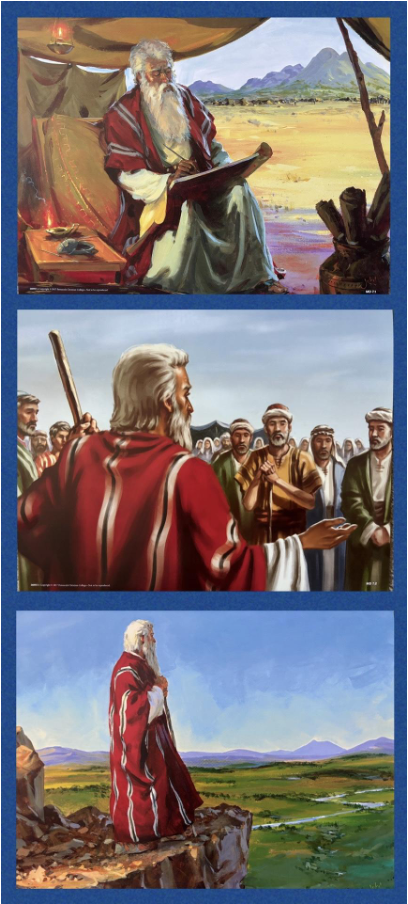
Deuteronomy 31 begins with Moses acknowledging his advanced age (120 years) and telling the Israelites that he will no longer be their leader.  Deuteronomy 31:2b says, “The Lord has said to me, ‘You shall not go over this Jordan.’“  Moses does not get to enter the promised land because he broke faith with God – but he does get to see it from a mountain before he dies (Deuteronomy 32). We learn in this brief statement that God’s word WILL hold true, He had told Moses he wouldn’t get to enter (Numbers 20:12) and His stated consequences will apply (helpful parenting tip).

This might seem overly harsh, but it helps us trust that what God says will happen, will happen.  Moses accepted this consequence from God and went on to give the Israelites some parting words.  He begins with telling them to be strong and courageous (verse 6) and reminds them that God will never leave them.  Then he commissions Joshua to lead the people and tells him to be strong and courageous and that God will never leave him.  He tells the Levites to read the law every seven years, specifically so that the next generation will hear it and fear God (verses 12-13). 

After God reminds Moses that he’s going to die soon, He tells him that the Israelites will break His covenant.  How sad that must have made Moses!   God then has a final instruction for Moses.  In verse 19a God says to Moses, “Now therefore write this song and teach it to the people of Israel” and verse 22 says, “So Moses wrote this song the same day and taught it to the people of Israel.”

What was so important that it was one of the last things God wanted Moses to do for Him?  You can read the song itself in chapter 32, but basically it was a warning to the Israelites.  The song Moses was instructed to write begins with a reminder of God’s faithfulness, then moves to their future failures and turning away from God and then of God’s punishment that will follow. 

So what can we learn from this passage that was directed very specifically at the Israelites of that day? 

First, can people trust us when we speak?  Do we do what we say we will?  It is important to know that we can trust God.  It is also important that we are trustworthy.

Second, it’s easy to look at the Israelites and think, “What was wrong with them?  God told them how they would fail Him and they didn’t stop it from happening!”  However, if we are honest with ourselves, we do the same thing.  God has told us in Romans 3:23 that, “all have sinned and fall short of the glory of God”.  We all sin.  We all turn away from God.  But the good news is that God is there, waiting for us to turn back to Him!

Amy Blanchard

Reflection Questions

  1. It is important that we are trustworthy.  Do your actions line up with your words? 
  2. Just like the Israelites needed to not get stuck in the place of accepting and acknowledging their sin but doing nothing about it, we are not to sit there, either.  God tells them in verse 21 that, “this song shall confront them as a witness”.  What confronts you when you reject God’s plan for you?  Do you heed the warning?

A Good God

Old Testament Reading: Deuteronomy 19 & 20

Psalms Reading: Psalm 86

New Testament Reading: Galatians 2

People have been messing up by accident (or on purpose) for our entire existence… in Deuteronomy, we see a few different ways that God helped set up processes for when people are people and mess up. 

In Deuteronomy 19 God has already established laws to follow, but He knows people will still mess up unintentionally, and so He takes the time to establish ways of showing justice and grace in those random, accidental sins.  Killing people will always equal sin, yet God creates a safe haven to run to for those who commit this sin unintentionally (v. 4).  Put yourself in that world and think of the magnitude of this gracious retreat to a neighboring city instead of facing death… in a culture where the governing law is “life for life” (v.21), having the opportunity to flee to a nearby city shows just how loving our God truly is.  No murder (or sin) is exempt, but God makes a way out of the death penalty that someone should be subject to… sound familiar?

In Deuteronomy 20 we get a GREAT “refrigerator” verse: “…for the LORD your God is the one who goes with you, to fight for you against your enemies, to save you. (v.4)”.  God knew the Israelites weren’t strong enough to defeat their enemies on their own, He knew He had to go with them and fight FOR them.  God uses the priests to weed out those who are not confident in His power, because He knows that a smaller, faithful army is stronger than a larger, cowardly one.  And He knows that there are plenty of cowards and uncommitted people in His people!  God knew that His people were easily influenced, which is why He tells them to utterly destroy their enemies, so that there is zero chance His people can be pulled away from Him in that way (v.17-18).   God also knew that His people would get rid of good things when they shouldn’t, which is why He clearly states to leave the trees that can feed His people (v.19).  He covered everything the Israelites needed, just because He is a Good God, who loves His people.  Again… sound familiar?

-Sarah Blanchard Johnson

Questions:

Where do you feel in your life God has covered you like He covered the Israelites?

These chapters give us several examples of God revealing His character.  How many words can you come up with using just these passages that describe God?  I came up with 6… 

Prayer:

Lord, we praise you because you are a Good God.  Thank you for the way you have always covered your people even when we mess up.  God, thank you for the gift of your son and the safe haven he is for our sins.  I pray that today we all feel your grace covering us, and that we show everyone around us that same grace – ultimately, being a light for you and for your glory.  Amen.

Loving the One Lord our God

Theme Week: 1 God, 1 Messiah – Deuteronomy 6

Old Testament Reading: Deuteronomy 1 & 2

Psalms Reading: Psalm 77

(Our SeekGrowLove 2023 Bible reading plan includes 7 theme weeks spread throughout the year. This week is the first and will focus on 1 God, 1 Messiah. The OT and Psalms readings will continue and the third reading will be a chapter that lends itself to the theme. At the bottom of each devotion is a link to the yearly schedule you may download and print if you would like to keep track of where we are going next. Thanks for reading along! Let’s keep Seeking God in His Word, Growing our Faith and Loving Him More and More!)

     Deuteronomy 6 is seen as a foundational chapter for discussing the “oneness” of God. People sometimes divide the teachings of Christianity into orthodoxy (right teaching) and orthopraxy (right action). On that basis the idea of there being only one God generally gets put under the heading of a teaching. But I think God may see our faith as a more active part of our lives than that description brings to mind.

     When Moses says, at the start of Deuteronomy 6, that he is relaying “the commandments, the statutes and the judgments which the Lord your God has commanded me to teach you” (NASB) he is continuing a thought from Deuteronomy 5 (see v. 31). Moses had described how it made the Hebrews afraid when they heard God’s voice at Horeb (Sinai) almost 40 years earlier. They had asked God not to speak aloud to them anymore, but to speak to them through Moses. The people gathered at that mountain knew that God was their God. God had already proven His faithfulness (He brought them safely from Egypt, after all), but God had also shown His judgment. They believed that to keep hearing that voice would mean their deaths. And God didn’t object to what they said. Maybe God even agreed that they risked death from being exposed so closely to God’s holiness, if only because they wouldn’t always respond to it properly. “Oh that they had such a heart in them, that they would fear Me and keep all my commandments always, that it may be well with them and with their sons forever!” (5:29).

     Moses says he is going to tell us “the commandments, the statutes and the judgments,” and what he starts with is that the Lord is God and is singular, which feels close to the core of the matter. This chapter opposed the nations in the land the Hebrews were about to enter. But the message is deeper than a warning against the idols that would all too often distract coming generations of Hebrews. This is about commitment and devotion in living for God. To love with your whole heart, your whole soul/life, and all your might – that is not something you can just fall into, it is something you choose, and which you need to keep on choosing.

     Moses was about to die, this speech was his farewell address, and he offered a plan that could steer the course of the history ahead of him. The generation that was being told these things was able to remember the miracles of the desert; many of them still could recall the Exodus and crossing the Red Sea. The idea was for that knowledge, that certainty about God, to be presented to each generation so it could take hold of faith for itself. But things did not go that way.

     Lord, please allow me to love you with my whole heart, soul and might. I know this is not the first time I have pledged this, and that I have not maintained that focus. But you, Lord, are a great God. You are worth turning back to, I will not give up on you because I am imperfect. And you are a merciful Lord who is willing to receive those who turn back. You will not give up on me because I am imperfect. Please help me to be renewed in what is appropriate for your glory, and to do service for your name and the name of your son, Jesus. Thank you, Lord. Amen

-Daniel Smead

Daniel Smead is a father of two, former pastor of the Eden Valley Church of God, former editor of the Church of God Adult Quarterly and sometime teacher at Atlanta Bible College. He lives in Minnesota with his family and attends the Pine Grove Bible Church. In his free time he is working on creating a board game centered around early Christian heresies.

reflection Questions:

  1.  The text says to bind these words on your hands and your foreheads. Some see this as a metaphor, saying to let the scripture affect what you do with your hands, and how you think. What are some ways you could do that?
  2. Verse 24 says that we are to “fear the Lord our God for our good always”. Is it difficult to remember that God does not want anything for us that is bad for us? How do you remind yourself of that?
  3. It sometimes seems impossible that the Hebrews were denying God’s existence, rather they failed to worship their God by choosing to describe God to themselves as something other than what God is. At Sinai they pictured God as a golden calf, wanting to see the unseeable God, making God more understandable for themselves. Perhaps at Jericho Achan – who had been present for Moses’ speech – managed to mistake God for someone who cared about human wealth and advancement more than purity. Perhaps you can think of some other applications of this principle. How clearly do you think you understand what God is like? How does that understanding help you?