John the Baptizer, a baptism for the repentance of sin

Matthew 3, Mark 1, Luke 3

We mentioned on Wednesday (John 1 and Luke 1) why and how John the Baptizer played such a key role in announcing the coming of Jesus the Messiah. John the Baptizer was such an influential figure in 1st century Israel that many people thought he may be the Messiah. But the Baptizer and the authors of the New Testament made it clear: this prophet of God was not the Messiah, but came to bear witness that Jesus of Nazareth was the Messiah and the Lamb and Son of God.

Mark 1:2 and Luke 1:17 tie the coming of John the Baptizer to a declaration of the last prophet of the Old Testament, Malachi (Mal. 4:46; cf. Matt.17:12, Mark 9:12). But all four of the Gospels quote a passage from Isaiah 40 in connection to the ministry of John the Baptizer (John 1:23 is the Baptizer’s own testimony).

“The voice of one crying in the wilderness;

Prepare the way of the Lord, make his paths straight”

Did the Prophets Isaiah or John the Baptizer think and proclaim that the LORD, Yahweh was literally to come to earth as a human being? This is the way much of traditional Christianity interprets this verse. However, it is clear that both prophets understood that the LORD Yahweh would come, and His glory be revealed, through the circumstances of events that were about to unfold. In Isaiah’s case the restoration of Israel from Babylon would be a second Exodus in which Yahweh the LORD is understood to come and lead Israel, displaying His glory.

For the prophet John the Baptizer, Yahweh, the LORD, would break into human history and reveal his glory by sending the Messiah, the one who “comes in the name of the LORD Yahweh” (Psa. 118:26, John 12:13). The Messiah is Yahweh the LORD’s messenger, Yahweh’s agent. To receive Yahweh’s messenger was to receive Yahweh.

And how were the people to prepare for the one who was to come after John the Baptizer, to whom John testified “I’m not worthy to carry his sandal”?

Repentance. Both John the Baptizer and Jesus preached a baptism of repentance for the forgiveness of sin. “The time is fulfilled, and the king of God is at hand; repent, and believe the good news of the kingdom” (Mark 1:4, 14-15, Matt. 4:17, 23).

-Bill Schlegel

Bill Schlegel is the author of the Satellite Bible Atlas and general editor of the One God Report podcast.

Today’s Bible passage can be read or listened to at BibleGateway here – Matthew 3, Mark 1, Luke 3

Tomorrow we will read John 2-4 on our way through our Bible reading plan.
With Great Joy

Nehemiah 11-13 & Psalm 126

Now that the wall’s been built, the city secured, and they’ve read from the Book of the Law to relearn God’s ways, it’s time to dwell in Jerusalem and the

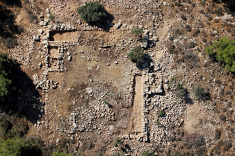
cities.  The leaders were designated to live in Jerusalem and the people cast lots to see which one out of every 10 would dwell in Jerusalem.  The rest would dwell in cities surrounding Jerusalem.  I lived in Israel 25 years and for most of the time we lived in a little village 10 miles west of Jerusalem.  It’s a mountainy and rocky area forested with some trees.  Most villages and Jerusalem were built around a water source, perhaps some type of spring.  Pictured is a photo of ruins of a Nehemiah period fortress in the hills of Judah near Jerusalem. (This photo courtesy of Israel Department of Antiquities.)

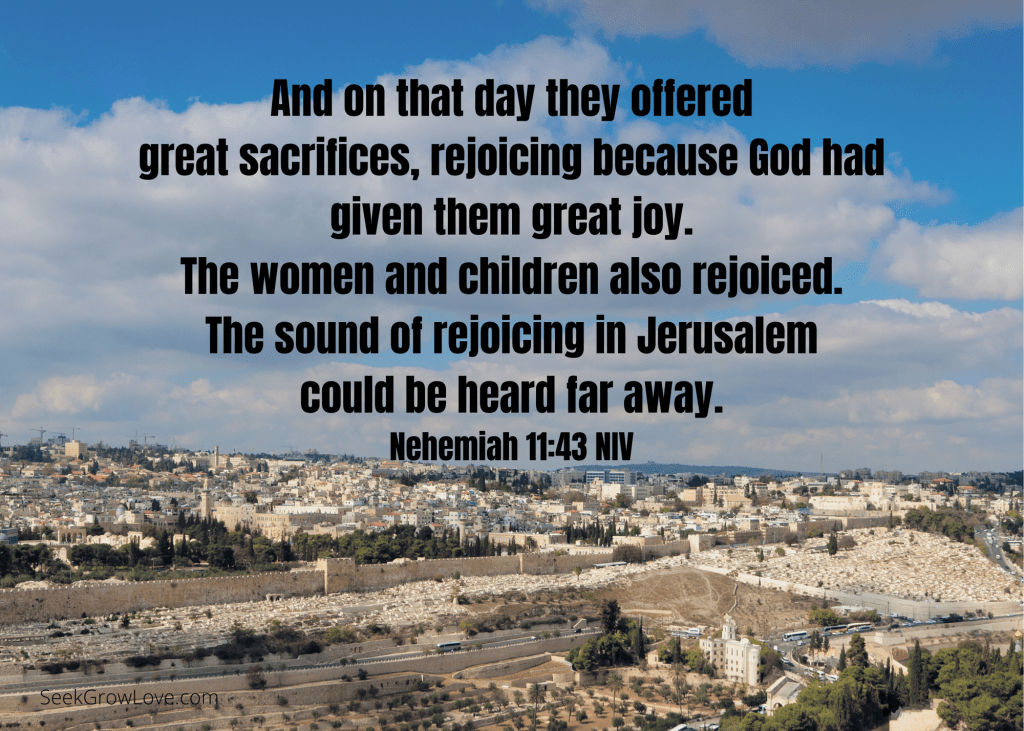
            It was a time of rejoicing.  Singers had built themselves villages all around Jerusalem (12:29). Also, two large Thanksgiving choirs with specific names and place locations are listed.  It’s amazing the record we still have today of the detailed descriptions of their locations. Also, great sacrifices were offered for God had made them rejoice with great joy.  The joy of Jerusalem could be heard from afar.  It’s amazing on the quiet of a shabbat or holiday when places are closed the noise that can be heard from a greater distance.  Psalm 126 says with singing they returned from captivity.  There must have been a joy to be back in the land of Israel again after being exiled. Though they “sow in tears, they’ll reap in joy.” At our oldest daughter’s wedding I told this to people as I wept, that I sowed in tears (such hard work raising kids overseas) and now I was reaping and weeping in joy, not out of sorrow but gladness that we made it to that day!! 😊


        Nehemiah returned after some time to Jerusalem and like a good parent had three firm corrections to make.  First, Eliashib, the priest, allowed Tobiah (Ammonite official) to have a large storeroom for himself, where articles and supplies for the Levites, singers, gatekeepers, were to be kept.  Thus, he threw out Tobiah’s things and cleansed the storeroom for proper use.  Then he asked God to remember him. (13:14) Secondly, he contended with the people for buying and selling on Shabbat and commanded the gates be shut and not open until after the Shabbat.  In current the state of Israel, every Friday afternoon stores, including all the malls shut down all over the country and remain closed until after sundown on Shabbat (Saturday), once two stars are visible.  Some weeks with holidays, the malls are closed for THREE full days!… Nehemiah prayed that God remember him. (13:22) Lastly, he contended with some of them, cursed them, struck some of them, and pulled out their hair, and made them swear not to give their children to foreigners!  That’s quite aggressive and zealous. Imagine the uproar he’d receive from all kinds of people and media today for those actions! But he prayed and asked God remember him for good. (13:29,30)

-Stephanie Schlegel

Today’s Bible passage can be read or listened to at BibleGateway here – Nehemiah 11-13 & Psalm 126

Tomorrow’s reading will be our last book of the Old Testament – Malachi – as we continue on our 2020 Reading Plan. God has great things in store! Come follow along!

Prophecy and Promise: A Reason to Hope

Ezekiel 46-48

This is what the Sovereign Lord says: “These are the boundaries of the land that you will divide among the twelve tribes of Israel as their inheritance, with two portions for Joseph. You are to divide it equally among them. Because I swore with uplifted hand to give it to your ancestors, this land will become your inheritance. Ezekiel 47:13-14 (NIV)

Congratulations! You’ve reached the end of one of the longest books in the Bible. It was a struggle, with ups and downs along the way, but you made it! Hopefully the positive outweighed the negative, and you came away with the same feelings and thoughts the author hoped to invoke from his readers. Ezekiel, as was mentioned previously, was written to the Jews while they were in exile. They had rebelled against God repeatedly and in increasingly worse ways. God warned the people that they would be exiled if they didn’t straighten up…and they didn’t straighten up. So God, through the prophet Ezekiel, set out to inform the people once again, that their wicked ways deserved punishment and this exiled life they were living was a fulfillment of his previous proclamations. But Yahweh didn’t want to kick Israel while they were down, He wanted to show them that He still held to His covenantal promises and would redeem His people, despite their rejection of His covenantal love.

So, in the last three chapters of Ezekiel we get another reminder that, though God has been angry with His people for their unfaithfulness, He will remain faithful and fulfill what He promised to the patriarchs and their descendants. The God who took the Israelites out of the Promised Land will establish the twelve tribes there. Not only will they receive their inheritance of land, but they will have a city with a river of life flowing through the land, with the name: Yahweh is There. Ezekiel ends with a push for the reader to have hope. Hope in a faithful God who always fulfills His promises.

We should also come away from reading Ezekiel with hope on our minds and joy in our hearts. For don’t we have a much greater reason to hope than the Jews in exile? God has made a new covenant through the blood of His own son, which offers a better deal to us. We don’t have to sacrifice the blood of animals to cover our sins–Jesus has already done that. And we don’t have to wait for God to redeem the earth or be a priest in the temple to feel His presence–God dwells in us through His Spirit. But God does expect us to be His representatives here and now and live lives that reflect His holiness and the character of His son. We are to offer ourselves as living sacrifices, holy and pleasing to God (Romans 12:1). We can do this knowing that with every challenge we face, every difficulty we overcome, every time our faith gets us through, we are that much closer to the return of Jesus and the establishment of God’s perfect kingdom. This has been promised through prophecy and Yahweh is a promise keeper. It is a reason for joy and a reason for hope. 

– Joel Fletcher

Today’s Bible passage can be read or listened to at BibleGateway here – Ezekiel 46-48

Tomorrow Joel will lead us through the book of – Joel – as we continue on our

The evil people will not gloat

Ezekiel 24-27

Ezekiel 25 6 7 NLT sgl

In Ezekiel 24-27 things start to get rough for Israel and then God starts handing out judgements for the enemies of Israel right away.


“In the ninth year, in the tenth month on the tenth day, the word of the Lord came to me:  “Son of man, record this date, this very date, because the king of Babylon has laid siege to Jerusalem this very day.”  (Ezekiel 24:1-2)


This occurred around 588 BC, when the siege of Jerusalem began.  This siege lasted between 18-30 months, and was horrific for those involved.  So that Ezekiel can understand how this feels for God to have his people destroyed completely, God allows Ezekiel’s wife to die.  This is very rough, but many people were dying in Jerusalem at this time.  While Ezekiel and God are going through some very rough times in the middle of this God starts to deal out judgments to the nations around Israel that were enemies and took advantage of Israel’s plight, and were happy to see Israel brought low.  Ammon, Moab, Edom, Philistia, and Tyre are all mentioned as part of the curses in chapters 25 and 26.  These nearby nations would have known about the God of the Jews and would now be mocking him, since it did not appear that he could protect his own people.  For the sake of his name God will bring down harsh judgement on them so that they will not forget to fear him.


“For this is what the Sovereign Lord says: Because you have clapped your hands and stamped your feet, rejoicing with all the malice of your heart against the land of Israel,  therefore I will stretch out my hand against you and give you as plunder to the nations. I will wipe you out from among the nations and exterminate you from the countries. I will destroy you, and you will know that I am the Lord.’” (Ezekiel 25:6,7)


This is a low point for Israel, and for the surrounding nations, and we will see that the bad times will only continue for some of these nations.

Chris & Katie-Beth Mattison


Today’s Bible reading can be read or listened to at BibleGateway here – Ezekiel 24-27

Tomorrow’s reading will be Ezekiel 28-31 as we continue with Ezekiel and our 2020 Chronological Bible Reading Plan

A Time for Justice, A Time for Mercy

Ezekiel 20-21Ezekiel 20 8b 9a NIV sgl

In Ezekiel 20 God is explaining to the Israelites why he has gotten so tired of their rebellion.  He explains how each time they had rebelled he had mercy on them for the sake of his name so that the rest of the world would not mock him, but this generation of Israelites is following in the path of their ancestors and this time he will not have mercy.


“30 “Therefore say to the Israelites: ‘This is what the Sovereign Lord says: Will you defile yourselves the way your ancestors did and lust after their vile images? 31 When you offer your gifts—the sacrifice of your children in the fire—you continue to defile yourselves with all your idols to this day. Am I to let you inquire of me, you Israelites? As surely as I live, declares the Sovereign Lord, I will not let you inquire of me.”


God has had mercy on them so much that the people of Israel do not really see the consequences of their sins and continue to go back to their sins over and over, and God has decided that it is time for them to feel the full weight of their sin and realize what the consequences are.  Again, though, he says that he will not stay angry with them forever, and he will bring them all back and will lead them again after a time.


“42 Then you will know that I am the Lord, when I bring you into the land of Israel, the land I had sworn with uplifted hand to give to your ancestors. 43 There you will remember your conduct and all the actions by which you have defiled yourselves, and you will loathe yourselves for all the evil you have done. 44 You will know that I am the Lord, when I deal with you for my name’s sake and not according to your evil ways and your corrupt practices, you people of Israel, declares the Sovereign Lord.’””


We are so blessed that we live after the time of Jesus, and can have our sins covered by his blood.  That way God can deal with us in mercy and use our example and our witness to spread the gospel and the glory of his name.  It is important to remember that it is not for our sake, but for the sake of God’s glory that we are shown this mercy.

Chris and Katie-Beth Mattison
Today’s Bible reading passage can be read or listened to at Biblegateway here – Ezekiel 20-21
Tomorrow’s Bible reading will be Ezekiel 22-23 as we continue on our 2020 Chronological Bible Reading Plan

They Will Know

Ezekiel 5 – 8

Ezekiel 6 10a NIV sgl

According to chapter 1, God called Ezekiel on July 31, 593 BC (using our calendar).   Jerusalem didn’t fall to Nebuchadnezzar until 586 BC.  This means that the first 7 years of Ezekiel’s prophesying in Babylon overlapped the last 7 years of Jeremiah’s prophesying in Jerusalem.


In addition to foretelling Jerusalem’s destruction for her sin, Ezekiel adds another recurring theme – “then they will know that I am the Lord.”  This phrase occurs 70 times in the book of Ezekiel, so it must be important.  Ezekiel 6: 9b-10 is an example, “They will loathe themselves for the evil they have done and for all their detestable practices.  And they will know that I am the Lord; I did not threaten in vain to bring this calamity on them.”


7:3-4 says, “The end is now upon you and I will unleash my anger against you.  I will judge you according to your conduct and repay you for all your detestable practices.  I will not look on you with pity or spare you; I will surely repay you for your conduct and the detestable practices among you.  Then you will know that I am the Lord.”


And God pointed out through Ezekiel that He wouldn’t listen to their prayers, because of their sin.  We see an example of this in 8:18, “Therefore I will deal with them in anger; I will not look on them with pity or spare them.  Although they shout in my ears, I will not listen to them.”


As we read this, we may think, “They were sure idiots for not turning back to God.”  But I wonder what truths might apply to us today?


Some of their sins were: idolatry, greed, arrogance, and lack of mercy – and these infuriated God.  If we were compared with the ancient Israelites, how would we as a nation measure up?  How would I as an individual measure up?


You may want to ask yourself a few questions:


  1. Is God more important to me than anything and everything else?  (If the answer is no, that sounds like idolatry).  And to make sure we understand what it means to put God first, is He obvious in every area of life – including areas as diverse as finances, conversation, entertainment, and charity?

  2. Am I merciful?  If you answer yes, how are you demonstrating that?  For example, how are you helping resolve the racial tensions that seem to be tearing our nation apart right now?  How are you helping those less fortunate than yourself?

  3. Am I greedy?  If the answer is no, where and how are you giving your time and money to God’s work – and to others?


If I’m honest, I see that I may not be much more righteous than the ancient Israelites.  And we as a nation don’t measure up well at all.


Romans 15:4 reminds us, “For everything that was written in the past was written to teach us, so that through the endurance taught in the Scriptures and the encouragement they provide we might have hope.”


If these things were written to teach us, will we learn?  What will it take for us to know that God is the Lord?  Will we humble ourselves, confess our sins, repent, and turn to God wholeheartedly?


2 Corinthians 6:2 reminds us, “I tell you, now is the time of God’s favor, now is the day of salvation.”


Hebrews 3:15 says, “Today, if you hear his voice, do not harden your hearts as you did in the rebellion.”


What will you do?

Steve Mattison

Today’s Bible reading passage can be read or listened to here Ezekiel 5-8

Tomorrow’s passage will be Ezekiel 9-12 as we continue on our 2020 Chronological Bible Reading Plan


Called and Used by the Generous God

Jeremiah 1-3

Jeremiah 1 5 NIV sgl

These first 3 chapters of Jeremiah have several applications for the reader. In the beginning of this book, we learn about the calling of Jeremiah. Before Jeremiah was even born, the Lord set him aside to be a prophet. God wanted to use Jeremiah to fulfill this calling. Jeremiah at first believed himself incapable of such a thing. But the LORD said he would be with Jeremiah. He would not only guide him; he would also protect him. Jeremiah then trusted God and began this work.

We can learn a lesson from this. Sometimes it is easy to doubt ourselves and believe that we are incapable of something. We may think that God couldn’t use us because of x, y, and z. In reality, though, it is not by our strength or ability that we serve the LORD. It is rather him working through us. So, by doubting ourselves, we are doubting the ability of the LORD to work through us. Jeremiah also did not believe himself capable of being called, but nonetheless he was. The LORD called many sinners such as David, Jonah, Paul, and countless others. So, do not doubt yourself. The LORD is capable of calling you and through him, you are capable of answering that call.

Another interesting thing found in these three chapters is the fact that God warned the people of their ways. He did not make them guess. Sometimes when we are upset with someone, we think that the offending party should be able to figure out why we are upset with them. God did not do this. He used Jeremiah to tell them what they were doing and what they needed to do. If I really think about this, I think of how generous and caring this act is. Even though the Israelites were completely in the wrong and should know what it was they were doing, God still communicated with them. He did not keep them in the dark even though they were ignoring him.

It is interesting also that it seems like the main thing that God is asking of the Israelites in these chapters is for their repentance. Through Jeremiah, he tells them that they should not continue on in their ways as though they are doing no wrong. They should acknowledge what they are doing and repent. They needed to accept that they were wrong.

It can be hard though to admit when we are wrong. By doing this our pride is injured and we have to humble ourselves. It is far easier to keep doing what we were doing and act like we are in the clear. This, however, is not right. We need to admit when we are wrong. Through doing so, we can grow and mature.


Hannah Deane


Today’s Bible passage can be read or listened to at https://www.biblegateway.com/passage/?search=Jeremiah+1-3&version=NIV

Tomorrow’s reading will be Jeremiah 4-6 as we continue on our journey through God’s Word with the 2020 Chronological Bible Reading Plan

A King and A Tyrant

2 Kings 20-21

2 Kings 21 9 NIV sgl

These two short chapters make me very glad for the American political system. Before I talk about what makes our system so good, I need to talk about the system in place in the passage that we read. Chapter 20 marks the end of the reign of a good king, Hezekiah, who accomplished many good deeds in the name of God. He was an iconoclast, one who destroys religious images (as an aside, archaeological evidence confirms the iconoclasm of Hezekiah’s age, very cool). He also increased the size of the Judahite kingdom and made it into a power on par with that of the Assyrians and Babylonians. Of course, all of this was made possible by the God who went before them in battle. Of all the kings of Judah, Hezekiah can be counted among the best, and under the guidance of a king such as he, a monarchy isn’t such a bad deal.

But when your good king is replaced by a 12-year-old tyrant, things aren’t so good. Manasseh reversed all the progress that Hezekiah made toward ridding Israel of idols and images of foreign gods. Manasseh turned away from God and brought Judah down with him. This is the power of a king. If he is good, then he can accomplish great things! But if he is evil, then he can accomplish even worse things. Somehow, Manasseh survived for fifty-five years as the king of Judah. Being a murderous beast of a man can certainly turn people away from the idea of overthrowing you. Luckily for the people of Judah, his son Amon was a bit more of a weakling, giving his advisors the opportunity to assassinate him.

This is the problem with monarchies. Everyone loves a prosperous generation under a king who does good, but if you are unfortunate enough to have a bad king (and there were a lot of them in Judah and Israel’s history), then the only way to get back on the right track is to murder the guy. Luckily for the Judahites, the next in line to the throne was an 8-year-old boy who ended up becoming arguably the greatest king of Judah. I wish I could talk more about how impressive Josiah is, but our passage cuts off just before his reign begins.

To summarize: a good king is great, but a bad king can only end in bloodshed, in the form of his people’s lives or his own. God knew this when he told Samuel that establishing a kingship was a bad idea. But God let the people have what they wanted. John Locke, a 17th century political philosopher whose thoughts helped lay the groundwork for the American system, knew this and argued against it in his treatises. The American system is designed to move slow, to never be controlled by one person long enough to do lasting damage. In America, you don’t have to wait a generation just to see political reform. Maybe if you are terribly concerned with nominal tax rates and zoning laws, then you can be frustrated with the snail’s pace at which the American political system moves, but the great advantage that we have in America is the lack of despotism and regicide. This alone gives you great reason to be happy to be alive in 2020 and not in the 8th century B.C. Let us thank God that the founders of this country were men of God who believed that each person is endowed with the spark of the Divine which is the source of our authority over our own lives, thus freeing us from the whims of tyrants like Manasseh.

Nathaniel Johnson


Today’s Bible passage can be read or listened to at https://www.biblegateway.com/passage/?search=2+Kings+20-21&version=NIV

Tomorrow’s Bible reading will be 32-33 as we continue the 2020 Chronological Bible Reading Plan

Better Things are Coming

Isaiah 59-63

Isaiah 60 2 NIV sgl

Isaiah 59 describes what it is like to be separated from God as we are now. Our sins are responsible for the barrier between us and God. Because of this barrier, there is sadness, there is depravity and there is a hope for something that cannot be attained. Everything in this world is touched by this separation. Our attempts at justice are a pale reflection of the true justice that God promises. In the American courts for example, there are instances where innocent men are punished, and guilty men go free. This is not justice, but it is the closest that we are able to get to it because of our human nature. We try to imitate true justice as well as we can, but we will always fall short. We even fall short in our pursuit of truth. Even when truth is proclaimed, there will be some who accept it and some who won’t. Truth is meant to have the power to convince anyone.

The following chapter speaks of what it will be like when that barrier is broken down, when God establishes His perfect kingdom. Everything that we love now, that brings us joy, will be replaced with something better. It says, “I will bring gold instead of bronze and silver instead of iron, bronze instead of wood and iron instead of stones.” If you had no possessions and someone asked you if you’d like $20, you would be excited and would gladly accept it. But if you knew that later someone was going to give you $1000, you would be grateful, but not nearly as excited. This is the way it is in God’s perfect kingdom. When thinking about the coming kingdom, we often lament the things that we will miss doing in our current lives if Jesus were to return today. “I can’t wait for the kingdom, but I’d like to finish college first.” Or, “I’d like to have children first.” There are so many things that we look forward to in this life, but here it says that the good things will be replaced with something better, and more than that, we will still have some of the good things that we already enjoy! It says that iron is replaced with silver, but also that stone is replaced with iron. When we think about our future in God’s kingdom, it can be hard to imagine, but we have to remember that God’s ways are not our ways and that he will give us something so much better than all of the good things we have now.

Nathaniel Johnson


Today’s Bible passage can be read or listened to at https://www.biblegateway.com/passage/?search=Isaiah+59-63&version=NIV

Tomorrow we finish the book of Isaiah with chapters 64-66 as we continue working through the 2020 Chronological Bible Reading Plan

Portion Sizes

2 Kings 1-4

Let me inherit a double portion of your spirit

On our occasional visits to Disney World, I often think about the cruel irony of Walt never laying eyes on his biggest dream.  He died just five years before the Magic Kingdom opened, just as they were breaking ground. While Disney was charismatic, passionate, creative, and a visionary, he surrounded himself with an entourage of like-minded people, so consequently, his dream did not die with him. By mentoring and empowering those who worked for him, he allowed their passion, creativity, and vision to fuse with his own, to accomplish even greater things than even he could imagine.  In some manner of speaking, each one of the people around him each received the spirit of Disney, yet retained their own spirit, allowing them to benefit from both. This legacy has been passed down over and over again, and Disney has become one of the most innovative companies in film, television, and travel.  Using a conversion that translates 1966 dollars to 2020, The Walt Disney Company is worth a hundredfold more today than it was 54 years ago, maybe even more than Walt, the greatest of the imagineers, could have ever dreamed.


While the opening today sounds like one of the final chapters of a leadership book, it is akin, albeit less significantly and definitely imperfectly, to the promises of Elijah and Jesus.  Both not only spent a great deal of their time speaking with God, prophesying, and doing miracles, but both these men made specific investments in the people around them for God’s message to increase.  Jesus surrounded himself with the disciples, and Elijah’s legacy is specific to Elisha.  There is no doubt that these men’s examples made a profound impact on those who spent the most time with them (and yes, the example of Jesus is reverberating, impacting us today, but that’s the direction we’re heading).  The momentum of Elijah or Jesus did not stop when they were taken to heaven.  In fact, Elisha, and Peter, often thought of as the disciple Jesus was closest to, were recipients of faith-induced natural phenomena (2 Kings 3:17 ; Acts16:26).  Additionally, both Peter and Elisha raised people from the dead (2 Kings 4:32-35; Acts 9::32-43). Years of watching, listening, and serving led to specific callings for each of these men to do bigger, bolder things than demonstrated by their predecessors (with exception to the propitiation of Christ).  In fact, both Elijah and Jesus prophesied this to be so (2 Kings 2:10; John 14:12-14)


This begs the question: who are we bringing along on our faith journey?  If we are effectively sharing the Gospel message, is there not someone who is receiving an exponential portion of whatever our faith has to offer?  How can we extend our finite time on earth to impact the infinite time we will inherit in the kingdom of God? It may be as simple as sharing our faith with our family.  As my children grow, I am alarmingly realizing the majority of their modeling and information is from my wife and me.  Our ultimate goal is that their faith far exceeds our own, yet if we do not show the devotion, love, and belief we have, they will never receive even a single portion of it, much less build upon the faith we have.  It could be we have served in ministry or occupation where we are now becoming the experienced one (this is also known as “old”).  It is time to take someone under our wing, share our testimony and calling.  By allowing someone to watch, listen, and serve, they can learn from our successes and failures without having to bear the consequences or responsibilities, ultimately placing them in a more successful position when they are on their own, long after our influence has left for one reason or another. Their trajectory is steeper, and at some point will outpace us.


Ultimately, we should be intentional about sharing our faith, vision (God-given), and resources (also, God-given) with our families or small circle of influence. Our greatest calling may be to prepare the way (Eli, Mordecai, and John the Baptist) for someone who will do more than we could possibly imagine because God will use them to exponentially grow his kingdom.  Let’s make some significant investments. Let’s sow and tend the seeds. Let’s watch as God makes the return thirty, sixty, or even a hundredfold because the world is starving for His message. Let us pray and work to serve up bigger portions than ever.

Aaron Winner

Today’s Bible passage can be read or listened to at https://www.biblegateway.com/passage/?search=2+Kings+1-4&version=NIV

Tomorrow’s reading will be 2 Kings 5-8 as we continue on the 2020 Chronological Bible Reading Plan