Making Breakthroughs

In Exodus 21 and 22 God lays down many laws for the Israelites to follow in order to try and establish them as a functioning and stable nation.  There is a lot in there about how to judge between two people when somebody is injured, or commandments to respect parents and authorities, or punishments for thieves.  Some of the laws, like the ones about how to deal with slaves, are quite outdated, but I think some of them can be very beneficial to us even today.

Exodus 22

21 “You must not mistreat or oppress foreigners in any way. Remember, you yourselves were once foreigners in the land of Egypt.

I think this is a good message today for how to treat foreigners and to help us realize that every person is a child of God and has value in his eyes, and that Jesus died for them as well.  But I think it also can apply to us when we look at unsaved people, because at some point in our lives we were all wandering away from God, and so we really cannot judge others who are currently living outside of God’s will too harshly, we need to humbly chase after them with love in hopes of helping them to find the grace of God that we have, not hit them over the head with a Bible so that we can let them know how wrong they are.

Meanwhile during Jesus’ ministry he is healing people and miraculously feeding thousands of people and is starting to get through to his disciples.  

Mark 8

15 As they were crossing the lake, Jesus warned them, “Watch out! Beware of the yeast of the Pharisees and of Herod.”

16 At this they began to argue with each other because they hadn’t brought any bread. 17 Jesus knew what they were saying, so he said, “Why are you arguing about having no bread? Don’t you know or understand even yet? Are your hearts too hard to take it in? 18 ‘You have eyes—can’t you see? You have ears—can’t you hear?’ Don’t you remember anything at all? 19 When I fed the 5,000 with five loaves of bread, how many baskets of leftovers did you pick up afterward?”

“Twelve,” they said.

20 “And when I fed the 4,000 with seven loaves, how many large baskets of leftovers did you pick up?”

“Seven,” they said.

21 “Don’t you understand yet?” he asked them.

Even after he had produced food out of nothing they were still thinking about physical food, not the deeper meanings of Jesus’ messages, but just a few verses later we see a breakthrough with Peter.

Mark 8

27 Jesus and his disciples left Galilee and went up to the villages near Caesarea Philippi. As they were walking along, he asked them, “Who do people say I am?”

28 “Well,” they replied, “some say John the Baptist, some say Elijah, and others say you are one of the other prophets.”

29 Then he asked them, “But who do you say I am?”

Peter replied, “You are the Messiah.”

I can imagine the relief that Jesus must have felt knowing that finally these think-headed, hard-hearted, best friends of his were starting to understand that he was doing something much deeper than just feeding people.  He was changing their hard hearts to love others the way he loved them.  He feels that same joy when we spend time studying his word and spending time with other believers and start to understand and reflect him more.

Chris Mattison

Links to today’s Bible reading – Exodus 21-22 and Mark 8
Writing the Law on our Hearts

After being taken out of Egypt, crossing the Red Sea on dry ground, grumbling their way through the Desert of Sin and failing many tests, the people of Israel have made it to Mount Sinai where God is going to meet with them and establish the rules for them.

Exodus 19

3 Then Moses climbed the mountain to appear before God. The Lord called to him from the mountain and said, “Give these instructions to the family of Jacob; announce it to the descendants of Israel: 4 ‘You have seen what I did to the Egyptians. You know how I carried you on eagles’ wings and brought you to myself. 5 Now if you will obey me and keep my covenant, you will be my own special treasure from among all the peoples on earth; for all the earth belongs to me. 6 And you will be my kingdom of priests, my holy nation.’ This is the message you must give to the people of Israel.”

Then, after Moses runs up and down the mountain several times, God gives the ten commandments to the people, and it was completely overwhelming.

Exodus 20

18 When the people heard the thunder and the loud blast of the ram’s horn, and when they saw the flashes of lightning and the smoke billowing from the mountain, they stood at a distance, trembling with fear.

19 And they said to Moses, “You speak to us, and we will listen. But don’t let God speak directly to us, or we will die!” 20 “Don’t be afraid,” Moses answered them, “for God has come in this way to test you, and so that your fear of him will keep you from sinning!”  

21 As the people stood in the distance, Moses approached the dark cloud where God was.

When the Israelites saw the pure raw power of God displayed before them they were terrified and realized that they had been disobeying and testing the one true God.  But this encounter was very impactful and the Israelites stuck to the ten commandments and the rest of the law until the time of Jesus, but we do see that their teachers had really perverted the commandments by then.  

In today’s New Testament chapter (Mark 7) Jesus is talking to some of the religious leaders, and they are mad because his disciples are not washing their hands before a meal, which is an old religious tradition from the time of Moses.  Jesus is disgusted with them because of the cleanliness of their hands contrasted with the perversion in their hearts.

Mark 7

9 Then he said, “You skillfully sidestep God’s law in order to hold on to your own tradition. 10 For instance, Moses gave you this law from God: ‘Honor your father and mother,’ and ‘Anyone who speaks disrespectfully of father or mother must be put to death.’ 11 But you say it is all right for people to say to their parents, ‘Sorry, I can’t help you. For I have vowed to give to God what I would have given to you.’ 12 In this way, you let them disregard their needy parents. 13 And so you cancel the word of God in order to hand down your own tradition. And this is only one example among many others.”

14 Then Jesus called to the crowd to come and hear. “All of you listen,” he said, “and try to understand. 15 It’s not what goes into your body that defiles you; you are defiled by what comes from your heart.

We have talked a bit about remembering what God has done for us, and having it in as obvious of a place as possible to remind us so that we do not forget about what God did for us, and this often leads to traditions, which can be very good to remind us.  For instance we have Christmas as a time to remind us to celebrate and thank God for sending Jesus, but it has turned mostly into a celebration of consumerism and credit card debt.  In all of this we need to remember that it is what comes out of our heart that is the most important.

-Chris Mattison

Links to today’s Bible reading Exodus 19-20 and Mark 7

Faith and Blessings

In Exodus 17 the Israelites again ran out of water and are ready to stone Moses if he didn’t give them water right away, and again God gives them water miraculously, but again the location gets a telling name, it was called “test” and “arguing”.  I really wonder what the names of some of the locations in our lives would be called?  Would your living room be named “disobedient”, or would your kitchen be named “hateful”?  Would your office be named “gossip”?  Would our churches be called “whitewashed tombs” if God was in charge of putting the letters in the sign on the road?  The way that we treat others can be a test, and every time we fail those tests, or do not trust in God, or grumble and complain about things it puts up big red signs all over the place and those outside of the church can see them.   

Luckily in Mark 5 we have examples of extraordinary faith and the blessings that followed.

Mark 5

25 A woman in the crowd had suffered for twelve years with constant bleeding. 26 She had suffered a great deal from many doctors, and over the years she had spent everything she had to pay them, but she had gotten no better. In fact, she had gotten worse. 27 She had heard about Jesus, so she came up behind him through the crowd and touched his robe. 28 For she thought to herself, “If I can just touch his robe, I will be healed.” 29 Immediately the bleeding stopped, and she could feel in her body that she had been healed of her terrible condition.

30 Jesus realized at once that healing power had gone out from him, so he turned around in the crowd and asked, “Who touched my robe?”

31 His disciples said to him, “Look at this crowd pressing around you. How can you ask, ‘Who touched me?’”

32 But he kept on looking around to see who had done it. 33 Then the frightened woman, trembling at the realization of what had happened to her, came and fell to her knees in front of him and told him what she had done. 34 And he said to her, “Daughter, your faith has made you well. Go in peace. Your suffering is over.”

I am sure many of you are familiar with my Mom, Beth Mattison, and her battle with cancer from 2016 to 2020. She had faith in God completely and we all prayed hard for her, and I firmly believe that God answered our prayers and helped reduce her cancer in 2016 when things did not look good, and he gave us four extra years with her and let her meet her children’s spouses and see her first grandchild.  God honors faith in this life, and ultimately he will reward our faith in him during his Kingdom.

Later we see several examples of people not seeing God at work around them, with Jesus’ neighbors not believing in him because they knew his family.  We then have another incident on water.

Mark 6

47 Late that night, the disciples were in their boat in the middle of the lake, and Jesus was alone on land. 48 He saw that they were in serious trouble, rowing hard and struggling against the wind and waves. About three o’clock in the morning[i] Jesus came toward them, walking on the water. He intended to go past them, 49 but when they saw him walking on the water, they cried out in terror, thinking he was a ghost. 50 They were all terrified when they saw him.

But Jesus spoke to them at once. “Don’t be afraid,” he said. “Take courage! I am here![j]51 Then he climbed into the boat, and the wind stopped. They were totally amazed, 52 for they still didn’t understand the significance of the miracle of the loaves. Their hearts were too hard to take it in.

During my Mom’s fight with cancer it would have been very easy for us to grumble or complain, or not see God at work, but it is important to soften our hearts and trust in God and see him at work around us.  

Chris Mattison

Links to today’s Bible reading – Exodus 17-18 and Mark 6

Passing the First Tests

So after the amazing events of Exodus 14 and the crossing of the Red Sea on dry ground and the waters swallowing up the armies of Pharaoh the Israelites spend some time praising God  and we have the text of their praises in the beginning of Chapter 15, and then they set out on the road.

Exodus 15

22 Then Moses led the people of Israel away from the Red Sea, and they moved out into the desert of Shur. They traveled in this desert for three days without finding any water. 23 When they came to the oasis of Marah, the water was too bitter to drink. So they called the place Marah (which means “bitter”).

24 Then the people complained and turned against Moses. “What are we going to drink?” they demanded. 25 So Moses cried out to the Lord for help, and the Lord showed him a piece of wood. Moses threw it into the water, and this made the water good to drink.”

It was there at Marah that the Lord set before them the following decree as a standard to test their faithfulness to him. 26 He said, “If you will listen carefully to the voice of the Lord your God and do what is right in his sight, obeying his commands and keeping all his decrees, then I will not make you suffer any of the diseases I sent on the Egyptians; for I am the Lord who heals you.”

27 After leaving Marah, the Israelites traveled on to the oasis of Elim, where they found twelve springs and seventy palm trees. They camped there beside the water.

Right after God showed them that he is capable of providing everything for them he gives them a test and they instantly fail the test.  God is showing them that they have bitter hearts and no faith, but they will have to have faith in God in order to survive.  After this they continue on.

Exodus 16

“1 The whole Israelite community set out from Elim and came to the Desert of Sin, which is between Elim and Sinai, on the fifteenth day of the second month after they had come out of Egypt. 

2 In the desert the whole community grumbled against Moses and Aaron. 

3 The Israelites said to them, “If only we had died by the Lord’s hand in Egypt! There we sat around pots of meat and ate all the food we wanted, but you have brought us out into this desert to starve this entire assembly to death.”

They do not look forward to the glory to come.  They have been promised a land of their own and that they will become a great nation, but all they can see is the pain of the moment.  They also do not see the past and the many ways that God has come through for them.  Again all they can see is their momentary pain.  We know from Hebrews 12:2 that Jesus endured the cross for the joy set before him, and that is what we need to do as well.  

One thing I notice is that a lot of the locations they went to got their names changed after something big happened there, I wonder how this desert got the name “the desert of sin”.

4 Then the Lord said to Moses, “I will rain down bread from heaven for you. The people are to go out each day and gather enough for that day. In this way I will test them and see whether they will follow my instructions. 

5 On the sixth day they are to prepare what they bring in, and that is to be twice as much as they gather on the other days.”

God’s responses are not just a handout, they are a test.  God does not provide for us just to fill a little need, it is to help us to grow, and to see our response.  After an encounter with God we are not supposed to go back to how things were, but continue growing. 

You have to wonder, if they would just handle one of these situations well, would the rest of the trip have gone easily? They are very impatient, kind of like how Moses was when he was younger, and killed the Egyptian and tried to get things started.  The Israelites just want to be there, but the journey and the growing is very important.  God wants his people to inhabit the lands of Canaan, not just some group of people that doesn’t know him.


Chris Mattison

Links to today’s Bible readingExodus 15-16 and Mark 5

Remember

Right after the passover God wants to make sure that the Israelites will remember what He did for all time.

Exodus 13

14 “And in the future, your children will ask you, ‘What does all this mean?’ Then you will tell them, ‘With the power of his mighty hand, the Lord brought us out of Egypt, the place of our slavery. 15 Pharaoh stubbornly refused to let us go, so the Lord killed all the firstborn males throughout the land of Egypt, both people and animals. That is why I now sacrifice all the firstborn males to the Lord—except that the firstborn sons are always bought back.’ 16 This ceremony will be like a mark branded on your hand or your forehead. It is a reminder that the power of the Lord’s mighty hand brought us out of Egypt.”

In our lives God has worked a lot, and maybe when you were less spiritually mature God did a work in your life and you forgot about it, well as you grow older maybe God will remind you of that time in your past that He has been with you.  As you grow you should realize that those times are important, and that you need to pass them on to help the faith of others.

Sometimes we need something to be so obvious and in our face, as a symbol on our hand in order to remember what God has done, and He understands that.

Then right after telling the Israelites to never forget about what He does for them and to pass it down for generations He leads them to the Red Sea and then leads them across it, which had to have been one of the most amazing events to see ever.

Exodus 14

19 Then the angel of God, who had been traveling in front of Israel’s army, withdrew and went behind them. The pillar of cloud also moved from in front and stood behind them, 20 coming between the armies of Egypt and Israel. Throughout the night the cloud brought darkness to the one side and light to the other side; so neither went near the other all night long.

21 Then Moses stretched out his hand over the sea, and all that night the Lord drove the sea back with a strong east wind and turned it into dry land. The waters were divided, 22 and the Israelites went through the sea on dry ground, with a wall of water on their right and on their left.

I’m sure this cements their faith in God….

Meanwhile in Mark 4 we see another example of God’s power over the water.

Mark 4

35 As evening came, Jesus said to his disciples, “Let’s cross to the other side of the lake.” 36 So they took Jesus in the boat and started out, leaving the crowds behind (although other boats followed). 37 But soon a fierce storm came up. High waves were breaking into the boat, and it began to fill with water.

38 Jesus was sleeping at the back of the boat with his head on a cushion. The disciples woke him up, shouting, “Teacher, don’t you care that we’re going to drown?”

39 When Jesus woke up, he rebuked the wind and said to the waves, “Silence! Be still!” Suddenly the wind stopped, and there was a great calm. 40 Then he asked them, “Why are you afraid? Do you still have no faith?”

41 The disciples were absolutely terrified. “Who is this man?” they asked each other. “Even the wind and waves obey him!”

The disciples would have known the story of the Exodus inside and out, and this showed them very clearly that God was working, and that Jesus must be serving God to have these abilities. Through the rest of the book, and in the other Gospels we see their lives changed by the message of God, and in the rest of the Exodus we will see how many of the Israelites receive God’s instructions, and I think Jesus summarizes the different responses we can have really well in Mark 4.

14 The farmer plants seed by taking God’s word to others. 15 The seed that fell on the footpath represents those who hear the message, only to have Satan come at once and take it away. 16 The seed on the rocky soil represents those who hear the message and immediately receive it with joy. 17 But since they don’t have deep roots, they don’t last long. They fall away as soon as they have problems or are persecuted for believing God’s word. 18 The seed that fell among the thorns represents others who hear God’s word, 19 but all too quickly the message is crowded out by the worries of this life, the lure of wealth, and the desire for other things, so no fruit is produced. 20 And the seed that fell on good soil represents those who hear and accept God’s word and produce a harvest of thirty, sixty, or even a hundred times as much as had been planted!”

The disciples will take a little while to catch on, but by their example that we see later in the New Testament we see that they were the good soil in this parable, and in Exodus we will start to see that many in the Israelite community represent the footpath or the rocky soil in this parable.  It is important for us to maintain our connection to other strong Christians and continue to read God’s word so that we can grow deep roots and weather the storms of life, so that we can be a good witness to others and keep the faith.

Chris Mattison

Links to today’s Bible reading – Exodus 13-14 and Mark 4

The Exodus: Starting a new thing

We have been building up in the last couple of chapters to bigger and bigger plagues and displays of God’s might and power over the gods of Egypt, and finally we are coming to the climax of that story.  God is about to unleash his judgement on every firstborn in Egypt, but he will spare the people of Israel if they will sacrifice a lamb and put its blood around their doors.  

3 Tell the whole community of Israel that on the tenth day of this month each man is to take a lamb for his family, one for each household. 

4 If any household is too small for a whole lamb, they must share one with their nearest neighbor, having taken into account the number of people there are. You are to determine the amount of lamb needed in accordance with what each person will eat. 

5 The animals you choose must be year-old males without defect, and you may take them from the sheep or the goats.

6 Take care of them until the fourteenth day of the month, when all the members of the community of Israel must slaughter them at twilight.

7 Then they are to take some of the blood and put it on the sides and tops of the doorframes of the houses where they eat the lambs. 

8 That same night they are to eat the meat roasted over the fire, along with bitter herbs, and bread made without yeast. (Exodus 12:3-8)

The meat of a lamb that you had taken care of for a week and that was cooked with bitter herbs and unleavened bread would not be a special feast that you would enjoy.  Emotionally this would be difficult, and the food would not taste that great.  This is to show the people of Israel that sacrifices and victories are not always joyous or exciting, but come at a personal cost.  For Moses it was seeing the Egyptians, the people he grew up with and who he cared for still, devastated and suffering.  This judgment was difficult for God as well since we know that he does not wish that any should perish, but he needed to show his people that the Egyptian gods they were following were powerless so that he could start to build them into his own people.

12 “On that same night I will pass through Egypt and strike down every firstborn of both people and animals, and I will bring judgment on all the gods of Egypt. I am the Lord. 13 The blood will be a sign for you on the houses where you are, and when I see the blood, I will pass over you. No destructive plague will touch you when I strike Egypt. (Exodus 12:12-13)

God is starting to prepare the Israelites to be his people so that one day he can have Jesus, his son, die for all sins as the ultimate sacrificial lamb whose blood will cover our sins. They have a long ways to go before they are really the people of God, but we can skip ahead to Mark 3 and start to see another major change that is being initiated.

Jesus went into the synagogue again and noticed a man with a deformed hand. 2 Since it was the Sabbath, Jesus’ enemies watched him closely. If he healed the man’s hand, they planned to accuse him of working on the Sabbath.

3 Jesus said to the man with the deformed hand, “Come and stand in front of everyone.” 4 Then he turned to his critics and asked, “Does the law permit good deeds on the Sabbath, or is it a day for doing evil? Is this a day to save life or to destroy it?” But they wouldn’t answer him.

5 He looked around at them angrily and was deeply saddened by their hard hearts. Then he said to the man, “Hold out your hand.” So the man held out his hand, and it was restored! 6 At once the Pharisees went away and met with the supporters of Herod to plot how to kill Jesus. (Mark 3:1-6)

This is very near the start of Jesus’ ministry and we see that he is running into a ruling group who have hard hearts and are therefore unable to follow God’s will.  Sadly this time it is the very teachers of the law that we will see Moses give later this week that are wanting to kill a Godly man.  

The biggest thing stopping God from working strongly in our lives is our own hard heart, and sometimes it can take a really major event in our lives to break down the walls that we set up around our heart, but I encourage you to take the first step and prayerfully listen to what God is trying to tell you.

I really enjoy the story of the Exodus and I hope you enjoy walking through this next chapter in the story of the Israelites and also in the early stages of Jesus’ ministry.  

Chris Mattison

Links to today’s Bible reading passages Exodus 11-12 and Mark 3

Darkness

Exodus 9-10

                In today’s reading the plagues continue:  livestock, boils, hail, locusts and darkness.  The plagues reap destruction on their food supplies and on their bodies.  God declares to Pharaoh His purpose for sending the plagues: “I have raised you up for this very purpose, that I might show you my power and that my name might be proclaimed in all the earth.” (Exodus 9:16)

                Once again, Pharaoh continues his predictable response: plague comes, Pharaoh says he repents and will let them go, the plague is lifted, Pharaoh hardens his heart and refuses to let them go.

                All of the plagues are bad but the 9th plague is of particular interest: darkness.  In my younger days I sang with a choir and performed Handel’s Messiah.  I was given the privilege of singing the bass recitative: “For behold, darkness shall cover the earth…” (If you’ve never listened to it check it out: “For Behold…The people that walked in darkness”, Philippe Sly, Julian Wachner – YouTube )

                The next year I was in college at George Mason University and we sang Handel’s Israel in Egypt and I sang the bass recitative “He sent a thick darkness over the land, even darkness which might be felt.”  Nearly 40 years later I still have vivid memories of our first performance of this, I was battling strep throat and spent the whole day nursing my throat with honey, lemon and salt water so that I could sing my solo that night (check it out here: Israel in Egypt, HWV 54, Pt. II: Part II: He sent a thick darkness over all the land (Chorus) – YouTube)  In fact you might want to listen to the entire Oratorio Israel in Egypt by GF Handel.

                In both of these Handel works with the Biblical texts and colors them with the accompanying music.  You can almost feel the darkness.  What does three days of thick darkness feel like?  How disoriented would it be for an entire nation to be blanketed in darkness?

                Jesus later used darkness to get Saul/Paul’s attention.  Saul was blinded for three days (Acts 9:9)  until Ananias prayed over him and the scales fell from his eyes and his sight was restored.  Paul responded by literally “seeing the light”  and he become a lifelong follower of Jesus Christ.  He immediately got up and was baptized into Jesus Christ.

                What happened after Pharaoh came out of three days of darkness?  You guessed it, his heart was once again hardened.  It was harder than ever.  After 9 plagues, 9 times God gave him a chance to repent after seeing God’s power at work. 9 Times Pharaoh had the chance to proclaim God’s greatness to all the earth.  9 times Pharaoh hardened his heart.

            Psalm 103 reminds us that:

The Lord works righteousness
    and justice for all the oppressed.

He made known his ways to Moses,
    his deeds to the people of Israel:

The Lord is compassionate and gracious,
    slow to anger, abounding in love.

                God balances His love and desire to see justice for the oppressed with his compassion and gracious love for the oppressor.  In the story God loves both His oppressed people Israel represented by Moses and He loves His children mired in pride and power who oppress his people, the Egyptians represented by Pharaoh.  God demonstrates His patience to Pharaoh by giving him 9 chances to repent.  God also demonstrates His love and faithfulness to Israel by limiting Pharaoh.

Peter later picks up this same theme in II Peter 3:9-10- “The Lord is not slow in keeping his promise, as some understand slowness. Instead he is patient with you, not wanting anyone to perish, but everyone to come to repentance.

 But the day of the Lord will come like a thief. The heavens will disappear with a roar; the elements will be destroyed by fire, and the earth and everything done in it will be laid bare.”

God was patient with Pharaoh, “Love is patient”.  But God was also merciful to Israel, God’s love and patience have limits.  Pharaoh was about to discover the limits of God’s patience.   It would cost him and all of Egypt their firstborn sons.

                How will America and the world respond to our current “plague” the Covid-19 Pandemic?  Will we soften our hearts and repent and turn to God and forsake our sins and put our full faith and trust in God?  Or will we harden our hearts again?  How much longer will God be patient and give opportunities to repent?  When will God finally say- it’s time to fully and finally set my people and all of the earth free from this dreaded curse of sin and death?  It’s time to bring about the final judgment?

                I don’t know and you don’t know.  But learn the lesson from Pharaoh and don’t test the limits of God’s patience and mercy.  May the scales fall from our eyes, may the thick darkness of sin and unbelief that covers our land be lifted.

-Jeff Fletcher

Links to today’s Bible readingExodus 9-10 and Mark 2

Hard Hearts


              In this week’s devotions we’ve been focusing on the last five chapters of Matthew.  Hopefully you’ve also been reading the Old Testament readings at the end of Genesis and the beginning of Exodus.  Today’s devotion turns our attention to the Exodus readings.

                Israel’s story shows the interplay between being part of the people of God while living in a broken world amid systems and structures that are broken by sin.  When Jacob and his family first went to Egypt, the most powerful nation in the world at the time, they went there to escape famine.  God positioned Jacob’s son, Joseph, to be one of the most powerful men in the Egyptian government.  Joseph was able to provide food and a safe place to live for his brothers and their families during the famine and beyond.

                Unfortunately, with the passage of time, Joseph died, and a new Pharaoh arose who did not know Joseph.  Suddenly, Israel went from being sheltered and protected by Egypt to being enslaved.  For 400 years they suffered under the Egyptian oppression.  The people cried out to God to set them free.  God heard their cries and provided a means of salvation.  A young baby boy born of the Hebrews, rescued from death and raised as a son of Pharaoh’s daughter.  He was the one who would lead his people to freedom.  But it took 80 more years for God to prepare Moses to lead his people.

                When the time came for Moses to lead the people to the Promised Land, God did so through a series of plagues.  In today’s reading God had Moses bring forth the first plagues: blood, frogs, gnats and flies.  With each plague Pharaoh asked Moses to pray to God to stop the plague and said that he would let the people go.  But each time, after the plague was over Pharaoh’s heart was hardened and he refused to let them go.

                Sometimes, when people are in the midst of a crisis, they soften their hearts and fall on their knees in repentance and turn to God for help and hope.  Sometimes, when those prayers are answered and things get better, those same people forget, and allow their hearts to grow hard again.

                As I write this devotion we are one year into the Covid plague.  As both a pastor and a hospital and nursing home chaplain I’ve had to live every day of this past year dealing with the reality of that plague.  I’ve have family and friends get sick.  Most got well, some didn’t.  Some died from Covid.  Others have suffered from the effects of our attempts to mitigate the spread of Covid.  Some have lost jobs, some have grown isolated and alienated and depressed.  I’ve seen churches struggle to keep going when they’ve been ordered to stop meeting in person and when able to meet in person I’ve seen many struggle with half as many people participating.  It’s been hard.  Some churches have been forced to close their doors and will never open them again.  It’s been sad.

                During Covid, some have turned to God and softened their hearts.  Others, like Pharaoh have hardened their hearts.  At the end of the day the question for you is, how is your heart?

-Jeff Fletcher

Links to Today’s Bible Reading – Exodus 7-8 and Mark 1

Resurrection Changes Everything

Today’s Bible Reading – Matthew 28 and Exodus 5-6

                During the 20th century among the more liberal wing of Christianity it became fashionable to interpret the Bible in a less literal more metaphorical way.  The story of the resurrection of Jesus was regarded not as historical fact but something that happened inside the disciples of Jesus that gave them hope.  The Episcopal bishop John Shelby Spong famously wrote of the resurrection of Jesus as a myth which opened the disciples’ eyes to the reality of God and the meaning of Jesus Christ. (whatever that means).

                John Updike is a well regarded novelist and poet, not a theologian, but he uses the tools of a poet to counter the theological attempts to reduce the resurrection of Jesus to a simple myth.  In his poem Seven Stanzas at Easter he writes:

Make no mistake: if He rose at all
it was as His body;
if the cells’ dissolution did not reverse, the molecules
reknit, the amino acids rekindle,
the Church will fall.


It was not as the flowers,
each soft Spring recurrent;
it was not as His Spirit in the mouths and fuddled
eyes of the eleven apostles;
it was as His flesh: ours.

The same hinged thumbs and toes,
the same valved heart
that-pierced-died, withered, paused, and then
regathered out of enduring Might
new strength to enclose.

Let us not mock God with metaphor,
analogy, sidestepping, transcendence;
making of the event a parable, a sign painted in the
faded credulity of earlier ages:
let us walk through the door.

The stone is rolled back, not papier-mâché,
not a stone in a story,
but the vast rock of materiality that in the slow
grinding of time will eclipse for each of us
the wide light of day.

And if we will have an angel at the tomb,
make it a real angel,
weighty with Max Planck’s quanta, vivid with hair,
opaque in the dawn light, robed in real linen
spun on a definite loom.

Let us not seek to make it less monstrous,
for our own convenience, our own sense of beauty,
lest, awakened in one unthinkable hour, we are
embarrassed by the miracle,
and crushed by remonstrance.

John Updike

https://www.poemhunter.com/poem/seven-stanzas-at-easter/

                What Updike so poetically states is that the resurrection of Jesus is no myth, no allegory, it actually happened.  Jesus’ dead corpse physically rose up from the tomb in which it had been buried.  Jesus was really raised to everlasting life.  The first disciples of Jesus would certainly have agreed whole-heartedly.

                Today’s passage from Matthew 28 is one of four Gospel accounts of the resurrection of Jesus.  Each of the Gospels, Matthew, Mark, Luke and John include and omit different elements of the story.  This is always true of witnesses.  In a trial or a new article when multiple witnesses are interviewed they will tell the story in different ways and include and exclude data.  Each person sees and experiences things from their own unique perspective.  In fact, if all witnesses say exactly the same thing in exactly the same way it raises suspicions that they got together and colluded beforehand what their statement was going to be.  Eye-witness accounts should have different details.  But the overall story should be the same.  This is true with the story of Jesus’ resurrection.  Each of the Gospels gives different details and some alter the chronological order of events, but they are all in agreement of the important facts- Jesus physically rose from the dead and there were numerous eye-witnesses.

                Outside of the Gospels, the Apostle Paul also offers his own testimony.  In the book of Acts Paul encountered the risen Christ while he was on his way to Damascus to persecute the Church.  And later, Paul wrote to the Corinthians about the resurrection of the dead:

For what I received I passed on to you as of first importance: that Christ died for our sins according to the Scriptures, that he was buried, that he was raised on the third day according to the Scriptures, and that he appeared to Cephas, and then to the Twelve. After that, he appeared to more than five hundred of the brothers and sisters at the same time, most of whom are still living, though some have fallen asleep. Then he appeared to James, then to all the apostles, and last of all he appeared to me also, as to one abnormally born. (I Corinthians 15:3-8, New International Version).

                Paul makes it clear that not only is the death of Jesus foundational to Christianity but so is his resurrection that was witnessed by more than 500 people including Paul.  According to the Old Testament Law it took two or three witnesses to confirm something as factual.  More than 500 witnesses is way more than necessary to confirm a fact.  Jesus really did rise from the dead.

                Paul then connects the resurrection of Jesus to the resurrection of all people.

12 But if it is preached that Christ has been raised from the dead, how can some of you say that there is no resurrection of the dead? 13 If there is no resurrection of the dead, then not even Christ has been raised. 14 And if Christ has not been raised, our preaching is useless and so is your faith. 15 More than that, we are then found to be false witnesses about God, for we have testified about God that he raised Christ from the dead. But he did not raise him if in fact the dead are not raised. 16 For if the dead are not raised, then Christ has not been raised either. 17 And if Christ has not been raised, your faith is futile; you are still in your sins. 18 Then those also who have fallen asleep in Christ are lost. 19 If only for this life we have hope in Christ, we are of all people most to be pitied.

20 But Christ has indeed been raised from the dead, the firstfruits of those who have fallen asleep. (I Corinthians 15:3-8)

Paul says here that if there is no resurrection of Jesus and no resurrection of the followers of Jesus, then we are wasting our time talking about faith.  The true, bodily resurrection of Jesus is no myth, it is central to our faith and it changes everything.

The Apostles certainly believed it was true.  They took up Jesus’ commission to go into all of the world and proclaim the good news that Christ has died and Christ has risen, and Christ will come again.  You and I are part of that same tradition.  We are called to pass along this same truth.  It is who we are.  Jesus Christ really did rise from the dead.  Jesus Christ really is coming again to raise those who have died and are asleep in their graves from death to everlasting life.  That is our hope and joy.  That is the foundation on which to live your whole life.

-Jeff Fletcher

In Despair

Today’s Bible Reading – Matthew 27 and Exodus 3-4

                As we move through the Gospel of Matthew one chapter per day it’s pretty amazing how quickly we move through the life of Jesus.  Matthew brings us through the entire earthly life of Jesus so quickly.  Think about it for a minute.  Less than a month ago we were celebrating Christmas and the birth of Jesus.  Just a week later we were celebrating the start of a new year, 2021 and we started the book of Matthew which summarized roughly 2000 years of Israel’s history from Abraham down to Jesus.  We heard the angels announcement to Joseph that Mary was going to give birth to God’s son.  We read of his birth, the visit from the magi and Herod’s attempt to have Jesus killed and his rescue to Egypt.  We fast forwarded to his 12th year visiting the temple and being precocious in his questions of the learned doctors of Jewish Law. Just like that Jesus is 30 and being baptized by John in the Jordan River and going into the wilderness to be tempted by Satan.  Then he’s calling disciples, performing miracles, preaching the Torah in a way that is more authoritative than the average rabbi.  Before we know it 3 more years have passed and Jesus is in Jerusalem having his last supper with his disciples and preparing them for his approaching death.

                Now, here we are reaching the climax of Matthew’s Gospel.  Jesus is tried, condemned and crucified.  This was not how any of his followers or any of the Jews for over 1000 years imagined how the story would go.  They envisioned the son of David as a triumphant King leading an armed rebellion and  defeating the powerful and oppressive Romans and being free to finally worship God under the rule of God’s anointed King, descended from the great King David of old.  Instead, they get a meek and gentle man being falsely accused and  refusing to defend himself, being rejected by his own people and, despite his complete innocence, meekly suffering and going to his death in the most shameful way imaginable: beaten, stripped naked and nailed to an execution pole for all to see and mock and serve as warning to any who might dare to defy Rome’s hegemony over the whole world.

                For the Apostle Paul and most every Christian since that day, this is foundational to the entire Christian message and the central event in the history of the world.

Paul wrote in I Corinthians 15:

15 Now, brothers, I must remind you of the Good News which I proclaimed to you, and which you received, and on which you have taken your stand, and by which you are being saved — provided you keep holding fast to the message I proclaimed to you. For if you don’t, your trust will have been in vain. For among the first things I passed on to you was what I also received, namely this: the Messiah died for our sins, in accordance with what the Tanakh says; and he was buried; and he was raised on the third day, in accordance with what the Tanakh says; and he was seen by Kefa, then by the Twelve;

(Complete Jewish Bible Translation)

                Paul reminds his readers that one of the first things he passed on to his students was the death of the Messiah, Jesus, for their sins as a fulfillment of the teaching of the Hebrew Bible (Tanakh or Old Testament).  Matthew tells the story more or less chronologically and it builds up to this.  But for Paul, this was among the first things he taught.  Whether it’s shared first as in Paul or toward the end as in Matthew, either way the death of Jesus and with it his resurrection, is the most important thing for Christianity.

                There is much for you to think about in this chapter but I will simply pause to name two and they both have to do with despair and death.  Matthew places side by side two men who have reached a crisis in their life, Judas and Jesus.  For both their crisis has brought them into great anguish and to the brink of death.

                Judas is in despair because he has betrayed his teacher and friend.  He sold Jesus out for 30 pieces of silver.  One might try to get Judas off of the hook by suggesting that he didn’t really have a choice in the matter.  It was God’s plan.  I’ve even heard it suggested and even wondered myself if Judas wasn’t simply trying to force Jesus to go to war against Rome.  Judas was a Zealot and growing impatient with Jesus.  Maybe he assumed that when Jesus was arrested he and the other disciples would defend him and bring him into his Kingdom.  When Judas realized that his plan backfired and Jesus was going to die without bringing in the Kingdom he was overcome with guilt and despair.  Or maybe he was just greedy and sold out his friend for the money.  Or maybe some combination of things.  Sometimes we humans beings do things and we don’t even understand why we did it, but afterwards we are filled with shame and regret and despair of life. 

                Judas responded to his despair by taking his own life.  Suicide is the final act of despair.  The suicide rate in the US has been going up each year.  I imagine when the deaths related to Covid are finally tallied we will see a significant number of deaths were not from Covid but because of people’s despair over Covid and the Covid related isolation, economic losses, disenfranchised grief, increased substance abuse and loss of connection with faith communities and other sources of hope and meaning.  Judas’ story ends in a tragic death of despair.

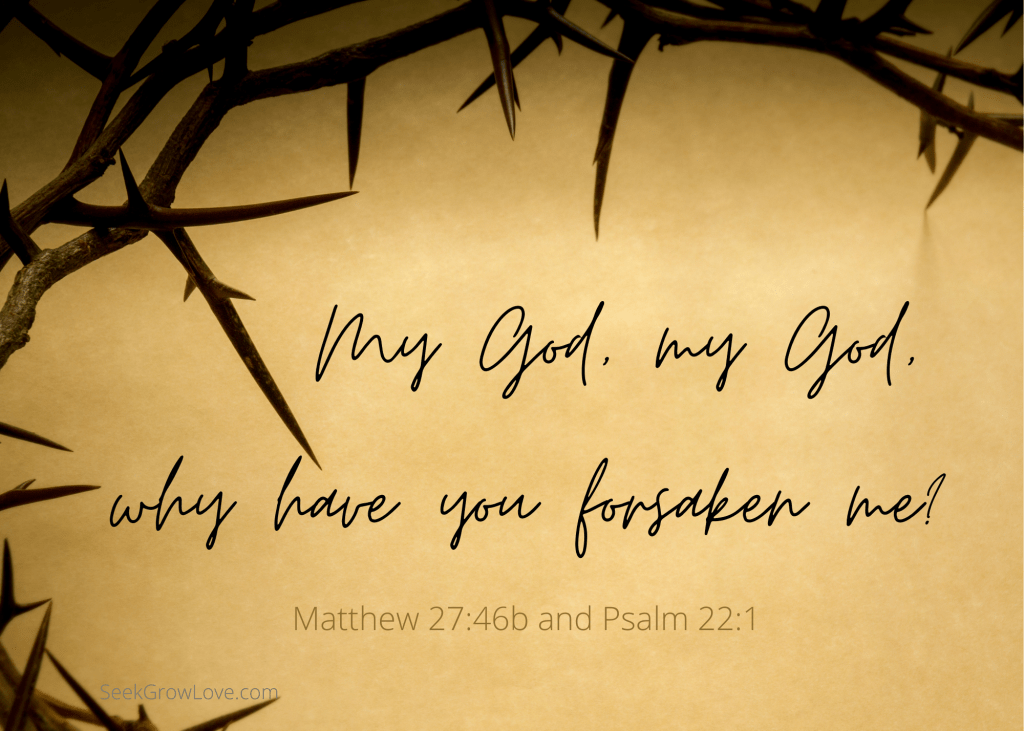
                Jesus is also facing his own existential despair.  He’s been betrayed, denied, abandoned and rejected by his friends and followers and all his fellow Jews.  Jesus was beaten nearly to death and is alone on the cross and has all of the guilt and shame of the world heaped upon him.  In his agony and isolation he cries out to God in despair ,“My God, my God why have you forsaken me?”  Jesus is having the worst day of his life, just as Judas did and Jesus is in extreme pain, just as Judas was and Jesus was about to die, just as Judas did.  And yet, their deaths couldn’t be more different.  Jesus never lost his connection to and faith in his father, even at this point of greatest pain.  Even as Jesus cries out, he is praying and maintaining his connection to his faith tradition.  “My God, My God why have you forsaken me” is the opening prayer of Psalm 22.  This was a Lament Psalm.  The Hebrews were very familiar with suffering.  They had been slaves for over 400 years in Egypt.  They spent 40 years traveling in the wilderness.  They spent 70 years in exile in Babylon.  The Hebrews knew suffering and it was in suffering that God continued to sustain them and draw them back unto himself.  Every Psalm of lament, no matter how much hurt or pain they processed, no matter how angry or betrayed by God they felt, there was always a remembering of the ways God had been with them and helped them in the past, and there was the hope and trust that God would sustain them through the suffering and restore them to wholeness and joy.

                Jesus never lost his connection to the father, even in the depths of pain and despair.  He surrendered his life to God, but he did not take his own life as Judas did.  Judas’ tragic death ends with no hope for him.  Jesus’ tragic death ends with hope for him and for everyone.

                We all go through periods of hurt, pain, disillusionment, brokenness, anger, shame, guilt and pain.  When we go through those time we are in a moment of decision.  Do we give in completely to the despair and give up on God, or do we cling to faith, remembering God’s faithfulness in the past and hope in the future.  That will make all the difference in how our story ends.  It doesn’t have to end like Judas.  Jesus offers the path to hope and life.

-Pastor Jeff Fletcher