
So Many Choices to Make

2 Chronicles 12 6 NIV sgl

2 Chronicles 10-12

Today’s reading (from 2 Chronicles) begins where yesterday’s reading began (in 1 Kings) – Solomon has just died and his son Rehoboam has been made king of all Israel.  It is a good time to use a lot of wisdom, especially since there are discontented citizens and a prophecy has been made that the kingdom (or 10 of the 12 tribes) would be torn out of the hand of Solomon’s son and given to Jeroboam (1 Kings 11:9-13 & 26-40).

When the potential revolters knock on the palace door asking Rehoboam how he will rule them, Rehoboam responds first with wisdom.  Rather than giving a rash answer he might regret later he asks them to return in 3 days – and he consults with his elders.  Well done, Rehoboam.  The wise elders advise the new king to be a servant leader and his countrymen would always be faithful to him (1 Kings 12:7, 2 Chronicles 10:7).  It wasn’t the answer Rehoboam was looking for.  He was looking forward to having great power, authority and fame – perhaps even greater than that of his dad Solomon or his grandpa David.  He didn’t see how a kind “servant” fit into the picture of leadership.

So, he goes to his young buddies he grew up with (perhaps about 40 years old 🙂 – 2 Chronicles 12:13) and asks them how he should proceed.  They are inexperienced, power hungry, arrogant, foolish “young” men.  But Rehoboam rejects the wisdom of the elders he asked first and follows the foolish advice of his friends and tells the people he will be a harsh and firm ruler.  Not too wise, Rehoboam.

Rather than submitting to these fear tactics, Israel revolts and 10 tribes go with Jeroboam, leaving just Judah (and parts of Benjamin) loyal to the house of David and his grandson Rehoboam.  This is exactly what God told Solomon would happen, as a result of his turning away from the Lord (1 Kings 11:9).  Like father, like son – it’s not enough to start out wise – you must stay the course and firmly resist the easy, enticing, foolish way that the worldly friends would lead you down.

In the next couple chapters we see Rehoboam, continue to yo-yo between good choices and bad choices.  He wisely listens to the word of the Lord and abandons plans to attack Israel and start an all-out bloody civil war with their dissenting brothers (2 Chronicles 11:4).  But then, “After Rehoboam’s position as king was established and he had become strong, he and all Israel with him abandoned the law of the LORD.” (Chronicles 12:1).   Too often when we are feeling strong, comfortable and sure of ourselves…our pride makes us think we don’t need God anymore.  And that is a dangerous place to be – for Rehoboam and the country of Judah as well as for you and me and our country.  In God we trust.  Or, we did once?  How sad and hauntingly eerie to read God’s proclamation against the nation that rejects God: “This is what the LORD says, ‘You have abandoned me; therefore, I now abandon you to …’ ” (2 Chronicles 12:5b).  And in came the invaders from Egypt.

The good news is, the story doesn’t always have to end there – and it doesn’t for Rehoboam!   He still had a bounce back left in his up/down/repeat journey.  Rehoboam’s pride had brought him down, turning from God, and leading to punishment.  Now, at the bottom, faced with a foreboding enemy he gets another chance to choose his response –  wise or foolish, humble or proud, repentant or heard-hearted?  Rehoboam and his countrymen chose wisely this time – they, “humbled themselves and said, ‘The LORD is just.’ ” (2 Chronicles 12:6).   God still sent the invaders from Egypt – to shake them up a little and teach them a lesson they needed to learn – there is a price to pay for turning from God and proudly putting your trust in yourself instead.   But, because of their humble response, God did not let the Egyptians annihilate them.

That would not be the end of Rehoboam.  He would reign in Jerusalem 12 more years.  But sadly the few wise choices we saw in Rehoboam were not enough.  In the end, it was recorded, “He did evil because he had not set his heart on seeking the LORD.” (2 Chronicles 12:14).

In reality, we are all a mix of wise and foolish choices.   There are consequences for the foolish ones and rewards for the wise.  But which will you be known for in the end?  Let us each work hard to make wise choices everyday.  Daily seek the LORD with humility – acknowledging our need for Him, our desire to follow His wise and right way, our willingness to set aside the selfish, prideful desire for power and and instead offer ourselves as a servant.

Seek Him!

Marcia Railton

Today’s Bible passage can be read or listened to at https://www.biblegateway.com/passage/?search=2+Chronicles+10-12&version=NIV

Tomorrow’s reading will be 1 Kings 15:1-24 and 2 Chronicles 13-16 as we continue the 2020 Chronological Bible Reading Plan
Following God not Man

Don’t Be Deceived!

1 Kings 12 28c NIV sgl

1 Kings 12-14

Perhaps we will be able to learn a thing or two about unity and peace and not being deceived and the supreme importance of following God’s purpose and plan as we read the historical accounts of the break-up of the Old Testament country of Israel.  What a sad and difficult time it must have been.

Remember back to those who had insisted that they wanted to have a king in order to be a real nation like all the neighboring tribes and countries.  Samuel told them they didn’t need a king if they had God, but they didn’t listen.  They wanted to be just like everybody else.  So, sure enough, they got themselves a king – and all the heartache and turmoil that comes with trying to follow man instead of God.

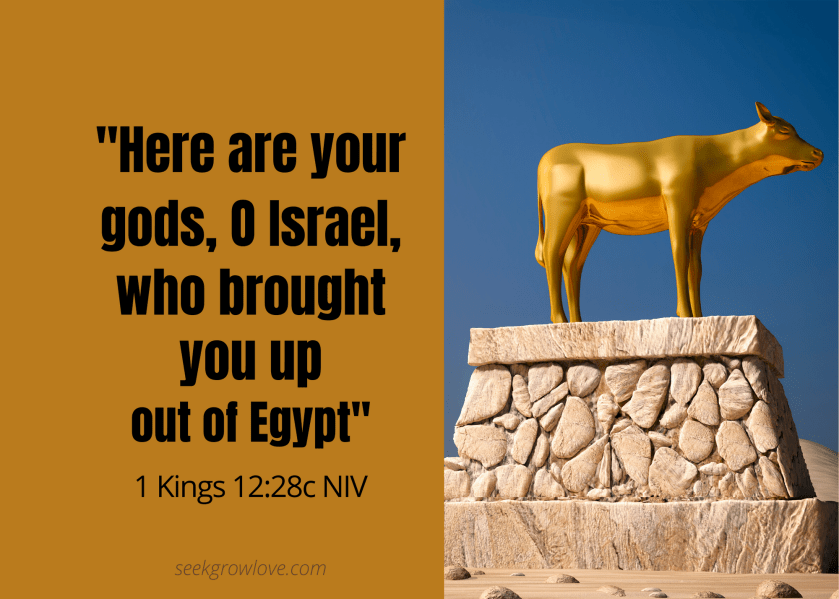
As we begin our reading today Israel had survived almost 100 years under 3 kings (Saul, David and Solomon).  And, as Solomon’s son Rehoboam is poised to take the reigns, the split comes and Jeroboam takes control of most of the country.  The land previously given to the tribe of Judah (home to Jerusalem and the beautiful temple Solomon built for the whole nation to worship the one true God in) remains as Rehoboam’s territory.  Jeroboam quickly decides he must build something for all the rest of Israel to worship, so that they don’t return to Jerusalem.  Two golden calves were created.  If the people knew God and their history a little better this should have sent all sorts of red flags.

God sent one new, large, red flag for the people.  A man of God came from Judah to speak God’s Word and reveal God’s power against this new idol worship.  He turns down King Jeroboam’s invitation to dinner because the word of the Lord said he must return home without eating or drinking in this land he was speaking against.  However, when an old prophet lies and says that an angel appeared to him and told him to have the man of God come to his house….the man of God goes.  But that same day judgement is prophesied against this man of God (from God through the previously lying prophet of God).  And sure enough while traveling home the man of God is killed by a lion (who “strangely” enough, does not eat him, just kills him).

I must say I have had some trouble with this story.  Here’s the man of God on special assignment from God – and doing it quite faithfully.  Speaking God’s word, showing God’s power, turning down even the King’s attempt to wine and dine him.  He seems totally devoted to what God wants him to do.  And, then, someone lies to him.  Someone who calls themself a prophet – should be a good person to listen to, right?

Not always!

Don’t believe every word from one who says they speak for God — without consulting what GOD has to say about it!  God had not changed what He had said to the man of God.  And, so that is what the man of God was responsible to be listening to and following.  The man of God was deceived because he listened to the lie – and it cost him his life.  God is serious about people following Him and His Word, rather than what man says about God.

So, too, today I fear there are many who, like the man of God in 1 Kings 13, are trying to speak God’s word – who are at the same time being deceived – and it just might cost them their lives – as it did for the man of God.   2 Timothy 3:13 lumps both the deceivers and those who are being deceived together in one sad group.   It seems harsh.  But, God has revealed himself as a jealous God who requires obedience to Him, and not to man and man’s ideas.  There is a price to pay for turning from His life-giving words of truth to the lies man (and even kings or “prophets”) have said about God and what He requires.

There are countless voices speaking today.  It can be hard to know what to believe and listen to.  The truth is not always spoken by the one who speaks loudest or longest or believed by the largest crowd.  But the truth is always in God’s Word.  Seek It!   And ask yourself – is it actually GOD’s Word you are following, or just someone who says they are speaking for God?  Are you following man-made traditions that have been handed down about God – or are you following GOD?  Do a little research and find out where the religious traditions you believe come from.  Do they come from God’s Word or from human traditions?  Did we get the idea of going to heaven when we die from the Bible or from Plato?  Did God, Moses, Jesus, the disciples and Paul teach about One God or about a triune God theory that developed centuries after Jesus’ life on earth?

How will you make sure you are not following a man-made religion – perhaps one just as dangerous as the golden calves Jeroboam set up in his country?  Not all lies and false gods are as blatantly obvious as a golden calf crafted by the king.  Sometimes it may come in the form of a seemingly harmless new word from the prophet, a slight contradiction or addition to God’s eternal Word.  Remember God is the perfect teacher – His words do not need to be added upon to be enhanced or explained better.   You are responsible for not listening to the lies.  God gave us the Bible – His Word that is full of truth.  Let’s dig in deep and find what it says and follow it with our whole being so we will not be led astray with a lie like the people who followed a golden calf built by a king or like the man of God who listened to the lie of the prophet rather than the word given to him by God.  There are consequences for what you believe and who you listen to and follow.  Take it seriously.  God does.

Marcia Railton


Today’s Bible passage can be read or listened to at https://www.biblegateway.com/passage/?search=1+Kings+12-14&version=NIV

Tomorrow we will read 2 Chronicles 10-12 as we continue seeking God’s truth and how it affects our lives today in the 2020 Chronological Bible Reading Plan
Dad!

Proverbs 30-31

Proverbs 30 4c NIV sgl

I doubt there are too many devotions over the last two chapters of Proverbs that are mostly aimed at the topic of Fathers, but for whatever reason or coincidence, here we are on Father’s Day – and our assigned Bible reading includes the Proverbs 31 superhero – the Wife of Noble Character.  But, I was surprised to see how many passages popped out to me regarding dear old dad and our relationship with him.

First of all, we run into an interesting passage of rhetorical questions about who can control the wind and water and established the ends of the earth?  “What is his name, and the name of his son?  Tell me if you know!”  (Proverbs 30:4 NIV)  I read some very differing commentaries on this passage and I feel a lot like the writer of this proverb, Agur, who confessed, “I am the most ignorant of men,” (Proverbs 30:2 NIV).  I do not have a full understanding of the Almighty God.  I can’t grasp His eternal greatness and power and all the deeds He has done  – and will do.  But, I am thankful that I DO know who created this spinning world we call home, the sun that warms it just right, the water cycle that refreshes it, the plants and animals that provide beauty, nourishment, and joy, and the families that inhabit it.  I marvel at the power, ingenuity and love of my Heavenly Father and the chance to be called His child.  And, I love, love, love, that He has a Son and I know his name is Jesus.  And this son Jesus would display his family resemblance to His dad by exerting power over the wind and the waves.  He would be given the most difficult but beautiful task of drawing us sinful creatures to His perfect Dad.

Poor Agur lived at a time when this plan of God was not yet revealed, but only hinted at here and there.  So, he was left asking – “Tell me if you know?”  If you know your Heavenly Father and what His Son has done so that YOU can be called a Child of God – who will you tell today?  Make it a Father’s Day that counts by telling someone about your Heavenly Father and His Only Begotten Son and the opportunity opened for them to have a perfect Dad, too.

I am so blessed that my father (and mother and grandparents and church family) on Earth did tell me – and many others.   Thanks, Dad!  It has been an honor to respect and try to live up to my dad.  I had a good one (and doubly blessed with a good father-in-law, too!).

There is a depressing passage of those who are haughty, disdainful, teeth for swords (heard any of that lately), devouring the poor.  And the FIRST description of these evil and hurtful people are, “There are those who curse their fathers…” (Proverbs 30:11 NIV) Can you think of any ways our society may have unknowingly become quite expert in cursing our fathers.  In so many sitcoms the father figure is stripped of all respect and is a bumbling goofball.  In giving women their “rights” we have neglected the responsibility and rights of dad.  And, then it sadly happens on a personal level, too.  Even in good Christian homes, sometimes.  How can we guard against cursing our fathers?  How will we show dad the respect God designed them to receive?  (Notice I did not say the respect that they have earned).

It appears there is even punishment in store for those who mock dad.  Oh be careful little tongue what you say.  AND – Agur seems to take it even a step further – be careful little eyes how you roll.  You know, the classic eye roll when you don’t agree with dad?  Guilty.  Proverbs 30:17 says “The eye that mocks a father, that scorns obedience to a mother, will be pecked out by the ravens of the valley, will be eaten by the vultures.”  Ouch.  This is serious stuff – regardless of what the “funny” sitcoms would have you believe.

Look at your own attitudes, words, actions, and eye rolls.  How are you showing respect for your father (and Christian father figures) not cursing or mocking?  Thankfulness not disdain?

Thanks Agur for the Father’s Day devotion.

Marcia Railton


Today’s passage can be read or listened to at https://www.biblegateway.com/passage/?search=Proverbs+30-31&version=NIV

Tomorrow’s reading will be 1 Kings 12-14 as we continue the 2020 Chronological Bible Reading Plan (1) (1)


The Queen of Sheba and Jesus

1 Kings 10-11 & 2 Chronicles 9

2 Chronicles 9 23 NIV

Who is the wisest person to ever live?
Let me tell you why you’re wrong. (Just kidding!)
Most of us answer Solomon, right? We are told that many times in Sunday School, and our teachers weren’t wrong. He was wise… to a point. We look at what he did at the beginning of his life and we see a man who was so dedicated to God that he asked for wisdom instead of riches, power, wealth or fame. For that, God gave him all wisdom and all the other things as well. Solomon was “wise enough to know that we are not wise enough on our own.” But, is Solomon the wisest person to ever live?
I believe our reading today disabuses of that notion quickly. Solomon starts off great, but in the end, his rule falls apart. His wisdom allowed his fame to increase. But as his fame increased, his wealth increased; as his wealth increased, his political connections, in the form of marriages, increased; as his number of marriages increased, the amount of gods he worshipped increased. And there’s our problem, but it doesn’t start there. Solomon, for all his wisdom, lost sight of the end goal. Wisdom is not meant for wealth. Wisdom is not meant for fame.
Wisdom is meant for godliness.
If we want to find the wisest person to ever live, we should look to the man who knew and had insight into the hearts of men and women, the one who even knew “all things.” Jesus, of course, is the wisest man to ever live. He unpacks the wisdom of God found in the Torah Law and applies it in a way that changes more than just behavior, but changes the heart. Jesus knew how to perfectly interpret scripture in wisdom. Most importantly, Jesus lived a life of wisdom by being Godly, doing what God wanted, all day, every day.
When we read about the Queen of Sheba and the wisdom of Solomon in 1 Kings 10 and 2 Chronicles 9, we need to remember that her praise was not only directed at Solomon. 1 Kings 10:9 reads “Blessed be the Lord your God who delighted in you to set you on the throne of Israel; because the Lord loved Israel forever, therefore He made you king, to do justice and righteousness.” The Queen of Sheba was wowed at the power of YHWH to give wisdom to people. The wisdom that Solomon imparted was that God was the giver of wisdom and that God was the blesser of his people; this, sadly, was a lesson Solomon forgot. It should be no surprise that Jesus said “The Queen of the South will rise up with this generation at the judgment and will condemn it, because she came from the ends of the earth to hear the wisdom of Solomon; and behold, something greater than Solomon is here.” (Matthew 12:42, Luke 11:31) Jesus knew that if the Queen of the South, the Queen of Sheba, were alive in his day, she would travel from the ends of the earth to hear the message of wisdom that he preached, because his teaching, his power, his wisdom far exceeds all that Solomon had.
May we my brothers and sisters, stand on the day of judgement found in the wisdom of Jesus, the wisdom that leads to godliness. May we recognize the wisdom of Christ over the wisdom of this world, and choose Christ every time. May you be blessed because you choose to trust and to live your days in the saving grace of the wisest person who ever lived.
Jacob (Jake) Ballard
——————-
Jake Ballard is Pastor at Timberland Bible Church. You can hear more of his thoughts and worship along with the TBC Family on Facebook, live streaming every Sunday at 10am. Reach out to Jake on Facebook, Twitter, or Instagram.
Tomorrow’s reading will be the end of the Proverbs (30-31) as we continue the 2020 Chronological Bible Reading Plan

Your Life is Not Meaningless

But it is Fleeting – so Live Wisely!

Ecclesiastes 12 13 NIV sgl

Ecclesiastes 7-12

In Ecclesiastes 7-12 the author, the Teacher, continues to discuss things that are “havel”, vain, futile, fleeting and temporary. (If you haven’t yet, go ahead and read yesterday’s devotion on Ecclesiastes 1-6 for a deeper understanding of “havel”.)
The author accepts that death is the end of every person and it is important to accept that fate and live with one’s face toward death. Much of the last half of this book is the reality righteous and wise people suffer the same fate as those who are wicked and foolish. However, we must not let this reality change how we read the entire book of Ecclesiastes. The author writes in 8:12-13 “Although a sinner does evil a hundred times and may lengthen his life, still I know that it will be well for those who fear God, who fear Him openly. But it will not be well for the evil man and he will not lengthen his days like a shadow, because he does not fear God.” While it is TRUE that the wicked and the righteous both end their lives in death, the author holds that there is good for a righteous person. Still, seek righteousness and wisdom because even a little foolishness can ruin one’s life. (10:1)
For you younger readers, the author commends that you seek out wisdom and that you remember God today! At this point in your life (12:1) There will be days of difficulty as life goes on, but in our days of joy, remember God. God is the one who gives comfort, joy, happiness, and strength on the days when the world is dark, the clouds are gray, and the pains of life are crowding in. Because the childhood and the prime of life are fleeting, temporary and transitory, enjoy them now. (11:10)
We are nearing the end of the book. We have been asking the question : “what lasts? What do people REALLY gain for all they do?” The last two verses of the book tell us what lasts : How we have lived, whether we kept the commands of God and feared him. All this in our life will be judged. Of course, this has been hinted before; now it is explicitly and clearly stated. If we believe, as some have, that the Teacher is a cynical, morose, or even godless man, then the last two verses are a radical departure. However, if this is a man who loves God and understands the futility, vanity, temporariness, FLEETING nature of life, then the final verses in Ecclesiastes are an understandable conclusion.
This of course effects how we read many passages. The author says “eat, drink, enjoy your labor, be merry!” (5:18, 8:15, 9:7) These passage show us that our labor, what we do, are not meaningless, but they are precious because of their very fleeting nature. The teacher says in 9:9, “Enjoy life with the woman you love all the days of your fleeting life…” You know you are precious to God. Your life is not meaningless, but it is havel, transitory, temporary. What we have in this life is not meaningless drudgery of existence, but the temporary good things are to be enjoyed, and to seek the eternal good things, doing the will of God and fearing him.
In the short time of our discussion we missed many interesting passages, some that are difficult (about death and sorrow) and some that are encouraging (about enjoying pleasure on the earth). But, my friends, remember : The entire duty for all people is to do the commands of God. We know that since Christ has come into the world “This is His commandment, that we believe in the name of His Son Jesus Christ, and love one another, just as He commanded us.” (1 John 3:23) As you continue to believe in the name of Jesus, may you love one another as you seek how to live wisely today!
Jake Ballard
Today’s Bible passage can be read or listened to at https://www.biblegateway.com/passage/?search=Ecclesiastes+7-12&version=NIV
Tomorrow’s reading will be 1 Kings 10-11 and 2 Chronicles 9 as we continue the 2020 Chronological Bible Reading Plan

Ecclesiastes gets a bad wrap. 

Ecclesiastes 1 3 NIV sgl
It shouldn’t but it does. Most people think it is a depressed Old Man Solomon sitting down at the end of his life saying “EVERYTHING IS MEANINGLESS.” Therefore, most of the book is about how everything is meaningless, life is not valuable, and it would be better to be dead.
But that’s a bad interpretation.
First, let’s look at 1:2. This is the key phrase of the book. Everything hinges on understanding this phrase correctly. And most of our translations do a poor job. That may seem arrogant, but let’s look at the word in Hebrew. The word, (transliterated) is “havel” or “habel”. Literally, it means “mist” or “vapor.” Very rarely is it used in this sense. Many more times it is used of idols, which are “mists” as opposed to God’s “concreteness.”  In its more poetic context, which the passage warrants, it means “temporary”, “fleeting”, “transitory”. The author is declaring “Passing! Fleeting! Un-lasting! Everything changes and nothing remains!” See how VASTLY different that sounds from the usual “eVeRyThInG iS mEaNiNgLeSs!” we normally read?
We need to understand that the central call of the book is about how nothing lasts because it makes the question in 1:3 make SO MUCH MORE SENSE! The author (Qohelet, the teacher, most likely meant to be Solomon, but not for sure) is not simply lamenting that work is hard and not much can be gained. Instead, the author is asking a very pointed question : “In everything I do, WHAT DO I HAVE THAT LASTS? What remains? What is not ‘havel’, not a temporary, fleeting, striving after the wind?”
Now THAT is a question we want an answer to!
This isn’t a depressed teacher moaning about how everything is terrible and nothing matters and that all the stuff we do is unimportant. He is asking (and implicitly promising to answer), “What will be the thing that will last when all the other futilities of life fade?”
He goes on in these first 6 chapters and tells us that it’s not wisdom (1:12-18)[though it is better than folly (2:12-17)], it’s not pleasure (2:1-3) or possessions (2:4-11), it’s not labor (2:18-23) [though labor is a good thing (2:24-26, 3:12-15)]. The justice and oppression of men is havel, those who seek after money will realize it is havel.
Look at what the author says in 3:14 “I know that everything God does will remain forever; there is nothing to add to it and there is nothing to take from it.” The eternal, so far as we know now, the thing that is not havel, temporary, fleeting or futile, is the work of God.
We leave this section of Ecclesiastes without the answer. There are some depressing things the author says, but once we have the answer for “what does a man gain? what LASTS?” we can reevaluate those passages in light of the answer.
Jake Ballard
Tomorrow we will finish the book of Ecclesiastes to find yet another wise answer to the questions of life on our walk through God’s powerful word – 2020 Chronological Bible Reading Plan
Counterintuitive Wisdom

Proverbs 27-29

Proverbs 27 6 NIV sgl

The Proverbs are, in many cases, fairly self explanatory. Don’t be lazy, don’t be a wicked ruler, don’t be foolish but be wise, be a righteous ruler, be diligent in your work. Each Proverb has it’s own meaning but they go along those lines. But some are not so self explanatory. They are counterintuitive.
A short example is found in 28:27. If you want to be prosperous and blessed, to never be in want, then we give our money to the poor. The world, our own sinful heads, and many economists believe that the way to grow our wealth and not be in want is to hoard our money. But that’s not the way God works. It is only in generosity and giving that we will be blessed. This comes from the fact that God will bless and many times he blesses us through the care of others in our time of struggle and hardship.
Also, 27:5-6 doesn’t seem to be true in the moment. I don’t like to be rebuked. I don’t like it when a friend calls me out on the garbage way I am acting. But the Proverb teaches us that we should delight when a friend rebukes us because their correction comes form a place of love and they want our life to be one of wisdom and righteousness. This is especially true for  our brothers and sisters in our local church. Many times, we may feel judged by the people of our church, but more often than not, they are wanting the BEST for us. The “wounds” they give are better than any kisses of those who tell us we have nothing wrong with us. There could be people who act like a friend and hurt you in terrible ways, but here we mean TRUE friendship, TRUE companionship, TRUE love from a brother or sister in Christ. That true love is shown in forgiveness and compassion, especially in our moments of weakness and humility. Many times, when we are sinning and are fearing the rebuke of those people, we hide our sin away, like 28:13 says. But counterintuitively, by hiding our sins, we only hurt ourselves more when they are brought to light in some other way. We need to confess our sins and turn away from them. When we do, compassion and forgiveness are waiting for us from the people of God and from God himself.
Jake Ballard
Today’s Bible reading can be read or listened to at https://www.biblegateway.com/passage/?search=proverbs+27-29&version=NIV
Tomorrow’s reading will be Ecclesiastes 1-6 as we continue on our 2020 Chronological Bible Reading Plan
To Answer a Fool – or Not?

Disagree – Wisely

Proverbs 26 4 5 NIV

Proverbs 25 & 26
Proverbs is hard to write ONE devotion about. From chapter 10 forward, nearly the entire book is a collection of pithy quick sayings that were meant to produce wisdom in those who learned them. (Only chapter 31 is different, but that will be for another author to work through!) Today, for chapters 25 and 26, I want to focus on just one set of verses.
There are two authors to every word of the Bible. The first is the human author, a person who lived in a specific place and time, thought and wrote in a specific language and who was fallible and failing just like the rest of humanity. Also, Christians believe the Bible is inspired by God. This means that God directed the author so that the words, ideas, and stories are those by which God wanted people to live and that everything in the Bible is true. Short and simple, the Bible is not full of lies and misinformation, and it doesn’t contradict itself. (1)
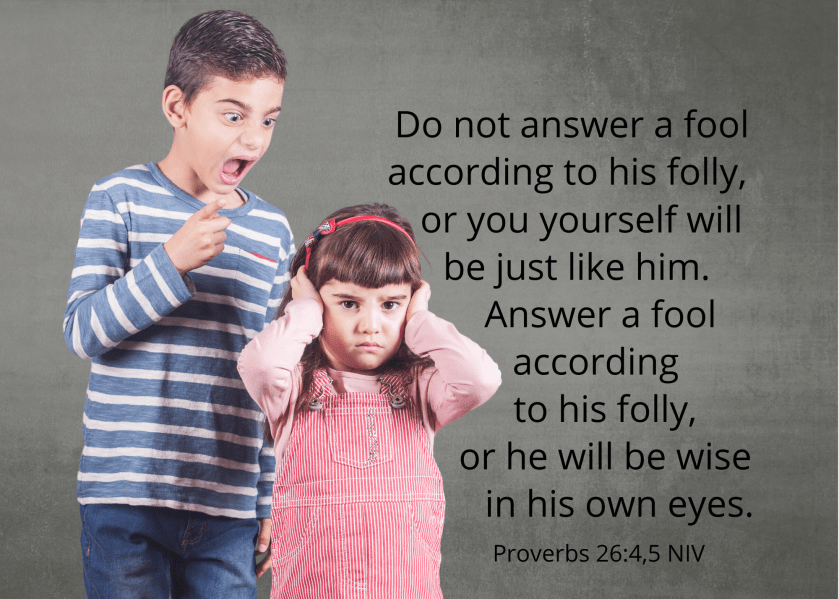
That seems like a hard standard to hold when we read Proverbs 26:4 and 26:5.
26:4 Do not answer a fool according to his folly,
Or you will also be like him.
5 Answer a fool as his folly deserves,
That he not be wise in his own eyes.
DO NOT X & DO X. That is a pretty clear contradiction, right?
Well, yes and no; let me explain. It is clearly contradiction if we believe that all the Proverbs must be followed all the time, like the laws of the Torah. But this is not how the Proverbs were intended to be used.
Proverbs were meant to make people wise, and therefore were to build wisdom AND BE USED WITH WISDOM. Every Proverb doesn’t always give what must be done in every situation always, but instead tells you a general way of living that should guide you in the moment to make a wise decision.
The question we are hard-wired to ask is : Is it right or wrong to answer a fool? But,  THAT’S A BAD QUESTION! Instead we should be asking : Is it wise or foolish to answer this fool right now? Sometimes you debate with a person in private who will never change his or her mind, and you have to throw up your hands and say, “Not worth it” or you could be dragged into the mud and muck of folly and error. Sometimes, you need to correct someone for the foolish thing he or she has said or done, or they go on being foolish forever. Either approach could be wise or foolish; it is the wisdom of God that will sort out which way we should go.
Thus, God’s word is kept from our bad interpretation and we recognize that there is no contradiction!
Jake Ballard
(1) Rarely, if ever, is something truly “short and simple.” There are lots of implications and theological, historical and scientific questions that come up, but sadly, we don’t have time for that at the moment.
Today’s Bible reading can be read or listened to at

Tomorrow’s reading will be Proverbs 27-29 as we continue the 2020 Chronological Bible Reading Plan

The Throne and the Temple

1 Kings 9 and 2 Chronicles 8

1 Kings 9 3 NIV sgl

In today’s passage, the temple in Jerusalem has been built along with the palace and throne of Solomon. David wanted to build the temple for God, but he was a man of war and bloodshed. Therefore God used David’s son, Solomon. In the passage from 1 Kings 9, we read God making a covenant with Solomon. We know about the Abrahamic and Davidic Covenants, but here we have the Solomonic covenant. There are lots of warnings in it, but there are two main verses I want to focus on. Each hold promises that I want to focus on today; two things that should interest us in this Older Testament text after the revelation of Jesus Christ.
First, in 1 Kings 9:5, God promises that, according to verse 4, if Solomon is righteous, then “you shall not lack a man on the throne of Israel.” Though the children of Solomon did turn away and not follow God with their hearts, we can see that God stays true to the promise he made to David and Solomon. Christ, the son of Solomon (Matthew 1:6-7), will rule on the throne of David and Solomon. He will sit on the throne of the New Jerusalem over the Kingdom of God on the earth. What a glorious day that will be. We can trust and hope that during these uncertain times, we have the certainty of Christ reigning among his people in the future. God has declared it, he has promised. If He speaks it, He will fulfill it. (Numbers 23:19)
Secondly, a metaphor for Christ is the “chief cornerstone” (1 Peter 2:4-8). It’s a building term; it was the most important stone in the entire project. The whole building was measured off the cornerstone. If the cornerstone was strong and level, the whole house would stand. If it was crooked or wrong, it would fall. Christ is the cornerstone, and we are stones in this holy building that God is building. And this building is not just any building! In both 1 Corinthians 3:16 and Ephesians 2:21, it is clear that the people of God collectively are the NEW TEMPLE OF GOD. God promises in 1 Kings 9:3 that he consecrated a house where he will dwell, that he put his name there forever, and His eyes and His heart will be there perpetually. But the house where God dwells now is not a building in Jerusalem, but in the community of the redeemed. When the people who have been saved gather together, God’s eyes are there, God’s heart is there, and His name is put into us forever.
Praise be to God that through Christ our Lord we have been given a savior who will rule on the throne of David and Solomon, a savior who builds his people into the temple where God dwells.
Jake Ballard
Tomorrow’s passage will be Proverbs 25 & 26 as we continue the 2020 Chronological Bible Reading Plan

Called to Worship

Psalm 134 & 146-150

Psalm 150 2 NIV sgl

What’s your favorite song? Not the one that makes you sound sophisticated to your friends or the one that is just a current fling, but the one that is your favoriteWhat’s the song that makes you wanna roll down your windows and sing out as you drive along? (It’s hard to narrow down, I know. There are many “emo” bands from the mid-‘00s that are contenders for me.) For many of you, it’s probably a song that is ‘happier”: they probably have upbeat lyrics, a fun melody, a catchy tune. (For you music nerds, probably a major key, rather than minor key.) The reason those kinds of songs may be your favorite is because music reaches into a deep part of what makes us human; joyful songs uplift our souls.
Joyful songs uplifting humans has been true across time. As we have been reading the psalms, we are of course reading the songbook(s) of the Jewish people. These were not just words on the page, but were a collection of songs that the people would sing. These songs, these Psalms we are reading today are songs of JOY, songs of SHOUTING, SONGS OF JUBILATION! Each one of them are the happy, joyful, exuberant songs that, were they sung today, would make you want to tilt your head back and let loose a “joyful noise” with everyone around you. I wish we could hear exactly as they sounded when they were sung as the people worshipped in the temple or on their way up to the temple mount.
The first and last psalms (134, 150) are short, but even the longest psalm (147) is written in a nearly breathless ecstasy. They are read quickly, at a pace that rushes along. This is because in all of them, there is a repetition of phrases. Search all the Psalms together in NASB on Bible Gateway. The effect of the repetition is quite striking and intentional by the author. In our minds, we may think that the author should have used different word or phrases to be interesting. Remember, when something is repeated, that is something the author wants us to remember. These songs are making use of something akin to a “chorus”. They wanted people to easily remember the song as they walked up the mount and sang.
Moreover, these psalms show us that the cacophonous world we inhabit is not just a torrent of noises, “a tale told by an idiot, full of sound and fury, signifying nothing.” Instead, Psalm 150 invites the praise of the instruments of the people. Trumpet and lyre and timbrel and cymbal, (and drums and guitar and piano and voice); ALL are called to give glory to God our maker and creator. Even more is the section of Psalm 148:7-12 where the psalmist asks the inhabitants of the earth to praise the Lord. But what is called to praise? Sea monsters, hail, and fruit trees, along with mountains and cattle. The list shows us that it is more than humans that are called to worship; we are to be the forefront of creation, but creation will praise its creator, and we have a choice to make in who or what we praise!
Today is Sunday. Today, above all days, is the day when we think about God who made us, who raised his Son from the dead, and who rules over us all. Find the song that allows you to worship him, crank it up in your headphones, in your speakers, in your car, and sing to the glory of the Lord. (To get “Jesus turnt” try : Amazing Grace by Phil Wickam, Glorious Day by Passion, or Church Clap by KB.)
Let everything that has breath, praise the Lord!
Praise the LORD!
Jake Ballard
Tomorrow’s Bible reading will be 1 Kings 9 and 2 Chronicles 8 as we continue on our 2020 Chronological Bible Reading Plan