
Called and Used by the Generous God

Jeremiah 1-3

Jeremiah 1 5 NIV sgl

These first 3 chapters of Jeremiah have several applications for the reader. In the beginning of this book, we learn about the calling of Jeremiah. Before Jeremiah was even born, the Lord set him aside to be a prophet. God wanted to use Jeremiah to fulfill this calling. Jeremiah at first believed himself incapable of such a thing. But the LORD said he would be with Jeremiah. He would not only guide him; he would also protect him. Jeremiah then trusted God and began this work.

We can learn a lesson from this. Sometimes it is easy to doubt ourselves and believe that we are incapable of something. We may think that God couldn’t use us because of x, y, and z. In reality, though, it is not by our strength or ability that we serve the LORD. It is rather him working through us. So, by doubting ourselves, we are doubting the ability of the LORD to work through us. Jeremiah also did not believe himself capable of being called, but nonetheless he was. The LORD called many sinners such as David, Jonah, Paul, and countless others. So, do not doubt yourself. The LORD is capable of calling you and through him, you are capable of answering that call.

Another interesting thing found in these three chapters is the fact that God warned the people of their ways. He did not make them guess. Sometimes when we are upset with someone, we think that the offending party should be able to figure out why we are upset with them. God did not do this. He used Jeremiah to tell them what they were doing and what they needed to do. If I really think about this, I think of how generous and caring this act is. Even though the Israelites were completely in the wrong and should know what it was they were doing, God still communicated with them. He did not keep them in the dark even though they were ignoring him.

It is interesting also that it seems like the main thing that God is asking of the Israelites in these chapters is for their repentance. Through Jeremiah, he tells them that they should not continue on in their ways as though they are doing no wrong. They should acknowledge what they are doing and repent. They needed to accept that they were wrong.

It can be hard though to admit when we are wrong. By doing this our pride is injured and we have to humble ourselves. It is far easier to keep doing what we were doing and act like we are in the clear. This, however, is not right. We need to admit when we are wrong. Through doing so, we can grow and mature.


Hannah Deane


Today’s Bible passage can be read or listened to at https://www.biblegateway.com/passage/?search=Jeremiah+1-3&version=NIV

Tomorrow’s reading will be Jeremiah 4-6 as we continue on our journey through God’s Word with the 2020 Chronological Bible Reading Plan

Growing Sin

Zephaniah 1-3

Zephaniah 3 1 NIV sgl

The book of Zephaniah is quite short, but it is full of descriptive language. It recounts the vision given to Zephaniah in the time of King Josiah’s reign. This prophecy paints a colorful picture of the price that must be paid for sin.

Sin is not something that we can pretend has never happened. If we deliberately continue living a life filled with sin, it will eventually catch up with us. To maybe understand this a bit better, I was reminded of our physical wear and tear. For those that play sports or enjoy physical activity, you may know that these pastimes can result in injury. The injury may start out as a minor sprain or cut, but we keep going rather than caring for this injury. It is inconvenient to allow something that seems so minor to hold us back from doing what we want. So eventually this minor sprain gets worse or that unattended cut gets infected. Slowly something that was in our grasp to fix becomes a bigger problem.

Sin is also like this. At first, we may stray a bit as a mistake, but then we slowly get lured in. “What difference will it make if I do this one more time”, we may ask ourselves. But slowly the minor problem turns into something bigger as we continue to turn our backs on God. Slowly this sin, whatever it may be, will eat at us. We will have to face the consequences that sin has left in its wake.

Just like in Zephaniah, one day, the LORD will eradicate the sin of this world. It will be good to one day be in a world without sin or pain. And thankfully, God has given us the possibility to be reconciled to him. We do not have to allow sin to rule our life. We can turn to God and he will help us fight temptation. We just must trust in him. In chapter 2 of Zephaniah, God summoned Judah to repent. He did not want these people to be lost to their sin. He wanted them to turn to him, so that they could be sheltered. He gave them a chance as he has given us one. He wants us to take refuge in the shelter he has lovingly offered.

Just as a government wishes for its citizens to abide by the law, the LORD wishes for us to turn to him. However, when those citizens rebel against those guiding principles, they must face the consequences of their actions. We, however, must make the choice to live for him. We must enter that shelter that our heavenly Father provides.

Hannah Deane


Today’s Bible passage can be read or listened to at https://www.biblegateway.com/passage/?search=zephaniah+1-3&version=NIV

Tomorrow we begin the book of Jeremiah (chapters 1-3) as we continue on the 2020 Chronological Bible Reading Plan
Take Action

2 Kings 22-23 and 2 Chronicles 34-45

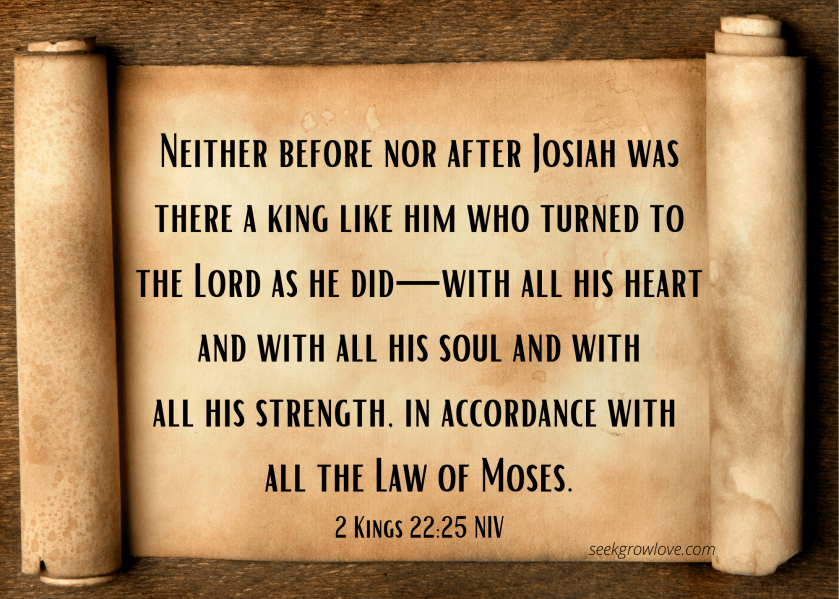
2 kings 22 25 NIV sgl

Josiah was only eight years old when he became king, yet he still did what was right. This was unlike many of the other kings that ruled in Jerusalem. We are told in these chapters that this young and inexperienced king did what was right in the eyes of the LORD.

It is amazing how zealous King Josiah was. He was truly grieved when he discovered, from the reading of the Book of Law, how far his people had strayed. He tore his clothes and audibly wept. I feel like this should inspire modern day Christians. It seems as though evil has become an ordinary thing that we see happen every day. We have news stories of murders, burglaries, and other reports of violence and suffering flash across our phones on a daily basis. Does this evil pain us the way the evil of Jerusalem pained Josiah? Or have we grown numb to this constant occurrence?

Not only did this pain Josiah, it also sparked a change. King Josiah did something with this revelation. He tore down the high places and idols built to glorify and worship false gods. He sought to destroy the things in Jerusalem that went against the LORD. He completed this quest with passion. He wanted Jerusalem to again turn to the LORD.

This should also inspire us. It is one step to see what is happening, but it is another to take action. What are we doing to combat the darkness? There is so much pain in this world. How are we being proactive?  It is easy to become complacent, but we must aspire to do all that we can as Josiah did. Josiah is an example of someone that truly sought the LORD.

Because of Josiah’s heart and his commitment, the LORD promised him that he would not see the destruction of Jerusalem. Josiah, however, was eventually killed in battle. This came about, though, because he did not heed the warning which God had sent him. We need to constantly look to the LORD and seek him as Josiah tried to do during his reign.

Therefore, let us allow the things we see to inspire us to also seek change. Let us, as Christians, be a city on a hill and reach out to the hungry, wounded, and lost. Even opening the door for someone or buying someone’s coffee in the drive-thru behind us can make another person’s day. This life can seem difficult at times, so let us be a light that keeps the creeping darkness at bay in the lives of many people. Josiah did not only grieve for the state of Jerusalem, he took action to better it. In the same way we should not be satisfied with only grieving for our world. We too, like Josiah, should seek to be the difference that we wish to see in this world.

Hannah Deane


Today’s Bible reading can be read or listened to at https://www.biblegateway.com/passage/?search=2+Kings+22-23%3B+2+Chronicles+34-35&version=NIV

Tomorrow’s reading will be Zephaniah 1-3 as we continue our 2020 Chronological Bible Reading Plan


A Price to Pay

Nahum 1-3

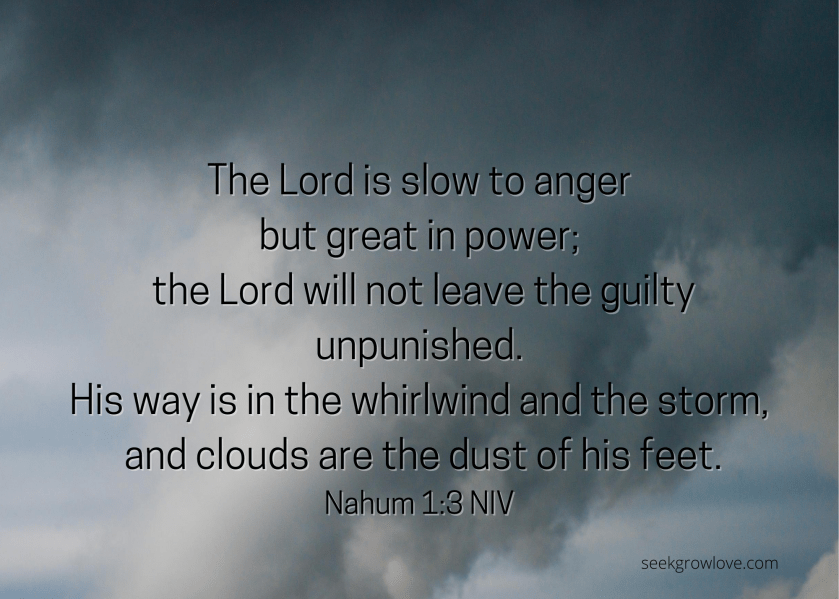
Nahum 1 3 NIV sgl

These three chapters make up the entire book of Nahum. At the beginning of this book we are told that it is the vision Nahum was given. This vision prophesied the downfall of the wicked city of Nineveh.  The language in this book is very vivid and paints a terrifying picture of the price that those in Nineveh were to pay.

God had been patient with Nineveh, but as Chapter 1 (v.3) reads, “The LORD will not leave the guilty unpunished.” The people of Nineveh had for too long relished in the ways of the flesh. The LORD could no longer tolerate the filth that they spread.

If you may recall, this is not the first time that we are introduced to the people of Nineveh in the Old Testament. A previous book, Jonah, describes how the people of Nineveh had before turned against the LORD. Eventually Jonah made it to Nineveh and told them of what God planned to do because of their wickedness. The people of Nineveh repented of their ways and the LORD preserved them. However, in Nahum, we learn that the people of Nineveh had again turned from the LORD.

An interesting part of this event is how it would have been in the grasp of the people of Nineveh to avoid such a fate. Chapter 1 even talks of how we can look to the LORD in times of trouble. It tells of his goodness and his care for those that trust in him. If only the people of Nineveh had continued to turn to the LORD rather than to sin.

Sometimes, though, it can be easier to turn away from the LORD. When we turn toward him, there are many tempting things of the flesh that we have to turn away from. Taking part in these sinful acts is not usually difficult on our part. It is easy to sin. However, the consequences that follow that sin are usually never easy. Our sin creates many issues for us in life.

This can be paralleled to how we use our time on a daily basis. Watching another episode of our favorite show on Netflix may be easier than getting work done, but in the long run, which one counts? Watching tv may feel good in the moment, but as we look back on our day, we will feel less accomplished and possibly even stressed because we may feel behind on our work. If we had worked hard at the start, we would have avoided the stress and been left with a feeling of accomplishment.

So, if we initially put in the effort to turn to the Lord and trust in him, he will be our refuge. We will be able to avoid some of the heartache and discipline that would have followed us if we took the easy way out and fell into temptation. That does not mean, though, that if we follow the Lord, we will avoid all kinds of trouble. On the contrary, there will always be storms that we face in this life. If we turn to the Lord, though, we will have a rock to stand firm on during these storms. We will not be blown away by the heavy winds.

Hannah Deane


Today’s Bible passage can be read or listened to at https://www.biblegateway.com/passage/?search=Nahum+1-3&version=NIV

Tomorrow’s Bible reading will be 2 Kings 22-23 and 2 Chronicles 34-35 as we continue the story of God’s people in the 2020 Chronological Bible Reading Plan
The Problem with Pride

2 Chronicles 32-33

2 Chronicles 32 25 NIV sgl

There are many lessons that we can learn from reading these chapters in the Bible. One of these lessons is that a proud heart can cause much trouble. For both Hezekiah and Manasseh this was an issue. Hezekiah did not want to credit the LORD, while Manasseh disregarded the LORD.

It is easy for us too to fall into this. There are times where we pray for guidance. However, once we receive the guidance we asked for, we neglect to go back to God and we just continue with our lives. We do not take the time to acknowledge the LORD’s hand in what was done and we do not do so until we feel we are again in need of him. It is easy for us to forget what he has done. The reality too, is that sometimes we like to think that we found the answers on our own. However, we would not have been capable of finding such answers without God. This situation is similar to Hezekiah when he allowed his heart to be proud and did not credit God with the successes of Jerusalem. He wanted to receive the glory that was owed to the LORD.

Other times, though, we may be able to better relate to Manasseh. During these times, we may be in outright rebellion toward God as Manasseh was. We want to do what we want. We may feel as though we do not need to listen to God because we are proud and think that we know best. We may say, “I know what I am doing.” That is until we receive a wake-up call and realize that we were not so wise in our thoughts and actions. We come to understand that we didn’t have a clue as to what we were doing. What a humbling experience this can be for our proud hearts!

This actually reminds me of a time when I was packing for a several month stent of studying abroad in Ireland. I had limited space, so I was trying to pack as lightly as possible. Because of this, I disregarded my mother’s advice to pack a small towel. I thought I was being smart. I will just get a towel when I get over there. “I know what I am doing”, I thought. This disregard for guidance offered to me by someone older and wiser than me resulted in me having to use a t-shirt as a towel for several days. Turns out that securing a towel in an unfamiliar country is not always so easy.

While this example is small in comparison, I think it shows how easily we can turn to ourselves rather than to others, and more specifically God. Even though the downfall of both Hezekiah and Manasseh were great, God forgave them when they repented. Because of the love our God has for us and the sacrifice of his son on the cross, we have the ability to be reconciled to him. That truly is something to be thankful for.

Hannah Deane


Today’s Bible reading can be read or listened to at https://www.biblegateway.com/passage/?search=2+Chronicles+32-33&version=NIV

Tomorrow’s reading will be Nahum 1-3 as we continue on the 2020 Chronological Bible Reading Plan

A King and A Tyrant

2 Kings 20-21

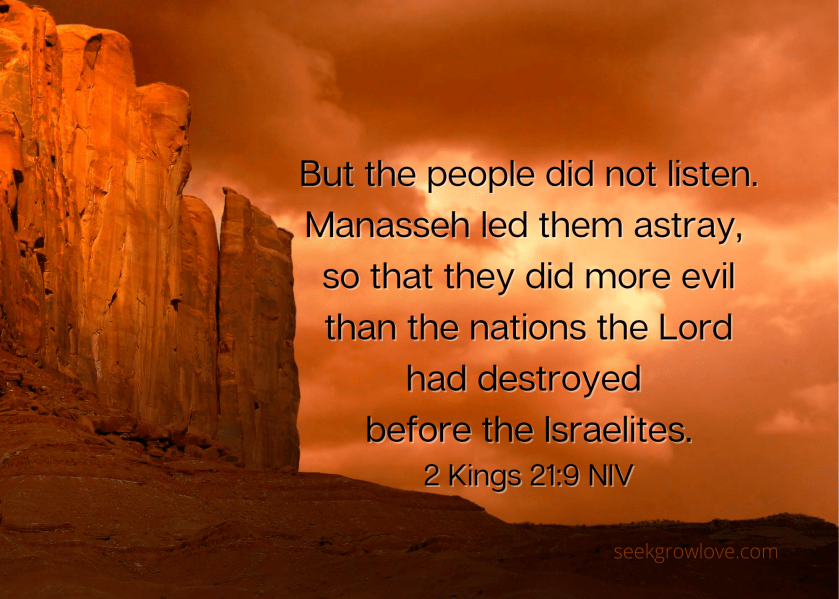
2 Kings 21 9 NIV sgl

These two short chapters make me very glad for the American political system. Before I talk about what makes our system so good, I need to talk about the system in place in the passage that we read. Chapter 20 marks the end of the reign of a good king, Hezekiah, who accomplished many good deeds in the name of God. He was an iconoclast, one who destroys religious images (as an aside, archaeological evidence confirms the iconoclasm of Hezekiah’s age, very cool). He also increased the size of the Judahite kingdom and made it into a power on par with that of the Assyrians and Babylonians. Of course, all of this was made possible by the God who went before them in battle. Of all the kings of Judah, Hezekiah can be counted among the best, and under the guidance of a king such as he, a monarchy isn’t such a bad deal.

But when your good king is replaced by a 12-year-old tyrant, things aren’t so good. Manasseh reversed all the progress that Hezekiah made toward ridding Israel of idols and images of foreign gods. Manasseh turned away from God and brought Judah down with him. This is the power of a king. If he is good, then he can accomplish great things! But if he is evil, then he can accomplish even worse things. Somehow, Manasseh survived for fifty-five years as the king of Judah. Being a murderous beast of a man can certainly turn people away from the idea of overthrowing you. Luckily for the people of Judah, his son Amon was a bit more of a weakling, giving his advisors the opportunity to assassinate him.

This is the problem with monarchies. Everyone loves a prosperous generation under a king who does good, but if you are unfortunate enough to have a bad king (and there were a lot of them in Judah and Israel’s history), then the only way to get back on the right track is to murder the guy. Luckily for the Judahites, the next in line to the throne was an 8-year-old boy who ended up becoming arguably the greatest king of Judah. I wish I could talk more about how impressive Josiah is, but our passage cuts off just before his reign begins.

To summarize: a good king is great, but a bad king can only end in bloodshed, in the form of his people’s lives or his own. God knew this when he told Samuel that establishing a kingship was a bad idea. But God let the people have what they wanted. John Locke, a 17th century political philosopher whose thoughts helped lay the groundwork for the American system, knew this and argued against it in his treatises. The American system is designed to move slow, to never be controlled by one person long enough to do lasting damage. In America, you don’t have to wait a generation just to see political reform. Maybe if you are terribly concerned with nominal tax rates and zoning laws, then you can be frustrated with the snail’s pace at which the American political system moves, but the great advantage that we have in America is the lack of despotism and regicide. This alone gives you great reason to be happy to be alive in 2020 and not in the 8th century B.C. Let us thank God that the founders of this country were men of God who believed that each person is endowed with the spark of the Divine which is the source of our authority over our own lives, thus freeing us from the whims of tyrants like Manasseh.

Nathaniel Johnson


Today’s Bible passage can be read or listened to at https://www.biblegateway.com/passage/?search=2+Kings+20-21&version=NIV

Tomorrow’s Bible reading will be 32-33 as we continue the 2020 Chronological Bible Reading Plan

A New World

Isaiah 64-66

As the new heavens and the new earth that I make will endure before me,” declares the Lord, “so will your name and descendants endure.

God called Jacob and He made the descendants of Jacob his Holy people. These are the ones who call on the name of the Lord. Yet today, there are those in Korea, China, Saudi Arabia, Kenya, Morocco, Malawi, Russia, Slovenia, Italy, Germany, France, America, Canada, Samoa, the Philippines and all over the world who know the name of the same God who called chose Jacob so many years ago. Even though they were his chosen people, God said, “Here I am, here I am” to a nation that was not called by his name (65:1). God has called Christians to the same promise that he called the Israelites. Indeed, He says “I have come to gather all nations and languages; they will come and see My glory…I will establish a sign among them, and I will send survivors from them to the nations…and the islands far away—who have not heard of My fame or seen My glory” (66:19).

Eight hundred years later, God sent a sign by the name of Jesus. Jesus himself performed sign after sign, from healing the blind (John 9) to raising the dead (John 11). The final sign was being raised from the dead himself, but this was different from the sign that he performed by raising Lazarus, for Lazarus returned to the grave. Jesus never returned to the grave; to make sure there could be no confusion, Jesus was taken up into the sky in the presence of his followers (Luke 24). The fact that Jesus was taken up is key here because it signifies his resurrection to something new, just as Isaiah prophesied that the world will be transformed into something new.

The closing words of Isaiah state that just as the new earth will endure, so will we. We will endure from new moon to new moon and from sabbath to sabbath. That is, we will continue living indefinitely. But the final verse takes a turn from the uplifting words that precede it; it promises destruction to God’s enemies, those who rebelled against him. It does leave you with a few questions though, what does it mean for their fire to never go out? It might point to an eternal suffering of those rebels as is believed by many Christians. I am not entirely sure, but asking questions that make you examine your own beliefs is important for growth. We must always be humble and accept that these prophecies are complex, and we may never fully understand them until the end has come.

Nathaniel Johnson


Today’s Bible passage can be read or listened to at https://www.biblegateway.com/passage/?search=Isaiah+64-66&version=NIV

Tomorrow’s reading will be 2 Kings 20-21 as we continue the 2020 Chronological Bible Reading Plan
Better Things are Coming

Isaiah 59-63

Isaiah 60 2 NIV sgl

Isaiah 59 describes what it is like to be separated from God as we are now. Our sins are responsible for the barrier between us and God. Because of this barrier, there is sadness, there is depravity and there is a hope for something that cannot be attained. Everything in this world is touched by this separation. Our attempts at justice are a pale reflection of the true justice that God promises. In the American courts for example, there are instances where innocent men are punished, and guilty men go free. This is not justice, but it is the closest that we are able to get to it because of our human nature. We try to imitate true justice as well as we can, but we will always fall short. We even fall short in our pursuit of truth. Even when truth is proclaimed, there will be some who accept it and some who won’t. Truth is meant to have the power to convince anyone.

The following chapter speaks of what it will be like when that barrier is broken down, when God establishes His perfect kingdom. Everything that we love now, that brings us joy, will be replaced with something better. It says, “I will bring gold instead of bronze and silver instead of iron, bronze instead of wood and iron instead of stones.” If you had no possessions and someone asked you if you’d like $20, you would be excited and would gladly accept it. But if you knew that later someone was going to give you $1000, you would be grateful, but not nearly as excited. This is the way it is in God’s perfect kingdom. When thinking about the coming kingdom, we often lament the things that we will miss doing in our current lives if Jesus were to return today. “I can’t wait for the kingdom, but I’d like to finish college first.” Or, “I’d like to have children first.” There are so many things that we look forward to in this life, but here it says that the good things will be replaced with something better, and more than that, we will still have some of the good things that we already enjoy! It says that iron is replaced with silver, but also that stone is replaced with iron. When we think about our future in God’s kingdom, it can be hard to imagine, but we have to remember that God’s ways are not our ways and that he will give us something so much better than all of the good things we have now.

Nathaniel Johnson


Today’s Bible passage can be read or listened to at https://www.biblegateway.com/passage/?search=Isaiah+59-63&version=NIV

Tomorrow we finish the book of Isaiah with chapters 64-66 as we continue working through the 2020 Chronological Bible Reading Plan

Let the Rains Fall

Isaiah 54-58

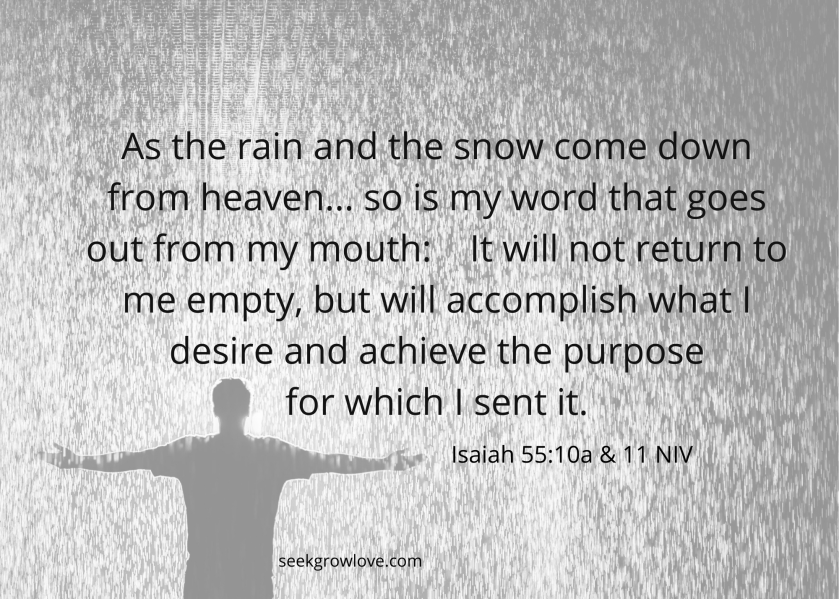
Isaiah 55 10a 11 NIV sgl

There is an endless cycle of the outpouring of God’s word followed by Man’s obedience and satisfaction before Man disobeys and becomes dissatisfied. This can manifest itself over the course of generations, as is the case in the story of Noah. God is with Man in the Garden and Man knows God. Man is obedient but his obedience quickly turns to disobedience. Once God decides it is time to pour out His Word, He speaks to Noah and Noah listens. Then the cycle repeats. We see an obedient generation in the early kingdom of Israel under David which becomes disobedient in a matter of generations. The cycle can also be seen in the life of individuals. I was fed the Word from the time I was an infant; I grew up with it and accepted it. Then I became disobedient as I became a teen only to see God’s word in a whole new light and to be brought back to obedience and satisfaction in God. In fact, I have seen this cycle no less than three times in my own life. The cycle can be a minor affair, not having to represent a complete falling out with God but instead moments of spiritual hunger and moments of spiritual contentment.

Isaiah 55:8-11 is a wonderful metaphor for this cycle. We see that God’s word is like the rain, for it exists for a purpose; it exists to nurture the earth and to bear fruit. At times the rain can come as a veritable monsoon, as in the days of the early church when men were prophesying and speaking in tongues and the church was spreading like wildfire. It can come and it can go without warning, bringing with it the full force of a thunderstorm, forcing everyone to watch in awe. It can also come gently in the night and no one will hear it.

Droughts can stretch on seemingly endlessly, but survival is still made possible by the preparations that we make during the rainy season. We store up food for ourselves so that we won’t go hungry. Droughts are tough. Some people don’t survive. Some are victims of their own inaction, unable to survive because they didn’t reap a harvest while it was available to them. Yet still others seem to be innocent, faithful in the harvest and responsible in the draught, but they fall victim to it nevertheless. It is possible that there was water nearby and all they had to do was search for it. Sometimes it requires the wisdom to move on from a place to survive a draught. After all, there is a reason that not many people live in the desert.  The draught is difficult to overcome but one thing is certain: the rain will come again.

Nathaniel Johnson


Today’s Bible reading passage can be read or listened to at https://www.biblegateway.com/passage/?search=Isaiah+54-58&version=NIV

Tomorrow’s reading will be Isaiah 59-63 as we continue on the 2020 Chronological Bible Reading Plan


I am He who says: Here I am.

Isaiah 49-53

Isaiah 58 9a NIV

I feel as though it would be a great disservice to pass over this portion of scripture and not comment on the incredible prophecies of and allusions to the Christ. So here is a comment: it is incredible. Please study this passage with a focus on the light it sheds on the history contained in the New Testament. Though I feel as though I should spend more time on this topic than those two sentences, my thoughts can’t help but be drawn to a seemingly simple, yet complex and culturally pervasive game known as “Peekaboo.”

Everyone has seen a parent play peekaboo with their infant child. They will hide behind their hands to the dismay of the child only to pop out with an exclamation of great joy from the same child. This game is not often given much thought, but it illustrates an important concept in developmental psychology known as object permanence. When an infant has yet to develop object permanence, they don’t know that an object still exists when it leaves their sight. Once they have grown and developed, they are able to understand the idea of “hiding,” and can tell that their mom or dad is still there hiding behind their hands even though they are out of the child’s sight.

Object permanence has parallel applications in all aspects of life. If you have never seen the ocean, you still know that it exists albeit with a lesser degree of knowledge than one who has been to the ocean, has seen the ocean, has been in the ocean and experienced the ocean personally. The act of knowing an object exists doesn’t extend just to objects that we can personally experience but also to those which we have no possible way of ever experiencing. We may know that the inner core of the earth is molten metal and that it is close to 10,000 °F even though we can’t see it, we can’t touch it and we may never be able to experience it in any direct way.

Of all the things that we cannot see and yet believe in, God is the one of whom we have the hardest time convincing ourselves. From the age of one, we begin to believe in things which we cannot see, which we cannot touch, which we have yet to experience. As we age and grow “wiser,” we begin to doubt that we cannot truly believe in something that we cannot experience. How foolish that is. If you have never been to the ocean, yet someone told you that it exists, would you not believe them? If a scientist told you that the inner core of the earth is 10,000 °F based on seismic and magnetic readings, would you not at least consider his claim plausible? Yet for some reason, when you tell yourself that God exists, there is a voice in the back of your head that says: “How can you believe in something you cannot see?” Again, I say: How foolish that is.

The Lord has displayed His holy arm in the sight of all the nations; all the ends of the earth will see the salvation of our God. The oral history of our God, the written history of our God and finally the life and works of Jesus Christ and those who witnessed him are an incredible power, foreseen centuries beforehand and proclaimed in the ear of a man, Isaiah, and then to the world, should be enough to convince anyone of the things unseen if only they are mature enough to see it. If you cannot see it, do not take that as a sign of your lack of faith. Instead, pray that you would develop and grow and develop the ability to believe in the things that you can’t see. It is self-evident in our experience as humans that it is indeed an ability that needs to be developed, to believe in that which we cannot see. When you cannot see God, wait and watch, for he is the one who says: Here I am.

Nathaniel Johnson


Today’s Bible passage can be read or listened to https://www.biblegateway.com/passage/?search=Isaiah+49-53&version=NIV

Tomorrow’s reading will be Isaiah 54-58 as we continue on the 2020 Chronological Bible Reading Plan