The Day God Needed a U-Haul Truck!

Ezra 1-4

ezra

Monday, November 5

God could have used a U-Haul truck when His people were allowed to go back to Jerusalem after being taken captive into Babylon for 70 years.  God moved King Cyrus of Persia to allow the repatriation of the Jews back to their home in Jerusalem.  There were a lot of people who went , especially those who were from priestly lineage.  To find out just how many people went on this journey back to Jerusalem take a calculator and add up the number of people listed in chapter 2 verses 2-65!  They also had to pack up all the dishes that were to be used in the house of God that had been previously ransacked from God’s temple in Jerusalem some 70 years before.  That’s a lot of people, and things, to move all at once.

When the Jews did return to Jerusalem they began to re-instate the priestly duties of sacrifices even though the foundation of the new temple had not yet been poured.   They also began to celebrate their festivals as was their religious custom.  Cyrus had agreed to help them build the temple so orders for the cedar wood from Lebanon which was to be used, were issued.  The main contractor of this building project was a man by the name of Zerubbabel.  His job was to take this pile of rubble and figure out how to help make it into a beautiful place for God’s temple once again.  The people were overjoyed when the foundation of the new temple was laid and a celebration was held.  Things seemed to be looking up for God’s people but then some of their jealous neighbors in the land began to complain.  They sent complaints to Cyrus and the following kings of Persia making up all sorts of claims about the Jews who had returned which were not necessarily true.  So, with the distractions of unhappy neighbors in the land, and many hassles and arguments about the rebuilding that the Jews were doing, soon they became discouraged and left the project of rebuilding God’s house undone.  Not until the second year of the reign of King Darius of Persia did the completion of the temple happen.

Having been through a recent cross country move myself what caught my eye was all those dishes that were to be used in God’s temple that had to be transported.  5,400 to be exact!  They were made of gold and silver so they would have to be packed very carefully as not to be scratched or broken.  This gives dish duty a whole new meaning.  In my move a few of my dishes broke.  Thinking about this it makes me think of how broken the city was and the temple of God was when the people returned to their beloved city.  They must have been excited at first at the prospect of going back, but once there I’m sure that seeing all the brokenness of the city must have been very discouraging.

Think about one of the greatest things God can do — He can fix what is broken.  Sometimes we may feel broken , or tossed about by the circumstances in our lives.  So did the Jews.  The good news is that God can fix what is broken.  He helped the Jews to rebuild the temple to Him, and their lives after being exiled for so long – He made them beautiful again.  He can help us too by fixing the broken parts of our lives and shaping it into something beautiful.  Key thought:  Think about how God has helped to fix the broken parts of your life and think about how He chooses to make it beautiful.

-Merry Peterson
Hey, Listen Up!

II Chronicles 35-36

2-chron-36

Sunday, December 4

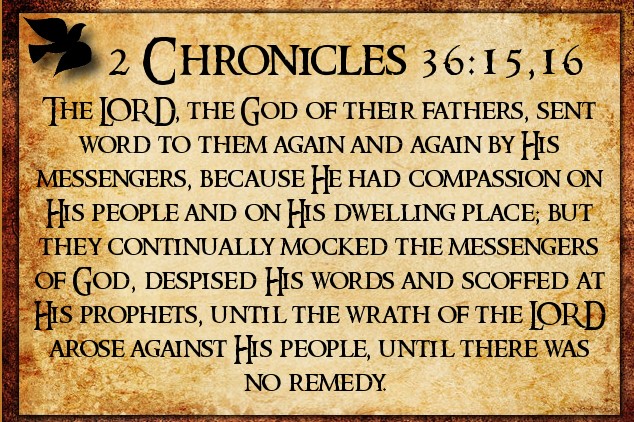
Have you ever wondered if God gets frustrated when people don’t listen to Him?  The people of Jerusalem had a great king while Josiah was ruler of Jerusalem but things quickly turned sour after his death.  Under King Josiah the people had experienced the re-instatement of the religious commemoration festivities of Passover.  The celebration was even mostly funded with animal sacrifices given by  Josiah and his officers on behalf of the laypeople.  We are told that such a tremendous Passover had not been celebrated like that in Israel since the days of Samuel the prophet, and that no other Passover celebration was quite like the one that Josiah had with the Priests of God.  But then something tragic happens.  Josiah, who normally would have listened to God, and his messengers decides to not heed God’s warning and goes to war unnecessarily where he is wounded and dies.

This is where the story of the people of Jerusalem takes a dramatic, terrible turn for the worse.  Under their next two kings who are ungodly men the country goes into a spiritual downward spiral.  The people forget the goodness of God, their devotion to Him and refused to listen to the prophets such as Jeremiah that God would send to warn the people to turn from their wicked ways.   Again, and again they were warned but they continually mocked the messengers of God, thus  raising  the wrath of God until there was no remedy.  The people and their kings did not listen, so God allowed King Nebuchadnezzar of Babylon to overtake their beloved city and carry many of the people off into exile in the land of Babylon.  To make matters worse the Babylonians carried off the sacred vessels and treasures of God’s house to their own land, slew many of the people, burned the house of God, and tore down the protective wall around Jerusalem.  The people stayed exiled in Babylon, and the city of Jerusalem lay in ruins for 70 years before God brought about a change by stirring up within Cyrus King of Persia’s spirit that the people that had been taken captive in the previous conquests should be allowed to go back to their homeland and worship in their beloved city once again.

What caught my eye in this passage is that the people would not listen and mocked the messengers of God and scoffed at the prophets God sent.  Doesn’t that  sound like the society we live in today?

Many of us have friends who are unbelievers, or even friends who claim to be Christians but their life choices and their actions don’t seem to follow God’s standards.  Many of them are doing the same thing today by scoffing at the idea that there is a God who is in control of the Universe or mocking God by not following his standards instead choosing to do whatever makes them feel good.  People often make excuses why they are the exception to God’s rules.  Does God like this?   From what we have read, God doesn’t.   Scripture reminds us that we should not be deceived, God will not be mocked, people reap what they sow.  By sowing disobedience to God, in turn God removed his protection from the people of Jerusalem and allowed them to be overtaken by enemies.

Every action has a consequence, every choice has a consequence.  Choosing not to listen to God, and honor him  has its consequences as well.  The people of Jerusalem found that out the hard way.  If only they had just  listened to  God how differently things might have turned out!     Key thought:  Choose to hear when  God is speaking to you!

-Merry Peterson


A Little About The Writer:

Merry Peterson is an Associate Pastor at Freedom In Christ Church in Welland, Ontario, Canada.  She grew up in Canada and recently moved back there after  pastoring a church in Wenatchee, Washington for 15 years.  She is a graduate of Atlanta Bible College, and Clayton State University.  She enjoys hiking, baking, reading, and often has pet goldfish.  Merry has enjoyed being at FUEL as a camper and as part of the staff. 


The Worst of Kings and the Best of Kings – Works Together for Good

2 Chronicles 33-34

romans_8-28

Saturday, December 3

Yesterday’s reading ended with an ominous sentence, “His son Manasseh succeeded him.” Manasseh might very well be the worst king of Israel. He sacrificed his own son as a burnt offering to a pagan god. He killed the prophet Isaiah. Yet when God punished him, he repented and tried to defeat the evil that he had done. However, his son was also evil, but then his grandson Josiah was one of the best kings ever in Israel.


A brief point I’d like to make on this passage: good things can create an opportunity for bad, while good can come out of bad. That sounds odd,  doesn’t it? Yet Hezekiah’s extended life, a gift from God, allowed him to produce Manasseh as an heir. Yet from the degeneration of the kingly line that began with Manasseh and continued with his son, came the best king of Israel. The point is that we cannot make predictions based on circumstances, but God will work for good whenever people will be open to him, regardless of how bad the people around them have been.


I thought of this often during the current election. People predicted dire consequences if either candidate was elected. Everyone of them could happen, but these are all human circumstances. Regardless of whether your candidate is elected or not, the only good that we can count on is what happens when people place their trust in God and act faithfully. Everything else is just a matter of circumstance.


Let’s finish this week by looking at the good that can happen when people respond to God in obedience. As unusual as it might seem, it appears that by the time of Josiah, God’s people were living by tradition rather than actually reading the Holy Scriptures. While doing the right thing and restoring the Temple, the priest Hilkiah found the book of the Law. Josiah was immediately convicted when he read these words and responded by bringing his life and the kingdom of Judah in line with the law of God. Great things happened because of it.


I really appreciate the opportunity to write these devotions this week. It thrills me that you are taking the time to read the word of God. There are many things that are difficult to understand, but good things will happen when we are obedient to the things that we do understand. One thing that I’m certain of is that obedience to what we know is the accelerator of Christian growth. In other words, we are all at different levels of spiritual maturity, but we can all grow by living the life that God reveals to us.

-Greg Demmitt

God’s Grace

2 Chronicles 30-32

2-chr-30-9-ww-cc-9x

Friday, December 2

Just a couple quick things to notice in these readings. One is that our readings this week have covered more than 200 years of Israel’s history. To put it in context of United States history, George Washington would have been president when this week started and most of you will be retired by the end of tomorrow’s reading. Just imagine how much has happened that we know nothing about. If you remember your readings in 1 and 2 Kings, you’ll notice differences in the story. I was surprised that this account does not include the sun moving backwards as a sign of  Hezekiah’s healing, nor does it give as dramatic an account of the defeat of the Assyrian king Sennacherib.

I want to focus now on 2 Chronicles 30:13-22. The back story is that Hezekiah is determined to celebrate the Passover like it had not been done since the time of Solomon. He is not content to celebrate only with those loyal to David in Judah, but has reached out to the northern tribes, many of whom have already been defeated and carried away captive by the Assyrians. Many have refused to come, but Judah graciously welcomes those who do.

Notice verses 18-20. “For a multitude of the people, many of them from Ephraim, Manasseh, Issachar, and Zebulun, had not cleansed themselves, yet they ate the passover otherwise than as prescribed. But Hezekiah prayed for them, saying, “The good LORD pardon all who set their hearts to seek God, the LORD the God of their ancestors, even though not in accordance with the sanctuary’s rules of cleanness.” The LORD heard Hezekiah, and healed the people.”

We have noticed throughout our readings that God gave strict instructions as to how his feasts were to be celebrated. Yet here we see grace, first in inviting those who were outside the faithful of Judah to celebrate the feast, and then in pardoning their mistakes in celebrating the feast. God understands human weakness.

We might imagine a person visiting our church who does not know how to behave in church. Perhaps she doesn’t know how to dress, perhaps he uses language that many would consider inappropriate. They don’t know the words to the songs, don’t know when to stand, when to sing, when to be quiet, what communion is about. Can we be glad they are with us, rather than focusing on their mess ups? How can we gracefully communicate that we are glad they are with us, welcoming them as Christ welcomes us?

-Greg Demmitt

Lessons from the Kings

2 Chronicles 26-29

2-chronicles-26-5

Thursday, December 1

In today’s passage, three out of four kings are more good than bad for a change, however one intriguing thing happens during the time of a bad king, while two good kings have different experiences in the Temple of God.


During the time of evil King Ahaz, Israel wins victories over Judah, but when they intend to treat people from Judah as slaves. a prophet of God who lives in Israel, then leaders of Ephraim also defend the captives (2 Chronicles 28:8-18). This shows that there can be people who fear God amongst those who do not. Think about how difficult it was for them to live amongst a rebellious people.


Two kings have different experiences in the Temple. Uzziah begins to reign at the age of 16 and starts out great, but becomes arrogant as he became more powerful. He decides that he will offer incense in the Temple, even though only the priests are supposed to do so. He ends up being afflicted by leprosy. In the end of today’s reading we read about Hezekiah’s great effort to purify the Temple. We might read both and wonder why God places so much emphasis upon ritual. I think it is good to take time to think about this. When we get to our readings in Hebrews we will read much more about this, but for now, just take time to think about why God gives such specific teaching about how the Temple is to be maintained.

-Greg Demmitt

Winning the Battle, but Losing the War

2 Chronicles 23-25

2-chron-25

Wednesday, November 30

I am enjoying the trailers for Rogue One, the soon-to-be-released film that chronicles the rise of the rebel alliance, setting the stage for Star Wars movies four through six. The search for the rightful ruler lies behind many such stories.


We see the same throughout Judah’s history. In today’s reading alone, we read of four different regime changes. The first is the best, as God’s priests serve as warriors defending the rightful king and overthrowing the usurping daughter of Ahab.


Stuart (1987) writes that the Chronicler likes to show immediate retribution for sin amongst God’s people, and we see that several times in today’s passage. One really sad event begins with King Amaziah trusting God and winning a battle against great odds, but then returning home to set up the defeated kingdom’s idols for Israel to worship. God’s prophet rightly asks him, “Why have you resorted to a people’s gods who could not deliver their own people from your hand?” (2 Chron. 25:15). Before long, Judah was overthrown by Israel.


Does life work like that today? How quickly do we experience the consequences of bad behavior?Sometimes it happens very quickly, but not always. The Apostle Paul warns us, “The sins of some people are conspicuous and precede them to judgment, while the sins of others follow them there. So also good works are conspicuous; and even when they are not, they cannot remain hidden.” (1 Timothy 5:24-25).


We must remember, however, that our life as Christians is not simply a matter of good things happening when we are good and bad things happening when we are bad. We are called into a life better than anything we read about in the Old Covenant because now we have entered into a wonderful new relationship with God because of what Jesus has done for us. We must not be dominated by the cycle of good and bad behavior that occurs in almost everyone, and instead live in faith that God loves us and enables us to live out our lives through the power of his Holy Spirit that dwells within us.

-Greg Demmitt

Douglas Stuart, Hosea–Jonah, WBC 31; Accordance electronic ed. (Grand Rapids: Zondervan, 1987), 262.

The Valley of Jehoshaphat

2 Chronicles 20-22

2-chron-20-12

Tuesday, November 29

Our reading today goes from Jehoshaphat’s greatest victory to the terrible things that his children and their wives did after he died. Let’s look at his great victory and the possibility of it happening again.


Numerous countries are aligned against Judah and Jehoshaphat knows that he cannot defeat them. He calls upon God and is told that his prayers will be answered. Instead of fighting Judah watched as its enemies destroyed each other.


Might that happen again? One of our older ministers, Don Ward from Missouri, wrote about the current situation in the middle east, where ISIS is directing most of its evil towards Islamic states. He said this could be a fulfillment of Joel 3:


1 For then, in those days and at that time, when I restore the fortunes of Judah and Jerusalem, 2 I will gather all the nations and bring them down to the valley of Jehoshaphat, and I will enter into judgment with them there, on account of my people and my heritage Israel, because they have scattered them among the nations.


Pastor Don pointed out that there is no valley in Israel named after Jehoshaphat, and instead suggested that it refers to 2 Chronicles 20 and the way Israel’s enemies destroyed each other, which could be what is happening now. I think that is fascinating to think about.

-Greg Demmitt

2-chron-20-15

One Foot in the World vs. Whole Hearted Devotion

2 Chronicles 17-19

2-chronicles-16

Monday, November 28

You might have noticed in your reading that 1 and 2 Samuel and 1 and 2 Kings read like history, while 1 and 2 Chronicles seem written to teach what it means to follow God rather than simply giving the history of the people. As noted in the intro to 1 Chronicles, these books might have been written after Israel returned from exile in Babylon. Since it covers material already recorded in Samuel and Kings, it would seem evident that this author has more in mind than simple history.


Here are two things to notice in today’s readings. First, Jehoshaphat made sure that the people were taught the way of God, first by sending teachers throughout the land (2 Chron. 17:7-10), and then by teaching the people how to live when they went to court to settle disputes (19:8-11). Second is the back story behind the battle alliance between Ahab and Jehoshaphat.


Before they went into battle, Jehoshaphat wanted to inquire of the Lord. All the prophets predicted success, but when he asked for one more, with reluctance Micaiah predicted that Ahab would be killed. He went on to say that God had put a lying spirit in the mouths of the prophets who curried Ahab’s favor. That certainly gives us something to think about, doesn’t it. It seems that if you want to believe the wrong thing, God will let you believe it.


So how can we know what to believe? Jehoshaphat went down the wrong road when he made alliances with a king who did not honor God. If we are trying to keep one foot in the world, we can never trust what we hear. Those who are whole-heartedly dedicated to God will not be misled.

Pastor Greg Demmitt

What Do You Put Your Trust In?

2 Chronicles 12-16

2-chronicles-16

Sunday, November 27

2Chr. 16:11   The acts of Asa, from first to last, are written in the Book of the Kings of Judah and Israel. 12 In the thirty-ninth year of his reign Asa was diseased in his feet, and his disease became severe; yet even in his disease he did not seek the LORD, but sought help from physicians. 13 Then Asa slept with his ancestors, dying in the forty-first year of his reign. 14 They buried him in the tomb that he had hewn out for himself in the city of David. They laid him on a bier that had been filled with various kinds of spices prepared by the perfumer’s art; and they made a very great fire in his honor.


I first noticed these verses, the last four of today’s reading, during the summer before my senior year in high school, when I read through the entire Bible for the very first time. That raised a lot of questions in my mind, especially if it meant that we were not supposed to go to doctors but instead trust that God would heal us without any medical intervention.


When you read today’s scripture, you’ll notice that it wasn’t the first time that Asa didn’t trust God. His rule as king started out great as he got rid of the idol worship in Judah, even confronting his mother for her idolatry. Because of this God gave him a victory over a huge army that invaded out of Ethiopia and Libya. However, later when the northern tribes of Israel threatened Judah, he made an alliance with the king of Aram rather than trusting God to deliver him from a much smaller army than that of Ethiopia and Libya. So the way that he treated his illness was a symptom of his lack of trust in God, rather than simply a misunderstanding about healing.


So is it wrong to get medical help? I don’t think this text speaks directly to modern medicine, but rather to a practice of medicine that was more like going to a witch doctor than a physician. If you have a splinter, you pull it out with tweezers instead of waiting for God to miraculously remove it. Many things in modern medicine are as clear to doctors as pulling a splinter is for us. I cannot imagine that it is wrong to use what has been learned through using the brains God has given us in order to make life better for people. I am thankful for the advances in medicine that helped defeat my cancer last year, even though I am also very thankful to God for getting me through it.


The bigger question is, are we willing to trust God when we are afraid? Asa forgot what God had done for him, and showed it by making the wrong alliances. Can we remember what God has done for us?


Each one of us can ask ourselves the question, “How do I demonstrate my trust in God in the life I am living?”

– Pastor Greg Demmitt  (Gatesville, Texas)

Kings and Queens Make a Full House

II Chronicles 8-11

queen-of-sheba

Saturday, November 26

Solomon has completed building the Temple and his house and has moved on to building cities. Everything Solomon touched was lavished with beauty and excess. He built one entire city for the purpose of housing his many horses and chariots. That is one way to build a name and gain a reputation. As word of Solomon traveled outward to other nations, interest grew to understand what this king was all about. Solomon shows that his desire to build was for his own pleasure and he enjoyed the benefits that his talents garnered. He was a man on display. He worked hard to share how God had chosen him to bless the nation of Israel and show justice and righteousness to God’s children.

One thing that was lost on Solomon was that God was the creator of all and wanted Israel to be a light to the nations. Instead  he would not allow Israel to do certain jobs he felt beneath them and would take nations as slaves and indentured servants to do the ugly work.

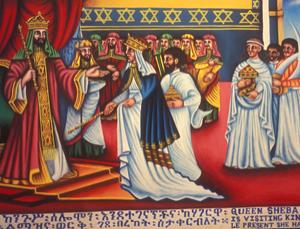
When the Queen of Sheba heard of Solomon she traveled herself to see if what she was hearing was true. And indeed she found him to be a man full of wisdom and in control of vast lands and wealth. After swooning over all his fame and power, she tells King Solomon, “It was a true report that I heard in my own land of your acts and of your wisdom. However I didn’t believe their words until I came, and my eyes had seen it; and behold, the half of the greatness of your wisdom wasn’t told me: you exceed the fame that I heard.” II Chron. 9:5-6

Even though Queen Sheba had heard the truth, it did not resonate with her until she saw it for herself. Others bringing word to her was not enough. King Solomon sounded too good to be true. This is why it is so important to be living out the word of God in our lives so that the message of Christ rings true to those who observe His truth in action. I can write this out using the electronic medium at our disposal today and maybe be a witness to some on God’s behalf; but it is the personal relationships that we create that witness into people’s lives and situations at a much more powerful level.

Solomon understood about God. He even spent an incredible amount of time and resources devoted to sharing Yahweh with others. Solomon was wonderful at telling others what would be best in any given circumstance, but he was not so good at heeding his own lessons. He is like some we witness who gain power and begin to feel they are above the law.

Years ago Brother Billie Kennedy said in a message at Camp Mack (yes, I am going back that far in my memory bank!) “Some people will miss the kingdom of God by 18 inches because that is how far it takes to get from your head to your heart.” That last few feet is the hardest step of all at times, but when we reach that final destination I am hoping for a full house and do not want anyone to miss out by just a few inches.

If the Queen of Sheba thought putting in the effort to check out the truth of who King Solomon was, how much more should we seek out the truth of God’s love and mercy toward all of his children.

-Glennis Walters