God’s Grace

2 Chronicles 30-32

2-chr-30-9-ww-cc-9x

Friday, December 2

Just a couple quick things to notice in these readings. One is that our readings this week have covered more than 200 years of Israel’s history. To put it in context of United States history, George Washington would have been president when this week started and most of you will be retired by the end of tomorrow’s reading. Just imagine how much has happened that we know nothing about. If you remember your readings in 1 and 2 Kings, you’ll notice differences in the story. I was surprised that this account does not include the sun moving backwards as a sign of  Hezekiah’s healing, nor does it give as dramatic an account of the defeat of the Assyrian king Sennacherib.

I want to focus now on 2 Chronicles 30:13-22. The back story is that Hezekiah is determined to celebrate the Passover like it had not been done since the time of Solomon. He is not content to celebrate only with those loyal to David in Judah, but has reached out to the northern tribes, many of whom have already been defeated and carried away captive by the Assyrians. Many have refused to come, but Judah graciously welcomes those who do.

Notice verses 18-20. “For a multitude of the people, many of them from Ephraim, Manasseh, Issachar, and Zebulun, had not cleansed themselves, yet they ate the passover otherwise than as prescribed. But Hezekiah prayed for them, saying, “The good LORD pardon all who set their hearts to seek God, the LORD the God of their ancestors, even though not in accordance with the sanctuary’s rules of cleanness.” The LORD heard Hezekiah, and healed the people.”

We have noticed throughout our readings that God gave strict instructions as to how his feasts were to be celebrated. Yet here we see grace, first in inviting those who were outside the faithful of Judah to celebrate the feast, and then in pardoning their mistakes in celebrating the feast. God understands human weakness.

We might imagine a person visiting our church who does not know how to behave in church. Perhaps she doesn’t know how to dress, perhaps he uses language that many would consider inappropriate. They don’t know the words to the songs, don’t know when to stand, when to sing, when to be quiet, what communion is about. Can we be glad they are with us, rather than focusing on their mess ups? How can we gracefully communicate that we are glad they are with us, welcoming them as Christ welcomes us?

-Greg Demmitt
Lessons from the Kings

2 Chronicles 26-29

2-chronicles-26-5

Thursday, December 1

In today’s passage, three out of four kings are more good than bad for a change, however one intriguing thing happens during the time of a bad king, while two good kings have different experiences in the Temple of God.


During the time of evil King Ahaz, Israel wins victories over Judah, but when they intend to treat people from Judah as slaves. a prophet of God who lives in Israel, then leaders of Ephraim also defend the captives (2 Chronicles 28:8-18). This shows that there can be people who fear God amongst those who do not. Think about how difficult it was for them to live amongst a rebellious people.


Two kings have different experiences in the Temple. Uzziah begins to reign at the age of 16 and starts out great, but becomes arrogant as he became more powerful. He decides that he will offer incense in the Temple, even though only the priests are supposed to do so. He ends up being afflicted by leprosy. In the end of today’s reading we read about Hezekiah’s great effort to purify the Temple. We might read both and wonder why God places so much emphasis upon ritual. I think it is good to take time to think about this. When we get to our readings in Hebrews we will read much more about this, but for now, just take time to think about why God gives such specific teaching about how the Temple is to be maintained.

-Greg Demmitt

Winning the Battle, but Losing the War

2 Chronicles 23-25

2-chron-25

Wednesday, November 30

I am enjoying the trailers for Rogue One, the soon-to-be-released film that chronicles the rise of the rebel alliance, setting the stage for Star Wars movies four through six. The search for the rightful ruler lies behind many such stories.


We see the same throughout Judah’s history. In today’s reading alone, we read of four different regime changes. The first is the best, as God’s priests serve as warriors defending the rightful king and overthrowing the usurping daughter of Ahab.


Stuart (1987) writes that the Chronicler likes to show immediate retribution for sin amongst God’s people, and we see that several times in today’s passage. One really sad event begins with King Amaziah trusting God and winning a battle against great odds, but then returning home to set up the defeated kingdom’s idols for Israel to worship. God’s prophet rightly asks him, “Why have you resorted to a people’s gods who could not deliver their own people from your hand?” (2 Chron. 25:15). Before long, Judah was overthrown by Israel.


Does life work like that today? How quickly do we experience the consequences of bad behavior?Sometimes it happens very quickly, but not always. The Apostle Paul warns us, “The sins of some people are conspicuous and precede them to judgment, while the sins of others follow them there. So also good works are conspicuous; and even when they are not, they cannot remain hidden.” (1 Timothy 5:24-25).


We must remember, however, that our life as Christians is not simply a matter of good things happening when we are good and bad things happening when we are bad. We are called into a life better than anything we read about in the Old Covenant because now we have entered into a wonderful new relationship with God because of what Jesus has done for us. We must not be dominated by the cycle of good and bad behavior that occurs in almost everyone, and instead live in faith that God loves us and enables us to live out our lives through the power of his Holy Spirit that dwells within us.

-Greg Demmitt

Douglas Stuart, Hosea–Jonah, WBC 31; Accordance electronic ed. (Grand Rapids: Zondervan, 1987), 262.

The Valley of Jehoshaphat

2 Chronicles 20-22

2-chron-20-12

Tuesday, November 29

Our reading today goes from Jehoshaphat’s greatest victory to the terrible things that his children and their wives did after he died. Let’s look at his great victory and the possibility of it happening again.


Numerous countries are aligned against Judah and Jehoshaphat knows that he cannot defeat them. He calls upon God and is told that his prayers will be answered. Instead of fighting Judah watched as its enemies destroyed each other.


Might that happen again? One of our older ministers, Don Ward from Missouri, wrote about the current situation in the middle east, where ISIS is directing most of its evil towards Islamic states. He said this could be a fulfillment of Joel 3:


1 For then, in those days and at that time, when I restore the fortunes of Judah and Jerusalem, 2 I will gather all the nations and bring them down to the valley of Jehoshaphat, and I will enter into judgment with them there, on account of my people and my heritage Israel, because they have scattered them among the nations.


Pastor Don pointed out that there is no valley in Israel named after Jehoshaphat, and instead suggested that it refers to 2 Chronicles 20 and the way Israel’s enemies destroyed each other, which could be what is happening now. I think that is fascinating to think about.

-Greg Demmitt

2-chron-20-15

One Foot in the World vs. Whole Hearted Devotion

2 Chronicles 17-19

2-chronicles-16

Monday, November 28

You might have noticed in your reading that 1 and 2 Samuel and 1 and 2 Kings read like history, while 1 and 2 Chronicles seem written to teach what it means to follow God rather than simply giving the history of the people. As noted in the intro to 1 Chronicles, these books might have been written after Israel returned from exile in Babylon. Since it covers material already recorded in Samuel and Kings, it would seem evident that this author has more in mind than simple history.


Here are two things to notice in today’s readings. First, Jehoshaphat made sure that the people were taught the way of God, first by sending teachers throughout the land (2 Chron. 17:7-10), and then by teaching the people how to live when they went to court to settle disputes (19:8-11). Second is the back story behind the battle alliance between Ahab and Jehoshaphat.


Before they went into battle, Jehoshaphat wanted to inquire of the Lord. All the prophets predicted success, but when he asked for one more, with reluctance Micaiah predicted that Ahab would be killed. He went on to say that God had put a lying spirit in the mouths of the prophets who curried Ahab’s favor. That certainly gives us something to think about, doesn’t it. It seems that if you want to believe the wrong thing, God will let you believe it.


So how can we know what to believe? Jehoshaphat went down the wrong road when he made alliances with a king who did not honor God. If we are trying to keep one foot in the world, we can never trust what we hear. Those who are whole-heartedly dedicated to God will not be misled.

Pastor Greg Demmitt

What Do You Put Your Trust In?

2 Chronicles 12-16

2-chronicles-16

Sunday, November 27

2Chr. 16:11   The acts of Asa, from first to last, are written in the Book of the Kings of Judah and Israel. 12 In the thirty-ninth year of his reign Asa was diseased in his feet, and his disease became severe; yet even in his disease he did not seek the LORD, but sought help from physicians. 13 Then Asa slept with his ancestors, dying in the forty-first year of his reign. 14 They buried him in the tomb that he had hewn out for himself in the city of David. They laid him on a bier that had been filled with various kinds of spices prepared by the perfumer’s art; and they made a very great fire in his honor.


I first noticed these verses, the last four of today’s reading, during the summer before my senior year in high school, when I read through the entire Bible for the very first time. That raised a lot of questions in my mind, especially if it meant that we were not supposed to go to doctors but instead trust that God would heal us without any medical intervention.


When you read today’s scripture, you’ll notice that it wasn’t the first time that Asa didn’t trust God. His rule as king started out great as he got rid of the idol worship in Judah, even confronting his mother for her idolatry. Because of this God gave him a victory over a huge army that invaded out of Ethiopia and Libya. However, later when the northern tribes of Israel threatened Judah, he made an alliance with the king of Aram rather than trusting God to deliver him from a much smaller army than that of Ethiopia and Libya. So the way that he treated his illness was a symptom of his lack of trust in God, rather than simply a misunderstanding about healing.


So is it wrong to get medical help? I don’t think this text speaks directly to modern medicine, but rather to a practice of medicine that was more like going to a witch doctor than a physician. If you have a splinter, you pull it out with tweezers instead of waiting for God to miraculously remove it. Many things in modern medicine are as clear to doctors as pulling a splinter is for us. I cannot imagine that it is wrong to use what has been learned through using the brains God has given us in order to make life better for people. I am thankful for the advances in medicine that helped defeat my cancer last year, even though I am also very thankful to God for getting me through it.


The bigger question is, are we willing to trust God when we are afraid? Asa forgot what God had done for him, and showed it by making the wrong alliances. Can we remember what God has done for us?


Each one of us can ask ourselves the question, “How do I demonstrate my trust in God in the life I am living?”

– Pastor Greg Demmitt  (Gatesville, Texas)

Kings and Queens Make a Full House

II Chronicles 8-11

queen-of-sheba

Saturday, November 26

Solomon has completed building the Temple and his house and has moved on to building cities. Everything Solomon touched was lavished with beauty and excess. He built one entire city for the purpose of housing his many horses and chariots. That is one way to build a name and gain a reputation. As word of Solomon traveled outward to other nations, interest grew to understand what this king was all about. Solomon shows that his desire to build was for his own pleasure and he enjoyed the benefits that his talents garnered. He was a man on display. He worked hard to share how God had chosen him to bless the nation of Israel and show justice and righteousness to God’s children.

One thing that was lost on Solomon was that God was the creator of all and wanted Israel to be a light to the nations. Instead  he would not allow Israel to do certain jobs he felt beneath them and would take nations as slaves and indentured servants to do the ugly work.

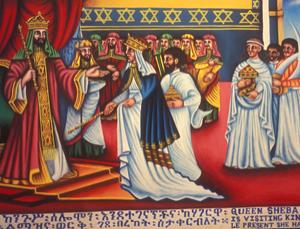
When the Queen of Sheba heard of Solomon she traveled herself to see if what she was hearing was true. And indeed she found him to be a man full of wisdom and in control of vast lands and wealth. After swooning over all his fame and power, she tells King Solomon, “It was a true report that I heard in my own land of your acts and of your wisdom. However I didn’t believe their words until I came, and my eyes had seen it; and behold, the half of the greatness of your wisdom wasn’t told me: you exceed the fame that I heard.” II Chron. 9:5-6

Even though Queen Sheba had heard the truth, it did not resonate with her until she saw it for herself. Others bringing word to her was not enough. King Solomon sounded too good to be true. This is why it is so important to be living out the word of God in our lives so that the message of Christ rings true to those who observe His truth in action. I can write this out using the electronic medium at our disposal today and maybe be a witness to some on God’s behalf; but it is the personal relationships that we create that witness into people’s lives and situations at a much more powerful level.

Solomon understood about God. He even spent an incredible amount of time and resources devoted to sharing Yahweh with others. Solomon was wonderful at telling others what would be best in any given circumstance, but he was not so good at heeding his own lessons. He is like some we witness who gain power and begin to feel they are above the law.

Years ago Brother Billie Kennedy said in a message at Camp Mack (yes, I am going back that far in my memory bank!) “Some people will miss the kingdom of God by 18 inches because that is how far it takes to get from your head to your heart.” That last few feet is the hardest step of all at times, but when we reach that final destination I am hoping for a full house and do not want anyone to miss out by just a few inches.

If the Queen of Sheba thought putting in the effort to check out the truth of who King Solomon was, how much more should we seek out the truth of God’s love and mercy toward all of his children.

-Glennis Walters

If and Then

2 Chronicles 5-7

2-chron-7-14

Friday, November 25

Sitting by my nephew tonight during our Thanksgiving meal I witnessed a typical ‘If and Then’ moment. “If you finish your turkey, then you can have dessert.” It’s a generally easy concept to understand and often times harder to live. Do you recall “If you eat of the tree, then you will surely die?”

These chapters in Chronicles hold many if and then scenarios. The Temple is built and praise is lavished upon God and Solomon alike. God offers that if the people who are called by his name keep their covenants then he will bless them. If the people reject him and break covenant with Him, then he will turn away from blessing them.

In the beginning God walked with His son. His creation. His love. God was not interested in Kings and Temples. What He desired was a one on one relationship with individuals. God relented and gave Israel a King. God allowed the Temple to be built, but it was not His plan, but David’s.

In Chapter 6:20 Solomon instructs the people to pray toward the Temple. God is being put into a box where He can be contained in the mind of Solomon and as a result the people of Israel. Solomon was creating a divide between men and his creator. God always lets us know He is longing for intimate contact and consistently seeks ways to bring us back into a relationship that centers on looking toward Him.

Solomon’s Prayer of Dedication over the temple is worth the read. There is more ‘if’ and ‘then’ bargaining going on. Most end with if (when) you sin, then turn again to God and repent. He wasn’t referring to a turning toward the Temple where he surmised God would dwell, but turn toward God’s goodness and mercy and see His rightness against any sin or ‘wrongness’.

God specifically told David He did not need or want a house built, that His preference was to walk with the people as they traveled about. God inhabited the praises of His people as they worshiped at the Temple, but the Temple was more about Israel’s need to have a place to point toward than a place where God wanted to dwell. God replies to Solomon’s prayer of dedication over the Temple with a response of His own. After many ‘if’ statements regarding specific behaviors and consequences God ends with a popular verse all of us have heard.

II Chronicles 7:14~ If My people who are called by My name shall humble themselves, and pray, and seek My face,  and turn from their wicked ways; Then will I hear FROM HEAVEN , and will forgive their sin, and will heal their land.”

The if and then list that finishes out the chapter describes in detail the consequences of following after other gods and building idols for them to dwell among them. God wants to walk with us daily, just as He did in the beginning of time with Adam and Eve. Anything that prevents taking that daily walk or trying to box God into a safe space to visit occasionally is simply an idol and false worship.

‘If’ and ‘then’ is still at work in our lives today. If you call upon His name, then He will hear and begin the healing that needs to take place. God is still looking for a place to live. Make room in your life today.

-Glennis Walters


Ask What I Shall Give You

The Second Book of Chronicles Chapters 1-4

Book of 2 Chronicles

Thursday, November 23

The life of King David comes to an end and ushers in the life and times of

King Solomon. II Chronicles opens with “Solomon the son of David was strengthened in his kingdom, and Yahweh his God was with him, and magnified him exceedingly.”  This verse would be a great way to end the story of his life, but these are the early years when he was still seeking after God.

Solomon decided since his kingdom was in order he was going to reward himself and prepare a feast for his friends and family and fans to attend. He also offered great sacrifices to God. It was a partay magnificent~ He was consumed with doing everything right and pleasing God, but his spirituality was more of a surface variety and didn’t hold up to future challenges.

After the great amount of feasting and great amount of offerings, God came to Solomon in a dream that night and tells him to “ask what I shall give you.” I had never noticed this before. I had always assumed that God told him to ask for whatever he wanted. God was ready to tell Solomon something important and instead Solomon reminds God how he had shown grace to David and explains to God how he needs wisdom and knowledge to be a leader and judge Gods people.

God gives Solomon what he asked for and then tells him that all he achieves will be additional gifts from God. His riches, wealth, honor unlike any before him or after him will be from the hand of God. Solomon goes on to do marvelous deeds. He builds the temple and his own personal home (Palace) and hanging gardens that were the envy of the world. Leaders came from far away, just as God promised to bow down and offer gifts. He is a man on the rise. Only he isn’t the messiah, and he is also ready for a fall.

David had prayed that Solomon would be the Messiah and at times Solomon seems to believe he was. David prayed specific prayers over Solomon (Psalms 72) and he seems to try and live up to his father’s desires, but he falls short. Solomon, for all his wisdom and attempts at trying to be the messiah fails and shows us once again the need for a true savior.

I think we all need to look at v.7 again and put our name in place of Solomon.  “In that night (after feasting and worshiping God and giving gifts to God for all his blessings) God appeared to _______ and said, Ask what I shall give you.

“Ask what I shall give you!”…. He is our reason for all our Thanksgiving. Find a way today to bridge a gap or help heal a hurt or simply remind someone how much God has given and stands ready to give.

Glennis Walters


Counted Faithful: Are You a Grain of Sand or a Star in the Sky?


(I Chronicles 27-29)

1chronicles-2820

Wednesday, November 23

“And so a whole nation came from this one man who was as good as dead–a nation with so many people that, like the stars in the sky and the sand on the seashore, there is no way to count them.” Hebrews 11:12

When I was around 8 years old I heard a pastor give a message titled “Are you a man or a mouse?” That title stuck with me because of the imaging that went on in my mind. Reading through I Chronicles 27-29 I kept wondering if I would be considered a star in the night sky or a grain of sand along the seashore.

King David had ordered a census of Israel, but in Chapter 27:23 we learn, “but David didn’t take the number of them from twenty years old and under, because Yahweh had said He would increase Israel like the stars of the sky.” They could have been counted to arrive at a number, but the faith of Abraham was still at work and was not to be discounted in the mind of David. He was looking expectantly toward the future and all who were to be added to that number.

We are a part of that number. And since I am beyond 20 years, I am wondering if my place is among the sands of the sea. I hope you all realize this is a bit tongue and cheek; but it does leave an image in my mind worth exploring. The idea of movement and brightness and dancing across the sky is a lot like children full of laughter chasing fireflies in the night.f

Lying on the ground as a grain of sand among the masses; with life washing over us and moving us along to different moments, circumstances and even settling among different groups of individuals does seem to fit my post 20 years a bit easier. Even the idea of being trampled upon by those unable to realize we are foundational to their days of relaxation seems to fit many of my days.

But the promise of God was not in counting the value of days, or the counting of the value in people. It was a counting of the faithfulness of God and what He is able to produce in the lives of those who trust in Him. It was a recounting of His giving life from what was impending death.

King David was not allowed to build the Temple for Yahweh, but that didn’t prevent him from gathering necessary provisions and having them ready for the project his son Solomon would oversee as King. Throughout Chapter 29 David acknowledges that all we have to offer back to God was given to us by God in the first place and still belongs to God. David’s reign was coming to an end, but he had faith in what God had promised and the life that was yet to come.


            “I know also, my God, that you try the heart, and have pleasure in uprightness. As for me, in the uprightness of my heart I have willingly offered all these things.”  King David                1 Chronicles 29:17


As we offer up ourselves and seek to build the Temple of God in our lives, keep in mind all we have to give is God’s already. We can count all our moments shining like a star in the heavens or count the days pressed along the edge of powerful events that truly are out of our control. We can even count our resources down to the penny. Or, we can live in faith, trusting God to supply our needs and fulfill His plans for our life as we give ourselves back to Him.

Keep shining the glory of God in purposeful ways throughout your day. And if you feel walked upon, know that God is looking at your heart and He wants to count you faithful.

Glennis Walters