~ Devotion by Cayce Fletcher (SC)
Cayce Fletcher is a wife and homeschool mom of three. She writes and podcasts at amorebeautifullifecollective.com where she helps women grow in grace, build with purpose, and live beautifully. Read the latest post in the Systematic Theology series here.
I was recently tasked with an errand by my husband. I was to go to the store and return to silt screens (big tarps with pickets attached to help with run-off on construction sites). When I pulled up to the store, I noticed there were no carts nearby, so I tried – with my three-year-old daughter in tow – to somehow lift the two rolls while she hung onto my shirt. (Any moms reading this probably are nodding their heads. You’ve done something similar.)
As we walked through the parking lot, I could feel the plastic start to slip down, and white-knuckling it, I tried to maneuver the tarps to the side to lift it back up without stopping in the middle of the road. About that time, a guy walked up with his wife and child, looked over, and immediately said, “Hey, do you need help with that?” Laughing, I responded that help would be great.
No matter who you are, this truth applies to you: We are all limited by our bodies. As parents with more than two children like to say, you only have two hands. We can only lift so much, and even the strongest person in the world has a limit to their ability. (If you are wondering, that title goes to Hafþór Júlíus Björnsson, who deadlifted 1,124 lbs(!).) We can only carry so much.
Today’s readings dealt with the idea of carrying burdens. In 1 Chronicles 14-15, we read the second part of the ark’s journey back to Jerusalem. After Uzzah died when the men tried to return the ark on a cart, David left the ark at a man’s house. In 1 Chronicles 15, David had done his research, and this time, he brought Levites who would carry the ark in the proper way back to Jerusalem.
Exodus 25:10-22 describes the way that the ark was meant to be carried – the ark was to be lifted up on poles. According to BibleHub, “The method of carrying the Ark on poles symbolizes the separation between the divine and the human, emphasizing God’s holiness and the need for reverence in worship. It also signifies the role of the Levites as mediators between God and the people, entrusted with the sacred duty of handling holy objects.”
Carrying the ark was the burden of the Israelites – one they could not shirk without dire circumstances.
In Galatians 6, we read more about burdens, but in this passage, we read about our own burdens as the new royal priesthood. After Paul lays out the freedom we find in Christ in the first half of Galatians, he then moves to encourage the people ‘to not bite and devour one another’ (Gal. 5:15) and instead produce fruit in keeping with the Spirit (Gal. 5:22-23).
In Galatians 6, he turns his focus from our own individual spiritual growth to how we can support each other in overcoming sin. In Galatians 6:2, we read, “Carry one another’s burdens; in this way you will fulfill the law of Christ.” The Enduring Word Commentary explains it like this, “When Paul brought up the idea [in verse 1] of the one overtaken in any trespass, it painted the picture of a person sagging under a heavy load. Here he expanded the idea to encourage every Christian to bear one another’s burdens.”
We don’t bear the weight as the Levites did of the ark. We are not the mediator between God and the people. But, we can lift each other up – just as the Levites lifted up the ark – towards God. When we come alongside each other and support one another in our spiritual growth, we are doing the good work we are called to do (verse 9-10).
Interestingly, right after this passage, we have a seeming contradiction in verse 5 when Paul seems to say that each person will have to carry their own load.
Some commentators say that this is due to the differences in translation. Load, in verse 2, comes from a word that emphasizes the heaviness of the burden. It paints the burden as excessive, something you would stumble under. Whereas in verse 5, load or burden is a word that comes from the word for a backpack a soldier would have. Verse 5 is in reference to loads that other people cannot carry for us (think: calling, marriage, family, etc.).
Other commentators say that this is actually a counter-example. Verse 2 is the optimal, Spirit-led response to burdens: We should bear each other’s burdens. However, if we want to respond ‘in the flesh’, we may try to think of ourselves as more highly than we ought. We take pride in ourselves alone and are responsible for our own work. Thus, we have to shoulder our own burdens.
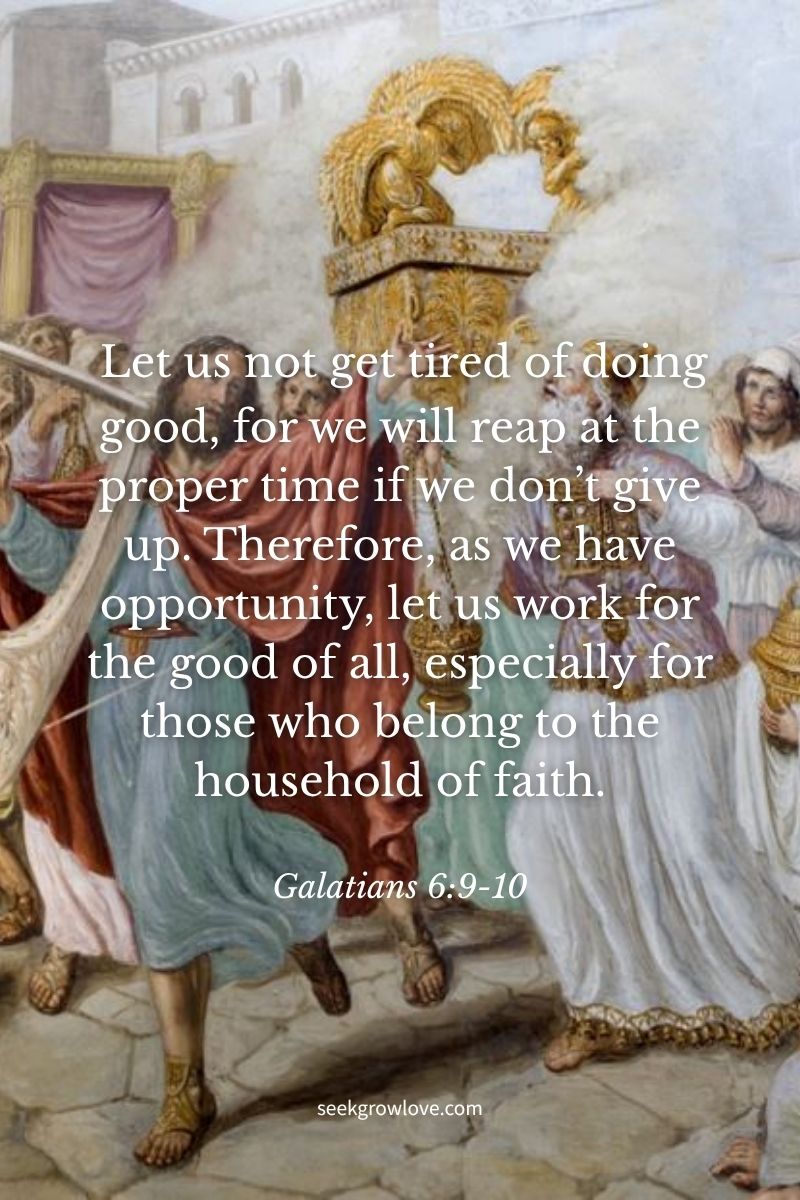
Verse 9-10 sum up our work and should be our motto as we do ministry: “Let us not get tired of doing good, for we will reap at the proper time if we don’t give up. Therefore, as we have opportunity, let us work for the good of all, especially for those who belong to the household of faith.” Amen!
Reflection Questions
- Why do you believe the ark had to be carried in this way? What does it symbolize?
- What do you think is the most likely interpretation of Galatians 6:2-5?
- What is a burden you could share with others? And, what is a burden someone has that you can help bear?
Prayer
Lord,
Please help us to be a people who support one another, not bite and devour one another. Help us to lift each other up to you. Let us not grow weary of doing good.
In Jesus’ name,
Amen.