
Unleavened

Old Testament: Joshua 11 & 12

Poetry: Psalm 50

New Testament: 1 Corinthians 5

As is frequent with God’s word, we see connections, themes, and promises fulfilled which transcend centuries, and today’s readings are an example of this. From our Old Testament reading of Joshua we see a thorough purging and annihilation of pagan people who were not followers of God in the land God wanted inhabited by his chosen people. Terms like “captured”, “struck every person”, “no survivor”, and “utterly destroyed” used more than once paint a pretty clear picture of what Joshua and the Israelites were busy doing. But, why? That is also repeated throughout, and while it could be summed up as “God said so”, it seems more beautifully stated in Joshua 11:15,

“Just as the Lord had commanded His servant Moses, so Moses commanded Joshua, and so Joshua did; he left nothing undone of all that the Lord had commanded Moses.” New American Standard Bible (La Habra, CA: The Lockman Foundation, 2020), Jos 11:15.

Over a thousand years later, our New Testament reading in 1 Corinthians written to the church in Corinth also references instructions on purging out the evil. And just like the pagan people and cultures surrounding and within the promised land in the time of Joshua, Corinth was certainly a place full of evil. A city known for immorality (not immortality as I just accidentally typed!), for all varieties of sexual sins and deviance, statues and idols of lovely false gods like Aphrodite and none other than a thousand prostitutes kept busy at the temple. One could imagine as new converts came out of this culture to Christianity, and for the existing church functioning within that society, there were some things that needed cleaned up. And then there were some things that just straight up needed called out, purged, and done away with. Finding ourselves progressed another couple thousand years from there, I think we can relate.

Tomorrow, the Jewish people and those celebrating Passover will be starting their remembrances and celebrations. I really like that the Jewish holidays have Biblical and spiritual meanings, and Passover is directly mentioned in our New Testament reading today. One instruction the Hebrews were given for the Passover was to remove the yeast/leaven from their homes on the first day. Today, there are all sorts of traditions on how to do this for Passover including varieties of special cutlery and cleaning to remove every speck of potential leaven from  cookware to corners of homes and cabinets. Even the kids are apparently often helpful at finding those hard to reach remnants. As Christians according to 1 Corinthians 5, we know Jesus is our Passover lamb, which brought about a huge culture change, and one I am incredibly thankful for because I absolutely do not want to be doing anything with the blood of lambs or goats! But, while Jesus’s sacrificial life and death is a tremendous gift and blessing that reconciles us with God, scripture also tells us we can’t just be thankful for Jesus and leave whatever filth we have in our lives, homes, and churches.  Leaven is often correlated to sin in scripture, and today’s reading is very clear. Leaven is not good in this case. It will creep into every corner of the loaf. It contaminates. If we tolerate evil, we will contaminate ourselves and the body of Christ if we are a member of it. If we ignore it and don’t even look for the small hidden pieces of leaven in our lives, the leaven is very efficient at growing, attracting bugs, and all the rest.

We are forgiven and cleansed through our Messiah who took the place of the Old Testament sacrifices. We also know we are human beings living in another Corinth, and it is easy to be deceived when society is screaming “that’s not leaven, that’s just fine”.  May we all prayerfully consider the internal, spiritual leaven within ourselves along with any other things we might be cleaning up this spring. While smudges on windows, crumbs under the stove, and dead leaves in landscaping simply do not matter in the big picture, the spiritual stuff is a life and death matter. I love these verses in Psalm 19: 12-14 which talk about intently looking for the hidden pieces of leaven in our hearts.

But who can discern their own errors?

Forgive my hidden faults.

Keep your servant also from willful sins;

may they not rule over me.

Then I will be blameless,

innocent of great transgression.

May these words of my mouth and this meditation of my heart

be pleasing in your sight,

Lord, my Rock and my Redeemer.

-Jennifer Hall

Questions:

1. What similarities do you see between the culture in Joshua’s day, the city of Corinth, and today?

2. Have you ever seen someone’s sin in the body of Christ negatively impact others in the church family?

3. What challenges do you and the church face in identifying sin and right/pure actions from a Biblical worldview in today’s society?

A Brother in Sin

1 Corinthians 5

June 6

As we continue past the previous chapters of 1 Corinthians, that of leadership in the church and the nature of true apostleship, we enter a new section that is initially and seemingly unrelated to the current mood of Paul’s letter. It feels kind of awkward to talk about certain sins and topics, today’s being incest, because it is so obviously horrendous that it almost feels like a waste of breath to talk about. However, this negligence is precisely why we need to discuss such things, so that they do not become the normative culture. (As is seen with a plethora of “hot-button” issues the modern church has just accepted due to ignorant doctrine.) Additionally, as we’ll see with what Paul wrote, these topics are also excellent gateways for further understanding other applications of the word: true faith in action.

Paul begins by calling out the sin of incest between two members of the Corinthian church, fixating the blame on the man responsible, and seems to be most uproarious about how proud the offenders are in their sin. Verse 2 reads, “And you are proud! Shouldn’t you rather have gone into mourning and have put out of your fellowship the man who has been doing this?” It appears as though, while the act of incest itself is an egregious sin, being boastful in it simply exacerbates its severity. This claim is supported by the next six verses and subsequent pseudo-parable. Verses 6-7 read, “Your boasting is not good. Don’t you know that a little yeast leavens the whole batch of dough? Get rid of the old yeast, so that you may be a new unleavened batch – as you really are. For Christ, our Passover lamb, has been sacrificed.” A little yeast, the parabolic equivalence of humility (i.e., the absence of excessive boasting), is sufficient to make useful bread. Old yeast is to be thrown out, as it makes bad bread and is useful for nothing; just as we need not boast at all, Jesus is our supplement for humility. We are called not to boast in our accomplishment or our sins, but to attribute all that we have done that is good to God.

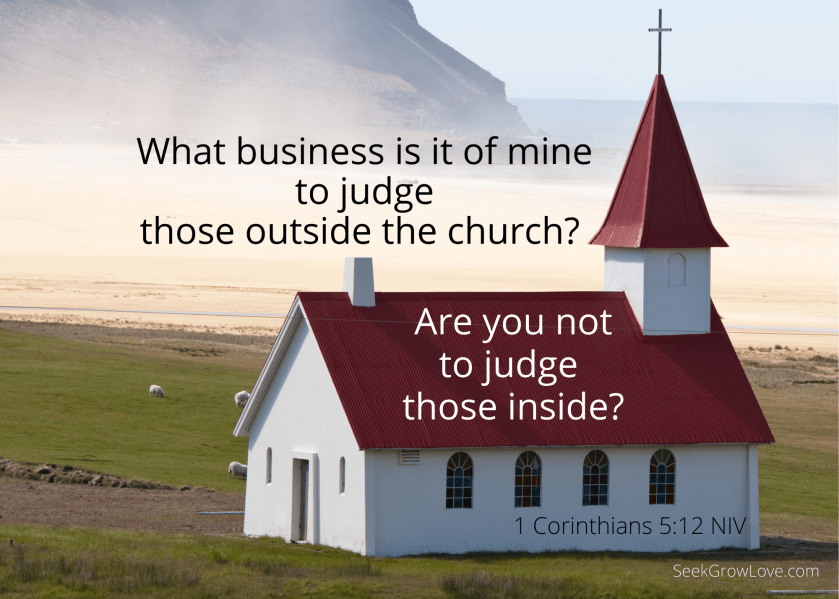
Returning to Paul’s initial command to extradite the man from the church, does that not seem antithetical to the accepting nature of faith? Perhaps upon an initial reading it may, but Paul acknowledges this and says in verses 9-11, “I wrote to you in my letter not to associate with sexually immoral people – not at all meaning the people of this world who are immoral, or the greedy and swindlers, or idolaters. In that case you would have to leave this world. But now I am writing to you that you must not associate with anyone who claims to be a brother or sister but is sexually immoral or greedy, an idolator or slanderer, a drunkard or swindler. Do not even eat with such people.” Paul is entirely aware that man is a sinful being, and that there was only one man to walk the earth who was blameless: Christ. Instead, in this passage, he makes the clarification that the people we are to not associate ourselves with are those who claim to be brothers and sisters in the faith, and STILL are boastful in their sin, unapologetic about their openly sinful life, perhaps even going as far as claiming that their actions are biblically justifiable. These are the people we are to lovingly rebuke, as they claim to live by the word and yet blatantly do not. So often, Christians are seen as judgmental toward outsiders. Unfortunately, this is not wholly unreasonable. Our issue is that we judge those who do not live by the law for not living by the law, while simultaneously turning a blind eye to those who CLAIM to live by the law and openly do not. Paul writes in verses 12 and 13, “What business is it of mine to judge those outside the church? Are you not to judge those inside? God will judge those outside. ‘Expel the wicked person from among you’.” Our responsibility is to spread the good news to those who do not have it, and to lovingly keep ourselves accountable.

-Mason Kiel

Questions for Reflection and Discussion

  1. Sin is sin. Why is there a difference between how we view, judge or treat various sinners?
  2. Are you personally more apt to spread more judgment to those outside the church or load on the mercy to those inside than Paul would recommend? What is the danger in each of these?
  3. What is the purpose of expelling a brother in sin?

To Judge or Not to Judge

1 Corinthians 5

1 Corinthians 5 12

We are going to take a look today at 1 Corinthians 5.

Paul has talked a lot up until now about how immature and unwise the Corinthians are, and we start to see here what he is talking about.  There is some really weird sexual immorality going on in the church at Corinth, and they were bragging about it. Paul is very critical of this and tells them “I have already passed judgment in the name of our Lord Jesus on the one who has been doing this”.  Because they have accepted Jesus they should have his wisdom and the Holy Spirit guiding their lives and they should know that these things are wrong, and therefore have no excuse in allowing this to go on.

“What business is it of mine to judge those outside the church? Are you not to judge those inside?  God will judge those outside. “Expel the wicked person from among you.”’ 1 Corinthians 5:12-13

Paul clarifies though, that he is not judging their culture, which finds this practice acceptable, but he can judge them because they have committed themselves to a higher standard and are falling short.  Many Christians today need to be reminded of this. We need to hold other Christians to the standard that Christ has set. It may make us uncomfortable, but if we see sin in the Church it is our responsibility to help fix it.  Confronting people is not easy, but if we love them then we will want them to be right with God.

On the other side we cannot judge the sins of non-believers because they have not committed themselves to Christ, and they do not understand that what they do is sinful.  It is not our place to judge the sin in the world, but it is our job to spread the good news that Jesus died for our sins, and then we can let the Holy Spirit convict that person of their sin, and hope that they make the right decision.  If we start by judging them for their sins we will only push them away, and that will not help the Kingdom to grow. We can see a widespread rejection of Christianity in our culture today partly because of a cultural backlash towards Christians that openly judge non-Christians.  So let us remember that our message is one of life and hope, not judgement and condemnation.


Thanks for reading,

Chris Mattison