Living Wisely in a Wounded World

2 Sam 19-21

The Kingdom of Israel is in the midst of a terrible civil war. Brother had turned against brother and sons against their fathers. The battle was over. Absalom, the rebellious son, had been killed. 

At first glance, it seems like David should be rejoicing. He was king again over Israel. Instead, he was caught up in his grief.

 Joab told him in 2 Samuel 19:5-7, “You have today covered with shame the faces of all your servants, who have this day saved your life and the lives of your sons and your daughters and the lives of your wives and your concubines, because you love those who hate you and hate those who love you. For you have made it clear today that commanders and servants are nothing to you, for today I know that if Absalom were alive and all of us were dead today, then you would be pleased. Now therefore arise, go out and speak kindly to your servants, for I swear by the Lord, if you do not go, not a man will stay with you this night, and this will be worse for you than all the evil that has come upon you from your youth until now.”

Then, David picked himself up out of the sackcloth and ashes and made his way back to Jerusalem to take back the throne. 

This passage strikes me in the way that David has to navigate the circumstances that appear. People grovel at his feet while double-crossing their masters. Political turmoil and intrigue roil underneath the surface as another revolt occurs. A famine stretches the land to its breaking point, and difficult decisions have to be made. 

David has to live wisely to save not only himself but also the entire nation from more war, brokenness, and suffering. 

And through it all, we see this: our choices carry weight.

What does wise living look like? 

  1. Wise Living means stepping out of our circumstances to fulfill our God-given role. Grieving is a necessary part of life. It has its place as we mourn those we love. But, we cannot stay in a place of grief forever. We have to move on and step into our calling. 
  2. Wise Living means pursuing reconciliation without compromising truth. As David worked to restore peace in Jerusalem, he had to act as judge over the people who supported him and revolted under him. Through it all, David was not led by vengeance. 
  3. Wise Living means recognizing the long-term consequences of sin. In a heartbreaking scene, we see how to pay the blood guilt of Saul a mother who had to lose her sons. Our sin can cause brokenness in our lives, our families’ lives, and the lives of future generations. 

Wise Living is a radical decision in this world, but ultimately, it leads to righteousness. How are you pursuing wisdom in this broken world today? 

-Cayce Fletcher

Cayce blogs at https://amorebeautifullifecollective.com about faith, family, and life. You’ll find encouragement for how to build intentional lives rooted in faith and beauty. Check out the latest post on the human nature of Jesus here. 

Reflection Questions

  1. What decisions am I making today that will shape the next season of my life or family?
  2. Where is God calling me to seek reconciliation, even when it’s complicated
  3. How might I carry my grief with both honesty and courage?

SGL.2025.MayFullPageDownload

Wise & Unwise Counsel

2 Samuel 16-18

In these chapters we read about a struggle between a King and his son, Absalom. I know from being raised in a family with 8 children that there are struggles within the family as the children try to assert their independence. In this story Absalom asks for advice from 2 friends. Ahithophel encourages him to go into his father’s concubines in the sight of all Israel, to show the disdain that he had for King David. He also told him to choose 12,000 men to pursue King David. Then Absalom calls Hushai to ask his advice. He tells him that the advice that Ahithophel had given him was bad advice. He reminds him that his father, King David, was surrounded by mighty and valiant men who were loyal to King David and would fight and die for him. Absalom decides to take Ahithopel’s advice, to his detriment. In Proverbs it says a lot about taking advice from others and to listen to wise counsel. I recently heard someone say that he could tell you what your future holds by the friends you surround yourself with. If they are foolish, we will make foolish decisions, as well. We need to make sure that we are listening to that Godly advice.

Hushai also shows his loyalty to King David by going and warning him of Absalom’s plans. King David was surrounded by people who were loyal to him, down to the servant girl who hid 2 of his friends in a well to keep them safe.

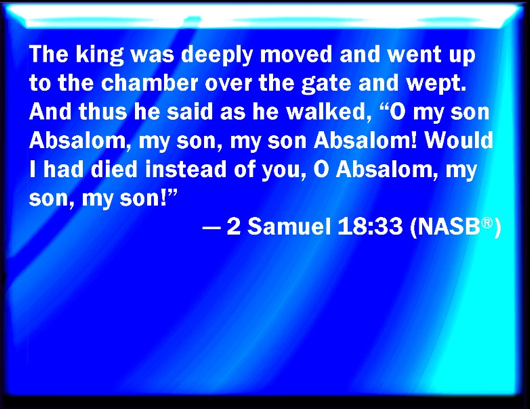
Even through all this, one of the things that stands out is the fact that King David loves Absalom and asks the people to treat him gently. This is his son that is trying to kill him.  In 2 Samuel 18:5, David says “Deal gently for my sake with the young man Absalom.” The last verse of chapter 18 is King David mourning for his son, after he heard of his death.

This is the type of love that God shows to us. He is constantly wanting the best for us. He grieves when we turn against him. 2 Peter 3:9 “The Lord is not slow in keeping his promise, as some understand slowness. Instead he is patient with you, not wanting anyone to perish, but everyone to come to repentance.” He is just waiting for us to turn back to him, like the father in the Prodigal Son parable.

-Sherry Alcumbrack

(originally posted October 23, 2016 for Grow16 which later changed names to SeekGrowLove)

Reflection Questions

  1. Who have you surrounded yourself with and have they helped you make wise or unwise decisions?
  2. Who are you loyal to? How do you show loyalty even in difficult times?
  3. What do you find admirable about David?
  4. How would you describe God’s love for you?

Reconciliation

2 Samuel 13-15

Have you ever been in a conflict where you feel extremely wronged in a situation? Everyone is like yes and amen. The story of our lives. Haha. Now secretly, to a really close friend you may be able to admit that you also did some wrong stuff, too; but there ain’t no way that anyone else is finding out about that. In fact, to all your friends you portray yourself as something resembling Jesus in the situation. I hope that you aren’t so disillusioned that you actually believe this has never happened to you. We really enjoy this social feedback loop.

There are other situations that come up in life where you have a single incident and then everything spirals out of control and that one incident ends up messing up everything in that relationship. I have totally had one of those.

It seems that there is nothing new under the sun because that is exactly what has happened with Absalom and David. The worst and most ridiculous thing about this story is that the catalyst to this relational tension didn’t even involve them. As you’ve read, this caused years of tension and problems and separation between father and son.

I am not going to speculate on whether David was right in not sentencing Amnon to death after rapping Tamar or whether Absalom should have killed his brother. There comes a certain point at which what has happened in life has happened. There is nothing you can do to change it and now you just need to live your life with the future in mind. In most of these cases keeping the tension and the bad blood in the relationship isn’t profitable to our own spiritual health and doesn’t promote godliness.

The section of today’s reading that I would like to discuss is 2 Samuel 13.37-39 and 2 Samuel 14.21-24, 28.  After Absalom killed Amnon, in worry and anxiety he fled to Geshur. It says that David mourned for his son in 2 Samuel 13.37. I am not sure which son he was mourning for but I believe that given the context of the paragraph and the verses around it the verse is telling us that David mourned for Absalom. This is also supported by v.39 where David says he longed to go out to Absalom. So why didn’t he?

David didn’t go out to seek his son Absalom, even though, he wanted to. He left him out in Geshur for 3 years. In fact, it wasn’t even David’s prompting that brought him back. Joab had to step in as mediator and be the counselor in this situation for Absalom to return. I think the responsibility falls on David to take the initiative to mend the relationship with his son instead of just leaving the situation in the wind. David essentially stuck his head in the sand and ignored the problem. Ultimately, this just caused problems between David and Absalom later on.

Finally, after Joab’s prompting David brings Absalom back to Jerusalem but tells Joab that Absalom can’t enter his presence. Absalom spends 2 years in Jerusalem before any action is taken in this relationship and the initiative once again wasn’t taken by David. It took Absalom saying it would have been better if I hadn’t left Geshur than to live like this and I would rather just have David do to me what seems right to him. Absalom hit the point where he would rather die if he had any guilt in him than live with this relational separation.

Surveying this whole situation, we see problems on both sides but I think the judgement ultimately lies with David. He took none of the initiative to repair this relationship. There is a real danger to leaving things unsaid that should have been said. I believe David’s longing to see his son at Geshur should have moved him to take action and confront the problems in relationship instead of just waiting. David longed for his son but out of pride or anger or stubbornness didn’t take the initiative to reconcile with Absalom.

When you consider the intensity of distress Absalom must have felt at the tension and loss of relationship that he would be willing to die if he had any guilt it is obvious that this weighed heavily on him. The two men’s reconciliation is sweet but was so long overdue that I think irreversible damage was done to the relationship given what happens in Chapter 15.

So, what can we draw from this? Firstly, to not let our conflicts go on forever. Secondly, when it is on your heart to apologize or you are longing for someone who you are in conflict with, it may be God working on your heart to repair the relationship. Thirdly, get a mediator or a counselor involved if needed. Don’t wait until someone else feels like something needs to be done. Fourthly, you are responsible for taking the initiative to reconcile or apologize for what you have done. Fifthly, don’t be afraid to let someone have the ability to go second. In this final scene where Absalom goes to his father, his father embraced him and kissed him. I have a feeling that David had longed for this moment. I can remember a moment in my relationship with my wife where we were in conflict and I had my defenses up to keep myself from over apologizing or taking too much of the blame. I remember so vividly her apologizing first and immediately all the weight was lifted, my defenses dropped, and I was no longer looking out for myself but I was looking for the good of the relationship. It gave me the freedom to really say the things I wanted to say when, at first, I may have even been hostile.

Finally, our relationships will only be as good as our communication in them. Remember it is wise to address conflicts as soon as possible. Do not leave things unsaid or problems unaddressed. They don’t just go away.

Daniel Wall

(originally posted May 14, 2020 for SeekGrowLove)

Reflection Questions

  1. How do you typically deal with conflict with someone close to you? What are the advantages and disadvantages to this approach? What would be better?
  2. What is the best response to our own sin? What is the best response to someone else’s sin?
  3. What was Joab’s role? How did he do it? Do you think God was pleased with Joab?
  4. Is there a situation where you might be able to help work towards reconciliation? (first in your own life, and then perhaps in someone else’s)

Bad Company Corrupts Good Morals (2 Samuel 16-18)

Sunday, October 23 – Week 14

prov-12-15

By Sherry Alcumbrack

In these chapters we read about a struggle between a King and his son, Absalom. I know from being raised in a family with 8 children that there are struggles within the family as the children try to assert their independence. In this story Absalom asks for advice from 2 friends. Ahithophel encourages him to go into his father’s concubines in the sight of all Israel, to show the disdain that he had for King David. He also told him to choose 12,000 men to pursue King David. Then Absalom calls Hushai to ask his advice. He tells him that the advice that Ahithophel had given him was bad advice. He reminds him that his father, King David, was surrounded by mighty and valiant men who were loyal to King David and would fight and die for him. Absalom decides to take Ahithopel’s advice, to his detriment. In Proverbs it says a lot about taking advice from others and to listen to wise counsel. I recently heard someone say that he could tell you what your future holds by the friends we surround ourselves with. If they are foolish, we will make foolish decisions, as well. We need to make sure that we are listening to that Godly advice.

Hushai also shows his loyalty to King David by going and warning him of Absalom’s plans. King David was surrounded by people who were loyal to him, down to the servant girl who hid 2 of his friends in a well to keep them safe.

Even through all this, one of the things that stands out is the fact that King David loves Absalom and asks the people to treat him gently. This is his son that is trying to kill him.  In 2 Samuel 18:5, David says “Deal gently for my sake with the young man Absalom.” The last verse of chapter 18 is King David mourning for his son, after he heard of his death.

2-sam-18-pic

This is the type of love that God shows to us. He is constantly wanting the best for us. He grieves when we turn against him. 2 Peter 3:9 “The Lord is not slow in keeping his promise, as some understand slowness. Instead he is patient with you, not wanting anyone to perish, but everyone to come to repentance.” He is just waiting for us to turn back to him, like the father in the Prodigal Son parable that Nathaniel mentioned in a previous devotion.

luke-15-10-pic


We thank Sherry Alcumbrack for writing this week.  Sherry is a wife to Bob, mother to Morgann, Marshall, Grant and Jacob.  She lives in lovely Anderson, SC and attends Guthrie Grove.  She enjoys traveling,  has been to 48 states, and looks forward to visiting Alaska and Hawaii. She loves flowers,lighthouses, waterfalls and sunsets and taking pictures of her family in front of them (her children love this as well.) Spring and Fall are her favorite seasons.  She also loves to read and walk her dog.

Which Type of Son are You? (II Samuel 14-15)

Saturday, October 21

psalm-139-17-pic

Nathaniel Johnson

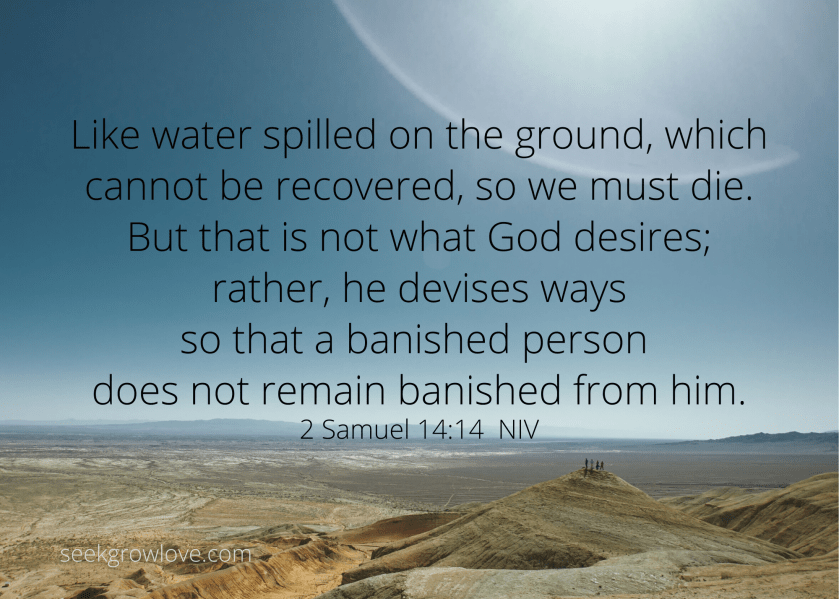
Let’s quickly take a look and see a parallel story in the parable of the lost son. In Luke 15, starting in verse 11, Jesus starts to tell the story of a son who took his inheritance and squandered it in reckless living. This son is a lot like King David’s son, Absalom. We know from Jesus’ parable that there are two types of sons. The first is like the lost son, the son who ran away and made his father worry. The other son was the one who stayed with his father. He did everything right; he worked hard for his father and followed the rules. But when his brother came home and his dad accepted him with loving arms, he resented his brother in his heart. Sometimes we can be like the first son. We openly rebel against God and choose not to listen to him. And sometimes we can be like the second son. We try our best to follow all the rules but we still end up sinning in our hearts. The bad news is, all of us fall into one camp or the other (Romans 3:23). The good news is “God does not take away life; instead, he devises ways so that a banished person may not remain estranged from Him” (2 Samuel 14:14). How great is that? Maybe you feel like you’ve been running away from God for a while now. You keep trying to find your way back but you seem to stumble all the way. Relax, God is pursuing you right now. He is coming up with ways to get you back onto his path and working you into his plan. God doesn’t want to stay separated from you.

Beware: Poison! (II Samuel 12-13)

Friday, October 21

oct-21-pic

Nathaniel Johnson

In the Garden of Eden, Adam and Eve were tempted to eat of the one forbidden fruit. In David’s kingdom, he was tempted to take Bathsheba as his own wife, even though she was already married. David’s son Amnon, was tempted to take his sister Tamar for himself, even though that is disgraceful. The sin that started with Adam found its way to king David, a man after God’s own heart, and on to his son Amnon. Like father, like son, they both went after the forbidden fruit. How silly of Amnon to not listen to Tamar! He could have been free of guilt had he only asked David to give him Tamar as his wife, but he couldn’t resist the temptation. The sin that Amnon commits spreads like a virus to his brother Absalom. Absalom handles this fairly well at first. He started to take care of his sister and let her live in his household. He also didn’t lash out at his brother. In fact, he didn’t say a single word to Amnon. But, he made one crucial mistake in dealing with his brother. He didn’t forgive him. I know it’s hard to imagine being in this situation and it’s even harder to be able to imagine being able to forgive someone for that. As Alan Cain once said, “Unforgiveness is the poison we drink thinking that it will harm someone else.” Absalom thought that by harboring this bitterness in his heart, he could pay back Amnon for what he did to Tamar. He was wrong. When the bitterness in his heart boiled over, he struck out and killed his brother. As a result, he not only hurt himself, but left an emptiness in his father’s life by running away in shame. When we sin, the worst thing we can do is duck our heads and run away. Just as David still wanted to see his son Absalom after he had sinned, our Heavenly Father wants to see us when we take a bite of that forbidden fruit. Through Jesus, God will always welcome us back with open arms as long as we come for forgiveness.