*Joshua 11-12
*Psalm 35
*Acts 4
-Devotion by Jeremy Martin (TN)
As we start off in Acts 4 today, the priests, the captain of the guard, and the Sadducees came up to Peter and John “greatly agitated” because they were teaching and proclaiming in Jesus (Yeshua) the resurrection from the dead. If you recall the breakdown of the “4 Philosophies” at that time, the Sadducees were “A priestly and aristocratic group who accepted only the written Torah (Pentateuch) as authoritative, rejected the oral law, and did not believe in resurrection or an afterlife.” So of course they were greatly agitated, because as a group they did not believe in resurrection…”So they were sad, you see?” (that bad joke was stolen from Sean Finnegan’s wonderful and highly recommended podcast on Restitutio.org, which you really should give a listen to, seriously).
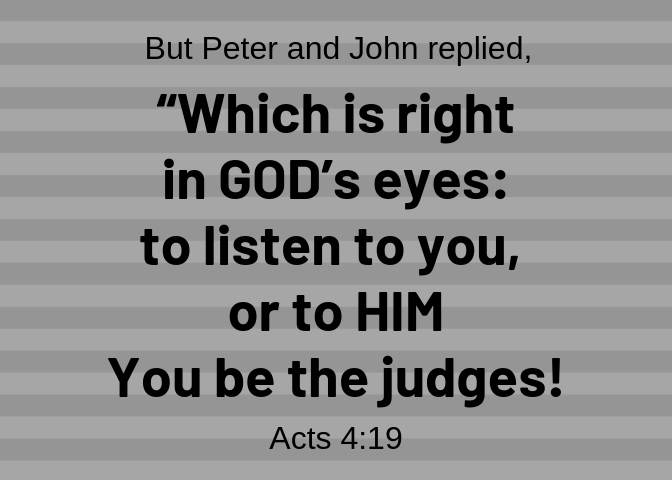
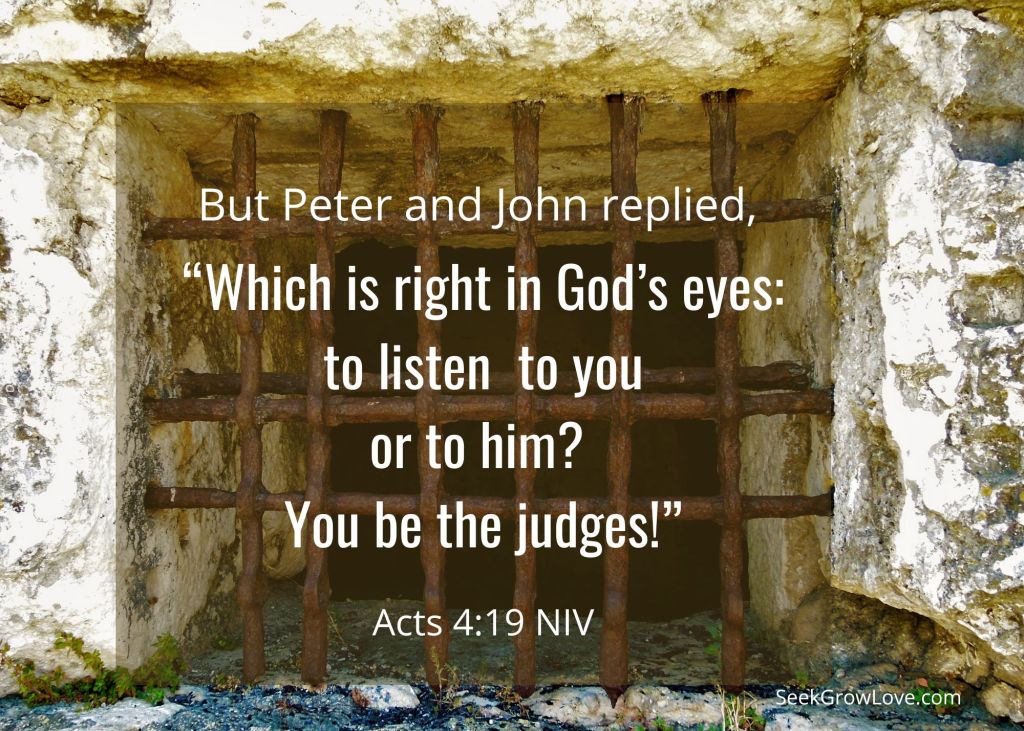
The chapter goes on to tell that the religious authorities of the day grabbed them, detained them and questioned them fiercely, then released them but not before threatening them to stop talking about such things. Their response is telling: “Whether it is right in the sight of God to hear you rather than God, you be the judge; for we cannot stop speaking about what we have seen and heard.” (Acts 4:19, LSB). Bear in mind, these were not just some guys, these were the religious leaders of the day, the authorities, the high priest (and his descendants, Acts 4:6) and represented the final say in spiritual matters at the time. It’s no wonder that they were marvelling at their confidence (Acts 4:13), this sort of behavior was unheard of amongst the Jews, you just didn’t defy the priests typically.
After they are released, they went to their own people and offered praise to God. Please pay special attention to their wording, because it clearly defines the doctrine of the earliest church here in Acts 4: 24-31. Without belaboring this beyond the last 2 days devotionals, please note that there is a clear delineation here, and a tiered level of authority that is clearly demonstrated with God (YHVH, the Creator, the Most High God) in authority over His servant Yeshua, Ha’Mashiach (Jesus, the Christ, the Anointed One) who is in turn in authority over his servants, us (the ecclesia, or church). We serve God through Yeshua, His servant and our King, whom God has anointed and established over humanity. This is repeated throughout scripture and succinctly restated in 1 Cor 11:3. It is highly problematic to insist on any other doctrinal statement, at least if you don’t want to stand in opposition to scripture. Peter and John confidently stood firmly against the religious giants of their day, the religious authorities who had gotten off course, and continued to speak the word of God. We face our own giants today, don’t we?
Here’s an interesting thing. Even if you have a map, even if you plan your route well, even if you have a compass; if you get even just a tiny bit off course you don’t end up where you wanted. A matter of just 1 degree off, and you could end up hundreds of miles away from where you wanted to be. The farther you go, the greater the error becomes. In my youth, I had gotten off course (see the Feb 5th devotional for some of the sordid details). I was in genuine fear for my life, because I was facing giants, and I knew that I could not win. I had resigned in my mind that the best I could hope for was to inflict maximum damage in return on my way into death and was quite prepared to do so. Psalms 35 really reminds me of that time, and of the mercy of God, who saved me. I won’t go into detail here, but know that this Psalm is an intensely personal one for me because it accurately sums up a time when I faced giants, and lived. Not by my actions, but by the grace of God alone and because God intervened in ways I could not have predicted or understood to remove the threat from my path (literally and physically, in some instances). Then, in an overwhelming display of unwarranted love, he corrected my path. I don’t even have the words to express my appreciation. Praise God!
As we dip into our Joshua reading today, we’re going to focus on a couple things that a lot of folks just skim over. Remember the old song, “12 men went to Canaan land (10 were bad and 2 were good!)”? That story is detailed in Numbers 13 and 14, and gives us a bit more understanding. In Num 13:33 it says “There also we saw the Nephilim (the sons of Anak are part of the Nephilim); and we became like grasshoppers in our own sight, and so we were in their sight.” (LSB). There’s a very simple and straightforward reason for this, and it’s because those guys were giants! So who were the Nephilim? Great question! Flip back over to Genesis 6:4 where it says: “The Nephilim were on the earth in those days, and also afterward, when the sons of God came in to the daughters of men, and they bore children to them…” (LSB)**. So the Nephilim were the offspring of “the sons of God” (ie, angels or some other form of heavenly being which God created) and humans, according to scripture. **For an extremely interesting apocryphal account of this, read the book of Enoch (it’s quoted in the book of Jude, but didn’t make it into the cut for “canonical”).
So, when the Israelites encounter ACTUAL GIANTS on the way in to the promised land, they got scared, rebelled, and as a result ended up wandering in the wilderness for another 40 years until the voices of dissension had (quite literally) died out (see Num 13&14 for the full story). In Joshua 12, we’ve returned after 40 years to “try again”. Now, when the Israelites are doing as God commanded and taking the promised land, it states: “Then Joshua…cut off the Anakim…(and) devoted them to destruction. There were no Anakim left…only in Gaza, in Gath, and in Ashdod some remained” (Joshua 12:21-22, LSB). In Josh 12:4, “Og king of Bashan” seems to be another one, “one of the remnant of the Rephaim”. Remember where Goliath was from, by the way? See there (I slipped in another cross reference)? Do you think he was larger or smaller than the others of his kind like him? Trivia aside though, the point is: this time they obeyed God, and they succeeded.
My point in bringing up these things is this: in our lives, sometimes we are given tasks that seem daunting. Sometimes, we are called upon to fight giants. Giants are, by their very nature, big and scary. Many times they will stand and taunt us. I’d point out in counterpoint that we’ve got a great big God; much bigger than any giant, and He fights for us, when we are doing His will. It doesn’t matter how big your particular giant is, God is bigger. As I write this devotion, it is the Sabbath before Easter Sunday. When I consider the overwhelming love and power of our God, and the generous offer of salvation to us gentiles, I am truly humbled. When I think about what His Anointed One suffered on my account, I am overwhelmed. When God raised up His servant Jesus again, it let me know that there is no giant that can overwhelm me. I may go down into the dirt, but I will stand again. God has this.
REFLECTION QUESTIONS
- Did you ever realize, or even think about, where the actual biblical “giants” came from?
- Each of us have our own metaphorical “giants”. What are yours?
- How many times has God conquered a giant for you; a problem you just couldn’t see a way around, a danger that you couldn’t escape, an intimidating moral dilemma? Reflect on them all for a moment, and consider the goodness of God.
- Why is it that when we see a “giant” we forget how big God is sometimes?
PRAYER
Father God, Creator and Sustainer of all life, thank you. Please help me to remember that I am not my own and that you bought me, and that the price paid for me was far too high. Please forgive me when I am scared, and give me the strength to do your will, even if it’s to conquer giants. Thank you for sending Yeshua, my King. Thank you for life, breath, and all things. In Jesus name, Amen.