Something NEW

Hebrews 8-10

heb-8-6-web-watermarked

Monday, July 10

Throughout the Bible, there have been many examples of priests and chief priests. However, out of all the priests that have lived, there is only one that is the most important: Lord Jesus Christ. Unlike the other priests and chief priests, Jesus made the ultimate sacrifice by dying for everyone’s sins and shedding his own blood rather than using goat or bull’s blood as an offering. Jesus died so that a new covenant could come into play. According to Hebrews 8:10-12, the Lord declared: “I will put my laws in their minds and write them on their hearts. I will be their God, and they will be my people. No longer will a man teach his neighbor, or a man his brother, saying, ‘Know the Lord,’ because they will know me, from the least of them to the greatest. For I will forgive their wickedness and will remember their sins no more.” This new covenant gives us the opportunity to know God through Jesus Christ if we believe that Jesus died for the payment of our sins and that he will come again to bring salvation to those waiting for him.

God wants us to be wholeheartedly obedient and devoted to him. He doesn’t want us to just be “half-time” Christians. “Let us draw near to God with a sincere heart in full assurance of faith, having our hearts sprinkled to cleanse us from a guilty conscience and having our bodies washed with pure water” (Hebrews 10:22). This is done when Jesus takes away our sins, enters our lives, and redirects us toward God through baptism. He wants us to encourage each other by showing love and doing good deeds. God is pleased with us when we continue to gather together with other believers because we belong with those who have faith and are saved. Some of you are serving on the UP Project in Minnesota this week, others are working or going to school, and still others may be so excited for FUEL that they are packing a week early. Whatever you may be doing, do it for the glory of God. Hebrews 10:36 states: “You need to persevere so that when you have done the will of God, you will receive what he has promised.” That sounds like some pretty good advice to follow.

Today, I pray that you find the time to open your Bible and really study God’s Word. He is waiting to have a relationship with you and truly wants your undivided attention. Come to Jesus and God with a sincere heart and a strong faith and ask Him what He wants you to learn or do for Him. Make sure you assemble with other brothers and sisters in Christ and be an encouragement to them. I pray that you will be strong in your faith and share what you have learned with others. God bless you. Amen.

-Cynthia Fyfe

(Photo Credit: http://www.alittleperspective.com/is-the-old-covenant-obsolete-2-2/)


Just What I Needed

Hebrews 5-7

heb-7-22-web-watermarked

Sunday, July 9

Every so often, I open my Bible and turn to a random book and start reading. I know that whatever page that I turn to that there is a lesson that I specifically need to learn. Interestingly enough, I found that the devotionals that I chose to write on about a year ago were the books of the Bible I needed to read now.

______________________________________
I wish I could say that I grew up in the Church of God- Abrahamic Faith, attended Sunday School, and went to church every single Sunday. A lot of my friends have grown up in the church, gone to state camp, Family Camp, Southeast Camp, and on retreats throughout their entire life. Growing up, I felt like I wasn’t spiritually fed and was still like an infant in my faith. Hebrews 5 explains that many people should be teachers of scripture yet they are still learning the basics rather than expanding their knowledge of what God wants to teach them.
I decided to attend FUEL for the first time about ten years ago to learn more about the Church of God of the Abrahamic Faith and just what it meant to be a Christian. I wasn’t disappointed. Hebrews 6:13-15 states: “When God made his promise to Abraham, since there was no one greater for him to swear by, he swore by himself, saying, ‘I will surely bless you and give you many descendants.’ And so after waiting patiently, Abraham received what was promised.” I love our church because I know that we are a part of this promise.
Hebrews 7 talked about how Melchizedek (who is known as a priest forever) and Abraham (the father of the chosen people) were two men who were faithful to God and followed Him because they had confidence that God would fulfill His promises. None of this would have happened without an oath. “Because of this oath, Jesus has become the guarantee of a better covenant” (Hebrews 7:22). Jesus is known as the high priest who is able to mediate between us and God since he sacrificed himself giving the ultimate sacrifice for the sins of the people. Hebrews 7:28 states: “For the law appoints as high priests men who are weak; but the oath, which came after the law, appointed the Son, who has been made perfect forever.” I don’t know about you, but I am extremely thankful that Jesus saved us from our sins.
It is important to understand that God wants us to obediently devote time in our every day lives to offer up prayers, work hard for His glory, and wait patiently for His promises. So take some time today and pray that God will provide confidence in you and that He will teach you something new.
-Cynthia Fyfe
 
(Photo Credit: http://www.alittleperspective.com/hebrews-7-our-better-hope/)

Do Your Best…Always

Colossians

verse-of-the-day (4)

Saturday, July 1

Colossians 3:23-24 states, “Whatever you do, work at it with all your heart, as working for the Lord, not for human masters, since you know that you will receive an inheritance from the Lord as a reward.  It is the Lord Christ you are serving.”  It starts out by saying “whatever you do”, which means we are talking about everything that you do.  We are talking about your homework, your job, mowing the lawn, taking a vacation, praying, and brushing your teeth.  We are talking about how you spend your time every day all day long.  You need to do everything with all of your heart.

That seems a bit extreme.  Everything?  Really?  When you are baptized, you are saying that you are no longer going to live your life for yourself, but rather for God and Jesus.  Therefore, your whole life, everything you do, should be for your heavenly masters.  You will want to do your best, work with all your heart, because you are doing it for Christ, not for human masters.

If you find yourself not giving your best effort, you need to ask yourself a question.  Should I even be doing what I am doing?  If your grades are slipping in school because you just aren’t trying very hard, you should ask yourself if you should even be attending school.  If you come to the conclusion that school is important because of all of the learning and that it will help you be much more successful in life, then you should start doing your best because you are doing it for Christ.  If it is worth doing for Christ, you need to do it well.

Most people fail at this from time to time with their jobs.  You may not enjoy the work you do and are just doing it for the money.  You may not like your boss and find it easy to slack off at times.  However, if you have determined that you should keep your job, even if it is just for the money, you need to work at it with all of your heart, as working for the Lord, not for human masters, since you know that you will receive an inheritance from the Lord as a reward.

If you are baptized, you have given your WHOLE life to Christ.  If something is worth doing for Christ, you need to do it with all of your heart.

-Rick McClain

(Photo Credit: https://biblia.com/bible/esv/Colossians%203.23-24)

I’ve Been Robbed of My Peace and Happiness

Philippians

verse-of-the-day (3)

Friday, June 30

There are three different types of problems, which sometimes can also be referred to as opportunities.  First, there are problems that are only problems because our perception of the situation is not what it should be.  Second, there are problems that are in our control and could be solved if we put our mind to it.  Lastly, there are troubling situations in our lives that we have little or no control over.  They all can rob our peace and happiness, but fortunately the first two types of problems can be eliminated.  But how can we find peace and happiness if there is a problem that won’t go away and we can’t do anything about?

Some examples of the type of problem where our perception needs to be altered are when they forget to put the French fries in the bag at the drive thru, when you can’t watch your television show because someone else had the television first, or when the strap on your purse breaks.  If these types of things make you upset or unhappy, you need to work on your perspective in life.  Stuff happens; we need to learn how to deal with it without getting so upset.  These are not the types of “problems” that I want to talk about today.

The types of problems in our control are that I cough too much because I smoke, I am getting poor grades in school because I waste too much time, or I don’t have enough energy because I am overweight.  We can solve these problems with a good dose of self-discipline.  Stop smoking, do your homework, exercise, and eat less.  You’ll be amazed at how your problems will disappear.  I’m not saying it will necessarily be easy, but it can be done.  I am also not going to talk anymore about these types of problems today.

I’ll be honest; I don’t have a lot of sympathy for people that get upset about the small stuff that aren’t really problems (sometimes referred to as first-world problems) or for people that have self-inflicted problems that they could fix if they wanted to.  However, there are problems that are quite real and there is little or nothing they can do to fix them.  They can be quite serious in nature and can very easily rob you of your peace and happiness.  I am talking about someone with an alcoholic spouse that refuses to get help, yourself or a loved one that has been diagnosed with an incurable disease, someone who has been paralyzed due to an injury, a parent who has a child who refuses to be a Christian, someone who made a big mistake and will be spending the rest of their life in prison, or someone who just had a parent die.  These problems are real and they suck.  These problems might not go away.  They can really weigh on your heart and mind and they can make you extremely sad or very stressed out.  How can you still have peace and happiness if your problem doesn’t go away?

The answer lies in Philippians 4:6-9.  In verse 6 we are told to never be anxious and to let our requests be known to God through earnest prayer and thanksgiving.  Verse 7 does not say that your problem will go away; instead, it says you will receive the peace of God that surpasses all comprehension.  God is saying that He will give you peace in your heart and mind in situations that peace doesn’t even seem possible.  How can you feel true peace when you know someone you dearly love is going to die soon?  That doesn’t begin to make sense, but that is exactly what God said, it surpasses comprehension.  It makes no sense that you could have peace, but God can give you an amazing gift of peace that we can’t understand because He is God.

I had a problem that pretty much sucked the joy out of my life for a long time.  I tried hard to make the problem go away, but to no avail.  I really struggled with this because I had always had a pretty easy life with few problems, and I couldn’t change this situation no matter how hard I tried.  I didn’t know what to do.  Then I stumbled across Philippians 4:8, which is now one of my favorite verses in the Bible because of the peace and happiness that it gave back to me.  “Finally brethren, whatever is true, whatever is honorable, whatever is right, whatever is pure, whatever is lovely, whatever is of good repute, if there is any excellence and if anything worthy of praise, let your mind dwell on these things.”  It all makes perfect sense.  If we dwell on the stuff that makes us sad or stressed out, we are going to be sad or stressed out.  Duh.  If we dwell on the excellent things in life that make us happy, we are going to be happy.  It was too simple, but I couldn’t figure that out until I read that verse.  It was life-changing.  Do I still think of my problem from time to time?  Sure, but I don’t dwell on it.  I will no longer let it rob my joy.

If you have a problem that you can’t fix, pray for some peace that surpasses comprehension and start dwelling on the good things in life.  It works.

-Rick McClain

(Photo Credit: https://biblia.com/bible/esv/Phil%204.8)

Power Struggle

Ephesians 4-6

ephesians-5-25-26

Thursday, June 29

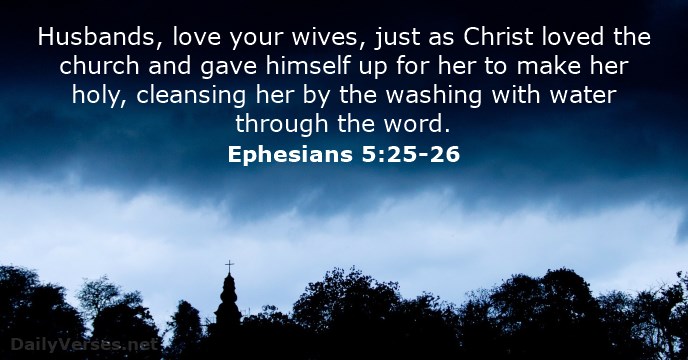
There is no such thing as a power struggle in a Godly marriage.  Ephesians 5:23 states that the husband is the head of the wife.  I get the feeling that some women have a hard time agreeing with that these days.  They aren’t going to let their husband tell them what to do.  I am convinced that the reason God put man in charge has not changed through the years and this rule still applies today.  Why would God have the man and woman become one in marriage, but then tell the woman to submit to the man?

I think God was trying to keep harmony in the marriage.  Think about a church board that had two people on it and they both got one vote.  In other words, neither one had more power than the other.  What would happen if they disagree on something?  Perhaps they could compromise or one could give in to the other, but I suspect if they both had very strong opinions, they may not be able to come to a resolution.  It would probably not end well.  I am not sure, but I suspect this could be the reason we no longer have Simon and Garfunkel.  What a shame.

The husband is the head of the wife, but it is important to look at the whole picture.  God is in charge of everything and Jesus is next in line, above man.  Man is number three.  The man has been given orders on how to be a leader.  He doesn’t get to make all of the decisions.  Many of the important decisions have already been made for him and he just needs to carry them out.  Think of God as the owner of a store, Jesus as the manager of the whole store, and man as the department manager of one of the departments in the store.  The owner gets to do whatever he wants to do with the store.  The store manager follows the directions from the owner and makes sure all of the department managers are doing what they are supposed to do.  The department managers get to make some decisions within their area, but they must follow the directions from the owner and store manager.  Man does not have the freedom to do whatever he wants; he must follow the directions from God and Jesus.

Wives need to submit to their husbands, but Ephesians 5:25 tells husbands that they need to love their wives.  Verse 28 clarifies it even more by saying husbands ought to love their own wives as their own bodies.  We all have selfish tendencies so we all know what it is like to want to make our own lives as good as possible.  A massage feels awesome, certain foods taste wonderful, and eight hours of sleep feels great.  In the same way that we desire these good things for ourselves, men need to make sure that they are supplying this level of love to their wives.  They need to constantly be aware of their wives’ needs and fulfill those needs with the same vigor they would use to take care of their own needs.  In fact, they will need to sacrifice their time and energy to love their wives the way they should be loved.

Men, it is true that you have been given the power to make decisions in your marriage, but I suspect some men abuse their power and use it to keep their women down.  They enjoy being in charge and they make sure their women know that they are in charge.  They use that power to make their own lives better, rather than loving their wives the way they should be loved.  Ephesians 5:26-27 explains what men should do with their power.  He should present her in all her glory, having no spot or wrinkle or any such thing; but that she should be holy and blameless.  In other words, he needs to use his power to lift her up, not keep her down.  He needs to invest in her life to make her the most she can be.

The struggle is NOT real as long as wives submit to their husbands and husbands love their wives.

-Rick McClain

What is Jesus Doing These Days?

Ephesians 1-3

ephesians 1

Wednesday, June 28

God is eternal in both directions, past and future.  He is all-knowing, all-powerful, and the only God there is.  Jesus received all his power and knowledge from God and he had a beginning.  Jesus is not God.  That is very clear to me for many reasons we will not talk about in this devotion.  However, I have always tried to figure out what Jesus’ role is today.  I have heard very different opinions about his authority and power.  I have heard some say he is our king today and others have said he will be our king in the future.  Should we pray to Jesus or only to God?  Can Jesus forgive our sins?  Should we worship Jesus?  The answers to these questions cannot be explained by me in a few paragraphs and I cannot even say I am totally clear myself how it all works, but I am going to point to some scripture that will help to answer some of the questions.

Ephesians 1:19-22 says,”…These are in accordance with the working of the strength of His might which He brought about in Christ, when He raised him from the dead, and seated him at His right hand in the heavenly places, far above all rule and authority and power and dominion, and every name that is named, not only in this age, but also in the one to come.  And He put all things in subjection under his feet, and gave him as head over all things to the church…”  Christ was put in a place of authority, power, and dominion FAR above everybody else when he ascended to heaven and was seated at the right hand of God.  This already happened so he is already in a great position of power and authority over all of us.

Does Christ use that power today?  In Matthew 11:27, Jesus says, “All things have been handed over to me by my Father.”  He follows that up in verse 28 by telling the weary and heavy-laden to come to him and he will give them rest.  He doesn’t tell them to go to God, Jesus says to come to him.  He clearly is willing to play an active role in our lives today.  This doesn’t mean God is not in the picture, in fact, Ephesians 2:18 says that through Christ we have access to the Father.  And again, all of this authority and power came from God in the first place.

In Mark 2:1-10, Jesus forgave the sins of a paralytic and the scribes started wondering the same thing that some still wonder today.  They thought only God alone could forgive sins.  Jesus let them know that the Son of Man has authority on earth to forgive sins.  Interestingly, this was obviously before he ascended to heaven that he already had the authority to forgive sins.

Philippians 2:9-11 states that God highly exalted Jesus, and bestowed on him the name which is above every name, so that at the name of Jesus every knee will bow and every tongue will confess that Jesus Christ is Lord, to the glory of God the Father.  The definition of lord is master, which means Jesus is our master.  He is the head of the church, which I believe is not just a title, but an indication that he is very involved in the church today.

This is far from an exhaustive study on this topic, but it is clear to me that Jesus is not on the same level as man these days and he is active in our lives if we want him to be.  He is also not on the same level as God, and God is still involved in our lives as well.  I will continue to search the scripture for more answers on this topic, but I think what I have covered in this devotion is a pretty good start.

-Rick McClain


Battle to the Death

Galatians 4-6

galatians-5-25

Tuesday, June 27

There is a life and death battle going on inside all of us.  In one corner we have the flesh and in the other corner we have the Spirit.  It is a battle to the death.  One will win; the other will die.

The desires of the flesh are listed in Galatians 5:19-21.  They are sexual immorality, impurity and debauchery (excessive indulgence in sensual pleasures); idolatry and witchcraft; hatred, discord, jealousy, fits of rage, selfish ambition, dissensions, factions, and envy; drunkenness, orgies, and the like.  We all have some of these desires and verse 21 says that if we give into these desires we will not inherit the kingdom of God.  Thus, if our flesh wins the battle, on judgment day you will be sentenced to death.

However, Galatians 5:24 states that those who belong to Christ Jesus have crucified the flesh with its passions and desires.  Galatians 5:16 says if you walk by the Spirit, you will not carry out the desires of the flesh.  I am sure most of you have heard of the fruit of the Spirit in Galatians 5:22-23:  love, joy, peace, patience, kindness, goodness, faithfulness, gentleness, and self-control.  I think many people look at the fruit of the Spirit as a list of good attributes that we ought to try to attain, but that is not what this verse is saying.  It says the FRUIT of the Spirit are these attributes, meaning you will automatically receive these attributes if you live by the Spirit.  You don’t have to try to be more patient; you will automatically be more patient because of the Spirit that is in you.  You will be more loving due to the Spirit and so on.

You will want to ask to be filled with the Spirit so you can be more loving because Galatians 5:14 says the whole Old Testament Law can be fulfilled by loving your neighbor as yourself.  Think about it.  If you crucify the selfish desires of your flesh and love others instead of yourself, you are fulfilling the whole Law.  You are not required to fulfill that Law, but it is pretty awesome to think we could do that by just living for others instead of ourselves.

Galatians 6:8 says, “For the one who sows to his own flesh shall from the flesh reap corruption, but the one who sows to the Spirit shall from the Spirit reap eternal life.”  We will reap what we sow.  The next verse (6:9) then tells us to not lose heart in doing good, for in due time we will reap if we don’t grow weary.  Verse 10 then adds that while we have the opportunity, we should do good to all men, but especially to those that are of the household of the faith.  Paul admits that it is not always easy to do good to all people.  You have to sacrifice your own desires to use your time and resources for others, and to make it even more difficult some people are not very deserving of your help and not at all grateful for the good you do for them.  It can be very tiring continually sacrificing for others even if they do appreciate it, but remember not to grow weary and you will reap the reward.

It sounds difficult to crucify all of your fleshly desires and live for others instead of yourself, but are you really sacrificing that much if the reward you get for doing this is eternal life in the Kingdom?  You will actually gain a WHOLE LOT MORE if you can stop living for yourself now in this short lifetime and live for others instead.  Seems like a REALLY EASY choice to make; crucify your fleshly desires and live by the Spirit.

-Rick McClain

(Photo Credit: http://www.dailylifeverse.com/posts/2014/11/galatians-5-25)

Power in Weakness

2 Corinthians 11-13

if-i-must-boast-i-will-boast-of-the-things-that-show-my-weakness-esv9891

Sunday, June 25

Have you ever felt on top of the world because everything was going your way and there wasn’t a problem in sight?  I felt like this quite a bit when I was younger because all of my needs were met and I just didn’t have very many hardships.  Life seemed easy.  I have fond memories of my youth and I thank God for the way he blessed me back then.  However, when times are good, it is easy to forget that we still need to rely on God.  When all of our needs are met without even thinking about them, it is easy to lose track of who is taking care of those needs for us.  When life is sailing smoothly, it is hard to remember how much we need God because we think we can take care of ourselves.

I’m sure some of you can relate to this, but there are probably many others that grew up with much more difficult lives than I had.  I can also say that real problems did eventually find me and life doesn’t seem nearly as easy as it used to be.  I don’t think God causes all of the problems in my life, but he obviously allows the difficulties to occur.  Why does God allow bad things to happen to good people?  Have you ever wondered why God would let you get a bad cold right before a big exam?  Why would He let you get in a car accident and break a leg?  Why would He let you lose your job when He knows you have a family to feed?  Why would he let someone steal your phone?  Why would he let your house burn down?  It is easy to question how much God cares about you when your life is full of problems.

Paul could have definitely questioned if God was on his side or not.  In 2 Corinthians 11 Paul listed his hardships:  imprisonments, beaten times without number, often in danger of death, received 39 lashes from the Jews five times, beaten three times with rods, stoned once, shipwrecked three times, a night and day he spent in the deep, frequent journeys in dangers from rivers, dangers from robbers, dangers from his countrymen, dangers from the Gentiles, dangers in the city, dangers in the wilderness, dangers on the sea, dangers among false brethren, labor and hardship, many sleepless nights, in hunger and thirst, often without food, in cold and exposure, and the daily pressure on him of concern for all of the churches.  Why would God allow Paul’s life to be so ridiculously difficult???  This is Paul we are talking about here!  He was an extremely important piece in God’s plan to spread the gospel, yet God let all of these bad things happen to him.

Paul was also given a thorn in his flesh to keep him from exalting himself.  He prayed three times to have it removed, but the answer to his prayers was probably not what he expected.  In 2 Corinthians 12:9, the Lord said to him, “My grace is sufficient for you, for power is perfected in weakness.”  Paul responded by saying he would rather boast about his weaknesses so that the power of Christ would dwell in him.  He actually said he was content with weaknesses, insults, distresses, persecutions, and difficulties for Christ’s sake because when he was weak, he was strong.  This seems to make no sense at all, until you dig a little deeper.

When life is good, we tend to depend on ourselves more.  When life gets tough, we realize we aren’t as capable as we thought.  When life gets really tough, we can give up and throw ourselves a pity party or we can reach out to the most powerful being in the universe and ask Him for grace and a whole lot of power.  Remember, “Power is perfected in weakness.”  However, we need to come to the realization that the power is not our own power; it is POWER from God.  So be content in your weaknesses and all of the difficulties life will throw at you like Paul was so you can experience what true power feels like.  Ask God to fill you with His power and you will see that none of your problems are too big for God to handle.  Power can be perfected during the tough times you are experiencing.

-Rick McClain

(Photo Credit: https://www.primobibleverses.com/topic/II%20Corinthians%2011)

How Generous Are You?

2 Corinthians 8-10

2corinthians-9-15-asv-preview

Saturday, June 24


The point is this: whoever sows sparingly will also reap sparingly, and whoever sows bountifully will also reap bountifully.           2 Corinthians 9:6


Paul has been talking about a collection of money that the Corinthians had promised to gather and prepare for the poor believers in Jerusalem, and he has sent certain brothers to come retrieve it and bring it to Judea (9:3-5). The collection was to be a free-will offering of monetary gifts for a relief aid to subsidize the needs of the saints in Jerusalem who were suffering.


To put his point bluntly, Paul uses an agricultural metaphor to convey the principle he desires his readers to understand. If little is sown, little will be reaped. If much is sown, much will be reaped. Now what is Paul teaching here. Is it that giving away a little money will result in you getting little money in life. Or giving away much money will result in receiving much money. Not at all. While Paul is openly encouraging the Corinthians to give of their abundance to help the needy believers in Jerusalem, his axiomatic metaphor is intended to set the premise that whoever does not want to give should not expect to receive, but whoever is generous should expect to receive generously. It is a simply matter of reciprocity that Paul is getting at.


According to the wisdom of Proverbs, the person who is willing to give will prosper and do well, and the person who is stingy and selfish will end up falling into poverty.


Proverbs 11:24

One gives freely, yet grows all the richer; another withholds what he should give, and only suffers want.


Proverbial wisdom is designed to demonstrate a general principle or prescribed attitude that its readers would do well to adopt. It should not be viewed as enforcing a formulaic approach to life. Even Jesus taught that “it is more blessed to give than to receive” (Acts 20:35). The choice for the free-will act of financial giving will result in blessings and provisions in your life. James also employs this principle of sowing and reaping when he says, “And a harvest of righteousness is sown in peace by those who make peace” (Jas. 3:18).


If we think that our giving of time, energy, or money is simply that—time, energy, and money—we will miss the way that God will turn that generosity back upon in like measure but perhaps in a different form than we think it might look. And also, often times in even exceeding degrees than the level of our demonstration of love in giving.


Be generous and give willingly and cheerfully, and trust that God will continue to provide your needs and bless you for your generous heart.


Proverbs 22:9

Whoever has a generous eye will be blessed, for he shares his bread with the poor.


-Jerry Wierwille


(Photo Credit: http://www.biblepub.com/downloads/wallpapers/preview?w=2corinthians-9-15-asv)

Living for the One who Died for your Sake

2 Corinthians 5-7

verse-of-the-day (2)

Friday, June 23

For the love of Christ compels us, because we have concluded this: that one has died for all, therefore all have died; and he died for all, that those who live might no longer live for themselves but for him who for their sake died and was raised.   2 Corinthians 5:14-15


Has anyone ever done something really nice for you and you then feel like you just want to do something nice in return for that person? That is how Paul views the love of Christ. Elsewhere, Paul declares that “for one will scarcely die for a righteous person—though perhaps for a good person one would dare even to die” (Rom. 5:7). Christ exemplified God’s selfless love in that he gave his life for us when we were nothing but unworthy sinners. We were not good people, or righteous people. We were sinners. But in spite of our rebellion and sin, Christ gave his life for us, and through that demonstration of love, we have been united with Christ in his resurrection and have new life inside us. Christ’s act of love and grace changed everything in Paul’s world, and it does in ours too.


Is the new life we have not the kindness and most generous thing anyone has ever done? Christ died for everyone so that everyone might have the chance to have true life in him. Therefore, for those who have put their trust in Christ and have received new life, the question becomes, “How should we respond to that act of kindness and love?” Do we feel like we want to do something nice in return? If we have the natural response to return kindness to our fellow neighbor for such a small favor of finite value, how much more should our response be to one who has shown the greatest kindness the world has ever seen?


Paul says that “the love of Christ compels us” (v. 14). He finds the rationale for this attitude in the fact that Christ’s gift of sacrificing himself on the cross is so moving and profound that it causes him to respond in humility and service to the Lord. Christ’s love is so deep and awe-inspiring that Paul describes it as a force that urges him to continue in his ministry and to live for the sake of Christ rather than his own self. The word translated “compels” means “to be pressing in” or “to constrain.” In Paul’s mind, he has “concluded” or “become so convinced” of the love that Jesus has shown him in his death that it has now become the controlling force that influences every single choice he makes in life.


What would make you not live for yourself but for someone else? Would someone dying in your place compel you to change your life? How do you repay someone who is responsible for saving you, for pulling you out of the death that so pervades the world and giving you a hope of a future and a joy and peace in your heart that exceeds anything the world can offer?


What is your response to such an act of love? Would you give up your selfish desires in response to that love? Would you live a life that glorifies and honors someone else and settle for being hated by the world? If Christ’s love compels you, ask in prayer how you should respond to the love of the savior? You might just find the most fulfilled life you never thought possible—living for the one who died for your sake.


-Jerry Wierwille


(Photo Credit: https://biblia.com/bible/esv/2%20Cor%205.21)