1 Corinthians 15 is a chapter all about resurrection. In 1 Corinthians 15 there were people within the church who don’t believe in the resurrection and feel like it’s not an important belief of being a Christian.
Unfortunately, this is still a belief held by some people today. There are people in the world that teach that the death and resurrection of Christ never really happened, instead it’s just a made up story. Some people even try to water down the gospel and come up with scenarios that are more “plausible” than Jesus dying and being resurrected. This is an incredibly dangerous thought process as the validity of the resurrection gives us purpose as Christians.
In 1 Corinthians 15:3-8, Paul reminds those that don’t believe in the resurrection that there is evidence it happened. There were hundreds of eyewitnesses that saw Jesus alive after being publicly executed by the Romans. Paul then goes on to explain that without the resurrection we are all lost. In 1 Corinthians 15:17-18 Paul says
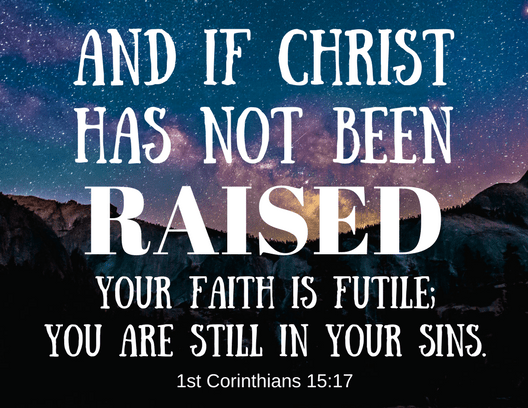
“And if Christ has not been raised, your faith is futile; you are still in your sins.Then those also who have fallen asleep in Christ are lost.”
Paul is essentially saying that without the resurrection our faith is pointless. We are unable to be saved and our loved ones are unable to be raised from the dead. Paul then goes on to remind us that the resurrection is real! The resurrection of Jesus reminds us of what’s really important in our lives, to glorify God during our lives on Earth.
-Brooke Cisneros
Reflection Questions
Why does it matter if you believe in the resurrection of Jesus Christ or not?
Do you believe in the resurrection of Jesus Christ?
How can you put into action verses 57 & 58, Paul’s concluding words on the resurrection and the difference it should make in our lives?
For the rest of this week, we are going to be looking each day at small sections of one chapter in the Bible- 1 Corinthians 13. When I was a kid I was taught that 1 Corinthians 15 is the Resurrection chapter, Hebrews 11 is the Hope chapter, and 1 Corinthians 13 is the Love chapter. If you’ve ever been to a wedding ceremony there is a good chance that you’ve heard all or at least a portion of this read as part of the ceremony. Today we will look at verses 1-3:
If I speak in the tongues of men and of angels, but have not love, I am a noisy gong or a clanging cymbal. And if I have prophetic powers, and understand all mysteries and all knowledge, and if I have all faith, so as to remove mountains, but have not love, I am nothing. If I give away all I have, and if I deliver up my body to be burned, but have not love, I gain nothing.
This is such a timely reading for me to consider. For the past 3 years, I’ve been working toward receiving my Doctorate of Ministry from Vanderbilt Divinity School in Nashville. It’s been a lot of hard work. For my project I read hundreds of articles and books, conducted interviews, presented ideas to colleagues, tested ideas on various groups, and wrote, edited, re-wrote, and re-edited until I had a project to present to my committee. Then after my committee read it, we met and I had to defend my project thesis orally. Finally, on April 9 I passed. On May 10 I’ll graduate and receive my official title D.Min, Doctor of Ministry in Integrative Mental Health Chaplaincy. The afternoon I passed my wife Karen said “Hello, Dr. Fletcher.” I said, “That’s the only time you’re ever going to call me that, right?” She said, “Absolutely, I hope you enjoyed it.”
So, I’ve been feeling relieved, accomplished, grateful, and good about having achieved this milestone in my academic and professional career.
But God had a lot more to teach me. And Brother Paul put his finger on it. In 1 Corinthians 13:1-3 Paul is saying a lifetime of accomplishments, being a gifted speaker, full of knowledge, or being spiritually gifted with miraculous powers, in the absence of concrete acts of love, is just a bunch of noise. You can get all the degrees and accolades and knowledge, but if you don’t put love into practice, it’s a bunch of noise and worthless.
It reminds me of a story I once heard: There was a child psychologist who was famous and had written many best-selling books on parenting and how to raise children. Recently, he had spent many hours constructing a new driveway at his home. Just after he smoothed the surface of the freshly poured concrete, his neighbors’ small children chased a ball across the driveway, leaving deep footprints. The man yelled after them with a torrent of angry words. His shocked neighbor heard these words and said to him, “You’re a psychologist who’s supposed to love children.” The fuming man shouted, “I love children in the abstract, not in the concrete!”
Paul is saying in I Corinthians 13:1-3 that love in the abstract is worthless.
A few days later, God showed me what love in the concrete looks like. I shared the following story on my Facebook page recently. It resonated with a lot of people because it’s been shared hundreds of times and I’ve heard more responses to it than anything else I’ve ever posted on social media. It illustrates to me what Love in the Concrete looks like:
I met Jesus yesterday. Face to face.
He’s a cashier at a grocery store in Front Royal, Virginia.
I was on my way home from work after a busy Monday visiting sick patients at the hospital, supporting families as their loved ones face the end of life, helping people struggling with addiction and staff cope with the challenges of being full-time caregivers. I’m a chaplain and a pastor, that’s what I do all day. It’s what I’ve trained to do, studied, practiced.
But then, yesterday, out of the blue, with no warning I met Jesus working the register at a grocery store.
First, I saw him patiently help the customer ahead of me. The one who only had 3 items in her cart, was very confused trying to figure out how much she could spend because she needed to have enough left over. He was gentle and patient with her. He couldn’t be more than his late teens, maybe early 20s, but he was attentive and caring. No eye rolls or looks of frustration, just caring for this confused and frustrated woman. (I was the one who was frustrated at how long it was taking).
Then it was finally my turn to check out. He was a thin young man, wearing a cross made of horseshoe nails and wire. He smiled and asked gently, “May I pray for you?”
That was unexpected and caught me completely off guard. I said, “Yes, please.” I was so moved that this young man would take the time to notice me and ask if he could pray for me. This was more than a transactional relationship for him. He was there to do more than simply earn his paycheck and go home. He saw me as more than an object, a thing to help pay his bills, he saw me as a person, a human being made in the image of God, who has a life outside of this 5-minute transaction and has needs that can be helped by God’s intervention. I was deeply moved.
But he wasn’t finished.
“What would you like me to pray for?” What should I say? How specific should I be? Should I say, “I’m currently under treatment for 2 types of advanced cancer and trying my best to keep going?” Should I tell him about my concerns about family members that I love, my desire to help my Church grow, and all the needs of the people I visit and staff I serve in the hospital?
There wasn’t time to go into all of that, so I simply said “My health.”
He stopped and said, “So you are having health problems. I’ll pray for that.”
By then the tears were starting to well up in me and I hurriedly helped him bag my groceries so I could get out of there before I started ugly crying in the grocery store check-out line.
But he wasn’t done yet.
“What’s your name?” That about finished me off. He wasn’t just making conversation or using spiritual cliches like “I’ll pray for you” as well-intentioned people often do, but sometimes forget to actually do. I knew that he really meant it. He was and is praying for me, Jeff, who has health needs. And based on what I saw, he’s already pretty close to God. So I have a feeling God will listen attentively to his prayers.
As I sat in my car afterward waiting for the tears to subside, I had the overwhelming sense that I had just spent time with Jesus.
I met Jesus yesterday.
He works as a cashier at a grocery store in Front Royal, Virginia.
Since I shared this on Facebook I’ve had dozens of people who live locally write to me or tell me in the hospital that this same young man has left others equally in tears when he prayed for them and they, too, equally felt touched by Jesus.
This young man probably doesn’t have a doctorate in spiritual care, but you don’t need one of those to show people concrete love in the name of Jesus. Go and be Jesus wherever you are today.
Pastor Jeff Fletcher
Reflection Questions
Name a time when you were surprised by God’s love revealed to you in unexpected places.
How would you describe the difference between abstract love and concrete love?
The young man showed Jesus’ love while checking people out at the grocery store. Where can you show the love of Jesus today?
As is frequent with God’s word, we see connections, themes, and promises fulfilled which transcend centuries, and today’s readings are an example of this. From our Old Testament reading of Joshua we see a thorough purging and annihilation of pagan people who were not followers of God in the land God wanted inhabited by his chosen people. Terms like “captured”, “struck every person”, “no survivor”, and “utterly destroyed” used more than once paint a pretty clear picture of what Joshua and the Israelites were busy doing. But, why? That is also repeated throughout, and while it could be summed up as “God said so”, it seems more beautifully stated in Joshua 11:15,
“Just as the Lord had commanded His servant Moses, so Moses commanded Joshua, and so Joshua did; he left nothing undone of all that the Lord had commanded Moses.” New American Standard Bible (La Habra, CA: The Lockman Foundation, 2020), Jos 11:15.
Over a thousand years later, our New Testament reading in 1 Corinthians written to the church in Corinth also references instructions on purging out the evil. And just like the pagan people and cultures surrounding and within the promised land in the time of Joshua, Corinth was certainly a place full of evil. A city known for immorality (not immortality as I just accidentally typed!), for all varieties of sexual sins and deviance, statues and idols of lovely false gods like Aphrodite and none other than a thousand prostitutes kept busy at the temple. One could imagine as new converts came out of this culture to Christianity, and for the existing church functioning within that society, there were some things that needed cleaned up. And then there were some things that just straight up needed called out, purged, and done away with. Finding ourselves progressed another couple thousand years from there, I think we can relate.
Tomorrow, the Jewish people and those celebrating Passover will be starting their remembrances and celebrations. I really like that the Jewish holidays have Biblical and spiritual meanings, and Passover is directly mentioned in our New Testament reading today. One instruction the Hebrews were given for the Passover was to remove the yeast/leaven from their homes on the first day. Today, there are all sorts of traditions on how to do this for Passover including varieties of special cutlery and cleaning to remove every speck of potential leaven from cookware to corners of homes and cabinets. Even the kids are apparently often helpful at finding those hard to reach remnants. As Christians according to 1 Corinthians 5, we know Jesus is our Passover lamb, which brought about a huge culture change, and one I am incredibly thankful for because I absolutely do not want to be doing anything with the blood of lambs or goats! But, while Jesus’s sacrificial life and death is a tremendous gift and blessing that reconciles us with God, scripture also tells us we can’t just be thankful for Jesus and leave whatever filth we have in our lives, homes, and churches. Leaven is often correlated to sin in scripture, and today’s reading is very clear. Leaven is not good in this case. It will creep into every corner of the loaf. It contaminates. If we tolerate evil, we will contaminate ourselves and the body of Christ if we are a member of it. If we ignore it and don’t even look for the small hidden pieces of leaven in our lives, the leaven is very efficient at growing, attracting bugs, and all the rest.
We are forgiven and cleansed through our Messiah who took the place of the Old Testament sacrifices. We also know we are human beings living in another Corinth, and it is easy to be deceived when society is screaming “that’s not leaven, that’s just fine”. May we all prayerfully consider the internal, spiritual leaven within ourselves along with any other things we might be cleaning up this spring. While smudges on windows, crumbs under the stove, and dead leaves in landscaping simply do not matter in the big picture, the spiritual stuff is a life and death matter. I love these verses in Psalm 19: 12-14 which talk about intently looking for the hidden pieces of leaven in our hearts.
But who can discern their own errors?
Forgive my hidden faults.
Keep your servant also from willful sins;
may they not rule over me.
Then I will be blameless,
innocent of great transgression.
May these words of my mouth and this meditation of my heart
be pleasing in your sight,
Lord, my Rock and my Redeemer.
-Jennifer Hall
Questions:
1. What similarities do you see between the culture in Joshua’s day, the city of Corinth, and today?
2. Have you ever seen someone’s sin in the body of Christ negatively impact others in the church family?
3. What challenges do you and the church face in identifying sin and right/pure actions from a Biblical worldview in today’s society?
As we look into Mark 12 and prepare our hearts for resurrection Sunday the question that I wanna ask is Are you ready for the Kingdom? Have you put your heart in the right standing with God? Have you asked good questions? One of the questions that comes up that is a good question is from the book of Mark.
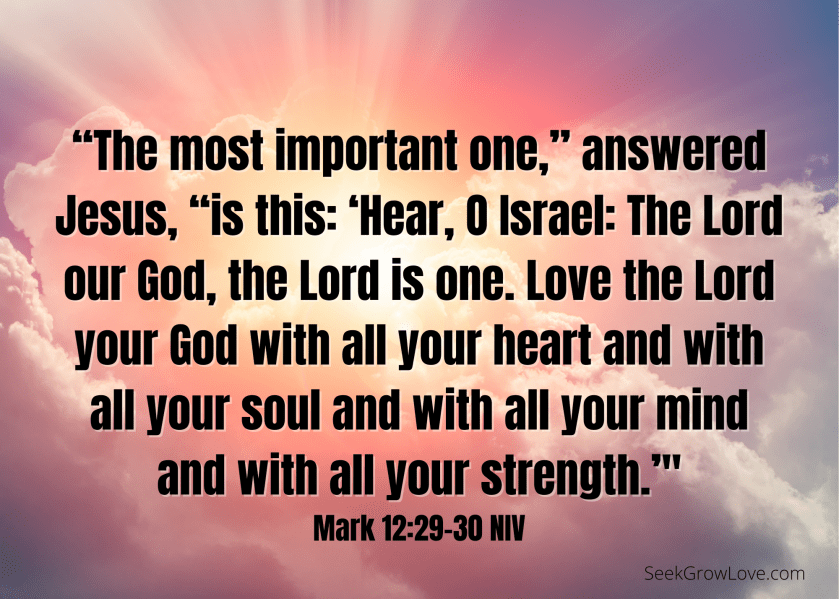
In Mark 12:28–34, Jesus has an interaction with a scribe who asked him what the most important commandment in the Old Testament was. Jesus responded by telling him that the most important commandments were to love God and love your neighbor (see Deuteronomy 6:4–5 and Leviticus 19:18). The scribe understood Jesus’ teaching and recognized that loving God and loving others were far more important than burnt offerings and sacrifices. When he heard his response, Jesus said, “You are not far from the kingdom of God” (Mark 12:34).
One reason Jesus told the scribe, “You are not far from the kingdom of God” is that the scribe faithfully interpreted Jesus’ words regarding the most important commandment in the law. After hearing Jesus’ answer to his question, the scribe didn’t correct Jesus or even challenge Him more. He simply acknowledged that what Jesus said was right and good. When Jesus heard this response from the scribe, he knew that the man was “not far from the kingdom of God” because his heart reflected God’s.
Isn’t that what we all want. To be able to reflect God perfectly? To know God’s heart and follow in it. This was a great question the scribe asked, and it moved him towards greater understanding. Are you asking good questions?
Another key reason why Jesus said to the scribe, “You are not far from the kingdom of God” is found in the last part of the scribe’s response to Jesus. The scribe said that loving God and loving your neighbor are “more important than all burnt offerings and sacrifices” (Mark 12:33). The scribe here understood that God is more concerned with whether people are loving Him and others than with how well they follow the law’s other requirements. After all, it is possible to go to church and not love God, it is possible for someone to bring a burnt offering and have hatred in his heart toward his brother. It is possible to do the right thing and still be wrong. Such a heart condition is not pleasing to God, no matter how many sacrifices one offers.
By acknowledging the importance of loving God and loving your neighbor, the scribe proved that he was “not far from the kingdom of God.” The only thing he needed to officially enter the kingdom of God was to follow Jesus. Then he would come to truly understand what it means to love God and love your neighbor, for the secret of the kingdom of God is embodied in Jesus Himself. Given the scribe’s response to Jesus, it is entirely possible that the scribe ultimately believed in Jesus after the Lord’s death and resurrection.
Today, many people talk about the importance of loving others. Some will say things like “Love is love” or “Love is all you need” to convey this message. Such beliefs and sayings show that many people understand the importance of loving others. However, until one chooses to follow Jesus—the One who performed the greatest act of love (John 15:13)—he or she will not be able to understand what it means to truly love. More importantly, our love for other people is rooted in our love for God. Jesus taught this by putting these two commands together in Mark 12:30–31.
There may be many people in this world who are “not far from the kingdom of God.” But until believers preach the gospel to them and help such people place their faith in Jesus, these individuals cannot be a part of the kingdom of God. It would be wise for you to ask this question to yourself. Have I put myself in a position to be not far from the Kingdom of God?
-Andy Cisneros
Reflection Questions
What grade would you give yourself for Loving the Lord your God with all your heart and with all your soul and with all your mind and with all your strength?
What grade would you give yourself for Loving your neighbor as yourself?
Where do you get stuck following the laws/traditions/giving the burnt offerings, but without a heart of love?
What changes can you make to love God and others more and more?
Ask yourself: Have I put myself in a position to be not far from the Kingdom of God? What do I need to get even closer to the Kingdom of God?
Once again, we have come across another section of Numbers with a number of sacrifices, laws, and other things that the ancient Israelites were expected to fulfill. Unfortunately for us, those laws are not as relevant to us today and can seem boring. To them though, these were essentially important to living in communion with their God. But what lesson can we Christians who are no longer bound by the Old Covenant take from this section?
I believe that 27:15-23 has very great insight for all people of all ages. This passage explains that Moses will not be leading the people into the Promised Land because of his disobedience back in 20:8-12. However, Moses is commanded to install Joshua as his successor as leader of the Israelites. Up to this point, Joshua was likely studying underneath Moses and worked with him.
The point of this lesson is two-fold: Those that are older need to prepare someone younger to take their place eventually, and those that are younger need to learn from those that are older. Unfortunately today, people have a mindset that their generation is the only one that is correct, while the truth is that there is much that can be learned from all generations, both older and younger.
To those that are older: Look for the potential in those that are younger in your church and start training them up to eventually enter ministries that you will be leaving eventually
To those that are younger: Learn from those older than you, be willing to do ministry work in your church, and develop a passion for the Lord.
-Talon Paul
(originally posted September 8, 2016)
Reflection Questions
What was Moses’ concern when the Lord told him he would not be entering the Promised Land?
If you are on the older end of ministry – who are you mentoring and teaching to do the ministry you are doing? Who else can you get involved?
If you are on the younger end of ministry – who will you ask to teach you how to serve and minister?
It’s getting close to planting time in northern Indiana, so it seems a great time to look again at the Parable of the Sower – one of my favorite parables. And I love how I still find new thoughts and ideas in this teaching from Jesus. I remember how this parable ministered to me when I was a young youth worker experiencing heartache over a youth who had received the word but was going in a different direction. This parable encouraged me. Jesus didn’t expect that every seed we helped to sow would grow into a healthy, whole, fruit-bearing plant. But, he did, and does, expect us to keep sowing the seed. And, we never know which of the seeds we sow will indeed grow, bloom, and produce beautiful, life-giving fruit.
Today I want to zero in on the seed among the thorns, but first a quick review of the other three types of soil and Jesus’ explanation of each to provide contrast.
Seed 1 – fell along the path – birds came and ate it – as soon as they heard the word Satan (the birds) came and ate it
Seed 2 – fell on rocky places – not much soil – not much root – sprang up quickly – when sun comes up plant is scorched and withers – receive the word with joy – but lasts only a short time – trouble and persecution comes and the plant falls away
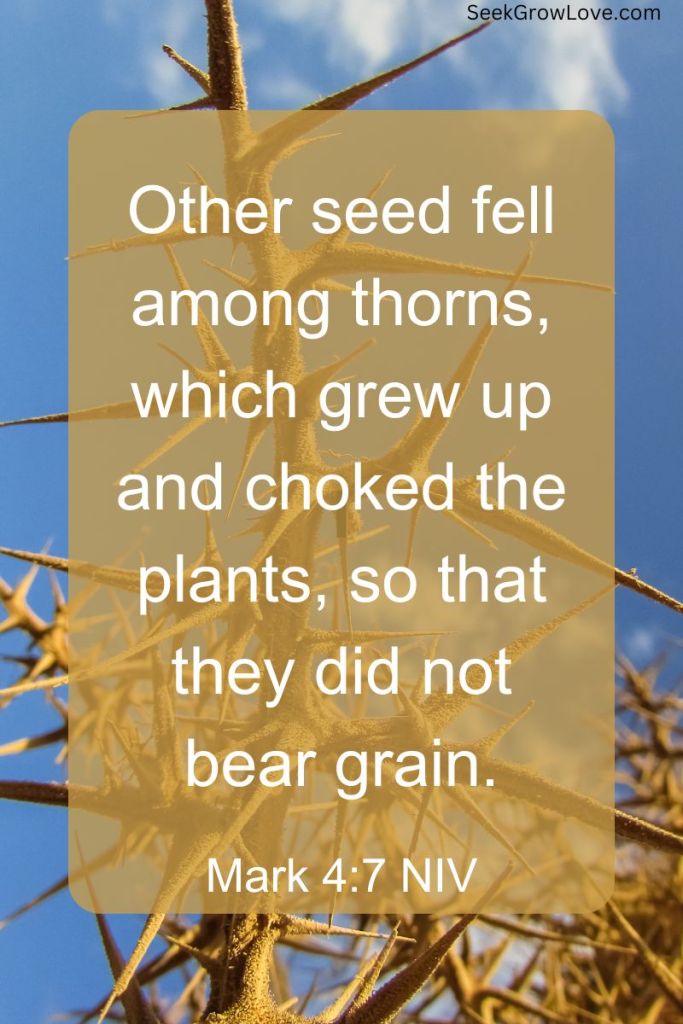
Seed 3 – fell among thorns – thorns grew up and choked the plant – plants did not bear grain – hear the word – but worries of this life, deceitfulness of wealth, and the desires for other things comes in – the plant is choked out, making it unfruitful
Seed 4 – fell on good soil – came up and grew and produced a crop, multiplying 30, 60, or even 100 times – hear the word, accept it and produce a crop
It is important to remember that in each of these scenarios the seed is all the same. There is nothing inferior to seed 1, 2 or 3. It is the same as seed 4. It is the perfect word of God being sown into the world. What creates the difference is where in the world it lands. Some people will accept it and do all that is necessary to make it grow in their lives and even produce fruit to give life to others. Some people will not. But, either way, the seed is still good and perfect.
The new thing I saw when I read the parable this time is that the plant from seed 3 that fell among the thorns did not necessarily die. Seed 1 never had a chance at life. Seed 2 enjoyed life for a short time but withered/fell away. I think in my mind I was giving a death sentence to seed 3 already as well. But, that’s not exactly what the Scriptures actually say. Both in the original parable and Jesus’ explanation it says the plant was choked by the thorns – it does not say killed by the thorns – at least not yet.
It is not down and out, yet. It is still alive – it might be sitting in your pew with you at church or it might be your neighbor across the street. It has a pulse. It might be a family member – it might be you. It is not dead, yet. It is alive – but it is not healthy. A healthy plant doesn’t have thorns wrapped around its neck. Jesus tells us the result of being choked by the thorns was that it did not bear grain – it was unfruitful. It is alive – but it is not experiencing the abundant life that Jesus spoke of. It is not producing and displaying the life-giving fruit of the Spirit. It is not reproducing and giving new life to others. It is alive but it isn’t passing along life. It is a sad place to be – whether you are a plant or a Christian.
Who needs a vegetable garden with no vegetables? Or an orchard with no apples? Or a wheat field with no wheat? Or a Christian with no fruit?
What can be done for such a plant? Is there any hope for the plant choked by thorns? I say yes! Cut off the thorns! Sometimes when I am gardening I am not sure what needs to be pruned and what needs to stay. What would kill the plant and what would help it grow healthy? I love that Jesus tells us exactly what the thorns are so we know what to cut out. He tells us the thorns are “the worries of this life, the deceitfulness of wealth, and the desires for other things” (vs. 19). And if you aren’t cutting them out, be sure that they are choking new life out of you. A worried Christian. A greedy Christian, or a Christian relying on his own bank account. A Christian with other priorities. It is not a healthy place to be. And it certainly doesn’t promote new life.
Examine your plant carefully. Being alive is good. But are you bearing fruit? What does your fruit look like? What does it smell and taste like? Where are you giving new life to others? If you aren’t sure if you are bearing fruit now – what do you want your fruit to look like? What do you need to get rid of first?
What thorns might be creeping up toward your neck? What are you worried about? Do you think your problems are too big for your God? What are you putting your trust in? God or yourself or your job or your paycheck? Do you hoard, are you always striving for the next big toy, is it hard to be generous? Have you bought any of the ‘deceitfulness of wealth’? Is pleasing God the most important thing in your life? Or are there other things you desire more? What have you made the number one priority in your life?
Cut out the thorns so you can have life – and bear fruit – which will in turn give life.
-Marcia Railton
Questions above – and what other questions would you add?
What can your God do? Is there anything He can not do? In our Bible readings today we get a glimpse into how a few different people might have answered those questions.
Let’s look at Job 12 first. Job is replying to his friend Zophar who just suggested that since God is great and right and true and since Job is suffering, that must mean that Job is deceitful, evil, or witless (or all three) and is being punished. Job is ready with a quick reply. Do his friends think “wisdom will die with you?” (vs. 1). He certainly still has some spirit left in him.
Most of this chapter Job is giving credit to God for what God can and has and will do:
– giving life and breath to every creature and all mankind (vs 10)
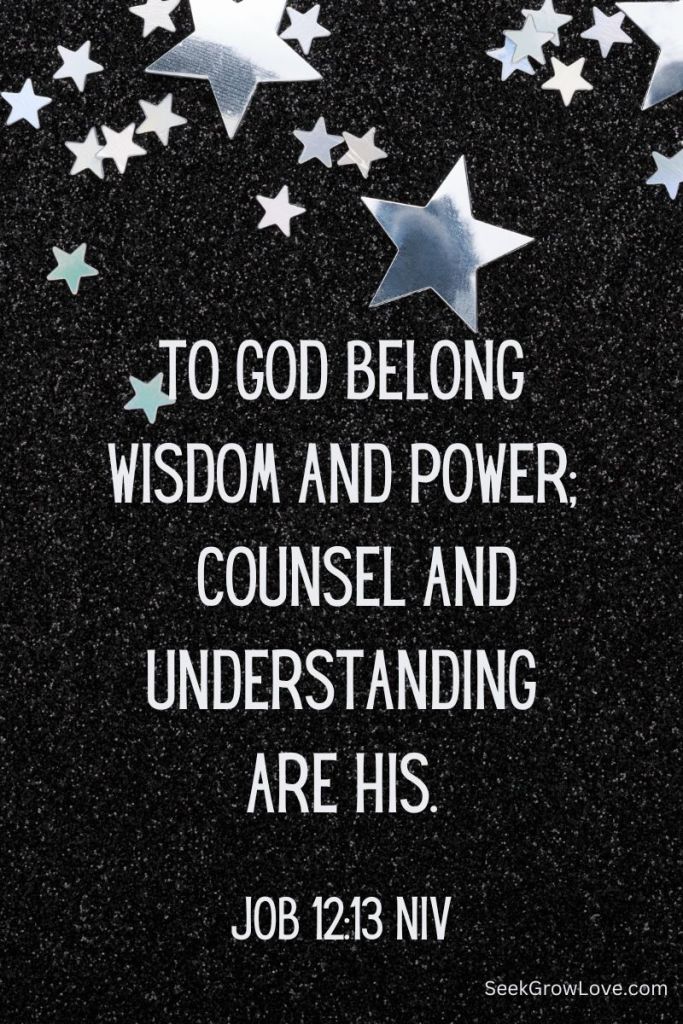
– owning wisdom and power, counsel and understanding (vs 12)
– controlling the waters with drought or flood (vs 15)
– holding strength and victory (vs 16)
– overthrowing men long established – even judges, kings and priests (vs 17-19)
– reveals the deep things of darkness (vs 22)
– makes nations great, and destroys them (vs 23)
– deprives the leaders of the earth of their reason (vs 24) – hmm – interesting
Job is agreeing with his friends on the greatness of God! No one can come anywhere close to comparing to what God is and what He can do. No human wisdom, strength, plans, or power can successfully stand against Him. When God wants to bring them down, He can and He has and He will! He can make them rise. He can make them fall.
Oh, if only the 10 scared spies knew that lesson from Job! How might their lives – and the lives of ALL of the Israelites who listened to them – have been different. In Numbers 13 we see Moses following God’s direction to send out 12 men (one from each tribe) to look over Canaan land which God had promised long ago to Abraham’s descendants. The twelve found the land just as wonderful as God had promised – flowing with milk and honey, huge clusters of grapes, bountiful harvests. It must have looked pretty amazing as they had just spent a couple years in the wilderness mostly surviving on God’s manna and quail – which were also true signs of God’s miraculous provision – but ones they had become accustomed to and now took for granted.
But rather than believing God for the promise and remembering how He had bested the powerful Egyptians, they shrunk back in fear. They knew on their own they were no match for the strength and size of all the people who already lived in the land. But they forgot what God could do. They forgot how God had already gotten them this far. They forgot what was most important to remember! They forgot what their God can do!
-Marcia Railton
Reflection Question
What have you seen God do for others? What have you seen God do for you? What promises do you believe God will indeed accomplish?
When you feel like a grasshopper up against a giant, what can you remember about your God? What can He do?
How does your view of what He can do change what you do?
Who have you told what God can and has and will do? Who else can you tell?
In chapter 16, we found out that Paul was a Roman citizen. Being a citizen of this vast empire was a great privilege. There were only two ways to gain Roman citizenship; you could either purchase it (something only the rich could afford to do), or be lucky enough to inherit it from your parents when you were born. Paul was born a Roman citizen.
The reason why you would want to be a Roman citizen in the first century is that they were given rights others were not guaranteed. The rights to marry another Roman citizen, to sue and to be sued, to have a legal trial, and to not be crucified were just some of the benefits offered to those privileged enough to be Roman citizens.
As we saw in chapter 21, Paul had already used his citizenship to get out of being flogged (Romans, legally, could not be tortured or whipped). In chapter 25 Paul exercised another of his rights–the right to appeal to Caesar. Paul knew that if he was brought back to Jerusalem, the men that had pledged to kill him would probably succeed. He also knew that he had to get to Rome to testify there. Thus Paul used his privilege to get to where he needed to go, so he could do what he was required to do (though, as we shall see in the coming chapters, this journey would not be an easy one).
If you were born in the West (especially the United States), you, like Paul, are privileged. You have rights like freedom of speech, freedom of religion, and freedom of the press. But there are many parts of the world today where these rights that are taken for granted here are only the ideals of dreamers. There are Christians throughout the world who have to look over their shoulder as they travel to church (if a public place of worship is even allowed) and others who are worshiping with the knowledge that every gathering may easily be their last.
There is another privilege you share with Paul: you are a citizen of Heaven. This citizenship cannot be purchased or inherited. It is not exclusive. The Kingdom of Heaven (or, Kingdom of God) is open to anyone. The poor and the rich, the weak and the strong, the lost and the found are all welcome. The cost of this privilege was paid for by God with the blood of His Son. It is offered to any who will receive it.
Paul was first and foremost a citizen of Heaven. He lived his life devoted to advancing the Kingdom and the One who will establish it in its fullness. The rights his Roman citizenship granted him were nothing compared to those his Lord did. That being said, Paul exercised his privilege as a Roman in order to promote God’s Kingdom as a Christian. He wanted to make sure as many people as possible would become citizens of the Kingdom. You also can use your rights as a citizen of your country to further the cause of the Kingdom. Exercise your earthly privileges in a way that leads others to receive heavenly ones.
-Joel Fletcher
(originally posted March 6, 2019 for SeekGrowLove)
Reflection Questions
Do you think of yourself first as a citizen of the country you were born in/live in – or a citizen of heaven (where God dwells)? What are the differences?
How can you use your rights and privileges to promote God’s Kingdom?
Who do you know who needs to know more about how to become a citizen of the Kingdom of God? How can you share with them?
What stands in the way of you living completely committed to God? Time management problems, a secret (or not-so secret) sin, a preoccupation with _______, a friend taking you in the wrong direction? Many in the early church in Acts were living out a completely committed relationship with God and His Son, Jesus. And the results are exciting to watch as we read through the book. Their faith was living and active and daily – and tested regularly.
I wonder if today too many people who carry the label ‘Christian’ use their faith as a once-a-week booster shot, if they can make it to church that week. But then are quite content to spend the week surrounded by (and sometimes covered in) the germs and sicknesses of worldly living and priorities.
When you read Acts 19 search for all the sold-out characteristics and examples; and while you’re at it – spot the imitations as well (those exist today, too). I particularly like the passage in verses 18-20 where the believers were confessing their practices and bringing their (expensive) magic books to be burned. They had heard about Jesus and they believed and they were excited and ready to change! It’s not that they had heard about Jesus and kind of believed and were sort of interested and wanted to add in some Jesus/church/faith to their already full lives. See the huge difference? They were radically changing their lives because they wanted to follow Jesus well.
Do you have anything in your life to add to the bonfire? Anything that is keeping you from being totally committed to God and His Coming Kingdom? Anything that doesn’t mix well with Jesus’ message that you need to give up?
The believers burned 50,000 drachmas worth of obstacles to living sold-out lives (a drachma was a silver coin worth about one day’s wages) – that’s a lot of obstacles they eliminated! The very next thing Luke wrote was: “In this way the word of the Lord spread widely and grew in power” (Acts 19:20). Sacrifice and true change brought growth. Are you ready to grow?
-Marcia Railton
(Original devotion posted for SeekGrowLove on April 19, 2018)
Reflection Questions
In your reading of Acts what do you find impressive about the early church?
What in your life is keeping you from living totally committed to God and His Coming Kingdom? What do you have to confess? What do you have to add to the bonfire?
What changes can you make in your life that would help the word of the Lord to spread and grow in power?
What does your church already do that is similar to the actions of the early church? How can you help your church look more like the early church?
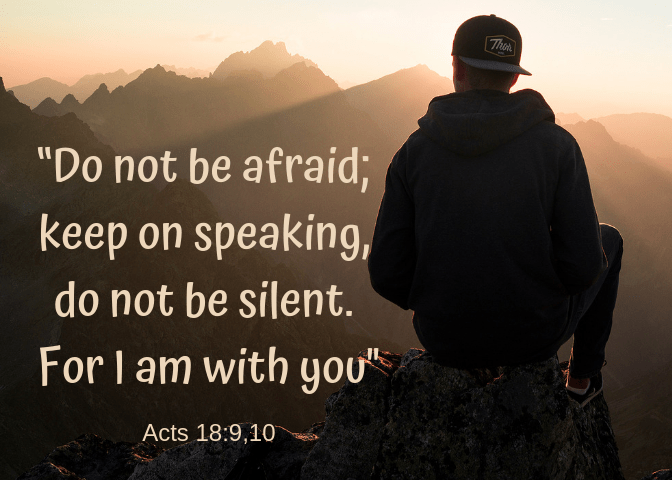
Acts 18 details the cities that Paul visited on his way from Jerusalem to Greece and some of the highlights in those cities. While in Corinth Paul again has issues with the Jewish community there and instead finds a Gentile man named Titius Justus who was a worshiper of God. Paul also has a vision from the Lord saying,
“Do not be afraid; keep on speaking, do not be silent. For I am with you, and no one is going to attack and harm you, because I have many people in this city.” (Acts 18:9,10)
I understand why Paul would need this encouragement with the number of cities that he had been thrown out of after annoying the local Jewish population with his message.
What I find interesting is the fact that Paul is the first missionary to set foot on the continent of Europe and just recently we read about the first convert in the area, yet even in this “heathen” land filled with idols and false gods God is working in people’s lives and has people who worship him. These people do not know the gospel and need to hear about Jesus desperately, but even without that knowledge they are seeking God and worshiping him. We see this today in many of the mission fields that we send people into. The people do not know about Christ, but it is obvious that God has been working in their community to prepare them to hear. This is why it is so important that we get out there and evangelize. The harvest is plentiful but the workers are few.
Then while traveling in Ephesus in modern day Turkey, Paul runs into a man named Apollos who was a Jew that knew his scriptures (Old Testament) thoroughly and knew only the message of John the Baptist. With only this information he was boldly speaking about Jesus and the fact that he was the son of God. He was off on some things, but he was on fire for God and was running with it.
These verses are encouraging because they show that you do not need to have everything figured out theologically in order to follow God. You don’t need a master’s degree or years of training for him to be working in your life. Now I do think that seeking truth should be an important part of any believer’s life, but all that is needed to get started with God is faith in Jesus, and the Holy Spirit to work in your life.
-Chris Mattison
(Originally posted Feb 27, 2019 for SeekGrowLove)
Reflection & Application:
If you heard the Lord speak to you in a vision do you think he would say, “Do not be afraid; keep on speaking, do not be silent” or “Do not be afraid; START speaking, do not be silent” or something else?
Like Apollos, who didn’t first know the whole story, how has your understanding and knowledge grown? What and who has helped you in this area?
How, where, when and to whom do you think God wants you to share what you know about Him, His Son and His plan of salvation?





 Seek Grow Love