Watch Out for Those Thorns!

Old Testament: Numbers 23 & 24

Poetry: Job 18

New Testament: Mark 4:1-25

It’s getting close to planting time in northern Indiana, so it seems a great time to look again at the Parable of the Sower – one of my favorite parables. And I love how I still find new thoughts and ideas in this teaching from Jesus. I remember how this parable ministered to me when I was a young youth worker experiencing heartache over a youth who had received the word but was going in a different direction. This parable encouraged me. Jesus didn’t expect that every seed we helped to sow would grow into a healthy, whole, fruit-bearing plant. But, he did, and does, expect us to keep sowing the seed. And, we never know which of the seeds we sow will indeed grow, bloom, and produce beautiful, life-giving fruit.

Today I want to zero in on the seed among the thorns, but first a quick review of the other three types of soil and Jesus’ explanation of each to provide contrast.

Seed 1 – fell along the path – birds came and ate it – as soon as they heard the word Satan (the birds) came and ate it

Seed 2 – fell on rocky places – not much soil – not much root – sprang up quickly – when sun comes up plant is scorched and withers – receive the word with joy – but lasts only a short time – trouble and persecution comes and the plant falls away

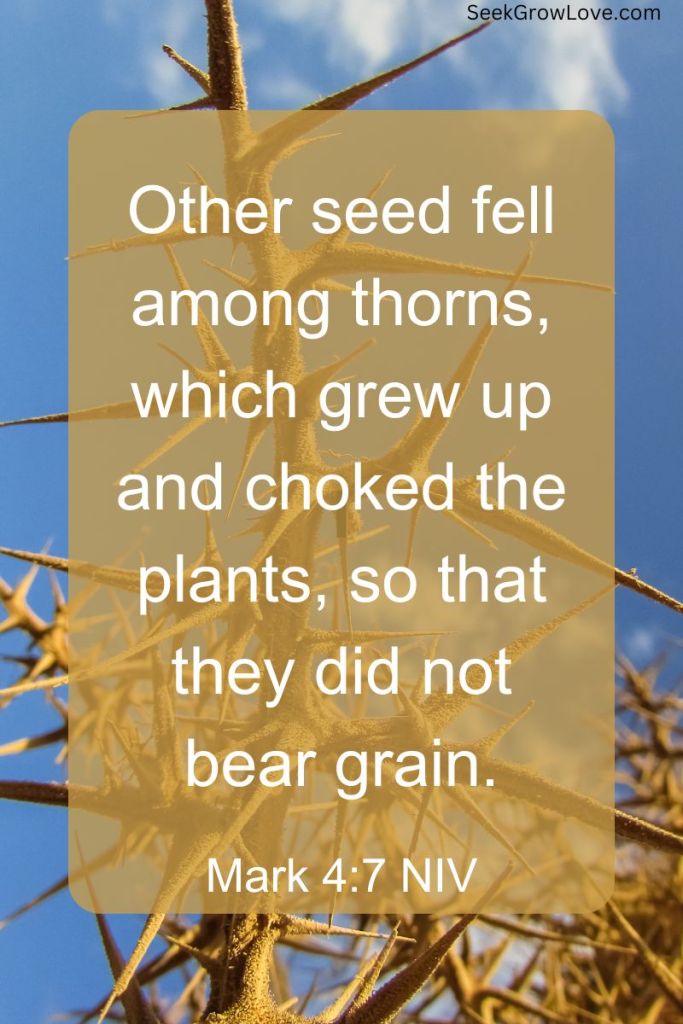
Seed 3 – fell among thorns – thorns grew up and choked the plant – plants did not bear grain – hear the word – but worries of this life, deceitfulness of wealth, and the desires for other things comes in – the plant is choked out, making it unfruitful

Seed 4 – fell on good soil – came up and grew and produced a crop, multiplying 30, 60, or even 100 times – hear the word, accept it and produce a crop

It is important to remember that in each of these scenarios the seed is all the same. There is nothing inferior to seed 1, 2 or 3. It is the same as seed 4. It is the perfect word of God being sown into the world. What creates the difference is where in the world it lands. Some people will accept it and do all that is necessary to make it grow in their lives and even produce fruit to give life to others. Some people will not. But, either way, the seed is still good and perfect.

The new thing I saw when I read the parable this time is that the plant from seed 3 that fell among the thorns did not necessarily die. Seed 1 never had a chance at life. Seed 2 enjoyed life for a short time but withered/fell away. I think in my mind I was giving a death sentence to seed 3 already as well. But, that’s not exactly what the Scriptures actually say. Both in the original parable and Jesus’ explanation it says the plant was choked by the thorns – it does not say killed by the thorns – at least not yet.

It is not down and out, yet. It is still alive – it might be sitting in your pew with you at church or it might be your neighbor across the street. It has a pulse. It might be a family member – it might be you. It is not dead, yet. It is alive – but it is not healthy. A healthy plant doesn’t have thorns wrapped around its neck. Jesus tells us the result of being choked by the thorns was that it did not bear grain – it was unfruitful. It is alive – but it is not experiencing the abundant life that Jesus spoke of. It is not producing and displaying the life-giving fruit of the Spirit. It is not reproducing and giving new life to others. It is alive but it isn’t passing along life. It is a sad place to be – whether you are a plant or a Christian.

Who needs a vegetable garden with no vegetables? Or an orchard with no apples? Or a wheat field with no wheat? Or a Christian with no fruit?

What can be done for such a plant? Is there any hope for the plant choked by thorns? I say yes! Cut off the thorns! Sometimes when I am gardening I am not sure what needs to be pruned and what needs to stay. What would kill the plant and what would help it grow healthy? I love that Jesus tells us exactly what the thorns are so we know what to cut out. He tells us the thorns are “the worries of this life, the deceitfulness of wealth, and the desires for other things” (vs. 19). And if you aren’t cutting them out, be sure that they are choking new life out of you. A worried Christian. A greedy Christian, or a Christian relying on his own bank account. A Christian with other priorities. It is not a healthy place to be. And it certainly doesn’t promote new life.

Examine your plant carefully. Being alive is good. But are you bearing fruit? What does your fruit look like? What does it smell and taste like? Where are you giving new life to others? If you aren’t sure if you are bearing fruit now – what do you want your fruit to look like? What do you need to get rid of first?

What thorns might be creeping up toward your neck? What are you worried about? Do you think your problems are too big for your God? What are you putting your trust in? God or yourself or your job or your paycheck? Do you hoard, are you always striving for the next big toy, is it hard to be generous? Have you bought any of the ‘deceitfulness of wealth’? Is pleasing God the most important thing in your life? Or are there other things you desire more? What have you made the number one priority in your life?

Cut out the thorns so you can have life – and bear fruit – which will in turn give life.

-Marcia Railton

Questions above – and what other questions would you add?

What Can Your God Do?

Job 12:13 for SGL

Old Testament: Numbers 13

Poetry: Job 12

New Testament: Acts 26

What can your God do? Is there anything He can not do? In our Bible readings today we get a glimpse into how a few different people might have answered those questions.

Let’s look at Job 12 first. Job is replying to his friend Zophar who just suggested that since God is great and right and true and since Job is suffering, that must mean that Job is deceitful, evil, or witless (or all three) and is being punished. Job is ready with a quick reply. Do his friends think “wisdom will die with you?” (vs. 1). He certainly still has some spirit left in him.

Most of this chapter Job is giving credit to God for what God can and has and will do:

– giving life and breath to every creature and all mankind (vs 10)

– owning wisdom and power, counsel and understanding (vs 12)

– controlling the waters with drought or flood (vs 15)

– holding strength and victory (vs 16)

– overthrowing men long established – even judges, kings and priests (vs 17-19)

– reveals the deep things of darkness (vs 22)

– makes nations great, and destroys them (vs 23)

– deprives the leaders of the earth of their reason (vs 24) – hmm – interesting

Job is agreeing with his friends on the greatness of God! No one can come anywhere close to comparing to what God is and what He can do. No human wisdom, strength, plans, or power can successfully stand against Him. When God wants to bring them down, He can and He has and He will! He can make them rise. He can make them fall.

Oh, if only the 10 scared spies knew that lesson from Job! How might their lives – and the lives of ALL of the Israelites who listened to them – have been different. In Numbers 13 we see Moses following God’s direction to send out 12 men (one from each tribe) to look over Canaan land which God had promised long ago to Abraham’s descendants. The twelve found the land just as wonderful as God had promised – flowing with milk and honey, huge clusters of grapes, bountiful harvests. It must have looked pretty amazing as they had just spent a couple years in the wilderness mostly surviving on God’s manna and quail – which were also true signs of God’s miraculous provision – but ones they had become accustomed to and now took for granted.

But rather than believing God for the promise and remembering how He had bested the powerful Egyptians, they shrunk back in fear. They knew on their own they were no match for the strength and size of all the people who already lived in the land. But they forgot what God could do. They forgot how God had already gotten them this far. They forgot what was most important to remember! They forgot what their God can do!

-Marcia Railton

Reflection Question

  1. What have you seen God do for others? What have you seen God do for you? What promises do you believe God will indeed accomplish?
  2. When you feel like a grasshopper up against a giant, what can you remember about your God? What can He do?
  3. How does your view of what He can do change what you do?
  4. Who have you told what God can and has and will do? Who else can you tell?

Citizen Rights and Privileges

Acts 25 11 NIV for SGL

Old Testament: Numbers 12

Poetry: Job 11

New Testament: Acts 25

In chapter 16, we found out that Paul was a Roman citizen. Being a citizen of this vast empire was a great privilege. There were only two ways to gain Roman citizenship; you could either purchase it (something only the rich could afford to do), or be lucky enough to inherit it from your parents when you were born. Paul was born a Roman citizen.

The reason why you would want to be a Roman citizen in the first century is that they were given rights others were not guaranteed. The rights to marry another Roman citizen, to sue and to be sued, to have a legal trial, and to not be crucified were just some of the benefits offered to those privileged enough to be Roman citizens.

As we saw in chapter 21, Paul had already used his citizenship to get out of being flogged (Romans, legally, could not be tortured or whipped). In chapter 25 Paul exercised another of his rights–the right to appeal to Caesar. Paul knew that if he was brought back to Jerusalem, the men that had pledged to kill him would probably succeed. He also knew that he had to get to Rome to testify there. Thus Paul used his privilege to get to where he needed to go, so he could do what he was required to do (though, as we shall see in the coming chapters, this journey would not be an easy one).

If you were born in the West (especially the United States), you, like Paul, are privileged. You have rights like freedom of speech, freedom of religion, and freedom of the press. But there are many parts of the world today where these rights that are taken for granted here are only the ideals of dreamers. There are Christians throughout the world who have to look over their shoulder as they travel to church (if a public place of worship is even allowed) and others who are worshiping with the knowledge that every gathering may easily be their last.

There is another privilege you share with Paul: you are a citizen of Heaven. This citizenship cannot be purchased or inherited. It is not exclusive. The Kingdom of Heaven (or, Kingdom of God) is open to anyone. The poor and the rich, the weak and the strong, the lost and the found are all welcome. The cost of this privilege was paid for by God with the blood of His Son. It is offered to any who will receive it.

Paul was first and foremost a citizen of Heaven. He lived his life devoted to advancing the Kingdom and the One who will establish it in its fullness. The rights his Roman citizenship granted him were nothing compared to those his Lord did. That being said, Paul exercised his privilege as a Roman in order to promote God’s Kingdom as a Christian. He wanted to make sure as many people as possible would become citizens of the Kingdom. You also can use your rights as a citizen of your country to further the cause of the Kingdom. Exercise your earthly privileges in a way that leads others to receive heavenly ones.

-Joel Fletcher

(originally posted March 6, 2019 for SeekGrowLove)

Reflection Questions

  1. Do you think of yourself first as a citizen of the country you were born in/live in – or a citizen of heaven (where God dwells)? What are the differences?
  2. How can you use your rights and privileges to promote God’s Kingdom?
  3. Who do you know who needs to know more about how to become a citizen of the Kingdom of God? How can you share with them?

Make it Spread and Grow

xr:d:DAF-jOL4x5w:6,j:901140544355471458,t:24030412

Old Testament: Numbers 3 & 4

Poetry: Job 5

New Testament: Acts 19

What stands in the way of you living completely committed to God?  Time management problems, a secret (or not-so secret) sin, a preoccupation with _______, a friend taking you in the wrong direction? Many in the early church in Acts were living out a completely committed relationship with God and His Son, Jesus. And the results are exciting to watch as we read through the book.  Their faith was living and active and daily – and tested regularly.

I wonder if today too many people who carry the label ‘Christian’ use their faith as a once-a-week booster shot, if they can make it to church that week.  But then are quite content to spend the week surrounded by (and sometimes covered in) the germs and sicknesses of worldly living and priorities.

When you read Acts 19 search for all the sold-out characteristics and examples; and while you’re at it – spot the imitations as well (those exist today, too).  I particularly like the passage in verses 18-20 where the believers were confessing their practices and bringing their (expensive) magic books to be burned.  They had heard about Jesus and they believed and they were excited and ready to change!  It’s not that they had heard about Jesus and kind of believed and were sort of interested and wanted to add in some Jesus/church/faith to their already full lives.  See the huge difference?  They were radically changing their lives because they wanted to follow Jesus well.

Do you have anything in your life to add to the bonfire?  Anything that is keeping you from being totally committed to God and His Coming Kingdom?  Anything that doesn’t mix well with Jesus’ message that you need to give up?

The believers burned 50,000 drachmas worth of obstacles to living sold-out lives (a drachma was a silver coin worth about one day’s wages) – that’s a lot of obstacles they eliminated!  The very next thing Luke wrote was: “In this way the word of the Lord spread widely and grew in power” (Acts 19:20).  Sacrifice and true change brought growth. Are you ready to grow?

-Marcia Railton

(Original devotion posted for SeekGrowLove on April 19, 2018)

Reflection Questions

  1. In your reading of Acts what do you find impressive about the early church?
  2. What in your life is keeping you from living totally committed to God and His Coming Kingdom? What do you have to confess? What do you have to add to the bonfire?
  3. What changes can you make in your life that would help the word of the Lord to spread and grow in power?
  4. What does your church already do that is similar to the actions of the early church? How can you help your church look more like the early church?

Keep on Speaking

Old Testament: Numbers 1 & 2

Poetry: Job 4

New Testament: Acts 18

Acts 18 details the cities that Paul visited on his way from Jerusalem to Greece and some of the highlights in those cities.  While in Corinth Paul again has issues with the Jewish community there and instead finds a Gentile man named Titius Justus who was a worshiper of God.  Paul also has a vision from the Lord saying,

“Do not be afraid; keep on speaking, do not be silent.  For I am with you, and no one is going to attack and harm you, because I have many people in this city.” (Acts 18:9,10)

I understand why Paul would need this encouragement with the number of cities that he had been thrown out of after annoying the local Jewish population with his message.

What I find interesting is the fact that Paul is the first missionary to set foot on the continent of Europe and just recently we read about the first convert in the area, yet even in this “heathen” land filled with idols and false gods God is working in people’s lives and has people who worship him.  These people do not know the gospel and need to hear about Jesus desperately, but even without that knowledge they are seeking God and worshiping him. We see this today in many of the mission fields that we send people into. The people do not know about Christ, but it is obvious that God has been working in their community to prepare them to hear.  This is why it is so important that we get out there and evangelize. The harvest is plentiful but the workers are few.

Then while traveling in Ephesus in modern day Turkey, Paul runs into a man named Apollos who was a Jew that knew his scriptures (Old Testament) thoroughly and knew only the message of John the Baptist.  With only this information he was boldly speaking about Jesus and the fact that he was the son of God. He was off on some things, but he was on fire for God and was running with it.

These verses are encouraging because they show that you do not need to have everything figured out theologically in order to follow God.  You don’t need a master’s degree or years of training for him to be working in your life. Now I do think that seeking truth should be an important part of any believer’s life, but all that is needed to get started with God is faith in Jesus, and the Holy Spirit to work in your life.

-Chris Mattison

(Originally posted Feb 27, 2019 for SeekGrowLove)

Reflection & Application:

  1. If you heard the Lord speak to you in a vision do you think he would say, “Do not be afraid; keep on speaking, do not be silent” or “Do not be afraid; START speaking, do not be silent” or something else?
  2. Like Apollos, who didn’t first know the whole story, how has your understanding and knowledge grown? What and who has helped you in this area?
  3. How, where, when and to whom do you think God wants you to share what you know about Him, His Son and His plan of salvation?

Tell Me Again

Old Testament: Leviticus 14 & 15

Poetry: Psalm 38

New Testament: Acts 11

I love that right after Luke wrote about Cornelius and Peter’s God-orchestrated visit (in yesterday’s reading of Acts 10) he spends the bulk of the next chapter telling all the events again. This time Peter is explaining his actions to the circumcised believers in Jerusalem who were criticizing him for going into the home of an uncircumcised man and and even eating with them. This story is obviously near and dear to the writer’s heart. In Luke’s gospel and his sequel book of Acts how many times did Luke write of the events of the birth of Jesus? Once. How many times did Luke recount the events of Jesus’ death and resurrection? Once. But Luke, the Gentile doctor, perhaps the only Gentile writer of the New Testament (depending on who wrote Hebrews), takes the opportunity to tell this story twice.

For this story – this true factual account complete with times and locations – opened up a new way for Jews and Gentiles. This story had the power to change ministry, to change lives, to save lives – a lot of lives. Now God’s overwhelming love, forgiveness, salvation through the blood of his Son – the Jewish Messiah – and the newly poured out gifts of the Spirit were not just for the circumcised Jews who believed but for anyone in the whole world who would listen and accept and do what is right. God in His mercy and grace can and will and has cleaned up what was thought could never be clean. This is BIG NEWS worthy of retelling.

Did you catch what Luke reports the Gentile named Cornelius was doing when God’s angel appeared to him with a message, that when followed, had the potential to change his life and the lives of his family and the lives of all Gentiles to come? If you aren’t sure, check out Acts 10:30. Did you catch what Luke reports the Jew named Peter was doing when he received the vision (3 times, because once wasn’t enough) that would completely change the brand new life of the early church and Christian movement? If you aren’t sure, it’s recorded in Acts 11:5. I don’t think it is mere coincidence that both of these devout men were praying AT THE TIME when God gave them directions that would change their world.

“Draw near to God and He will draw near to you” (James 4:8).

What might have happened if Cornelius and Peter had been too busy to pray? I don’t doubt that God’s amazing plan would have proceeded, but perhaps through the actions of someone else. What would have happened if either of these men had not followed the directions given to them when they prayed? What if they had just come to God in prayer to quickly deliver their most recent “God Please Do” list and then get on with their day as they had planned? What if Peter had continued with his, “Surely not, Lord” protests because the directions he was receiving weren’t what he expected?

Might there be times we have missed out on God’s life-altering blessings and messages because we didn’t take the time to pray to draw near to God? Are there times when we steal Peter’s line and tell the Almighty, “Surely not, Lord”? Are there people and situations we doubt God can clean? Have you ever tried to stand in God’s way? Are there times we haven’t followed the Lord’s direction because it doesn’t line up with what we were expecting? Maybe we need to hear this story again?

-Marcia Railton

Reflection Questions

  1. What does this account in Acts 10 and 11 mean to you? What do you find amazing about it?
  2. Is your prayer time drawing near to God, not just turning in your most recent “God please do” list? When you pray are you ready to really receive direction from God?
  3. Have you tried telling God, “Surely not, Lord”? Have you tried to stand in His way? Do you more often stand in His way or follow His way?
  4. Is there anything you think God can not clean?

Down, but Not Out

Psalm 37:24 NLT – Down, but Not Out

Old Testament: Leviticus 10 & 11

Poetry: Psalm 37

New Testament: Acts 9

Today’s reading in Acts is the conversion of the Apostle Paul, once called Saul. This is a huge moment for the church. This man once persecuted Christians. Remember, he was there nodding in agreement when they stoned Stephen to death. After His encounter with Jesus, he became a servant to the Gospel. He wrote many books in the New Testament and was instrumental in spreading Christianity to the Gentiles. He is an important figure. However, I’m not going to focus on him today. I felt a little guilty about skipping over his story, but I’m reasoning most of us know Paul. Paul’s been taught many times to us and will be many times again. Instead, I want to share some insight I gained after doing a word study years ago on a verse in Psalms 37.

Psalms 37:23-24 says, “The LORD directs the steps of the godly. He delights in every detail of their lives. Though they stumble, they will never fall.” (NLT)
In the English language, the words “stumble” and “fall” mean the same thing. A look at the original Hebrew text for this verse reveals something different.

The Hebrew word used for the term “stumble” in verse 24 is the word “Qual” meaning to fall or lie down. The Hebrew word for the term “fall” in verse 24 is the verb “Hofal” which means to pitch, reel, cast down. In fact, the word Hofal is used throughout the Old Testament to describe objects being thrown. A more literal translation for this verse is: “Though they [the godly] fall, they will not be thrown out.” Or in other words, “down but not out!”

Understanding this verse in its original language reveals God’s amazing grace. Even when we struggle, even when we fall, God has not abandoned us.

We will make mistakes. We will sin. Earlier this week we read Leviticus 4 and 5 which gave instructions on the proper sacrificial offerings for unintentional sins. Sometimes our sin is not always deliberate. Sin can be the result of a broken heart.

Several years ago, I went through a very difficult breakup. I was mad at God. Mad at myself. Mad at the boy. In my anger, I threw a tantrum.

I witness tantrums on a daily basis. Let me tell you, there is a difference when a young child throws a tantrum and when a young child is deliberately disobedient.

When a young child throws a tantrum it is in anger because something did not go his or her way. In the early years of development, children are still learning how to handle big emotions. Instead of quietly moping or dealing with it, children whine, scream, throw themselves on the floor, talk back, run, hit friends, hit you, throw things. Literally ANYTHING to make it clear they are unhappy with you and the situation, while at the same time trying desperately to get your attention because they still need your affection. As mad as they are at you, they don’t want to be left alone.

During that period of my life, I fell, and I fell hard. Though I never walked completely away from God, I definitely ran around on fire screaming at God but refusing to jump into the refreshing pool of living water that could heal me. I took the long road towards healing. While it may have made me a more understanding teacher, I definitely would not recommend.

Once I was ready to properly deal with my disappointment and work through things with God, it took me twice as long to recover. I had to deal with the breakup and deal with the damage I caused while being angry with God. Thankfully, amazingly, God does not leave us. He does not cast us out. Though we may sin, struggle, fall along His righteous path, He does not throw us away. Our freedom to continue along His righteous path is bought with the precious blood of His son. In the words of Dr. Joe Martin “Hallelujah! Praise God! Amen!” *slam a table or wall*

-Emilee Ross

Reflection Questions

  1. This Psalm was written by David. What did he know about the godly stumbling? What could a full fall (or throwing out) have looked like for David? How was God holding his hand?
  2. When have you stumbled? Did you throw a tantrum? What could have a full fall (or throwing out) looked like in your situation? How was God holding your hand?
  3. What characteristics of God make Him really good at holding the hands of the godly, even when they stumble. What role does Jesus play? Be thankful!

Step by Step

xr:d:DAF9hCSmstM:6,j:7038419800685676399,t:24022212

Old Testament: Leviticus 8 & 9

Poetry: Psalm 37

*New Testament: Acts 8

The story of Philip and the Ethiopian eunuch provides us with an example of how to witness and share our faith with others. Let’s start from the beginning of Phillip’s journey in Acts 8:26.

Philip is told by God to travel in a certain direction. Next he is told to walk next to a certain carriage. His directions are coming step by step. Philip trusts God. He doesn’t demand to know the game plan, but allows the Holy Spirit to guide his way bit by bit. Sometimes, that is how God delivers his instructions to us.

Next, we see Philip addressing the Ethiopian man with a question. Philip sees the man is reading scripture and instead of butting in with his own agenda, Philip asks the man if he understands what he is reading. Starting with a question is a great way to initiate a conversation about faith. This allows the other person to set the tone of the conversation with how he or she chooses to answer. In this instance, I love the man’s response, “‘How can I, unless someone instructs me?’” (Acts 8:31 NLT) He is straight up honest, aware of his own limitations, and you’ve got to admire that!

Philip joins the man in his carriage and instead of launching into his own explanation, he waits for the eunuch to ask his own followup question. Again, Philip is allowing the man to take control of the conversation. Philip is not following his own evangelical agenda, but meeting the man where he’s at with what he wants to know. Therefore, even though the eunuch is admitting to not having knowledge on the subject, Philip is giving him dignity by letting the man determine the direction of their discussion.

I love what Philip does next. Acts 8:35 says “Beginning with the same scripture, Philip told him the Good News about Jesus.” Beginning with the same scripture. That phrase is key. Philip didn’t ignore the eunuch’s questions and launch into his own prepared testimonial speech. He didn’t pull out the Roman Road, or a pamphlet in his back pocket on how to talk to people about Jesus. He related what the man was already reading to the Gospel.

This is not to say anything negative about evangelical tools. In fact, I led a Bible study in college using the Roman Road method, and I think it’s great. There is nothing inherently wrong with these tools, but that’s just what they are, tools. Tools to use with human judgment. Not every faith related conversation calls for your life story on how God changed you. Not to say we shouldn’t tell our stories, but we should find an appropriate way to fit it into the conversation while witnessing. We should never ignore someone asking direct questions about our faith.

One year in my high school art class I sat next to a girl who was openly a non-believer. Art class is one of those few classes in school where you can actually get away with talking as long as you are still focused on your work. When she learned I was a Christian she would come into class with prepared questions for me. I don’t know if she was actually genuinely interested, or if she was just trying to find a way to trip me up. It seemed more like the latter. She asked the hard big questions, like why does evil exist, why did God give us freewill. I never pressed her too much, but I answered her questions. If I didn’t know the answer, I would ask the adults in my life or look it up on my own then come back with an answer later. This went on for several weeks. I didn’t preach at her, but I answered her questions honestly and in doing so, shared the Gospel with her. I prayed for her in my own quiet time with God and asked for his direction during our conversations. I never had a come to Jesus moment with her, but I don’t think I was ever meant to, either. I kept hearing a voice in my head urging me to plant the seed. I don’t think she was ready to receive the Gospel at that point in her life. I believe I was meant to plant a seed that would be given the chance to grow years later. I did all this by meeting her where she was at, with her questions, instead of my own agenda.

Philip quite literally and figuratively meets the eunuch where he is at. Eventually, the eunuch becomes so moved by what he has heard from Philip he decides to be baptized. Church history relates this encounter to how the Gospel came to Africa. After the eunuch was baptized and Philip left him, the man brought his new found faith to his people. This all comes from Philip being willing to follow God and being open to the promptings of the Holy Spirit. Next time you find yourself in a position to share the Gospel, remember Phillip. Remember how Phillip treated the eunuch tactfully with dignity, meeting him right where he was at, just as Jesus does with us.

-Emilee Ross

Reflection Questions

  1. How well do you follow promptings from the Holy Spirit, especially as it applies to sharing your faith? Have you ever felt like you missed a God-given opportunity? How can remembering Philip help you?
  2. What questions do you think are common among the world regarding faith in God?
  3. Pray for guidance and wisdom in knowing how God wants to see you sharing your faith.

Gold and Goat Hair

Exodus 35:5a NIV

Old Testament: Exodus 35 & 36

Poetry: Psalm 34

New Testament: Acts 1

Gold and goat hair. Silver and sea cow hides. Bronze metal and blue yarn. Onyx stones and olive oil. These all were great offerings to do the work of God. These were just some of the precious, as well as the more common, everyday items that were brought as offerings to create the very first tabernacle.

God had given Moses some very specific plans for what He wanted for His tabernacle including the furnishings and priestly garments. The creative Creator who designed heaven and earth and fashioned all sorts of lands, plants, fish, birds, animals and unique human beings was now showing His flair for architecture (albeit tent-like architecture that would travel well), interior decorating (including specific dimensions, materials and details for the furnishings and surfaces), and even fashion designing (of the stunning priestly wardrobe).

God gave the precise plans – and He also gave His Spirit. God gave His Spirit to fill these craftsmen (Bezalel, Oholiab and other skilled persons) with skill, ability and knowledge so they would know how to create His masterpieces in gold, silver, bronze, stones, wood and “all kinds of artistic craftsmanship” (Exodus 35:33). And the Bible records that God also gave both Bezalel and Oholiab the ability to teach others these skills. What a creative and masterful and wise Spirit of God, which God still gives today! Have you received any of His crafty, skilled Spirit? If so, how are you using it to do His work? Are you able to teach others what God has given you? How can teaching others your skills and abilities further God’s work?

God gave the plans and His Spirit with the skills, it was up to the people to give the resources. ”All the Israelite men and women who were willing brought to the LORD freewill offerings for all the work the LORD through Moses had commanded them to do.”  (Exodus 35:29) These offerings were not required (as other offerings were), but these were voluntary offerings. ”Everyone who was willing and whose heart moved him came and brought an offering to the Lord for the work.” (Exodus 35:21) And they did give! They donated their gold jewelry to the cause. Those who had acacia wood, bronze, spices and oil gave what they had. The skilled willing women got to work spinning the colorful yarn, linen and goat hair. There was no gift too large and no gift too small. It was all given with a willing heart and would be used for the Lord’s work. They even gave and gave until they were told to stop because they had given more than enough to complete the sanctuary. 

I am not sure your church would find a good use for your donated goat hair today…um, wait, correction, my quick internet search just now revealed several common uses for goat hair including paintbrushes, rugs, carpet, and even Mohair or cashmere (different from rabbit cashmere) to be used in making sweaters or even fine pants for your pastor. So, go ahead keep collecting your goat hair for God, if that is what you have and your willing heart is telling you to give it to Lord’s work. 

And also consider, what do you have, or could you acquire with what you have, to provide for God’s work today. I’m guessing God’s not planning on building a tabernacle in your backyard, but do not doubt He has many, many plans that you can be an exciting part of with your participation and your offerings. What is your church doing that you can be a part of, contributing your time, talents and what you have to a larger extent than ever before? Could the children’s ministry use new crayons or is the kitchen running out of coffee cups? Would a tray of cookies be useful after church or could you help provide a spring cleaning spruce-up? What needs can you provide? Do you have a crafty skill to create a piece of artwork or functional thing of beauty (furniture or banner or blanket) for God’s church or even for His work outside of the church (perhaps a donation for a non-profit organization). Where is God’s work around the world in need of what you have? Sometimes the need is as simple as highlighters, glasses, or flat frisbees. Sometimes it’s Bibles, bikes and fertilizer. Sometimes it’s larger, like a church building – a new tabernacle. What do you have (given to you by God), that He would love to see you use to further His work with one of your neighbors in need – your means of transportation, your coffeepot, you sharing a skill? 

What is your heart moving you to offer to God’s work? Consider both your valuable and precious resources as well as your common and everyday items? What gold and goat hair will you offer to God with a willing heart? 

-Marcia Railton

Reflection & APplication

  1. What do you have (or have the means to acquire) that could be used to do the work of the Lord? How is your heart moving you to give offerings to the Lord’s work? 
  2. Pray about it and do it.

The Priests

Old Testament: Exodus 29 & 30

Poetry: Psalm 31

New Testament: Matthew 26

I am struck by the stark contrast of the priests of God in our reading today. In Exodus we are shown the beginning of the priesthood. The LORD sets apart Aaron and his sons. They were called, consecrated and ordained to serve Him. These men were anointed to serve the Lord and their anointing was to be a priesthood that could have continued “throughout their generations.” 

But as we travel forward through the centuries to the time of Christ in Matthew 26, we see the high priest, chief priests and elders scheming to secretly arrest and kill Jesus. They are counting out the 30 pieces of silver to be given to his betrayer. The chief priests and the whole Sanhedrin were looking for false evidence to condemn Jesus to death. Rather than leading his people in the observance and the true meaning of Passover the high priest is interrogating Jesus. The high priest commands, “I charge you under oath by the living God: Tell us if you are the Messiah, the Son of God.” Jesus replied, “You have said so. But I say to all of you: From now on you will see the Son of Man sitting at the right hand of the Mighty One and coming on the clouds of heaven.” This truthful statement is met with the high priest tearing his clothes and pronouncing Jesus as a blasphemer. The leaders declare that he is worthy of death. They even go as far as slapping him, striking him with their fists, mocking him, and spitting in his face. How could these religious leaders fall so far from God? They were prideful of their positions and were so filled with jealousy, and hatred that they could not recognize the Son of God.

But praise God that we know our Lord Jesus is the Son of God and we know that God called him to serve as our High Priest. The book of Hebrews explains, Christ did not take on himself the glory of becoming a high priest. But God said to him, “You are my Son; today I have become your Father.” “Therefore, since we have a great high priest who has ascended into heaven, Jesus the Son of God, let us hold firmly to the faith we profess.”(Hebrews 4:14) As Jesus offered himself as a sacrifice, we should offer our lives to God. We will follow the example of our High Priest, Jesus Christ so we may be known as “a chosen people, a royal priesthood, a holy nation and God’s special possession.”

-Rebecca Dauksas

Reflection Questions

  1. What was the job of the priests, and specifically the high priest? 
  2. How is Jesus the perfect high priest? 
  3. In what ways can you now serve as a chosen people, a royal priesthood, a holy nation and God’s special possession?