Union with Christ

Philippians 3

IMG-0279

The last few days we’ve been talking about unity in the body. Today I want to spend some time discussing unity (or union) with the head of the body. Our connection with Jesus affects every relationship in our lives. If we are to achieve unity in our local church, we must maintain union with our Lord.


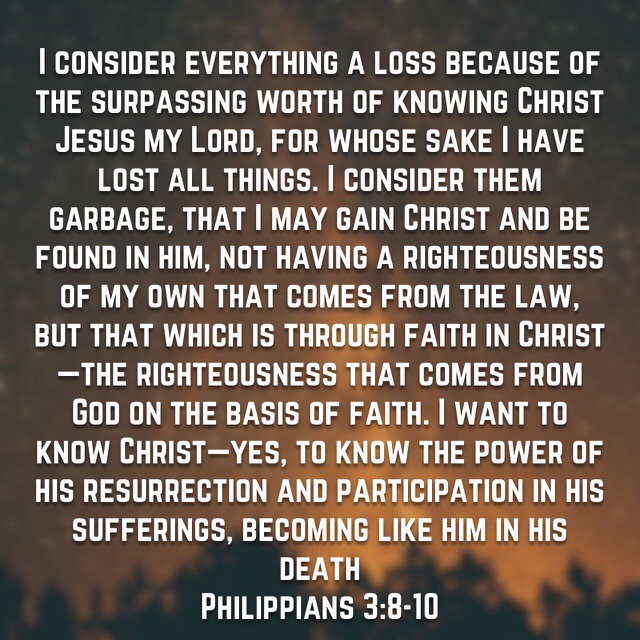
Union with Christ has two important aspects. The first is knowing him. This does not mean to know who he is or to know some things about him. It is to understand what he went through and why he endured it. It is to realize that without him we are hopeless. It means communicating with him. It means recognizing that our own efforts count as nothing towards our salvation and that only through him can we be saved and that this is a good thing. Paul says that everything he could boast about in himself is garbage compared to the worth of knowing Christ (Phil. 3:8), and in John 17:3 Jesus says that eternal life is to know the only true God and His son. Knowing Christ is essential for salvation and for being united with him.


The second aspect of our union with Christ is being like him. Earlier in Philippians, Paul tells readers to have the same mind as Christ (2:5).  Just as Jesus lived to serve the will of God, we should. Just as he was willing to give up his life for others, we should. He lived perfectly and we should strive to do the same. In Galatians 2:20 (ESV) Paul says, “I have been crucified with Christ. It is no longer I who live, but Christ who lives in me. And the life I now live in the flesh I live by faith in the Son of God, who loved me and gave himself for me.” Union with Christ is about emptying ourselves of the muck that comes from our sinful nature and replacing it with the holiness that comes from Christ—out with the old, in with the new.


“Therefore, if anyone is in [union] Christ, the new creation has come: The old has gone, the new is here!” (1 Corinthians 5:17, NIV)


In this life, we will never achieve perfect union with Jesus. We will not fully know him or be totally like him until we can be with him—without the presence of sin. Paul recognized this and writes that despite his shortcoming he would “press on toward the goal for the prize of the heavenly call of God in Christ Jesus” (Phil. 3:14, NRSV). We, too, should press on towards the goal to have union with Jesus. It won’t be perfect, but it will go a long way in furthering our own spiritual development and the unity of the Church.

– Joel Fletcher

Four Enemies of Unity

Philippians 2:12-30

IMG-0276

Yesterday we learned about Paul’s advice for moving towards unity—having an attitude of humility. Today, I’d like to discuss some attitudes and actions that can hinder unity. These four enemies of unity that I will mention are just some of the obstacles that get in the way of the Church achieving unity. 

Enemy 1: Pride

Pride is the opposite of humility. In humility, we put ourselves in the service of others; in pride, we use others to serve our own purpose. It is an easy trap to fall into; pride catches those who do well and convinces them that this gives them cause to boast in themselves. It inflates their ego—giving them a reason to look down on others and view their own ideals as the be-all-end-all. When even just one person in a church body is infected by pride, it can have terrible consequences for church unity. This why Paul cautioned against boasting in one’s self and works:

“For it is by grace you have been saved, through faith—and this is not from yourselves, it is the gift of God—not by works, so that no one can boast. For we are God’s handiwork, created in Christ Jesus to do good works, which God prepared in advance for us to do.” (Ephesians 2:8-10, NIV)

Enemy 2: Gossip

There is no redeemable quality in gossip—it is a destroyer of friendships and communities. Gossip is broadcasting the shortcoming of others with no attempt to help them get better. It is a mechanism used to make the one gossiping feel better about themselves. Where gossip is present, unity cannot exist. The one being gossiped about is treated like an outsider and is pushed away from the community. Gossip is a unity killer.

“Do not let any unwholesome talk come out of your mouths, but only what is helpful for building others up according to their needs, that it may benefit those who listen.” (Ephesians 4:29, NIV)

Enemy 3: Complaining/Grumbling 

When we complain or grumble about something we don’t like, this is typically a sign we are struggling with pride and not embracing humility. If something is actually wrong, grumbling under your breath about it is not the way to go. Never will a good solution be found when it is brought to the attention of leaders through complaining. If we feel something is not being done the way it should be, we should humbly voice our concern to those in leadership after much prayer and meditation. Complainers don’t promote unity—those who genuinely want what is best for the church need to find the right way to address changes. 

Enemy 4: Arguing 

By arguing, I don’t mean mere disagreement, but an incessant need to be proved right (which also comes from pride). When a person goes around trying to convince everyone that their own views on various issues are right and then get angry when they’re not agreed with, it is not beneficial. We must always be striving to find the truth, but we must never do so in a matter that is unloving. Our discussions should be edifying and result in a more unified body; not filled with bitterness and anger which causes strife.  

“Do everything without grumbling or arguing, so that you may become blameless and pure, ‘children of God without fault in a warped and crooked generation.’ Then you will shine among them like stars in the sky as you hold firmly to the word of life. And then I will be able to boast on the day of Christ that I did not run or labor in vain. But even if I am being poured out like a drink offering on the sacrifice and service coming from your faith, I am glad and rejoice with all of you. So you too should be glad and rejoice with me.” (Philippians 2:14-28, NIV)

Each one of these enemies come about naturally from our human nature. We must fight against them just as we do with other sins. We must instead embrace humility, love, peace, and encouragement in order to promote unity and avoid these divisive enemies. 

If you struggle with any of these, start pushing them out of your life today. 

– Joel Fletcher

The Purpose of Unity

 Philippians 1

IMG-0274

One of the main reasons Paul decided to write a letter to the church at Philippi was to encourage unity among them. If they achieved this unity, it would make his joy complete (Phil. 2:2). But for what purpose did Paul want them to be unified? What is the common idea around which their unity was to be based? The answer to this question is found in chapter 1.


Paul had a singular focus in life: to preach the Gospel (good news) to the world. In particular, he wanted to spread it beyond the Jewish people to the Gentiles. In Philippians 1 Paul mentions the persecution he had faced in his life. While he doesn’t go into detail, we know from other sections of the New Testament that Paul suffered greatly. He was thrown into prison multiple times, he was shipwrecked, and, among other things, he was beaten. Despite this suffering, Paul says in verse 12 “…that what has happened to me has actually helped to spread the gospel.” Paul also heard of people who were preaching the gospel out of “envy and rivalry.” Despite these selfish motives, the important thing to Paul was that Christ (the central figure of the Gospel) was being preached. Paul was able to rejoice because his focus was on Christ and the Gospel—even when the situation wasn’t always…pleasant.


And this brings us to Paul’s purpose in imploring the Philippians towards unity.


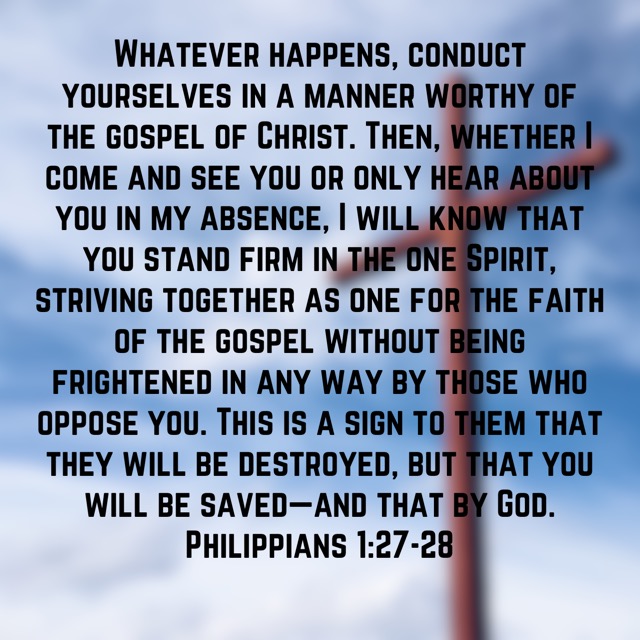
Verses 27 and 28 say:

“Whatever happens, conduct yourselves in a manner worthy of the gospel of Christ. Then, whether I come and see you or only hear about you in my absence, I will know that you stand firm in the one Spirit, striving together as one for the faith of the gospel without being frightened in any way by those who oppose you. This is a sign to them that they will be destroyed, but that you will be saved—and that by God.”


Paul wanted the church to be unified in their desire to further the Gospel. This meant conducting themselves in a manner worthy of the Gospel—no matter what happened. If everyone in the Church would start doing this one thing, then they would be striving together as one for the faith of the gospel; they would be unified. No outside force could intimidate them and throw them off course, and no disputes from within could form to distract from their common purpose. This would make Paul’s joy complete.


If we want to bring unity to our churches today, we must make sure that we are unified around the same idea: spreading and living out the Gospel. If it is not for that purpose then it’s pointless. And if we want to bring unity to our churches, each of us as individuals must start living in a manner worthy of the Gospel. If we are committed to the same purpose and to living in the same manner, unity is assured to ensue.


– Joel Fletcher

Making Paul’s Joy Complete

IMG_0272

Hello everyone! My name is Joel and I will be bringing you this week’s FUEL Bible Readings. Each day we will be taking a look in the letters of Paul (Philippians in particular) at the theme of unity.


We’re living in a time filled with divisiveness and disunity. Every day our Facebook feeds, television screens, and other sources for news are filled with stories of conflict. This conflict manifests itself in many ways: arguments, protests, hostility, and even war. Sadly, conflict is not just a problem in secular society; the Church is not immune to it. But this is nothing new; from the very beginning of the Church and continuing for almost two thousand years, there has been discord and conflict among those who claim to follow Jesus of Nazareth.


But this, my brothers and sisters, is not how it should be.


The Church is to be united: having the “…same mind, having the same love, being in full accord” (Phil. 2:2, NRSV).  This is what Paul wanted for the church in Philippi—it would make his “joy complete”. And I am sure that, if he were writing today to any of the many churches dealing with disunity, he would encourage them to do the same.


So this week, as you are reading these devotions and the words of Paul, I would encourage you to look at yourself to see if there is anything you are doing that is promoting disunity within your church and look for ways in which you can make Paul’s joy complete.


– Joel Fletcher


Memory Verse:

“1 If then there is any encouragement in Christ, any consolation from love, any sharing in the Spirit, any compassion and sympathy, 2 make my joy complete: be of the same mind, having the same love, being in full accord and of one mind. (Philippians 2:1-2, NRSV)

Searching for Jesus

Mark 16:1-8 (Friday)

Mark 16-6

On the Sunday after Jesus was crucified, Mary Magdalene and Mary the mother of James & Salome went to the tomb to anoint Jesus’ body.  They went first thing, right as the sun was rising (as early as they could and still respect the Sabbath).  When they reach the tomb, they find the stone rolled away and a young man in white telling them Jesus was raised from the dead and was no longer here.  He tells them go and tell Jesus’s disciples and Peter that “He is going ahead of you to Galilee to meet you there.”  So the two women fled from the tomb in astonishment and trembling, saying nothing.

And that is how the oldest versions of Mark end.  That’s it.  All the rest of chapter 16 (verses 9 – 20) were added afterwards.  No appearances of the risen Jesus.  No commission to the world.  No ascending up to heaven.  Just an empty tomb and silence.

What in the world is Mark doing?!  If this were a movie, it would easily be one of the worst movie endings of all time.  And that includes some pretty unsatisfying movie endings (Inception, X-Men 3, Matrix Reloaded…).  BUT, as we’ve seen, Mark isn’t a crummy writer.  Remember his artful use of “stay alert” and his plot timings in the Temple?  Mark knew how to craft a remarkable story and to tell it with purpose.  I believe that Mark was up to something here that makes me like this older ending more than the extended one (it’s like the original vs the extended edition).  Here’s my take on Mark’s original ending.

First, we – as the reader/audience – are in the know.  From the very beginning we know that Jesus has been raised and that the church emerged as his followers continued his work.  So we know what happened.  Because we know that the church exists and that the disciples continued the work, we know that Mary & Mary weren’t silent forever.  The word spread and the gospel message grew.  I think that Mark is using our knowledge of this as a way to emphasize the irony of this moment and as a challenge for the audience to do what they know wasn’t done: DON’T BE SILENT!  Spread the good news!  From the first verses, Mark is preparing us to speak out; to be the voice in the wilderness shouting out.  We are meant to take the message forth to take up the responsibility we know we have but that is left unfulfilled in the text.

Second, the audience is meant to experience the suffering and despair of the crucifixion – not just for Jesus but for his followers as well.  Mark leaves us unsatisfied as a tool for helping us step into the shoes of those who were living this out in real time.  We experience the uncertainty and trepidation that comes with uncertainty.  BUT we still must move in light of that uncertainty.  Which then becomes faith.  Faith is belief in things unseen.  In Mark’s gospel, that faith is put into the text literally with the absence of the risen Christ.  If Mark wasn’t written until the disciples and witnesses of Jesus were all dying, then it was for an audience that would have never seen Jesus face to face.  Their faith isn’t based on some encounter with a man but an encounter with his love in the community he started.  Mark’s original ending helps us feel the void of uncertainty (what happens in our lives all the time) but also move us to a faith that is open to uncertainty and still demands that we act anyways.

Finally, I think that Mark is leaving the story in our hands.  The man in the tomb says, “Jesus is going ahead of you; there you will see him.”  Jesus isn’t in heaven in this story.  Jesus is out there – in the world.  Waiting for us.  We have to go find him.  We have to search for him.  We have to take this story and find Jesus in the love and grace and truth of a community that is searching together in the world.  This is my favorite idea in Mark; that this ending calls us to go forth and live a life for Christ so that we might find him.  But where can we find Christ?  We’ll find him in the orphan we adopt, the prisoner we visit, the poor we protect, the immigrant we give refuge, the sick we heal, the hungry we feed, and the oppressed we redeem.  I know that Jesus is in heaven now, and I can’t see heaven.  But I can see the Kingdom of God – the good news he came to spread – break into this world bit by bit when I live out the life I was created to live.  Jesus is out there, waiting for us to come and serve and find him.

Now Mark says, what are you going to do?  Will you remain here, quiet?  Or will you go and be a part of the work God is doing?

-Graysen Pack

The Strength of Christian Friends

Mark 2

paralytic top

Many years ago, a precious lady in our church was coming to the end of her battle with cancer. One of her closest friends, also from our church, was sharing that she had been to her bedside to visit. While she was there our friend said that she could no longer pray for herself. The visiting friend reassured her that she had fought the good fight, she had finished the race and she had kept the faith, but it was time for her to rest and others would be praying on her behalf.


I’m not sure why this has stuck with me for probably longer than 20 years. Maybe it’s because I know that the bond of friendship between these two Godly women had endured a great many of life’s other trials as well as celebrations.


In Mark chapter 2 we see another wonderful example of friendship. Four friends going to extreme measures to bring another man to the Great Physician. Because of their faith, the man with the physical disability was healed and the five of them walked out of the room together. Can you imagine the celebration that took place among them and their families?


I realize that many lessons from Mark 2:1-5 have been taught about faith and the healing powers that Jesus demonstrated on that day. But to me, my attention always gets drawn to the message of how important friendships are.


We are not meant to walk our faith out in isolation. Faith is meant to be experienced in community. I know I said this in yesterday’s post, but we need others of like-minded faith, by our sides. This is so, so important. Our friends in the faith are who keep us on track, who support us when life gets tough, and who help us cheer when life is spectacular. And just as importantly, we do the same for them.


My prayer for you is that you have a network of people with whom you can do life together.  


-Bethany Ligon


Converse with the Almighty

bible

Saturday’s Weekly Recap with Graysen Pack

This week we’ve walked through another six chapters of Proverbs and found words that, although written thousands of years ago, still speak to the persistent struggles of human existence.  Answers to guide us seek the wealth that God promises, to join God’s work as he defends the orphaned and poor, to earnestly engage in honest community, to be aware of the emotional strife of ourselves and others, and to use our words to build a church of sincerity.


It can be easy to forget that even when we read the oldest parts of the Bible, the words are still alive and active.  And we don’t really read Scripture, but instead engage in a conversation with it.  It isn’t a professor lecturing at us from the front of a large classroom.  Instead, it is a dialogue that speaks to who, where, and when we are.  The words of God are both alive in the history of Israel and the church as well as our lives today.


As you continue to read through the Word of God this year, remember that you are entering a conversation that will speak to your life and the life of the world today.

Victorious God

Revelation 8-12

1023-REV011015ENGKJV08000480ISP02066256000

Wednesday July 19

Seven is the number of completion, of fulfillment.  The number seven appears repeatedly in Revelation:  seven Churches, seven seals…. and now seven trumpets.  A trumpet is blown to get people’s attention- something important is about to be announced.  The seven trumpets here announce the judgment of God upon the earth.  God is about to bring this evil age to a close to make way for the age to come, when the Kingdom of God replaces fully the kingdoms of this world.
Each of the seven trumpets are blown by an angel of God followed by some great disaster.  There is hail, fire, blood, large burning rocks falling from heaven (a meteor or asteroid).  Then stars fall from heaven, the sky becomes filled with darkness, more heavenly bodies fall to earth opening deep pits in the earth which release demonic creatures.  There are plagues and wars and all manner of destruction heaped upon the earth.  Here it’s important to remember that much of this is symbolic language.  The point is that there will be calamities which bring about destruction on the earth, some are ecological, some are interstellar, and some are man made.  This Summer there’s a t.v. show on called Salvation.  The premise of the show is that NEO object is heading toward earth and is likely to cause massive death or even total extinction.  In real life, under Yellowstone National Park in Wyoming there is a super volcano, which, if it erupts, would place nearly all of the continental US under a cloud of darkness that would result in massive famine.  Of course, we hear regularly dire predictions about global warming, rising sea levels, the melting of the Arctic permafrost etc…  And don’t forget the expanding nuclear arsenals of places like North Korea and Iran.  There are any number of ways that global destruction could occur.  This is a part of our human consciousness… and it was a part of human consciousness in the first century as well.  There has always been the understanding that there is much that is outside the limits of human control: drought and famine, earthquakes and fire from heaven.  These events were usually linked to belief that whatever gods that community worshipped were angry.  Destruction was linked to judgment, which was linked to human sin.  The normal response was to bring sacrifices to the gods and a promise to stop doing bad things.
In this section of Revelation, we see that the one true God is behind these disasters, but there is no willingness of the people to repent. In Rev. 9:20-21 the people refuse to repent of their idolatry, of their murder, of their sexual immorality.  The people will not link the calamities that befall them and the earth with their own bad actions that violate God’s word.
Revelation 12 gives another picture. It’s an overview of the history of the earth and it shows the cosmic dimension of the battle that’s taking place.  There is a spiritual warfare. Behind it all is this picture of evil described as the dragon, or the ancient serpent, or the devil or Satan.  Evil is making war on God’s people.  Yet, evil will be brought down and God’s people who refuse to submit to evil will be victorious.  Even though they may be killed by evil, yet will they ultimately be victorious.
Remember, when John received this vision, Christians were suffering at the hands of the powerful evil empire of Rome.  It seemed like a powerful or insurmountable monster that was able to impose his will on God’s people.  Imagine how hard it would have been to stay faithful to Jesus Christ during such a difficult time.  Yet here is a message of hope, a message of victory.  Evil and the human faces of evil will not win.  God has far more power available to him than evil does.  Those whose hearts are turned against God and refuse to repent will not be swayed by these displays of judgment and power, but those who are faithful to Jesus Christ and remain faithful, even to the point of death, will emerge victorious.
There are always events that happen in our lives that tempt us to doubt God or to turn away from Him.  These apocalyptic texts in Revelation serve as a vivid reminder that, no matter how bad things may get in the world, even for believers in God, God will be victorious.  Let us stay faithful and keep trusting God and our faith will not be disappointed.

-Jeff Fletcher

Requirements

Titus & Philemon

Did you panic a little bit when you found you had to read two entire books of the Bible today? As you have hopefully found now both Titus and Philemon are pretty short books. In fact, Philemon checks in as the third shortest book of the Bible (only 2 John and 3 John are shorter).

First, let’s talk about Titus.  If you owned a business and were looking to hire managers to oversee the company what would you require?  Would your job posting read that the applicant needed silky hair, mad four-square skills, and a deep love of chicken nuggets?  If so your company would probably not be in business for long because there would be no purpose behind the requirements you wanted. Hopefully, your requirements might be along the lines of:  must be self-controlled, honest and just.  If so you and God have those requirements in common except these are the requirements that God asks of the elders of the church which is a person who “manages God’s household” (Titus 1:7).

He also has requirements for those who aren’t elders.  In chapters 2 and 3, Paul outlines what God expects from everyone who claims to be a follower of Christ. It says in chapter 3 verse 1- 2 that we are, “to be subject to rulers, to authorities, to be obedient, to be ready for every good deed, to malign (which means to harm) no one, to be peaceable, gentle, showing every consideration for all men.”

Paul carries over the idea of being peaceable and gentle in the book of Philemon.  Paul writes to Philemon, who is a brother in Christ, concerning a slave named Onesimus.  It seems that Onesimus was full of passion for spreading God’s word so he ran away from his master Philemon to join Paul.  Paul sent Onesimus back to Philemon and requested that Philemon would, “accept him as you would me” (vs.17).  Paul treats both parties with grace and love to resolve the issue at hand and so once again practices what he preaches showing that he is a fully committed follower of God just as we are to be.

-Lacey Dunn

No Scamming Here

Romans 8-10

quote-100bible-Romans-10-09-300x300

Thursday, June 15

There are so many powerful verses in the three chapters for today but the section that really stuck out to me was this:


Romans 10:8-13


8 But what does it say? “THE WORD IS NEAR YOU, IN YOUR MOUTH AND IN YOUR HEART”—that is, the word of faith which we are preaching,

 9 that if you confess with your mouth Jesus as Lord, and believe in your heart that God raised Him from the dead, you will be saved;

10 for with the heart a person believes, resulting in righteousness, and with the mouth he confesses, resulting in salvation.

11 For the Scripture says, “WHOEVER BELIEVES IN HIM WILL NOT BE DISAPPOINTED.”

12 For there is no distinction between Jew and Greek; for the same Lord is Lord of all, abounding in riches for all who call on Him;

13 for “WHOEVER WILL CALL ON THE NAME OF THE LORD WILL BE SAVED.”


“Whoever will call on the name of the Lord will be saved.”  It doesn’t matter who you are, how you look, what race you are, or how much money you have…we can all be saved!  You believe with your heart, which results in righteous or “right” living, which means you are obedient.  Then, with your mouth, you confess, you speak out loud that Jesus is your Lord.  Calling Jesus your Lord means that you obey him.  He has authority over you and your life is not your own, it is his.  Doing these things, results in salvation!


Bonus!!! Our God is abounding in riches for all who call on Him.  It almost seems too good!  Usually when something seems too good to be true, it isn’t true.  It is a scam.  Like when someone calls my phone from a faraway place and tells me I entered a contest and won…and they just need some vital information to process my winnings!  Thousands of dollars could be mine if I will give them my name, social security number, and birthdate.  Humph!  I don’t think so!


Scammers market things to you that appear like they will improve your life in some way but truly it is to rob you.  With God, the truth is that He wants you!!  Not only does He want you but He wants to give you the things that money can’t buy like peace, joy, love, and purpose.  Don’t be scammed by the world.  Too many times we have seen people in our small group get the job they have always wanted, promotion, or a boy/girlfriend, only for it to take them away from church and the family of God.  The most precious thing we have is our faith and our hope.  Make a solid confession and live righteously. If you have slipped in some area and are not giving your whole life to your master Jesus Christ, recommit yourself to him and surround yourself with strong believers.


God wants you more than anything and those verses above contain the necessary information for you to be with Him forever!


1 Timothy 2:4

“who desires all men to be saved and to come to the knowledge of the truth.”


-Ruth Finnegan

(Photo Credit: http://insta.bible/romans-109-niv/)