Today we are reading three brief, but powerful, psalms, totaling 85 verses. The phrase “Praise God” (or some similar variation) is found 12 times in these passages. And that’s just that phrase, not the verses describing why God is worthy of praise, which make up the majority of the text!
Much of the praises today are focused on God’s compassionate character as the Creator of the world and everything in it. The praise is focused on God’s works, and forgiveness, despite humanity’s faults. Even in Psalms 102, where the author is lamenting over their life circumstances, they still give praise and recognition to an eternal and compassionate God before the psalm ends!
Most Psalms have all these similar themes of praise and recognition of God’s character, just phrased differently and from different perspectives in different life situations. They are not written to recount a story from long ago like most of the other books in the Bible, but are written by people experiencing very real, raw, emotions. It’s basically like reading someone’s personal prayer journal! Because these authors were real people, there is a strong likelihood you resonate with their real feelings of real life situations. And because we praise an unchanging God, we can have confidence that we too, can experience the same comfort and joy when we praise Him. No matter if you are in a time of lament, a time of needing redemption, or a time of awesome recognition of our creator, you can find a way to Praise Yahweh.
Sarah Johnson
Reflection Questions
How’s your “praise life” been lately? Are you taking opportunities to Praise God instead of just petition Him in your prayers? How can you improve this week?
Pick your favorite “praise” verse from today’s reading to focus on this week. Consider memorizing it to add to your own prayers!
In our 1 Chronicles passages today we read about the death of Saul due to his unfaithfulness towards God. Saul began consulting others instead of God, and certainly did not praise Him for all the provision he had been provided. Read Psalms 103 again, keeping this story in mind. What can you apply from the message of this Psalm to Saul’s life and death?
Today we continue what we started yesterday – a list of questions to consider for each verse of Psalm 103. Open your Bible and let’s get to work on five more verses.
VERSE 6 – What groups of people do you think would make up the “oppressed” spoken of here? Who do you know personally who falls into the oppressed category? What might adding righteousness look like in their life? What might adding justice look like? Have you seen God working righteousness and justice in their situation – yet? In what ways have you seen and heard of the oppressed receiving righteousness and justice? If this is important to God should it be important to us? How might God want to see you work righteousness and justice for the oppressed?
VERSE 7 – What did God make known to Moses about Himself and His ways? Why? What deeds did God do for the people of Israel? Why? What is the spiritual use of learning history and studying the Old Testament? What about in more recent history? What did God make known about Himself and what deeds did He perform in the New Testament? What about in your family’s history? What ways of God does He want us to know about today? What deeds has He done for you?
VERSE 8 – Where else in the Bible do we find a similar description of God as we find here in Psalm 103 verse 8? (There are multiple places, but don’t miss it in our Old Testament reading for today. God lined that up pretty well for us today! It is also included when God reveals Himself and His ways to Moses as referenced in the previous verse. Where is that passage? HINT: the search feature in BibleGateway.com is pretty useful. Try searching something like compassionate gracious. Sometimes searching in different Bible versions helps.) How would you define/describe and give a Biblical example for each of these qualities of God: compassionate, gracious, slow to anger, and abounding in love. Now, when have you experienced each of these characteristics from God in your own life? When have you shown others God’s character by reflecting these characteristics to others in the way you treat them? Which one is the biggest struggle for you? How can remembering God’s character help you act more godly towards others?
VERSE 9 – Have you ever known someone who is ALWAYS accusing? What is it like to be with him/her? Would the perfect God still be RIGHT if He was always accusing – could he always find something wrong with what we do/have done? Why do you think He chooses not to always be accusing? When, in history or in your life, have you seen or experienced God giving up His right to accuse or be angry? When have you seen or experienced God letting go of His anger, not “harboring his anger forever”? How can we mirror His attitude?
VERSE 10 – What are your sins? Wait. Stop – don’t go on yet. Seriously – spend more than 2 seconds thinking about this answer. It is important. What are you guilty of? What have you done that has grieved God’s heart and the heart of others? What are you ashamed of? Also, are there sins you haven’t even acknowledged yet or feel guilty of yet, perhaps because of your pride or selfishness – 2 other sinful attitudes? When has your sins blocked the opportunity you have to share God’s characteristics with others? What do you deserve because of your sins? What repayment would be just because of your iniquities? Has God given you everything your sins deserve?
It’s not the most pleasant place to end for the day. But, recognizing our sin and what we deserve is such a vital point before we can truly appreciate the incredible verses that come next. See you again tomorrow as we Seek Grow & Love together.
Justice is a solid theme throughout the book of Amos. Through the prophet Amos, God is pronouncing judgement upon Israel and neighboring nations. He first announces why said nation is being punished, and then warns of the coming consequences. It stood out to me how God cast judgment upon the same nations he would also be defending. For example, in Amos 1:12, the people of Edom are to be punished for crimes committed against Israelites. In 2:1, Moabites are punished for having desecrated the bones of Edom’s king. In later chapters, Israel is being punished for idolatry. God’s justice reigns.
Whether a group was victimized or guilty, God did not let wrongs go unnoticed.
God is a God of compassion and mercy, but he is also just. It can be difficult for us to fully comprehend how these attributes coexist, but that is because we are understanding these concepts in mere human terms. To simply put, God has a God brain, and we, with our human brain, will never be able to fully understand how God works through both grace and justice. Fortunately, we don’t need to know the how in order to believe He does.
Everyone experiences injustice in their lives. Whether large scale injustice like racism or sexism, to smaller personal injustices within relationships and friend groups. No matter the severity, God is aware of them all. It is the smaller injustices I want to address, today.
When our feelings are hurt, when lies or gossip has been spread about us, when we are betrayed by people we trust, we feel robbed and empty. We want someone to hear our side of the story. If we’re honest with ourselves, we really aren’t looking for God to rain down fire upon the guilty individual(s). Usually, all we really want is an apology. But there are some situations in which we will never get this. This can hurt, so deeply. I know. I’m in a situation like that now.
If you’re like me, dealing with a relational injustice, you probably aren’t wishing terrible horrible judgment upon said person. You are probably just wanting closure or a chance to be heard. Take comfort in today’s reading. God is a God of justice, one who rights wrongs. While I may never get the respect I deserve, or the chance to rewrite the narrative believed about me, God knows, and God sees. In these cases, punishment need not necessarily occur in order for us to feel justified. The fact the LORD knows and sees can be justice enough.
~ Emilee Ross
(originally posted July 10, 2020 for SeekGrowLove)
Reflection Questions
Amos 6:12 says: “But you have turned justice into poison and the fruit of righteousness into bitterness”. What might this look like?
Justice is important to God. How does He show justice?
We previously read the Seek.Grow.Love year’s readings with the objective of focusing on what we could discover and celebrate about God’s character. Today’s reading in Psalm 72 paints a beautiful picture of the kingdom and highlights wonderful attributes of God’s amazing character. We read in verses 4 and 12-14 about His heart for the afflicted, the crushed and the needy.
Give the king Your judgments, O God,
And Your righteousness to the king’s son.
4
May he vindicate the afflicted of the people,
Save the children of the needy
And crush the oppressor.
12
For he will deliver the needy when he cries for help,
The afflicted also, and him who has no helper.
13
He will have compassion on the poor and needy,
And the lives of the needy he will save.
14
He will rescue their life from oppression and violence,
And their blood will be precious in his sight;
I am always blown away that we are blessed enough to have a Heavenly Father with such compassion and unconditional love for us. Let that sink in for a minute. This passage actually made me think of a few other passages. One was from the story of Ruth and Naomi and we read how they were able to glean the fields per the provision of God’s law. Those harvesting the land were not to clear the grounds of the crops that had fallen or clear all the way to the edges so that the needy could glean the field.
We can read about this law in Leviticus 19:9 “‘When you reap the harvest of your land, do not reap to the very edges of your field or gather the gleanings of your harvest. 10 Do not go over your vineyard a second time or pick up the grapes that have fallen. Leave them for the poor and the foreigner. I am the Lord your God.
Here are a couple of other passages that came to mind:
James 1:27 Religion that God our Father accepts as pure and faultless is this: to look after orphans and widows in their distress and to keep oneself from being polluted by the world.
Isaiah 1:17: learn to do good; seek justice, correct oppression; bring justice to the fatherless, plead the widow’s cause.
If reading these passages doesn’t give you pause, it really should. Take a moment to really think about God’s heart and what that means for you. Take time to deeply celebrate and appreciate who He is! May we seek to imitate His character by looking after the needy, the fatherless and the widow.
-Kristy Cisneros
ReFLection Questions
Where have you seen evidence of God’s amazing character?
How would you describe God’s heart?
How can you pass on God’s compassion and helping hand to others?
Can the fruits of the Spirit of love, kindness and goodness be seen in you?
1 Samuel 24 contains one of my most favorite stories in all of scripture.
David, the prophesied King of Israel, the chosen, warrior king whom Saul rejected but whom a number of people adored, is living in a cave. And, speak of the devil, Saul walks right into that self-same cave to relieve himself.
… Saul goes out to hunt David and goes into a cave to sit upon his “throne”.
David had Saul dead to rights.
He had caught Saul with his pants down (or his robe up) and was close enough and stealthy enough to cut his robe.
Is there any more humiliating, powerless position to be in?
So the question is : why didn’t he kill Saul and end it?
Saul has tried to pin David to the wall.
Saul is currently tracking David’s whereabouts with 3000 men.
Saul is doing this though all David ever did was to honor his king.
Still, David does not end the pursuit; he allows God to be the one who brings justice.
“May the Lord judge between you and me, and may the Lord avenge me on you; but my hand shall not be against you.” (1 Sam. 24:12)
David did not rebel against Saul, David did not hate Saul.
David gave Saul pity on the potty,
Mercy in the men’s room,
Compassion on the commode.
You probably won’t have a king chasing you through the wilderness, but you may have enemies. People who hate you. People who want the worst for you.
Jesus, however, teaches us to be compassionate in the way David is compassionate.
“You have heard that it was said, ‘An eye for an eye and a tooth for a tooth.’ But I say to you, Do not resist the one who is evil. But if anyone slaps you on the right cheek, turn to him the other also. And if anyone would sue you and take your tunic, let him have your cloak as well. And if anyone forces you to go one mile, go with him two miles. Give to the one who begs from you, and do not refuse the one who would borrow from you.” (Matt. 5:38-42)
Jesus gives us this command because there are times when we are being chased and we need to cut the robe… and there are times when we are the ones on the toilet.
The times when we are the hero doing right by another and the times where we are the villain who looks like a madman.
Jesus forgives us in all of these situations and desires that we live and love better.
We are called to do to others what we desire done for us. (Matt. 7:12)
We are called to desire *and work for* the good, even the best, of the other. (Matt. 5:43-48)
“Be perfect,” Jesus says after speaking of loving your enemies, “as your Heavenly Father is perfect.”
God has spared us, even as we were his enemies.
God gave us pity, mercy, and compassion.
God, through Jesus, teaches us to forgive ostentatiously and go beyond what is “necessary,” to not just show love but be love to our enemies.
So the next time you find your enemy in the cave where you are hiding and they are in your hands,
Give them the love of God… while they are in the loo.
-Jake Ballard
Reflection Questions
Grace, Grace, God’s Grace: Have you given your heart to the Lord, to trust in his grace, mercy, and love? God loves you, he wants to forgive your sins, and give you eternal life in his presence. However, his love calls to us rather than demanding from us. Will you trust in the God who desires the best for you, even when you were his enemy?
Your own Saul: Do you have an enemy chasing you down? What does that look like in your life? Jesus asked for forgiveness for the people currently involved in killing him (Lk. 23:34); so he calls you to forgive those who are “seeking your life”. If that feels impossible, ask for the strength of the God who does the “impossible,” and he will make the impossible possible.
Be David, Not Saul: Are *you* chasing someone else down? Are you seeking someone’s life; bent on revenge, or “justice”, or “fairness”, or “making them feel like I felt”? You are called to let it go. Saul is the bad guy, the madman, and God judges against him because he is so focused on his own glory, rather than focused on what God was doing through his people and his anointed. Be David, not Saul, and let the Lord bring about his will.
Yesterday, I said I was going to skip over the Paul stuff, but we’re actually going to look at parts of his story today. There’s a theme in Paul’s story that I think is often overlooked but continues through with today’s story in Acts. I want to end my week of writing for you with a note on accepting others.
Ever since I was little, and heard the story of Paul, I’ve been struck by the seemingly minor character Ananias. It is important to note, the Ananias in Paul’s story is different from the guy in Acts 5. Not much is known about him through scripture and he is not mentioned anywhere else besides in association with Paul. I’ve always felt like he got very little credit for the role he played. God performs a tremendous miracle through him in restoring Paul’s sight. Ananias must have been a man full of compassion and courage. God tells him to go seek a man who has been persecuting people with Ananias’ beliefs. Never forget, the people in the Bible have free-will. Ananias could have said no. And, if not for God asking him to go, I’d say Ananias had every right to refuse – after all, Saul wanted to kill him (Acts 9:1). Even so, Ananias had compassion on Saul. Sought him out, healed him, and loved him. Much like Jesus does with us.
Barnabas is a more well known member of the early church in Acts. If I’m being honest, my interest in this character does stem from the fact my grandmother, Gayle Ross, named a cat after him. He was my favorite cat, next to the orange tabby named Buster, whom Barnabas (the cat) coincidentally reminded my grandma of so much she got the cat’s name officially changed to Barnabuster several years later. Alas, my curiosity over his namesake led to a love for this character. Again, like Ananias, Barnabas had to be a pretty compassionate and courageous person. When Saul initially arrived in Jerusalem as a changed man, many church members were afraid of him. Once Barnabas befriended him, he took him along to meet the apostles. It was then people started to take Saul’s change of heart seriously. Barnabas took Paul under his wing, encouraged him, and supported him. Not only is this Christ-like but also something Jesus commands us to do in his teachings.
Ananias’ and Barnabas’ attitude of acceptance matches that of Peter’s in chapter 10. There are incredible connotations for Peter’s actions in visiting and eating with Cornelius. These will be further discussed in chapter 11. For now, it’s important to note there was a division between Gentiles and Jews and thus between Gentile believers and Jewish believers. Peter starts to break down this barrier with his actions in Acts 10. He even tells Cornelius “I’m a human being just like you!” (verse 26 NLT) Peter is displaying love and acceptance just as his predecessor once showed a stinky, rowdy, uneducated fisherman.
There are some Christians who have been complaining about the Super Bowl’s He Gets Us commercials. I understand some of their arguments. Perhaps the ads give off a Jesus that is accepting of sin or tolerant of sinful lifestyles. However, I think these critics might be missing the point. I think the purpose of these ads were to show the side of Jesus that is sadly overlooked in mainstream culture today. The Jesus that ate with Zacchaeus. Zacchaeus’ change of heart occurs AFTER his visit with Jesus, not before. Jesus doesn’t wait for Zacchaeus to be ready for him. He eats with this lying cheating tax collector despite his sordid reputation. In doing so, Zacchaeus is changed after experiencing the Savior’s mercy. Jesus was not accepting of Zacchaeus’ lifestyle, but he did accept Zacchaeus as a man and saw him as someone worth sharing a meal.
It is so easy to forget that while we are called to not be of this world, we are called to still live in it. This means loving the people who love the world. Who disagree with us. Now, trust me, loving is not the same as tolerating or condoning unrighteous behavior. Having said that, here’s something I have learned from my work with kids. It is so much easier to discipline once you have built a loving relationship. We need not accept sin, but we should be accepting of the sinner. It is through our example and how we treat people Jesus will be made known to the world. What sort of Jesus do you want to preach? A judgmental king or the bridge between a holy God and an unholy people.
Notes on Leviticus 12 and 13: As someone who firmly believes in the teachings in Galatians 3:28 I was perplexed to read about differences in the purification process for women after delivering a baby. Should a woman deliver a boy, she had to wait 33 days until she could be declared ceremonially clean from the bleeding of childbirth. If she delivered a girl, she would have to wait 66 days. I found an interesting and reasonable commentary on why there was a difference. Basically, the reason a woman had to wait twice as long was because she was not only waiting for herself to be purified, but the second waiting period was symbolic of her daughter’s purification period for her future menstrual cycle and childbirth bleeding. It’s not so much God is being unfair in demanding a longer waiting period. Rather, this was a way of honoring the importance of a woman’s role in Israelite culture to bring children into the world by having her mother account for a purification process on her behalf. Another thing I found interesting was the rules for skin diseases. Turns out, the same protocol the priests used is the same daycares use when it comes to Hand Foot and Mouth disease. If the sore is open, oozing and bleeding, it’s unclean and the child must be sent home. If the sore is closed up with a remaining scab, the child is good to remain at school.
-Emilee Ross
Reflection Questions
Who has been accepting of you? What can you learn from them? From Ananias? Barnabas? Peter? Cornelius? Jesus?
What sort of Jesus do you want to preach? A judgmental king or the bridge between a holy God and an unholy people.
Did you read Psalm 37 every day this week? What can be learned, remembered and treasured from this Psalm?
I do not care for the ending of Jonah. It is such a cliffhanger to me. I love to read stories. And when I read stories, my judgment on the quality is if it makes my stomach clench throughout. Even a book I have re-read 5 times can have that same effect on me. I know I’m involved with the characters when that happens. And Jonah is a pretty good story. But if the ending of this book was in the ending of another book I have read, I would be quite upset. I want to know what happened!
So post-preaching to the Ninevites, Jonah has a bad attitude. He starts out in a good mood, sitting down to wait for the smiting of his enemies. But as time goes on and it doesn’t happen, he gets grumpy. To the point of comedy in my opinion.
Do we see that in our own lives? Maybe not the waiting for the smiting of enemies (or maybe for some readers, that is true), but just for the fulfillment of what we want? Maybe you have something in your mind of how things should go, and you are happily waiting to see that happen. But when it doesn’t, you get angry, grumpy, and over-dramatic. Do we stop to think that maybe what we want isn’t always the best way?
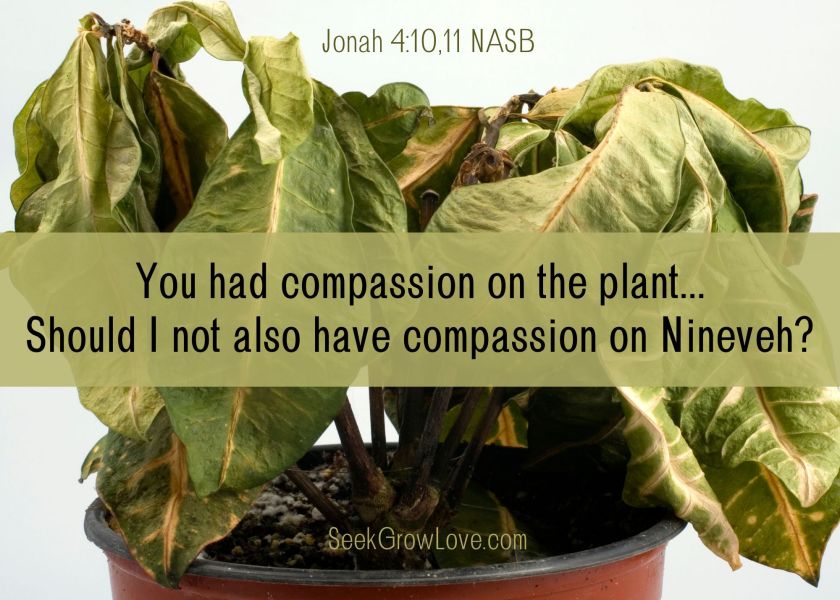
God’s response to Jonah in the last chapter is powerful to me. He says to Jonah, “I made them, who are you to decide they need to die? You care more about a plant that you didn’t even plant than these living, breathing people that I designed.” (not actually a quote from Scripture – my paraphrase).
Do you ever care more about what you want to have happen than the people God designed? Again, it might not be that you are waiting for them to die. But maybe you are more upset that your order at a restaurant was messed up than the fact that the person taking your order was having a really bad day and made a mistake. Maybe you want so much to be proven that you are the most right about something at school or work or church that you are alienating people that you could be having an impact on?
When you are focused on yourself and what you want, remember that other people matter too. The fact that someone managed to show up for work might be a huge victory for them, even if your order got messed up. Taking the time to care about people more than your own selfish, petty desires, not only can improve someone else’s life, but your own too.
~Stephanie Fletcher
Reflection Questions
How would your rate Jonah’s compassion? God’s compassion? Your compassion?
When do you find yourself more focused on what you want than on what others need and how you can serve them?
What do you learn from Jonah in the book of Jonah? What do you learn about God in the book of Jonah?
I was touched by the beautiful imagery of the LORD calling to Israel as a child. Teaching him to walk and taking him into His arms. Here the LORD is also leading with kindness and bonded to His people in love. And I can just imagine a compassionate care taker releasing an animal from its burden-taking off the bridle and bit to allow the animal to freely eat and drink. The love and compassion of God are so evident in these passages. But Israel’s obstinance is also evident. These collections of poetry are calling out again to the people. Turn to God, do what is right and be saved. God desires for people to come to Him to be healed, forgiven and saved, but as we have seen over and over, the people continued to reject Him.
We are told what the result is, “Because there is no faithfulness or kindness or knowledge of God in the land. There is swearing, deception, murder, stealing and adultery. They employ violence, so that bloodshed follows bloodshed. Therefore, the land mourns, and everyone who lives in it languishes (4:1-3a)”. It is disturbing that this scripture could be describing parts of our own country today. But the poetic words of the prophet Hosea still speak through this book. Telling us about the LORD’S perfect character and His justice. We still hear a main theme of not rejecting, but accepting and remaining faithful to our God. How horrible to become stubborn and self-willed against the Only True Living God. That is a place that we never want to occupy. Unfortunately, I know that we could name some individuals who have turned away and have chosen lives that are in complete opposition to God. But we want to be those that faithfully hold to God. Hosea 14 describes it this way, “Whoever is wise, let him understand these things; Whoever is discerning, let him know them. For the ways of the Lord are right, and the righteous will walk in them, but transgressors will stumble in them (v.9)”. Hosea explains that someday the sons of Israel will return and seek the LORD their God; they will come trembling to the LORD and to His goodness. It is incredible that we can know, walk with, and most of all be in a loving relationship with Him right now.
-Rebecca Dauksas
(originally posted for SeekGrowLove on November 4, 2022)
REFLECTION QUESTIONS
How is your nation like Israel? How are they different from Israel? How are you like Israel? How are you different from Israel?
How would you describe God as a parent?
How will you respond as His child? When have you been rebelled against Him? What is His desire for You?
In this chapter (Matthew 9) we see that Jesus and the disciples are continuing an active pace proclaiming the good news of the kingdom and healing every disease and sickness. This lively passage not only records 6 healing incidents, but also shows 3 incidents where the teachers of the law are becoming rattled by the actions and rising popularity of Jesus.
Ready for anything and everything, the action rolls out as follows for Jesus and the disciples: 1) heals a paralyzed man, 2) calls Matthew the tax collector, 3) stops a hemorrhage in a woman, 4) raises a dead girl, 5) gives sight to 2 blind men, 6) and loosens the tongue of a mute man
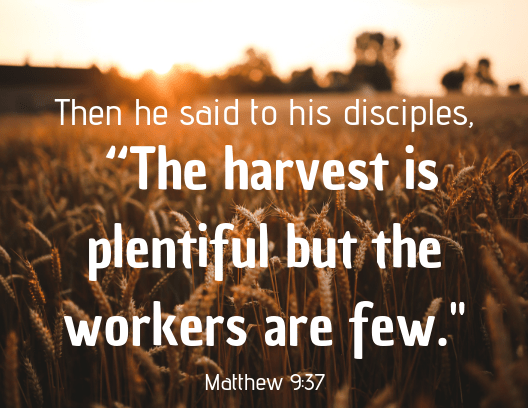
Not only was Christ seemingly running a mobile emergency room, he was “hiring” new workers, contending with naysayers, and stopping to notice the big picture of the work ahead.
Verse 36 takes my breath away. “He saw the crowds and had compassion on them.” We are not lost in a crowd to Him. He knows our name and our needs. There is no end to His goodness. No bottom to the well. You can’t wear Jesus out. He’s not running on low. He’s not in a bad mood because it’s you again. “For from His fullness we have all received, grace upon grace.” John 1:16
The biggest problem in these 38 verses is that Jesus needed assistance to support the needs of the “harassed & helpless.” Nothing’s changed. May God stir your heart and mine this day to be a worker fit and ready to support the hurting. Let God’s “grace upon grace” compel us to action to not overthink but DO!
-Julie Driskill
(originally posted for SeekGrowLove January 14, 2019)
Reflection Questions
What do you learn about Jesus in Matthew 9? In what ways does he give?
Who do you see who are harassed and helpless? What can you give to them?
In what ways have you received “grace upon grace”? How can you share that with others?
My dad had polio. Polio is an illness caused by a virus. It can sometimes lead to paralysis. Polio reached pandemic levels throughout the world in the first half of the 20th century.
My dad was diagnosed as a teenager in the early 1940’s, and he spent weeks and weeks in St Anthony Hospital in Rockford, IL. I don’t know much more about that challenging time in his life, because he did not talk about it to my brother and me. It didn’t occur to us to ask him about it. We were kids. We simply knew our dad had had polio and he walked with a limp. One of his legs had been severely affected by the disease.
My dad was a carpenter, and he was usually dressed in a gray work shirt and jeans, or occasionally in dress pants and shirt. But NEVER in shorts.
One day when I was a teenager, my dad injured his affected leg. My mom needed to render first aid and dad’s pant leg was rolled up above his knee. For the first time, I saw my dad’s leg that caused him to limp. I was shocked! It looked thin, wrinkled, shriveled. How could the sight before me be a man’s leg? My dad was strong, rugged, tough, a working man who did hard physical labor. I turned away, sensing I had seen something I shouldn’t. At that moment, I began to “see” my dad differently, I began to slowly understand, he had endured pain and sacrifice to provide for his family. His shriveled leg was a testament to that.
In the beginning verses of Mark 3, Jesus enters the synagogue and encounters a man with a withered hand. The hand is useless. One Commentary says the hand muscles were shrunken and the limb shorter than normal—the cause may have been infantile paralysis. In any event, the man was unable to work for his living.
Jesus sees his need. He has compassion for him. He also sees the Pharisees watching, waiting for his next move.
In recent days, Jesus had healed a paralytic man, and dined with tax gatherers and sinners. In both instances, the scribes of the Pharisees questioned Jesus’ words and actions.
Now it is the Sabbath. Jesus and his disciples had just passed through a grainfield and picked and eaten some heads of grain. (Mark 2:23-28) The Pharisees had called him out on it, saying Jesus was doing work on the Sabbath, the day of rest. By the time of Jesus’ ministry, the Mosaic law of Sabbath rest, (Exodus 20:9-11) had been “enhanced” by the religious leaders through the years to include countless petty regulations and rules. Jesus had deflected the Pharisees in the grainfield encounter, citing David’s eating of the shewbread (I Samuel 21:1-6) and declaring, “The Sabbath was made for man, and not man for the Sabbath. Consequently, the Son of Man is Lord even of the Sabbath.”
Perhaps minutes to hours later, the Pharisees are now ready to pounce again with a new Sabbath challenge. Jesus is prepared. He asks the disabled man to step forward, so all the crowd can see him. (verse 3). And then Jesus addresses the Pharisees.
“Is it lawful on the Sabbath to do good or to do harm, to save a life or to kill?” (verse 4)
We can imagine the silence was deafening. Because, indeed, the Pharisees did not respond. And then we come to verse 5, filled with emotions, drama and action.
“After looking around at them with anger, grieved at their hardness of heart, He said to the man, “Stretch out your hand.” And he stretched it out, and his hand was restored.”
Jesus looks deep into each Pharisee’s eyes, face, inner feelings. He is angry at their lack of compassion, at their challenges to his God-given authority, at their unhearing, unseeing judgement. The anger turns to grief as Jesus witnesses the hardness of their hearts to his ministry. The Pharisees choose their “enhanced” laws over a poor man’s plight, choose their power OVER him, instead of a blessing FOR him.
Then brilliantly, Jesus asks the disabled man to stretch out his hand. The hand is cured without any labor, but simply by Jesus’ voice. Jesus does not break the Sabbath labor laws, and neither does the man. Surely the Pharisees will approve. Their reaction is recorded in verse 6.
“The Pharisees went out and immediately began conspiring with the Herodians against Him, as to how they might put Him to death.”
The Pharisees’ reputation with the people has been thwarted. They will not accept this outcome. Immediately their plans for Jesus’ destruction begin.
Only the man with the withered hand was rewarded. Healed, restored, able to work and enjoy his life. Forever blessed by the Savior.
My father awaits that blessing too. At Jesus’ return, he will rise up from the grave, his withered, diseased leg fully restored. No more limping, no more pain. Oh, what a day that will be. I can’t wait to see him. I can’t wait to see my coming King.
Paula Kirkpatrick
Reflection Questions
Think about a person you know who will be healed when Jesus returns. How does that motivate you to share the good news of salvation in Jesus?
Jewish law had “evolved” to extreme regulations about what was considered work on the Sabbath. How do you feel about businesses that stay closed on Sunday, to honor the Lord?
Are we ever guilty of “following the rules” instead of having compassion for people in a difficult situation? What example can you think of?









 Seek Grow Love