We see that God has founded the earth and established himself on it. God’s reign will not perish, and His words won’t be changed. The Psalm says “Forever, O LORD, your word is firmly fixed in the heavens.” (Psalm 119: 89 ESV). This is something that is easy to forget as we live our busy lives. He made the earth, and he is still here, performing works all the time. He has given us the ability through prayer to connect with him and access his presence.
In verse ninety one the psalmist writes “By your appointment they stand this day for all things are your servants.” As God’s creation, we are made to love God and follow his commandments just as a son should love and obey his father. As the scriptures later reveal through Jesus, our lives should be a constant act of servitude towards God. The Psalmist wants to bring glory to God through the obedience of the law. We should conform our lives to God’s will by following His commandments.
“If your law had not been my delight, I would have perished in my affliction”(Psalm 119:92 ESV) He made laws and commandments not out of selfish reasoning to show his dominion over us but for our good. Just as a parent tells their child not to touch the stove when it is hot, God likewise gave his people commandments to protect them. It is not hard to see in modern culture what it looks like when we mess up. Living our lives selfishly, not following God’s Law. The world stays in turmoil with great nations constantly at war, families being divided, and sin taking over. It Has been like this since The Fall in Genesis 3. If we follow God’s word, he will bless us and be with us.
-Bridger Grable
Hi, my name is Bridger Grable. I am 19 years old and live in Southern California. I have 8 siblings so it’s always a party at my house. I love hiking and the outdoors.
Reflection Questions
How can you keep in mind today that God and His word are firmly fixed in the heavens? What can happen when we forget this?
How can you bring glory to God through obeying His Word today?
Is God’s law your delight? Explain what that does (or would) look like? What afflictions can you handle better when His law is your delight?
Today we remember that God is not just the God of the Jews – but the God of the world – all the nations. And as God has watched the sins of these nations – so will He exact discipline on these nations. Jeremiah writes what God tells him to write regarding the coming destruction that God will oversee and orchestrate against Israel’s neighbors.
Jeremiah uses vivid imagery to describe these events:
“The sword will devour till it is satisfied, till it has quenched its thirst with blood.” (Jeremiah 46:10 NIV)
“Moab is disgraced for she is shattered.” (Jeremiah 48:20 NIV)
His descriptions show not only how scary and total the destruction will be – but also what a sad state of affairs these societies had become. The most powerful passage that got my attention was in the message against the Philistines, “Terrified fathers run madly, without a backward glance at their helpless children.” (Jeremiah 47:3b NLT). Where have the strong, brave protectors and defenders of their families gone?
We would do well to pay special attention to the passages that point to the reasons for this judgment. All of these neighbors are being punished for their mistreatment of God’s chosen people, as well as for their own sins. “Since you trust in your deeds and riches, you too will be taken captive…We have heard of Moab’s pride – her overweening pride and conceit, her pride and arrogance and the haughtiness of her heart…In Moab I will put an end to those who make offerings on the high places and burn incense to their gods…Moab will be destroyed as a nation because she defied the LORD” (Jeremiah 48:7, 29, 35, 42 NIV). How many similarities do you have to Moab, which was just one of the countries that would feel the burn of God’s discipline? How do you treat God and His people? Is your pride in check? Where do you put your trust – in your job, your finances, your teachers, your doctors, yourself – or in God? When have you defied the Lord God? Do you offer your best and first time, talents and resources to God or to selfish pursuits and false gods?
After 46 verses of judgment against Moab, the final verse of chapter 48 says, “Yet, I will restore the fortunes of Moab in days to come.” Hope and restoration is coming – at least for those judged worthy. Amongst all the condemnation of these chapters, Jeremiah includes a beautiful word from God for Israel as well,
“But do not be afraid, Jacob, my servant; do not be dismayed, Israel. For I will bring you home again from distant lands, and your children will return from their exile. Israel[f] will return to a life of peace and quiet, and no one will terrorize them. 28 Do not be afraid, Jacob, my servant, for I am with you,” says the Lord. “I will completely destroy the nations to which I have exiled you, but I will not completely destroy you. I will discipline you, but with justice; I cannot let you go unpunished.” (Jeremiah 46: 27-28 NLT)
God sees and will not let the guilty go unpunished. But His deepest desire is to find and reward faithfulness in His children so He can live with them in peace. God still judges in His love today – as a wise and caring parent. There will yet be a time of unequaled punishment for those who appeared to get away with evil with a proud heart, relying on themselves and turning their backs on God. This is discipline with justice. And, then, there will be restoration and peace for those faithful to God. Which camp will you be in? Come Lord Jesus Come – may he find us faithful.
Marcia Railton
(Originally posted Aug 21, 2020 for SeekGrowLove)
Reflection Questions
Just as last week we asked if you could see yourself in any of the 7 churches in Revelation, today we ask, can you see any little bit of yourself in the descriptions of the sins of Israel and her neighbors during the time of Jeremiah?
As asked above, how do you treat God and His people? Is your pride in check? Where do you put your trust – in your job, your finances, your teachers, your doctors, yourself – or in God? When have you defied the Lord God? Do you offer your best and first time, talents and resources to God or to selfish pursuits and false gods? What other similar questions can you create from the sins and offenses given in today’s reading?
What might God’s just discipline look like? Why is it just?
You’ve made it to the last letter! Thank you, as always, for joining me as we grow in our faith walk. It is always a pleasure and a growth experience for me as well!
Laodicea is one church briefly mentioned outside of these Revelation verses. While writing to the Colossians, Paul also mentions the church in Laodicea, encouraging them throughout his letter there, and reminding the Colossians that this letter was meant for the Laodiceans as well (Colossians 4:16). By some verses, it seems that Paul himself did not travel there, but did have fellow believers he was connected with that traveled there on his behalf and supported the ministry. There is some scholarly debate as to if Paul ever wrote Laodicea a letter directly that may be hidden in one of the other New Testament books, or lost, or simply is a misunderstanding of translation. A mystery you could choose to explore yourself… but not our main point for today.
Laodicea was a very wealthy, abundant city. When destroyed by an earthquake, they refused to take Roman funds but instead paid themselves to rebuild it back to its prosperous state. It was full of strong, independent, rich people. And yet, it is listed as a church with no positive attributes and only rebuke from Jesus. In fact, Jesus writes of his desire to spit or vomit them out (v.16). Ouch.
So, what’s so bad about being lukewarm? At least they weren’t called spiritually dead like in Sardis, right?? Well, Sardis was at least doing something, and there were a few members still actively living out the truths of Jesus’ ministry. It seems that Laodicea was truly doing nothing… they weren’t being useful in any capacity, and were so inflated with their own sense of self that they didn’t even notice they were really poor, blind, and naked (v.17)! They had turned their hearts so far towards their own wealth and recognition, that they truly just abandoned their faith. Maybe they still met at church for a social gathering, but there was no discussion, no action, no edification, no growth. They weren’t doing one thing wrong, they were doing absolutely nothing.
To correct this, Jesus gives them advice to buy gold from him that has been refined by fire, clothes to cover their nakedness, and salve to heal their blindness (v.18). In the context of this particular church and city, this probably felt a bit like a slap in the face. They had their own gold, they made their own beautiful linens, and they even were known for their medicinal salve! Why would anyone tell them they needed to go anywhere else to get those things? Well, Jesus was trying to point out the fact that what he was “selling” was nothing they could find in their own material possessions. He was intending to knock them down a few notches and realize what they needed was God’s grace, and that wasn’t something they could just buy at one of their various stores around town!
In verse 19, Jesus reminds this church that he rebukes and corrects the people he loves. One thing this church has going for them, that really every single person has, is that Jesus loves them enough to call them out! In this letter he reminds them that he is present, he is knocking at their door, calling for them, with an invitation to spend time with him (v.20). Jesus is actively pursuing this group of people with a desire to include them, to lift them up to a place of majesty (v.21). He deeply wants them to be part of the Kingdom, but they needed to first recognize how much they needed him to get there. There is a destruction coming that they aren’t going to be able to pay for themselves… and Jesus wants them to be on the side of redemption instead.
When we experience worldly wealth and success, we run the risk of becoming lukewarm in our faith, because we lose the recognition of our true need for God. We must have a level of humility and respect (or fear!) for the Creator of all things in order to really put our faith in action daily! We are dependent on God for so much more than we may consciously think throughout our days, but when we ignore how we desperately need His Grace, His Son, and His plan for salvation, we miss out on the opportunity to be in His Kingdom. Not to mention so many other blessings we could experience in this current life!
My prayer for anyone reading these devotions this week is that you were able to find something that spoke to you. Whether it was conviction, encouragement, or an idea for how to apply it in your home and church, I hope you found something in it for you. I pray it was a blessing and that you continue to dive deeper in Scripture to continue strengthening your faith!
Reflection Questions:
Have there been seasons in your life where you “forgot” to rely on God? Have there been seasons where you were reminded of just how much you needed Him? What were the biggest differences in your life at those times?
What barriers do you see in your life that prevent you from relying on God, and may get in the way of you focusing too much on your sense of self?
If you’re anything like me, you probably saw a bit of yourself in each letter. When reflecting on each letter, which do you resonate with the most? Re-read Jesus’ correction for the church you feel most like, and see how you can apply that rebuke to your life this week.
In today’s passage, we read about the church in Philadelphia, the church that (most people agree) had ZERO correction from Jesus. What an honor they had earned!!
Jesus comes in with powerful encouragement for this church in “Little Athens”, where it was surrounded by temples to other gods. This church was the youngest in comparison to the rest of the churches listed here, and experienced many physical challenges, specifically earthquakes, throughout its entire existence. The city itself was smaller and less populated, but was strategically built as a gateway city for the larger areas around them. This unique geographical location placed the church in a vital position for supporting the growth of Christianity. They truly had an open door if you will…
Most scholars believe that this open door to evangelism is what Jesus is referencing in verse 8 – reminding this church of their opportunity to spread the Gospel to a whole new group of people, that could continue growing and spreading in new cities. And of course, right before this in verse 7 he introduces himself as one who holds the keys to open what no one else can, and to shut what no one else can. Some people debate if this was a way that Jesus was correcting this church, by putting them in their place to remember who really was the one to give them such a successful ministry.
This church received praise for holding fast to Jesus Christ, his teachings and his name. Jesus acknowledges that he has seen their works, knows they don’t have much strength, and yet they have persevered (v.8). His encouragement to them was focused on condemnation for their enemies, and validating his love for them to those who may have been persecuting them (v.9). He also describes how their patient faithfulness will save them from later suffering when the world is experiencing testing and trials (v.10). Not only would this serve as encouragement for those believers, but it would have also served as a strong reminder of what they needed to continue doing in order to experience those promises!
So, what is this young, tiny, faithful, and weak church to do with the abundant opportunity they have received? They are to hold on to what they have, knowing that Christ is coming again (v. 11).
Living in today’s day and age, we all have abundant opportunities to share the Gospel of Jesus Christ. Whether it’s in-person, virtually, maybe even through online devotionals… (I’m sure Marcia would love a few more writers next year – or even next week has a few holes 🙂) we all have ample chances to tell people about the Kingdom, and to know and uphold the Word. We are probably just as weak and tiny as the church in Philadelphia felt, and maybe as young! Yet we have the same chance to claim this same victorious message when we hold firmly to Jesus’ teachings and his name.
Here’s the thing: we already know how the story ends. We know who the winner is of this constant war and messed up world. And, we know HE IS COMING SOON! That message should excite us, energize us, and encourage us daily! It can be so challenging when we are bogged down by the many woes of this life. We live in an incredibly imperfect world, full of yucky people, horrific disasters, and overall just depressing moments. I’m sure the Philadelphians were probably sick of seeing all these pagan gods, constantly rebuilding their homes from earthquakes, and being picked on by everyone around them. If they can withstand life’s challenges so well that Jesus is shouting their praises, maybe we can too.
Reflection Questions:
How would you feel to receive a letter like this from Jesus? What things in your life right now do you think Jesus would be praising? What would he be correcting?
In Psalm 119:71, David writes about how his afflictions helped him learn God’s decrees. In Jeremiah 40, we read about Jeremiah finally getting some freedom back after being confined and imprisoned, and continuing to spread God’s messages. What challenges have you experienced in your life that you have come to see as a blessing or an opportunity to grow in your faith?
What is one way you can seize an opportunity to share Christ in your world today? What doors do you see that Christ has opened in your life?
We’ve made it to the fifth letter in our series! Thanks for joining again!
Sardis is another church not mentioned elsewhere in the Bible with limited information. Historically, we are told Sardis was once a wealthy city citizens thought was well-defended because of their geographical location up above most other cities. Because of this, Sardis experienced multiple significant attacks they were ill-prepared for, and as a result, the city had deteriorated significantly from what it once was or what it could have been. Keep this in mind as we take a look at the letter itself today.
Jesus does not take much time before diving right into some pretty critical correction for this church. He immediately jumps to calling out their fake reputation – calling them dead instead of alive as it may seem (v.1). This would have been a pretty close comparison to how their city also had the appearance of being well-off, when in reality, they could not withstand the attacks of those around them! So what are they to do? WAKE UP. Jesus tells Sardis to take action in strengthening what little remains (possibly referencing the few in the church that have remained worthy (v.4)), because he still sees a chance for them to finish or perfect their deeds or purpose (v.2). Some Bible translations use the language, “…I find your actions do not meet the requirements of my God.” This means there are some actions happening, but they are unfinished and not up to standard.
Sardis was a church full of barely believers who were just scratching the surface of what it means to be a Christian. Full of people coming together and going through the motions, maintaining the look of a “good” church, and yet missing out on true spirituality and fellowship with Christ. People who weren’t motivated by their love of Christ, or love of others, but rather by their desire to be viewed with the “Christian” label. That is why Jesus calls this church to remember what they learned at first, Biblical truths of who he is and what the Kingdom will be, hold it fast, clinging to these truths with passion and deep love, and repent, because where they are is dangerous for their salvation (v.3). Jesus uses the analogy of a thief coming at an unknown time because he knows this would be an image that resonates with this group of people, and he desperately wants to convey the urgency behind his words.
It is incredibly simple to slip in a pattern of apathetic worship and works. All it takes is falling out of good spiritual habits like daily fellowship with God through prayer, reading our Bible, and genuine worship to fall into a rut of maintaining a reputation. I personally feel this is one of the biggest ways Satan draws Christians away from Christ in the United States today. BUT, when we listen and act on what Jesus tells the church in Sardis (remember, hold fast, and repent), we have the best chance of our name being written in the Book of LIfe, acknowledged by Jesus to his Father, and angels (v.5).
It is overwhelming to feel like or recognize that you or your church may be spiritually dead. But be encouraged that we worship a God who raises the dead. His Kingdom is coming, and you have a chance to be part of it. Praise God!
Reflection Questions:
What is one thing you have done recently (or can do), to re-energize your love of Christ? How can this help you avoid a pattern of apathy?
What are the things you learned at first that God may be calling you to remember? What does it look like for you to hold fast to these things in your daily life?
Our other passages today offer multiple examples of people who held on to God’s words regardless of their reputations. In Psalm 119:58 David writes how he has sought the Lord’s face with his whole heart. Despite his own shortcomings, David clearly had a deep relationship with God and was blessed because of his dedication. Living in a post-Jesus world with access to Old Testament scriptures, we are at even more of an advantage to developing a relationship with God. How are you utilizing the time you live in now to further your relationship with God and His Son?
While we don’t hear much about Thyatira outside of these passages, we do get a little sneak peak at it in Acts during one of Paul’s trips where he meets Lydia, and she and her whole family are baptized in the truth of Jesus Christ. From there, we are told Lydia offered a place for Paul to stay (Acts 16:13-15). While we don’t know the number of days Paul stayed with Lydia, it is likely that the believers reached during this time were the ones to eventually establish the church in Thyatira. While this isn’t incredibly relevant to our main point, I do think it’s pretty amazing that just one family made such an impact in their community!
Now getting into the praise Thyatira received: The church here was doing good work, and it seems that they were improving in this throughout their existence too! They are commended for their love, faith, service, and perseverance (v.19). This was a group of active Christians who clearly cared deeply for their community. They had a big focus on outreach and growth. Both great things to aspire for!
Now comes to their correction… Thyatira had allowed a false prophet, a “Jezebel” (think the Biblical “Karen”… not really their name, but the stereotype that goes with it), into their church and followed her teachings, even into sinful acts such as sexual immorality and eating food sacrificed to idols (v.20). It is possible that this church was so focused on the external look of creating a community where no one was pushed away, that they instead let in someone(s) that became like a cancerous growth in their congregation. Rather than confronting someone with wrong teaching, the church allowed false prophets a space to teach that incorrect doctrine, ultimately dragging down the church as a whole.
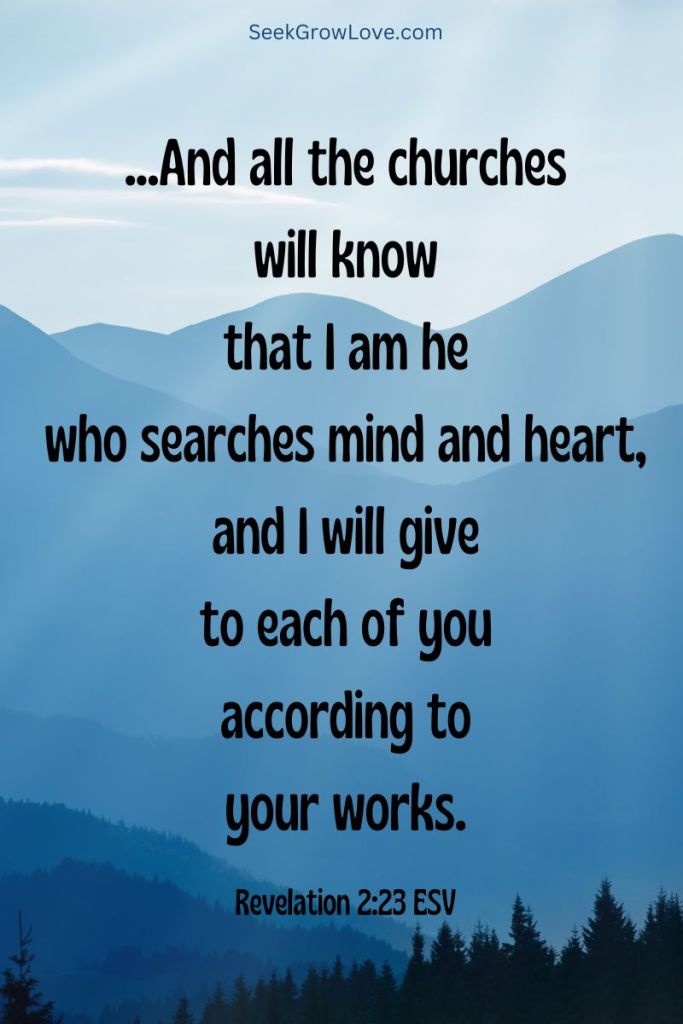
In this letter, Christ reminds the church, and the false prophets, that those who go off the path of Christ’s teaching will perish, but there is still an opportunity for repentance (v.21-22). In verse 23, it’s written that Jesus will repay each one in the church according to their deeds. Now, for a church that was commended for their deeds, this may not seem too concerning. However, within the context of the same verse, it appears this is more of a warning for these Christians. Even in their good deeds, if they have been actively following a false prophet and engaging in actions they know to be sinful according to Scripture and Christ’s teachings, those deeds will also be repaid. I think this is Jesus taking a moment to remind Christians that without obedience to God’s expectations Jesus taught, the result will still be death, no matter how good their deeds were. Interestingly, there seems to be a group within the church here that has been defying the false teachings, and Jesus urges them to continue to hold on until he returns (v.24-25). Just a little light within that grim reminder!
That harsh correction also comes with a very exciting promise for everyone just a few verses later. Jesus reminds these believers that those who do his will to the end will be given authority over nations and a morning star (v.28). These promises are hopeful, exciting, and rewarding!
In our modern day, it can be just as easy to allow false teachings to slip into our churches and our lifestyles as in the time of Thyatira. This makes it that much more imperative for each individual believer to have a strong foundation of Biblical knowledge to test teachings with! Church leaders also have an important task of addressing false teachings inside the church appropriately and timely. We all must use discernment to evaluate the messages we hear inside (and outside) our churches to ensure they truly align with the teachings of Jesus. And if or when they don’t, we must have the courage to call it out! Always remembering that everyone is created by God, and given the same chance for repentance as you and I. It’s no easy task, but the reward makes it all worth it.
Reflection Questions:
Have you experienced a time where you had to use discernment in confronting sin in your life, or in the life of another believer? What went well in that situation, and what could have improved?
In our Psalms passage today, we read that David finds comfort during suffering because God’s promise preserves his life, and he finds comforts in God’s laws. When you consider the laws and Jesus’ teachings, do you find comfort in obeying them? Are there any that are challenging for you?
In our Jeremiah verses for today, we see an example of God’s response to disobedience to His laws for the sake of “freedom” from them. How has this concept remained the same throughout history? How has this concept changed since Jesus?
While Pergamum (or Pergamos) is not mentioned directly in other places of Scripture, it is located in the region Mysia, which Paul traveled through on his way to Troas (Acts 16:7-8). Some scholars believe this is when the church would have “picked up” the Christian beliefs and began around this time, and may have been strengthened by Paul’s later travels to Ephesus. Pergamum was a very lofty, worldly place that served as a temple for many pagan gods, including the temple for Zeus (AKA “Satan’s throne”). It was a challenging place to have belief in the One True God, and His son, Jesus Christ.
For this reason, Jesus commending the church for remaining true to his name is all the more powerful. This is a group of people who day in and out were faced with false gods and pressured to worship them. Even through martyrdom experiences, they held fast to the name of Jesus (v.13). What a compliment and praise to receive from the Savior!
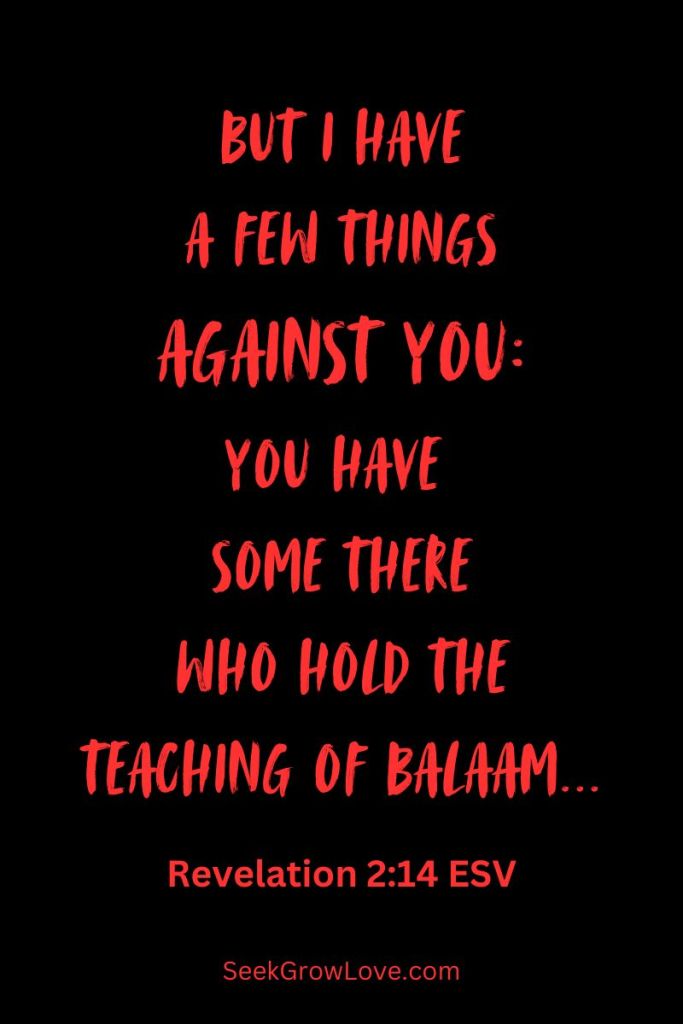
BUT, unfortunately, the praise Jesus gives quickly turns to correction. Despite continuing to believe in Jesus, many believers did not hold fast to the doctrine Jesus taught, and tolerated the ungodly practices in their church. They did not maintain the command to worship no other god, except God himself. Instead, they permissed to teachings of Balaam and the Nicolaitans (v.14). Really, what this means is this church had compromised the teachings of Jesus for what the world around them was teaching. They accepted the teachings of false gods and allowed them in their lives. And Jesus calls them out! He tells them to repent, or else face the sword of his mouth (v.16), which we know is the Truth of who he is and his Father!
In comparison with the church in Ephesus, Pergamum seems to be on the opposite end of the spectrum. Ephesus struggled being too far away from their community to speak the truth in love, whereas Pergamum struggled to be set apart from the world and speak the truth at all.
Again, Jesus reminds this church that this message is for anywho who has ears. He writes to them about the promise of hidden manna (being filled with Jesus, the bread of life), a white stone (a clean slate free of judgment), and a new name (an identity in Christ). Those who not only remained faithful, but also remained set apart for Christ, were given a satisfying, safe, community to be part of.
In today’s modern day, it can be far too easy for believers to compromise the biblical truths they know for what the world has to offer, for the sake of wanting to belong or be comfortable, or just not ruffle any feathers. Yet, we are called to more, with a reward that is so much more than anything anyone in this world could even come close to comparing to. Our society yearns to be satisfied, safe, and accepted. But the only way to truly experience those things is when we cling tightly to Jesus Christ and his teachings, and fully put on our new identity in him. When we withhold the truth from anyone, we are not truly loving them the way Christ loves his church. Jesus loved the church in Pergamum enough to call them to repentance. Do you have the same love for those around you?
Reflection Questions:
We know that the world markets false satisfaction, safety, and acceptance today. How can you ensure you are equally marketing the truth about Jesus in a loving way?
One of the best ways to proclaim the truth of Jesus to nonbelievers is through our actions. Are you acting set apart, and loving, the way Jesus calls us to? What can you do today to live out the truth you know, and show the world around you?
Our reading in Psalms today talks about delighting in God’s commands, something Pergamum struggled with acting out. Is this something you find yourself naturally doing? How can you work to love the commands God gives us?
Looking at some historical context of Smyrna is a bit harder than other churches, because it is only mentioned here in these verses. However, we do know that the church of Smyrna is the only church still thriving in the modern day. Reportedly, more Christians have lived in this area than any other Turkish city in the world. This is quite impressive, considering this region has experienced repeated wars, massacres, earthquakes, and plague since they first received this letter.
Smyrna was a very rich area, populated by Roman and Jewish-born people. Unfortunately, Christians were viewed as “cult followers” and often banned from being able to work, purchase needed items, and often faced social or physical persecution. This really highlights what Jesus was speaking of in verse 9 when he described their poverty and afflictions. So how could they possibly be rich? Well, because just like all of us who are baptized, they had the promise of life, and avoiding hurt in the second death (v. 10-11).
From historical records, it has been concluded that a pastor at the church in Smyrna by the name of Polycarp, refused to worship Caesar and renounce the name of Christ. Because of his choice, he was burned at the stake. From these records, it is reported that when commanded to reject Christ, he stated “Eighty-six years have I served Him, and in nothing hath He wronged me; and how, then, can I blaspheme my King, who saved me?”. From there, records indicate he was heard singing praises to the Son of God while being burned alive. It seems Polycarp truly took the words of Jesus to heart, not fearing what he was suffering, and being faithful to the point of death.
It’s hard to imagine even a fraction of the persecution that was experienced in Biblical times, living in modern day America. Even harder, we know that both social and physical persecution still exists around the world today. In a recent report from Open Doors (link below), it is estimated that 1 in 7, or 365 million, Christians worldwide faced persecution in 2023. Of those numbers, roughly 5,000 murders are recorded to be directly related to a person’s faith. Nearly 15,000 churches or Christian properties were attacked. From these reports, it has been determined that North Korea is the most dangerous place in the world to be a Christian. Despite this, Christianity continues to be the highest category across the global population, AND is projected to continue to grow even higher based on current trends. Even with the affliction and suffering, Jesus continues to touch the lives of billions around the world.
Smyrna was one of many churches to experience persecution, but because of their faith, they are considered rich and worthy of the victor’s crown. This message of reward was not meant just for them, but is for everyone who has ears to hear what the Spirit says (v.11). You will face trials in this life as a Christian, whether or not they may be as severe as others around the world. Will you remain faithful?
Reflection Questions:
Have you ever imagined yourself in the place of a Christian around the world? Contemplate how you would respond when faced with persecution. Pray today for those that experience this on a daily basis. For more information, check out the “World Watch List” found here: https://www.opendoors.org/en-US/persecution/countries/
In the passages in Jeremiah today, we see an example of God describing His restoration on earth, sharing the same promise that we also cling to in times of trials. Reading those chapters, what verse sticks out to you as most encouraging when you consider the perfect restoration we will get to experience?
What ways can you hold fast to your faith when you experience suffering in this life? What has worked for you in the past? How can you encourage and support a fellow believer who may be struggling right now?
Hello all! Although the other material is just as wonderful, we will be taking a focused look on the Revelation passages, exploring the Letters to the Churches. Let’s dive in!
Each letter has a general pattern of a greeting and introduction, praise for their behavior, a warning or correction, plus a reminder of what is to come (hint, it’s the Kingdom!)
For some context, the church in Ephesus was visited and established by Paul back in Acts 18 & 19. We know from these passages that the silversmith Demetrius, and his shrines or idols to the goddess Artemis, were popular opposers of the message of Jesus the Messiah. From the book of Ephesians, we know that Paul believed the Ephesians loved all of God’s people, but still needed guidance on how to daily live out the Christian walk. Knowing this can impact how we read the letter John transcribed to them in Revelation 2, and how we can take that message and apply it to our own churches and lives.
After greeting the church in Ephesus, through John, Jesus writes to the church of Ephesus and commends them on their hard work, perseverance, and holding fast to doctrinal truths diligently (v.2-3). But their correction is that they have forsaken the love they had at first (v.4). Some people debate the exact meaning this has, but personally, when paired with the information we have from Paul’s writing, I believe this means they have lost the love they had for God’s people.
Back in Paul’s time, they were a church in the middle of a dark, secular, perverse community. Yet, they were growing and evangelizing in a way that was drawing people away from worshiping other gods, and bringing them to repentance. Clearly they were doing something right at this time to be so appealing to people in such a community, so much so that those trying to make a profit off of sinful practices started a riot! And THAT is what I believe they lost.
This church seems to have swung the pendulum to the side of practicing truth without love. While we can only speculate, I do think this likely looked like church leaders who were so focused on ensuring their church stood out from the worldly crowds, they lost the compassion for those outside of their own doors. They lost the zeal and vigor for spreading the gospel, and became too heavily focused on trying to maintain the doctrinal ‘purity’ they had built.
Notice how Jesus doesn’t say in these verses they should stop holding fast to those important practices, but rather they should do them in combination with what they did at first, loving others in their community so well that they were attracted to the church. In fact, right after this reminder, he even says that he appreciates that they hate the same detestable practices he does! Jesus was never saying to disregard the importance of true and accurate teaching of the Gospel message. But he was challenging a church who had been a beacon of light to their community, to remember how they felt in those early days when they received the Holy Spirit, and go back to the same energy and passion for the people they were surrounded by.
Well-established churches or believers, especially those who hold tightly to doctrinal truths, must be on guard for this same loss of love in their own communities and hearts. Not compromising on the biblical truths they hold, but never losing sight of the greatest commandment, to LOVE one another. We all may have a bit more Ephesus in us than we think… which isn’t always a bad thing, but is something we must be cognizant of to make sure we are still remembering the love we must show, in order to have the opportunity to experience the “paradise of God” (v.7).
Reflection Questions:
Consider yourself and your church, have you lost your first love? If you have, what steps can you take to revitalize that passion?
Think of someone you care about deeply. Have you shared the truth of Jesus Christ with them in a loving way? If not, how can you start that conversation?
Reread Psalms 119:29-32 from today’s reading. Clearly we see throughout all Scripture the importance of holding fast to God’s commands, just like the church in Ephesus. Are you truly “setting your heart” on God’s laws as in these Psalms verses?
Human instincts are a funny thing. We have certain tendencies that our bodies will turn to without thinking in order to preserve itself. Some will say it’s hard-wired in after years of evolutionary learning. I say it’s given by God, a level of thought that we can have without even realizing we’re having it. Our nervous system is an incredible miracle, along with the rest of our body, in how it communicates.
I’m taking martial arts classes currently, and one of the things they teach us in self defense is the ability to yell past our tension. They have us pull air from deep within, really forcing the diaphragm to the point of discomfort, and expel a yell that feels almost animalistic. And we, especially females, practice that in order to help us should we ever have a violent encounter. You see, when we meet a moment of fear and stress, our fight/flight/freeze/fawn response kicks in. We will either spring into action, run, freeze in fear, or try to appease our opponent.
No matter which decision is made, what often occurs first is a moment of freeze, as you try to process. And breaking out of that freeze is DIFFICULT. I know because it has happened to me. When frozen in terror, it’s a struggle to make any noise at all. We practice yelling before and during attacks, so that muscle memory will hopefully help us if we ever have a confrontation. We prepare so that we can push past our instinctual response of fear and call for help or cry out in attack.
Preparing so that you can overcome an instinct seems counterintuitive. We must have that instinct for a reason, right? But our natural instincts don’t always serve us best.
Verses 17-21 say, “But, dear friends, remember what the apostles of our Lord Jesus Christ foretold. They said to you, ‘In the last times there will be scoffers who will follow their own ungodly desires.’ These are the people who divide you, who follow mere natural instincts and do not have the Spirit. But you, dear friends, by building yourselves up in your most holy faith and praying in the Holy Spirit, keep yourselves in God’s love as you wait for the mercy of our Lord Jesus Christ to bring you to eternal life.”
We have a lot of natural instincts. Children don’t need to be taught to lie, they do it instinctually to avoid trouble. The instinct to act on attraction is a natural one that causes endless trouble. We have instincts to avoid pain, both emotional and physical, which can lead to us not reaching out to others. We have survival instincts that make us want to look out for our own needs or the needs of our closest family members before looking to the needs of others, frequently leading to selfishness and greed.
Jude is warning us that we can’t let people who follow these natural instincts divide us. Not only that, but we have to build ourselves up in faith. In other words, we must train ourselves out of those instincts. God calls us to a higher level. The world will say to act on how we feel, because those feelings are natural. But there are many things that are “natural” that are actually terrible for us.
Train yourself out of those instincts by frequently turning to God’s word. We are told to test every idea, every belief, every teaching, and even every instinct to be sure whether or not it is of God. Test it against the scriptures. 1 John 4:1 says, “Dear friends, do not believe every spirit, but test the spirits to see whether they are from God, because many false prophets have gone out into the world.”
Do not let the world lead you astray simply because something “feels” right. Test that feeling against scripture every time. This is going to pit you against most of society. Stand firm. Hold fast and keep yourselves in God’s love.
Reflection:
What tendencies do the world see as “right” because they are “natural,” when the Bible calls them wrong? How can you keep those views from dividing you? Do you see those sorts of divisions happening in your church? They could be as simple as concerns over money keeping us from helping others as much as we should. They could be as socially complex as issues of homosexuality, or sex before marriage.
What are some instincts you find in yourself that you find difficult to contend with? How can you “build yourself up” in faith and train yourself out of some of your own dangerous instincts?
Beloved friends, my prayer for you today is the same as the one ending Jude: “To him who is able to keep you from stumbling and to present you before his glorious presence without fault and with great joy – to the only God our Savior be glory, majesty, power, and authority, through Jesus Christ our Lord, before all ages, now and forevermore! Amen.” – Jenn Haynes









 Seek Grow Love