Scripture: “So now, Yahweh our God, save us, please, from his hand, so that all the kingdoms of the earth may know that you, Yahweh, you alone, are God.” — 2 Kings 19:19 (LEB) “Teach me, O Yahweh, your way, that I may walk in your truth; unite my heart to fear your name.” — Psalm 86:11 (LEB) “Now when these things begin to happen, stand up straight and raise your heads, because your redemption is drawing near!” — Luke 21:28 (LEB)
In 2 Kings 19, King Hezekiah faces a seemingly insurmountable threat from the Assyrian king, Sennacherib. Instead of succumbing to fear or relying on his own strength, Hezekiah turns to God in prayer, seeking divine intervention and deliverance. This theme of seeking God in times of distress is echoed in Psalm 86 and Luke 21, offering us a comprehensive understanding of faith, humility, and hope.
When confronted with Sennacherib’s threats, Hezekiah’s first response is to seek God. He spreads the threatening letter before God in the temple and prays for deliverance, not only for the sake of Judah but also for God’s glory to be known among all nations. Hezekiah’s prayer exemplifies humble dependence on God and a desire for His name to be exalted.
Psalm 86 reflects a similar heart of dependence and trust in God. David’s prayer, asking God to teach him His way and unite his heart to fear God’s name, mirrors Hezekiah’s desire for God’s guidance and intervention. Both prayers highlight a deep reliance on God’s wisdom and sovereignty in navigating life’s challenges.
In Luke 21, Jesus speaks about the end times and encourages His followers to stand firm and look up, for their redemption is near. This message of hope and anticipation ties into Hezekiah’s situation, where trust in God’s deliverance leads to ultimate salvation. It reminds us that, no matter how dire our circumstances, God’s redemption and intervention are always near.
Hezekiah’s immediate response to crisis is to turn to God in prayer. This act of faith underscores the importance of seeking God first in our times of need, trusting in His power and sovereignty. By spreading out the letter before God, Hezekiah shows his complete dependence on God. Similarly, Psalm 86 calls us to seek God’s guidance and unite our hearts to fear His name. Jesus’ words in Luke 21 encourage us to stand firm and look up, for our redemption is near. Hezekiah’s trust in God’s deliverance and the anticipation of God’s intervention are powerful reminders of God’s faithfulness and sovereignty.
-Jeff Ransom
Reflection Questions:
When faced with a crisis, what is your first response? How can you make seeking God in prayer your immediate reaction?
In what areas of your life do you need to humble yourself and depend more fully on God’s strength rather than your own?
How can you live in a way that brings glory to God, showing others that He alone is sovereign and that His redemption is near?
This week, reflect on these questions and consider how you can seek God more earnestly in your times of need. Trust in His power and sovereignty, and live in a way that brings glory to His name.
As Marcia mentioned in yesterday’s devotion, many of us were at Midwest Family Camp last week, where the theme was “Stand Firm”. In a nutshell, if we don’t have a relationship with the Lord, it is critical that we repent and come into a relationship with Him. If we already have a relationship with the Lord, we need to strengthen that relationship, and stand firm in the faith – no matter what.
In today’s reading in Proverbs 28, there are a few verses that jumped out at me which reinforced that message. The first is found in Proverbs 28: 9, “If anyone turns a deaf ear to the law, even his prayers are detestable.” This proverb tells us that if we’re not doing everything to live the life God called us to live, if we’re not following His rules, then He won’t listen to our prayers. Since many of our prayers are about asking for God’s help with various things, if we selfishly want Him to answer our prayers, then we need to obey His rules, and live for Him. As we grow in relationship with Him, we come to long for an even deeper relationship with the Lord. Then we learn that prayer is powerful, and we don’t waste it just asking for superfluous things.
Proverbs 28:13 goes on to say, “He who conceals his sins does not prosper, but whoever confesses and renounces them finds mercy.” This is saying if we pretend to be Christians, we won’t prosper (you can’t fool God). But if we confess and renounce our sins, and turn completely to God, we will receive God’s mercy. I don’t know about you, but I would much rather have His mercy than to have Him holding me back from prospering.
As we continue to read through this chapter, we get to verse 20, which says, “A faithful man will be richly blessed, but one eager to get rich will not go unpunished.” I’ll take a detour here and comment on the health and wealth teachings we often hear from people who don’t know better. The theory goes sort of like this… “if someone follows God, God will bless every aspect of their life. They will be rich, healthy, and blessed.” Many people who call themselves Christians subscribe to this false belief. Jesus told us in John 16:33, “…In this world, you will have trouble. But take heart, I have overcome the world.” We have to remember this life isn’t our reward. This life is the test to see what reward we will receive when Jesus returns. If we are faithful to the Lord now, we will enjoy peace with God now, and eternal life when Jesus returns. If we are just trying to get rich, we are actually worshiping money, not God — our reward is in this life, and we will forfeit eternal life.
1 Tim 6:9-11 says, “People who want to get rich fall into temptation and a trap and many foolish and harmful desires that plunge men into ruin and destruction. For the love of money is a root of all kinds of evil. Some people eager for money have wandered from the faith and have pierced themselves with many griefs. But you, man of God, flee from all this, and pursue righteousness, godliness, faith, love, endurance, and gentleness.”
Instead of trying to get rich, we need to follow the advice given in Proverbs 28:27, “He who gives to the poor will lack nothing, but he who closes his eyes to them receives many curses.” Again, I think the idea is that if I’m greedy, wanting to keep all my money for myself, I’m not trying to please God, I’m just greedy for money, and God will curse me for not following Him. But if I’m generous with the things God has given me by giving them to the poor — this mimics God’s generosity to me. When I am imitating God, God loves that. In fact we’re commanded in Ephesians 5:1, “Be imitators of God, therefore, as dearly loved children.”
So the bottom line is this. We need to do everything we can to reconcile ourselves to God. We need to confess and renounce our sins, obey His laws, be faithful, and be generous. All these things are required to live in close relationship with God. And if we live in a close relationship with God, we will have peace with God in this life, and an amazing reward in the life to come. In Rev 21:4, we’re told, “He [God] will wipe every tear from their eyes. There will be no more death or mourning or crying or pain…” Rev 21:7 goes on to say, “He who overcomes will inherit all this, and I will be his God and he will be my son.”
How well are you imitating Dad?
Stand Firm.
–Steve Mattison
(Originally posted June 28, 2021 – but we did just return from another week of Family Camp, where the theme was “Pray Continually”. You can watch Steve’s Thursday Night sermon and story on Yield to God’s Will here.)
Reflection Questions
What are the prayer lessons to be remembered from Proverbs 28?
How well are you following God’s instruction?
When was the last time you confessed your sins to Him?
What relationship do you have with money? Is it stronger than it ought to be? How would you rate your generosity? Why do you think God values our generosity?
Today is our final look at Proverbs for the week. We have looked at these Proverbs as wisdom that leads to greater flourishing. In today’s Proverb there is a strong theme around our attitudes to the poor. If you know anything about King Solomon, he was the wealthiest man in all of Israel. He lived in a palace, had armies and servants in abundance and was the envy of other world leaders. There’s even a story in the Bible about the Queen of a place called Sheba who traveled to Israel just to see for herself how magnificent Solomon’s Kingdom was.
As wealthy as Solomon was, he also recognized that wealth could be dangerous and lead to pride which can do great spiritual damage to a person. Solomon cautiously warns his readers not to look down on people who are poor or to take advantage of the poor.
The rich and the poor meet together; the Lord is the Maker of them all. (Proverbs 22:2).
Whoever has a bountiful eye will be blessed, for he shares his bread with the poor. (22:9).
Whoever oppresses the poor to increase his own wealth, or gives to the rich, will only come to poverty. (22:18).
Do not rob the poor, because he is poor, or crush the afflicted at the gate for the Lord will plead their cause and rob of life those who rob them. (22-23).
Solomon gives some heavy-duty warning here. Many cultures throughout human history have looked down on the poor or otherwise economically challenged. In some cultures, the Hindu culture of India, they believe that poverty is simply Karma, the poor person is being punished for sins committed in a previous life (they believe in reincarnation of the dead, rather than sleeping till resurrection as the Bible consistently teaches). So that poor person is poor because they are bad. You can see how this attitude might breed a certain attitude of superiority. They are poor because they deserve it. On the other side, many think, I am rich because I am being rewarded for being a good person. In actual fact, more often than not the reverse is true. Many very poor people are actually very caring and loving people. Their poverty has nothing to do with their character or their sins. Poverty has many causes. There are all kinds of factors in society that can affect a person’s ability to acquire wealth or even a subsistence level of economic resources.
Consider a community where most laborers work in a factory. In some cases, several generations of their family worked in that same factory. What happens when suddenly the new CEO of the company decides that the shareholders will make more money if they can cut manufacturing costs by outsourcing production to a country with much lower labor costs. They can produce the same goods at lower production costs and sell them for the same amount resulting in greater profits and more dividends for the shareholders, and a nice healthy bonus for the CEO. Everybody wins, right? Wrong. The people who worked at the factory for 30 years suddenly find themselves unemployed. How will they feed their families? What happens to the town when suddenly a large part of the population are unemployed? I think you get my point. Suddenly you have poor people who are now poor through no fault of their own. They are victims of the wealthy people who are now even wealthier at their expense.
In our society, it is tempting to look at those kinds of situations as the result of our system but trusting that the system will balance itself out. But does it really? Now, don’t misunderstand me, I’m not advocating for communism or socialism as a better alternative to capitalism, but we must acknowledge that there is a moral component to wealth and we should not blind ourselves to the reality that there are systemic elements in society that do contribute to poverty and we need to be aware and mindful of ways that we contribute to that.
It is easy to look at poor people and blame them for ‘being too lazy’ or ‘on drugs.’ Sometimes that is no doubt true. But we don’t necessarily know that. We don’t know how lack of educational opportunities, racial inequalities, generational poverty and many other factors may be contributing to their situation. Sometimes substance abuse is the cause of poverty, but other times it is a symptom of one who has lost all hope for economic success and has given in to apathy and hopelessness and now is self-medicating. Poverty can also come as a result of mental illness. Many unhoused persons suffer from severe mental illness and most states lack sufficient resources to treat and support them, so they end up living lives of unmitigated poverty and misery.
Mindlessly throwing money at problems is not the solution, but neither is blame or even worse, intentionally taking advantage of the poor to make ourselves richer. Every day I get spam calls and texts from people who are phishing for my data so that they can access my bank account and take my money. They often target elderly people, try to scare them, or confuse them into sharing their personal information, so they can steal from them. In the same way, a predatory lion will look for the weakest gazelle in the herd to take down, predatory people often do the same. Solomon knew back then how the poor were often victimized by the predatory rich and he warned against it. Not much has changed.
When Jesus says that we are to love our neighbors as ourselves, he includes the poor. The person who wants to flourish spiritually will be intentional in how they treat everyone, especially those who are economically challenged and most vulnerable.
~ Jeff Fletcher
QUESTIONS:
What is your attitude to the poor? How does this translate into action?
Why does God care about the poor?
How does taking care of the poor relate to justice? How does it relate to wisdom?
Vs. 23. Whoever guards his mouth and his tongue keeps himself out of trouble.
At the beginning of the movie, Blindside, the narrator explains the role of the offensive line and one position in particular, the left guard. Her explanation goes something like this: “When a woman is paying the household bills, the first check she writes is to pay the mortgage, the second check is to pay the insurance.” The meaning: you want to ensure you have your greatest financial asset, your house so you pay the mortgage, and you want to make sure that your asset is protected, so you make sure your insurance premium is up to date. That all makes logical sense. As it is applied to football, you first make sure that you have a great quarterback to run the offense, and second, you want to make sure that your quarterback is well-protected, so you invest in a very good left guard to watch and guard the quarterback’s blindside.
Solomon, of course, knows nothing of football. In his world, as king of Israel most of the work that he accomplishes is with his mouth. When he as King utters a decree, it becomes law. As King, his words matter. The King’s words have the power of life and death. In some ways, the King’s authority is exercised by his words, they are powerful and effective. In some ways, they are very similar to God’s Word, which the Bible also says is powerful and effective. In Genesis 1 God speaks His word and the heavens and earth are formed.
So Solomon understands the power of our words. In Proverbs, he emphasizes the importance of protecting the source of our words, our tongue. “Whoever guards his mouth and his tongue keeps himself out of trouble.” (Proverbs 21:23). If your tongue is the quarterback, you need to invest in good protection, a good guard. That is putting knowledge into practice, that is wisdom.
Practically speaking, think of all the ways that an unguarded tongue can get a person into trouble: lying, gossip, slander, and cursing are just a few examples of trouble that comes courtesy of an unwisely guarded tongue. Lying can get you in trouble with your parents, with your husband or wife if married, with your boss, with your friends and with God. That’s a lot of trouble. People usually tell lies to try to keep out of trouble, but often it backfires and they get into more trouble. Lie to a police officer and you won’t only get into trouble for whatever you did, but then you’ll have extra trouble for lying about it. There’s a reason that when arrested they say “You have the right to remain silent, anything you say will be used against you.” What that means is, you’re better off just keeping your mouth shut then to tell a lie to try to cover up. Even if you are innocent of the charge, you can still get yourself into trouble by what you say. Please not, I’m not advocating for you to commit crimes and tell you how to avoid jail, but simply showing the wisdom of guarding your tongue. Think before you speak.
In this age of social media, guarding your tongue takes on greater meaning. With social media, our words can go farther faster and last longer. I have heard of incidents of people not being hired for a job they were otherwise qualified for because the prospective employer looked at their social media feed and saw objectionable content from years earlier. I’ve heard of people losing jobs because of their words. Unguarded words can be very costly. They can cost not only jobs; they can cost relationships.
Solomon wisely counsels that in many situations it is far wiser to say nothing at all. Proverbs 17:28 says: “Even a fool who keeps silent is considered wise; when he closes his lips, he is deemed intelligent.” An old adage attributed to Mark Twain or Abraham Lincoln (but probably someone different) says “It is better to be silent and be thought a fool than to open your mouth and remove all doubt.”
Words have heavy spiritual consequences as well. Ecclesiastes 5:2 says: “Do not be quick with your mouth, do not be hasty in your heart to utter anything before God. God is in heaven and you are on earth, so let your words be few.” Think about the promises that you make to other people, and think harder about the promises you make to God. For instance, when you are baptized, you promise to make Jesus Christ your Lord and Savior be faithful to him and follow him. That’s a very strong promise. A disturbingly large number of people who used to go to church faithfully are dropping out of the church, and many no longer identify as Christian, they are joining the swelling ranks of so-called “nones” or people with no religious affiliation. That’s a lot of people who made promises to God who are no longer keeping those promises. But good news: God is very forgiving and welcoming to those who repent, turn back to Him. Still, think about any promises you make with your mouth before God. Whether it’s to faithfully follow Jesus Christ, be faithful to a wife or husband, commit to serve in a ministry, don’t be quick to make a promise that you don’t really intend to keep.
In short, your words really do matter, so a spiritually wise person needs to “think before you speak.” So be sure to guard your tongue the way a left guard protects his quarterback. That’s a key to spiritual victory in life, that is a way towards true flourishing.
~ Jeff Fletcher
QUESTIONS:
What power do words have? Have you ever been greatly hurt by words? What about greatly encouraged?
Why is it always better to tell the truth rather than lies?
How can you cultivate your ‘word filter’? How can you practice thinking before you speak?
As I was reading through today’s chapter in Proverbs I felt pulled in several directions. There’s so much really good stuff in this one chapter and I had a hard time choosing which of the many wonderfully wise sayings I wanted to talk about.
Verse one was tempting: “Whoever isolates himself seeks his own desire; he breaks out against all sound judgment.” We could think about the wisdom in having connection to a community of wise and trusted others to help us navigate challenges and get their feedback on important decisions.
Verse eight was also tempting: “The words of a whisperer are like delicious morsels; they go down into the inner parts of the body.” We could spend some time with that thinking about the effects of gossip and slanderous speech and how much time people invest in reading or sharing gossip about others. In fact, this chapter has a lot of little Proverbs that have to do with our speech. Those who want to live a flourishing life should pay careful attention to what comes out of their mouths.
I finally settled on verse twenty-two: ”He who finds a wife finds a good thing and obtains favor from the Lord.” I cannot resist taking the opportunity to think with you about how important this is. Dr. Dustin Smith recently published an excellent book Wisdom Christology in the Gospel of John. In his book he spends time looking at the book of Proverbs and how it lauds “lady wisdom” as being a very important part of God’s creation. He shows how the book of Proverbs refers to this lady wisdom throughout and builds to a climax in the final chapter with a description of an exemplary wife as the embodiment of wisdom. (You should check the book out, It is available on Amazon in both print and Kindle).
Throughout Proverbs there is a close connection between wisdom and a “good wife”. King Solomon who wrote or assembled much of the material in Proverbs certainly had a somewhat complicated life in relation to women or wives. His own mother, Bathsheba, became his father David’s wife in a very ungodly way. His father committed adultery with her and then had her husband killed in battle to try to cover it up. Talk about family skeletons. Solomon himself took the trapping of being a king way too far and had a whole harem of wives and concubines. As wise as he eventually was, it was a challenge to live out the truth. Perhaps Solomon came to the wise insight of this problem as he reflected on the challenges and costs of having multiple wives and a stable of sexual partners. This might appear to be the perfect life (think Hugh Heffner, the founder of Playboy magazine, constantly surrounded by beautiful young women- isn’t that the fulfillment of every young man’s fantasies?
Yet, at some point in his life, Solomon finally comes to the wise realization that having a large number of sexual partners is in fact, not very satisfying, not very wise and in fact is not the path to a flourishing life. Solomon comes to realize that true joy, true flourishing comes in finding “a wife”, one, singular woman with whom to enter into a lifetime covenant. This was God’s design from the beginning of creation. God created Adam from the earth, but recognized that Adam would not flourish in isolation. He needed a companion, someone alongside him to share his life. So God created Eve and told them to work together to bring flourishing to the earth. This was God design for flourishing.
Solomon came to wisely recognize the truth that having a wife, not 700 wives and 300 girlfriends, is the truly good thing and is a true gift from God and a sign of God’s gracious favor. It is too bad that Solomon did not learn this lesson earlier, as the Bible says his multiple wives turned his heart away from God. But at least in his honest and reflective moment he could come to terms with his own mistakes and sins and see where the truth really is in God’s design. And that is true for all of us. Wisdom is not poured into our brains, it comes by experience and we make many mistakes on the way to wisdom.
As I write this devotion I am getting ready to go on a special trip with my wife. This year we are celebrating 40 years of marriage so we are going to a beautiful place far away to celebrate our life together. During that 40 years we have been blessed with eleven children and fifteen, soon to be sixteen grandchildren. Our marriage has not been perfect. I did plenty of really stupid stuff when I was younger. (And, to be honest, I still do stupid stuff sometimes.) My Karen has been by my side throughout. She loves me, she bore, nursed, fed and clothed and cared for my eleven children. She accompanied me to each place I did ministry, packing up everything and organizing massive relocation projects. She has helped me navigate challenges in my ministry, my spiritual growth, my ongoing education and my ongoing health challenges. I can honestly say that she has made me a better person. Apart from my decision to accept Jesus Christ as my savior and follow him, my decision to marry Karen is the wisest thing I have ever done. She is a daily reminder to me that Solomon’s wise words are 100% true, ”He who finds a wife finds a good thing and obtains favor from the Lord.”
When I was young, I didn’t understand the wisdom of these words. Even when I was newly married I failed to appreciate just how true these words are. I am speaking this from the perspective of a man married to a woman. A woman’s view of her husband may be different in some respects, but I would say that there is much you can apply in your life as well. The importance is taking the time to truly appreciate the value that your spouse brings to your life and if you are unmarried, consider how truly important the decision on who you will marry is, and when married, the importance of gratitude for the one God has provided for you. They are not perfect just as you are not perfect, but they are a gift from God and a part of a flourishing life so appreciate them, value them, cherish them.
~ Jeff Fletcher
QUESTIONS:
In modern culture, we often use the term life partner when talking about spouses. Why is it so important to ‘partner’ with someone who has the same values as you?
A spouse always influences you. What are traits of a spouse that would influence you to live a godly life?
If you are already married, how can you show love and appreciation for your spouse? How can you influence each other to live a godly life?
Do you ever secretly celebrate inside when someone you Do not like very much gets in trouble, or hurt, or worse? Be honest. Maybe It is when the class bully gets taken down. You have that secret satisfaction of seeing the bad guy finally get his. I confess that whenever I watch the movie A Christmas Story each yet I get a certain bit of satisfaction when Ralphie loses it and goes to town on Scut Farkas and nearly pulverizes his long-time nemesis. People often do it instinctively. The cheer when the opposing quarterback gets sacked for the third time or when the opposing teams best player fouls out of the basketball game you sing, “Na-na-na-na, na-na-na-na, hey, hey, hey, goodbye.” (Do they still do that at basketball games?” I am sure more than a few haters of former President Donald Trump took great delight in seeing him on trial and hearing the lurid details drug out before Melania and the rest of the world to see.
Did you know that there’s actually a word for that? It is a German word called Schadenfreude and it is an emotional experience of finding joy in another’s misfortune or struggle. The Very Well Mind website says: “Schadenfreude is a German term that translates to “damage” (schaden) “joy” (freude).It is the ripple of delight you get from watching fail compilation videos, or the twinge of excitement you feel when a rival coworker doesn’t get the promotion they expected.”
The day back when President Trump announced that he had Covid Webster’s Dictionary says that Schadenfreude was the most looked up word that day. Lots of people took great delight in seeing Trump get Covid. Or when notorious child molester Jeffrey Epstein was found dead in his jail cell a lot of people were celebrating. And if you were around and conscious when they finally found and killed Osama Ben Laden you know there was a lot of celebrating going on that day.
If Schadenfreude is so common, we all do it, it must be okay, right? Well….. let’s go back to yesterday when we talked about God’s desire for us to flourish. We said that the book of Proverbs provides wisdom to help us pursue a flourishing life. Does taking delight in the pain, suffering trauma of people that we Do not like lead to a flourishing life? Today’s Proverb, Proverb 17… By the way, did you notice that this week the Proverbs match the day of the month. Today’s the 17th and we’re looking at Proverbs 17. By the way, you can start on the first day of the month reading 1 Proverb a day and essentially read the entire book of Proverbs through every month (when there are 31 days in the month it matches up perfectly.) Among the many excellent little nuggets in today’s Proverb we read: “Whoever mocks the poor insults his Maker; he who is glad at calamity will not go unpunished.”
Oops! You know all those things we just said about schadenfreude? This Proverb is saying that It is not very wise to engage in in finding joy in someone else’s suffering. The path to a flourishing life does not include celebrating when our frenemy gets in trouble, gets hurt, fails a test, loses their job, breaks up with their boyfriend/girlfriend or any of the other things you can think of celebrating.
Those of you who are particularly clever might say “now wait just a darn minute there, doesn’t God sometimes celebrate when his enemies get theirs?” You make a good point. Psalm 2:1-6 says:
Why do the nations conspire
and the peoples plot in vain?
2 The kings of the earth rise up
and the rulers band together
against the Lord and against his anointed, saying,
3 “Let us break their chains
and throw off their shackles.”
4 The One enthroned in heaven laughs;
the Lord scoffs at them.
5 He rebukes them in his anger
and terrifies them in his wrath, saying,
6 “I have installed my king
on Zion, my holy mountain.”
Here we have God laughing derisively at His enemies failed attempts to destroy his anointed King (that would be Jesus, by the way). If God can do it, why can’t we?
I Do not have a lot of time and space to unpack the theological complexity of that question, so I will simply say “He can, because He is God and he knows everything including what’s in a person’s heart. We are not God, and we aren’t the judge and can’t know what’s truly in the heart of another.
What I can say is what Jesus, who came to teach us how to have an abundant, flourishing life said. Jesus said that we are to love our enemies and pray for those who persecute us (see Matthew 5:43-48).
What about that first bit in today’s Proverb where we are told that when we mock poor people we are actually insulting God? What does that mean? It is so easy to judge others harshly without having all of the facts. In ancient society in many cultures it was believed that the reason people suffer is because they did something wrong to tick off God or in other cultures “the gods”. Even among God’s people the Israelites it was a commonly held misconception that people who suffer physically or financially or relationally are just getting what they deserve for the bad stuff they must have done. The Book of Job goes to great lengths to debunk that false belief. Job was a very righteous man who suffered terribly for no good reason. Bad things really do happen sometimes to good people and It is not our place to judge others or mock them for their suffering because we think that they deserve it.
And while the Bible does talk about God laughing at those who oppose his anointed King there in Psalm two, we need to look at the greater story of God in all of the Bible. This is well captures in Ezekiel 33:11 “Say to them, ‘As surely as I live, declares the Sovereign LORD, I take no pleasure in the death of the wicked, but rather that they turn from their ways and live. Turn! Turn from your evil ways! Why will you die, people of Israel?’
God gets not joy from seeing even wicked people suffer or die. God was not celebrating when Jeffrey Epstein killed himself (or was murdered) in his jail cell. There were no parties in heaven the day Osama Ben Laden was killed. God doesn’t take joy in seeing the wicked suffer, and neither should we. God’s heart is for even the most broken, evil or lost people to change direction and turn to Him for forgiveness and healing. That should be our attitude as well. We need to practice love and grace not mocking judgment and schadenfreude… even when our worst frenemy gets dumped right before senior prom. That’s the way of wisdom, the way to true flourishing.
~ Jeff Fletcher
QUESTIONS:
Have you ever felt Schadenfreude (or joy at someone else’s misfortune) before?
How does it change our hearts to ‘love our enemies and pray for those that persecute us’? Does that kind of attitude lead to a hardened or softened heart?
How can you practically practice loving your enemies? What are some ways you can put this teaching into practice this week?
I have spent the last 3 years of my life and academic studies focusing on the subject of human flourishing. Let me ask you a question this morning…Are you flourishing in your life? Would you like to? To flourish is to grow healthy, to thrive. I believe it is God’s ultimate goal for us to flourish. If you look at the Bible from beginning to end, it is all about flourishing. In Genesis God creates the heavens and the earth. He fills the earth with abundant plant and animal life and that places humans on the earth to act as his stewards. Humanities first job was to cultivate and enjoy a flourishing garden. God’s first command to humans was “be fruitful and multiply.” That is all flourishing language. At the end of the Bible, in Revelation 22 it shows the culmination of God’s plan to live with humans on a restores and renewed earth where there is flourishing. There is a picture of a river flowing from God’s throne and along the banks of the river are the tree of life that bears fruit all year long and whose leaves bring healing. This is, once again, flourishing language.
Throughout his ministry, Jesus uses the language of flourishing as well. He says things like “I have come that they might have abundant life.” (John 10:10). That is the language of flourishing. In John 15 he says that he is the vine and we are the branches. We must remain connected to him to bear fruit. This is flourishing language. Later, the Apostle Paul picks up this same language of flourishing. In Galatians 5:22-23 he speaks of the “fruit of the spirit” as love, joy, peace, patience, etc… This is most definitely flourishing language.
God wants His children to flourish. As we know, in order for a plant to flourish it needs certain conditions. It needs good soil with good nutrients, it needs the right amounts of sunlight and rain, it needs to be nurtured, weeds to be pulled, pruning, pests and parasites need to be kept away. In the same way, God’s children need to have conditions that are favorable to our flourishing. God lays these out throughout the Bible.
The week we are going to focus on Proverbs. I think it is helpful for us to think of the Proverbs as very simple and clear instructions on how to spiritually, emotionally, relationally and even physically flourish. To learn how to grow a flourishing garden you might want to talk to a wise and seasoned gardener who can give you insights into how to get the most flourishing. How to prepare the soil, when to plan the seeds of plants, how deep to plant, how far apart to space them, how much watering is needed, do they need more sun or more shade, when and how to prune. Proverbs give these kinds of practical wisdom instructions to help God’s people flourish.
Consider one of the short Proverbs in today’s reading: “Gracious words are like a honeycomb, sweetness to the soul and health to the body.” (Proverbs 16:24). Raw honey has health benefits, it contains antioxidants and other good things, and it tastes sweet. I remember as a child seeing my very English grandfather put a giant teaspoon of honey into his cup of tea which he drank several times a day. He lived to be almost 100 (hey maybe I need to start putting honey in my tea?). So honey tastes good and is good for you, win-win, right? In that same way, in our spiritual, emotional and relational life, speaking gracious words or words that are full of grace also taste good and are good for you. Jesus is the ultimate example of what a flourishing human life looks like and it was said of Jesus that he was “full of grace and truth.” (John 1:14). Colossians 4:6 says: “Let your speech always be gracious, seasoned with salt, so that you may know how you ought to answer each person.”
Maybe I am just getting old, but it seems to me that people are often not very gracious in the ways they speak to each other. In many ways, social media makes it easier to speak very ungracious words to others behind the safety of anonymity or the filter of a phone or computer screen. Now, when I hear someone speaking graciously in public or on social media, I am like, “Wow, that was nice to hear for a change.”
God wants us, His children, to experience flourishing lives. One way toward flourishing is to monitor how we speak and intentionally choose to speak words that convey grace to others. We do not always have to agree with others and even Jesus spoke truth to his opponents, but even hard truth can be spoken with grace. That is part of being wise in our speaking and that is one-step towards a fruitful, productive and flourishing life.
~ Jeff Fletcher
Jeff is a pastor and chaplain who lives in the beautiful mountains of Virginia. He has spent his life in ministry and recently earned his doctorate from Vanderbilt University. He has a large, loving family and is very active in all the COG events and ministries.
Questions:
In what ways are you flourishing in your life? Where do you feel like you are not flourishing?
Have you noticed flourishing language in the Bible before? How does the Bible speak about flourishing? What is flourishing according to the Bible?
How does the wisdom of Proverbs help you to flourish in your life?
Here’s a disquieting fact to start our devotion today: According to the International Brain Injury Association, 5.3 million Americans are living with some kind of disability due to a traumatic brain injury. 5.3 million is the population of South Carolina! Of course there are varying degrees of injury, but most are due to car accidents and sports-related incidents.
And while 5.3 million is a staggering number, I’m willing to bet that there are so many more people living with spiritual battle scars in their minds.
Our minds are such a vulnerable space and it’s one of the enemy’s favorite areas to attack. At least, that’s been my experience. Anyone else struggle with random thoughts popping up that obviously aren’t from God?
But why attack the mind? Why not make the heart the primary target? Because our thoughts turn into words, which turn into actions, which turn into habits, which turn into our character. James, the half brother to Jesus, said it this way, “It is the evil that a person wants that tempts him. This desire causes sin. Then the sin grows and brings death.” (James 1:14-15, ICB) This is why it is imperative to protect this part of our body.
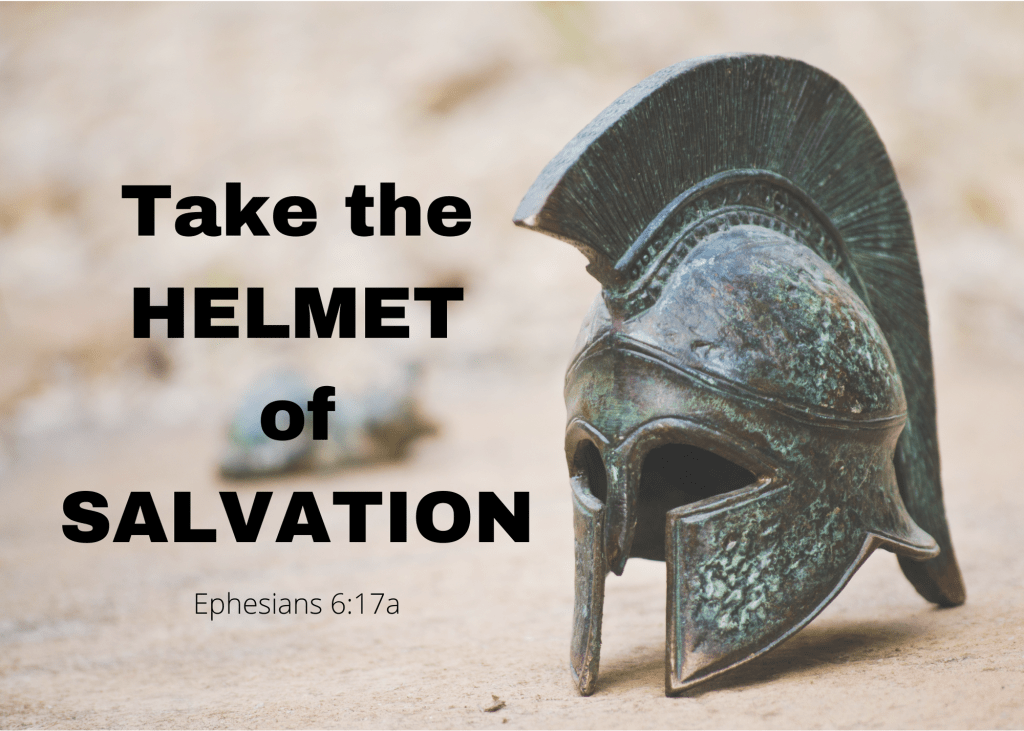
For the apostle Paul, the author of this Epistle, the helmet was the perfect metaphor; after all, he was under house arrest when he wrote this letter. He probably had a lot of face time with a Roman guard who most likely wore some kind of helmet. Each piece of the helmet added another layer of protection against injury or death.
Paul calls this piece of the armor the helmet of salvation. The Greek form of the word for salvation is used only in this verse in all of the New Testament and it means “peace”. As we don this piece of armor, we can have the “peace of God that transcends all understanding will guard your hearts and your minds in Christ Jesus”. (Philippians 4:7)
Where does this salvation or peace come from? It comes from being in the Word of God daily: reading, studying, meditating, and memorizing it. We need to be intentional about the media that we consume and the conversations that we participate in. We need to be aware of entertaining the thoughts that seem to come out of nowhere. Protecting our minds against the thoughts that flow in and out should be something that is carefully monitored as we go about our daily living.
If you want to be in God’s Shalom peace while you engage in spiritual battle, be sure to wear the helmet of salvation.
-Bethany Ligon
Reflection Questions
How do you think the enemy attacks minds? What about yours in particular?
Describe the progression from thoughts to words to action to habits to character. Give an example that leads to ungodly character. Give an example that leads to godly character. Which type of thoughts do you work at thinking most?
What protection is available to you against the thoughts that lead to ungodliness and death? In what ways can salvation and peace mean the same thing? What can you do (today) to strengthen your protection that God has made available to you?
In the Seek Grow Love reading plan, we are given the opportunity to connect with the Old and New Testament each day, and one pro of reading the Bible this way is the opportunity to see connections and evidence of a sovereign God directing things, weaving things together from beginning to end. It is especially nice for me when the New Testament authors clearly state the connections like we run across today in 1 Corinthians 10. Immediately following a paragraph of Old Testament events from over 1000 years before, we then see several verses connecting the past to the present. Verse 11 makes it very clear that the events of the Old Testament were expected to be studied and known by Christians under the new covenant and had a benefit for their learning:
“These things happened to them as examples and were written down as warnings for us, on whom the culmination of the ages has come. So, if you think you are standing firm, be careful that you don’t fall! No temptation has overtaken you except what is common to mankind. . .” (1 Corinthians 10:11-13)
In this case, it appears the “things that happened” referenced in this verse include the Israelites crossing the Red Sea, being under a cloud, God being displeased with them in the wilderness, eating manna, getting water from a rock, etc. If we have read the Old Testament stories, these things are familiar to us, but we see in 1 Corinthians that some of the connections referenced are symbolic and a foreshadowing of what is to come when the Messiah comes on the scene, not necessarily the exact same events repeated. For example, the Israelites were not literally baptized in the Red Sea and a cloud. We are told they crossed on dry ground, they were set apart and led by God, and we can certainly identify how that connects to what Jesus brings us in salvation and protection for believers. The same idea is evident in verse 4 where we are told they drank from a rock and that rock was Christ. They did not literally drink from Jesus, nor was a rock following them around in the wilderness. While Jesus existed in the plan and complete foreknowledge of God at that time, the Messiah was not even born yet, and I feel the need to emphasize this after seeing some very confusing commentaries out there on this passage. It appears that Paul is using a familiar story from the Old Testament as a teaching metaphor comparing what was achieved through the Messiah to the provision and salvation God gave the Israelites. For a lovely chat on this subject, I highly recommend 21st Century Reformation’s video commentary below:
I find this to be a good reminder that God has had a plan for all time and His ways are better than ours. I also find comfort that just like the Israelites did reach the promised land, we also have promises yet to be fulfilled for a place even better than Canaan when Jesus comes back as king.
-Jennifer Hall
Questions:
How does it make you feel to know that God has had a plan of salvation for you since the very beginning?
What other examples of foreshadowing can you think of from the Bible?
Since Paul tells us the Israelites were examples for those generations which came later, and warns us not to be cocky in thinking we are standing firm, what can we do to help us not fall?
In today’s reading in Joshua we see the establishment of cities of refuge for those needing a safe place to dwell, whether Israelite or soujorner. The Israelites had been instructed to sanctify these cities, consecrating them and declaring them cities of refuge for the innocent. I am always impressed in the attention to detail and proactive instructions for so many scenarios when I read through the Old Testament law. For example, in this chapter we have very concrete directions for what to do for those who “accidentally kill someone.” It is clear God had a detailed plan, and the instructions He gives us are not flippant or derived from the latest child-rearing or leadership self-help book. They are put in place by a holy, sovereign Father who knows all and wants the best for His children.
The Matthew Henry Commentary points out the Hebrew meaning of the names of these cities of refuge we read about in Joshua 20 and some potential correlation to the place of refuge we as Christians find in Jesus.
Kedesh: holy
Shechem: shoulder (e.g. the government is upon his shoulder)
Hebron: fellowship
Bezer: fortification
Ramoth: high or exalted
Golan: joy or exultation
In the same way God planned for safe dwelling places in the time of Joshua, He planned the same for us in the gift of His son who came to preach the gospel of the coming kingdom and died and was resurrected as a sacrifice for us. Not just for those who “accidentally” did something wrong, but for us who have done wrong knowingly. Time and time again. For those like David who plotted a murder, committed adultery, and whose words we read again today in Psalm 51. David seemed to live much of his life seeking safe dwelling places, but he ultimately claimed his safety in God as his refuge. In fact, if you scan the Bible for uses of God as a refuge, you’ll definitely find yourself in Psalms! Like David, we won’t find safe dwelling places regarding what matters to God in the caves, suburbs, America, or by stockpiling weapons and descending into underground bunkers. We find our safe dwelling place in God through Christ. Hebrews 7:23-25 states this very nicely:
“Now there have been many of those priests, since death prevented them from continuing in office; but because Jesus lives forever, he has a permanent priesthood. Therefore he is able to save completely those who come to God through him, because he always lives to intercede for them.”
With current events exploding with more and more people living in such turmoil from the Middle East to every corner of the globe it seems, safe dwelling places are not things to take for granted. If we are a follower of Christ, we have been reconciled to God finding immediate safety today as well as the most beautiful hope in the coming kingdom and eternal life with Jesus. Only then will true refuge be found.
“God is our refuge and strength, an ever-present help in trouble. Therefore we will not fear, though the earth give way and the mountains fall into the heart of the sea, though its waters roar and foam and the mountains quake with their surging.” – Psalm 46:1-3
-Jennifer Hall
Questions:
Are there things in the world you seek or believe to be sources of refuge outside of God and His sources of refuge?
What encouragement can you find in today’s reading or God’s word regarding His promises to be our source of refuge?
What do you look forward to in God’s coming kingdom where we will have perfect safety and an eternal dwelling place?





 Seek Grow Love