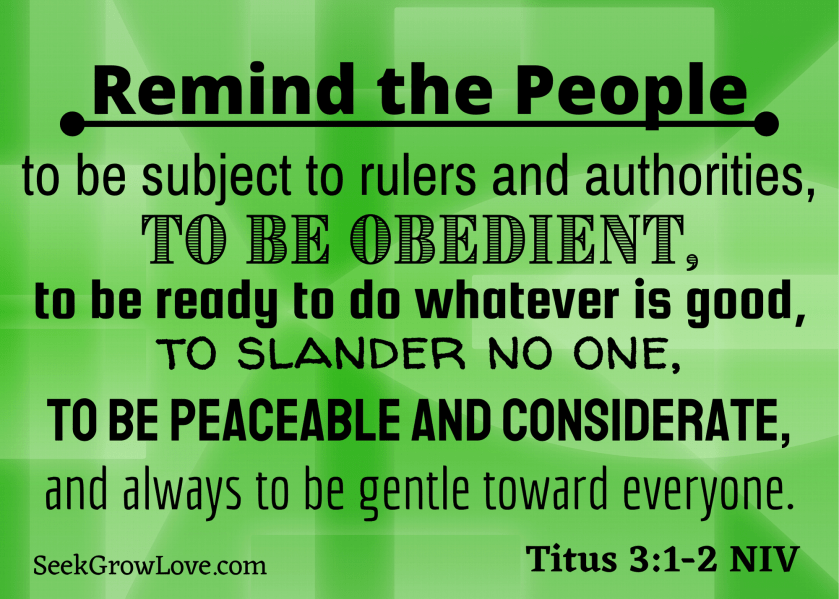
An Important Letter

Titus 1-3

Devotion by John Tullis (OH)

Everyone likes to get a letter in the mail!  Especially around Christmas time.  Getting a letter from a friend or loved one might seem old fashioned, but letters have a way of being more personal and intimate.  Receiving a letter from a mentor or person you respect is especially important when the letter includes an important message. 

The Book of Titus is a letter written by Paul to his “true son in the common faith” Titus.  Titus was an early Christian leader and a close friend of the apostle Paul.  He is best known as being the leader of the churches in Crete and Corinth.  He was sent by Paul to these churches to help them solve problems.   In this letter, he asks Titus to ask the people in the churches to stop arguing with each other over silly things and to focus on doing good things in the name of Jesus.

To help the church at Crete, Paul sent recommendations on how to pick good leaders to look after the church (Titus 1:5-9).  Having leaders who are qualified is important in leading a church.  Like shepherds of a flock of sheep, the “elders” of the church look after us and protect us from making mistakes that can harm us.  Their job is to help us do good works for God.

Paul also reminds us that we should always do good because we are Christians. Paul writes that the grace of God “teaches us to say ‘No’ to ungodliness and worldly passions”.  As Christians we should always seek to serve other people and be good to them.  Sometimes it is hard to live obediently for God.  Paul asks us to be “self-controlled” and live upright and godly lives.  It’s not easy, but God wants to help us and to “purify for himself a people that are his very own, eager to do what is good”. (Titus 2:11-15).

It is important to always remember that God has shown His mercy to us not only because He wants us to be good, but so that He could adopt us into His family.  Paul hopes that each of us “might become heirs having the hope of eternal life” (Titus 3:7).  Living a godly life is how we declare our thankfulness for His great mercy.  As we accept God’s gift of grace, it makes us want to do good things for the Kingdom of God.

Questions for Discussion:

  1. In Titus 2:2, what does it mean to be “self-controlled”?
  2. What does Paul mean when he says to “avoid foolish controversies” in Titus 3:9?
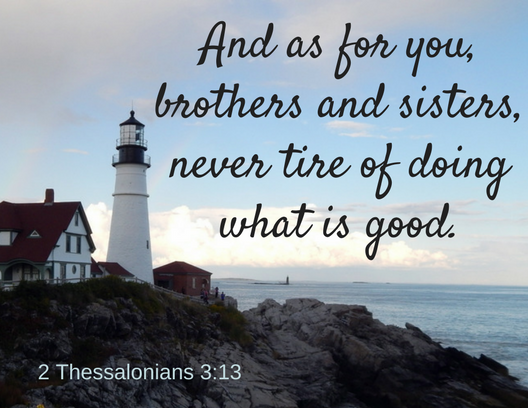
Our Job

2 Thessalonians 1-3

Devotion by Emilee (Ross) Christian

After spending the last two days discussing unity, today’s reading from 2 Thessalonians may seem counterintuitive as there appear to be a lot of divisive factors. In Paul’s explanation of the second coming there is clear division between the saved believers and evil doers. What I find interesting is who is doing the dividing. 

Paul makes it clear God will take care of Evil. There is a plan. While we may not have all the details of how said plan will work out, verses like 2:8 make it pretty obvious a plan exists. Today’s text seems to be saying it is God’s job to judge and take care of evil; it is our job to love and teach. 

Throughout both letters to the Thessalonians, Paul commends their ability to love one another and remain faithful. In this letter, Paul specifically instructs them to “never tire of doing good” (3:13). The Greek word used here is kalopiountes meaning “to do well, act honorably, do what is right. From Kalos and poieo; to do well, ie Live virtuously” (Strong’s 2569). We know from Paul’s other writings he regards love as the greatest virtue (1 Corinthians 13:13). Basically, after discussing God’s plan to vanquish evil, Paul instructs the Thessalonians to show love. I think there is significance in the order he presents these topics. Our response to God’s judgment upon the earth is to love. 

Yet, it’s also clear Paul does not equate love with acceptance. Again, Paul warns against idleness. Here is where I believe the call to teach comes. While we are not called to judge, we’re also not called to hold the truth to ourselves. In fact, Paul even instructs the Thessalonians to “warn” the ones who “refuse to obey what we say in this letter” (3:14 NLT). As Paul did with the Athens people, we need to find a way to express the Gospel Truth to those with destructive ways of living. This takes faith. This takes action. This takes love.  

Reflection Questions

  1. What are your thoughts on the statement: “Our response to God’s judgment upon the earth is to love”?
  2. What does a loving warning look and sound like? Have you ever received one? Have you ever given one? Is there a person to whom God is asking you to give a loving warning? Pray about it.
  3. When have you been guilty of holding the truth to yourself? How could you respond next time?
  4. How will you show your faith, action and love this week?

Big Bold Prayers

Isaiah 37-38 and 2 Thessalonians 3

Welcome back friends!

Today in Isaiah 37 we see a glimpse of Hezekiah’s prayer life and the boldness he has when asking God for deliverance.  This boldness is not in an outward appearance…when Hezekiah hears the King of Assyria’s threats he rips his clothes and wears sackcloth, both common practices for those who are mourning or in a vulnerable state.  While he seems unsure, Hezekiah is still willing to ask God for deliverance from this threat, even though we do not hear much regarding his faithfulness or attitude towards God until this time.  In my opinion, this makes his request even more bold because he seems to lack relationship with God!  And yet, we see a prayer for his city to be saved for the purpose that they know God is LORD (v.20), and God delivers!  God sends an angel to strike down the Assyrians and scares away the king (v. 36).  While the appearance of Hezekiah almost seems cowardly to human eyes, God saw Hezekiah’s humility and his acknowledgement of the one true God and rewards him for that!

In chapter 38 we see Hezekiah again boldly ask for healing from God.  This bold request for healing shows Hezekiah has confidence in God’s power and knows God can do amazing things.  It’s easy to think, “If I had experienced an answered prayer like Hezekiah I would always pray boldly!”, however, we experience answered prayers daily, but I know I am constantly reminding myself to pray boldly with the concerns I have!  Maybe it’s just me, but when I get caught up in the brokenness of the world it doesn’t always come as my first instinct to offer up a prayer.  Sometimes I may first try to find a solution on my own, other times I may just ignore the problem, or maybe I just sit in the problem!  Although it may seem unlikely, Hezekiah can be a great example of how to pray boldly and have complete trust in God’s power to answer those bold requests.

When we look at our passage in 2 Thessalonians, we see Paul’s encouragement to bold and consistent prayer.  In this chapter, Paul is specifically requesting prayer from the church to guard against the evil one and for the gospel to be spread and honored (v. 1 – 3).  Paul also asks and reminds the church to pray for them to have strength to carry on in good things such as spreading the gospel and working hard to provide for immediate needs.  These requests may not seem as bold as asking God to destroy an army, but I do find them much more relevant to our lives today, and still just as difficult to remember to pray for!  Spreading the gospel is an easy thing to say, but doing so truly does require great effort, dedication, and strength.  Asking for help in this is certainly a bold task, mainly because if you ask God to help you spread the gospel, He is going to put you in places to practice that!  Paul writes “Do not grow weary in doing good” (v. 13), which tells me to expect that doing good will be wearisome.  In this letter we can see the benefit in not only praying bold requests for ourselves, but also praying boldly to encourage our brothers and sisters. 

You may not know, but the Church of God has over 600 fellowships of believers outside of the United States.  We have a LOT of brothers and sisters in Christ that can constantly use our prayers for strength, encouragement, and deliverance.  If you are interested in knowing more about our fellow believers, I encourage you to go to https://lhicog.com/ to learn more about what bold prayers you can bring to God on their behalf!

One thought I had (and maybe you did too) during today’s reading was ‘What about when prayers aren’t answered?’  I prayed about this thought, and here is what I felt based on our reading for today:  We must faithfully know that God’s purpose is greater than our own.  I do not believe there are UNanswered prayers, but rather prayers that have an answer yet to come or an answer we do not want to hear.  There are other stories in the Bible where bold prayers are not answered the way that people want or when they want…  I think of David and Bathsheba’s son dying after David prayed and fasted, Hannah diligently praying for her future son to be born, or Jesus himself who prayed to not have to go through the horrible crucifixion process!  We may not be able to comprehend the purpose God has, but we are always invited to pray with boldness and faith.  We are also invited to pray for “peace in every way” (v. 16) for ourselves and our fellow believers when the prayers don’t result in what we want or when we want them.  I look forward to a day when we will never have to bring another bold request to God because we will be living in a perfect Kingdom where all believers can constantly rejoice in God’s holy presence and perfection!  Until that day, let’s continue to boldly pray and praise our amazing YHWH.

-Sarah (Blanchard) Johnson

Today’s Bible reading plan passages can be read or listened to at BibleGateway.com here – Isaiah 37-38 and 2 Thessalonians 3

Self-improvement Help Needed

But Not From Yourself

Romans 7

I think everyone can empathize with Paul when he states, “I do not understand what I do. For what I want to do I do not do, but what I hate I do.” (Romans 7:15)

Even in every day routines there may be areas we want to improve or change. Just look at the huge amount of self-improvement and renewal books that are printed each year. Maybe we want to: lose weight, get fit, stop bad habits, eat healthier, get out of debt and save money, spend more time with family, be less stressed or read through the Bible. Ok, hopefully this one is happening.

So wanting to overcome sin and do good is a great goal, but maybe you feel as Paul did, “For I have the desire to do what is good, but I cannot carry it out.” On our own, we cannot overcome sin, but as Christians we are not on our own. Thank the LORD, He is with us and He has provided what we need to overcome sin. In verse 25 we see that Paul is relying on God’s provision in Christ. “Thanks be to God, who delivers me through Jesus Christ our Lord!”

We are no longer condemned because we are in Christ Jesus, but sin is condemned. Through Christ Jesus the law of the Spirit who gives life has set you free from the law of sin and death. We no longer live by our sinful nature, but according to the Spirit. And as we will discover in Romans chapter 8, we are more than conquerors through him who loved us and nothing in all creation, is able to separate us from the love of God that is in Christ Jesus our Lord. We truly need to realize the love that God has for us and rely on His Spirit working in us. 

-Rebecca Dauksas

Today’s Bible reading passage can be read or listened to at BibleGateway here – 2 Chronicles 15-16 and Romans 7

“This time the mission is a man.”

Daily reading: Titus 1-3

In the movie Saving Private Ryan, Tom Hanks’ character spends the bulk of the film working to save the life of one man, Private James Francis Ryan, who is slated to be sent home after his three brothers have all been killed in combat. Near the close of the film, Hanks leans in to Matt Damon, who plays Private Ryan and whispers his last words, “Earn this.”

The final scene of the movie is both touching and convicting. Ryan, now an old man, stands at the grave of the man who gave his life to save him and he weeps. He looks to his wife, “Tell me I’ve lived a good life,” he says, “Tell me I’m a good man.”

(Here’s the scene, if you want to give it a watch: https://www.youtube.com/watch?v=IZgoufN99n8)

For him, the reality of living a good life in response to the sacrifice that was made on his behalf was tangible because he had looked in the eyes of the man who died in his place. I think, perhaps, we miss something because we can’t do that, don’t you?

Paul wanted us to think about doing good with our lives. It seemed to be important to him.

His letter to Titus is not long. It’s only 46 verses. But almost 1/5 of them talk about doing what is good (17.5% for you math heads out there).

“I want you to stress these things, so that those who have trusted in God may be careful to devote themselves to doing what is good.”

Our lives as believers preach louder than any Bible verses we post to our Facebook pages or how pious we consider ourselves to be. Perhaps that’s why Paul concludes his letter to Titus with the reminder that,

“Our people must learn to devote themselves to doing what is good, in order to provide for urgent needs and not live unproductive lives.”

We all know that we can’t earn salvation, but we can earn (or lose) other people’s trust.

— The way that we speak to, and about, our parents or our spouse could make someone want to know more about the God we serve…or less.

— The integrity we exhibit at work might make them want to pick up a Bible…or never set foot in a church.

— Our gentleness, kindness, and considerate behavior may be the thing that draws someone to experience the love of God for the first time…or they might come to believe that God is rude and harsh and uncaring.

To put it another way… why would your unbelieving boss want to consider Christianity if you are the laziest employee they have? Or… Do you think anyone cares how many Bible verses you know if you make everyone around you feel like garbage?

We can all fall into the self-focused trap far too easily. So here’s your reminder that (and you might need to sit down for this): It’s not about you.

I had kind of an ‘a-ha’ moment in Sunday morning worship not too long ago when we were singing the song, Awakening. Some of the lyrics say,

For the world You love
Your will be done
Let Your will be done in me

Praying for God’s will to be done in your life is a good thing no matter what. But it hit me over the head that Sunday morning that the purpose of Him wanting to do his will in my life wasn’t just for me. “For the world you love…”

While we can’t ever “Earn this” we can embrace the passionate and intentional living that Private Ryan embraced and regularly examine ourselves with questions like he asked…Am I living a good life?

Or more specifically… Is how I’m living drawing people towards God or repelling them from Him? Am I reflecting Him accurately?

Am I devoting myself to doing what is good?

-Susan Landry

Today’s Bible reading can be read or listened to at BibleGateway here – Titus 1-3

Tomorrow we will read 1st Peter 1-5.