Three Areas to Consider Your Conduct

Matthew 17
Mark 9
Luke 9:28-62

Devotion by JJ Fletcher (Minnesota)

Several sections in part of our text today (Mk 9:33-50) stand out to me as timely. The wisdom of Jesus is always timely, but these jumped off the page (screen, really). Contending with our brothers and sisters (think humility), contending with those that are not in our tribe (think bridge building), and our example to those who come up behind us in the faith (think training and discipleship).

Jesus, likely already knowing the answer to his question, asks his disciples what they were discussing on the road to their next stop. The subtext indicates that they were embarrassed, for they were arguing about who was greatest, or who would have the highest standing in the hierarchy under Jesus.  Jesus’ teachings place a lot of value on humility and submission to God. When looking at the Pharisees, we see that they valued their status and relied on that status to give them advantages in their lives. Jesus says in verse 35 that “if anyone would be first, they must be last and a servant of all”. This reminds me a little bit of John F. Kennedy’s line, “Ask not what your country can do for you, but what you can do for your country”. Being a good citizen means that you are not just looking out for your own needs but looking out for the welfare of those around you. How can you help build others up, and how can you protect and advocate for others? Those are questions a good citizen might ask. One might also ask how they can hold themselves accountable as they try to make a difference. 

The disciples clearly cared about what Jesus was doing and teaching, but they seemed to have too much focus on what the benefit of their relationship to Jesus might mean for them and their status. Living as a follower of Jesus has some similarities to living as a citizen in our own contexts, but it has a greater scope and reach. As future citizens of the Kingdom of God, we need to be looking at how to build up other Kingdom citizens. This means that we shouldn’t be squabbling or striving to have the most prominence, status, or influence. We should be striving to do good. In doing good, we may perhaps become influential and be respected, but that should not be our primary goal. We need to work to please God, not to please or appease men. We should not be working to satisfy the needs of our ego, but rather let ourselves decrease, so that Jesus might increase.

We next jump to the disciples telling Jesus that someone who was not in their group was casting out demons in Jesus’ name. This bothered them because they somehow thought it was improper for someone to be doing good works, but not be officially affiliated with Jesus. Good is good, whatever the motivation might be. Unbelievers can do good things. Does that mean we should stop them? There is an opportunity to form coalitions with people that we might not otherwise align with, and in doing so, we might create more opportunities to speak into their lives and influence their thinking. Now, sometimes someone might represent something that we can’t in good conscience join with, but that is not what appears to be happening here. Perhaps the disciples see this as Jesus not getting credit, but that would be a weird take since they were calling out the name of Jesus. Perhaps it ties into their ego thing a little bit; if those who are not with Jesus can do this, it diminishes what we are doing with Jesus. Jesus makes this point that we should take to heart: “the one who is not against us is for us”. We can stand alongside, or leave alone, those who are doing good things that go along with the works that we should be doing, even if they have a different motivation for doing them. We can work with other Christian groups to serve, even if we don’t agree on everything doctrinally. You can take the stand of not sharing in communion over certain differences while still trying to meet the needs of others.

Finally, we get this idea from Jesus: If you become a stumbling block for others, specifically, it seems young believers, it’s a travesty. Essentially, we get the idea that you’d be better off dead than to cause someone to sin. It’s a good reminder that eyes are always watching you. When you serve in public and when you live in your private life…your church is watching. Your kids are watching. Your friends are watching. What are you communicating with your actions? Are you living on the up and up? Are you abusive in some way that might drive someone away from the gospel? Your example or your direct action toward an individual or group can have a lot of influence on how someone grows and lives. You can be salt and flavor the world for the kingdom, or you can be like expired milk and be good for nothing. 

We always need to be mindful of our ego, our behavior, and our influence. We should be examining these things in light of the gospel and the life and teaching of Jesus, and see how we’re doing and where we might need help. We should always aim to learn from mistakes, whether they are our own or made by another.

Reflection Questions:

1.        Do you ever find yourself in the same kind of spot as the disciples, concerned with your status in the church or in another group? What drives that, and how can you combat that trait?

2.        Do you sometimes get the urge to dismiss a person or group that is doing something good simply because they don’t share your motives or affiliations? What is the danger here, and what cautions might one need to take when trying to make inroads with groups that might not share motivations, but do share similar convictions and goals?

3.        What do you think of Jesus’ saying that it would be better to have a millstone tied around your neck and be cast into the sea than to cause one of these little ones to sin? What kind of perspective should that give us when evaluating our conduct and behavior? 

Ego Problems

New Testament: Esther 3 & 4

Poetry: Psalm 27

New Testament: John 7

And all the king’s servants who were at the king’s gate bowed down and paid homage to Haman, for the king had so commanded concerning him. But Mordecai did not bow down or pay homage.   Esther 3:2

When I read this description, it reminds me of a scene from a movie. In The Avengers, Loki tells a group of people outside an opera house to kneel before him. There’s one old man in the crowd who stands when Loki says to the people,

“In the end, you will always kneel.”

“Not to men like you,” the gray-haired man says.

Loki responds arrogantly, “There are no men like me.”

“There are always men like you.”

Turns out, he was right! There have always been men like Loki, people who are consumed with pride, hungry for power and so murderous in their pursuit of it that they are willing to wipe out a population of people. Genocides in Rwanda, Bosnia…the Holocaust. These modern tragedies, though horrendous, are not new.

Haman, from our passage in Esther, was so like Loki that he set out to destroy not only Mordecai, but his entire people.

Letters were sent by couriers to all the king’s provinces with instruction to destroy, to kill, and to annihilate all Jews, young and old, women and children, in one day, the thirteenth day of the twelfth month, which is the month of Adar, and to plunder their goods.  Esther 3:13

I don’t watch scary movies…but isn’t that kind of the plot of The Purge?

Haman was clearly a petty man. Willing to murder an entire race because one man didn’t give him the respect he felt he deserved.

…when Haman saw that Mordecai did not bow down or pay homage to him, Haman was filled with fury. Esther 3:5

Most of us won’t commit genocide over a slight. Most of us won’t even get filled with fury when we don’t get the recognition we deserve. But we may become filled with jealousy, or bitterness, or discouragement. Ego can take a lot of different forms.

Haman based his worth in his status, and it was easily dismantled when that status was challenged. Like Haman, we can find our worth in the wrong place. Our successes or wins, being right, our appearance, finances, being liked, our intellect… really any number of things. And when that worth is dismantled (as it will surely be) we can go the way of Haman and act out to try and earn what we have lost, or we may simply feel worthless.

I don’t think we’re any more aware of doing this than Haman was. We are deceived, and we experience the results of our deceit, causing us to react. Maybe instead of trying to change our reactions, we would be better served to dig a little deeper and expose where it is we believe our value is based. Awareness may not eliminate our bent, but shining a light on deceit is the first step in seeing the truth.

-Susan Landry

Reflection Questions:

  1. How would you describe Haman? How would you describe Mordecai? How are you like, and unlike, each of these characters?
  2. How are you most likely to react when your ego is damaged?
  3. Where do you find your worth? Is it serving you well? Are there adjustments to be made? What does God say makes you valuable?

Half-Hearted Obedience

2 Kings 9-10


Sometimes, it’s easy to confuse serving God with serving our own desires. You can go out and do amazing things, things God would love to see you doing, but that doesn’t mean you’re truly doing it for God. Our intentions behind the works are what matter. Only obeying God when it happens to align with your own agenda is not truly serving Him. We are called to take up our crosses daily, to surrender our lives to God wholly and completely. Half-hearted obedience isn’t going to cut it. It can make the world a better place, momentarily, and it can even be used by God to carry out His plan. But God isn’t asking us to be lukewarm, available-only-when-it’s-convenient-for-us Christians. A true follower of Christ is willing to do whatever God asks, and go wherever He leads, everyday.


When Jehu was anointed and declared the next king of Israel after Joram (aka Jehoram), he was tasked with a very morbid vocation. He was called to bring judgement on the house of Ahab; a very harsh judgement consisting of a lot of killing. Fortunately, the intense Jehu was up to the task, and in a way, was one of the most successful kings Israel had during this time. After a long run of very bad kings, Jehu was a refreshingly obedient type of ruler, who did exactly what God called him to do… until he didn’t.


In 2 Kings 10:12-14, we watch as Jehu viciously takes the additional life of King Ahaziah. This was a whole separate ordeal from the righteous fulfillment of God’s command to end the house of Ahab, and later he kills more relatives of Ahaziah. This was not apart of the instructions God provided, but he went on ruthlessly anyways. His ego and yearning for glory gave rise to unsolicited murder, of which he was thoroughly proud. In 2 Kings 10:16-17, Jehu requests that the honorable Jehonadab come with him and see his zeal for the LORD, and then kills more people. Jehu’s continued obedience is noteworthy, and even impressive, but in the end, he was proud of his own zeal, and only followed God’s command when it went along with his own ambitions.


2 Kings 10:31 says: “But Jehu was not careful to walk in the law of the Lord, the God of Israel, with all his heart; he did not depart from the sins of Jeroboam, which he made Israel sin.” He was quick to end the worship of Baal in Israel, but continued with the worship of false idols of Jeroboam. Jehu fought hard against idolatry, but not with all his heart. He fulfilled God’s work, and served Him well, but he never really had a true relationship with God. He destroyed everything in his path, partially for God, but ultimately for his own gain.

As followers of Christ and servants of the Most High, we are called to live everyday for something greater than ourselves, whether or not that lines up with our personal plans, desires, or ambitions. I pray that we may always serve our loving God wholeheartedly, for His cause, and not ours.

-Isabella Osborn

Today’s Bible reading passages can be read or listened to at BibleGateway here – 2 Kings 9-10 and Proverbs 9

Four Enemies of Unity

Philippians 2:12-30

IMG-0276

Yesterday we learned about Paul’s advice for moving towards unity—having an attitude of humility. Today, I’d like to discuss some attitudes and actions that can hinder unity. These four enemies of unity that I will mention are just some of the obstacles that get in the way of the Church achieving unity. 

Enemy 1: Pride

Pride is the opposite of humility. In humility, we put ourselves in the service of others; in pride, we use others to serve our own purpose. It is an easy trap to fall into; pride catches those who do well and convinces them that this gives them cause to boast in themselves. It inflates their ego—giving them a reason to look down on others and view their own ideals as the be-all-end-all. When even just one person in a church body is infected by pride, it can have terrible consequences for church unity. This why Paul cautioned against boasting in one’s self and works:

“For it is by grace you have been saved, through faith—and this is not from yourselves, it is the gift of God—not by works, so that no one can boast. For we are God’s handiwork, created in Christ Jesus to do good works, which God prepared in advance for us to do.” (Ephesians 2:8-10, NIV)

Enemy 2: Gossip

There is no redeemable quality in gossip—it is a destroyer of friendships and communities. Gossip is broadcasting the shortcoming of others with no attempt to help them get better. It is a mechanism used to make the one gossiping feel better about themselves. Where gossip is present, unity cannot exist. The one being gossiped about is treated like an outsider and is pushed away from the community. Gossip is a unity killer.

“Do not let any unwholesome talk come out of your mouths, but only what is helpful for building others up according to their needs, that it may benefit those who listen.” (Ephesians 4:29, NIV)

Enemy 3: Complaining/Grumbling 

When we complain or grumble about something we don’t like, this is typically a sign we are struggling with pride and not embracing humility. If something is actually wrong, grumbling under your breath about it is not the way to go. Never will a good solution be found when it is brought to the attention of leaders through complaining. If we feel something is not being done the way it should be, we should humbly voice our concern to those in leadership after much prayer and meditation. Complainers don’t promote unity—those who genuinely want what is best for the church need to find the right way to address changes. 

Enemy 4: Arguing 

By arguing, I don’t mean mere disagreement, but an incessant need to be proved right (which also comes from pride). When a person goes around trying to convince everyone that their own views on various issues are right and then get angry when they’re not agreed with, it is not beneficial. We must always be striving to find the truth, but we must never do so in a matter that is unloving. Our discussions should be edifying and result in a more unified body; not filled with bitterness and anger which causes strife.  

“Do everything without grumbling or arguing, so that you may become blameless and pure, ‘children of God without fault in a warped and crooked generation.’ Then you will shine among them like stars in the sky as you hold firmly to the word of life. And then I will be able to boast on the day of Christ that I did not run or labor in vain. But even if I am being poured out like a drink offering on the sacrifice and service coming from your faith, I am glad and rejoice with all of you. So you too should be glad and rejoice with me.” (Philippians 2:14-28, NIV)

Each one of these enemies come about naturally from our human nature. We must fight against them just as we do with other sins. We must instead embrace humility, love, peace, and encouragement in order to promote unity and avoid these divisive enemies. 

If you struggle with any of these, start pushing them out of your life today. 

– Joel Fletcher

The Fruit of Deception

Hosea 10-14

hosea 10

Tuesday, April 11

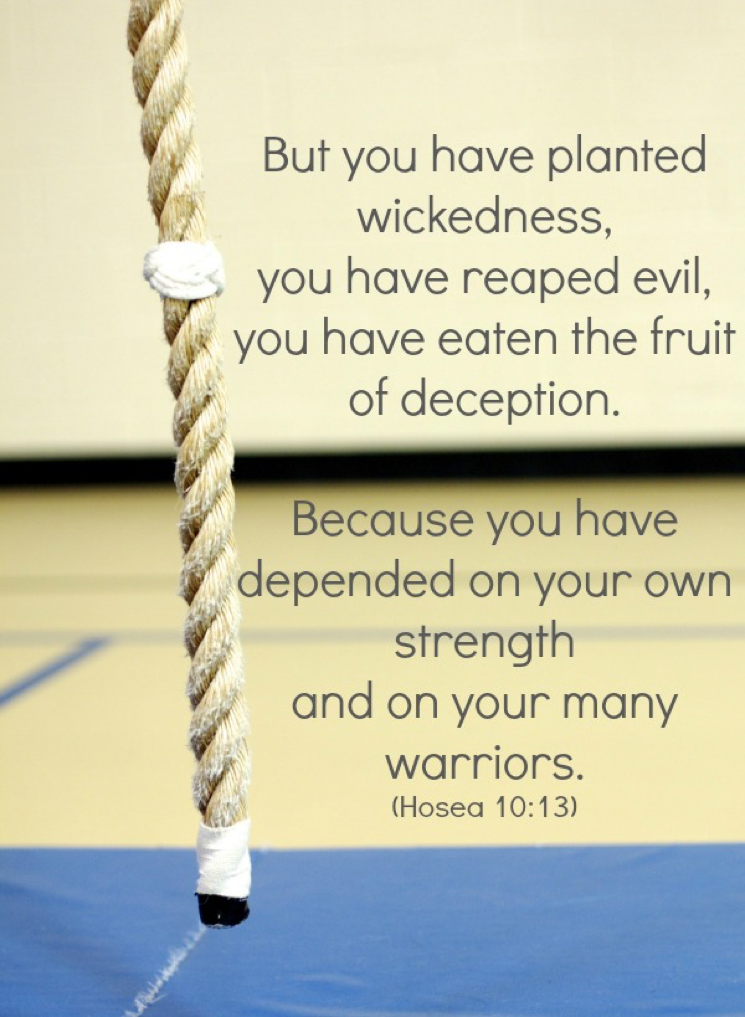
But you have planted wickedness,
    you have reaped evil,
    you have eaten the fruit of deception.
Because you have depended on your own strength
    and on your many warriors.     (Hosea 10:13)


I don’t have a lot of upper body strength.  Never have.  The rope climbing unit in gym class was the worst.  I had one teacher who thought it might help me to start higher up the rope, so he lifted me onto his shoulders and had me grab on.  There I hung.  (And not for very long.)  Same weak arms, just higher up.  So depending on my own strength isn’t going to happen.

I also do not have any soldiers at my disposal, warriors to send out to do my bidding.  Would be cool, but I imagine none of you do, either.  So I guess we can overlook this verse, yes?

Unless….

Unless there are other things that we might be tempted to depend on.  Things we might rely on above God and His word.

A professor, maybe?

Scientists?

A boyfriend or girlfriend?

Your feelings?

Who is wise? Let them realize these things.
    Who is discerning? Let them understand.
The ways of the Lord are right;
    the righteous walk in them,
    but the rebellious stumble in them.  (Hosea 14:9)

Are you stumbling on the Word of God?  Do you have trouble reconciling it with what you are being told or what you “know”?

Maybe you have “eaten the fruit of deception”?

I pray regularly that if my understanding is wrong, that God would correct me.  I ask Him to show me where I’m wrong.  Sadly, though my arms are weak, my ego is strong, and it’s been hard to admit that at times I’ve been mistaken.

Make that your prayer today.  Ask God to show you if you’ve been deceived.  And be willing to act on what He shows you.

-Susan Landry