At the beginning of Acts 3, we find two disciples (Peter and John) endowed with the Holy Spirit perform a miracle. John and Peter told a lame man (Acts 3:2-8), who had been unable to walk since birth, to get up and walk…and the man did! Unused and weak legs were instantly transformed, and the man was healed. Not only was he able to walk, but his gratefulness could not be contained, and he leaped into the air and praised the LORD. That is why most miracles are performed so that God will get the glory.
Soon, however, the word of the supernatural occurrence got around. According to what Peter said, the crowd gave the two men credit for the healing. Instantly Peter corrected their error, “… When Peter saw this, he said to them: “Fellow Israelites, why does this surprise you? Why do you stare at us as if by our own power or godliness we had made this man walk?”
God is still in the miracle performing business. While we no longer have apostles with us today (those who physically walked with and were taught by Christ) we do have followers of Christ. Righteous men and women who believe God works miracles even today. When God does the impossible, it is always He that should be honored, never a man. The person used to do God’s will is simply that, one that God used.
Unfortunately, the Healer and the Changer of the impossible often gets forgotten. God seldom gets the glory for doing the incredible. People pray for healing or a bad situation to change. It is changed, but God does not get the credit. Others believe that a certain “man of God” can change the situation. The preacher’s prayers are honored, and the man is sometimes revered as being responsible. Often little credit is given to God. The man, medicine, or objects are just the vehicles God uses. God is the only one that can change anything.
“When in doubt, give God the glory.”
-Andy Cisneros
Questions for Reflection and Discussion
Does God do miracles today? How do you know?
Do we still pray to Him expecting to be heard? Has God answered prayer in your life? As little as the answer to a prayer or request may be, it still is a miracle. Did you thank God for answering your request?
Object permanence is a milestone babies hit when they begin to understand that an object still exists when they can’t see or hear it. When their mother leaves the room, she still exists; when their favorite toy is hidden under a blanket, it still exists, too.
Object permanence is a skill Jesus reinforced in his disciples on their final night together, before his arrest and subsequent death.
Jesus went on to say, “In a little while you will see me no more, and then after a little while you will see me” (John 16:16).
The disciples mourned Jesus’ death, and they rejoiced at his resurrection just three days later. Even though they could not see Jesus, he wasn’t gone forever. Just like a baby’s favorite toy hidden under a blanket, Jesus was merely out of sight for a little while.
You and I have never seen Jesus, yet the disciples’ hope is our hope, too. We can’t see Jesus now, but we will someday—when he brings his Father’s Kingdom down to Earth. We have faith that even though we cannot see him, he is real and he is working. After all, faith is the certainty of the things we cannot see (Hebrews 11:1).
Although we’ve never seen Jesus, we can see the impact of his life all over our own lives—the freedom of forgiveness, peace in unfathomable situations, victory over temptation and sin.
Therefore we do not lose heart. Though outwardly we are wasting away, yet inwardly we are being renewed day by day. For our light and momentary troubles are achieving for us an eternal glory that far outweighs them all. So we fix our eyes not on what is seen, but on what is unseen, since what is seen is temporary, but what is unseen is eternal (2 Corinthians 4:16-18).
We have the same hope as the disciples. We can’t see Jesus now, but we will soon.
Jesus is coming soon.
We will see Jesus face to face.
-Mackenzie McClain
Discussion Questions:
Even though you’ve never seen Jesus, have you seen evidence of his existence in your life? How so?
How would you live your life differently if you were constantly reminded of Jesus’ coming return?
I have a story to tell you. It’s the scariest horror story and, simultaneously, the greatest love story. I’m not talking about ghosts falling in love. No, I’m talking about a garden.
We’re all little branches in a big, beautiful garden. It’s our job to grow fruit to please the Gardener.
A day is coming, however, when the Gardener will cut off the fruitless branches—the diseased, dead, good-for-nothing twigs.
“If you do not remain in me, you are like a branch that is thrown away and withers; such branches are picked up, thrown into the fire and burned”(John 15:6).
It’s scary to think about the judgment that is coming—about the branches thrown into the fire. The Bible is filled with examples of people meeting God’s wrath, like a flooded Earth, a pillar of salt, a plethora of plagues, and people dropping dead. That day is coming for us, too. This begs the question, are you living in a manner that is consistent with your calling to be holy, to bear good fruit?
I have good news for you, Little Branch. There is a Vine who is crazy about you. His job is to keep you close, to hem you in, to wrap around you, and cover you in grace. This Vine is Jesus, and he says:
“Abide in me, and I in you. As the branch cannot bear fruit by itself, unless it abides in the vine, neither can you, unless you abide in me” (John 15:4).
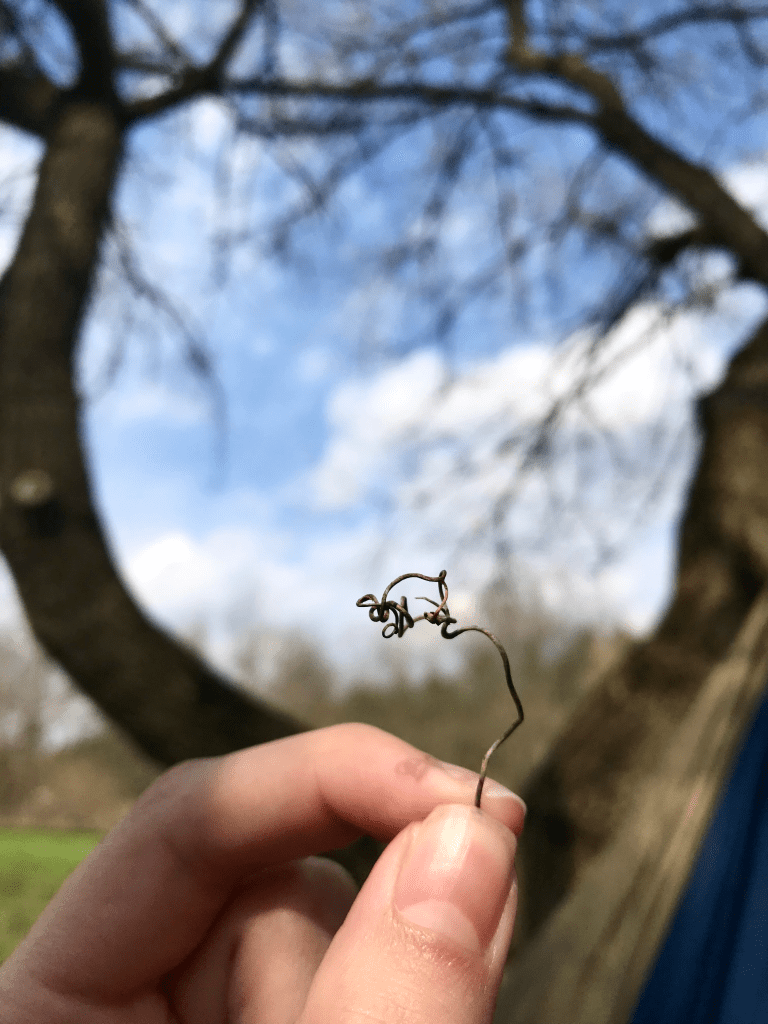
I took this picture of a vine in my sister’s backyard. Look at the way it twists, turns, and loop-de-loops to seek out and envelop a branch. The love Jesus has for you is the same. It’s reckless and unrelenting. It’s the well that never runs dry, the shepherd that leaves the ninety-nine to rescue the one, and the blood-stained body on the cross.
The same Jesus who first told us to “Come,” also tells us to “Abide.” To remain. To stay. To obey.
“If you keep my commandments, you will abide in my love” (John 15:10a).
-Mackenzie McClain
Discussion & Reflection Questions:
As the old hymn says, are you ready for judgment day? Are you bearing good fruit?
What commands do you struggle to obey? Where in your life do you need a good pruning?
Do the people you pass in your daily life know that you follow Jesus? Your coworker in the adjacent cubicle, the cashier at the grocery store, your neighbor down the street? How do they know? It’s probably not the length of your prayers, the Bible verses you have memorized, the fancy church jargon you use, or the gourmet casseroles you bring to your church potlucks.
They will know you by your love.
“A new command I give you: Love one another. As I have loved you, so you must love one another. By this everyone will know that you are my disciples, if you love one another” (John 13:34-35).
Following Jesus isn’t about knowing the most, but loving the most.
Love is our faith in action. It might not always make sense to unbelievers, especially in the midst of our self-obsessed culture.
Love your enemies and pray for those who persecute you (Matthew 5:44).
Sell your possessions and give to the poor (Luke 12:33).
Honor one another above yourselves (Romans 12:10).
Look after orphans and widows in their distress (James 1:27).
Carry each other’s burdens (Galatians 6:2).
We ought to lay down our lives for our brothers and sisters (1 John 3:16).
When we love—even when it doesn’t make sense—we show our allegiance to Jesus. He is the perfect personification of love. This week, we celebrate the love he showed on the cross, where he bled and died to win your heart, where he was scoffed at by a world who couldn’t make sense of such great love.
If we’re followers of Jesus, we’ll do as Jesus did. We’re called to pour even when our cup is empty, to give when it hurts, to expect nothing in return, and to lay down our lives for others. By this, the world will know you belong to Jesus.
-Mackenzie McClain
Discussion & Reflection Questions:
Who will you show this nonsensical love to this week? How will you do it?
Loving others cost Jesus his life. What might loving others cost you?
By being known as a follower of Jesus, people will make assumptions about who Jesus is based upon how they see you act. What implications does this have for how you live your daily life?
A good leader, a bad leader, a boasting field commander, mourning, praying for those left, searching for a word from the Lord, reports of fighting here and there, a large impressive bully nation, a pleading king. It’s almost enough to make me look for a time and date stamp to check what century I am reading of. Am I reading the headlines of the newspaper today, or from 2 Kings 19, an account of when the small country of Judah and her king Hezekiah were being bullied and intimidated by Sennacherib the king of Assyria?
For a better understanding, we might need to back up a couple hundred years from where we are reading in 2 Kings. It is tricky fitting the whole wealth of Old Testament history and beauty and lessons into 105 days, as our Bible reading schedule this year dictates, but let’s catch up on a couple hundred years here. The end of last week we were reading of the son of King David, King Solomon – the third king of Israel. His reign over Israel was blessed by God and Israel prospered. However, after King Solomon the kingdom divides into the 10 northern tribes of Israel (which rejected the rule of the line of David and created their own system of worship since they no longer held Jerusalem, the home of God’s temple) and the 2 southern tribes then called the nation of Judah.
Israel would have one bad king after another. But still God was active and at work in their nation, as we saw with the powerful ministries of the prophets Elijah and Elisha in our readings earlier this week. But it wasn’t enough to turn the tide of the nation that had chosen to reject God. Israel would be overtaken by the bully nation Assyria (see 2 Kings 17). This was God’s judgment on a country that had rebelled against Him.
And now, Assyria was coming after the nation of Judah. Hezekiah, the 12th king of Judah and from the line of David, had been king 6 years when Israel had fallen to Assyria, within the next 8 years Assyria had attacked and captured all of the fortified cities of Judah, except the capital city of Jerusalem. Scared Hezekiah, feeling desperate to save his nation, had even tried paying tribute to Sennacherib king of Assyria – striping the temple and palace of all its gold and silver. But still, Assyria advanced and now they were at the gates of Jerusalem. Sennacherib’s field commander, had just delivered an intimidating speech to the occupants of Jerusalem – promising protection and life if they surrendered and destruction and death if they did not. He tried convincing the people saying, “Do not listen to Hezekiah, for he is misleading you when he says, ‘The Lord will deliver us.’ Has the god of any nation ever delivered his land from the hand of the king of Assyria?” (2 Kings 18:32b-33). And, that is where we are when we read 2 Kings 19.
The king, the leaders and the people are scared. Assyria has already conquered so many, including Israel and the fortified cities of Judah. It seems perhaps this will be the end of Jerusalem and all Judah as well. Hezekiah sends his advisers to the prophet Isaiah asking for prayer for the people. Isaiah replies – Don’t be afraid. God heard the boasting blasphemous words of the field commander – and God is preparing a surprise for them.
Sennacherib sends a written intimidating message to Hezekiah. I love what Hezekiah does with the letter. He takes it to the temple, spreads it out before the Lord and prays:
“Lord, the God of Israel, enthroned between the cherubim, you alone are God over all the kingdoms of the earth. You have made heaven and earth. 16 Give ear, Lord, and hear; open your eyes, Lord, and see; listen to the words Sennacherib has sent to ridicule the living God.
17 “It is true, Lord, that the Assyrian kings have laid waste these nations and their lands. 18 They have thrown their gods into the fire and destroyed them, for they were not gods but only wood and stone, fashioned by human hands. 19 Now, Lord our God, deliver us from his hand, so that all the kingdoms of the earth may know that you alone, Lord, are God.”
(2 Kings 19:15-19)
What a beautiful prayer that lays it all out before God. First, acknowledging God for who He is and what He has done – no small matters. Go back and read it again to hear the awe and reverence in Hezekiah’s voice. He knew he was speaking to the creator of heaven and earth! How awesome is that? Then, bringing before God what was on his heart. What do we want Him to look upon, and listen to? Yes, God already has heard it and seen it all. Hezekiah wasn’t surprising God or giving Him new information. But He was asking God to act on what Hezekiah was seeing and hearing, what was important to Him. And, believing that God could do it, he asked for deliverance, not just to save their own hides – but “so that all kingdoms on earth may know that you alone, O LORD, are God.” (2 Kings 19:19).
God did answer this prayer in such a way that all those kingdoms knew that He alone with God. That night, the angel of the Lord visited the Assyrian camp and killed 185,000. Sennacherib and the rest went running home. Sennacherib survived, for a short time, only to be assassinated by two of his sons. Hezekiah lives to have more prayers answered in the next chapter.
But here we are today, surrounded by more conflict, and more bully leaders, and more scared leaders and still One TRUE God over them all. Perhaps now is a good time for more heartfelt prayers to God. We know more righteous judgment from God is on its way – both now and ultimately at the end of this age when His son Jesus returns to earth. We so look forward to a time when the faithful from all nations and kingdoms are gathered before the throne – no longer waving national flags, if now their allegiance is to the Lamb of God.
Questions for Reflection and Discussion
Hezekiah’s strongest weapon was not his armies or alliances or his gold and silver – but his heartfelt prayer to God. How can we better use prayer in our own time of desperate need? How can we better use prayer for the nations in conflict today? What do you want to make sure God hears and sees? Tell Him about it, even though He already knows.
Hezekiah praised God for His creation. I wonder if, or how much, Mr Darwin and the theory of evolution has blocked the prayers of “believers”. What do we truly believe in today? When we strip God of His power and His creation, do we also strip Him of His power or desire to act on our behalf? What are other ways we fail to recognize God’s greatness and power? What do you believe God can do and will do and has done?
Do a little word study on nations or kingdoms – how do they show up in Scripture? What about in Revelation?
I have a similar ailment to Naaman’s. No, not leprosy, but a pride that makes me want to be right, even sometimes to the point of thinking God (or the man of God) is doing it wrong if He/they aren’t following the step by step plans I designed. And, sometimes a pride like that leads to a bit of anger when our best laid plans are contradicted by an all-knowing and pretty creative God who also likes to witness our obedience.
So, here we have Naaman – the proud, leprous army commander of the country of Aram at the door of Elisha’s house. He had already humbled himself to listen to the captured Israelite servant girl who was sure Naaman could be healed of his dangerous skin disease if he got to the prophet of God in Samaria (capital city of Israel, Aram’s enemy). He had already secured from the king of Aram a very impressive payment (including 750 pounds of silver and 150 pounds of gold and 10 sets of clothing) for the one who could heal Naaman. He had already travelled by horse and chariot over 100 miles – first to the king of Israel (who was absolutely no help and was scared this was an enemy trap) – and now to the door of the prophet Elisha’s house.
Naaman has rehearsed in his mind how this is all going to go down. His life is about to be changed and the dreaded leprosy will be gone forever. So, he is completely caught off guard when Elisha instead of waving his magic wand (or hand) sends a servant out to him to tell him to go wash 7 times in the Jordan River which is another 30 miles down the road. 2 Kings 5:11 says, “But Naaman went away angry and said, ‘I thought that he would surely come out to me and stand and call on the name of the Lord his God, wave his hand over the spot and cure me of my leprosy. ‘” He went away angry because God’s plans didn’t match up with his. He had envisioned instant and easy healing – the wave of a holy man’s hand. He had faith it could be so – that was good. But he also had prideful arrogance that he should be the one to choose how God worked. And when his plans and God’s plans didn’t match up – then God must be wrong. God desired faith and simple obedience. Naaman had faith and a big helping of pride, arrogance and anger. Faith without obedience (deeds) is dead. He would rather live with his deadly leprosy than humble himself to obey and do it God’s way. And he walked away from the healing God had prepared for him.
Some stories tragically end this way. How devastating if Naaman’s story also ended with him angrily turning his back on the blessings God wanted to pour out on him in the dirty Jordan River. Luckily for Naaman, he had some bold and wise servants who calmly reasoned with him and convinced him to try it God’s way. And, when he had faith and obedience, he received the blessing and new life that he was searching for – because he humbled himself and did it God’s way.
God, please heal me of my pride. I don’t want my stubborn pride to get in the way of receiving your blessings. Help me to faithfully obey you, even if I had a different plan. I don’t have to be right – You are. Always.
-Marcia Railton
Questions for Reflection and Discussion
Has there been a time your plans and expectations didn’t match up with God’s? How did you handle it?
Why do you think people tend to get mad at God when they don’t understand or abide by His plan? Have you seen some angrily walk away from God and the blessings He wanted to give? What wise and bold counsel would you offer?
How do you rate your own faith and obedience? How can you improve both your faith and your obedience?
Later in this chapter Gehazi gets into trouble because of his covetousness. Explain what happens to him and why? What other sins did he commit? Has wanting what others have ever gotten you into trouble? How do we avoid the great dangers of covetousness?
In Steve Mattison’s devotion this past Sunday on 1 Kings 17 he pointed out the difference between God providing for the needs of those who love and serve Him compared to God providing an easy life to those who love and serve Him. One can be counted on, but not the other. We can always count on God to provide what we need, but that is not the same as never being in need. In fact, it is during the more difficult times in our lives that we have the opportunity to put all our faith – and our deeds – into His hands to see how He will provide once again. Those difficult times are faith building opportunities.
2 Kings 4 includes two women with impressive stories of how God provided for them in their time of need through the prophet Elisha.
The first account is of a God-fearing widow with two sons and demanding bill-collectors. She has already lost her husband but now if she can’t pay her debts the bill collectors will take her sons to pay off her debts. Her life has been far from easy. But I love how God would show Himself faithful – working with her and her generous community. God could have just supplied all the coins she needed in the mouth of a fish or something – guess He was saving that “trick” for later. When God provides, it doesn’t mean we just sit and watch, often there is a job for us to do to get things rolling. Sometimes it might mean going out to catch the fish with the coin in its mouth (Matthew 17:24-27). For the widow, Elisha asked her what she DID have. God can use the little bit we are thankful for and recognize we DO have to then multiply our blessings.
In this case, the widow was also to ask her neighbors for help – she needed their empty jars. Her community had the opportunity to play a part in supporting her. They weren’t going to be the ones paying the debt for her, but they were providing part of what she needed in order for her to faithfully fulfill her role so God could pour out the blessings like only He can do. Elisha told her, “Don’t ask for just a few (jars).” (2 Kings 4:3). If she would have had a bad attitude and said, “This is stupid, I don’t want to ask my neighbors for jars, I don’t like relying on others, how is this going to help? I will just get a handful of jars” then she would have just experienced a tiny miracle and she wouldn’t have had enough to pay off the full debt. God doesn’t need to bless the bad attitudes. Watch your attitude. When the man of God says, “Don’t ask for just a few”, then go out and ask for a lot! The size of her miracle was going to depend on how faithful she was, and how big her view of God was. If she thought God could only help a little, only a few jars would be collected and only that much oil would have poured from her little jar of oil. Thankfully, it appears she collected quite a few, so that so much oil poured from her little jar she would be able to not only sell the new full jars to pay off the debt but then also live off of the rest. God supplied even more than what she needed at that time – because she was faithful to do her part and had a big view of what God could do – and so she listened to and obeyed the man of God.
The second woman in 2 Kings 4 is a well-off woman with a husband but no sons. She recognizes Elisha as a man of God and practices hospitality (first inviting him several times for supper, and then even creating an addition on their house – a small room on their roof – so he could stay overnight.) Their town of Shunem was about half-way between Elisha’s hometown and Mount Carmel, which Elisha still visited regularly, so Elisha would come and go – and was always well provided for when he was with them. So, Elisha promises her a son, a miracle from God as her husband is old and she had resigned herself to a life without children.
The baby is indeed born, but a few years later he dies in her arms, struck with some sudden severe ailment. She carries her dead son to Elisha’s room and lays him on the bed, and then tells her husband in the field that she will need a servant and donkey as she is going to travel to find Elisha. A commentary suggested she didn’t tell her husband of the death of their son for fear that he would have him buried right away as it was hot harvest season. Instead, her faith spurs her on to action. She needs to speak to the man of God. It’s a great story that I can’t tell as well as the writer of 2 Kings – so make sure you read it to see how the story ends…
God provides. He doesn’t just hand out the easy life. Be prepared for difficulties. They don’t mean God is not there, or He doesn’t care. Even in the trials, God provides. He calls you (sometimes through the men and women of God) to step out in faith – still believing even when you are in pain. When you feel at a loss, keep your big view of God and all He can do. God provides.
Questions for Reflection and Discussion
How have you seen God provide for you? What might He have asked of you in order to receive the blessings He wanted to give to you? How did others play a part?
How can you help those in your community who are in the midst of difficult times?
How would you rate your hospitality? What blessings have you (or might you) receive from welcoming others? How can you show hospitality this month?
Why did God allow the death of the Shunammite’s son? Look ahead to 2 Kings 8:1-6 for even more insight. How does God provide even when the dead are not raised – right away?
Today’s reading starts out, “When the Lord was about to take Elijah up to heaven in a whirlwind…” And to think, some people say reading the Bible is too boring. Sorry, I can’t agree.
Elijah and Elisha did a lot of walking that day. They started at Gilgal, walked to Bethel, then to Jericho, then to the Jordan River. Each time they moved on, Elijah asked Elisha to stay behind, but Elisha would not be separated. When he promised to follow Elijah, in 1 Kings 19:20, he meant to follow him to the end, and he was going to. Elisha was dedicated.
They walked through areas of spiritual significance. It had been at Gilgal that the Israelites first camped when they had entered the promised land, and it was there they were circumcised, and officially became “sons of the covenant” (Joshua 4:2-9). Bethel had been the place Jacob had a dream with a stairway to heaven, with angels going up and down; and where God had promised to be with him wherever he went (Genesis 28:11-19). Jericho had been the site of Joshua’s amazing victory as a result of just obeying God by walking around the city – no matter how ridiculous that seemed (Joshua 5-6). And the Jordan River was where the river parted before Joshua and the Isrealites on their way into the promised land. Elijah and Elisha walked down memory lane together.
In their travels, they visited two schools of the prophets (Bible Colleges), where the students told Elisha that Elijah was going to be taken away from him that day. It seemed like everybody knew what was about to happen, and it broke Elisha’s heart.
When they got to the Jordan River, Elijah hit the water with his cloak, the water divided, and they walked across on dry land. It was then that Elijah asked Elisha if there was a parting gift Elijah could leave to Elisha. Elisha replied, “Let me inherit a double portion of your spirit.” Interesting. The thing Elisha wanted most in this world was to be closer to God than even Elijah had been. Elisha had his priorities right.
Elijah told Elisha that if he saw Elijah being taken away, he would receive his wish.
2 Kings 2:11-12 then says, “As they were walking along and talking together, suddenly a chariot of fire and horses of fire appeared and separated the two of them, and Elijah went up to heaven in a whirlwind. Elisha saw this and cried out …”
Now Elisha couldn’t rely on Elijah’s help anymore. He was alone… or was he? God was still on His throne.
Elisha picked up Elijah’s cloak. I think this is significant in that he was picking up the mantle of Elijah’s ministry. But now Elisha was stranded on the East side of the Jordan River. How was he going to get across? You guessed it. Elisha struck the river with Elijah’s cloak, the water separated, and he walked across on dry ground. God was with Elisha! And the 50 Bible College students that were watching knew that Elisha was now the new head prophet.
Elijah then went on to Jericho, where he healed the water and land around Jericho (which Joshua had cursed in Joshua 6:26).
The final miracle in this chapter is a little gruesome. Elisha went to Bethel, where a bunch of punks mocked Elisha, saying, “Go on up, you baldhead!” repeatedly. Presumably, they were saying that Elijah had been caught up to heaven and they were rid of him, now they wanted to get rid of Elisha’s godly influence (and condemnation) too. Elisha called a curse down on them, and two bears came out of the woods and mauled 42 of them. We’re not told that they were killed, so I assume they were scarred and maybe disfigured for the rest of their lives as a living testimony to what may happen when someone rebels against God.
After that, Elisha went to Mount Carmel, where Elijah had initiated the “god contest” that we talked about in yesterday’s devotion. Then, Elisha started his own ministry.
So how can we apply stories from this chapter to our own lives today?
Elisha was committed to spending as much time as possible with Elijah – to learn as much as possible from him – as long as he had the opportunity. I think it is important for less mature Christians to learn as much as they can from more mature Christians, while they have the chance. I also think more mature Christians need to seek out those they can mentor in the faith (2 Timothy 2:2). And while we’re on the topic, I also have to wonder if Elijah intentionally visited those Bible Colleges to encourage those students one last time before he was taken away. What are you doing to learn from those more mature and to share with those less mature?
Elisha was completely dedicated and followed Elijah to the end. Are you as dedicated to following God to the end?
Elisha’s greatest desire was to be even more godly than Elijah had been. And it was granted. (By my count, God performed 8 miracles at Elijah’s request, and 16 at Elisha’s request.) What is your greatest desire?
Elisha picked up the mantle when it was his turn to lead. And he then lived by faith. How about you?
And how often do you grumble against your preacher? Remember those 42 mauled hoodlums.
Elisha revisited places where he had treasured memories of Elijah, then struck out on his own to start his own ministry. We can’t live in the past either (although I personally would prefer to). We need to be looking forward to what God still has for us to do, and we need to take action. How are you doing on that front?
Finally, while we can’t expect to be caught up to heaven in a whirlwind like Elijah was, we do have this promise in 1 Thessalonians 4:16-17, “For the Lord Himself will come down from heaven with a loud command, with the voice of the archangel and with the trumpet call of God, and the dead in Christ will rise first. After that, we who are still alive and are left will be caught up together with them in the clouds to meet the Lord in the air…” But this only applies to the righteous. When Christ returns, will you rise to meet the Lord in the air? I hope to. I hope you do, too.
-Steve Mattison
Questions for Reflection and Discussion
What are you doing to learn from those more mature in the Christian faith and to share with those less mature? Why is each important?
Elisha was completely dedicated and followed Elijah to the end. Are you as dedicated to following God to the end?
What is your greatest desire? What else gets in the way? How can you be more devoted to your greatest desire?
Elisha picked up the mantle when it was his turn to lead. And he then lived by faith. How about you? What do you think God still wants you to do for Him?
Do you grumble against or put-down the leaders God has put in place?
As we mentioned yesterday, Elijah did what God told him to do, and did it when God told him to do it. So in I Kings 18, when God told Elijah to “Go and present yourself to Ahab, and I will send rain on the land.” Elijah went to find Ahab – even though Elijah was a wanted man. And Elijah knew that God was going to finally send rain – after a 3.5 year drought.
When they met, Elijah proposed a “God contest” to Ahab. He told Ahab to gather at Mount Carmel the 450 prophets of Baal and the 400 prophets of Asherah, along with representatives from throughout all of Israel. (The 400 prophets of Asherah declined the invitation.) Once everyone was assembled, Elijah made a speech in front of all of the representatives saying (1 Kings 18:21), “How long will you waver between two opinions? If the Lord is God, follow him; but if Baal is God, follow him.”
Then Elijah proposed a challenge. Give a bull to the 450 prophets of Baal, and Elijah would get a bull. They would build an altar, and he would build an altar. They would pray to Baal, and he would pray to Jehovah. The god that answered by fire from heaven would be the real god. All the people replied, “What you say is good.”
So the 450 prophets of Baal got to go first. They chose their bull, and built their altar. They prayed from morning until noon, but nothing happened. At noon, Elijah started taunting them, “Shout louder! Surely he is a god. Perhaps he is deep in thought, or busy, or traveling. Maybe he is sleeping and must be awakened.” So they shouted louder, and started slashing themselves with swords and spears – but there was still no response.
Then Elijah got his turn. He rebuilt the altar of God, cut up the bull, and put it on top of his altar. He then dug a trench around the altar, and had the people pour 12 large jars of water over the offering and the wood. (Remember there had been a drought for 3.5 years, so water was very precious, and this had to have seemed like a huge waste of water.) The water completely filled the trench – Elijah was giving himself a handicap. Then Elijah prayed, “O Lord, God of Abraham, Isaac, and Israel, let it be known today that you are God in Israel and that I am your servant and have done all these things at your command. Answer me, O Lord, answer me, so these people will know that you, O Lord, are God, and that you are turning their hearts back again.”
Did you notice Elijah’s reason for asking God to send fire from heaven? Was it to make Elijah look good? No. It was to show the people that Jehovah is the only true God, and to show the people that Elijah obeyed God. And ultimately, it was so the people would turn back to God.
Anyway, Elijah prayed, then *poof* fire fell from heaven and burned up the sacrifice, the wood, the stones, and even the water. When the people saw this, they fell face-down on the ground and said, “The Lord – He is God. The Lord – He is God.”
Once the 450 prophets of Baal were slaughtered, Elijah told Ahab to go eat and drink before the rain started. Then Elijah knelt to the ground and prayed for rain. He sent his servant to look out over the Mediterranean Sea to see if he saw any clouds. There were none. This was repeated. After the seventh prayer, the servant said he saw a small cloud forming. Elijah told Ahab to jump in his chariot and escape to Jezreel before the rain stopped him, so Ahab rode off. “The power of the Lord came upon Elijah and, tucking his cloak into his belt, he ran ahead of Ahab all the way to Jezreel.” – 17 miles.
In addition to Elijah’s obedience mentioned in yesterday’s devotion, in this story we see examples of his incredible faith. Would you have had the guts to confront Ahab, even though Ahab had put a bounty on your head? Elijah did. Would you have been bold enough to challenge the pagan priests to a contest to call fire from heaven to declare which god was real? Elijah did. Would you have been so bold as to tell Ahab to eat before the rain stopped him – even though the sky was still clear. Elijah did.
How could Elijah have such profound faith in God? It was because he was doing what God had told him to do. And since he was obeying God, he had complete faith that God had things under control, even when things seemed impossible. And then as icing on the cake, God gave him supernatural strength and endurance to outrun a horse and chariot for 17 miles to stay ahead of the rain.
The incredible faith, answers to prayer, and incredible endurance that Elijah experienced were all because he followed God wholeheartedly.
Wouldn’t you love to have incredible faith, amazing answers to prayer, and other incredible things happen to you too? You can – if you too choose to follow God wholeheartedly, and obey him in every way. Or are you stuck “wavering between two opinions?” If so, I’m reminded of Revelation 3:15-16, “I know your deeds, that you are neither cold nor hot. I wish you were either one or the other! So, because you are lukewarm – neither hot nor cold – I am about to spit you out of my mouth.”
Make up your mind. Completely commit to one side or the other. I’m choosing Elijah’s side – God’s side. Which will you choose?
-Steve Mattison
Questions for Reflection and Discussion
Imagine you were an observer on Mount Carmel. What sights, sounds, smells, and emotions would you experience? What would you tell others about this experience?
What other false gods and idols have taken the place of Baal today?
Can you be on God’s side – just a little bit? What will happen?
How are you doing at following God wholeheartedly? What would God suggest you change in order to follow Him better?
I know the Kingdom of God which will be set up at the return of Jesus will be greater than anything I can imagine. I am really looking forward to a time when all tears will be wiped away and God will dwell with men (Revelation 21:1-4). At that time, I would really love to see God whip out his favorite home videos to show his resurrected and faithful family some of the highlights of how He worked through the ages. VeggieTales are great, but can you imagine watching these ancient recordings, with the Bible heroes at your side commenting on their exploits! Don’t tell me it can’t be done – I know my God can do anything. And if He wants it to be so – it will be. And, if He doesn’t, then He has a better plan than mine (that’s surely happened a time or two before!)
If you and I are there at His feet watching – I can only imagine that one of the favorite reels will be of the young shepherd David boldly and faithfully fighting the godless giant Goliath. Picture this: “As the Philistine moved closer to attack him, David ran quickly toward the battle line to meet him. Reaching into his bag and taking out a stone, he slung it and struck the Philistine on the forehead. The stone sank into his forehead, and he fell facedown on the ground.” (1 Samuel 17:48 & 49). And the white robed crowd of overcomers watching the ancient playback erupts in cheers, patting David on the back and giving high-fives and fist bumps. Victory is a beautiful thing to watch!
But, sometimes the victory never happens because God’s people miss the opportunity. They are scared into silence and submission by the boisterous repeated taunts of the wicked who are defying God and shaming His people. They listen to the family member or friend (like David’s older brother Eliab) who is full of negativity and says you don’t belong and you aren’t useful and you should just go back home to do what you’ve always done. They give up when the leadership says you aren’t experienced enough yet, wait until you are older to be bold, speak up and step into a ministry. They get flustered when they try on the safe armor and find it isn’t a good fit, maybe they weren’t meant for this after all. They fail to prepare for the battle by packing their pouch with the surprising items needed for a successful fight against evil. And, perhaps most of all, they lack the faith that the great big awesome God of the universe can use them to do His work, to beat back evil and advance His Kingdom.
Imagine yourself again – in the Kingdom, watching God’s home videos – and whose face appears next on the screen – yours. There you are: standing up to a godless bully, running towards the battle, representing God when others were too scared to speak up or act, believing in a great big God who saves.
You are not too small, too young, too inexperienced, too insignificant to do mighty things for God. (And, you are also not too old – but that’s a different Bible story). Step out in faith. Be courageous with God. Don’t miss the opportunity to gain a victory for God.
-Marcia Railton
Questions for Reflection and Discussion
David was confident that the Lord who saved him previously would save him again, even against a larger foe. “The LORD who delivered me from the paw of the lion and the paw of the bear will deliver me from the hand of this Philistine.” (1 Samuel 17:37) What has God already helped you to accomplish? How can this build your confidence? What larger project can you have faith that He will help you accomplish next?
At first I am a little disappointed that David is concerned with what rewards will be given to the brave fighter who faces Goliath – it seems a bit selfish and I am tempted to question his motives. But, I too am excited about what rewards are awaiting God’s faithful – and they do make for great motivation to get in the battle. What rewards are you eagerly anticipating and what do they motivate you to do?
Sometimes God’s people lose heart on account of evil and those defying (openly resisting) God. Where do you see this happening today? How can we do battle against them today? What tools/weapons would God have us use?