1 Timothy 1

monday devo

“Timothy, my son, I am giving you this instruction so that by them you may strongly engage in battle, having faith and a good conscience. Some have rejected these and have suffered the shipwreck of their faith.” ~ 1 Timothy 1:18-19

1 Timothy is jam-packed with rich truths that Paul wrote to Timothy, a mentee in the faith. 1 Timothy was written sometime between 62-67 A.D. while Paul was out of prison. He wrote to Timothy, a person who he had known since about 46 A.D. and who was currently ministering in Ephesus, a town in Asia Minor. A majority of this letter focuses on how to ‘do church,’ discussing a range of topics from  worship services to church leadership to interactions between church members. 

1 Timothy begins with an instruction to remind people to not teach different doctrines or pay attention to myths or genealogies (1 Tim. 1:3-4). In doing this, Paul said that the people were promoting “empty speculations rather than God’s plan, which operates by faith.” Wow! That’s a powerful statement. The discussions of the people of the church in Ephesus were not glorifying God. Instead, they were people just carelessly making a prediction about topics related to the concepts Paul taught. The discussions of the people were like junk food instead of a wholesome diet. They tasted good in the moment, but they ultimately produced nothing of value for the people. 

We need to ask ourselves what type of instruction we are filling ourselves with, as well as what types of instruction we are giving others. If are not taking in any instruction or teaching about God’s word, we will starve. God’s word is our daily bread, and we daily have to get into the word to get the nourishment that we need. Once we do, we have to look at the type of teaching we are getting. Are we taking in things that will build us up and draw us closer to God? Or does a majority of our Bible study focus on acquiring knowledge that we could use in a debate or class but ultimately leaves us spiritually unfulfilled? If we are teachers, we also need to ask ourselves these same questions. Is what we are teaching empty speculation, or are we teaching what Paul was teaching? Paul said that his ultimate goal for the instruction he gave was to produce a love that “comes from a pure heart, a good conscience, and sincere faith” (1 Tim. 1:5). If that is not our goal for what instruction we take in and give, then we need to reevaluate our purpose for that instruction. 

Paul recognized the importance of analyzing the purpose for what we do. When we reject producing pure love as our goal, we can lead ourselves and others down a path that leads to the shipwreck of their faith. In other terms, when we are not placing God’s plan first in our lives, we are choosing to not allow God to work in our lives. Let’s all strongly engage in the battle of our faith. This begins with the spiritual food that we take in. Make sure that you are taking in good things, not empty things.

~ Cayce Fletcher 

2 Thessalonians 3

“Brothers, do not grow weary in doing good.” ~ 2 Thess. 3:13

In 2 Thessalonians, Paul is encouraging believers to hold fast to the traditions that was taught to them by his message or letters (2 Thess. 2:15). His final directions to the believers in Thessalonica was to watch how they were living. Paul had first touched on this in 1 Thessalonians 4:9-12 where he says, “We encourage you to seek to lead a quiet life, to mind your own business, and to work with your own hands, as we commanded you, so that you may walk properly in the presence of outsiders and not be dependent on anyone.” In the months that spanned in between the letters, those who were living irresponsibly had not yet changed how they were living. He says in his second letter, “If anyone isn’t willing to work, he should not eat” (2 Thess. 3:10). Though at first this can seem harsh, Paul is not talking about someone who is physically not able to work. In the Thessalonian church, some able-bodied believers were not working for their own food. Instead, they were relying on the church for their food, thus taking away from those who may have actually needed the food because they couldn’t work. They were also using their free time to interfere with the work of others. 

So how does this passage relate to us today? We all have a responsibility to contribute to our community of believers. If you are not regularly meeting with church or body of believers, the first step is to find a church and get involved! Then, we have to evaluate our attitude, actions, and speech about the church. Unlike the irresponsible believers in Thessalonica, we should adopt the attitude in our church of givers not takers. Do we view the church as a place that we go to for a service once or twice a week? Or do we view the church as a community that we are currently building up? If we believe the church is meant to serve us, our attitude will be that of a taker, a selfish attitude that focuses on ‘What does this place do for me?’ A giving attitude focuses on what we can do to help to strengthen the church. Our attitude is directly related to our actions. A taker attitude will be critical, hands-off, and selfish, whereas a giving attitude will be encouraging, supportive, and selfless. A giving attitude will try to build up members of the church through encouraging words, financial support, and tithes of time and resources. When we are focused on giving to the church, our speech will also be focused on building up rather than tearing down. A taker attitude will lead to speech that criticizes without ever contributing solutions. A giver attitude will use wise words so that their speech helps to glorify God. 

The way that we work and contribute to the community of believers is a testimony to the world of our faith. We have to focus on how we can give to glorify God. And when it seems too much, we can remember Paul’s words, “Brothers, don’t grow weary in doing good.” 

Sunday Devo

~ Cayce Fletcher 

Peace

1 Thessalonians 3

1 Thessalonians 3 8

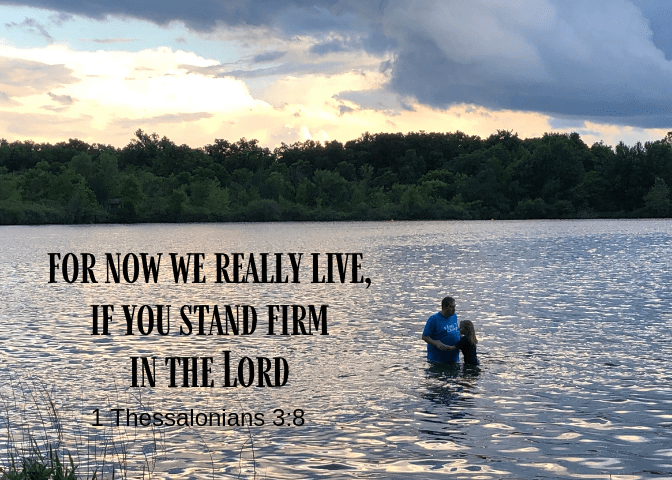
The big three are faith, hope and love.  Chapter three is all about growing stronger in faith. (vs. 7).  Esther and I have been watching all the very small things God has been doing through each day to show His love to us.  Things such as sending rain after the baptism tonight instead of during.  Things such as God’s gentle spirit blowing the door shut to the tabernacle as we write this devotional.  Things such as the enormous peace in the stone chapel as we prayed very early in the morning.


Application: As Christians, we can endure all persecution, and still have faith God loves us as we obtain perfect peace with both God and other friends.


-Paul & Esther


Roots

Colossians 2

Colossians 2 6 7

 If there was just one thing, I had to point out in my life that has been consistent it would be my faith. With unpredictability being a close second. Ever since I can remember God has always provided me an opportunity to go to church, VBS or camp. These opportunities I believe gave me the idea “church is good”. So, when I was a teenager, I felt it was necessary to return to church and go every week. It is this foundation I am so very thankful God built for me. I became rooted and strong in faith because of those experiences when I was young. Paul in Colossians 2:6,7 says this,

 “Therefore as you have received Christ Jesus the Lord, so walk in Him, having been firmly rooted and now being built up in Him and established in your faith, just as you were instructed, and overflowing with gratitude.”

What things are you rooted in that you are thankful God laid out for you to grow in Christ?

Jesse Allen

If Paul can, You can

Philippians 1 

7

Shipwrecked on an island, stoned, bitten by a snake, beaten, and thrown into prison. It seems that Paul could never catch a break. The letter of Philippians was actually written while Paul was imprisoned in Rome. After a short greeting to the church of Philippi, Paul explains his current predicament:

Now I want you to know, brothers and sisters, that what has happened to me has actually served to advance the gospel. As a result, it has become clear throughout the whole palace guard and to everyone else that I am in chains for Christ. And because of my chains, most of the brothers and sisters have become confident in the Lord and dare all the more to proclaim the gospel without fear.(Philippians 1:12-14)

Paul’s attitude is truly humbling. Instead of grumbling, blaming, or whining, he recognizes that all of his difficulties have “served to advance the gospel.” What a mindset to strive for! By being transparent about his sufferings, Christians at the time were encouraged to be more confident and daring, spreading the gospel without fear. I was shocked to read that the people were more encouraged by Paul’s endurance than petrified by his tribulations.

My sister once brought a box of bacon-cheddar flavored crickets to a family gathering. At first, everybody thought the crickets were an amusing joke, but nobody seriously considered eating one. After staring at the crickets for a long while, my brother-in-law finally ate one as we all goggled and gawked. Then the next person ate one, and the next person, and eventually everyone in the room had eaten a cricket. After witnessing someone else eat the cricket, it was much easier for me to eat a cricket, too. (FYI crickets don’t taste like chicken).

In the same way, early Christians adopted an “If Paul can, I can” kind of faith. Let Paul’s resilience and conviction in the face of obstacles encourage you, too, to proceed boldly in your faith. If Paul can withstand being shipwrecked on an island, stoned, bitten by a snake, beaten, and thrown into prison, you can be daring and bold in your faith, too.

When was the last time you took a risk for your faith? Get your hands dirty, get uncomfortable, and get moving.

I eagerly expect and hope that I will in no way be ashamed, but will have sufficient courage so that now as always Christ will be exalted in my body, whether by life or by death.  For to me, to live is Christ and to die is gain. (Philippians 1:20-21).


-Mackenzie McClain

In Step with the Spirit

Galatians 5

Gal 5 7

Chapter 5 picks up right where 4 left off (if you haven’t already, you might just want to read the whole book straight through to get the most out of it – it’s only 6 chapters).

1 It is for freedom that Christ has set us free. Stand firm, then, and do not let yourselves be burdened again by a yoke of slavery. […] You were running a good race. Who cut in on you to keep you from obeying the truth?

From chapter 4, we know that the Galatians were struggling, falling back to their old ways. Paul is still trying to get to the heart of the why and how.  He wants them to quit trying to be justified by the law – because by doing do, they miss out on Christ’s promise and are once again bound into slavery.

Do you ever get bogged down by doing things exactly by the letter and then realize that you have been missing the point?  Paul is specifically talking to the Galatians about circumcision, but I think the same idea could apply to many things.  This reminds me of Jesus’ teachings about the Sabbath.  The Pharisees were so focused on making sure no work was done, that they wanted to condemn Jesus for healing someone.  Jesus pointed out that if a sheep fell into a hole on the Sabbath, they would pull it out – and how much more valuable is a person!  So Paul’s point is to quit being so focused on the letter of the law – he says in verse 5 “The only thing that counts is faith expressing itself through love.”

So rather than focusing on the law, focus on this:

13 You, my brothers and sisters, were called to be free. But do not use your freedom to indulge the flesh[a]; rather, serve one another humbly in love. 14 For the entire law is fulfilled in keeping this one command: “Love your neighbor as yourself.”

It could be easy to say that if we are not bound by the law that we are free to do whatever we want, but I believe we are called to a standard higher than the law by this freedom.  If we look to Romans 6, Paul clarifies here that we are to offer ourselves to God as an instrument of righteousness and to not let sin reign.

This chapter finishes with the fruit of the Spirit.  You are probably familiar with these, but I usually think about these alone, not in the context of this book.  If we are children of God through Christ, then we have the Spirit to guide us rather than the law.  This list isn’t easy.  They are high standards of living.  I am going to leave you today with these verses as a reminder – let’s try to live in step with the Spirit.

22 But the fruit of the Spirit is love, joy, peace, forbearance, kindness, goodness, faithfulness, 23 gentleness and self-control. Against such things there is no law. 24 Those who belong to Christ Jesus have crucified the flesh with its passions and desires. 25 Since we live by the Spirit, let us keep in step with the Spirit.


~Stephanie Fletcher

Who Deserves Our Faith & Following

1 Corinthians 1

1 Corinthians 1 18 (1)

Hey guys this is Chris and I’m excited to go through 1 Corinthians 1-7 with you this week.  I hope you enjoy this book as much as I do.


In 1 Corinthians 1:10-17 Paul chastises the people in the Church at Corinth for being divided based on the person they were baptized by or whose teachings they followed.  I think that this is a very good message for us today. Many Christians are drawn to a well spoken pastor, or an impassioned speaker, and these are good people to follow, but too often people place too much of their faith in that person.  I have seen it many times, these types of leaders will move away from their church or they will have a scandal, and the faith of the people will be shaken and many will stop going to that church. Hebrews 4:14 says “Therefore, since we have a great high priest who has ascended into heaven, Jesus the Son of God, let us hold firmly to the faith we profess.”  We need to follow Jesus as the head of the Church because he will not fail us, and he is the only one who deserves our faith. Also, in this age of social justice people can get caught up in a certain movement or behind a certain leader and let those ideas influence them, and we need to remember that Christ’s teachings come first. Those other movements may be good things, but we need to check what they are saying against what Christ teaches.


1 Corinthians 1:18-31 tells us that salvation is not attained through wisdom or knowledge that you can gain if you study long enough.  That was the teaching of the Greeks such as Plato and Aristotle, that seeking wisdom was the highest goal. Salvation comes through faith.  In the Church of God we can be very focused on the Word of God and the truth, which is a good thing, but we need to make sure that we do not take pride in our knowledge and somehow think that we are any better than other Christians. We are saved by our faith, not our knowledge or wisdom.  Knowledge and wisdom will come as we seek God and grow, but we should not have pride in our knowledge, only in Christ and his works.


Have a blessed day.

Chris Mattison

Paul is Proof

Free Theme Days – Evidence for the Risen Jesus

Acts 9

Acts 9 5 (2)

Much of what we believe in the Christian faith is taken, understandably, on faith. However, if I had to give one story that almost shuts down the need for faith and instead have PROOF about  Jesus and the Resurrection, it would be the story of Saul/Paul and his conversion in Acts 9.

Up until the point in Acts 9, Saul has been persecuting the Christian faith. They were most likely being stoned or thrown in prison for trumped up charges. Stephen was accused of blasphemy and he was stoned to death. We all know he spoke no words of blasphemy, because the truth is not blasphemous, but that is where the Jewish leaders were.

But in Acts 9, something amazing happens, Saul gets knocked off a horse, goes down, hears the voice of a man who claimed to be Jesus, goes blind, and wanders into Damascus blind and healed by a Christian, one of the very people who he had just been persecuting.

Why does this count as proof for me?

1. Because it’s clear that Paul is not crazy. In a day and age where scholars doubt everything from the historical Moses to the historical Jesus, one would assume that when they agree on a traditional understanding, that counts for something. No scholar doubts that Paul wrote Romans. Ask for yourself, is Romans the work of a man out of his mind with guilt, that turned to follow Christ because he was driven to the small band he once hated out of a plagued conscience? There are parts of certain letters where we see Paul’s expressed sorrow (1 Corinthians 15:9, for example), and one could point to that as a case. But Romans! It’s a theological magnum opus! He is a man still gifted with all his intellect and faculties.

2. Could Paul be lying, hoping to gain wealth or fame off this new movement? We will go into this kind of theory even more in depth tomorrow, but Paul lost everything by getting on board this Jesus movement. He was persecuted, beaten, battered, and abused (2 Corinthians 11), and this after he had everything he ever wanted. He was the top dog of Judaism (Philippians 3) but he turned away from all those things so that he may follow Christ.

I encourage you to consider the persecutor-turned-evangelist Paul. What could cause a man rabidly dedicated to defending the faith of his ancestor and the honor of his God to so drastically change his tune and agree with those whom he persecuted?

For my part, it convinces me there is something going on with this Jesus movement, particularly that the leader must still be alive.


So, do you believe Jesus is alive?


-Jake Ballard

IF you Believe, THEN…

John 8

John 8 31 32

As we have read repeatedly in the last two chapters, we see again in John 8:30, 30 Even as he spoke, many believed in him.

Then Jesus shared this powerful truth:

31 To the Jews who had believed him, Jesus said, “If you hold to my teaching, you are really my disciples. 32 Then you will know the truth, and the truth will set you free.”

This passage points out that while belief is important, belief alone is insufficient.  If I’m completely honest, I don’t like the implications of this passage.  I want to just believe and know I’m ok.  Unfortunately, I see a similar warning in James 2:19, where we’re told, “Even the demons believe – and shudder.”

Now Jesus has my attention.  If belief alone isn’t enough, what does He expect? I interpret these two verses as Jesus giving his followers a series of If .. Then conditions:

  1. If you hold to my teaching (which I interpret as meaning: you need to live your life like Jesus told you and demonstrated to you).
  2. Then you are really my disciples (meaning, you’re not really His follower unless you do what He told you to do.)
  3. If you are really my disciples, then you will know the truth. (This suggests to me that people can’t even understand the truth unless they are really Jesus’ disciples.)
  4. Finally, when one knows the truth, the truth will set them free.


The believers Jesus was talking to had the same reaction I tend to have.  Wait a minute, set me free?  I’m not a slave.


Jesus went on to say that anyone who sins is a slave to sin, and Jesus came to set people free from sin.


This is really interesting to me.  As members of a denomination that claims to have the faith of Abraham, we may tend to think we have a corner on the market for faith and truth.  But how focused are we on the holiness message Jesus is sharing in this passage?  This should challenge us.

Verses 35 and 36 go on to say, 35 Now a slave has no permanent place in the family, but a son belongs to it forever. 36 So if the Son sets you free, you will be free indeed.

I don’t know about you, but I want a permanent place in God’s family.  But to have that place, I need to be set free – first, from sin, and ultimately from death.


This requires adding to belief:

  1. Following Jesus’ teaching
  2. Becoming his disciple
  3. Knowing the truth
  4. Having Him set me free.

Sign me up!  How about you?

-Steve Mattison

Missing the Messiah – Still?

John 5 23 b

John 5

Welcome back for the last time this week!  Thanks for sticking with me this far… just one left before you get to hear from someone MUCH cooler than me!  Let’s take a look at John 5.

Thought #1 – Vs. 1-9: It’s weird to me how this story is glossed over so easily when I think of this chapter and all that it carries.  Jesus cured a man who had been unable to move for nearly 40 years!!  That is huge!  And yet it took me three times of reading this chapter before I decided I should even write about it!  That by itself got me thinking… as someone who grew up in the church, how many of the amazing things that Jesus has done or that the Bible tells us do we gloss over because we’ve heard it multiple times?  For me, that answer is uncomfortably high.  I want to always be amazed by the things Jesus has done, even if I’ve read the story more times than I can count.  I think a huge way of getting to that point is simply to pause.  If this story is familiar to you, take a moment and pause.  Read through it again and try to find something new to you.  If you haven’t read this story often, make sure not to rush through!  Take your time and think about the emotions that would have surrounded this story in an effort to get a deeper understanding of its message.

Thought #2 – Vs. 16-30: So, because Jesus was doing what he was sent to do… the persecution starts.  Because the people didn’t listen to prophets before him, because they were just a little too full of themselves and self-righteous, they missed out on the Messiah and all of the amazing things that he was about to do.  These weren’t even the people you’d expect to miss someone as important as the Messiah!  These were Jewish leaders, people who were intelligent and should have been the most aware of Jesus’ coming.  And yet they missed it, because they were too wrapped up in the law of how it was supposed to look on the Sabbath.  How often do you miss out on something greater, maybe even to the point of intentionally driving it away, because you’re too wrapped up in how it looks on the surface?  Now I am not saying that we should ignore the laws we have, but I am saying that we should be more focused on living a Godly life versus living a life that makes others think we’re living a Godly life.  It is so easy to get sucked into the social media craze that includes Bible verses, pictures in your Sunday best with a quote from the pastor, etc. or in a prayer group that is really a place to gossip about others in the church openly without shame.  None of those things by themselves are wrong necessarily, but more often than not, they can distract us from the true purpose of being a believer in today’s world.  We are called to spread the message of Jesus Christ, and social media can be a very useful tool in that.  We are called to pray for one another and help hold each other accountable.  But all of these things must be done in love, and accompanied by a genuine faith and following of Christ.  Have you gotten sucked in to the less-than-realistic believer mentality that keeps things focused on the surface level?  How can you work to move past that and create a deeper, more genuine faith in Jesus?

Thought #3 – Vs 39-40; 44-47: This is more a continuation of Thought #2 than an individual thought.  Here we see Jesus speaking about those who have put their faith in something or someone other than God.  It’s not that these people he is referring to have put their faith in something unholy, unclean, or sinful, and that is the toughest part for me!  These people are putting their time and effort into studying Scripture, and the words of prophets who speak truth.  And yet, Jesus says that they “refuse to come to [him] to have life.”  In my experience with the COG, we tend to have much smaller church bodies that are very close knit.  I love this!!  BUT, I have seen and heard where that can create problems.  People in authority start to hold more weight than what is being taught, and churches can struggle when certain “higher-ranked” members have opinions or do things differently than what the church is meant to do.  These members are good people, but they are not God.  As a church, as a believer, we must put more faith in God than we do in our own personal congregations and churches if we want to experience the life Jesus Christ can provide through the Father.

Well thank you all for finishing Romans and starting John with me!  I hope that something along the way was beneficial to you; I know I gained a lot from getting to write these 😊

~Sarah Blanchard