My son, Jonah, is afraid of the dark. For a while, after we would read him a bedtime story and sing “Silent Night” as a lullaby, we would close the door to a dark, quiet room. And, a few moments later, we would hear the pitter-patter of feet as he would get out of his toddler bed, go over to the lamp in his room, and click it on. One day while he was playing, he told me that he had to turn his light on because he doesn’t like the dark because there are monsters in the dark.
Even though I am grown, I can empathize with his fears. I remember – and I bet you do too – those moments of fear when the lights go out. I remember begging my parents to leave the closet light on because I was unsure what was lurking out there in the dark past my bed. It seems only natural to be a little afraid of the dark, those places you can’t see. It’s a built-in defense mechanism that humans have to navigate nighttime in our world.
The Bible is full of themes that occur from beginning to end. You could trace the way water is used as a symbol of chaos and cleansing or the way trees represent a strong, godly life. One theme that occurs from beginning to end is the contrast between dark and light. Darkness is always connected with sin and evil, whereas light is connected with righteousness and God himself.
This is a quick overview of the way this theme is used in scripture. In the beginning, God created the light and called it good (Gen. 1:4). After the fall, the world is described as being in darkness. God is constantly beckoning his people to be a light to the surrounding nations (Gen. 15:5), but Israel repeatedly chose darkness. Jesus is the true light that shines out into the dark world – and his light “gives light to everyone” (John 1:9). We are now the torchbearers that continue to shine a light in the world. We are called to “shine as lights in the world” (Phil. 2:15). We “cast off our works of darkness and put on the armor of light” (Rom. 13:12, see also Eph. 5:7-14).
We see an example of being a light to the world in Judah’s king Josiah. After two dark, wicked kings of Judah, Josiah repairs the temple. He becomes a light to the nation calling them back to worship God and obey him after over half a century of disobedience. He repairs the temple and shares the law with Judah. The people were in darkness because of the evil kings, but Josiah was being a light pointing them back toward God. Just like the nation of Judah, we also have a tendency to pull toward darkness. In fact, sometimes we seem to like darkness; we prefer it over having our deeds exposed in the light. However, since we are in Christ, we need to put aside those worldly desires and choose to follow God completely. God is light and there is no darkness in him (1 John 1:5). We cannot do the deeds of darkness and follow God at the same time. Let’s be like King Josiah, and be a leader of light to those around us.
~ Cayce Fletcher
Reflection Questions:
Why do you think that the Bible uses the imagery of light and darkness to represent good and evil?
How was King Josiah a light to his country?
How can you be a light that represents Jesus to others today? What are some actions you could take?
Yesterday, we learned about the exile of the nation of Israel because of the idolatry that they practiced. 2 Kings 17:34 describes the Israelites who lived in Samaria: “To this day they do according to the former manner [fearing God but also serving the gods of the surrounding nations]. They do not fear the LORD, and they do not follow the statutes or the rules or the law of the commandments the LORD commanded the children of Jacob, whom he named Israel.” The nation of Israel had spiraled down the dark, deep hole of sin that ended in exile.
There is a glimmer of hope in 2 Kings 18, as we read about Hezekiah the good king of the neighboring nation, Judah. “He trusted in the LORD, the God of Israel, so that there was none like him among all the kings of Judah after him, nor among those who were before him. For he held fast to the LORD. He did not depart from following him but kept the commandments that the LORD commanded Moses” (v.5-6).
A little over halfway through his reign, Hezekiah is faced with a terrible situation. The king of Assyria attacks Judah and forces Judah to pay him tribute. Things even got so bad that Hezekiah stripped the gold off the temple doors and gives it to the Assyrian king. The Assyrians mock God and swear that God has forsaken Judah. This is where chapter 19 picks up.
When faced with a terrible situation, what does Hezekiah do? Hezekiah humbles himself, goes to God, and listens. Hezekiah sent people to Isaiah to pray in the nation’s behalf (v. 4). This proves to be exactly the right course of action.
We can learn so much from the reign of Hezekiah, but I think it’s so important to look at how he handled these difficult situations. You can follow the example of Hezekiah in doing the following:
Humble yourself. Hezekiah tore his clothes and covered himself with sackcloth. He didn’t try to appear to have his life together. He recognized the severity of the situation and knew he could not save himself without God.
Go to God. Hezekiah went to the house of the Lord immediately. He knew where to turn with the situation got tough.
Seek counsel and comfort from godly people. Hezekiah gathered up a few trusted servants and priests to go to Isaiah, the prophet for help.
Recognize that you have a mediator who knows your needs. Hezekiah turned to Isaiah to be a mediator between God and him. He asks Isaiah to pray for him. We don’t have to turn to men to pray for us. Instead, we can go to God ourselves because we have a mediator in Jesus.
At the end of this chapter, Isaiah gives some reassuring news. The Assyrian king would not destroy Judah. In fact, he would fall by his own sword. Verse 35-37 goes on to say, “That night the angel of the LORD went out and struck down 185,000 in the camp of the Assyrians. And when the people arose early in the morning, behold these were all dead bodies. Then Sennacherib king of Assyria departed and went home and lived at Nineveh. And as he was worshiping in the house of Nisroch his god Adrammelech and Sharezer, his sons, struck him down with the sword.” God’s promises are true. Praise God that we can go to him in all of our sufferings.
~ Cayce Fletcher
Reflection Questions:
What difficult situation are you facing today? What strikes fear in your heart? Makes you despair? Bring this situation to God.
Who are some people you can turn to in difficult situations that can help to point you to Christ?
How is prayer different from the Old Testament to the New Testament because of Christ?
The school year has just ended in SC, and I am thoroughly enjoying summertime. After teaching for 5 years (and being in public school/college all those years before it), summer has become a beautiful time of rest, relaxation, and lots of swimming and sunshine. Summer is one of the perks of being a teacher, but it is definitely a time that feels earned. After a year of pushing students to be better learners and better people, I need a break.
One of the most challenging things about being a teacher is the constant redirection and discipline that are required to make sure a classroom runs smoothly. If everyone is always doing what they want – whether that’s blurting out, going to the bathroom (as soon as we start taking notes!), or playing on the iPad – not much learning is happening. One of my jobs as a teacher is to set up a structure for my classroom that involves rules so that students know how to overcome doing what they want so that they can do what they need in order to learn. Sometimes students are happy to follow these rules. But, sometimes they are not. When they don’t follow rules, there is a system of warnings and consequences to try to get them back on track. Lunch detention, emails home, you know the drill. Occasionally, a student will not listen, and that is when the big punishment happens: ISS or OSS. Any public school kids know about this place of detention. The purposes of ISS, or in-school suspension, are two-fold: (1) By taking them out of the classroom, they miss out on the fun and good things we do as well. Normally, they don’t want to be away from the class because of this. (2) It also removes the student from the learning environment so they don’t pull everyone else down with them.
In our reading today, we see the punishment the Israelites received that reminds me quite a bit of ISS, except much more severe and far-reaching. The Israelites were exiled from their land as a consequence of their sin. We read in 2 Kings 17:1-23 about how the Israelite king, Hoshen, continued to follow the pattern of doing evil in God’s sight. This caused the king of Assyria to invade the land and ‘carry the Israelites away to Assyria and place them’ throughout the land of Assyria (v. 6). Verse 7-8 says, “And this occurred because the people of Israel had sinned against the LORD their God, who had brought them up out of the land of Egypt from under the hand of the Pharaoh king of Egypt, and had feared other gods, and walked in the customs of the nations whom the LORD drove out before the people of Israel, and in the customs that the kings of Israel had practiced.” Verses 9-23 go on to describe the Israelites’ descent into sin from the time they entered the promised land with Joshua until the present time. In Deuteronomy 28, we read the promised consequences for the sin of disobedience and see these consequences given after the Israelites choose repeatedly not to listen to what God has told them to do. Despite knowing these consequences, the Israelites still pursued other gods and idols. When God would try to call them out of their sin and draw them back to him, they would not listen.
Ps. 135 describes the difference between God and idols. Calling back to the deliverance from Egypt, it states the great works of God and praises him because “For the Lord has chosen Jacob for himself, Israel as his own possession” (v. 4). In contrast, the idols are the work of human hands that cannot speak, see, hear, or breathe. “Those who make them become like them, so do all who trust in them” (v. 18). It’s chilling to read this Psalm after seeing the demise of the state of Israel. Because the Israelites trusted in their idols, they either died or were forced to live in captivity where their “life shall hand in doubt before them. Night and day they shall be in dread and have no assurance of their life” (Deut. 28:66). Instead of Israel being God’s chosen possession, God “rejected all the descendants of Israel and afflicted them and gave them into the hand of plunderers, until he had cast them out of his sight” (2 Kings 17:20).
This is a harsh consequence, but like the punishment of ISS, it is twofold in purpose. The descent into sin needed to be stopped. This was God’s boundary line, stating that if they continued to act like this they would not be allowed to remain with him. It also removed Israel from close proximity to Judah, the nation that still remained in the Promised Land. At this point, Judah was not too far gone, so God didn’t want Judah to be brought down further into sin by Israel.
God takes idolatry seriously, and there are severe consequences for it. We cannot be God’s chosen people if we choose to pursue idols. Idols look different than in the Israelites’ time, but they are all around us: Beauty, Money, Sex, Work, Family, Political Beliefs, Identity, Alcohol, Drugs, Social Media, Image. These are the intangible idols. We can’t hold them in our hands like idols of the olden days, but we may worship them all the same, giving offerings of our time, money, and relationships – sometimes sacrificing our parents, children, spouses, or friends on the altar of their worship. We will be exiled from his presence if we choose to pursue idolatry if we choose these things over God. It is not too late to turn back to him! Cast down your idols today.
~ Cayce Fletcher
Reflection Questions:
What are some of the idols that you see in your life or the life of the people around you?
Why does God give such harsh consequences for idolatry? What is the danger of idolatry?
What does exile look like in a modern day context? Do you think God punishes people in the present day, or is it just a future consequence (aka a lake of fire punishment)?
Philippians Introduction
Paul wrote the book of Philippians to the Christians in Philippi, which was the first church Paul established in Europe. Despite the fact that Paul wrote this letter while he was a prisoner in Rome, Paul repeatedly talked about joy – showing that he could be content in any circumstance (4:11).
Paul reminded the Philippians to conduct themselves in a manner worthy of the gospel of Christ (1:27), despite the persecution they were suffering (1:29-30). He pointed to Jesus as the ultimate example of humility and submission, and reminded the Philippians that they should have the same attitude as that of Jesus (2:3-11).
In chapter 3, Paul reminded the Philippians that even Paul didn’t earn his righteousness from following the law, even though he was a model Jew. Instead, all of us receive righteousness that comes from God and is by faith in Christ.
I particularly like Paul’s admonition in 4:6-7, “Do not be anxious about anything, but in everything, by prayer and petition, with thanksgiving, present our requests to God. And the peace of God, which transcends all understanding, will guard your hearts and your minds in Christ Jesus.”
I also like Paul’s reminder in 4:13, “I can do everything through him who gives me strength.”
May we be able to say like Paul in 4:9, “Whatever you have learned or received or heard from me, or seen in me – put into practice. And the God of peace will be with you.”
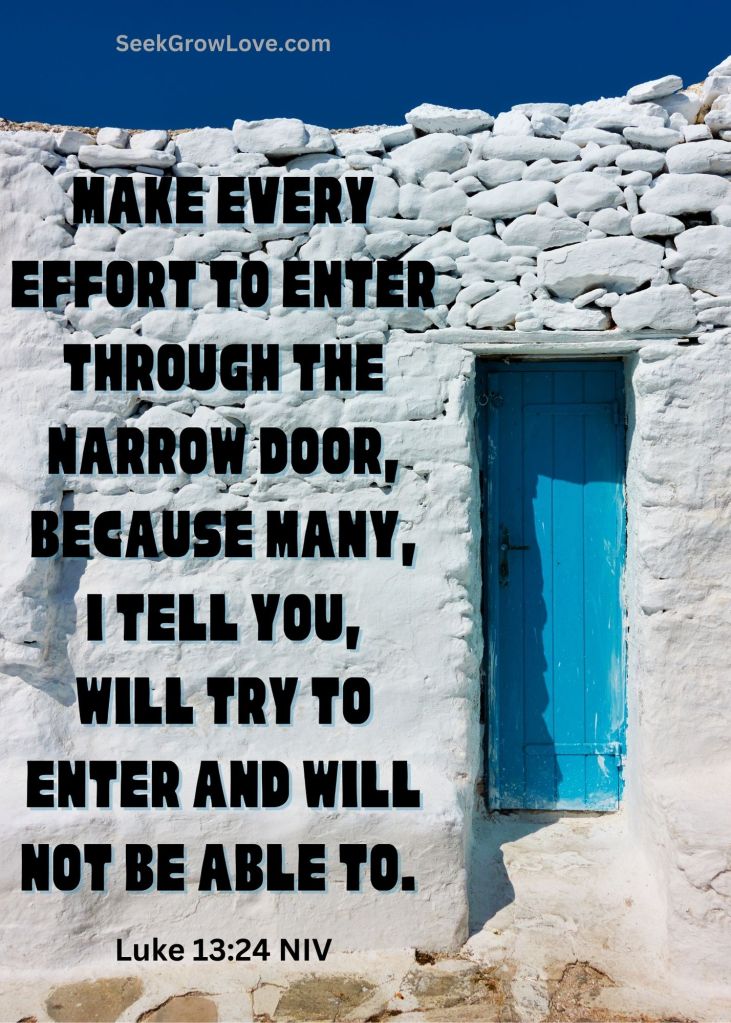
“Make every effort to enter through the narrow door, because many, I tell you, will try to enter and will not be able to.”
In thinking about one’s faith, how easy is it to get caught up in the motions of religion. “I go to church every week, I attend Sunday school, I make food for the potlucks, I give an occasional offering, I went to church camp as a child, etc…when the kingdom comes, surely I will be known and in relationship with the Lord.”
Luke 13:25-27
“Once the owner of the house gets up and closes the door, you will stand outside knocking and pleading, ‘Sir, open the door for us.’ But he will answer, ‘I don’t know you or where you come from.’ Then you will say, ‘We ate and drank with you, and you taught in our streets.’ But he will reply, ‘I don’t know you or where you come from. Away from me, all you evildoers!’”
Thinking about where your heart is and what kind of faith you have takes courage, honesty, and oftentimes real change within our daily habits.
Today is a perfect day to renew or strengthen your relationship with God and his son Jesus Christ. This looks different for all in many ways. When I picture a narrow door, I think of a door that not many choose to enter through. This “door” may not be the popular choice, the easy choice, or the fun choice. However, choosing to live a life that is pleasing to God is more rewarding than any earthly desire or temporary pleasure. I encourage you to take a moment today and consider one tangible way that you could get to know God on a deeper level this week. This may be through prayer, worship through song, spending time in nature, reading your Bible, serving others, etc.
May we be a people who stand outside the door and are fully known as our hearts align to God through his son Jesus Christ.
-Kayla Elwell
Reflection Questions
Choose at least one way you could get to know God on a deeper level this week? When will you do it? Where? How? Why?
How does “Make every effort to enter through the narrow door” work with Ephesians 2:8&9. Do you think Jesus would say that there are some people who rely too much on their works? Do you think Jesus would say there are some people who rely too much on God’s grace? How do you keep from being in either camp?
Without repeating themes from the previous days this week, like the punishment of Israel or the reconstruction of the remnants of Jacob, we’re going to focus on one verse in particular.
“It will come about at that time That I will search Jerusalem with lamps, And I will punish the men Who are stagnant in spirit, Who say in their hearts, ‘The Lord will not do good or evil!’ ” (Zephaniah 1:12)
These words of God issue a strong warning to a multitude of people, many of whom are within our churches. Similar to the warning issued by Jesus about not having a lukewarm faith, here God is warning us to increase our own. The follow up to that is when those who are stagnant in spirit then say “The Lord will not do good or evil”, It is stated that God will indeed punish them. This draws me to think of Romans eight, when Paul writes about either being in the flesh or the spirit.
It is my understanding that you are either living in the flesh or in the spirit. There isn’t really a way to balance it. The people saying that “The Lord will not do good or evil” are trying to balance and will receive punishment.
I am reminded of a saying I have heard from an elder in my church that goes like “Being a Christian requires more than being a ‘good ole boy.’ ” The older I get, the more I realize that is much too prevalent in our world. Too many think that just being a good person is all there is to living for God.
It is my encouragement to all readers today to structure a prayer along with the wishes of the apostles in Luke 17:5. “Increase our faith!” When we become on fire for God and don’t remain lukewarm we can truly experience what God has required of us. To fully dedicate our lives, as a living sacrifice.
-John Evans
Reflection Questions
How would you describe the stagnant in spirit or those with a lukewarm faith? What are their attitudes toward God? Where do you see this today?
Do you want your faith to grow? If so, definitely pray for it! Then what? How badly do you want your faith to grow? What are you willing to change in your life, your schedule, your speech, your heart, your priorities in order to see your faith grow?
I want to use this devotion today as a part confession, part devotion to share. At multiple times in my faith I have doubted God. The most common question I ask is “Why does so much bad happen in the world if we have a powerful God?”
And that’s the question Habakkuk asks when communicating with God. The minor prophets before him continuously condemned the corrupted Israelites, but all Habakkuk does is ask God that same question.
The main reason I share that about my life is so that even if one reader out there has asked that question, they know they’re not alone. The cool thing about it? It’s not a new or unusual question! Luckily the answer to the question, that eventually brought me peace, lies within this book.
To really focus on what Habakkuk three is all about we have to look at the set up of the previous two chapters. In the first chapter, he’s complaining to God about the corrupt Israelites. God then responds by saying that’s why he is raising Babylon. Habakkuk then flips to backtracking and telling God to slow down, Babylon is WAY worse than Israel. God teaches Habakkuk that all of the nations will have to answer eventually and that he’s not with Babylon, simply God’s not bringing them down just yet. These sins of Babylon aren’t exclusive to Babylon, there will always be a Babylon. Will God let this cycle continue?
So this back and forth is developed through the first two chapters to lead us to the third and final chapter. Habakkuk implores God to renew them in their days, not wanting to wait any longer. In verses three through fifteen Habakkuk then goes on in prayer, starting with God’s mighty appearance to the world, “radiance Like the sunlight”, a lot like the appearance of God to the Israelites way back in Exodus. He then produces in this prayer/poem that God will indeed crush evil.
“In indignation You marched through the earth; In anger You trampled the nations. You went forth for the salvation of Your people, For the salvation of Your anointed.
You struck the head of the house of the evil To lay him open from thigh to neck.” (Habakkuk 3:12-13)
This is Habakkuk eventually coming to realize the truth. God will come around to having evil vanquished from our world and our lives, and he will do it by our side.
In the last three verses of the chapter, Habakkuk choses faith. He chooses that whether in war or peace, or famine or harvest, he will choose triumph in the Lord. To rejoice in the God of his salvation.
Understanding what went on in the whole book of Habakkuk draws very clear parallels to the lives of any and all who, at one time or currently, have doubted God. Take extra time to pray today but structure it differently. Pray to have your faith increased, and to be strengthened in submitting yourself to the timing of our God.
-John Evans
As a new writer for SeekGrowLove, I was asked to include a short bio about myself, so here goes...Currently attending McGintytown Church of God of Abrahamic faith, and serving as a youth leader, deacon, and assisting with worship. At Twenty-One years of age I have a lot to learn, but was once told I don’t have to know everything to be a great teacher, I just have to know something you don’t. Thanks for reading, have a blessed day.
Application
Have you ever doubted God? What can you learn from Habakkuk?
If you were to write a personal version of Habakkuk 3:17-19 what are some “Even if..” statements you would include? Consider hardships God has already seen you through, hardships you are currently in, as well as what the future may hold. How would you describe God’s strength and benefits for you (verses 18 & 19). Share your new poem with God as you pray for your faith to be increased.
We are in a battle right now. However, that is not a unique characteristic of today. In the New Testament, Jude recognized it and wrote in Jude 3, “Dear friends, although I was very eager to write to you about the salvation we share, I felt compelled to write and urge you to contend for the faith that was once for all entrusted to God’s holy people.” He wanted to warn people so that they could be prepared.
It is no different today. We live in an age that touts religious freedom and tolerance, yet people are still dying for their faith and the faith of many continues to fall further and further from the truth. We still have a job to do.
Though we may be seeing a change in culture in our own country, we are still fairly blessed when it comes to the freedoms that we have in our faith. In looking at the whole world, there are many countries in which admitting to being a Christian is liable to get you killed. In that way, the fight for the faith is considerably different. They are literally fighting for their physical lives as they fight for the faith.
We have a different, less physical fight in the U.S. A decline in church attendance, a falling away from the faith, a bending of the faith to fit what culture says. Are we willing to stand up, to contend, for our faith?
Jude 3 tells us that the faith was entrusted to all of God’s holy people. I believe that by accepting Jesus into our lives, we become one of those holy people. That means we are entrusted with the faith. We should be fighting for what is true, to hold on to that faith, so that at Christ’s return, we, and as many others as possible can be found faithful.
~Stephanie Fletcher
Reflection Questions
After urging his readers to contend for the faith, what warnings does he give through the rest of his short book? What situations, sins, and characteristics of people is Jude warning against?
What does Jude want to see from God’s people?
Where do you see a battle for the faith taking place today? How do you think God wants you to participate?
One more song this week – 1 John 5:4-5 “for everyone born of God overcomes the world. This is the victory that has overcome the world, even our faith. 5 Who is it that overcomes the world? Only he who believes that Jesus is the Son of God.”
Those two verses are the song, but verse 4 picks up in the middle of a sentence & thought, so backing up a couple verses:
This is how we know that we love the children of God: by loving God and carrying out his commands. 3 In fact, this is love for God: to keep his commands. And his commands are not burdensome, 4 for everyone born of God overcomes the world. This is the victory that has overcome the world, even our faith. 5 Who is it that overcomes the world? Only the one who believes that Jesus is the Son of God.
When we have faith, we can overcome this world. Our faith that Jesus is the son of God gives us victory and makes God’s commands not burdensome thereby helping us to keep His commands. And by keeping His commands, we can love one another – the children of God.
Verse five is also a reminder that the victory is exclusionary. Who overcomes the world? Only those that believe that Jesus is the Son of God. We have to strike a balance in our love for others. Because if we love based on the world’s terms, we accept anything. But to do that would not be love. Because onlythose who believe that Jesus is God’s son overcome this world. So if we in our “love” just leave our friends alone because we don’t want to make them feel uncomfortable, or we don’t want to feel uncomfortable, we put them in a position of not having that victory. That isn’t real love.
We give a lot of reasons not to share the love of God with other people and I think fear forms the basis of a lot of it – fear of rejection, fear of being ostracized, fear of losing money/power, etc…
But when we read verses like this, we should be reminded that we have to push through that fear. To show our love in actions (chapter 3), we need to share with others that while we have been separated from God, God provided an atoning sacrifice for our sins (chapter 4), and with this sacrifice, if we believe, we can overcome and have the victory (chapter 5).
And what is that victory? As he wraps up his letter, John tells his audience – 13 I write these things to you who believe in the name of the Son of God so that you may know that you have eternal life.
We need to believe in Jesus as the Son of God to be a part of that eternal life, and if we are loving others, we should be telling them so they can have that victory too.
~Stephanie Fletcher
Reflection Questions
1.”Who is it that overcomes the world?” (1 John 5:5a – see 5b for the correct answer). Who thinks they are overcoming the world? What are they missing? Do you fall into the overcoming category?
2. Who do you know who does not believe that Jesus is the Son of God? How can you truly love them?
3. What is the victory that you have to share? How would you explain it? How will you share it?
“His divine power has granted to us all things that pertain to life and godliness, through the knowledge of him who called us to his own glory and excellence, by which he has granted to us his precious and very great promises, so that through them you may become partakers of the divine nature, having escaped from the corruption that is in the world because of sinful desire. For this very reason, make every effort to supplement your faith with virtue, and virtue with knowledge, and knowledge with self-control, and self-control with steadfastness, and steadfastness with godliness, and godliness with brotherly affection, and brotherly affection with love. For if these qualities are yours and are increasing, they keep you from being ineffective or unfruitful in the knowledge of our Lord Jesus Christ. For whoever lacks these qualities is so nearsighted that he is blind, having forgotten that he was cleansed from his former sins. Therefore, brothers, be all the more diligent to confirm your calling and election, for if you practice these qualities, you will never fall. For in this way there will be richly provided for you an entrance into the eternal kingdom of our Lord and Savior Jesus Christ.” (2 Peter 1:3–11 ESV)
We have great and precious promises that have been made that will enable us to become partakers of the divine nature! As Jesus put on a new nature in his resurrection from the dead, so shall we when through faith, we endure through life’s many challenges and inherit the promise of the coming Kingdom of God.
Hebrews 11:1 says that “…faith is the assurance of things hoped for, the conviction of things not seen.” As we have faith that God will restore all things (Acts 3:21), upon our faith we must add virtue: meaning good quality of life or uprightness – not simply believing but living out our lives as something that reflects the nature of God’s goodness, justness, and righteousness. After believing and living a changed life, we are to add knowledge to that; we should always be striving to learn from God’s inspired word and learn from his spirit as it is active in us… And more than that, seek after his spirit that we might become more in line with his will and come to a greater understanding of its importance and how beneficial it is to us to walk in his ways.
Following the call to add knowledge, we encounter again the call to be self-controlled! It really does seem that much of what we read in scripture hinges on self-control and that circles back to our need to not stifle the spirit in our lives. If one of the elements that the fruit of the spirit brings forth in our lives is self-control, then we ought to do whatever it takes to drive away any behaviors that might cause God’s spirit to depart from us (Judges 16, 1 Samuel 16). Self-control allows us to endure – to stay on the course – as Paul might say, “to run the race”. We have to endure through all of the challenges and temptations that life throws at us, and we must allow the motivation of our hope, our uprightness, and the self-control that we are enabled to have through God’s spirit carry us through.
As we endure, we ought to have a reverential feeling or devotion to God, that’s what the Greek work translated godliness indicates. As we experience God’s goodness and see how His spirit works in us, we should feel more and more awe and reverence to our creator… After all, He put the plan into place that leads us into a life that transcends the brokenness that sin imparts on our lives – even though we sin and are affected by sin, God’s directives lead us onto a path that (through Jesus) casts that sin aside and draws us into community with him.
And as all these things are ingrained into our life, the part that affects others the most is the cherry on top… We are to have brotherly affection (love) as a defining characteristic in our lives! Love and care for one another as believers will lead us to speak into one another’s lives and help us when we hit rough patches. Even the most spiritually minded people hit dark periods in their lives (google the dark night of the soul). If we love our brothers and sisters in Christ, we will take the time to come alongside them, to care for them, to call them out, to admonish and encourage – brotherly affection means being intimately involved in the lives of our faith family – not being apathetic or half-hearted. We need to invest in each other as Christ has invested in us through his sacrifice (sometimes we must be self-sacrificial).
These qualities keep us from being ineffective witnesses and fruitless workers. We must be bearing the fruit of the word implanted in us (James 1) and strive to be effective ministers to the lives of those who are hurting and struggling. Peter says that whoever lacks these qualities is so nearsighted that he is blind! Yikes… lacking these qualities as I read this means that we cannot see beyond ourselves, and that it a tremendous problem when one of our chief goals is to preach the gospel to all creation.
If we take these qualities to head and practice them diligently it says we confirm our election (or being chosen out) into beneficiaries of the grace of God. Also, it says if we practice these things we will never fall. So, practice these things so that you may have entrance into the eternal kingdom of our Lord and Savior Jesus Christ (v11).
-J.J. Fletcher
Reflection:
1. Think about how Jesus exemplified all these characteristics listed in verses 5-7. If he had not exemplified all these things, would he have had the wherewithal to endure through his father’s plan of salvation through him? How can we expect to live exemplary lives if we do not take these characteristics to heart.
2. Think about the first 6 items listed (faith, virtue, knowledge, self-control, steadfastness, and godliness) and the final one: brotherly affection/love. What do the first 6 produce without the 7th? We’re designed (as individuals and as a church body) to be in community, how might we be rendered fruitless and ineffective if we excel at the 6, but lack the 7th?
Gender is a hot topic these days. We live in a society where there is much flexibility in how someone chooses to live their life, irrespective of cultural norms or the directives of our creator (let’s stick to what Peter writes about in his letter). Misogyny and radical feminism are two ways in which humans have messed up what was designed to be a tremendous blessing from God.
There is a lot to unpack here as Peter begins by addressing wives. In reading the text and then looking at commentaries it appears that foremost in Peter’s mind is a woman who has come to a saving faith in Jesus but is married to a man who does not share that faith (though we can gain something from this even if we’re not in that demographic).
The way that societies functioned, specifically the society that Peter would be writing to, did not offer much in the way of opportunity for a woman to exert influence over her husband. Her options may be quite limited in what her husband allowed her to do or permitted her to go. Where a husband and father who came to faith would be expected (even simply allowed) to bring his family along with him to religious functions, the same could not be said for the wife.
So how is a woman to minister to her unbelieving husband? How does she influence him intentionally in a way to bring him into the body of Christ? Nagging is probably not the most effective way to do this, in fact it might have the opposite effect; rather, the solution that Peter proposes is to allow the gospel of Jesus (i.e., the gospel of the Kingdom) to radically influence your way of living. Being salt and light (Matthew 5:13-14) is not just something that you are to be for people whom you may be unfamiliar with, even more importantly it is something you are to be with those who you are most intimate with. Living a life that bears the fruit of the spirit (Galatians 5:22) and exemplifies Jesus’ beatitudes (Matthew 5:3-11; Luke 6:20-26) will make you a more desirable (and influential) person.
Obviously, there is no way to guarantee that an unbelieving spouse will come to faith, but by being holistically attractive (not just externally, but internally as well) you will have a far better chance to influence them than if you were to try to get by on physical attraction (I don’t even know how that would really work) but be ugly on the inside.
Peter addresses the ladies in verses 1-6, but he shifts gears in verse 7 and speaks to husbands. He says to “live with your wives in an understanding way” (ESV), literally living with her “according to knowledge” as opposed to living with her in “sheer thoughtlessness” as the Expositor’s Bible Commentary puts it. I can speak from experience, it is very easy to do what I want and expect my wife to pick up the slack, but that is not the way that Peter instructs husbands to operate. Instead of living in a way that could breed resentment and other problems (infidelity?), husbands are commanded to live in a thoughtful way.
Husbands are instructed to honor their wives as “the weaker vessel.” Huh? What does that mean? There are different ways to look at this… Societally women were weaker (we’ve already considered the lack of influence), typically women are weaker in physical strength (I can think of a few ladies that could probably wipe the floor with their husbands in a fight), and sometimes women are more emotionally fragile (have a wider range of feelings?) than men. The word for weaker (ἀσθενεστέρῳ) can be translated with lots of nuance, but one big take away from this is that women are not inferior to men. Whatever Peter is getting at with the idea of the wife being a weaker vessel, something is very clear: we are co-heirs of all the benefits that come with accepting Jesus and believing in the kingdom message. As objects of God’s salvation there is no distinction between male and female, just as there is no distinction between Jew or Greek. While husbands and wives may be called to different roles in their relationship and even in their roles in the church, this is not because of a lack of capability, this is the function that God has laid out. Husbands and wives are to minister to one another and to minister to others. We can use our marriages as an example and an opportunity in ministry. Authentic Christianity has done more to liberate women from misogyny and oppression than any other organization ever has; that being said, it has not changed the fact that men and women are different. We have equality in standing before God, we have equality in salvation, we ought to have equality in rights, but we are still different and that is a blessing. As the church is a body with many parts, the one flesh that we become in marriage takes into account our uniqueness as individuals and the differences in our physiology. We are to be reliant on one another (do not read as co-dependency), and we are responsible to one another to meet the needs that we have as image bearers of God and the uniqueness that we have as men and women.
-J.J. Fletcher
Action/Reflection:
To those of us who are married: We should evaluate where we are at in living as Peter instructs. Hopefully you are married to a fellow believer who you can discuss this passage with and commit to one another to implement these tactics in your union. If married to a non-believer, behave in a way that is intentional in living the gospel out to them.
To those of you who are engaged or hope to be married one day: Look for a spouse who takes scripture seriously and is willing to change their behavior to conform to what scripture dictates, both in their life as an individual and the way that they approach relationships.
For those of you who are called to a life of singleness (or just end up that way) or those of you who know someone who fits that description: I believe that the behaviors that the relational and internal things that Peter speaks of here will be beneficial in building authentic relationships that help navigate the potential challenges that a life of singleness may bring.