
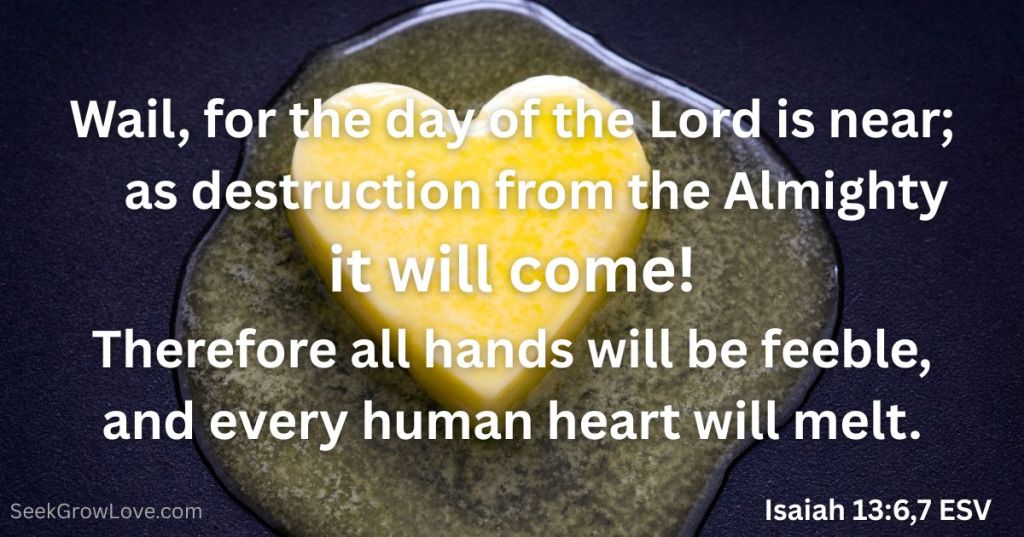
Melted Hearts

Isaiah 13-14

Psalm 111

Revelation 7

-Devotion by Daniel Smead (MN)

Grim language and violence dominate Isaiah 13 and 14. The prophecies it contains mix references to “the day of the Lord” and comments about the conquest of Babylon by the Medes – two tough times. We can see these prophecies as partly about letting suffering people know God is paying attention, and that their situation will change.

The day of the Lord has been described as about judgment for the wicked, and rescue for the oppressed. It is discussed in several Old Testament texts. One way we may easily think of this event is that it comes like a thief in the night (2 Peter 3:10). We link it with Christ’s return at the end of this age.

Babylon’s defeat is a classic example of ‘the mighty fallen,’ which involves Babylon being treated terribly by its conquerors – much like Babylon treated the peoples it conquered. I need to remind myself that Isaiah’s message for Babylon isn’t

“now this, and this, and this will happen to your people”

But

“now this, and this, and this will happen to your people.”

Or, perhaps more clearly:

“now these things you have done to others will happen to your people.”

As part of this process Babylon also loses the power to keep harming others. However, perceiving this doesn’t remove all the discomfort I get when reading these chapters.

It also is helpful to recall that God saying a thing will happen doesn’t mean God approves of the event / how it happens. In 2 Kings 8:7-15, Elisha informed Hazael that he would become king of Aram, and almost immediately Hazael betrayed and murdered the king. (Which raises the question: did Elisha’s message prompt the murder?) Aram went on to behave in ways similar to those carried out by the Babylonians and Medes. Elisha wept over what was coming; he explained his tears by saying “I know the evil that you will do to the sons of Israel” (v. 12). For God’s prophet to describe a thing doesn’t demonstrate approval.

“Wail, for the day of the Lord is near!
It will come as destruction from the Almighty.
Therefore all hands will fall limp,
And every human heart will melt. . . .

I will also put an end to the audacity of the proud
And humiliate the arrogance of the tyrants.

I will make mortal man scarcer than pure gold.”

(Isaiah 13:6-7, 11-12a)

The emphasis with the “day” is on the wicked, tyrants, the proud, etc. But multiple texts also say that hardly anyone survives the “day.” (Perhaps the more people are in the world when it starts, the more survivors there can be from it and still give this impression.)

The presence of such tough issues in the chapter, both related to the “day” and to the fall of Babylon, may connect to the oracles acting as warnings. These words were not simply for the benefit of the suffering; they gave sinful people at risk an opportunity to understand their risk and repent. It would be nice to think that some saw the warnings and did repent. In a similar way Deuteronomy 28 warns the Hebrew people of the dangers in abandoning their commitment to God. And among that set of warnings we can see many of the practices Babylon later engaged in against those it conquered – had Deuteronomy been heeded the conflict with Babylon could have been avoided in the first place.

PRAYER

Lord, help us to be cleansed from all that would hold us back from you, so that we can be ready in whatever circumstances arrive, including for your day. Not knowing when that day will be, please aid us in maintaining ourselves, examining the state of our hearts, being honest with ourselves in what we find, and having compassionate openness with another. Amen   

REFLECTION QUESTIONS
  1. Paul tells us that God wants to provide a way out when we are tempted (1 Corinthians 10:13). Do you think that statement is directed only to Christians?
  2. God is compassionate, slow to anger, and loving in many other ways, but will not leave the guilty unpunished (Exodus 34:6-7). Have you ever thought God was punishing you for unrepented sin? If so, do you still think that was the case?
  3. In a situation of ongoing sin, how would we distinguish God punishing from God allowing us to experience the results of the wrong behavior? Or how would we distinguish it from the Spirit trying to prompt us to confess and be freed from what is harming us? (Recall, God always wants the best for us – and sin is always harmful.)  

She Falls

Old Testament: Ezekiel 29 & 30

Poetry: Psalm 103

New Testament: Revelation 18

     Revelation 18 pictures the shock of those who supported and gained from the success of Babylon the great, and then see it destroyed. As others have said, true wealth is found only in Christ, so those who tried to gain from corrupting themselves with Babylon did so at the cost of their lives (Matthew 16:26). When the voice from heaven warns to come out of Babylon it isn’t just about leaving before the city falls if you happen to be there, but to avoid contamination with its practices lest we fall as well (compare 2 Corinthians 6:17).

     It is again difficult to decide whether some details in the chapter were meant literally. Does Babylon engage in sorcery, or does that express its evil influence on those caught up with it? Which of the trade goods listed are we to think Babylon truly receives – the list wasn’t going to include modern luxury items, but is it just trying to give the feel of wealth based on first century items? Is it in the slave trade, or does it wreck people’s characters? Some will ask if Babylon is a port city at all, or a system with a global reach. Is Babylon destroyed and burned in a single hour, or does it just suffer a rapid fall? (In Revelation 17:12 we were told that the ten kings shared their power with the Beast for one hour, so we may have a reason to see this time reference as metaphorical. Contrast for example the effort taken in the text to show that three and a half years / 42 months / 1260 days is a precise figure.) That last point would be simple to explain in our modern society, however, as a collapse after a single hour which leaves fire behind could refer to a nuclear attack.

     You might hear part of this chapter and think you were in the Old Testament (for example you could compare Ezekiel 27). There is that feel to it. You could imagine Jonah saying these things about Nineveh. It’s all from the same God. Sometimes God gets to show mercy, but when judgment is called for God does not hold back. In fact, after recounting the despair of the kings and merchants and sailors who sinned with Babylon, the chapter calls on God’s servants to rejoice in what has come about. In Revelation 18:21 a strong angel announces Babylon’s permanent fall and punctuates the point by throwing “a stone like a great millstone” into the sea. Jeremiah never went to Babylon, but he sent a scroll there with Seraiah describing the fate of the city and told him to read it aloud, and then tie a stone to it and throw it into the middle of the Euphrates (Jeremiah 51:63). The judgment of God was being left to sink to the bottom, like the city would sink. As I said, we are reading words in a familiar style.

     I’ve long been struck by cases where God set up instructions that don’t seem to have end conditions. How long was the Garden of Eden guarded by an angel with a flaming sword (Genesis 3:24)? Perhaps it was until the flood of Noah’s day destroyed it, or it could have all withered away first. And while the millennium brings grace across the world, will the former site of Babylon the great sit as a blighted patch reminding people of old evils? That may be its fate. As the angel said, no more will the sounds of music, work or happiness be found in her. But then “in her was found the blood of prophets and of saints and of all who have been slain on the earth.” It seems like Babylon the great is worthy of the treatment it receives. We would do well to learn its lesson in advance and turn our backs on all its ways and put our hearts fully toward that other city (the one with foundations; Hebrews 11:10).

     Lord, thank you for sanctifying us by the Spirit and faith in the truth. Thank you for teaching us to take pleasure in righteousness. Thank you for disciplining us for our good, so that we may share in your holiness. Thank you for giving us sound words through your servants. Please help us to listen, and to reflect on what you have said. Help us to grow in your will. And in everything we do, in word or deed, may we do all in the name of the Lord Jesus. Through him we give thanks to you, dear God. Amen.

-Daniel Smead

Reflection Questions

1.  When you envision God, do you see God as preferring to show mercy or to give judgment?

2.  What do you find yourself most valuing about your life as a Christian?

3.  What do you most look forward to in your future as a Christian?

4.  What do you most appreciate being able to share with others as a Christian?