Holiness and Thanksgiving

Theme Week – Thanks: Romans 1

Old Testament: Ezekiel 41 & 42

Poetry: Psalm 109

Yesterday, we learned that giving thanks to God is a part of our duty as those saved by grace through faith in Jesus. Today in Romans we see what happens to our souls when we don’t give thanks to God. 

In the magnum opus that is Romans, Paul lays out the case that Jews and gentiles both are redeemed by grace through faith in Jesus, that we are all members of Israel made new and we all can be grafted into the people of God. But to get to that point, Paul has let us know there is some bad news ; people are unrighteous. To be clear, God is angry at sin and those things that oppose his good will upon the Earth. God’s desire for humanity has been “made clear” by his creative action and people are without excuse to worship him. (Rom. 1:18-20)

Then we get to the point : “For although they knew God, they did not honor him as God or give thanks to him, but they became futile in their thinking, and their foolish hearts were darkened.” (Rom. 1:21)

Read that again : Paul seems to be connecting what they did not do and what happened to them. When people who could know God do not honor him or give thanks to him, they THEREFORE become futile in thinking and have darkened hearts. Which could also mean that if we want to not become futile in our thinking, if we do not want our hearts to remain in the dark, we need to honor God as God and give thanks to him. 

Now, let’s be clear about Paul’s point : we are not going to give thanks to God enough to be saved. Romans presents a powerful case that we can’t save ourselves! “We have all sinned and fallen short of the glory of God” (Rom. 3:23) and “the wages of sin is death.” (Rom. 6:23) However, we also remember what God gave: “the free gift of God is eternal life through Jesus Christ our Lord.” (Rom. 6:23) 

Rather than simply “being thankful”, today give thanks to God for Jesus Christ our Lord, through and in whom we have salvation : “Thanks be to God through Jesus Christ our Lord… There is therefore now no condemnation for those who are in Christ Jesus.” (Rom. 7:25-8:1)

Application and Reflection

Paul gives us a number of different ideas of what to be thankful for today : 

  1. Paul gives thanks to God for the church in Rome. (Rom. 1:8) When was the last time you gave thanks to God for your local church? Your local youth group or youth pastor or pastor? Take a moment to give thanks to God for that today.
  2. Paul gives thanks to God for the salvation of others! (Rom. 6:17) Look around at your mom, dad, brothers, sisters, and other family. Think about those people around you who know the salvation of God found in Jesus. Thank God for those who know Jesus around you. If you have some people who need to know more about Jesus and God, how can you share the gospel message of salvation by grace through faith with them?
  3. Paul says that we should give thanks for our food (Rom. 14:6) Will you take the time before every bite of food today to remember that God has given you this food? Will you make sure that God is honored by your thanks today?

-Jake Ballard

If You Knew, You Would Ask

John 4

April 1

Humanity has been battling social status and hierarchy since sin first ever entered the world. Humanity tends to do everything it can to climb to the top to be seen as great and to push others down. Unfortunately, this resulted in billions of people being put in a place of oppression, neglect, poverty, abuse, and all other kinds of horrors. This was also the case for the woman we read about in John 4. She was a woman, which unfortunately meant that she was a second class person in biblical times. On top of that, she was a Samaritan, which was a people who the Jews hated. As if that wasn’t enough, she wasn’t even allowed to associate with the other women due to her poor reputation. She was just about the lowest one could be in their culture.

Despite this, Jesus has a conversation with her at a well. Here is Jesus, who is culturally considered to be at the highest end of social status: male, Jew, teacher of God’s law, prophet, and even a miracle worker. Culturally, people would wonder why on earth would Jesus be around a Samaritan woman, let alone talk with her? As if that wasn’t strange enough, he even asks for a drink of water from her! He wanted to be around her, talk with her, and even ask a favor from her. This was unheard of in their day. She certainly felt this way when she asked, “How is it that you, a Jew, ask for a drink from me, a woman of Samaria?”

Jesus’ response was profound, powerful, and broke every single cultural understanding she ever had, “If you knew the gift of God, and who it is that is saying to you, ‘Give me a drink’, you would have asked him, and he would have given you living water.” Jesus was willing to “ruin his reputation” by talking with her, and he was even suggesting that he would give her the most precious gift of all. Jesus had no care and regard for social status, he knew it was a byproduct of a prideful, arrogant, and sinful world. He was much more interested in saving people to become God’s children.

I love the conditional phrase Jesus gives in his response, “If you knew.” If she truly understood she was talking to her Lord and Savior, she would have known it was completely okay and expected of her to humbly receive the undeserved gift of grace.

I think we would all do well to remember this story’s valuable lesson. Jesus’ love is not determined by your level of “goodness” you have achieved in the church. Jesus’ grace is not dependent on your social status in God’s kingdom. Jesus’ value for you will never change. Therefore, we ought to accept that we can’t climb up the social ladder to earn Jesus’ good graces. Instead, we need to humbly ask him for a drink of the “living water.”

-Isaac Cain


Questions for Reflection and Discussion

  1. Do you know the gift of God? If so, how would you describe it to others – and specifically to whom will you share it? If not, who can you ask about it?
  2. How does Jesus’ example challenge us to break social, ethnic and religious norms, prejudices and barriers? How can you follow his example?
  3. Re-read the passage looking specifically at the Samaritan woman: what she does (and doesn’t do), the questions she asks and her replies. What do you think she is feeling as the story progresses? How is she an example for us?
  4. What does Jesus reveal to her? How does this information change her? Has this information changed you? Should it?
  5. What did Jesus mean when he told the disciples, “My food is to do the will of him who sent me and to finish his work.” (vs. 34)? How important is doing the will of God to you?

Kingdom Ticket – Paid

Will You Accept the Gift?

Hebrews 5_8,9

Hebrews Chapter Five

Hebrews chapter seven is known for being the chapter about Jesus being our high priest.  However, that theme is found in previous chapters, including chapter five.  Jesus being our high priest is one of the main themes of Hebrews.  God appointed Jesus to be our high priest.  Verse one shows us that the purpose of a high priest is “to act on behalf of men in relation to God, to offer gifts and sacrifices for sin.”  Jesus being our high priest acts on our behalf in relation to God.  He is our mediator between us and God.  Jesus being our high priest also offers a sacrifice for our sins.  A normal high priest like Aaron needs to offer sacrifices for his own sins and the sins of others.  However, Jesus had no need to offer a sacrifice for himself because he was sinless.  Rather, he offered himself up to be our permanent sacrifice for sins.  That is a sign of a high priest who loves us dearly.

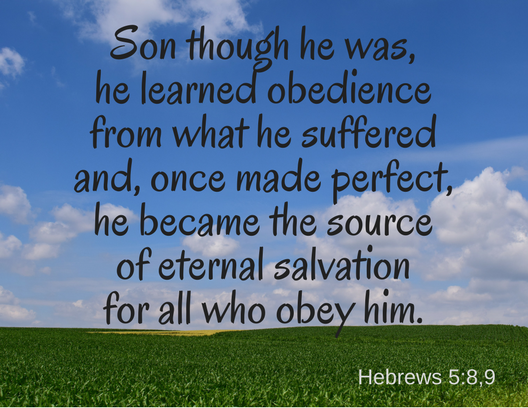
One would think that since Jesus was perfect that he would not suffer.  However, Jesus “learned obedience through what he suffered,” (Heb 5:8).  Jesus truly did suffer when he was here on this earth.  Two examples that come to my mind are when Jesus wept when his friend Lazarus died and when Jesus sweat tears of blood in the Garden of Gethsemane before he was crucified.  It’s through experiences like this that Jesus learned obedience.  It’s through experiences like this that we too can learn obedience.  It’s often through the most difficult times in life that people draw closer to God.  Job is a great example of this, as he lost nearly everything he had in one day.  However, he responded by worshipping and praising God.  He was brought closer to God and learned obedience through his suffering.

In verse nine, we see that “being made perfect, he became the source of eternal salvation to all who obey him.”  Jesus truly was made perfect, and he was sinless.  He was the last person in the world who should have had to suffer on the cross.  However, because of his and our Heavenly Father’s great love, he did die and suffer on the cross.  Through his suffering on the cross, he became the source of eternal salvation!  Jesus paid our way to go to the Kingdom!  All we have to do is accept the free gift of God of eternal life through Christ Jesus our Lord.  Unfortunately, not everyone is going to accept that free gift.  Verse nine states that Jesus is “the source of eternal salvation to all WHO OBEY HIM.”  To accept the free gift of eternal life, we must obey Jesus.  We accept the gift through obedience and faith.  Similar to what we talked about yesterday, don’t belittle the consequences and meaning of sin because eternal salvation is granted to those who obey Jesus, not those who disobey.

Similar to the chapter break between chapters three and four, the chapter break between chapters five and six is an awkward break.  At the conclusion of chapter five, the author of Hebrews is talking about the difference between elementary and mature doctrines, and he continues the talk in chapter six.  The author compares the elementary and mature doctrines to milk and solid food.  A baby needs milk, and adults eat meat.  New Christians focus on the elementary doctrines, whereas the mature Christians should focus on the more mature doctrines.  Since it’s a weird chapter break, I also want to sneak peek to verse one as well.  Hebrews 6:1 states, “Therefore let us leave the elementary doctrine of Christ and go on to maturity.”  Throughout the first six chapters of Hebrews we have seen some good proof to suggest that the Trinity may be false.  This is good proof as well.  Many people who claim they believe in the Trinity cannot even explain the Trinity themselves because it is so confusing and complex.  They have to use extra biblical illustrations to describe the Trinity.  The Trinity is anything but an elementary doctrine.  It is one of, if not the most, complicated doctrines out there.  However, the author of Hebrews states that the doctrine of Christ is supposed to be elementary.  Jesus being the Son of God does sound like an elementary doctrine to me, not the Trinity.  This is just some food for thought (pun intended).

I hope you have a great day!

In Christian love,

Kyle McClain