Celebrate and Remember

Deuteronomy 16

February 21

Chapter 16 begins with the reminder to celebrate the Passover. It was a time that was set aside to remember how their God saved them from Egyptian slavery. More specifically from the angel of death that passed over those Jewish people who placed the blood of a lamb on their door posts.

We also see the reminder of the Festival of Weeks (celebrating the harvest/first fruits) and the Festival of Tabernacles (remembering the years of wandering). Each were given specifications as to how and when to celebrate. 

Each of these celebrations was to be a reminder of where they came from and to celebrate God’s provision. God provided a way out, he provided the harvest and he provided for the Jewish people in their 40 year wilderness wandering. 

Knowing that God will provide in all life circumstances should give us joy and help encourage us in difficult times. God has been there before and he will be there again. He provides, always!

We all should set up reminders to celebrate the way God has worked in our lives. The reminders can help us remain thankful and never take for granted what God has done, is doing or what he will do in the future. 

-John Wincapaw

Questions for Reflection and Discussion

  1. Make a list of how God has provided for you. How will you express your thankfulness to the Lord? What reminders do you already have in place, and what reminders can you add to your home, your routine, and your calendar to ensure that you remember and thank God for the way He has provided?
  2. What is the danger in not being intentional in remembering what God has done and provided?
  3. What is your favorite holiday? Why? How do you celebrate it? What might God want you to remember as you celebrate? How could you do that better?
  4. Each of the three festivals decreed in Deuteronomy 16 included bringing a sacrifice, gift or offering to the Lord. “No one should appear before the Lord empty-handed: Each of you must bring a gift in proportion to the way the Lord your God has blessed you.” (verses 16b & 17) What can you give to the Lord so you do not come before Him empty-handed?

The LORD Will Provide

Genesis 22

February 3

There are many different times that different people in the Bible confess their true faith. At the beginning of Genesis 22, God tells Abraham to sacrifice his only son. We see Abrahams’s true faith when he doesn’t protest or complain. He just does what God told him to do. I for one am very jealous of his faith. 

As Abraham was stretching out his arm to slay his son, an angel of the Lord called to him from heaven telling him to stop. Then, they heard a rustle from behind them and it was a ram. This shows us that God is with us and He will always provide a way. We just have to have faith like Abraham. I hope that we can all grow our faith in the near future and fully trust in Him.

-Nik Ransom (youth who attended reFUEL: North last month, and son of one of our writers two weeks ago)

Questions for Reflection and Discussion

  1. Take a moment and think about what you love most in life. Would you be willing to give whatever it is if God told you to? Would you give it up with or without hesitation?
  2. Abraham is known as a man of great faith. Why? What does James have to say about Abraham in the New Testament? (James 2:14-26) Is it possible to have great faith without action/deeds/obedience? How can we practice growing our faith?
  3. Re-read the account of Abraham willing to sacrifice his son Isaac while knowing what you know of God’s sacrifice of His son Jesus. What similarities do you find? What differences? What does this say of God’s sacrifice and love for you?

Tomorrow we will be reading Genesis 27.

Self-improvement Help Needed

But Not From Yourself

Romans 7

I think everyone can empathize with Paul when he states, “I do not understand what I do. For what I want to do I do not do, but what I hate I do.” (Romans 7:15)

Even in every day routines there may be areas we want to improve or change. Just look at the huge amount of self-improvement and renewal books that are printed each year. Maybe we want to: lose weight, get fit, stop bad habits, eat healthier, get out of debt and save money, spend more time with family, be less stressed or read through the Bible. Ok, hopefully this one is happening.

So wanting to overcome sin and do good is a great goal, but maybe you feel as Paul did, “For I have the desire to do what is good, but I cannot carry it out.” On our own, we cannot overcome sin, but as Christians we are not on our own. Thank the LORD, He is with us and He has provided what we need to overcome sin. In verse 25 we see that Paul is relying on God’s provision in Christ. “Thanks be to God, who delivers me through Jesus Christ our Lord!”

We are no longer condemned because we are in Christ Jesus, but sin is condemned. Through Christ Jesus the law of the Spirit who gives life has set you free from the law of sin and death. We no longer live by our sinful nature, but according to the Spirit. And as we will discover in Romans chapter 8, we are more than conquerors through him who loved us and nothing in all creation, is able to separate us from the love of God that is in Christ Jesus our Lord. We truly need to realize the love that God has for us and rely on His Spirit working in us. 

-Rebecca Dauksas

Today’s Bible reading passage can be read or listened to at BibleGateway here – 2 Chronicles 15-16 and Romans 7

God Sends Answers

1 Chronicles 25-26

Reading through Chronicles it is easy to skim past large sections that seem to drone on for hours. But the fact that the whole book of Chronicles was true history of the Israelites, that was written down for us to read thousands of years later is truly fascinating. The book of Chronicles which starts off with the genealogy from Adam, shows how much the Israelites appreciated and treasured their heritage and lineage. They viewed their history as all the ways God provided for them over the years. 

Chapters 23-26 are devoted to the organization of the temple. It tells in detail the families who served in the temple and how God chose the people to be servants of the temple by being musicians, gatekeepers, treasurers, and temple officials. These positions were cast by lot. The high priest who wore the special ephod was able to cast lots using the urim and thummim. This was one way God communicated with his people. It allowed God to give the Israelites a direct yes (urim) or no (thummim) answer. 

There are many times in the Bible where it tells us that something was determined by lot. For example, Saul was appointed King of Israel by lot, and the lot was cast on Jonathan when he ate the honey he wasn’t supposed to eat according to Saul’s orders (1 Samuel 14:42), and Matthias was chosen as the apostle to replace Judas by lot (Acts 1:26), and to make decisions on how to divide the land to each of the 12 tribes (Joshua 18:6). The Bible records many other times when the people used lots to seek God’s counsel. 

So what can we take away from all of this? God loves his people, He wants to show us His plans for our lives. Part of God’s character is that he is immutable- never changing through the ages. In most cultures today, casting lots is often overlooked as a means of receiving communication and answers from God, but we must not overlook His word given to us – including Chronicles- which show God’s continuity and love to His people. God knows that we are a forgetful people who don’t remember all the many things God has done over the years. Through Chronicles we see a God who kept his promises to the Israelites and who organized the temple and determined its leaders by lot. This same God is involved in our lives as well. It’s filled with the history of God providing for and keeping true with his promises to his people. It was used to remind the Israelites of these things and it can remind us as well how God was working through their lives and how He is and was and will work in ours. And knowing this helps us Stand Firm for Him.

-Makayla Railton

Today’s Bible reading passages can be read or listened to at BibleGateway here – 1 Corinthians 25-26 and Proverbs 29

When You’re Ready to Give Up

1 Kings 19-20

Have you ever been hiking on a strenuous trail or baled hay on a hot summer day? These tasks can prove quite difficult as your muscles become strained, you become overheated, and your endurance slowly dwindles. The idea of stopping and taking a nap or just quitting all together sounds very tempting. It seems like the best thing to do, but you have to keep going.

I remember one day when I was unloading a wagon full of hay bales on a hot and humid summer day. There were about 60 hay bales to unload and stack in the barn. About halfway through, I started to get tired. I was hot from the bright sun. I was itchy because of the hay that covered me, and I had rope burns from the twine on the bales. I was ready to be done, but I couldn’t stop. Rain was coming in that evening and I had to get the hay under cover before that happened. So, I kept going until my task was finished.

In 1 Kings 19, we find Elijah at a point where he is ready to give up. He is on the run again. Jezebel wants him dead, so he flees from her grasp. But he is tired of running and having to look over his shoulder. He felt like he could not continue in this way any longer. Those before him had been put to rest and he says he is no better than them. Therefore, he asks God to let him die.

Rather than letting him die, though, God sent him sustenance through an angel. Bread and water were offered to Elijah that he might have the strength to continue. So, he went to sleep again and then the angel appeared once more providing more food. This food gave him the strength he needed. For without it, he could not have made the journey. It was not yet Elijah’s time. There was work that he still needed to do, and God gave him the strength to do so.

Sometimes it can be hard to carry on with our tasks, but God is there to strengthen us. Like a cool glass of water at the end of a hike or when baling hay, God is there to sustain us. God was there to strengthen Elijah and we too can be strengthened through God.

-Hannah Deane

Today’s Bible reading passages can be read or listened to at BibleGateway here – 1 Kings 19-20 and Proverbs 3

Passing the First Tests

So after the amazing events of Exodus 14 and the crossing of the Red Sea on dry ground and the waters swallowing up the armies of Pharaoh the Israelites spend some time praising God  and we have the text of their praises in the beginning of Chapter 15, and then they set out on the road.

Exodus 15

22 Then Moses led the people of Israel away from the Red Sea, and they moved out into the desert of Shur. They traveled in this desert for three days without finding any water. 23 When they came to the oasis of Marah, the water was too bitter to drink. So they called the place Marah (which means “bitter”).

24 Then the people complained and turned against Moses. “What are we going to drink?” they demanded. 25 So Moses cried out to the Lord for help, and the Lord showed him a piece of wood. Moses threw it into the water, and this made the water good to drink.”

It was there at Marah that the Lord set before them the following decree as a standard to test their faithfulness to him. 26 He said, “If you will listen carefully to the voice of the Lord your God and do what is right in his sight, obeying his commands and keeping all his decrees, then I will not make you suffer any of the diseases I sent on the Egyptians; for I am the Lord who heals you.”

27 After leaving Marah, the Israelites traveled on to the oasis of Elim, where they found twelve springs and seventy palm trees. They camped there beside the water.

Right after God showed them that he is capable of providing everything for them he gives them a test and they instantly fail the test.  God is showing them that they have bitter hearts and no faith, but they will have to have faith in God in order to survive.  After this they continue on.

Exodus 16

“1 The whole Israelite community set out from Elim and came to the Desert of Sin, which is between Elim and Sinai, on the fifteenth day of the second month after they had come out of Egypt. 

2 In the desert the whole community grumbled against Moses and Aaron. 

3 The Israelites said to them, “If only we had died by the Lord’s hand in Egypt! There we sat around pots of meat and ate all the food we wanted, but you have brought us out into this desert to starve this entire assembly to death.”

They do not look forward to the glory to come.  They have been promised a land of their own and that they will become a great nation, but all they can see is the pain of the moment.  They also do not see the past and the many ways that God has come through for them.  Again all they can see is their momentary pain.  We know from Hebrews 12:2 that Jesus endured the cross for the joy set before him, and that is what we need to do as well.  

One thing I notice is that a lot of the locations they went to got their names changed after something big happened there, I wonder how this desert got the name “the desert of sin”.

4 Then the Lord said to Moses, “I will rain down bread from heaven for you. The people are to go out each day and gather enough for that day. In this way I will test them and see whether they will follow my instructions. 

5 On the sixth day they are to prepare what they bring in, and that is to be twice as much as they gather on the other days.”

God’s responses are not just a handout, they are a test.  God does not provide for us just to fill a little need, it is to help us to grow, and to see our response.  After an encounter with God we are not supposed to go back to how things were, but continue growing. 

You have to wonder, if they would just handle one of these situations well, would the rest of the trip have gone easily? They are very impatient, kind of like how Moses was when he was younger, and killed the Egyptian and tried to get things started.  The Israelites just want to be there, but the journey and the growing is very important.  God wants his people to inhabit the lands of Canaan, not just some group of people that doesn’t know him.


Chris Mattison

Links to today’s Bible readingExodus 15-16 and Mark 5

He Watches Over Me

Psalm 121, 123-125, 128-130

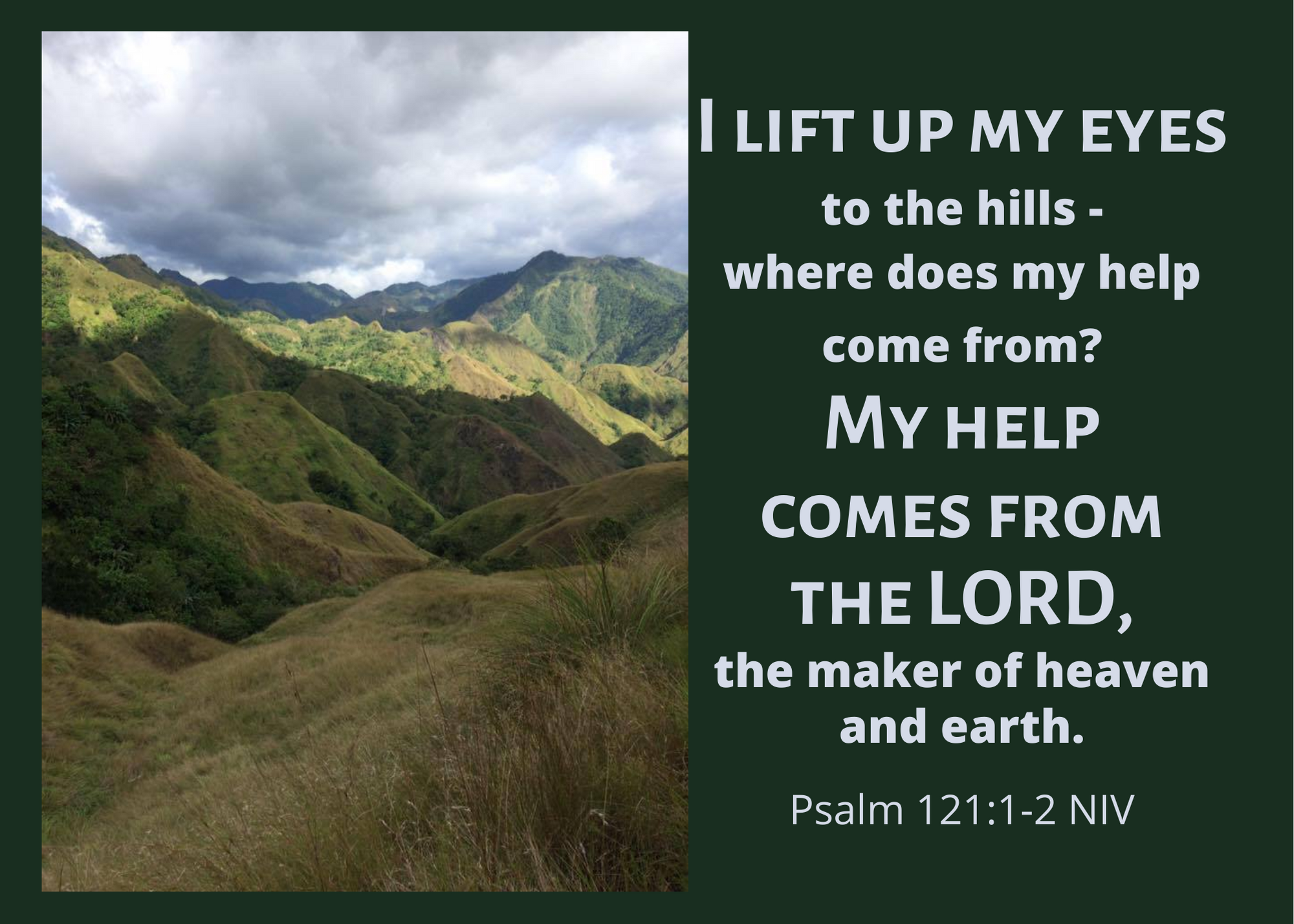
Psalm 121 1 2 NIV

Today’s Bible reading is 7 Psalms, each titled  “A song of Ascents”.  They were written to be traveling songs.  I know there isn’t much traveling going on right now, but remember when we would travel to visit family and friends and exciting destinations?   Remember the great fun of planning a trip and hitting the open road – though sometimes there were unplanned surprises around the bend.

Several years ago, right after church the three kids and I were taking the 2 hour jaunt from our hometown in northern Indiana up to my native Grand Rapids, Michigan to enjoy a Sunday dinner with my extended family.  Half-way there, my tire blew and we were stranded on the side of a busy highway.  I did what I could in my dress in the rain, but it quickly became obvious I was going to need some help (and this was back when all my kids were shorter and weaker than I was).  How fortunate for us that an off-duty police officer who was taking his son to the circus saw us in our distress, covered us with his protection, gave of his time and changed our tire for us.  With great relief we thanked him, watched them leave and continued on our way – for a matter of yards.  It didn’t take much for our old spare tire to shred to bits and there we were on the side of the road again, with no spare and our Good Samaritan just out of sight and getting further and further from us.  But with one phone call, my brother left the family dinner table, drove an hour, brought my parent’s spare tire that fit my van, changed the tire and followed us all the way to our destination.

There was no doubt I knew I was very protected and watched over and blessed on that journey, even though it was far from the journey I had planned or expected.  The journey was not without trouble or danger or delay.  It didn’t go according to my time schedule.  But my God was watching over us every step (and tire) of the way.

In today’s psalms the Israelites are traveling up to the temple – to Jerusalem on Mount Zion – to worship the One who never forsakes them.  They don’t have to worry about flat tires, but there would have been many other possible dangers along the way.  In the 8 short verses of Psalm 121 the word “keeps” (also translated “watched over”) is used 6 times.  How comforting to remember the times – over and over again – that God has watched over the Israelites.  And the times that God has – over and over again – watched over me.  And, this protector is not weak.  He is not asleep.  He is not surprised.  He is here.  He is powerful.  He is the Creator of the Universe.  And He cares for you and for me.  We must lift up our eyes to seek Him and acknowledge Him.

You may not be planning a trip today – but you are no doubt on a journey.  A journey of life that includes some unforeseen challenges and flat tires along the way.  Sometimes we will feel weak and stranded. But, Praise God, we are being watched over.  The Maker of Heaven and Earth is keeping us safe.  He is not sleeping on the job.   We can rejoice in rising up to thank the One who protects and guides and cherishes His children, even when our journey has some bumps along the way.

Also, remember God often uses people to do His work.  How will you be a part of God’s rescue of someone who feels weak and stranded and perhaps ready to give up?  How will you provide protection from the dangers on the road?  Maybe you thought you were off-duty and heading to the circus, but God will show you someone who needs your help along the way.  You will arrive just a little later and a little wetter to the circus; but, someone will know you cared – even if you couldn’t provide a permanent fix.  Maybe you will be the brother who leaves the feast to help someone in need get going in the right direction.  God has provided for you.  He has blessed you and supplied you with what you need to be a very valuable part in His rescue of others.  Rejoice in the way He has watched over and provided for you – and let Him use you today.

Marcia Railton


Today’s Bible reading can be read or listened to at https://www.biblegateway.com/passage/?search=Psalm+121%2C+123-125%2C+128-130&version=NIV

Tomorrow we continue the events of David’s life as we begin 2nd Samuel, chapters 1-4 on our journey through the 2020 Chronological Bible Reading Plan.  It’s a great time and place to jump on and travel with us.  Look up and seek Him!

God Sees Our Work

Genesis 30-31

Genesis 31 42

My second job as a young man was as a fountain worker at Friendly’s (read: I worked in an ice cream shop). Due to this particular ice cream shop’s location next to a movie theatre and a mall (remember: I worked there before amazon was a real thing) it was very busy even in the winter time.  You honestly wouldn’t believe how much ice cream people eat in the winter. Even when we were in the middle of a blizzard. There were nights I drove home through over a foot of snow too because we still had customers in the store.  At 29 I have worked a bunch of different jobs and I think that was the job that I had to work the hardest at. Not necessarily because of the mental difficulty of the work but time wise it was very demanding. There was even a day that I worked straight for an 8 hr stretch without even a water break. Now that isn’t healthy behavior (read: I was an idiot for doing that). That job paid minimum wage at the beginning and barely over minimum wage the longer I worked there. I did learn some valuable lessons during my time there however. It taught me how to work hard and it showed me the reward of hard work. The truth is that your first job will be more valuable to you in the character that you build than the wage you receive. I wish someone had told me that when I was younger.

So, you are probably wondering why I shared with you about my second job. I believe it will tie in well with our reading today. In a previous devotion we read that Jacob worked for 7 years for Rachel and 7 years for Leah. He worked for 14 years just as a bride price, just for his wives. He worked for an additional 6 years just to have some sort of inheritance to walk away with from his father-in-law. Jacob in this situation details all the work that he did for Laban, his father-in-law, in Genesis 31.38-41. He tells Laban how he had worked tirelessly for 20 years in the heat of the day and cold of the night in order to take care of his flocks. In verse 41 Jacob says that Laban had changed his wages 10 times.

I couldn’t even imagine working for the same boss if he changed my wages that many times. I have been working now for around 14 years and I couldn’t imagine working for that long on a job that is essentially 24 hours a day for a boss like that. The life of a shepherd is a difficult life. They often had to spend their time away from home in order to keep the sheep near grass and water. They probably spent many nights under the stars away from their family to protect the herd. Additionally, having your wages changed in this job must have been really disheartening.

In verse 42 I love Jacob’s response, he cites God’s provision for him and He says that despite how Laban treated him he was walking away with something because of God caring for him. Jacob says that God looked down on his affliction and provided for him. God had even intervened the night before Laban came after Jacob and told Laban not to speak good or bad to Jacob.  Even though Laban had not seen all of Jacob’s efforts and affliction God did see it and acted between the two men according to righteousness.

I know that in my own life it can be easy to look at my wage as the reward for my labor. I often forget who exactly I am working for, like actually working for. As a Christ follower I have given away every minute of everyday to God. My life simply isn’t for my own enjoyment. The work we do, whether it is for a wage or it is on our own free time, is supposed to be in submission to God’s will as Christ followers. 1 Corinthians 10.31 tells us “…whatever you do, do all to the glory of God.”.

I believe this is one of the greatest ideas behind our faith. The idea that we would live as we should unto God and leave the reward and our wage to Him. The reason why is that it allows us to live in the freedom to love others and love God whether that is through our words, actions, vocational work, or voluntary work without fighting for ourselves. I am not saying you can just go do whatever you want and just let God provide for you. I’m saying that if you are serving like you should and working like you should by doing it all unto the glory of God that God will fight your battles. He will make a provision for you just like he did for Jacob.

We no longer need to be consumed with whether others do right by us because we have a God who sees it all and will provide for us.


Daniel Wall


Today’s Bible passage can be read or listened to at https://www.biblegateway.com/passage/?search=Genesis+30-31&version=NIV


Tomorrow’s reading will be Genesis 32-34 on our 2020 Chronological Bible Reading Plan

Contentment and So Much More

Proverbs 30

Proverbs 30 8 9 NIV

The author of this proverb, Agur, begins by belittling his understanding. The irony is that his words hold great wisdom. He is not bragging about his knowledge and understanding. He is declaring the LORD our God as unfathomably great. He asks six questions, five of which identify the power of God. The sixth is prophetic of the yet unborn son of God, Jesus. Additionally, his understanding of the perfection of God’s word and the refuge it provides us is astounding. This is a man of great wisdom who humbly recognizes his insignificance before God which in itself makes him all the more wise.

He then focuses on two requests of God; honesty and contentment. He asks that falsehoods and lies be kept far from him. He provides a variety of ways in which lies and deception can bring curses down upon our heads. They destroy our relationships and cause us to spiral ever further from the God who loves us. Entwined in these illustrations are lessons of being satisfied with what we have. Appreciating that our needs are met and being content with that is not easy when there is often so much more that we want. God provides for our needs, the author acknowledged this. Everything beyond our needs comes from our desires which are, more often than not, borne of our sinful natures.

Agur then contrasts contentment with greed. First pointing to leeches which will gorge themselves beyond their needs. Then he personifies four things which are never satisfied. Two of these are actually life-giving; the womb and land. These are bookended by destructive examples; the grave and fire.

Verse seventeen seems oddly out of place and more than a little disturbing. It actually goes with the theme of honesty. The person suffering such a creepy fate has been dishonest in action and words with their family, and likely with everyone else in their life. Ultimately they will be alone and everything they had will be scattered among the people around them.

How do the eagle, snake, ship and couple fit together? Is this what Agur did not understand? I doubt it. Each of these examples can be seen as somewhat mysterious in what path they will take. The eagle is not limited in the great expanse of the sky just as there are few obstacles that the snake could not overcome. Without a rudder and someone to steer, the ship would be tossed at the whim of the sea just as the whims of men and women often make courtship, that is dating for all those not familiar with the term, tumultuous. So how does this fit in with what Agur is trying to convey? It goes back to his self-proclaimed ignorance of, well, everything but specifically of God’s ways and will.

And then we get back to a verse that makes us scratch our head. The mention of the adulteress is actually an example of someone who is neither content with their relationship or dealing honestly with others. Additionally, she is completely without remorse as she sees nothing wrong with her actions. My prayer is that none of us would get caught up in this specific type of behavior but even more so that we would be remorseful of any actions that we take or words that we use which hurt others.

Up until verse 21, Agur has been consistent with themes of God’s power and majesty, honesty, and contentment. Somewhat enigmatic but consistent nonetheless. Beginning with verse 21 though he expands his words of wisdom. First to include the injustices of the world or what he refers to as four things by which the earth cannot bear. Of the four examples the first and last are of one who is raised to a higher position, likely without the benefit of knowledge or understanding of their responsibilities. This type of unfair promotion can lead to disaster in most cases. It is not uncommon though to see someone with little knowledge of how to manage situations or how to lead people placed in a high position. Additionally it is a warning to us not to seek after something we are not prepared or equipped to handle. I guess that goes back to one of the main ideas as well, contentment.

Agur then reminds us that wisdom and understanding are not reserved for anyone. Young and old, big and small may seek after these great treasures. His specific examples are of course of the small creatures and the wisdom found in how they act. The contrast however is of larger creatures and their “stately bearing.” The imagery used is of pride and arrogance. Perhaps a reminder of humility in our own positions, whatever they may be. Given how this proverb concludes that would certainly seem to be the final lesson.

So what have we learned from Agur, other than that he has a pretty cool name? Humility is greatly valued, especially in light of our amazing God’s power. He was in awe of the gift of God’s word that has been given to all men. He esteemed honesty and contentment as the greatest gifts to request from God. And he reminds us that it is not our age or size that matters but our willingness to seek after wisdom that counts.


To be continued…

Jeff Ransom

Different – Like Jesus

Mark6BellaPic

Mark 6


Wow! It’s now been a full week since Fuel ended, and I’m sure that many of you who attended are, like me, missing your friends, your classes, the sessions, and the overall atmosphere. But hopefully, we have been able to take what we learned that week and apply it to the way we live our everyday lives. How to be (drum roll, please)…DIFFERENT! We can see many examples of how to be different and serve the way Jesus served in Mark chapter 6. I think of this chapter as a sort of series of steps telling us how we are meant to serve.

So Jesus starts this chapter off with saying, “A prophet is not without honor except in his own hometown and among his own relatives and in his own household.” (Mark 6:4) The King James version actually says, “in his own country.” So in essence, he’s telling us, “Hey, I know you like your friends, your family, your home, and it’s easy to feel comfortable there, but I need you to GO OUT and share the truth with the world.” It is not God’s will for us to stay confined to our own little nook of the world. We have to go love everybody, everywhere. Don’t be afraid to venture outside your comfort zone, and love people there.

The next main point Jesus gets to is that when you stop in a town to share the truth with people, they might not accept it; they may simply say “no”. In that case, our job is to “shake the dust off our feet” (Mark 6:11), and move on. Because what happens when we stay in one place, working on bringing the same person to the truth for too long? We miss out on bringing so many other people to the truth! If someone is not willing to accept the truth and live for God, we have to know that it’s time to move on and find people who are. Because our mission is to get as many people into the Kingdom as possible.

After the sad and brutal story of the death of John the Baptist, Jesus told the disciples to “Come away by yourselves to a secluded place and rest for a while.” (Mark 6:31) In order to help other people build a relationship with God, we need to keep ours strong. Luke 5:16, one of the memory verses from last week, says “But Jesus Himself would often slip away to the wilderness and pray.” So one important step we have to take in our lives is to take the time to go somewhere by ourselves and focus on our own spiritual health, so that we may be better equipped to go out and make disciples.

In verses 33-44, we read about how Jesus fed five thousand people with five loaves of bread and two fish. It says in verse 34 that Jesus saw them and felt compassion for them. But he didn’t just push the feeling away and continue on; he acted on his compassion. He did something. It may seem impossible to do what Jesus did, but God provides you with the means to do what you are called to do. And it’s not impossible by the way – if God thinks that you should feed five thousand people with a couple of tacos and a strawberry shake, you will feed five thousand people with a couple of tacos and a strawberry shake.

Next we come to Jesus walking on the water. His disciples were astonished when he climbed in the boat all nonchalant after walking out to the middle of the sea to calm the winds for them. Why were they so flabbergasted? I mean, they just witnessed him feed five thousand people with five loaves and two fish! Well, in verse 52 we read that they “had not gained any insight from the incident of the loaves, but their heart was hardened.” Don’t let your heart be hardened. Open your eyes to the things God is doing all around you, and let it affect you. Let it change your mindset, your behavior, the very way you live your life. Because that’s why God let Jesus do these crazy things, so that we could see His power and have faith in Him. Later on, in verses 53-56, we see how the people of Gennesaret recognize Jesus and flock to him, assuming that he can heal them, because they know he has before. Flock to Jesus. Know his Father’s power. Trust in Him. Let Him make you different.


-Isabella Osborn