From Beginning to End

Malachi 1-4

            In the English Bible we’ve come to the last book of the Old Testament, but not for the Hebrew Bible. It’s the end of the Prophets and now the Writings start. In my Hebrew/English Bible the next page starts the Psalms then Proverbs…. The book of Malachi is filled with warnings and exhortations and many familiar and excellent verses for such a small book. He’s a contemporary of Ezra and Nehemiah.

            “The LORD is magnified beyond the border of Israel.” (1:5) Amen!  That’s for sure these days from those days.  Look how far from the borders of Israel He’s magnified. “If then I am the Father, where is my honor? And if I am Lord, where is my reverence?” (1:6) “For from the rising of the sun, even to its going down, my name shall be great among the Gentiles.” (1:11) “Have we not all one Father? Has not one God created us?” (2:10) Amen.

            “The LORD God of Israel says that He hates divorce. For it covers one’s garment with violence, says the LORD of hosts.” (2:16) “Behold I send my messenger, and he will prepare the way before me.” (3:1) “For I am the LORD, I do not change.” (3:6) Those are very simple and yet clear verses.

            “Will a man rob God? Yet you have robbed me. But you say, ‘In what way have we robbed you? In tithe and offerings.” (3:8) This is a good question to ask children. I’ve asked some of our older kids before, and now I’m going to ask our younger children and see what response I get. 

            “For behold, the day is coming, burning like an oven, and all the proud, yes, all who do wickedly will be stubble, and the day which is coming shall burn them up,” says the LORD of hosts.” (4:1) This is certainly true, and, in some ways, THIS is the ultimate climate change and global warming some are talking about now that will one day take place.  God will purify and purge, and it won’t be by a flood the next time like he promised.

            The last two verses of Malachi 4:5,6 are quoted in Luke 1:17, when the angel told Zacharias about his son, “He will also go before him in the spirit and power of Elijah, to turn the hearts of the fathers to the children.” So even though it’s not the end of the Hebrew Bible it still fits going into the English New Testament.  So does the end 2 Chronicles in Hebrew that goes into the New Testament, when Cyrus king of Persia was stirred by the LORD which says, “May the LORD his God be with him, and let him go up!” (36:23) That also goes nicely with Matthew 1:23, which says, “the virgin will bear a son and call his name Immanuel, God is with us.” Same idea, God is with us and helping us (not God the flesh). “The LORD is magnified beyond the border of Israel.” (1:5) Amen! 

Stephanie Schlegel

Today’s Bible passage can be read or listened to at Bible Gateway here – Malachi 1-4

Tomorrow we begin the NEW Testament, with Luke 1 and John 1:1-14. If you haven’t already, now would be a great time to commit to reading the New Testament before the New Year begins. Finish off 2020 strong in God’s Word. Below is the Bible reading plan we will be following with our daily devotions. Let’s seek God together!
With Great Joy

Nehemiah 11-13 & Psalm 126

Now that the wall’s been built, the city secured, and they’ve read from the Book of the Law to relearn God’s ways, it’s time to dwell in Jerusalem and the

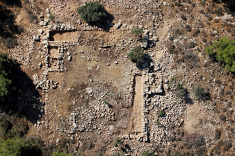
cities.  The leaders were designated to live in Jerusalem and the people cast lots to see which one out of every 10 would dwell in Jerusalem.  The rest would dwell in cities surrounding Jerusalem.  I lived in Israel 25 years and for most of the time we lived in a little village 10 miles west of Jerusalem.  It’s a mountainy and rocky area forested with some trees.  Most villages and Jerusalem were built around a water source, perhaps some type of spring.  Pictured is a photo of ruins of a Nehemiah period fortress in the hills of Judah near Jerusalem. (This photo courtesy of Israel Department of Antiquities.)

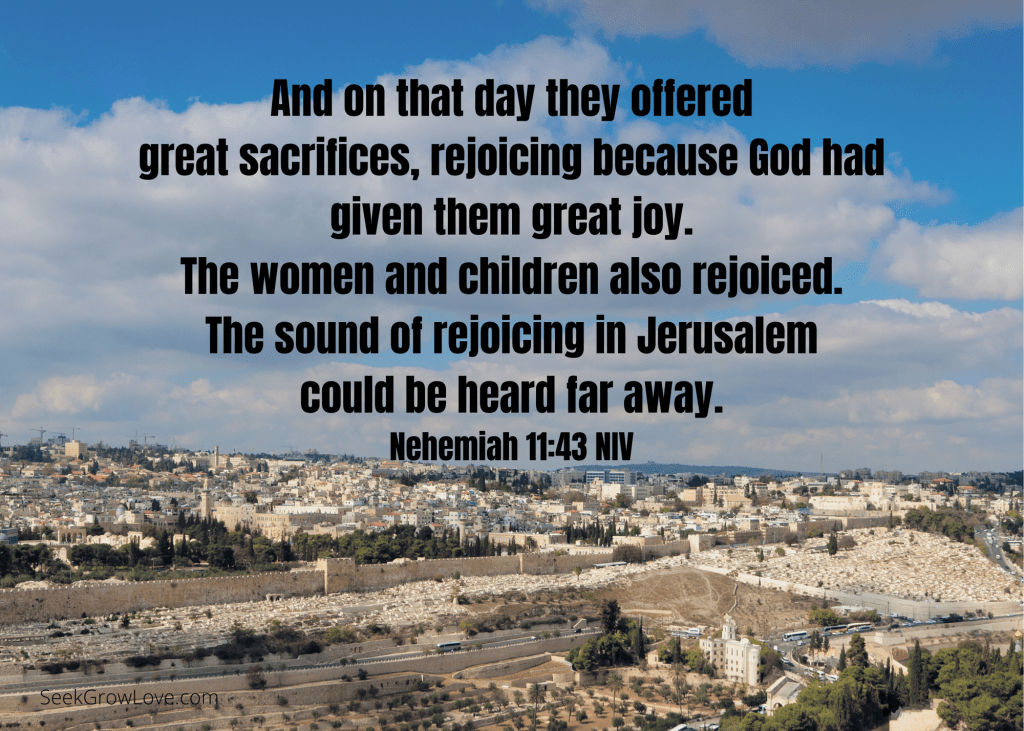
            It was a time of rejoicing.  Singers had built themselves villages all around Jerusalem (12:29). Also, two large Thanksgiving choirs with specific names and place locations are listed.  It’s amazing the record we still have today of the detailed descriptions of their locations. Also, great sacrifices were offered for God had made them rejoice with great joy.  The joy of Jerusalem could be heard from afar.  It’s amazing on the quiet of a shabbat or holiday when places are closed the noise that can be heard from a greater distance.  Psalm 126 says with singing they returned from captivity.  There must have been a joy to be back in the land of Israel again after being exiled. Though they “sow in tears, they’ll reap in joy.” At our oldest daughter’s wedding I told this to people as I wept, that I sowed in tears (such hard work raising kids overseas) and now I was reaping and weeping in joy, not out of sorrow but gladness that we made it to that day!! 😊


        Nehemiah returned after some time to Jerusalem and like a good parent had three firm corrections to make.  First, Eliashib, the priest, allowed Tobiah (Ammonite official) to have a large storeroom for himself, where articles and supplies for the Levites, singers, gatekeepers, were to be kept.  Thus, he threw out Tobiah’s things and cleansed the storeroom for proper use.  Then he asked God to remember him. (13:14) Secondly, he contended with the people for buying and selling on Shabbat and commanded the gates be shut and not open until after the Shabbat.  In current the state of Israel, every Friday afternoon stores, including all the malls shut down all over the country and remain closed until after sundown on Shabbat (Saturday), once two stars are visible.  Some weeks with holidays, the malls are closed for THREE full days!… Nehemiah prayed that God remember him. (13:22) Lastly, he contended with some of them, cursed them, struck some of them, and pulled out their hair, and made them swear not to give their children to foreigners!  That’s quite aggressive and zealous. Imagine the uproar he’d receive from all kinds of people and media today for those actions! But he prayed and asked God remember him for good. (13:29,30)

-Stephanie Schlegel

Today’s Bible passage can be read or listened to at BibleGateway here – Nehemiah 11-13 & Psalm 126

Tomorrow’s reading will be our last book of the Old Testament – Malachi – as we continue on our 2020 Reading Plan. God has great things in store! Come follow along!

Feasting on His Word

Nehemiah 8-10

Now that the wall of Jerusalem was completed the people gathered together at the Water Gate to have Ezra read from the Book of the Law of Moses on the first day of the seventh month (which was actually last weekend on the Jewish calendar and the Feast of Trumpets. It’s not really the Jewish New Year, that was adapted from a later time in exile. The first month of the Jewish year is Passover). It states NINE times that “all the people” are included in the events happening in chapter 8.  The priests even helped the people to understand the readings, (8:8) and the people responded with WEEPING (8:9). Nehemiah encouraged them to go and “eat fat and drink sweet” for this day is holy to the Lord. They weren’t to be sad, for “the joy of the LORD is your strength.” (8:10) They knew the words were declared to them.

 The second day they gathered again to hear the Law and learned that in the seventh month they were to dwell in booths for a week.  They were to go to the mountains and gather olive branches, myrtle, palm, and leafy branches to make a booth.  The other day on my fast walk in the neighborhood I plucked various leafy bushes to add to the pop-up booth card I’m making to send to our grandson next week. 😊   I’m going to also include some fruit snacks he can enjoy by his “booth” as a celebration of the end of the harvest season. In Israel today, where we lived for many years, they still make and “dwell” in booths during this weeklong holiday.  They’re on rooftops, balconies, and yards.  They’re decorated with paper chains, lights, and pictures. Our kids liked to sleep in them some nights with their friends.  The people in Nehemiah’s time hadn’t celebrated the Feast of Booths/Tabernacles since the time of Joshua, so it was a time of “great gladness” (8:17), and still is to this day. Although, this year might be different as they’re on a full lockdown in Israel during these holiday times because of Covid.   

            They continued to read the Book of the Law for a ¼ of the day and for another ¼ of the day they confessed their sins and worshipped the LORD their God. (9:3) Some of the Levites stood up and recalled God’s work through Moses, Egypt, Wilderness, and how He brought them into a good land.  However, they “cast His Law behind their backs and killed prophets sent to them.” (9:26) So God “gave them saviors” when they cried out for help and many times delivered them. (9:27) “For many years You had patience with them and testified against them by Your Spirit in Your prophets, yet they would not listen.” (9:30)

Now therefore, our God, the great, the mighty, and awesome God, who keeps covenants and mercy… (9:32) You are just in all that has befallen us.” (9:33) How patient God was and is with His peopleIt says not the kings, princes, priests, or fathers have kept God’s Law.( 9:34)  How important it was for all the people to gather together and recall God’s work over time and their own lack of commitment, and thus to refocus their love and service for the LORD their God for the future.  Now that the wall of Jerusalem had been rebuilt, they needed God’s protection over them. Instead of blaming God for failures, it’s good they acknowledged they were wrong and refocus on Him as they move forward.  We too, can learn from their example in our lives today.

Stephanie Schlegel

Today’s Bible passage can be read or listened to at BibleGateway here – Nehemiah 8-10

Tomorrow we will finish the book of Nehemiah and read Psalm 126 as we continue seeing God’s faithfulness in our

Overcoming the Opposition

Nehemiah 6-7

So much work had already been done – the walls of Jerusalem had been rebuilt – now they just needed to finish the gates. Surely this project was God-ordained and he picked the right leader for the job – Nehemiah. He was able to get everyone motivated and working together, and despite the opposition they were able to finish their job on the 25th of Elul (which appears to correspond to somewhere between Sept 15 and October 2). So, this week is a super time to celebrate the work that is accomplished when working for God.

So much good had been done already – but the work did not end and neither did the opposition!

Nehemiah was under attack. Satan (along with Tobia, Sanballat, Geshem and the rest of those fighting against God) were using every weapon at their disposal to bring this righteous leader down: lies, fear, wolves in sheep’s clothing, attempting to distract him from his work with other business, spreading gossip and accusations of sedition to either silence him or get him in serious trouble with the authorities, even hiring a false “prophet” to scare him into sinning.

But Nehemiah stood strong. We continue to see him turn to God in prayer. Asking for strong hands and asking for God to take care of those getting in the way of the Lord’s work. He obviously had a strong knowledge of God’s law to not be tricked into sinning. This gave him wise discernment in knowing who to listen to and what to do, and not do. And, he knew to fear God not men.

We can learn a lot from Nehemiah today because Satan keeps using the same ploys. Adolf Hitler wrote, “Mental confusion, contradiction of feeling, indecisiveness, panic; these are our weapons.” Evil men seeking to destroy God’s work have come and gone and yet remain today. It is indeed a vivid reminder that, “Our struggle is not against flesh and blood, but against the rulers, against the authorities, against the powers of this dark world and against the spiritual forces of evil in the heavenly realms.” (Ephesians 6:12 NIV). They love nothing more than trying to interrupt God’s work and if they can bring down a godly leader at the same time they probably get bonus points.

We see so much of this evil and oppression today. But like Nehemiah, we must not give up! We must turn to God again and again when faced with the lies and fears and Satan’s strong man tactics that would love to have us throw in the towel and take the easy way instead. Pray, fast, seek His word and His way, don’t fear man, resist sin, use discernment in knowing who to trust, what to say and do. Pray, too, for our leaders that they will have the wisdom and strong hands of Nehemiah

Satan has been running rampant and the result is a broken world. Keep at God’s rebuilding work – one brick at a time.

Marcia Railton

Speaking of our opposition, mental confusion, lies, panic, and pleasing man not God, reminds me of the life and death fight for the most innocent of God’s creations. Tonight would be a great time to watch See Life 2020 and #LoveEveryHeartbeat. And pray for strong hands – and hearts – to do the work God wants you to do.

Today’s Bible passage can be read or listened to at BibleGateway here – Nehemiah 6-7

Tomorrow we will read Nehemiah 8-10 as we continue seeking God on our

Love and Marriage

Ezra 7-10

Ezra, who was from the lineage of Aaron the high priest came up from Babylon. He was skilled in the Mosaic Law. King Artaxerxes gave the children of Israel the right to return to Jerusalem if they chose. In 7:10 it says, “For Ezra had prepared his heart to seek the Law of the Lord, and to do it, and to teach statutes and ordinances in Israel”. A letter was given to the ones returning from the king. Interestingly enough, this would have been the stepson of Queen Esther. Maybe he had heard about God through her. He starts out “Artaxerxes, king of kings, to Ezra the priest, a scribe of the Law of the God of heaven:” He allowed the Israelites who wanted to return to go back, they were given gold and silver from the royal treasury, and then they were urged that if they needed anymore, that they were to pay for it from the king’s treasury. Ezra said in 7:27 “Blessed be the Lord God of our fathers, who has put such a thing as this in the king’s heart, to beautify the house of the Lord which is in Jerusalem.” It sounds like Queen Esther must have talked about God to her family, and the king acknowledged that he was the God of heaven, and he did not want to have the wrath of God on him or his sons.

In chapter 8 they list those who returned, I love 8:21 “Then I proclaimed a fast there at the river of Ahava, that we might humble ourselves before our God, to seek from Him the right way for us and our little ones and all our possessions.” They fasted and prayed to God before making any decisions, just like we read in Esther as well. It is important that we follow these guidelines in our lives before we make decisions, pray about it and ask God to lead us in the direction that He would have us take.

In Chapter 9, we see the beginning of some problems, the children of Israel had taken pagan wives for some of their sons and daughters, even the religious leaders were included in this sin. Ezra was very upset at this and he prayed and wept before God because of their sin. They had been forbidden in Deuteronomy 7:3, to take foreign wives. Now, this was not a matter of being racist, because the foreign people could convert to Judaism, but the ones they married were pagans, which meant that they continued to worship idols. In 1 Kings 11:2b “the Lord said to the children of Israel “You shall not intermarry with them, nor they with you. Surely they will turn away your heart after their gods. Solomon clung to these in love.” V.4 “For it was so, when Solomon was old, that his wives turned his heart after other gods, and his heart was not loyal to the Lord his God, as was the heart of his father David.” This was when their idolatry began which eventually led to the kingdom being conquered by the Babylonians. It is a fact that if we marry outside our faith it makes it more difficult to love God with our heart, soul, and might. That’s why we are told in 1 Corinthians not to be “unequally yoked with an unbeliever.” I believe who we choose to marry is one of the most important decisions we can make in our lives. I have a friend who said that of her four children, only one remained in the faith. She said it was who they married that made the difference. One married someone who was an active participant in church, two would go on occasion, and one married an atheist. When we marry, we are to be one, and it works best to be in accord with one another, and to both be pulling in the same direction. You will not get very far if the two oxen are trying to go in opposite directions.

The assembly decided that they would put away the pagan wives and children that they had with them. They confessed their sin and repented of it. Ezra 10:2b “We have trespassed against our God and have taken pagan wives from the peoples of the land; yet now there is hope in Israel in spite of this.” 10: 10b-11 “You have transgressed and have taken pagan wives, adding to the guilt of Israel. Now therefore, make confession to the Lord God of your fathers, and to do His will; separate yourselves from the peoples of the land, and from the pagan wives.” There was hope when the people repented because God will always accept us back when we return to him.

That is what is so encouraging to us as we read the history of the Old Testament. None of our patriarchs were perfect but God is able to use imperfect people to accomplish His will. We all need to be willing to let God use us in our imperfections. When we sin and make mistakes, that isn’t the end, if we return to God, he will return to us as we read earlier this week.

-Sherry Alcumbrack

Today’s Bible passage can be read or listened to at BibleGateway here – Ezra 7-10

Tomorrow we will begin the book of Nehemiah (chapters 1-5) as we continue on our

Haman’s Pride and Prejudice – Part 2 (The Rest of the Story)

Esther 6-10

When we left you yesterday, evil Haman was going to go in the next day and ask King Ahasuerus to hang Mordecai on the gallows that he had built in anticipation. Now we will find out the rest of the story. During that night the King was having trouble sleeping so he asked for his book of records to be brought to him and read out loud. In it they read the story of Mordecai saving his life. He asked how they had honored him, and they said that nothing had been done for him. And Mordecai had not ever tried to get any special recognition for this act of bravery.

When Haman shows up that morning to visit the king, he asks Haman, “What shall be done for the man whom the king delights to honor?” Haman, thinking he must be talking about him, says, dress him in a royal robe, put him on a royal horse with a crest, and then have a prince lead him through town, proclaiming before him. The King said, Quick, do everything you have suggested for Mordecai the Jew, who saved my life. Not quite what he envisioned.

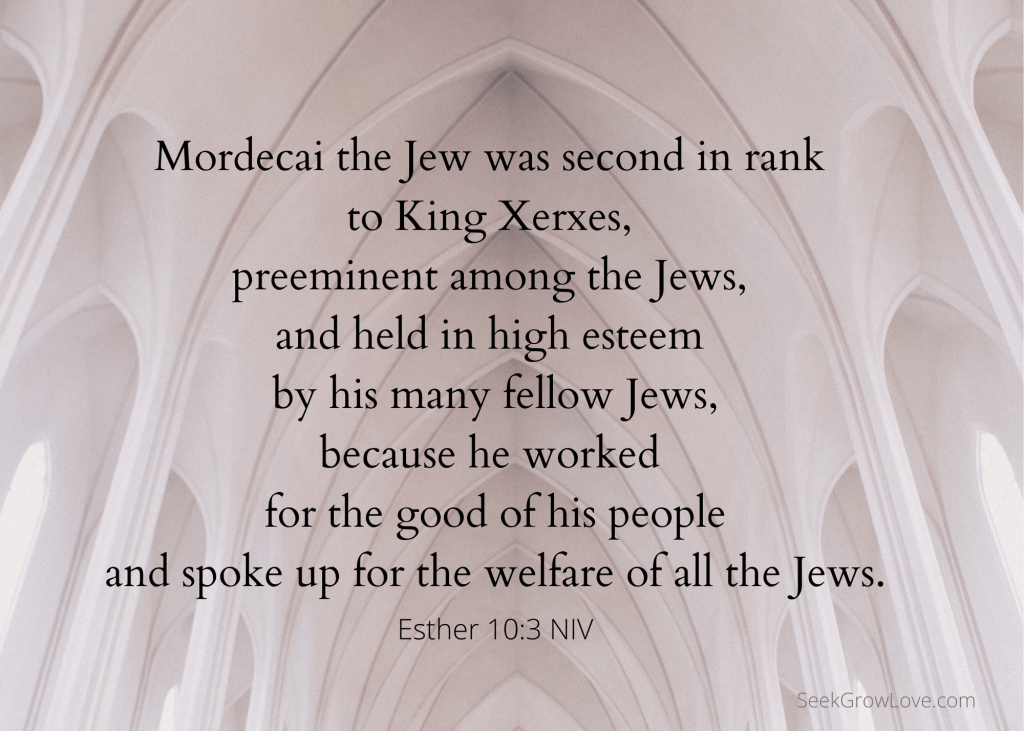
The King and Haman go later that evening to the special banquet with Queen Esther. Once again, the King tells her she will receive anything she asks for, up to half of the kingdom. Chapter 7:3 “Then Queen Esther answered and said, “If I have found favor in your sight, O king, and if it pleases the king, let my life be given me at my petition, and my people at my request.” Our enemy will have us destroyed, killed, and annihilated. He asks, “Who is this enemy?” she replies, “The adversary and enemy is this wicked Haman!” Haman pleaded for his life, but the king sent him to the gallows that he had built for Mordecai to be hanged. King Ahasuerus gave Queen Esther Haman’s estate, and gave the signet ring that he took from Haman to Mordecai because the Queen appointed him to manage things. Then she begged the king to stop the decree that Haman had already sent out to kill the Jews. He had another decree sent out that allowed the Jews to protect themselves against anyone who would assault them. The Jews overpowered those who hated and wished to destroy them.  After two days of fighting, they enjoyed a day of rest, celebrating their victory with a feast. Mordecai made a decree that the Jewish people would celebrate this holiday every year as a time when, God through Esther, saved the lives of the Jewish people and the evil plot which Haman had devised failed and returned upon his head. His ten sons were also killed on the gallows. The days of Purim are still celebrated by the Jewish people today. King Ahasuerus advanced Mordecai in his kingdom until he was second only to the king. Chapter 10:3 says: “For Mordecai the Jew was second to King Ahasuerus and was great among the Jews and well received by the multitude of his brethren, seeking the good of his people and speaking peace to all his countrymen.”

This story reminds me of how faithful God is to his children. I am reminded of Genesis 50:20 when Joseph told his brothers, “But as for you, you meant evil against me; but God meant it for good, in order to bring it about as it is this day, to save many people alive.” The things Haman had devised were evil, but God was able to turn it around for the good of His people. God had orchestrated so many things to be in place to save them. We need to trust God, even when we are going through hard times. We need to realize that we are not going through them alone, because God has promised that he will be with us.  It also brought Ephesians 3:20 to mind, “Now to Him who is able to do exceedingly, abundantly above all that we ask or think, according to the power that works in us.” Queen Esther asked for her life and the life of her people. She was given that and more. The King gave her the estate of Haman and Mordecai was able to advance to the number 2 man in the kingdom, even though they were Jews. He became very powerful and influential, and it says in the last verse that even with all his power, “he was seeking the good of his people and speaking peace to all of his countrymen.” Mordecai was a wise man and he used his life to lead people to seek God and live a life according to his will. What purpose have we been made for, let’s be courageous and trust God and let him use us as He wills, let’s seek good for others as we work for God’s glory.

-Sherry Alcumbrack

Today’s Bible passage can be read or listened to on BibleGateway here – Esther 6-10

Tomorrow we will finish up the book of Ezra (7-10) and then just 2 more books to read in the Old Testament before we get to start the New Testament next Wednesday.

Hello, IT. Yeah Huh. Have You Tried Forcing An Unexpected Reboot?

Ezra 1-3

The book of Ezra picks up the story of Israel at a very important moment: the return from exile. The Persians swoop in and conquer the Babylonians in 539 BC. The persian King, Cyrus the Great, acknowledging God for giving him the kingdoms of the earth, issues a proclamation that the temple in Jerusalem should be rebuilt. The Jews who were taken captive and exiled in Babylon are allowed to return to the land they call home and help rebuild the temple. We’re reminded of the Exodus, when God’s people were freed from the clutches of Pharaoh.

For an ancient king, Cyrus seems to be especially respectful of the customs and religions of his subjects. It turns out that this is in a way beneficial for him, since allowing your subjects freedom of religion and not enslaving them earns you so much more support and makes for a more stable empire. He was a bit of a trend setter in this regard.

Cyrus is reversing what Nebuchadnezzar set in motion. Nebuchadnezzar and his Babylonian empire conquered Jerusalem, destroyed the temple, took the temple vessels, and scattered the people into exile. Cyrus has conquered Babylon, allowed everyone to go back to where they call home, given back the temple vessels, and ordered the temple rebuilt. But really it is God doing the exiling and reversing, through the hands of these kings, to give his people another chance.

Ezra 2 gives an extensive list of the wave of 50,000 some people who returned to Judah, and details the livestock, if you were dying to know. We usually think this kind of passage is a bit of a drag, but it’s really more of a celebration, with more confetti at every name and number. Think of the importance they placed on leadership, and the legacy and roles of the people mentioned. Each of these people are going back to wherever they call home, where they have deep roots and history. Each of them has something unique to contribute toward rebuilding their lives, and they’ll need the skills and resources of everyone to restore Jerusalem and the temple.

Similarly, in the body of Christ, we need the unique skills and gifts everyone brings to the table. We all play an important role in taking care of each other and reaching out into the world.

And so the project begins. First things first! They make sure there is at least an altar and that the usual schedule of sacrifices is back on track. They are trying to build a continuity between what their lives were like before the exile and what they are like now after the exile. Being able to worship again is a stepping stone toward restoration. Routines are important!

Into the second year after returning to Jerusalem, the materials and workers are all being gathered to get the temple together again. When the foundation is laid, there is a big ceremony with music and singing to God. They sing, “For he is good, for his steadfast love endures forever toward Israel.” Things are looking up. We’ve got the people, the temple foundation, and some semblance of our usual worship.

But there is something in the air that signals to us that not everything is quite right again. While many people are shouting loudly for joy, many of the older folks who saw the first temple are weeping loudly. It is bittersweet. It is good that there is now at least part of a temple, yet it doesn’t hold a candle to what it was before.

We end chapter 3 with this very divided response to the temple. The noise is so loud that they can’t tell who is joyful and who is sorrowful. They’ve been waiting so many years just for this chance to rebuild, and now it’s not even clear if it is a good thing or not. 

But restoration is a process. Most things that we want, we can get almost instantly. I can drive to the store and get ice cream. I can order something from Amazon almost without moving a muscle, and it will arrive in two days. Way in the future, in the year 2000, we’ll just think of what we need, and it will materialize in our teleportation device. But doing something of significance takes time, effort, prayer, and also probably money. And so does rebuilding Jerusalem. It is tempting to compare back to what things used to be like (the “good old days”) and be discouraged. What we might be missing is that God’s plans and ideas usually break our categories for what we think is even possible.

-Jay Laurent

Today’s Bible passage can be read or listened to on BibleGateway here – Ezra 1-3

Tomorrow’s Bible reading will be Ezra 4-6 and Psalm 137 as we continue on our

The Lifting of the Zadokites: Ministerial Faithfulness

Ezekiel 44-45


“‘But the Levitical priests, who are descendants of Zadok and who guarded my sanctuary when the Israelites went astray from me, are to come near to minister before me; they are to stand before me to offer sacrifices of fat and blood, declares the Sovereign Lord. They alone are to enter my sanctuary; they alone are to come near my table to minister before me and serve me as guards. Ezekiel 44:15-16 (NIV)


Yesterday we discussed God’s holiness and how it must be separated from the common. Today we will continue along those lines but in terms of ministering in the presence of such holiness. The temple was the place where God’s presence was located on earth and was considered the holiest place on the planet; it was a sacred space. Not just anyone could visit the temple; Israel was ripped by God for allowing uncircumcised (of heart and body) non-Jews to go into the temple (Ez. 44:7). After laying out the dimensions for a new holy temple in the last few chapters, God turns Ezekiel’s attention to who gets to minister there and in what capacity. 


Israel had not taken seriously the holiness of God, even in the temple, where the Holy of Holies was found. The Levitical priests, despite being chosen to act as ministers in the temple, couldn’t fulfill their duties without corruption. They allowed the unworthy to come into the temple and served as priests to idols. These priests may not have been, but Yahweh certainly was serious about keeping His temple holy and having the right people ministering there. So, in this new temple, those who hadn’t appreciated the importance of the job would miss out. Those who remained firm, those who did not go with the crowd, those who did appreciate the holiness of the temple, the Zadokites (descendants of Zadok), would be lifted up as an example and given the jobs the less than faithful had forfeited.


Today there isn’t a grand temple complex where we must minister before God. We don’t have to make animal sacrifices, wear special clothes, or worry about remaining ceremonially clean. But that doesn’t mean God isn’t just as serious today about those who represent Him as ministers. The sacrifices of today are spiritual in nature and offered by those who have chosen to follow Christ as their High Priest. We are to act as royal priests who, following the example of our High Priest, surrender ourselves completely to the will of God and do the ministry He calls us to. Just like the Zadokites, who were lauded for their faithfulness despite Israel’s disobedience, we need to make sure we stay true to who we are as disciples of Christ and God’s representatives on earth, regardless of how others act–Christian or not. Our God still cares about holiness and has put His spirit within us, let us guard the new temple with the same (or greater) fervor and faithfulness as (than) the Zadokites did. 

-Joel Fletcher

Today’s Bible passage can be read or listened to at Biblegateway here –Ezekiel 44-45

Tomorrow we will finish the book of Ezekiel (chapters 46-48) as we continue on our

The Holy and the Common

Ezekiel 42-43

Why is it that older churches and cathedrals seem to have an aura about them that is missing from newer Christian constructions? There is a special reverence that is shown to these historical places of worship, but why? They appear to be more “holy” than modern church structures–are they really or is it just perception?

In our reading today, we get more details about the temple complex being shown to Ezekiel. As I mentioned yesterday, one intention for the prophet in giving specifications to all of Israel was so they could imagine what it would be like. Another reason, which flows from first is to draw attention to God’s holiness and, in turn, Israel’s sinfulness. But why would imagining the temple lead to recognizing sin? This question and the ones in the above paragraph are tied together.

The idea of holiness in the Bible is connected with being different, set apart, or sacred. The God of the Bible is called holy; He is without sin, He is all powerful, He is worthy of worship and adoration. Yahweh is distinct from His creation. Though humans are made in His image, they have sins which separate them from God, showing Him to be holy and people common. When humans encounter God’s holiness, it leaves them in awe of His majesty and with awareness of their own sinfulness (see Isaiah 6). When you see a dirty object–even one you think is clean–held up to something that is flawless, every little blemish is revealed. That is what happens when humans meet God.

When we see older churches or cathedrals, we are looking at something different, uncommon, a building designed to be set apart from other constructions. Older places of worship are usually taller, more distinctive, and, dare I say, were built by people more reverent than us. They have brilliant stained glass, magnificent architecture, and invoke a deep sense of beauty. Modern churches, by contrast, aren’t much taller than most middle-class housing and, in most cities, are located every few blocks. They look dull in comparison, with nothing extraordinary to offer. Older churches appear more holy because they stand out more, while modern ones seem all too common.

Older churches and cathedrals were built as the place where humans go to encounter God, much like Jews viewed the temple. Many modern Christians understand they don’t have go to a building to worship God, but for most of Christian history the church building has been the place where followers of Christ have gathered to worship their creator, which is why those older churches were so grand. They wanted the building to reflect the holiness of the God they worshiped. God’s holiness causes people to recognize their own sinfulness. It’s no wonder that the dulling down of Christian architecture has mirrored a more laissez-faire attitude towards sin.

What should we do then? Should we go back to designing and building grand places of worship?

No. When Jesus left the curtain torn, the separation between the holy God and sinful humanity was broken. This means striving after good works and the sacrificing of rams and bulls is not the way to achieve holiness. Instead, we put our faith (believe) in the one responsible for ripping the veil in half and offer ourselves as living sacrifices to God. Because of the righteousness of the Messiah, we can be holy and the spirit of God can dwell in us, as we live as the temple of God (1 Cor. 3:16).

God’s holiness still causes us to recognize our own sin, but we don’t have to go to a grand building to see it. We encounter it through scripture, reading about God Himself or His son who reveals so much about Him. We see it in nature, looking through binoculars, telescopes, or with the naked eye. We see it when the Church (the people, not the building) acts as it was intended to. Thankfully God’s holiness doesn’t just reveal our sinfulness, but His love for us and willingness to forgive those who ask for it. What a holy, loving, and awesome God we serve!

– Joel Fletcher

Today’s Bible passage can be read or listened to at BibleGateway here – Ezekiel 42-43

Tomorrow we will read Ezekiel 44-45 as we continue on our

Imagine

Ezekiel 40-41

Here we go! I thought we were past the “boring” parts of the Bible. Yesterday we read about God obliterating a mighty leader and his allies and today we get dimensions for a temple? Two whole chapters on dimensions and part of another(we’ll get to that tomorrow)? Give me a break…

Maybe it’s just me, but it seems we are living in one of the least imaginative periods in world history. If you asked me to write a simple short, short story, like under 1000 words, I don’t know if I could think up something that would hold your interest for 10 minutes. I don’t know if it would be because of my lack of imagination or yours (maybe both). This is why we find passages like today’s so boring. And I think I know why our imaginations are so lacking. It is because of the constant bombardment of visual stimulation. We don’t need to exercise our imaginations, so we don’t. We have blockbuster films so we don’t need novels. Kids have IPhones so they don’t need to play made up games. Cars have DVD (or Blu-ray) players so they don’t have to exercise their vocabulary (which takes imagination) to play the Alphabet game. I don’t want to sound like some old fart harping on modern technology, but anyone who thinks smartphone usage among the adolescent (and younger and older) doesn’t carry consequences is being naive at best. Maybe I’m delusional, but at least that means I have imagination, right?

Now on to these “boring” dimensions…

In our key verse for today (40:4) Ezekiel receives instructions to look, listen, and pay attention to what is being said and then to tell it to the people of Israel. This signals for us that even the most minute measurements of this passage are seen as important to the people of Israel. It makes sense that these small details would matter; anyone who has done carpentry knows that even an eighth of an inch can make a big difference when trying to make something square (flush). And that’s the case even if you make something as small as a birdhouse. How much more so when you’re creating a compound as big as the temple being described. If this temple is actually going to be built, it needs detailed specifications. No one builds anything on a grand scale without a blueprint about how to build it. So it makes sense that the builders of this temple would need to know this “boring” stuff. But why does all of Israel need to know what this temple will look like? The answer to this question reveals in part why Ezekiel was told to tell all of Israel the vision and part of what we should glean from the passage. God wanted Israel to be able to imagine what the temple would look like. They could make a mental picture in their minds and imagine being there with Yahweh, the Holy One of Israel . This would have filled the righteous with joy, hope, and a longing for the future and the idolatrous with guilt, fear, and hopefully a desire to repent. It would have revealed God’s holiness to them and made them think about their guilt (we’ll talk about this more tomorrow). There’s no doubt in my mind the Jews in exile had better imaginations than us.

Now to us unimaginative folks…

Just as God wanted to have the people of Israel use their minds to picture the temple and imagine what it would be like to be there, our creator wants us to use our imaginations. We are to love Yahweh with all our heart, soul, strength, and mind. I think this last one gets under appreciated or is used simply to refer to knowing about God, but part of loving God with our mind is using our inherent ability to imagine. Today’s passage is a great opportunity to do so. As you’re reading (or, listening) to Ezekiel 40 and 41 and the dimensions listed (read a version with measurements you’re familiar with) picture the temple in your mind and what it would be like to be there with God. There are other parts of the Bible with much less detail, but where we can still picture the scene in our mind. This should help us in our study of scripture and fulfilling the command to love God with all our mind. We can imagine what it was like at creation, what it was like to follow in the footsteps of Jesus, or what it will be like in the Kingdom. These are not only great exercises for our lacking imaginations, but I believe they are ways to worship. We are made in the image of the one who created the entire universe out of nothing. Imagine that-

Joel Fletcher

Today’s Bible reading passage can be read or listened to at BibleGateway here – https://www.biblegateway.com/passage/?search=Ezekiel+40-41&version=NIV

Tomorrow we will read Ezekiel 42-43 as we continue on our