Seek Not to Please Myself

John 6-7

john-6-35

Saturday, May 27

As I started reading John 6 & 7 a few key quotes from Jesus recorded in the end of John 5 were still ringing in my ears:

“For I seek NOT to please myself but him who sent me.” (John 5:30)

“I do not accept praise from men…How can you believe if you accept praise from one another, yet make no effort to obtain the praise that comes from the only God.” (John 5:41, 44)

Here Jesus Christ, the Son of God and Son of Man, was saying quite clearly and repetitively – it’s not about me.  He did not seek to please himself or earn the praises of men – his goal was only and always to please God and hear the praises of his Heavenly Father.

Chapter 6 begins with this same Jesus feeding the famished five thousand with five small barley loaves and two small fish – and ending up with twelve baskets of left-overs.  As the one primarily responsible for feeding my family of 5 three times a day, I have always been greatly impressed with this miracle!  And, he follows it up with walking on the water!  There is no doubt that this Jesus has just earned some serious bragging rights.

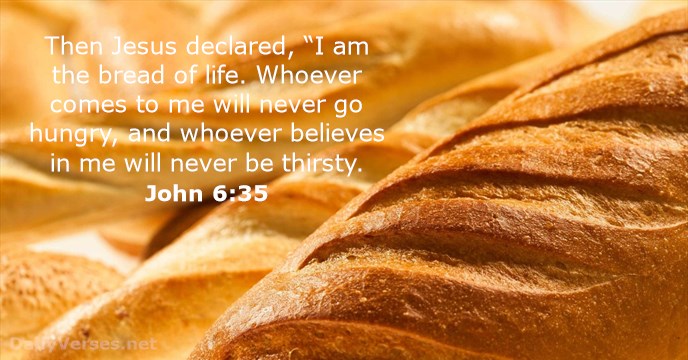
Instead, he turns it into a teachable moment and offers himself as the bread of life – the bread and body that must be broken for others to live.  This is what he offers to the world not because he is the one who dreamed it up, and not because he was looking forward to it, and not because he desired it – but because he knew he came, “Not to do MY (Jesus’) will but to do the will of him who sent me.” (John 6:38).

In Chapter 7 he continues, “My teaching is not my own.  It comes from him who sent me.” (7:16) and “I am not here on my own, but he who sent me is true.” (7:28).   While some wanted to kill him, others wanted to make him king.  And yet – none of that really mattered to Jesus.  He was teaching God’s Word and living – and later dying – God’s Will.  His one-track mind and life was centered on what his Daddy desired and had planned from the beginning of the world.

Two things seem clear.

First, Jesus was definitely NOT claiming to be God, nor did he desire to be considered as God in any way.  His repeated use of, “not me/mine…but He/His” were pointing out the differences – two beings, even though their purposes would be the same – at Jesus’ choosing.  Today, would I hold any credibility if I stated, “I do not seek to please myself, but only what I want?”  Or, if I said, “My teaching is not my own but it comes from me”, would people listen to me for long?  Over and over again, Jesus is drawing some pretty clear lines between His Father God and himself.  Two beings, united in purpose – because that is what Jesus chose – to follow His Father and not himself.

Second, how must I change my focus, my goals and my everyday life so that I, along with Jesus, can confidently say, “Not my will, but His be done,” “My teaching is not my own, but God’s.”  “I seek not to please myself, but my Heavenly Father.”  No doubt the Son of God set an example for us to follow.  It is a path that requires laying aside all selfishness and pride, as well as false teaching.    It is not an easy road.  But when we live our life to please God our Father, just as Jesus did, we won’t be disappointed in the end!

-Marcia Railton


(Photo Credit: https://dailyverses.net/john/6/35)

An Impossible Question

Luke 20-21

luke 20

Tuesday, May 23

Throughout chapter 20, the Pharisees attempt to undermine Jesus with trick questions, and starting at verse 20, they decide that they’re going to try to pose him another unanswerable question. They comment on his lack of favoritism in his teaching, although it seems to imply that they are cynically calling him out on a lack of respect for authority. Following up on this, they ask him another question meant to undermine his teachings.

They ask Jesus whether or not they have an obligation to pay taxes to Caesar. This has an important historical context behind it, because there had been several Jewish revolutions against Roman occupation that had turned out terribly for the Jews. The Pharisees, who were cooperating with the Roman governors much to the expense of their own people, were essentially asking Jesus an impossible question.

Consider this, if Jesus had answered that they were obligated to pay taxes, then he would be implying the relevancy of both Roman authority and the authority of Pharisees and would be undermining the tenacity of his own teachings. However, if he had spoken against the need to pay taxes to Caesar, he would be openly defying Roman authority and so would be putting himself on grounds of treason, and would have been executed as quickly as it could be reported to the Romans. As it was, Jesus’ answer was simple and avoidant, while also proving a much larger point to them. His response is to take a look at whose face is on the coin, which was Caesar’s face. He then tells the Pharisees to give to Cesar what is “his” and give to God what is “God’s”.

Not only did Jesus successfully navigate around their impossible question, but he also gives a stronger context for understanding his teachings as well. This seems to tie into what Jesus meant when he said that his purpose was not to destroy the law, but to fulfill it. According to Jesus, the call that we have is a moral one beyond the law or social convention. Neither is he advocating that law is unnecessary. Rather, he invites us to be pragmatic about the circumstances, but understand that the truth he teaches is a way of finding meaning in our lives, rather than how to simply conduct it.

-Dillon Driskill


(Photo Credit: https://www.jarofquotes.com/view.php?id=and-he-said-unto-them-render-therefore-unto-caesar-the-things-which-be-caesars-and-unto-god-the-things-which-be-gods)

It’s Not What it Looks Like

Luke 14-16

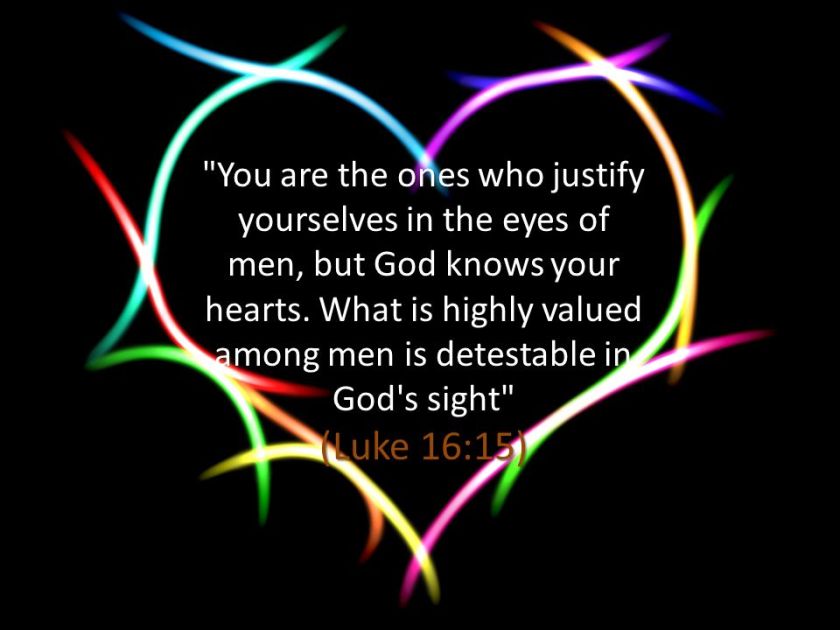
(Luke 16:15)

Saturday, May 19

“Its not what it looks like! I’m just looking for Devin!” The moment I had said this I was seeing my life flash before my eyes as my friend’s 220 lbs, Marine vet, picked me up by my neck and roughly placed me on the hood of his truck. After that I had explained and showed his dad the text that was from Devin asking for me to meet him at his house. I was not trying to steal anything from their house, but Devin’s Dad did not know it until I proved it.

 One day God will correct all dues according to the heart of every man/woman. In Luke 16:15  It says God knows the heart of Man. That is true, God knew my intention in walking into Devin’s garage that day was innocent. Although things were figured out sooner than judgement day, God still knew it.
Have you ever found yourself in a “It’s not what it looks like!” situation? If you have, did you try to reconcile it or prove it was “not what it looks like”? Don’t worry if you are innocent, God will forgive it in the end, but if you are guilty, maybe you should give it some thought to confront your situation. Don’t forget, God knows your intentions and heart.
-Jesse Allen

Some Peace in this Crazy World

Luke 6-7

o-LOVE-YOUR-ENEMIES-facebook

May 16, 2017

Have you ever prayed for your enemies? Not to make you feel guilty if you haven’t but I think it’s a good habit to start. My reasoning behind this relies on the fact that the kingdom of God will be peaceful, and if we are to be a part of the kingdom of God why not pray for that peace now? You might think praying for peace is different than praying for your enemies but I don’t think there is that big of a difference.


But prayer is one thing, what about actions? Can we love our enemies with our actions? Jesus seems to think so, and even demands that we do it in Luke 6:27-36. He even gives a couple examples, one of which is prayer.


Why should we do this? Well, other than to be obedient to Jesus, which is emphasized in verses 46-49, it is because God has been intentional in reaching out to us. Yes, at one point in time, we were against God, and yet he still gave his Son for us. He was merciful to us, even when we might have hated him. Luke 6:36 “Be merciful, just as your Father is merciful.”


I encourage you today to read through this section of verses. Write down how you could love those who you may consider enemies. Your answers may surprise you, and if you follow up by doing some of the things you write down, you might find that loving your enemies isn’t all that hard. Who knows, you might even create some peace is this crazy world.


-Jesse Allen

thechristiantaco


Included:Luke 2-3


May 14, 2017

The feeling of exclusion is one of the worst feelings I have ever felt. It’s the classic “I get picked last at recess” feeling. It is also the feeling we get when we find out someone that we normally do stuff with is doing something without us, and they post it on social media. Feeling excluded can often trigger us to feel unwanted or worthless, but I am here to tell you that is not the case.

May I turn your attention to Luke 2:30-32 and Luke 3:6-9? These verses talk about the salvation of God. One interesting fact about the salvation of God is what is said in verse 32 “A light of revelation to the Gentiles,”. This phrase is talking about how Jesus will reach out in his ministry and include the Gentile people in salvation. This concept is hinted upon in verse 10 as well when the angel that scared the shepherds says, “I bring you good news of great joy which will be for all people”. The word “all” in verse ten and the phrase, “Presence of all peoples” leads me to believe that everyone will be included, not just the “people of God” at that time who were the Jews. Also, this idea is found in Luke 3:6 when it says “all flesh” which includes the Gentile, or non-jew, in salvation.

How can this be, that all people, can now be included in salvation? Well, I think that John the Baptist explains this very well in the next chapter. In Luke 3:7 John starts to rebuke those who are coming to be baptized only for the sake of looking good in front of others and not actually because they care about being saved. He continues and spurs them to change by telling them to bear fruit “worthy of repentance”. Not claiming that they are a part of the Jewish faith, that no longer matters because everyone is included now as long as they bear fruit. He also tells them the consequence of not bearing fruit, which is being chopped down and throw into the fire.

How can we accept the offer and become included in the salvation that Jesus brings? We change our lives and actions to reflect that of Jesus’. Since Jesus was the Light to the Gentiles, it no longer matters if you were a Jew by heritage to be a part of the people of God. Sometimes I feel that we think the same way the Jews did, “Well, I have the title of Christian so that must make me one, right?” According to John the Baptist in these verses, it does not. But those who bear good fruit, of the spirit of God, will not be thrown into the fire and will have salvation. So the next time you’re feeling excluded remember that Jesus wants you to be included in the people of God.

-Jesse Allen

Fear NOT

Luke 1

Luke_1_30_37_praise_image_scripture_image, with_God_nothing_is_impossible

Saturday, May 13

What are some fears that impact you? Spiders? Snakes? Heights? Public speaking? We have many fears that may consume us. Some of these fears protect us physically, other fears may protect us socially. We should take time to evaluate our fears and see if it is something that is actually a danger or just a perceived danger. One of my daughters is afraid of crickets…is the cricket that makes her scream really going to do her any harm? No, however the snake she found in the yard as a toddler could have been poisonous and a real danger (Thankfully it was not). Sometimes it can be difficult to tell the difference in these fears. In the moment, the fear is powerful regardless of actual danger levels.


In Luke 1 we find fear mentioned when Zacharias (Zechariah) encounters the angel Gabriel and again when he appears to Mary. It says in verse twelve that Zacharias was “troubled when he saw the angel, and fear gripped him.” It says Mary “was very perplexed … and kept pondering what kind of salutation this was.” I can only imagine what it would have been like for either of these individuals, to be in the presence of “one who stands in the presence of God and {has} been sent to speak to you.” That would be quite the intimidating situation. This would, by far, rival the fears we face on a daily basis.


I am drawn in by Gabriel’s response to both Mary and Zacharias. He says to them, “Do not be afraid …” It is obvious from his statements that he is there to be God’s messenger and that these messages are meant for the good of God’s people, yet there is still fear instilled when he appears. Gabriel had to deal with this fear before he continued to share God’s Good News. We must learn to deal with the fears in our hearts before we can effectively share the gospel message with those around us. God tells us, “Do NOT fear!” He is with us, He has given us hope, He has placed a message in our hearts and in our mouths. We MUST share that message and FEAR NOT!!!

-Bill Dunn

(Photo Credit: Photo by Eric Valentine – http://praisephotography.com/2010/12/19/overwhelmed-with-joy/)

Go

Mark 14-16

mark16.15

Friday, May 12

As we started our journey through the book of Mark on Monday we saw that Jesus was all about the gospel of the Kingdom of God. Now as we come to the end of Mark we see Jesus is still about the same work. He is seated with his disciples and tells them in 14:25, “Truly I say to you, I will never again drink of the fruit of the vine until that day when I drink it new in the Kingdom of God.”


We see later in chapter 14 that he was “deeply grieved” and asked that God would “remove this cup.” Death was not what he wanted even in this situation, knowing what was coming, he still said, “not what I will, but what you will.” Jesus knew the prophesies, he knew the suffering he was about to face, yet still he sought the Kingdom of God. Jesus, along with his passion for the Kingdom to be fulfilled, is our inspiration to follow the will of God. We must “seek first the Kingdom of God”(Matt 6:33). It is of utmost importance.


Even after Jesus was crucified and was raised from the dead He still focused on the Kingdom. He told his disciples to “Go into all the world and preach the gospel to all creation.”(Mark 16:15) We are to preach the gospel of the Kingdom of God to all around us no matter how popular the message is or isn’t.


-Bill Dunn


(Photo Credit: http://dailybiblememe.com/tag/mark-1615/)

Choose Your Battles

Mark 10-13

temple tantrum brick testament

Thursday, May 11

What are some of the things that make you mad and how do you react when you are upset?  Do you think Jesus ever got mad or expressed his anger?

We read in Mark 11 of a time where Jesus was anything but quiet and soft spoken. We see Him turning tables and running people out of the temple. This is not to say that we should go flipping tables and chasing people whenever we get upset, that is NOT what was happening here. Jesus reacted in this way not because someone disagreed with Him, in those instances He says to turn the other cheek. He reacted this way because these individuals had taken the temple of His Father and they were using it like a common marketplace. The things they were doing were a disgrace to the sanctuary of God. Jesus was angry with a righteous indignation. He was furious because the temple of God was being defiled!

Do you get more upset and react in a more dramatic way if someone speaks against you or against your God? Hopefully we are faster to defend our God rather than ourselves. We tend to be pretty quick to jump at small things, leaving the big things for someone else to handle. I think of David before He became king, he was willing to fight a giant because of what he had said about our God.

We must pick our battles. It isn’t easy to let someone talk about you or your family. It isn’t easy to let them bad mouth a friend. These things don’t matter as much in the end though. What truly matters is how we defend our faith, how we stand for our God. We MUST stand firm when it comes to the scripture, we MUST share our faith, and we MUST learn to choose our battles as Jesus did.

– Bill Dunn


(Photo Credit: 

http://www.thebricktestament.com/the_life_of_jesus/temple_tantrum/jn02_15b.html)

Calm in the Storm

Mark 4-6

mark 4

Tuesday, May 9

Do you like the power of a storm or are you terrified by that power? Are you one to sit on the porch and watch as a thunderstorm rolls in or run for cover when it is forecasted? I have always been captivated by the incredible power of a storm. I love to feel the temperature change as the front rolls in, you can almost feel the electric in the air as the lightning gets closer and closer. As I watch a storm moving in I can’t help but think of the fact that as powerful as the storm is it cannot come close to the power of our creator. The storm rages in its fury and is uncontrolled as the lightning strikes and the thunder crashes. God is powerful and in control, He put His power to use as He spoke and the universe came into existence.


As we read of the storm in Mark 4 we find that this storm raged on and on.  We can almost see the disciples frantically running around the boat trying to secure everything and keep the boat afloat while our Messiah quietly sleeps in the stern. As the disciples rush to wake him and ask how he could be sleeping at a time like this he calmly says to the sea, “Hush, be still.” The wind stops, the waves calm and they go peacefully through the rest of their journey. Sometimes I think we are like the disciples, we get so worked up over what is happening around us that we forget who is living in our hearts. We forget that Jesus has promised that he will never leave us. We forget that God has called us for a purpose. We forget that even if we don’t survive this storm, we have the promise of eternal life in the Kingdom of God. In the storms of life never lose sight of the One who holds you! Never lose sight of the one who can either calm the storm or calm you!

-Bill Dunn


(Photo Credit:http://thedailyverses.blogspot.com/2013/09/mark-440-isaiah-4110.html)


Justice vs. Mercy

Matthew 25-26

mercy vs justice

Saturday, May 6

Which is more important in God’s eyes, justice or mercy?  That might be a difficult question to answer, but let me give it a try.

First let’s talk about justice.  There are many examples of God’s justice in today’s reading.  In the parable of the ten virgins, those who were not ready for the return of Christ were told by Jesus that he did not know them.  They were receiving justice for the lives they lived.  In the parable of the talents, the man who did not use the talents that were given to him was sent to the place where there shall be weeping and gnashing of teeth.  Justice was on display again.  In Matthew 25:31-46, those that did not help the needy were sentenced to eternal punishment.  Justice served.  Judas betrayed Jesus and Jesus said it would have been better for Judas if he had not been born.  That was a warning that justice was on its way.  There was no mercy shown in any of these instances, only justice.

In Matthew 26, Jesus is arrested and his death on the cross is imminent.  We know why Jesus needed to die – to pay the debt for our sins.  The wages of sin is death so we all deserve to die since we have all sinned.  But think about this for a minute.  Couldn’t there have been a different way to make it right?  Jesus even prayed that prayer three times.  He didn’t want to die and he was hoping there was a different way to handle this.  God is in charge of everything so certainly he could have come up with an alternative solution to this problem.  Maybe if we sincerely repented for our sins, God could have shown us mercy and wiped our slates clean without anyone having to die.  Or maybe if we showed Him that we loved Him he could have overlooked our sins.  There had to be a different way.  Why did someone have to die?  The reason someone had to die is because of justice.  God is such a just God that He could not ignore justice.  It is very clear to me that God believes justice must always occur.

So where does that leave mercy?  Let’s go back to the death of Jesus.  Jesus was God’s own son.  He was also without sin.  There has only been one person on this earth in the history of mankind that did not deserve death, and that was Jesus.  God watched his only son be tortured and killed on the cross for something he did not do.  I can’t even imagine how painful it would be to watch one of my children suffer and die for something they did not do.  Yet God allowed it to happen, even though He could have stepped in and rescued him at any time.  Why would He just watch and do nothing?  It was because of His immense love for each of us.  He let His own son die for our sins so that we would not have to.  I believe that is the greatest act of mercy that has ever taken place.

So the answer to justice vs. mercy is “both”.  God will make sure justice occurs 100% of the time and He is on record as committing the most merciful act in history.

-Rick McClain

(Photo Credit http://www.breslev.co.il/articles/breslev/rebbe_nachmans_wisdom/mercy_vs__justice.aspx?id=26842&language=english)